If you are wondering what communication methods can I use for my project, the answer starts with a simple but powerful classification. Project communication methods fall into three broad categories: interactive communication, push communication, and pull communication. These categories are widely used in project management to help project managers choose how to share information with stakeholders in a way that fits the message, the audience, and the moment. The choice is not always obvious, and many project problems trace back to using the wrong method at the wrong time.
Communication sits at the center of almost every project activity. Requirements gathering, status reporting, risk escalation, change requests, and stakeholder engagement all depend on moving information between people. A project manager might have technically sound plans and skilled team members, but if the communication method does not match the situation, misunderstandings pile up quickly. The three categories give you a practical framework for thinking through those choices before a message goes out.
In formal project management frameworks, communication methods are part of the Communications Management knowledge area. The project manager analyzes communication requirements and then decides what information, how much, and through which channels it should flow. That decision includes selecting among interactive, push, and pull approaches. Each method has strengths, limitations, and typical use cases. The rest of this article walks through those methods in detail and shows how to apply them in real project work.
Communication Methods for Your Project: Key Topics at a Glance
| Key Concept | Summary |
|---|---|
| Communication Classification | A structured classification of communication types guides project managers in selecting the right channel by evaluating message complexity, audience needs, and situational context. |
| Information Flow | Effective information flow coordinates requirements gathering, status reporting, risk escalation, change requests, and stakeholder engagement across project roles and governance levels. |
| Method Alignment | When the communication method does not match the situation, misunderstandings accumulate and can undermine even sound plans and skilled team members. |
| Interactive Communication | Interactive communication enables real-time dialogue and immediate feedback, making it the preferred method for requirements workshops, scope negotiation, and collaborative problem solving. |
| Conflict Resolution | Live tone, pace, and body language convey nuance that written channels cannot replicate, which strengthens negotiation and accelerates conflict resolution. |
| Documentation Risk | Interactive sessions generate a durable record only when participants document decisions and action items; otherwise critical follow-up tasks can be lost. |
| Pull Communication | Pull communication through shared repositories allows stakeholders to retrieve process documentation, technical specifications, training resources, and archived reports on demand, reducing dependency on sender availability. |
| Self-Service Onboarding | New team members can independently access onboarding materials, standard operating procedures, and documented lessons learned, which shortens the path to productivity and reduces the need for formal briefings. |
Core Communication Methods in Project Management
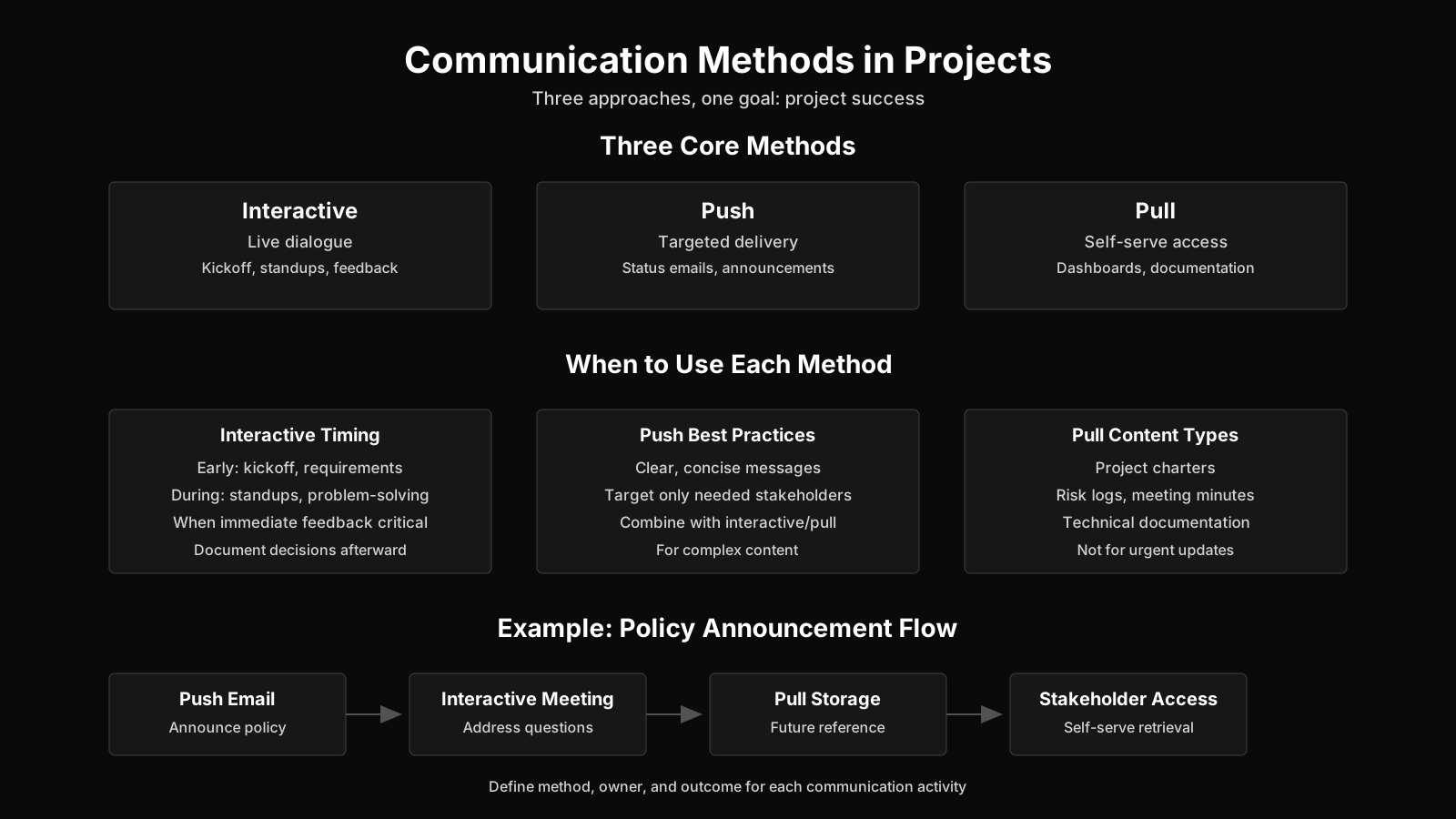
Understanding the three core project communication methods helps a project manager match the right approach to each stakeholder need. The three methods differ in direction of information flow, level of interaction, and how recipients access the content. Interactive communication involves a multi-directional exchange. Push communication sends information outward to specific recipients. Pull communication makes information available for stakeholders to retrieve on their own. Each one serves a different purpose in a project environment.
These methods are not mutually exclusive. A single project might use all three during the same week. The project manager does not pick one method for the entire project and ignore the rest. Instead, the choice is made message by message, audience by audience, and phase by phase. What makes these categories useful is that they force you to think about whether a message needs immediate feedback, whether it needs to reach a defined group, or whether it can simply be stored and accessed later. That clarity reduces the risk of information getting lost or misunderstood.
The source material from project management practice defines these categories in a straightforward way. Interactive communication is the most efficient way to ensure a common understanding by all participants on specified topics. Push communication ensures that information is distributed but does not certify that it actually reached or was understood by the intended audience. Pull communication is used for very large volumes of information or for very large audiences, where recipients access the content at their own discretion. These definitions carry important implications for how a project manager should use each method.
Interactive Communication Methods for Multi-Directional Exchange
Interactive communication involves two or more parties performing a multidirectional exchange of information. Meetings, phone calls, video conferencing, and instant messaging all fall into this category. The defining feature is that participants can respond in real time, ask questions, clarify ambiguities, and correct misunderstandings on the spot. That makes interactive communication the strongest option when the goal is to build shared understanding around complex or sensitive topics. A requirements workshop where business users and developers debate acceptance criteria works far better as an interactive session than as a long email thread.
This method is particularly valuable in the early stages of a project. When scope is being defined, risks are being identified, and stakeholders are forming expectations, real-time dialogue prevents assumptions from hardening into defects. A project manager might schedule a video conference to walk through a draft project charter and let sponsors raise concerns directly. The back-and-forth gives everyone a chance to align before the document is finalized. Interactive communication also supports negotiation and conflict resolution, where tone and body language carry meaning that written channels lose.
However, interactive communication is not free of problems. Scheduling meetings across time zones can be difficult, and poorly facilitated meetings waste time without producing decisions. Interactive sessions also create a record only if someone documents them, which means agreed action items can slip away if notes are not taken. The project manager has to balance the richness of interactive methods against the practical cost of bringing people together. Used too often, interactive communication becomes a source of fatigue and delays rather than clarity.
Push Communication Methods for Sending Information to Specific Recipients
Push communication sends information to specific recipients who need to know it. Letters, memos, reports, emails, faxes, voice mails, and press releases are common push communication methods. The information flows in one direction, from sender to receiver, without a built-in mechanism for immediate response or confirmation. A project manager might push a weekly status report to a steering committee or send a change notification to affected departments. The method works well when the audience is defined and the content is relatively stable.
One important limitation of push communication is that distribution does not equal understanding. An email can be delivered to an inbox and never opened. A memo can be posted and ignored. Press releases can be published without journalists reading them. The sender knows the information went out, but not whether it reached the right person or whether that person understood it. For routine updates this may be acceptable. For critical decisions, contract changes, or safety information, relying on push communication alone creates a dangerous gap.
Despite that limitation, push communication remains the backbone of many project reporting routines. It is efficient for distributing standard information to large but defined groups. A project manager can send the same status report to all team leads without holding a meeting. The trick is to use push communication for the right kind of content and to pair it with interactive or pull methods when confirmation matters. For example, after emailing a new risk register, the project manager might ask specific risk owners to acknowledge receipt in a follow-up call.
Pull Communication Methods for Large Audiences and Repositories
Pull communication is used for very large volumes of information or for very large audiences. Recipients access the communication content at their own discretion. Intranet sites, e-learning platforms, knowledge repositories, and document libraries are typical pull communication methods. A project team might store process documentation, technical specifications, training materials, and archived reports in a shared repository where stakeholders can find them when needed. The sender does not push the information; instead, the receiver pulls it.
This method reduces the burden on the sender when information is too large to distribute directly. Sending a 300-page project manual to every stakeholder by email would overwhelm inboxes and likely fail. Placing that manual in a central location and pointing stakeholders to it is more practical. Pull communication also supports self-service learning and reference. New team members can read onboarding materials, standard operating procedures, and historical lessons learned without waiting for a formal briefing. The information is available when and where the user needs it.
The downside is that pull communication does not guarantee anyone will access the content. A repository can become a graveyard of documents that nobody reads. If stakeholders do not know the repository exists or do not find it easy to navigate, the information effectively disappears. Project managers often need to combine pull communication with a light push announcement, such as an email linking to the new document and explaining why it matters. That hybrid approach respects the volume of information while still drawing attention to it.
Key Insights on Communication Methods
- Three distinct communication methods
- These methods vary by information flow, interactivity, and content accessibility, enabling project managers to align the communication approach with the specific needs of each stakeholder.
- Interactive communication ensures common understanding
- Interactive communication provides the most reliable path to shared understanding because participants can exchange real time feedback, raise questions, and resolve ambiguities immediately.
- Push communication lacks delivery assurance
- Push communication sends information to a predetermined audience yet offers no confirmation that recipients received or comprehended the content.
- Interactive sessions require documentation
- Interactive sessions generate a formal record only when participants actively document them, which means action items may be lost if no one captures the discussion.
Choosing Which Communication Method to Use for Your Project
Selecting the right project communication method is not a one-time decision. The project manager decides, based on communication requirements, what information to communicate, how to communicate it, and when each method should be used in the project. This decision is driven by several practical factors: the urgency of the message, the size of the audience, the complexity of the content, the need for immediate feedback, confidentiality concerns, and the documentation requirements. Ignoring any of these leads to mismatches that create confusion or delays.
Urgency often pushes a project manager toward interactive communication. If a production deployment is scheduled for tonight and a server configuration issue emerges, an email will not do. A phone call or video conference lets the team resolve the issue in minutes. Complexity also favors interactive methods. A new risk model or a revised budget allocation often requires explanation and discussion, not just a one-way memo. On the other hand, routine updates with low complexity and no need for feedback are ideal candidates for push communication. Pull communication fits large reference materials that stakeholders can consult on their own schedule.
Audience size matters in a different way. Push communication works well when the recipient list is known and finite. Pull communication becomes necessary when the audience is so large or fluid that direct distribution becomes impractical. A company-wide project announcement might be posted on the intranet rather than emailed to thousands of employees. Interactive communication does not scale well to huge groups. A town hall meeting may allow questions, but true multi-directional exchange is limited when hundreds of people are involved. The project manager has to recognize that scaling limits exist.
Analyzing Communication Requirements Before Selecting a Method
Before choosing interactive, push, or pull communication methods, the project manager should identify who needs what information, at what frequency, and in what format. Stakeholder analysis is a necessary precursor. A sponsor may need high-level status summaries every two weeks. A technical lead may need detailed defect logs daily. A regulatory body may need formal reports on a fixed schedule. These different needs point to different communication methods. A status summary can be pushed by email. A defect log might be pulled from a tracking system. A regulatory review might require an interactive meeting to walk through findings.
Communication requirements also include security and confidentiality constraints. Sensitive contract negotiations may require face-to-face or encrypted interactive channels rather than broadcast push methods. Personnel changes might need targeted push communication to only those with a legitimate need to know. Pull communication on a shared intranet is inappropriate for confidential information unless access controls are in place. The method must align with the governance rules that apply to the project and the organization.
Documentation needs also shape the choice. Interactive meetings can be recorded or minuted, but the raw exchange is often lost if no one captures it. Push communication has the advantage of creating a written record by default, assuming the email or memo is saved. Pull communication serves as an archive for future reference. A project manager who expects an audit trail may lean toward push or pull methods for formal decisions, while using interactive methods for exploration and alignment.
Matching Communication Frequency and Format to Project Phases
The project lifecycle influences which communication methods work best at different times. During initiation and planning, interactive methods dominate. Kickoff meetings, requirements workshops, risk identification sessions, and stakeholder interviews all rely on real-time dialogue to build a shared foundation. Push communication appears in the form of draft documents circulated for review. Pull communication might be used for accessing historical project data or organizational process assets stored in a knowledge base.
During execution, push and pull methods become more prominent. Weekly status reports, progress dashboards, and issue logs are often pushed or pulled rather than discussed in meetings. Interactive communication is reserved for high-stakes decisions, blockers, and team coordination events like daily standups. The project manager has to avoid the trap of calling a meeting for every update when a push report would suffice. At the same time, critical issues should not be buried in a push email that nobody reads in time.
During closing, formal push communication often dominates. Final reports, deliverable handoff documents, lessons learned summaries, and closure notifications are sent to specific recipients. Interactive sessions, such as a project retrospective or closure meeting, allow the team to discuss what happened before the final report is archived. Pull communication supports the transfer of project records to an organizational repository where future projects can learn from them. The lifecycle phase provides a natural rhythm for switching between methods.
Considering Stakeholder Preferences and Organizational Culture
Stakeholders have different communication preferences, and those preferences affect how well a method works. Some executives prefer concise push emails they can read between meetings. Some technical staff prefer pull access to dashboards where they can explore data themselves. Some regulatory stakeholders require formal interactive briefings. A project manager who ignores these preferences may send the right information through a channel that the stakeholder never checks. That is a common failure mode in project communication.
Organizational culture also matters. In some organizations, face-to-face meetings are the default way to resolve anything. In others, asynchronous written communication is valued and meetings are considered interruptions. Remote and distributed teams often rely more on pull communication and written push methods because time zones make real-time interaction difficult. A project manager should adapt the mix to fit the environment while still ensuring that critical understanding is not lost. For example, a dispersed team might use a shared wiki for decisions, but schedule a short video call when a decision is contested.
Business Value-Oriented Project Management practices emphasize brief planning documents that are read by everyone, including new joiners. That suggests a pull-oriented approach for onboarding reference material, but the brevity requirement means the documents must be clear enough to be useful without a live walkthrough. The project manager can support those documents with targeted interactive sessions for people who need deeper explanation. This kind of layered approach respects different stakeholder needs without turning every piece of information into a meeting.
Common Pitfalls and Real-World Challenges with Project Communication Methods
Most project communication failures are not caused by a lack of information. They come from choosing a communication method that does not fit the message or the audience. A project manager may push a detailed technical change to a non-technical sponsor who does not understand it. A team may hold daily meetings that could have been a two-line update. A repository may contain brilliant documentation that nobody knows exists. These are common communication method pitfalls, and they show up in almost every project at some point.
The first pitfall is over-reliance on push communication for complex or sensitive messages. An email can convey facts, but it cannot read body language, answer questions, or adjust the message in real time. If a project manager sends a budget cut announcement by email, the recipients may misinterpret the tone or the implications. The message reaches inboxes but not necessarily understanding. Push communication should be used for distribution, not for building consensus or managing emotional reactions.
The second pitfall is meeting overload from interactive communication. When every issue becomes a meeting, the project calendar fills up and real work slows down. Interactive communication is powerful but expensive in time and attention. Many routine updates, confirmations, and simple questions can be handled through push or pull methods. A project manager who schedules a one-hour meeting to share information that could have been a short memo is not being efficient. The goal is to use interactive communication where dialogue genuinely adds value, not as a default for every update.
The third pitfall is assuming pull communication works just because the information is available. A team may build a beautiful project portal and then wonder why nobody uses it. Pull communication requires promotion, ease of access, and a clear reason for stakeholders to visit. If the portal is difficult to search or the documents are outdated, stakeholders will stop coming. The project manager has to actively manage pull communication by linking to it, updating it, and telling people what has changed. Otherwise, the pull channel becomes a static shelf.
When Push Communication Fails to Confirm Understanding
One of the most dangerous moments in a project is when a project manager sends a push message and then assumes the recipient understood it. Status reports, change notifications, and risk alerts often travel by email or memo. The sender presses send and checks the task off. But the recipient may have missed the email, skipped the attachment, or read it without grasping the urgency. The project then moves forward with a false sense of alignment.
This failure is especially costly in matrix organizations where team members report to functional managers. A push message sent to a functional manager may not reach the actual team member doing the work. The project manager needs to verify receipt for high-priority items. That does not mean requiring a read receipt on every email. It means knowing when confirmation matters. A short interactive check-in after a critical push message can close the loop. The source definition is blunt about this: push communication ensures distribution but does not certify understanding. A project manager who forgets that fact will be surprised later.
Avoiding Meeting Overload with Interactive Communication
Interactive communication can easily become the default answer for everything. Team members want to talk through an issue, and the project manager wants to show responsiveness. Before long, the calendar is packed with check-ins, syncs, walkthroughs, and ad hoc calls. The project slows down under the weight of its own conversations. Some teams spend more time talking about work than doing the work. A disciplined project manager asks before scheduling a meeting: is there an existing document, dashboard, or log that already answers this question?
A practical way to reduce meeting overload is to reserve interactive communication for situations that actually require real-time exchange. Those situations include making decisions, resolving conflicts, negotiating scope changes, and building shared understanding around ambiguous requirements. For simple coordination, push methods like a short update or a kanban board work fine. For reference material, pull methods save everyone time. A team that uses all three methods intentionally will find that fewer meetings are needed, and the meetings that do happen are more focused and productive.
Why Pull Communication Often Gets Ignored
Pull communication depends on the audience taking initiative. That is a fragile assumption. Stakeholders are busy, and a project repository full of documents does not command attention by itself. In practice, pull communication often gets ignored unless the project manager actively drives people to it. A team member may have no idea that a new onboarding guide was posted. A sponsor may never open the project dashboard unless someone sends a link and explains what to look for. The information is technically available, but availability is not engagement.
To make pull communication work, the project manager should treat it as a destination rather than a delivery mechanism. The destination needs clear navigation, updated content, and regular promotion. A weekly push email can highlight what has changed in the repository and why it matters. A brief interactive demo can show stakeholders how to use the project portal. Over time, stakeholders form the habit of checking the repository when they need information. Until that habit forms, pull communication alone is not enough. The project manager should expect to invest effort in building the pull channel's visibility and usefulness.
Balancing All Three Methods to Avoid Gaps
No single communication method covers everything. Interactive communication builds alignment but can be slow and expensive. Push communication distributes information efficiently but cannot confirm understanding. Pull communication scales to large audiences but risks being ignored. The most effective project managers use a mix that matches the message to the method. A typical week might include a brief daily standup, a pushed status report, and a shared dashboard that stakeholders can pull when they want more detail.
The balance shifts as the project evolves. Early in the project, interactive methods take the lead because ambiguity is high. During steady execution, push and pull methods carry more of the load. When a crisis hits, interactive communication returns to the forefront. There is no fixed formula. The project manager monitors stakeholder feedback, team performance, and risks to see whether the current balance is working. If people are consistently surprised by new information, push communication may need to be supplemented. If meetings feel repetitive, pull communication may need to be improved. Adjustment is part of the job.
Key Insights on Communication Method Pitfalls
- Email's inherent limitations
- Email cannot convey tone, observe nonverbal cues, or respond to follow-up questions in real time, which makes it a poor channel for sensitive announcements such as budget cuts where misinterpretation carries high costs.
- Push for distribution only
- Push communication works best for distributing information to a wide audience, whereas consensus building and emotional responses demand synchronous or interactive channels that allow for immediate feedback and adjustment.
- Meeting overuse slows work
- Using meetings for routine status updates that a brief memo could cover creates unnecessary scheduling overhead and fragments focus, so simple confirmations and factual questions are better routed through push or pull channels.
- False confirmation assumption
- Treating a sent push message as confirmation of understanding is risky, particularly in matrix organizations where decisions, conflicts, scope changes, and ambiguous requirements call for interactive dialogue to verify alignment and surface hidden concerns.
Building a Communication Strategy Around These Methods
Developing a project communication strategy around interactive, push, and pull methods gives the team a clear picture of how information will flow. The strategy does not need to be a heavy document. At its core, it specifies which stakeholders receive which information, through which method, at what frequency, and who is responsible for producing and sending it. This aligns with the project manager's role of deciding what, how, and when communication methods are used. A documented strategy also helps new team members understand the communication rhythm without guessing.
The communication strategy should be built during project planning and reviewed at key milestones. It is not a static artifact. As the project team changes, stakeholders shift, and risks emerge, the strategy may need to change. A new stakeholder joining late in the project might need a different onboarding approach than someone who was present from the kickoff. A regulatory deadline might require more frequent interactive briefings than originally planned. The strategy is a living guide, not a bureaucratic requirement.
One common mistake is to confuse the communication strategy with the communication plan. The plan is often a matrix of stakeholders, messages, methods, and frequencies. The strategy is the reasoning behind why those methods are chosen. It explains that complex scope decisions will be handled interactively, routine updates will be pushed, and reference material will be pulled from a repository. That reasoning helps the team make consistent choices when new communication needs arise. It also prevents the project manager from improvising method selection on the fly, which is where many errors enter.
Integrating Methods into the Communication Management Plan
The communication management plan is the practical artifact where interactive, push, and pull methods get assigned to specific communication activities. For example, the plan might state that weekly status reports are pushed by email to the steering committee, while the detailed project schedule is available on a pull basis through the project management information system. It might also state that critical change requests are discussed in interactive change control board meetings before being formally approved. Assigning methods in this way turns the conceptual categories into concrete routines.
In PRINCE2 environments, the Communication Management Strategy serves a similar purpose. It considers stakeholder information needs and defines the means and frequency of communication. While PRINCE2 does not use the exact interactive, push, and pull labels as a central taxonomy, the underlying logic is the same. Some information requires dialogue, some requires directed distribution, and some is best stored for on-demand access by a large or shifting audience. The project manager can map those needs to the three methods to create a practical communication approach that fits the framework being used.
Agile environments also use these methods even if they do not always name them. The daily standup is interactive communication, short and focused. Sprint reports or release notes may be pushed to stakeholders. A product backlog, definition of done, and team working agreements are often pull communication, available for anyone to read. The key difference in Agile is the cadence and the preference for lightweight documentation. But the communication methods themselves remain the same. The project manager or Scrum Master still has to ensure that critical information does not get lost between the daily meeting and the shared wiki.
Monitoring and Adjusting Communication Approaches Throughout the Project
Communication needs to be monitored just like schedule, cost, and quality. The project manager should watch for signs that the current communication methods are not working. A rise in missed deadlines may indicate that push reports are not being read. An increase in rework may show that interactive requirements sessions did not result in a shared understanding. A decline in repository usage may mean pull communication has become stale or hard to navigate. These signals prompt adjustments to the method mix.
Feedback from stakeholders is another monitoring source. A quick survey or a retrospective discussion can reveal that sponsors want shorter push updates, or that team members need a pull dashboard with real-time data instead of weekly emails. The project manager should ask directly whether the current communication flow is useful. Sometimes stakeholders do not complain until the project is already off track, so proactive monitoring is better than waiting for formal complaints. Small adjustments early can prevent larger communication breakdowns later.
Business Value-Oriented Project Management reinforces the idea that planning documents should be brief and actually read by everyone, including new joiners. That points to a communication practice where pull documents are not just filed but actively used. The project manager can monitor whether new team members are able to find and understand key project information without excessive hand-holding. If they cannot, the pull repository is not fulfilling its purpose. The strategy should be adjusted to make onboarding and ongoing access more effective.
Aligning Methods with Project Governance and Reporting
Governance structures shape communication methods in specific ways. A project board or steering committee may expect formal push reports at defined intervals. A change control board may require interactive review meetings before decisions are made. A lessons learned process may depend on pull access to a historical repository at the end of the project. The communication strategy must respect these governance expectations while remaining practical. Formal reporting requirements often cannot be replaced by a quick chat, no matter how efficient that chat might feel.
Reporting cadence interacts with method choice as well. Monthly performance reports are naturally push communication. Ad hoc risk escalations are often interactive because they require immediate attention. A project dashboard that executives can check at any time is pull communication. The project manager should design the reporting system so that push reports provide the necessary summary without duplicating what is already available in the dashboard. If the dashboard is reliable, push reports can become shorter and less frequent. If the dashboard is not trusted, push reports may need to carry more of the load.
Finally, the communication methods chosen must support accountability. Interactive meetings should produce action items and owners. Push reports should have clear senders and recipients. Pull repositories should have owners responsible for keeping content current. Without accountability, even the best-chosen method will fail. A project manager who defines the method, the owner, and the expected outcome for each major communication activity creates a system that can be sustained over the full project lifecycle. That is the real payoff of thinking carefully about communication methods: not just moving information, but moving it in a way that actually helps the project succeed.