Understanding the outcomes of monitoring and controlling risks is essential for any project manager who wants to keep risk responses aligned with actual project conditions. The Monitor and Control Risks process does not simply produce a review report; it generates a series of updates, requests, and revised documents that shape how the project continues and how the organization learns. These outcomes are often underappreciated, yet they determine whether risk management remains a living discipline or becomes a static exercise.
In the PMBOK framework, Monitor and Control Risks sits within the Project Risk Management knowledge area and the Monitoring and Controlling Process Group. Its purpose is to track identified risks, monitor residual risks, identify new risks, and evaluate the effectiveness of risk processes throughout the project life cycle. The process uses inputs like the risk register, the risk management plan, and work performance data to compare actual risk conditions against planned responses.
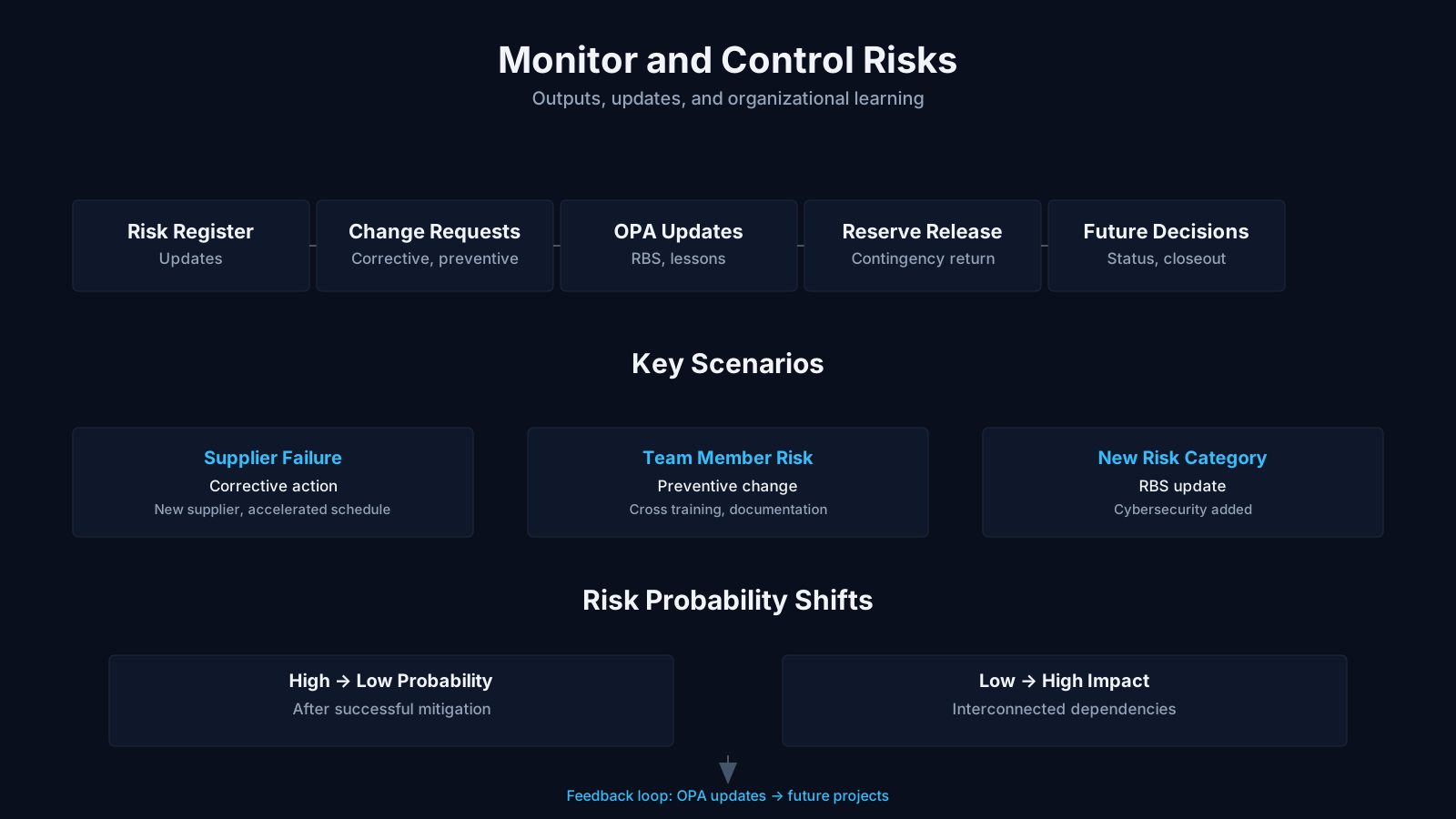
The outputs of this process can be grouped into five broad categories: risk register updates, organizational process assets updates, change requests, project management plan updates, and project document updates. Each category serves a different audience and has a different shelf life. Some updates are immediately visible to the project team, while others become valuable only after the project closes and a future project begins. The following sections explore each outcome in depth.
Key Outcomes of Monitoring and Controlling Risks
| Core Concept | Summary |
|---|---|
| Process Purpose | The Monitor and Control Risks process continuously tracks identified risks, monitors residual risk exposure, detects emerging risks, and evaluates whether risk management activities remain effective across the project life cycle. |
| Key Inputs | It integrates the risk register, the risk management plan, and work performance data to compare actual risk conditions against planned responses and detect variances early. |
| Risk Register Updates | The primary output is an updated risk register that captures insights from periodic reviews, reassessments, and risk audits, ensuring the project team maintains a current and accurate risk profile. |
| Risk Reassessment | Risk reassessments are performed at scheduled intervals and after major project events, such as phase completion or a significant issue, to reflect evolving conditions and adjust risk responses accordingly. |
| New Risk Discovery | Reassessment often surfaces new risks that were not present during planning. For example, a construction project may discover that a revised permitting process introduces an unanticipated schedule risk. |
| Risk Audits | Risk audits can identify gaps such as teams deviating from approved risk response plans or risk owners lacking the authority or resources to execute assigned actions. |
| Closing Risks | A risk is closed when its underlying condition no longer exists, the risk event occurs with minimal impact, or the response plan successfully neutralizes the threat. |
| Reserve Management | Contingency reserves allocated to closed risks should be released promptly; retaining them overstates the project's remaining risk exposure and distorts financial reporting. |
Risk Register Updates as the Core Outcome of Risk Monitoring and Control
The most direct outcome of the Monitor and Control Risks process is the set of risk register updates that reflect what the project team learned during periodic reviews, reassessments, and audits. The updated risk register functions as the project's current memory of risk. It contains not only the list of risks but also the latest thinking about their probability, impact, priority, planned responses, and assigned owners. Without these updates, the risk register quickly becomes a historical artifact rather than a management tool.
Risk reassessments happen at scheduled intervals or after major project events, such as completing a phase or encountering a significant issue. During a reassessment, the team may identify entirely new risk events. For example, a construction project might discover that a local permitting process has changed, creating a new schedule risk that did not exist during planning. The risk register gains a new entry, and the team must decide whether to accept, avoid, transfer, or mitigate it. At the same time, previously identified risks are reexamined. A risk that once seemed highly probable may have become unlikely due to better weather forecasts or resolved supplier constraints. The probability and impact scores are updated accordingly, which can shift the risk's priority ranking.
Risk audits provide a separate stream of information. While reassessments focus on individual risks, an audit examines the overall risk management process. The outcomes of a risk audit may reveal that the team is not following its own risk response plans, or that certain risk owners lack the authority to act on their assigned risks. These findings are recorded in the risk register as updates to ownership or response strategy. For instance, an audit might show that a technical risk owner is also overloaded with daily operations, so the risk is reassigned to a dedicated technical lead. Periodic risk reviews, often conducted during project status meetings, can also produce incremental updates that keep the register fresh between formal reassessments.
Another essential part of risk register updates involves closing risks that are no longer applicable. Risks can become obsolete for several reasons. The underlying condition may have disappeared, the risk event may have already occurred without causing the expected impact, or the response may have successfully eliminated the threat. When a risk is closed, the project manager should release any associated contingency reserves. Those reserves were set aside to address the risk if it materialized; leaving them allocated after the risk is closed misrepresents the project's remaining exposure. A well-maintained risk register therefore shows not only active risks but also a clear record of closed risks and released reserves.
Capturing Actual Outcomes for Future Risk Planning
The risk register also captures the actual outcomes of the project's risks and of the risk responses. This information goes beyond the planned probability and impact scores. It records what actually happened when a risk materialized, how severe the impact really was, and whether the planned response worked as intended. If a mitigation strategy reduced the impact by 60 percent instead of the expected 80 percent, that difference matters. Project managers can use this data to calibrate their risk assessments on future projects. The organization benefits because the same types of risks often appear across different projects, and historical outcome data sharpens the accuracy of future probability and impact estimates.
Consider a software development project where a key integration risk was expected to cause a two-week delay. The actual delay turned out to be four weeks because the response plan underfunded the testing effort. The risk register update notes this variance. On the next project involving a similar integration, the team can allocate more contingency time and budget. This kind of learning does not happen automatically. It requires the project manager to record actual outcomes honestly and to ensure the information is accessible beyond the project itself, which connects directly to the next outcome category.
Core Insights on Risk Register Updates
- Risk register is the primary output
- Each iteration of the Monitor and Control Risks process produces risk register updates that translate observations from periodic reviews, formal reassessments, and audits into actionable record changes.
- Register must stay a living tool
- Regularly updating probability, impact, priority, response plans, and owners keeps the risk register active and useful instead of letting it become a historical artifact.
- Reassessments follow defined triggers
- Risk reassessments are triggered by scheduled intervals and by significant project events, such as the completion of a phase, allowing emerging risks like a revised permitting process to be captured and acted upon before they escalate.
- Audits expose response and authority gaps
- Risk audits often expose breakdowns in plan execution and insufficient owner authority, leading to corrective measures like reassigning an overburdened owner to a dedicated technical lead.
Organizational Process Assets Updates as Durable Outcomes of Risk Monitoring
Beyond the individual project, the Monitor and Control Risks process contributes to organizational process assets updates that outlive the project team. The six Project Risk Management processes produce information that can be reused by future projects, and that information should be captured in the organizational process assets. These assets include templates, checklists, risk breakdown structures, and lessons learned. The Monitor and Control Risks process plays a particularly important role because it reveals what actually worked, not just what was planned.
Templates for the risk management plan are a common update. After a project finishes, the risk manager can revise the template based on what the team learned about facilitating risk workshops, defining probability and impact scales, or setting risk thresholds. The probability and impact matrix embedded in the risk management plan may need adjustment if the team found that certain categories of impact were consistently underestimated. The risk register template can also be improved. For example, if the team struggled to distinguish between risk triggers and risk symptoms, the template might be modified to include separate columns for each. These refinements make the next project's risk planning more efficient and more accurate.
The risk breakdown structure is another organizational process asset that benefits from monitoring and controlling outcomes. A risk breakdown structure organizes potential risk sources into categories such as technical, external, organizational, and project management. During monitoring, the team may discover that a particular subcategory, such as regulatory changes or subcontractor dependencies, caused more repeated issues than expected. That insight can lead to a revised risk breakdown structure that prompts future project teams to consider those sources earlier and more thoroughly. This is a classic example of organizational learning that remains invisible unless someone takes the time to update the asset.
Lessons Learned and Final Versions at Project Closure
Lessons learned from project risk management activities form a critical part of organizational process assets updates. These lessons are not limited to negative outcomes. A response that exceeded expectations, a risk that was successfully closed early, or a particularly effective risk owner who communicated clearly under pressure all provide material for future projects. The Monitor and Control Risks process generates these lessons continuously, but they are often consolidated and finalized at project closure. The final versions of the risk register, the risk management plan templates, checklists, and the risk breakdown structure are all included in the organizational process assets.
One practical pitfall is delaying organizational process asset updates until the very end of the project. Insights that are fresh during a risk review meeting may be forgotten or distorted months later. Experienced project managers often update templates and checklists incrementally as the project progresses, then perform a final cleanup at closure. This approach preserves the detail that makes the asset genuinely useful. Another pitfall is capturing only the outcomes of risks that caused problems. Positive outcomes, such as a risk that was overestimated and consumed unnecessary contingency, are equally valuable for calibration.
Change Requests as an Outcome of Risk Monitoring and Control
Implementing contingency plans or workarounds sometimes triggers change requests that must be submitted to the Perform Integrated Change Control process. Not every risk response requires a formal change request, but when the response alters scope, schedule, cost, or quality baselines, a change request becomes necessary. The Monitor and Control Risks process identifies these situations because it is the point where planned responses collide with actual project conditions.
Recommended corrective actions are one type of change request that arises from risk monitoring. Contingency plans are preplanned responses that the team activates when a risk trigger occurs. Workarounds, by contrast, are responses that were not initially planned but are required to deal with emerging risks that were previously unidentified or accepted passively. A workaround often emerges in the moment. For example, if a critical component fails and the intended backup supplier has also gone out of business, the team might decide to use a different component that requires a design modification. That design modification represents a change to the project scope and needs a formal change request.
Corrective actions and workarounds are sometimes confused with each other. The distinction matters because contingency plans are already approved within the risk management plan, so activating them may not require a change request. A workaround, however, introduces an unplanned solution that usually affects baselines and therefore must go through integrated change control. Project managers who skip this step often find later that the workaround created an undocumented deviation that complicates audit trails and lessons learned. The change request ensures that the workaround is evaluated for its full impact across all project constraints, not just the immediate technical problem.
Preventive Actions and Their Link to Risk Control
Recommended preventive actions form the second category of change requests. These are documented directions to perform an activity that can reduce the probability of negative consequences associated with project risks. Preventive actions differ from corrective actions because they focus on future risk exposure rather than on a risk that has already materialized. During risk monitoring, the team might notice a trend indicating that a particular supplier is becoming unreliable. A preventive action could involve adding a second source of supply or increasing inspection frequency. If that action requires a change to the project schedule or budget, a change request is prepared.
Preventive actions often emerge from risk reassessments and periodic reviews. The key is to link the preventive action to the risk register entry that motivated it. This linkage makes it easier to evaluate later whether the preventive action achieved its intended effect. It also helps the change control board understand why the change is being requested at that particular moment. Without that context, a preventive action can look like an arbitrary addition to scope, and it may be rejected or delayed. The Monitor and Control Risks process supplies the evidence that justifies the change.
Key Takeaways on Risk Response Change Requests
- Contingency plans may avoid change requests
- Activating a contingency plan when a defined risk trigger occurs generally does not require a formal change request, because the response has already been approved as part of the risk management plan.
- Workarounds require integrated change control
- Workarounds address previously unidentified or passively accepted risks and typically alter project baselines, which means they must be processed through the Perform Integrated Change Control process.
- Skipping change control creates undocumented deviations
- Bypassing change control for risk responses frequently leaves undocumented deviations that later complicate audit trails and lessons learned, making corrective actions from risk monitoring essential.
Project Management Plan Updates After Risk Control Decisions
When approved change requests affect the risk management processes, the corresponding component documents of the project management plan are revised and reissued. These project management plan updates ensure that the plan remains consistent with the project's risk management approach after a change. The elements of the project management plan that may be updated are the same as those in the Plan Risk Responses process. This includes the risk management plan itself, as well as subsidiary plans for scope, schedule, cost, quality, and procurement when risk responses alter their baselines.
For example, suppose a workaround approved through integrated change control introduces a new procurement activity. That change may require updating the procurement management plan to add the new vendor selection criteria. It might also update the cost baseline if the workaround increases the budget. The risk management plan may need a revision if the workaround introduces a new category of risk that the team did not previously consider. These updates are not cosmetic; they keep the project's formal guidance aligned with what the team is actually doing.
The phrase "revised and reissued" points to a formal control process. Project management plan updates are not informal notes jotted in a meeting. They go through document control, versioning, and distribution to stakeholders. This formality ensures that everyone works from the same understanding of the project's approach. A common mistake is to assume that because the workaround was approved, everyone knows about the underlying plan change. In reality, team members often continue to follow the old plan unless the revised version is actively communicated.
Project management plan updates also occur when risk reassessments lead to revised risk thresholds or updated risk response strategies. If the team decides that certain risks should now be escalated to a higher authority, the risk management plan's escalation procedures may change. These updates keep the plan responsive to the project's evolving risk profile. The Monitor and Control Risks process is the trigger for many of these revisions because it is where the team discovers that the original plan is no longer adequate.
Project Document Updates in the Monitor and Control Risks Process
Beyond the formal project management plan, the Monitor and Control Risks process produces project document updates that record the operational details of risk responses. The project documents that may be updated are the same as those in the Plan Risk Responses process. These are not part of the project management plan, but they are used to manage the project and are often referenced by the team on a daily basis.
Common project document updates include revisions to the assumption log, the issue log, and various technical documents. When a risk response reveals that an earlier assumption is no longer valid, the assumption log must be corrected. For example, an assumption that a certain software library would be stable may be invalidated when the vendor announces a major change. The team updates the assumption log, which in turn may trigger new risk identification. The issue log also receives updates when risks materialize and become issues that need active management.
Stakeholder registers and responsibility assignment matrices may also be updated if risk ownership changes during monitoring. Reassigning a risk owner often means updating the stakeholder register to reflect the new person's role and contact information. Technical documentation, such as interface specifications or test plans, may be updated when a workaround changes a technical solution. These project document updates might seem minor compared to project management plan updates, but they carry the day-to-day information that keeps the project moving.
The distinction between project management plan updates and project document updates can confuse new project managers. A simple way to remember it is that the project management plan describes how the project will be managed, while project documents describe what the project is doing. Risk monitoring touches both because risk responses often change both the management approach and the operational details. Keeping these two types of updates separate is essential for maintaining document control and for knowing which documents require formal approval versus which can be updated by the project team.
Key Takeaways on Document Updates
- Assumption log corrections
- Correcting the assumption log after a risk response invalidates an earlier assumption updates the project's factual baseline and can trigger new rounds of risk identification.
- Issue log updates
- When a risk materializes into an active issue, updating the issue log ensures it is formally tracked, assigned to an owner, and resolved through the project's issue management process.
- Maintaining document control
- Keeping project document updates separate from the project management plan is essential because it clarifies which documents require formal change control approval and which the team can update directly.
Integrating the Five Outcomes in Practice
Applying all five monitoring and controlling risks outcomes consistently requires an integrated approach that views them as parts of a feedback loop rather than as isolated deliverables. The risk register update captures what changed, the organizational process assets update preserves that change for future projects, the change request authorizes new work, the project management plan update aligns the formal management approach, and the project document update records the operational details. When one of these outcomes is delayed or neglected, the loop breaks, and the project drifts out of alignment with its risk management intent.
Consider a project where a risk materializes and a workaround is implemented. The team updates the risk register to close the original risk and add the new risk introduced by the workaround. A change request is submitted and approved. The project management plan is revised to reflect the new scope element. Project documents, such as the technical specification, are updated to match the workaround. Finally, the lessons learned about why the original risk was not mitigated effectively are captured in the organizational process assets. Missing any single step creates inconsistency. For example, if the technical specification is not updated, a future team member may rely on outdated information and reintroduce the same vulnerability.
In practice, many project teams treat these updates as administrative overhead rather than as value-adding activities. The reality is that each update reduces the chance of future surprises. The risk register update is often the one people remember, but the organizational process assets update is the one that prevents future projects from repeating the same mistakes. This is where a business value-oriented perspective becomes relevant. Some modern practices, such as those in BVOPM, emphasize separate product risk management with quantified loss size units and dynamic filtering, which encourages teams to attach concrete value to risk monitoring outcomes rather than treating them as purely procedural.
Current thinking in project management also recognizes that risk monitoring works best when it is continuous rather than episodic. Agile environments, for example, often integrate risk review into regular retrospectives and backlog refinement sessions. The outcomes remain the same in principle, but they are generated more frequently and in smaller increments. A risk register update after each sprint might be small, but the cumulative effect keeps the register far more current than a single major review at the end of a phase. The key is to match the frequency and formality of these outcomes to the project's complexity and risk profile.
One final practical note relates to reserve management. Releasing reserves when risks are closed is not just a bookkeeping task. It requires discipline to tell stakeholders that previously allocated contingency is no longer needed and can be returned to the organization or reassigned to new risks. Failing to release reserves can artificially inflate the project's perceived risk buffer and lead to poor portfolio decisions. The Monitor and Control Risks process includes this release as part of risk register updates, but it only works if the project manager treats reserve management as an active responsibility rather than an afterthought.