Forecasting the estimate at completion is one of those tasks that separates a forensic project accountant from a seat-of-the-pants project manager. While the initial budget at completion, or BAC, often carries the weight of a contractual promise, it rarely survives contact with reality for very long. As a project progresses, the actual cost incurred begins to diverge from the plan, and the question shifts from “Are we on budget?” to “Where will we actually land?” The answer emerges from a sequence of increasingly refined forecasts that combine what has already been spent with a projection of the remaining work. This process is fundamental to project control, and it sits squarely within the monitoring and controlling process group in the PMBOK framework, where the project manager uses work performance data to update cost predictions. Yet the mechanics of building a reliable estimate at completion, often abbreviated EAC, involve subtle choices about which performance indicators to trust and which risks to embed in the calculation.
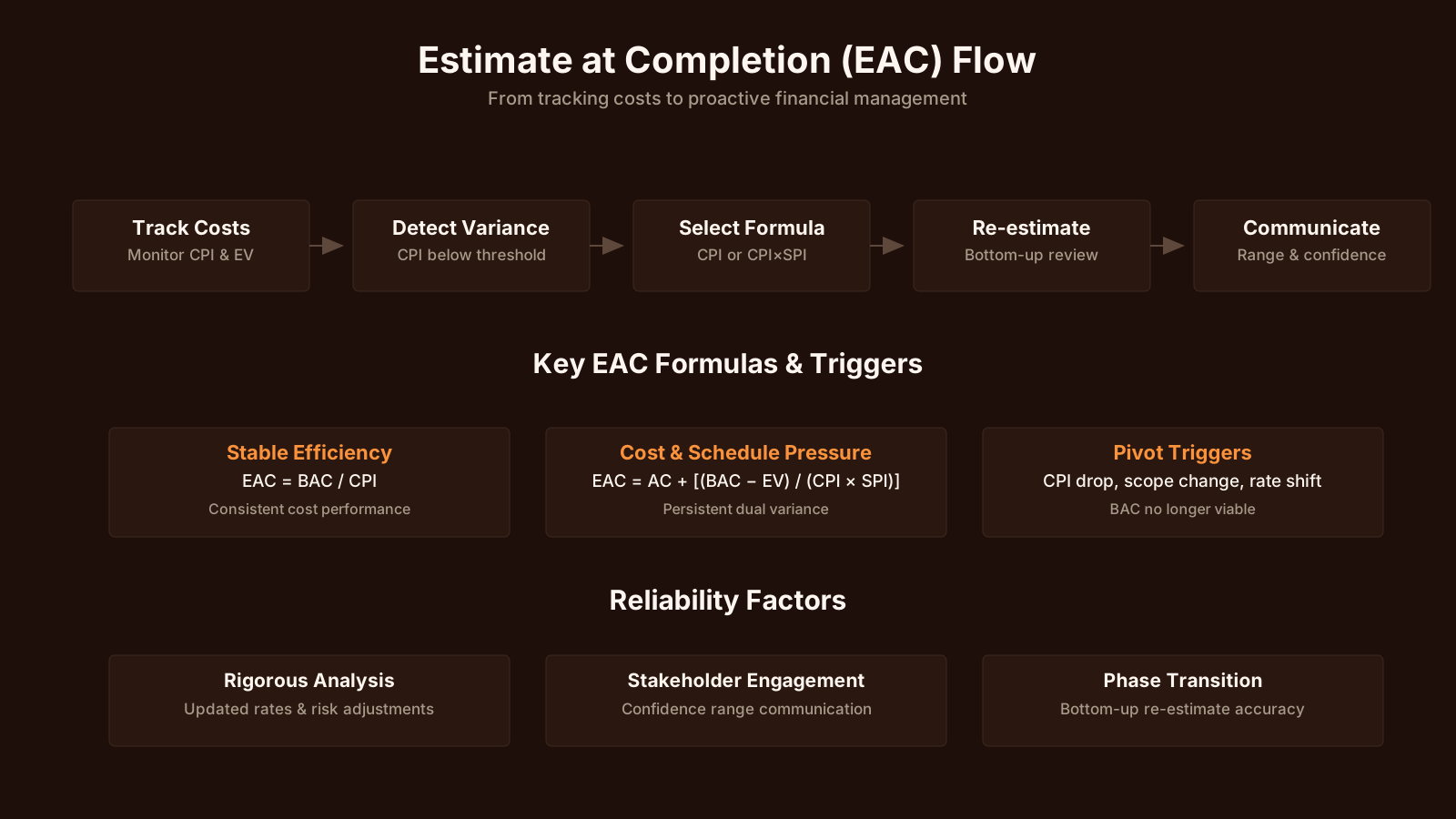
EAC Forecasting Methods at a Glance
| Key Concept | Summary |
|---|---|
| EAC Purpose | The Estimate at Completion is a core project control mechanism that converts actual work performance data into a refreshed cost projection, enabling informed decisions within the monitoring and controlling processes. |
| BAC Baseline | Budget at Completion aggregates the full work breakdown structure cost estimates and contingency reserves to form the definitive cost baseline against which all spending is measured. |
| Baseline Limitations | As a project evolves, direct comparisons against the original BAC become misleading, much like navigating with a map that no longer captures newly built roads and changed terrain. |
| Forecast Triggers | A revised EAC is triggered by persistent cost efficiency gaps, major design changes, or, in PRINCE2 environments, when the forecast exceeds tolerance thresholds and threatens the continued business case viability. |
| Decoupling Approach | The essential first step in the EAC process is to detach the forecast from the anchoring pull of the original budget, accepting the new estimate as a more accurate representation of the project’s cost trajectory. |
| Review Cadence | Traditional predictive projects often review EACs on a quarterly basis, while Agile contexts integrate more frequent cost forecast updates through backlog refinement and release planning rhythms. |
| Behavioral Bias | Pressure from prior cost overruns can lead team members to pad their estimates, injecting hidden buffers that erode forecast reliability and obscure true cost variance. |
| Root Cause Factor | Overlooking the root cause of overruns, such as systemic underestimation of user interface complexity, will quickly invalidate a forecast that merely resets spending to the planned burn rate without addressing the underlying error. |
When Does the Budget Stop Being Useful?
Every project starts with a budget that feels solid on paper. The numbers are summed from the work breakdown structure, contingency reserves are added, and the resulting budget at completion, or BAC, becomes the baseline against which all subsequent spending is measured. But the BAC is inherently a snapshot of a moment before the work begins. As activities unfold, the actual costs rarely march in lockstep with the planned values. Suppliers charge more than expected, productivity fluctuates, scope creeps in ways that the change control board did not formally approve. Over time, the project team realizes that comparing actual costs to the original BAC is like trying to navigate with a map that shows rivers where new roads have been built. The manager needs a revised destination, and the estimate at completion provides when the budget at completion becomes unrealistic.
Forecasting the EAC is not simply a mechanical update; it is a diagnostic act. When the project manager initiates an EAC revision, she is acknowledging that the initial planning assumptions no longer hold. Perhaps the team has consistently worked at 80 percent of the planned cost efficiency, or a critical design change has added several weeks of engineering effort. The EAC captures the financial consequence of these realities, integrating actual costs with a fresh estimate of the remaining work. This process aligns with PMBOK’s Control Costs process, which describes how work performance information is used to update the cost baseline and generate forecasts. It is also a common trigger in PRINCE2 environments, where the continued viability of the business case is assessed whenever a forecasted cost exceeds tolerance levels.
One of the subtle challenges is that many organizations treat the BAC as a fixed target, and updating the EAC is sometimes perceived as admitting failure. But seasoned project managers understand that an inaccurate forecast is far more dangerous than a realistic one that signals trouble early. The EAC is not an excuse; it is a steering instrument. Without it, stakeholders operate on outdated expectations, and corrective actions are delayed until the damage is irreversible. So the first step in any EAC exercise is to decouple the forecast from the psychological weight of the original budget, and to treat the new numbers as a better reflection of the project’s trajectory.
Key Insights on Budget Relevance
- Budget at completion is a snapshot
- BAC represents the authorized cost baseline, yet actual expenditures routinely deviate due to supplier price shifts, productivity variability, and unapproved scope modifications that erode the plan's relevance.
- Original budget quickly loses predictive value
- When project conditions diverge from the baseline, comparing actual costs to the initial BAC is akin to navigating with an outdated map, rendering cost variance analysis misleading.
- EAC merges actual costs with forward-looking estimates
- By integrating incurred costs with a re-forecast of remaining work, the Estimate at Completion delivers a transparent financial snapshot that supersedes the original budget, consistent with PMBOK's Control Costs process.
- Detach the forecast from the original budget
- A critical first step in any EAC recalculation is freeing the forecast from the psychological drag of the original budget, enabling the updated figures to serve as an accurate indication of the project's forward trajectory.
Building a Bottom‑Up Estimate at Completion
The most direct way to answer the question “How do I forecast the estimate at completion?” is to sit down with the team and painstakingly re-estimate every remaining work package from scratch. This bottom‑up approach produces a detailed estimate to complete, or ETC, which, when added to the actual costs incurred, gives the EAC. A bottom‑up estimate at completion delivers high accuracy because it leverages the latest knowledge that the team has gained during execution. Nobody knows the true complexity of integrating a particular software module better than the developers who have been elbow‑deep in the code for weeks. So the project manager collects these granular ETC inputs, aggregates them, and arrives at a number that reflects the project’s current reality.
The formula is elegant in its simplicity: EAC equals actual cost plus the bottom‑up ETC. But anyone who has attempted this in the middle of a tight iteration or sprint knows the disruptive nature of the exercise. Team members must stop what they are doing and mentally reconstruct the effort, dependencies, and risks for tasks that are still months away. The process often consumes a few days of productive time that nobody has budgeted for forecasting work. In traditional predictive environments, this might be a quarterly exercise; in Agile settings, a similar activity happens more frequently, though the effort is distributed across backlog refinement and release planning sessions. So while the bottom‑up method is the gold standard for accuracy, it comes with a transaction cost that must be weighed against the value of precision.
There is also a behavioral nuance: team members, when asked to provide their best estimate, may inadvertently pad numbers because they recall the pressure of previous cost overruns. Others might be overly optimistic, assuming that future tasks will go as smoothly as the original plan envisioned. The project manager must calibrate these inputs, cross‑checking them with historical performance data and risk registers. In some cases, the bottom‑up exercise reveals that certain work packages are simply no longer needed due to scope adjustments, which immediately improves the EAC. But overall, the method remains a thorough but heavyweight approach, most suitable when the project has encountered significant changes, or when an EVM‑based forecast triggers a threshold that demands deeper investigation.
Earned Value Management Forecasts for the Estimate at Completion
When the project cannot afford the disruption of a full bottom‑up re‑estimate, or when the manager needs a quick, formula‑based sanity check, earned value management (EVM) steps into the spotlight. EVM provides a family of EAC calculations, each reflecting a different assumption about how the remaining work will behave. These formulas draw from a handful of core metrics: actual cost (AC), planned value (PV), earned value (EV), and the budget at completion (BAC). From these, the cost performance index (CPI) and the schedule performance index (SPI) are derived. The art of forecasting with EVM lies not in the arithmetic but in selecting the assumption that best matches the project’s circumstances. Using earned value management formulas for estimate at completion allows a rapid projection that can then be validated or refined with team input.
The distinction between these formulas is fundamental and is often lost on newcomers. Each EAC variant tells a story about whether past performance is indicative of the future. One formula assumes that the anomalies that have plagued the project so far are behind us, and the remaining work will proceed exactly as budgeted. Another assumes that the current rate of cost burn will persist. A third acknowledges that schedule pressure is also distorting cost efficiency. The project manager’s job is to evaluate which narrative holds true, which requires a close reading of the root causes behind cost variances. Was the CPI dragged down by a one‑time supplier price hike that will not recur? Then a future‑back‑to‑budget assumption might be fair. Is the same team with the same tools continuing to face the same obstacles? Then the CPI‑persistence assumption is more realistic.
EAC Forecast Assuming Future Work Follows the Budgeted Rate
This EAC formula accepts the actual costs to date without judgment and then assumes that all future work will be completed at the planned cost efficiency. Mathematically, EAC equals AC plus the remaining budget, which is BAC minus EV. It effectively wipes the slate clean for the rest of the project. This method is appropriate when the project experienced a contained event, a storm that shut down a site for a week, an unexpected regulatory filing that required a burst of legal spending, that is now resolved. The formula says: we have spent more than planned to reach this point, but the path ahead is clear and we can revert to the original estimates.
In practice, many project managers apply this formula when they receive verbal commitments from teams that future productivity will improve, or when a new technology has been adopted that is expected to bring efficiencies. However, it is one of the most optimistic EAC forecasts, and it can easily become a self‑deception if the root cause of poor cost performance is systemic. If the project is over budget because the estimators consistently underestimated the complexity of user interface work, simply resetting the future to the budgeted rate will produce a forecast that is quickly proven wrong in the next reporting period. Therefore, the project manager should use this EAC only after verifying that the conditions causing the variance have genuinely ended.
EAC Forecast Assuming Future Work Continues at the Current CPI
When cost performance is stable but unfavorable, the most straightforward forecast is EAC equals BAC divided by the cumulative CPI. If a project has a CPI of 0.8, meaning it earns eighty cents of value for every dollar spent, continuing at that rate implies a total cost that is twenty‑five percent above the original budget. This formula is widely used because it requires minimal assumptions: it simply extrapolates current efficiency into the future. The math is quick, the message is clear, and it often serves as a wake‑up call for stakeholders who assumed the budget deviation was temporary.
Nevertheless, applying this formula blindly can be misleading when the CPI is volatile or when the project is in its early stages. A CPI calculated from only two months of data, where one month included unusual procurement costs, will not stabilize until more periods are accumulated. Many experienced project controllers wait until at least twenty percent of the work is complete before placing much trust in the cumulative CPI. And there is a subtle conceptual warning: the CPI measures cost efficiency relative to the earned value, but it does not discriminate between inefficiency due to poor productivity and inefficiency due to legitimate work that was not in the original baseline. If the project has significant unapproved scope, the CPI will look artificially low, and the resulting EAC will overstate the true forecast. So the manager must always pair the CPI with a scope verification check.
EAC Forecast Considering Both Schedule and Cost Performance
The third major EVM formula incorporates the schedule performance index alongside the CPI. The formula is EAC equals AC plus the remaining budget divided by the product of cumulative CPI and cumulative SPI. This approach recognizes that when a project is severely behind schedule, the efforts to catch up inevitably consume extra cost. Overtime payments, accelerated shipping fees, or the simple overhead of having more people working simultaneously on interdependencies all inflate the cost of the remaining work. The SPI acts as a penalty factor, amplifying the cost projection.
This composite formula is especially relevant in industries like construction or aerospace where schedule delays trigger contractual liquidated damages and pressure the organization to spend more to recover time. It paints a more pessimistic picture than the CPI‑only forecast, and that can be exactly what is needed to stimulate re‑planning conversations. On the other hand, applying this formula when the project is slightly behind schedule due to a non‑critical path activity that has no bearing on future costs might produce an unnecessarily dire forecast. The SPI in earned value management is based on monetary value of work, and it can lose meaning when schedule delays are localized. So this EAC is best reserved for situations where cost and schedule performance are genuinely correlated, and where the manager has evidence that the schedule compression will demand extra resources.
EAC Forecasting Core Insights
- Rapid formula-based EAC estimates
- EVM offers a suite of estimate-at-completion formulas that provide quick, structured forecasts when a full bottom-up re-estimate would be too disruptive or time-consuming.
- Core EVM metrics drive forecasts
- The EAC calculations rely on four foundational metrics: actual cost, planned value, earned value, and budget at completion, each feeding distinct project performance data into the forecast.
- Matching assumptions to project reality
- The art of forecasting lies in selecting the formula whose assumption about future performance best aligns with the project's specific situation and the root causes of its cost variances.
- Budgeted rate forecast limitations
- The formula that assumes future work proceeds at the planned rate is reliable only when cost overruns originate from contained, resolved events; it produces misleading results if overruns are driven by systemic underestimation.
Selecting and Interpreting EAC Forecasts
Having multiple EAC forecasts on the table is not an academic exercise; it is a practical technique for detecting early warning signals. Selecting the right EAC method requires comparing the outputs of the different formulas and noting where they diverge. If the BAC‑based forecast (the one that assumes future work at budgeted rate) is only slightly higher than the CPI‑based forecast, the manager can infer that the cumulative cost variance is minor. But if the two forecasts are far apart, the project likely has a deep‑seated inefficiency that the team does not yet fully acknowledge. The gap between the optimistic and pessimistic forecasts becomes a conversation starter with the team and sponsors.
In many project environments, the project management office maintains a threshold for what constitutes an unacceptable cost overrun. When any EAC exceeds that threshold, a formal re‑baselining or change request is triggered. The project manager does not need to commit to a single EAC number immediately. Instead, she can track a range bounded by the bottom‑up EAC on one end and the CPI×SPI EAC on the other, and update this envelope each month. As the project converges toward completion, the range narrows, and the forecast becomes a consensus that has the backing of both quantitative models and qualitative team input.
Interpreting these numbers demands a certain amount of storytelling. The project controller might report to the steering committee: “Our raw CPI predicts an EAC of 2.4 million, but after reviewing the reasons for the poor CPI during the first quarter, we believe that the new procurement process will stabilize costs from next month onward. Therefore we are recommending the EAC that keeps future work at the budgeted rate, which sits at 2.0 million.” This narrative ties the formula choice to a specific risk assessment, and it demonstrates that the project manager is not just plugging numbers into a spreadsheet but exercising judgment.
Common Pitfalls and Practical Realities of Forecasting
One of the most insidious pitfalls in forecasting the EAC is the confusion between actual costs and earned value. In organizations new to earned value management, there is a temptation to think that if actual costs are below the planned value, the project is healthy. But without earned value, you cannot distinguish between being ahead of schedule and simply spending money faster than expected. An EAC forecasting pitfall is the assumption that the current cost performance index will naturally revert to 1.0. In reality, it rarely does without active intervention. Project history across industries shows that the cumulative CPI tends to stabilize after about twenty percent completion and then becomes relatively fixed. Waiting for it to self‑correct is a recipe for an overrun that catches sponsors off guard.
Another common mistake is applying EVM formulas mechanically to projects that are either too small or too dynamic for the metrics to stabilize. On a pure Agile software project where scope is deliberately fluid and teams re‑plan every sprint, traditional earned value may feel like an imposed abstraction. In such settings, the equivalent forecast is often expressed as a burn‑up chart that projects when the backlog will be completed based on recent velocity. While the terminology differs, the underlying principle is the same: use actual throughput (velocity as a surrogate for earned value) and extrapolate. The project manager who understands both worlds can translate between the languages and pick the right tool for the context.
The disconnect between the bottom‑up method and EVM formulas can also create tension within the team. The EVM calculations may yield a lower EAC than the bottom‑up rebuild, because the EVM models assume a mechanical continuation that ignores specific upcoming risks already known to the engineers. Seasoned project managers will always give more weight to the bottom‑up ETC when the team identifies discrete risks that the aggregate indices cannot capture. On the other hand, if the bottom‑up ETC is substantially lower than the EVM forecast, that often signals collective optimism bias, and the manager should probe the team’s assumptions more rigorously. The forecast is healthiest when both methods are used as checks on one another, not as competitors.
Core Pitfalls in EAC Forecasting
- Actual cost versus earned value confusion
- Organizations new to earned value management often interpret actual costs falling below planned value as a sign of health, yet absent earned value data they cannot distinguish genuine schedule advancement from mere accelerated spending.
- CPI self-correction is a false hope
- Cumulative CPI typically stabilizes near the 20% completion mark and rarely improves thereafter, so expecting a return to 1.0 is a common trap that leaves sponsors unprepared for looming cost overruns.
- Mechanical EVM application has limits
- Applying EVM formulas mechanically to projects that are too small or too dynamic prevents metric stabilization and generates forecasts that obscure true performance rather than illuminate it.
- Agile projects need alternative forecasts
- In Agile contexts where scope is deliberately fluid and replanning occurs each sprint, a burn-up chart that projects backlog completion from recent velocity provides the most coherent forecasting counterpart to an EAC.
- EVM can underestimate the EAC
- EVM-derived estimates frequently understate the final cost compared to a thorough bottom-up reassessment, because the formulas extrapolate past trends while ignoring specific upcoming risks that engineering teams already recognize.
The Estimate at Completion and Business Value Considerations
Forecasting costs is only half the equation; the other half is comparing those costs to the value the project is expected to deliver. In BVOPM (Business Value‑Oriented Project Management), the estimate at completion is not evaluated in isolation. Instead, it is mapped against business value points that track the projected benefits throughout the project lifecycle. A persistent decline in business value points, when paired with an escalating EAC, may trigger a serious discussion about project closure or scope reduction. This integration of cost forecast and value monitoring ensures that the organization does not pour money into a project whose returns have eroded.
BVOPM also introduces the concept of process damage, which is an invisible organizational harm that occurs when a project consumes excessive resources that could have been deployed elsewhere. From this perspective, an inaccurate EAC that is consistently understated causes process damage because it conceals the true resource drain, delaying the reallocation of funds to more valuable initiatives. By enforcing frequent EAC reviews and tying them to business value assessments, BVOPM provides an early detection mechanism that traditional cost control processes sometimes lack. While the EVM formulas and bottom‑up methods remain conceptually unchanged, their relevance is amplified when the forecast feeds directly into a business value dashboard visible to senior leadership.
Even without formal BVOPM adoption, organizations that link EAC forecasts to benefit realization reviews are following a similar logic. The forecast should never be a purely financial artifact; it is a strategic signal. If the EAC climbs above the benefits case threshold, the project ceases to be viable as originally conceived, and the response might be a radical scope cut, a schedule extension to absorb costs differently, or a termination. This is where the project manager’s role expands from cost controller to business interpreter, contextualizing the numbers for decision‑makers who care less about CPI formulas and more about return on investment.
Continuous Forecasting and the Cost Control Cycle
Forecasting the estimate at completion is not a one‑time effort; continuous forecasting cycles ensure the EAC stays aligned with project realities as new work performance data arrives. In PMBOK’s Monitor and Control Cycle, the EAC is updated during the Control Costs process, and it is formally communicated through performance reports. The frequency of these updates matters. In a fast‑paced technology project, leaving the EAC unchanged for three months can render it so stale that corrective actions come too late. Some organizations mandate an EAC review at every status meeting, even if the numbers haven’t changed, simply to keep the conversation alive. The act of revisiting the forecast forces the team to ask: “What new information do we have that could change our projection?”
The interaction between change control and EAC forecasting is particularly critical. Scope changes that are approved but not yet reflected in the performance measurement baseline will distort the earned value metrics and lead to inaccurate forecasts. Before updating the EAC, the project manager must ensure that all approved changes have been incorporated into the BAC and that the work performance data is properly adjusted. Failing to do so can produce an EAC that is artificially low, because the earned value does not fully reflect the scope that the team is actually delivering. This kind of normalization work is tedious but essential for forecast integrity.
Another practical aspect is the treatment of management reserves and contingency. Organizations that maintain separate contingency reserves beyond the cost baseline must decide whether the EAC includes those reserves. Some forecasts are expressed against the original baseline only, while others incorporate the management reserve drawdown that has already been authorized. If the EAC is to be compared to the original approved budget, it should be measured against the same baseline. If it is intended to reflect the total expected cost to the organization, then consumed reserves must be added. This choice can lead to very different numbers, and confusion arises when different stakeholders use different baselines. The project manager’s responsibility is to clearly label which version of the EAC is being presented.
Essential Insights on EAC Forecasting
- Continuous EAC update cycle
- EAC forecasting operates as an iterative discipline within the Control Costs process, with each updated forecast formally communicated through performance reports to drive timely corrective decisions.
- Forecast review frequency matters
- Allowing the EAC to remain static over multiple reporting cycles erodes its predictive value and postpones critical interventions; consequently, leading organizations mandate a review at each status meeting to keep the forecast responsive.
- Align change control with EAC
- Incorporating all approved scope changes into the Budget at Completion before updating the EAC preserves the integrity of earned value metrics and prevents the generation of misleadingly low cost projections.
Making Forecasts Work in Your Organization
Ultimately, forecasting the estimate at completion is less about the formulas and more about the organizational culture around honest cost reporting. When project teams are punished for revealing that the BAC is no longer achievable, they have every incentive to cling to outdated numbers until the overrun becomes undeniable. Leaders who want reliable EACs must create an environment where early warnings are welcomed, not penalized. This includes providing dedicated time for the bottom‑up re‑estimation exercise when it is needed, rather than expecting teams to do it in their spare moments. It also means investing in the basic hygiene of time tracking and cost accounting, because even the most sophisticated EVM formulas are worthless if the actual costs are miscoded.
For the project manager, mastering EAC forecasting means developing a sixth sense for when the numbers feel wrong. It is the ability to glance at a CPI trend and notice that it has been flat for three periods while the actual costs keep climbing, indicating that the earned value metrics are not capturing some kind of hidden scope. It is knowing when to discard the formula‑based EAC and call for a detailed bottom‑up review, even if it disrupts the sprint. And it is having the confidence to present a range rather than a single point estimate, acknowledging that the future contains uncertainty that cannot be modeled away. The best forecasters treat the EAC as a tool for steering, not as a commitment, and they communicate the narrative behind the number with as much care as the number itself.