A bidder conference is a formal meeting between a buyer and all prospective sellers before anyone submits a bid or proposal. Depending on the industry, it may be called a contractor conference, a vendor conference, or a pre-bid conference. The purpose is to make sure every prospective seller shares a clear and common understanding of the procurement, including technical and contractual requirements, and to ensure no bidder receives preferential treatment. How you ensure a bidder conference is fair comes down to planning, transparency, and consistent documentation.
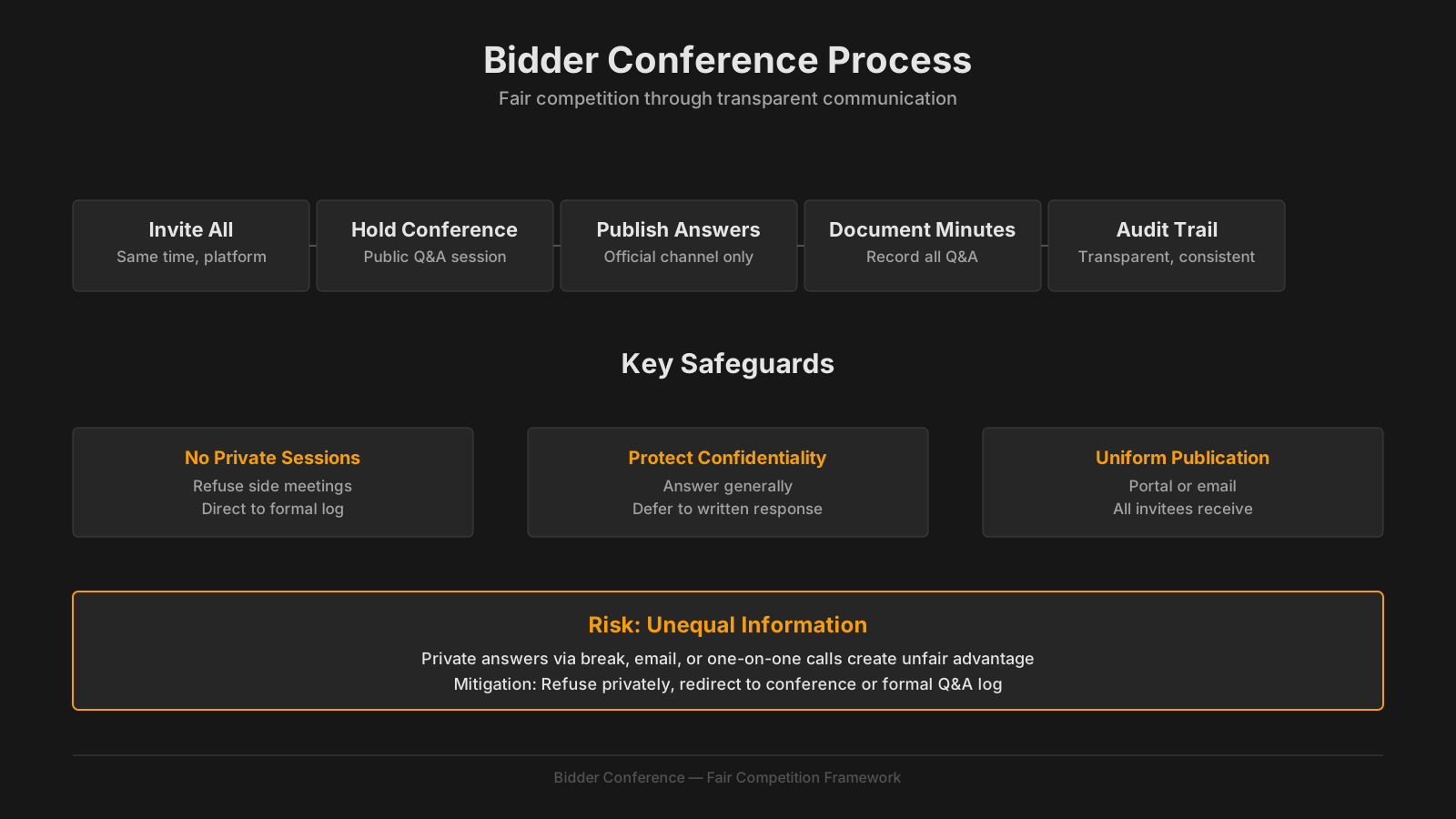
Key Topics for Ensuring a Fair Bidder Conference
| Purpose | Summary |
|---|---|
| Bidder Conference | A structured prebid meeting hosted by the buyer for all prospective sellers to establish a shared understanding of procurement requirements, evaluation criteria, and submission obligations before bids are prepared. |
| Requirement Clarification | The session surfaces ambiguous requirements and gives the buyer an opportunity to confirm that all bidders apply the same interpretation to the statement of work, technical specifications, and evaluation factors. |
| Solicitation Amendments | Questions and responses discussed during the conference may be formalized as amendments to the solicitation documents, which makes the clarifications contractually binding and creates a clear audit trail. |
| Fair Competition | To preserve competition, the buyer must not engage any individual bidder in side discussions about pricing, contract terms, or proprietary solutions, and must treat questions from all bidders with equal rigor regardless of company size. |
| Scope Limitations | A bidder conference cannot remedy a fundamentally deficient solicitation, but it can help the buyer identify and issue the amendments needed to correct material gaps. |
| Protest Exposure | Inconsistent treatment or undisclosed side communications can expose the procurement to formal protests, legal challenges, or cancellation of the solicitation in many public procurement frameworks. |
| Transparency Benefits | Documented transparency reduces downstream delays by preventing misunderstandings, bidder challenges, and disputes over the intended meaning of requirements. |
What is a bidder conference in the procurement process?
A bidder conference is a structured meeting between the buyer and all prospective sellers that takes place before bids or proposals are submitted. It is also known as a contractor conference, vendor conference, or pre-bid conference, depending on the sector and region. The buyer calls this meeting to make sure every prospective seller has a clear and common understanding of the procurement, including all technical and contractual requirements. The structure is not casual; it is a controlled forum where the same information flows to everyone at the same time.
The concept is straightforward. Procurement documents rarely answer every possible question about a complex scope of work. A bidder conference lets sellers ask clarifying questions face to face, virtually, or in writing. The buyer then provides answers. But the critical rule is that every prospective seller hears every question from any individual prospective seller and every answer from the buyer. Without that rule, the process would favor one bidder over another.
A bidder conference also gives the buyer a chance to correct ambiguities in the solicitation before the submission deadline. If multiple bidders ask about the same unclear requirement, the buyer knows the original wording was not strong enough. That insight can lead to a formal amendment that clarifies the requirement for all parties. The conference is therefore not only a question-and-answer session but also a quality check on the procurement documents themselves.
Core objectives of a fair bidder conference
The first objective is common understanding. The buyer wants every prospective seller to interpret the statement of work, specifications, delivery terms, and evaluation factors in the same way. The second objective is equal access to information. Any clarification that one bidder receives must be available to all bidders through the same channel. The third objective is documented consistency. Responses raised during the conference can be incorporated into the procurement documents as amendments, which makes the clarification binding and traceable.
These objectives matter because bids are competitive. A seller that misunderstands a requirement may submit a proposal that is too low, too high, or technically noncompliant. That hurts the buyer by reducing the quality of the field and can lead to disputes later. A fair bidder conference protects the buyer's interest as much as the bidders' interest by reducing the chance of defective or misaligned proposals.
What a bidder conference is not
It is not a negotiation. The buyer should not discuss price concessions, terms, or proprietary technical approaches with any single bidder outside the formal process. It is also not an evaluation session. The buyer is not there to rate vendors or hint at who might win. And it is not a replacement for careful procurement planning. If the solicitation is badly written, a meeting cannot fully repair the damage, though it can help identify necessary amendments.
Key Insights on Bidder Conferences
- Structured pre-bid meeting
- A bidder conference, also referred to as a contractor, vendor, or pre-bid conference, is a formal pre-submission meeting in which the buyer and all prospective sellers align on the scope and expectations of the procurement.
- Uniform information to all
- The buyer uses this controlled forum to distribute identical information to every seller at the same time, eliminating information asymmetry and establishing a common understanding of the technical and contractual requirements.
- Clarifications become binding
- Sellers can raise clarifying questions and the buyer can resolve ambiguous solicitation language, after which the responses are formally recorded in the procurement documents as binding and traceable amendments.
Why fairness is the core obligation in a bidder conference
Fairness in a bidder conference comes down to equal access to procurement information. Every prospective seller must have the same opportunity to learn about the procurement, ask questions, and receive answers. If only one bidder hears a question or answer, that bidder gains an advantage. It does not matter whether the advantage seems small; procurement integrity depends on the perception and reality of equal treatment.
This obligation is not just ethical. In many public procurement systems, unequal treatment can lead to formal protests, legal challenges, or cancellation of the solicitation. Private sector buyers face a different but equally real risk. Vendors talk to each other, and a reputation for preferential treatment can reduce the quality and number of future bids. Fairness also affects the reliability of the bids you receive. If one vendor has hidden information, their price or technical approach may be artificially stronger, which distorts the competition.
Here is a simple way to think about it. A bidder conference is like a teacher answering questions before an exam. If the teacher answers a question quietly for one student, the test is no longer fair. All students need to hear the same guidance, or the results cannot be trusted. In procurement, the buyer plays the role of the teacher, and the procurement documents are the exam. The meeting exists to level the playing field before the real assessment begins.
Some buyers worry that too much transparency slows things down or exposes them to criticism. Actually, transparency tends to reduce delays later because it prevents misunderstandings and disputes. A vendor that discovers another bidder got a private clarification may challenge the award. Re-running a solicitation takes far longer than documenting and sharing an answer during the conference.
Fairness also means treating all questions seriously, whether they come from a large established firm or a smaller newcomer. The buyer cannot ignore a question simply because it comes from a bidder who seems less likely to win. Every question and answer becomes part of the shared record, and that record is what keeps the process defensible.
Planning a fair bidder conference step by step
Effective fair bidder conference planning starts with deciding who needs to attend, what will be covered, and how information will be recorded. The buyer should first identify all prospective sellers from the solicitation list. Everyone who received the procurement documents or expressed interest should receive the same invitation at the same time. The invitation must include the date, time, location or platform, agenda, and ground rules.
The agenda should be specific. It might include a review of the statement of work, a walkthrough of the pricing structure, a discussion of key contractual terms, and a question-and-answer period. The buyer should not structure the meeting as a sales pitch. The focus is clarification, not promotion of the opportunity. Keeping the agenda tight also helps bidders decide who to send and what questions to prepare.
One practical step is to assign clear roles before the meeting. A facilitator manages the flow and enforces ground rules. A technical expert or project manager answers requirement questions. A procurement officer handles contractual and process questions. A note taker or recording system captures every question and answer. Without these roles, a bidder conference can drift into side conversations or leave critical answers undocumented.
Buyers also need to plan for the format. An in-person meeting may feel more direct, but it can be harder for distant bidders to attend. A virtual meeting is more accessible, but it introduces technology risks. A hybrid format can accommodate both, but it requires extra care to ensure remote participants hear and see everything that in-person participants do. The planning decision should favor the format that maximizes equal participation, not the one that is most convenient for the buyer.
Finally, the buyer should prepare in advance for likely questions. Reviewing the solicitation with the technical and contracting teams helps identify ambiguous clauses. Preparing draft answers can speed up the meeting, but the buyer must still allow live questions. Pre-prepared answers are not a substitute for hearing what bidders actually ask.
Inviting all prospective sellers consistently
Invitation consistency matters more than many buyers realize. A vendor that receives the meeting link late may miss the first ten minutes, where the buyer often states the ground rules. That can create a real disadvantage. The buyer should use a single distribution method and track acknowledgments. If the solicitation allows questions by email before the conference, those questions should be read aloud and answered during the meeting, not handled privately.
Essential Planning Steps for Bidder Conferences
- Invite all prospective sellers equally
- Identify every seller on the solicitation list and issue a single, simultaneous invitation to all parties that received procurement documents or formally expressed interest, so no bidder gains an informational or timing advantage.
- Include complete invitation details
- A complete invitation specifies the date, time, location or virtual platform, agenda, and ground rules, enabling bidders to select the right attendees and prepare focused, relevant questions in advance.
- Structure a practical agenda
- A practical agenda typically covers a detailed statement of work review, a line-by-line pricing structure walkthrough, discussion of key contractual terms, and a structured question-and-answer period, while maintaining a neutral, procurement-focused tone rather than a sales pitch.
- Assign clear meeting roles
- Assign a technical expert or project manager to answer requirement questions, designate a note taker or recording system to capture every exchange verbatim, and add safeguards in hybrid formats to ensure remote participants have the same visibility and opportunity to engage as on-site attendees.
Running the bidder conference and managing questions
The live meeting is where question and answer management determines whether the event is fair. The facilitator should open by restating the ground rules. Every question must be asked through the agreed channel, whether that means raising a hand, speaking into a microphone, using a moderated chat, or submitting a question in writing. The buyer should explain that no private answers will be given and that all substantive answers will be documented and distributed.
When a question comes in, the buyer should repeat or display it before answering. This serves two purposes. It ensures everyone hears the question, and it gives the note taker a clear record. The answer should be concise and limited to the actual question. If the buyer does not know the answer, the appropriate response is to say that the answer will be provided later to all bidders in writing. Guessing or speculating creates risk.
This is trickier than it sounds when a vendor asks a question right after the meeting ends. A bidder may approach the buyer in the hallway or stay behind on a video call. The buyer must resist answering privately. The correct response is to direct the bidder to submit the question through the formal process so it can be answered and shared with everyone. Even a seemingly harmless clarification, if given to one vendor only, can taint the procurement.
Managing dominant participants is another fairness issue. If one bidder asks dozens of questions, others may not get a chance. The facilitator can set a time limit per bidder or rotate questions. The goal is not to limit legitimate clarification but to ensure all voices have space. The same principle applies to virtual meetings, where a single participant can flood the chat.
Buyers should also be careful about body language and offhand remarks. Saying "that is a great question" to one bidder but not others can create a perception of favoritism. Procurement officials should remain neutral and professional. The safest approach is to treat every question the same way, regardless of which bidder asked it.
How to keep the live Q&A fair
A fair live Q&A requires a visible queue and a single voice. In a physical room, the facilitator can call on people in the order they raised their hands. In a virtual meeting, the moderator can read questions from the chat in the order they were received. The buyer should avoid answering direct messages, private chats, or off-channel emails during the event. Those responses often happen without thinking, but they are exactly how one bidder gains an unfair informational advantage.
Documenting responses and amending procurement documents
The most reliable way to ensure fairness is to amend procurement documents with the formal responses from the bidder conference. A verbal answer disappears once the meeting ends, and different attendees may remember it differently. The buyer should produce minutes or a question-and-answer log that captures each question, the full answer, and any impact on the solicitation. That record is then distributed to all prospective sellers.
Material answers should become formal amendments to the solicitation. For example, if a bidder asks whether a certain certification is mandatory and the buyer answers yes, that answer must be reflected in the procurement documents. If the answer changes the scope, timeline, or evaluation criteria, the amendment should specify the change and its effective date. Bidders should be required to acknowledge receipt of the amendment before submitting their proposals.
Not every answer requires a formal amendment. Clarifications that explain existing language without changing it can be recorded in the Q&A log. But the buyer should apply a simple test: if the answer changes how a reasonable bidder would prepare its proposal, it belongs in an amendment. Leaving that information in meeting minutes alone
Turning bidder questions into formal amendments
When a question reveals a genuine gap in the solicitation, the buyer should not simply say "we will consider it." The correct step is to issue a written amendment that modifies the procurement documents. The amendment should identify the changed clause, state the new language, and instruct bidders to acknowledge it. This makes the clarification part of the official requirement set rather than an informal interpretation.
Core Takeaways on Bidder Amendments
- Verbal answers require written records
- The buyer should document every verbal exchange in minutes or a question-and-answer log that records each question, the complete response, and any effect on the solicitation, because oral statements are easily lost or recalled inconsistently after the meeting.
- Material answers become formal amendments
- If an answer alters the scope, schedule, or evaluation criteria, it must be incorporated into the solicitation as a formal amendment rather than existing only in meeting minutes.
- Reasonable bidder preparation test
- The buyer should ask whether a response would change how a reasonable bidder prepares its proposal, and if it would, that response belongs in a formal amendment to the solicitation.
- Amendments need clear structure
- A well drafted amendment identifies the clause being changed, provides the replacement language, states the effective date, and requires bidders to acknowledge receipt.
Common pitfalls that undermine a fair bidder conference
Many bidder conference pitfalls are not deliberate. They come from time pressure, informal habits, or a misunderstanding of what the meeting is for. Honestly, many of these mistakes happen despite good intentions. The most serious pitfall is holding a private conversation with one bidder, whether before, during, or after the event. Even a short exchange about the scope can create an advantage. The buyer must consistently redirect all substantive questions to the formal record.
Another common mistake is giving verbal answers that are never written down. If a question arises during a site tour or a break, the answer might be accurate but still invisible to bidders who were not standing nearby. Fairness depends on the written record, not on who happened to be in the room at that moment. The buyer should have a note taker or recording device active throughout any official session, including site visits that are part of the conference.
Failing to distribute the minutes to everyone is equally damaging. Some buyers share answers only with attendees or only with bidders who ask a follow-up question. That approach creates an information gap. The safest rule is to send the full Q&A log and any amendments to every prospective seller identified in the solicitation file. If a bidder did not attend, they still need the same information.
A less obvious pitfall is allowing the conference to become a negotiation. A bidder might ask "would you accept a shorter warranty period if we lower the price?" The buyer should decline to negotiate and explain that all terms will be evaluated through the formal submission. Answering such questions selectively can reveal the buyer's preferences or trade-off priorities to one bidder, which is unfair.
Finally, some buyers treat the bidder conference as a formality instead of a risk management tool. They rush through the agenda, skip the Q&A, or delegate facilitation to someone with no authority to answer. That wastes the opportunity and often results in more questions during the proposal period. A structured, well-run conference reduces the need for later clarifications and protects the integrity of the procurement.
What practitioners often get wrong about fair bidder conferences
One misconception is that fairness means answering every question immediately. In fact, it is better to say "we will respond in writing to all bidders" than to give an off-the-cuff answer that later needs correction. Another misconception is that only formal amendments matter. Meeting minutes matter too because they document the shared understanding. If the minutes are incomplete or inaccurate, the fairness of the entire event can be questioned.
How bidder conferences fit into project management frameworks
In PMBOK terms, a bidder conference belongs to the conduct procurements process within Project Procurement Management. This process occurs after the procurement management plan and procurement documents are prepared, and before the buyer receives proposals. The bidder conference is a tool or technique used to facilitate the exchange of information between the buyer and prospective sellers. It supports the overall goal of obtaining accurate, complete, and competitive bids.
The PMBOK placement is useful because it reminds project managers that procurement is not an isolated purchasing task. The bidder conference draws on the scope baseline, the requirements documentation, and the risk register. If the project has unclear scope, the bidder conference will expose that uncertainty. The buyer can then address it through amendments before it becomes a costly problem later in the project.
PRINCE2 does not prescribe a specific bidder conference format, but its principles of continued business justification and learn from experience support the same behavior. A PRINCE2 project that buys products from external suppliers still needs a controlled process for clarifying requirements and ensuring probity. The bidder conference can be incorporated into the supplier engagement and contract management activities, with the project board and senior user supporting clear communication.
In Agile environments, procurement is sometimes less formal, especially for small purchases or team augmentation. However, when an organization runs a formal request for proposal, the basic fairness rules still apply. A vendor showcase or discovery session can function like a bidder conference if multiple vendors are invited and the same information is shared with everyone. Agile does not remove the need for transparency in competitive procurement.
There is also a connection to the Control Procurements process. After the contract is awarded, disputes often arise from differing interpretations of what was promised. The bidder conference Q&A log and amendments become part of the contract context. A well-documented conference makes it easier to resolve those disputes because the buyer can point to the shared record of clarification.
Bidder conferences in PMBOK and other methodologies
Project managers who follow PMBOK can treat the bidder conference as an input-driven activity rather than a standalone event. The procurement documents, source selection criteria, and seller proposals are all connected. The conference helps refine those inputs before the proposal evaluation begins. In hybrid or adaptive environments, the same activity may appear as a vendor forum or pre-proposal workshop, but the underlying fairness requirement remains unchanged.
Key Insights on Bidder Conference Frameworks
- PMBOK procurement process placement
- The bidder conference is positioned within the Conduct Procurements process, occurring after procurement documents are finalized and before sellers submit proposals, so that all clarifications are resolved before evaluation begins.
- Bidirectional information exchange tool
- As a formal tool or technique, it enables structured two-way communication between the buyer and prospective sellers, helping to eliminate ambiguities and promote accurate, complete, and competitive bids.
- PRINCE2 principle alignment
- PRINCE2 does not mandate a specific bidder conference format, but its principles of continued business justification and learning from experience align with the same goals of clarifying requirements and maintaining fairness in procurement.
- Vendor engagement incorporation
- Within PRINCE2 environments, the bidder conference can be integrated into broader supplier engagement and contract management activities, with the project board and senior user helping to ensure clear, consistent communication across the procurement lifecycle.
- Universal fairness requirement
- Regardless of whether the event is labeled a vendor showcase, discovery session, vendor forum, or pre-proposal workshop, the fundamental requirement that all vendors receive identical information remains constant across delivery environments.
Ensuring fairness in virtual and hybrid bidder conferences
Virtual formats are now common, but virtual bidder conference fairness requires more deliberate controls than a traditional room. The buyer must choose a platform that supports open questions, visible chat, and reliable recording. Every participant should receive the same access link, and the buyer should verify that all prospective sellers can connect before the meeting starts. A bidder who cannot hear or see the discussion is effectively excluded.
The biggest risk in a virtual event is private chat. Without clear rules, a bidder may send a direct message to a panelist, and the panelist may answer privately without thinking. The buyer should disable one-to-one chat where possible and instruct all participants to use a moderated Q&A function or a shared chat visible to everyone. If private chat cannot be disabled, the facilitator should state that private messages will not be answered during the event.
Breakout rooms present a similar risk. A facilitator might be tempted to place bidders in separate rooms for smaller discussions. That can inadvertently create different experiences for different bidders. The safer approach is to keep all bidders in the main room for the entire conference. If a breakout is necessary for technical troubleshooting, the buyer should ensure that no substantive procurement information is shared in that separate space.
Time zones and scheduling also affect fairness in virtual settings. A buyer in one city may schedule the meeting at 9 a.m. local time, which could be inconvenient or even outside working hours for some bidders. While one time slot cannot satisfy everyone, the buyer should consider holding two identical sessions or recording the session and accepting written questions from those who could not attend live. The key is that missing the live meeting should not mean missing the information.
After the virtual event, the buyer should send the recording, transcript, minutes, and any amendments to all prospective sellers. A recording alone is not enough if some parts are inaudible or if the chat contains questions that were not read aloud. The buyer should reconcile the chat log, the verbal Q&A, and the written minutes into one complete record. That is the only way to ensure the virtual conference produces the same fairness as a well-run in-person event.
Technology considerations for fair virtual pre-bid meetings
The buyer should test the meeting platform in advance with the exact settings that will be used. This includes microphone permissions, screen sharing, chat visibility, and recording. If the platform requires a download or a specific browser, the invitation should say so clearly. Bidders who struggle with the technology may miss critical answers through no fault of their own. A short pre-meeting connection check can reduce that risk.
Maintaining fairness after the bidder conference ends
The work does not stop when the meeting adjourns. The buyer should immediately consolidate the questions and answers, review them for consistency, and prepare the formal record. Any answer that affects the solicitation must be issued as an amendment. This step is where post-bidder conference fairness often fails because teams get busy and delay distribution. Delay itself creates a disadvantage for bidders who need time to revise their proposals.
After distribution, the buyer should continue to enforce the same no-private-communication rule. Bidders may follow up with additional questions. Those questions should go through the same documented process and be shared with everyone. If a bidder calls a project manager directly, the project manager should redirect them to the procurement officer. This ensures the post-conference period remains as fair as the meeting itself.
The buyer should also monitor for signs of unequal access. If some bidders acknowledge an amendment quickly while others do not, the buyer may need to follow up with the nonresponsive ones. Fairness does not mean chasing vendors, but it does mean ensuring they had a reasonable opportunity to receive the information. In high-value procurements, the buyer may require signed acknowledgment of each amendment before accepting a proposal.
Finally, the buyer should apply the same fairness standard during proposal evaluation. Information that was shared with all bidders through the conference record is fair game. Information that only one bidder received through a private exchange is not. The bidder conference record becomes a reference point for evaluators, especially when a proposal seems to rely on an interpretation that was not part of the written clarifications.
Key Takeaways on Post-Conference Fairness
- Promptly prepare formal record
- Immediate consolidation of all conference questions and answers enables the buyer to identify inconsistencies and issue formal amendments for any response that alters solicitation terms.
- Delay disadvantages bidders
- Delaying the record after the conference deprives bidders of the time they need to revise proposals accurately, creating an uneven playing field where only attendees may fully benefit from the discussion.
- Enforce strict communication rules
- After the conference, the buyer should maintain the prohibition on private communications and route any bidder who contacts a project manager directly back to the procurement officer for a documented response.
- Track acknowledgments and guide evaluators
- The buyer should follow up with bidders who fail to acknowledge amendments, require signed acknowledgment in high-value procurements, and instruct evaluators to use the formal record as the reference point when proposals rely on interpretations that were never stated in the solicitation.