In any project where external suppliers deliver goods or services, evaluating seller performance during the project becomes a cornerstone of procurement oversight. The buyer, typically the project team or a dedicated procurement function, prepares a set of documents that capture how well a seller is meeting contractual obligations, whether they can continue the current engagement, and if they should be considered for future work. Far from a bureaucratic formality, this evaluation directly shapes contract penalties, incentive payouts, and early termination decisions. The process also feeds an organization's institutional memory by populating qualified seller lists that influence future vendor selection. Without a structured evaluation, buyers risk making renewal or continuation decisions on anecdote and gut feeling rather than data.
Seller performance evaluation documentation is almost always owned by the buyer, not the seller. That ownership is crucial because it ensures the buyer controls the narrative and can apply the findings unilaterally when administering the contract. The evaluation isn't just a retrospective report card. It carries forward-looking weight: it predicts whether the seller can keep performing at an acceptable level until the contract closes. Many organizations underestimate how quickly this documentation becomes the legal backbone for a termination for cause or a claim of breach. When a dispute escalates, the absence of periodic, well-documented evaluations erodes the buyer's position.
The rest of this article unpacks exactly how buyer-side teams produce and use these evaluations, the criteria they consider, and the ways evaluation results feed into both immediate contract administration and long-term procurement strategy. We will also explore common missteps that weaken the objectivity of seller evaluations and examine how the practice fits within standard project management methodologies.
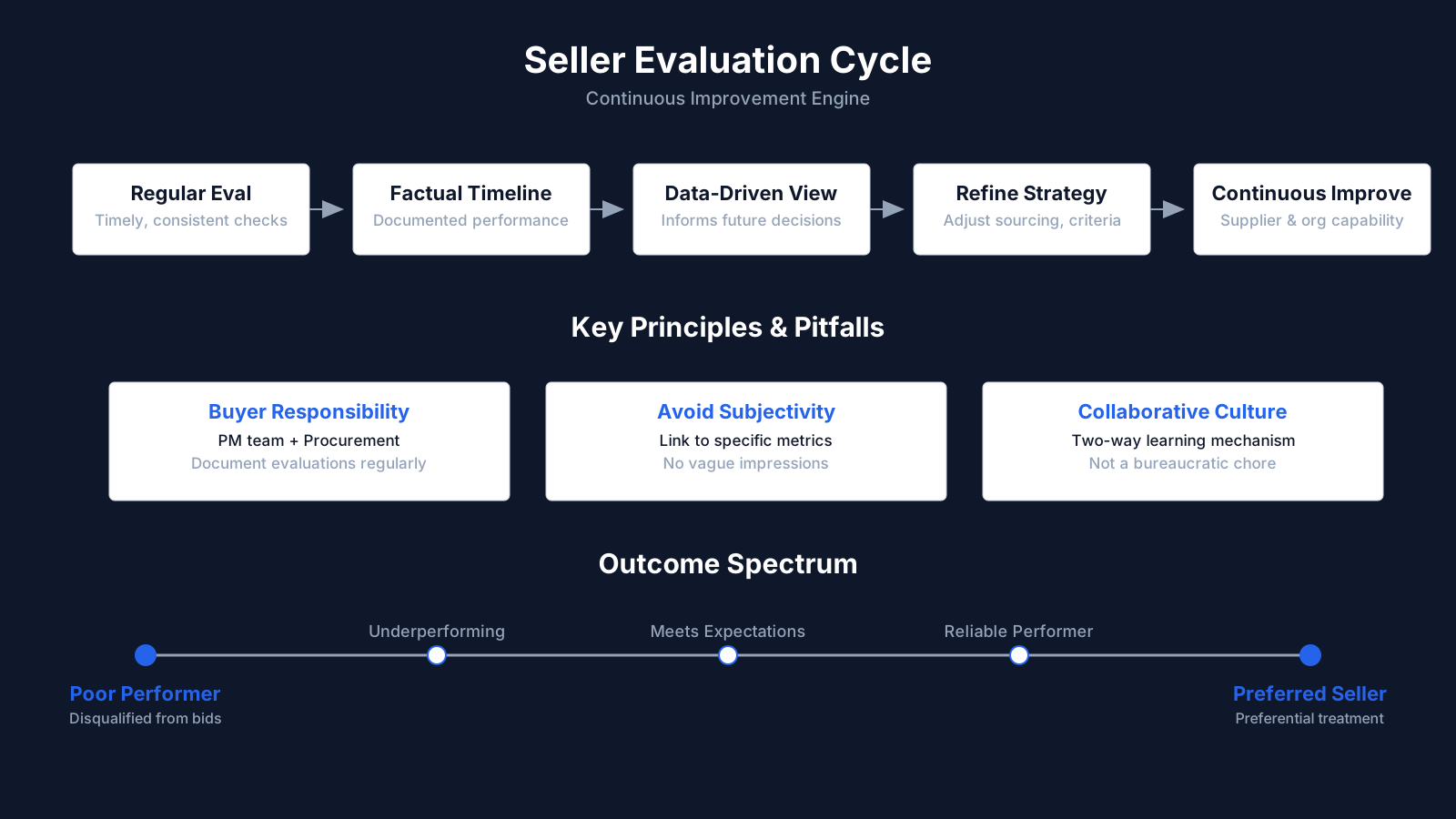
Summary of Seller Performance Evaluation Factors
| Concept | Summary |
|---|---|
| Evaluation Purpose | Buyer-side procurement teams systematically evaluate seller performance to validate contractual adherence, inform contract renewal or termination decisions, and shape the pool of pre-approved vendors for future engagements. |
| Evaluation Components | A comprehensive evaluation framework integrates quantitative KPIs such as defect density and schedule variance with qualitative assessments of collaboration and innovation, culminating in a clear retention or disqualification recommendation. |
| Ensuring Objectivity | Robust systems combine objective data points, including defect escape rates and delivery timeliness, with structured narrative rubrics to minimize evaluator bias and produce defensible, auditable results. |
| Escalation Protocol | A documented trend of missed milestones across consecutive review cycles equips buyers with the evidentiary foundation to escalate systematically from formal warning letters to cure notices and, ultimately, termination for default. |
| Incentive Mechanisms | Evaluations serve as the formal mechanism for scoring subjective award fees and compiling the milestone completion records needed to accurately calculate liquidated damages, directly linking performance to financial consequences. |
| Procurement Impact | Performance review data updates the organization's qualified supplier roster, guiding long-term sourcing strategies and feeding lessons learned into post-award analysis and future solicitation criteria. |
| Evaluation Timing | Mid-contract evaluations are timed to coincide with major deliverables, such as initial software releases, enabling measurement of performance against non-functional requirements like scalability and reliability before full deployment. |
| Common Pitfalls | Common pitfalls that erode objectivity, such as recency bias and halo effects, are mitigated by preemptively addressing friction points and triangulating structured metrics with contextual narratives. |
Why Seller Performance Evaluation Matters in Project Management
Many project managers first encounter formal seller evaluation only when a senior stakeholder demands to know why a critical vendor is slipping. The reality is that seller performance evaluation directly influences contract outcomes far beyond damage control conversations. It creates a fact base for administering penalties, adjusting incentive fees, and even halting work altogether. When the evaluation process is embedded early, it also sets behavioral expectations: sellers understand that their day-to-day performance is being captured and will have concrete consequences.
The documentation is not simply a record of what happened. It is a forward-looking instrument that answers three fundamental questions. First, does the seller have the ability to continue performing work on the current contract? Second, can the seller be allowed to perform work on future projects? Third, how well is the seller performing the present assignment right now? Each question drives a different type of decision, from immediate corrective action to long-term vendor disqualification. These questions form a simple but powerful framework that procurement teams return to over and over again.
In a projectized organization where the project manager controls procurement, evaluation authority often rests with the project manager. In a functional or matrix setup, a procurement department may own the template and the final sign-off, but the day-to-day input comes from the project team. This dual-ownership model can create tension if the project manager's qualitative observations clash with procurement's quantitative metrics. Successful evaluation systems anticipate that friction and blend hard data, like defect rates and on-time delivery percentages, with structured narrative assessments to mitigate subjectivity.
The stakes are high. A poorly executed evaluation can keep a chronic underperformer on the job, inflating costs and dragging schedule. Conversely, an evaluation that overweights a single incident can lead to an unjustified termination that triggers legal claims and disrupts supply chains. That's why practitioners treat the evaluation process as a disciplined management activity, not a last-minute scramble when things go sideways.
Key Insights on Seller Evaluation
- Evidence base for contract actions
- A rigorous evaluation record establishes the objective grounds to enforce contractual penalties, recalibrate incentive payments, or suspend underperforming vendors without ambiguity.
- Early evaluation shapes seller conduct
- Integrating evaluation frameworks from the outset makes clear to sellers that their daily work is continuously assessed, and that sustained underperformance carries real consequences like fee reductions or contract non-renewal.
- Guides future vendor selection
- Evaluation outcomes determine a seller's eligibility for future contracts, guiding decisions that range from targeted improvement plans to outright debarment from future bidding opportunities.
- Balance hard data with narratives
- Robust systems blend quantitative indicators like defect density and delivery timeliness with narrative assessments from stakeholder reviews, preventing a single outlier incident from driving an unjustified termination that could result in disputes or litigation.
Key Components of a Seller Performance Evaluation Document
A robust seller performance evaluation document typically combines quantitative metrics, qualitative ratings, and a specific recommendation about the seller's ongoing viability. The quantitative side often tracks schedule adherence, defect density, cost variance against the contracted price, and responsiveness to change orders. Qualitative sections might address the seller's communication cadence, their willingness to accommodate unforeseen scope adjustments, and their overall collaborative attitude. The blend matters because a seller can hit every numerical target while being so adversarial that the team wastes hours on rework caused by misinterpretation.
What makes the document especially powerful is its dual-use nature. First, it assesses the seller's ability to continue work on the current contract. If a pattern of missed milestones is documented over multiple review periods, the buyer has a factual basis to escalate from a warning letter to a cure notice, and eventually to termination for default. Second, the evaluation indicates whether the seller should be allowed to bid on future projects. This forward-looking component often gets overlooked by teams that just want to close out a troubled contract and move on. However, the organization's qualified seller list relies on exactly this kind of postmortem intelligence
The performance review also ties directly to the contract's incentive and penalty clauses. If the contract includes an award fee tied to subjective performance criteria, the evaluation document becomes the formal scoring instrument that determines how much the seller earns above the base fee. Conversely, if liquidated damages for late delivery are at play, the evaluation provides the milestone history needed to calculate the exact penalty. In all cases, the document serves as the authoritative source that the buyer can point to if the seller disputes the fee adjustment.
Think of the evaluation document like a health inspector's report for a restaurant. A single poor score might trigger a focused re-inspection and a warning. A pattern of failing grades across consecutive inspections provides the documented justification to revoke the operating license. Seller evaluations operate the same way: one bad rating prompts a conversation and a corrective action plan; persistent poor ratings become the legal foundation for contract termination.
How Seller Performance Is Evaluated During the Project Lifecycle
Seller evaluation is not a single event at contract closeout. Progressive organizations schedule evaluation checkpoints at key milestones, phase gates, or quarterly, depending on the contract duration. In a year-long software development engagement, a mid-contract evaluation might be scheduled after the first major release, giving the buyer a data point on the seller's ability to meet non-functional requirements like system performance under load. These interim snapshots allow early course correction without waiting until the damage is irreversible.
The rhythm of evaluation also interacts with the contract type. Under a fixed-price contract, the buyer might focus on scope compliance and deliverable acceptance criteria. Under a cost-reimbursable contract, evaluation tends to scrutinize cost control, transparency of reporting, and whether the seller is proactively proposing efficiencies. Under a time-and-materials arrangement, evaluation might emphasize productivity metrics and the efficient use of billable hours. Each contract type pulls different performance indicators to the foreground.
Regular evaluation also prevents the "surprise termination" scenario. If a seller learns for the first time at the final review that their performance has been unacceptable for months, the relationship has already decayed and the legal risk spikes. Periodic evaluations, shared transparently with the seller, give them a fair chance to remediate. This collaborative transparency often reduces the adversarial tension that can poison large procurement engagements.
How Seller Performance Evaluation Shapes Contract Administration Decisions
Contract administration lives and breathes on the data that seller evaluations produce. Seller performance evaluation can trigger early contract termination when documented failures cross the thresholds defined in the agreement. But termination is only one extreme outcome. More commonly, the evaluation guides the administration of penalties, the release of retention money, and the calculation of performance-based incentives. In fact, without a clear evaluation trail, administering an incentive fee can become an arbitrary exercise that invites protest.
The decision to issue a cure notice—a formal letter giving the seller a set period to remedy a breach—often rests entirely on the findings of a recent performance evaluation. The evaluation provides the precise description of the failing condition, the dates and numbers that back it up, and the impact on the project. Legal counsel will insist on this documentation before allowing the project manager to take contractual steps. The same logic applies when the buyer opts to reduce the scope of work assigned to a seller and reallocate it to another supplier or an internal team; the evaluation justifies the reallocation.
Another administrative lever that evaluations control is the fee structure in an award-fee contract. The buyer's evaluation determines exactly how much of the available award fee the seller receives. I once watched a project manager spend two full days crafting a detailed evaluation with supporting exhibits to justify a specific fee percentage, knowing that the seller's CFO would challenge every tenth of a point. The thoroughness paid off when the challenge arrived and was rebutted with a twenty-page appendix of documented performance data. That is the quiet power of a well-maintained evaluation system.
The Role of Seller Performance Evaluation in Incentive Contracts
Incentive contracts are designed to align the seller's motivation with the buyer's project objectives, but they only function as intended when seller performance evaluation is rigorous and credible. Evaluating seller performance for incentive determination requires scoring against predefined criteria—often a mix of technical performance, schedule attainment, and cost management. Without objective evaluation, incentive fees become a negotiation rather than a calculation, and the alignment mechanism breaks down.
Many contracts use a weighted scoring system where each evaluation period produces a composite score. The composite score then maps directly to an incentive payout percentage. For instance, a score of ninety out of one hundred might translate to the full award fee, while a score below seventy might zero out the incentive. The scales and mappings are negotiated at contract inception, but it is the periodic buyer evaluation that populates the numbers. Sellers quickly learn to manage their own behavior toward the metrics that the buyer is monitoring most closely.
A common trap is designing evaluation criteria that reward short-term output while punishing long-term quality. If the incentive is solely tied to hitting monthly delivery dates, a seller might ship substandard work on time, knowing the evaluation window is short. Savvy buyers incorporate quality lag indicators and even a "warranty period" evaluation, where defects that surface after delivery are traced back to the responsible evaluation cycle and retrospectively reduce the earlier score. This retroactive adjustment is allowed in many frameworks and creates a powerful disincentive to cut corners.
Key Insights on Evaluation-Driven Contract Actions
- Trigger for early contract termination
- Well-documented performance shortfalls that surpass contractually defined thresholds can provide legally sound grounds for terminating the agreement ahead of schedule.
- Basis for financial adjustments
- Evaluation results directly determine the application of penalties, the release of retention funds, and the calculation of performance incentives, while a clear evaluation trail prevents arbitrary financial decisions that could lead to disputes.
- Justification for cure notices
- A formal cure notice that grants the seller time to remedy a breach must be supported by evaluation findings that identify the specific deficiency, supporting metrics, and the adverse impact on project outcomes.
- Scoring against predefined criteria
- Incentive awards are derived by scoring sellers on technical performance, schedule adherence, and cost management, yet quality lag indicators and warranty-period evaluations can retroactively reduce earlier scores when defects surface after delivery.
Evaluating Seller Performance During the Current Contract
The immediate, operational need for seller performance evaluation is to confirm that the seller can keep performing the current scope of work. Evaluating current contract performance goes beyond checking off deliverables against a list. It probes whether the seller still has the technical capacity, the staffing depth, and the financial stability to finish the job. A seller that was strong at the start might be struggling six months in due to attrition of key personnel or cash flow problems that are invisible to the buyer until a deliverable misses its date.
One approach that works well is to separate the evaluation into performance results and capability indicators. Performance results are backward-looking: the quality of the last batch of deliverables, the adherence to the schedule in the previous period, the number of safety incidents on site. Capability indicators are forward-looking: staffing levels against the plan, upcoming resource bottlenecks flagged by the seller, and the seller's own internal quality audit results. This dual lens prevents the buyer from being blindsided by a capability gap that has not yet materialized as a failure.
The evaluation must also account for the extent to which performance problems are caused by the buyer's own actions. If the buyer has been late in providing approvals, access to the site, or necessary inputs, a simplistic evaluation that blames the seller will be challenged and will damage the relationship. Mature evaluation practices include a "buyer-furnished items" metric that adjusts the seller's performance score when delays are attributable to the buyer. This fairness element strengthens the evaluation's legitimacy and often prevents disputes from escalating to the contract administrator.
Additionally, assessing whether the seller can continue to perform sometimes leads to a constructive acceleration agreement. If the evaluation reveals that the seller is behind schedule but still capable of recovering with additional resources, the buyer might fund a compressed schedule if the business value of on-time completion justifies the cost. The evaluation document becomes the basis for the change order that authorizes the acceleration costs, while also documenting that the root cause of the delay was seller non-performance, preserving the buyer's rights to future liquidated damages if the recovery fails.
Using Seller Evaluations to Predict Future Project Performance
Organizations that treat seller performance evaluations as a strategic asset use them to decide which vendors to invite back. Seller performance evaluation results predict future project success with surprising accuracy when the data is aggregated across multiple contracts and compared across sellers in the same category. A mechanical contractor that consistently scores below threshold on safety metrics across three unrelated projects is unlikely to perform differently on the fourth, regardless of the promises made during the new bid process.
The predictive value comes from the structured ratings that get fed into the qualified seller list. This list, often maintained by a centralized procurement function, categorizes sellers as preferred, approved, conditional, or disqualified based on historical evaluation data. When a new project kickoff requires sourcing, the project manager pulls from the qualified list and, critically, can see the evaluation scores from prior projects. A seller with high scores on similar-scope engagements gets ranked higher, while one with flagged performance issues might require additional justification or a risk mitigation plan before selection.
What makes the system robust is the inclusion of multi-dimensional ratings rather than a single "pass/fail" flag. A seller might be exceptional on technical delivery but repeatedly problematic on invoice accuracy and contract administration. For a project where cashflow management is tight, that administrative weakness could be a disqualifier, even though the technical rating is stellar. The evaluation data allows buyers to match seller strengths and weaknesses to the specific risk profile of the new project.
This predictive function also supports a category management strategy. Aggregated seller evaluation data across an entire category—say, cloud infrastructure services—can reveal systemic underperformance that suggests the market segment itself is overstretched. The organization might then decide to develop an in-house capability or diversify into a new geographies for that category, a strategic pivot that originated from the accumulated weight of project-level seller evaluations.
Predictive Power of Seller Ratings
- Evaluations forecast future success
- Aggregated performance data across multiple contracts establishes a reliable benchmark for forecasting future project success relative to peers within the same category.
- Qualified seller list categorization
- Structured evaluation ratings populate a centralized qualified seller list that automatically classifies vendors into preferred, approved, conditional, or disqualified tiers based on their historical track record.
- Prior scores guide vendor selection
- When sourcing, project managers favor sellers with strong historical evaluation scores while those with flagged issues must submit a justification and a detailed risk mitigation plan for consideration.
- Category insights drive strategy
- Aggregated multi-dimensional ratings across an entire market segment can reveal systemic performance gaps, triggering strategic responses such as building in-house capabilities or entering new geographic markets.
Seller Performance Evaluation and Qualified Seller Lists
The direct link between a single project evaluation and the qualified seller list is one of the least discussed but most powerful levers in procurement governance. Seller performance evaluation results populate qualified seller lists that determine which companies receive future requests for proposals. When a project manager submits a final evaluation that rates a seller as "unsatisfactory" with documented justification, the centralized list is updated, and that seller may be suspended from bidding on new work for a defined period or until they demonstrate remediation.
The process requires governance to prevent abuse. A single negative evaluation from a project manager with a grudge should not automatically blacklist a strategic supplier. Most organizations implement a review board or a panel that validates low-score evaluations before they trigger a disqualification. The seller is typically notified and given a chance to respond, mirroring a due process approach. This validation step is essential because the qualified seller list has real commercial consequences for the seller, and an unjustified disqualification can provoke legal action.
The other side of the coin is that high evaluations can elevate a seller to preferred status, granting them preferential access to bid opportunities and, in some frameworks, a lower burden of documentation during the proposal evaluation. For sellers, the incentive to maintain high evaluation scores becomes a powerful motivator that extends beyond the current contract and influences their entire book of business with that buyer. The visibility of this link, when communicated clearly to sellers, often results in a measurable improvement in their day-to-day focus on quality and compliance.
Maintaining the qualified seller list also requires periodic purging of stale evaluations. A superb evaluation from seven years ago should not carry the same weight as a recent mediocre one. Procurement policies typically define a look-back period—often three years—after which evaluation records are archived and no longer influence current listing status. This ensures that sellers who have genuinely improved get a fair reassessment while preventing the list from becoming a historical museum that no longer reflects current capability.
Common Pitfalls in Evaluating Seller Performance
Despite the best intentions, objective seller performance evaluation is challenging because cognitive biases and organizational shortcuts creep into the process. Recency bias is the most notorious. When the evaluator weighs the most recent incident—good or bad—far more heavily than months of consistent, average performance, the entire evaluation skews. A seller who delivered perfectly for eleven months but stumbled in the twelfth month can end up with a shockingly low rating that does not reflect the overall contract value delivered.
Another frequent problem is the absence of predefined evaluation criteria. If the project manager sits down at the end of a quarter with no rating rubric, the evaluation becomes a narrative exercise heavily influenced by personal relationship dynamics. The resulting document may be eloquent but lacks the standardized data that later decisions require. Solving this starts with embedding clear evaluation criteria into the contract itself or the procurement management plan, so both parties know exactly what will be measured and how.
Sampling errors also distort evaluations. When the buyer only evaluates a small subset of deliverables—say, the ones that went through formal acceptance testing—while ignoring the larger body of work delivered smoothly, the picture is incomplete. The seller might have quietly resolved dozens of issues through their own quality process, but if the evaluation only tallies formal defect reports, the rating will be unfairly punitive. A balanced evaluation methodology captures both exception data and evidence of proactive problem-solving.
Organizational pressure to keep a struggling project afloat sometimes leads to inflated evaluations. The project manager fears that a brutally honest low score will trigger a mandated switch to a new seller, causing a transition delay that the project cannot afford. So the evaluation gets massaged upward, and the organization loses the chance to hold the seller accountable. This short-term smoothing plants the seeds for a much larger failure later. The only antidote is a governance structure that separates the project manager's desire for continuity from the procurement function's mandate to enforce standards.
Core Takeaways on Evaluation Pitfalls
- Recency bias skews ratings
- Evaluators commonly overweight the most recent incident, allowing a single late delivery or misunderstanding to eclipse months of consistent performance and unfairly depress an otherwise solid seller rating.
- Missing rubric invites subjectivity
- Absent a defined rating rubric, evaluations devolve into subjective narratives shaped by personal rapport rather than measurable, objective criteria, undermining consistency and fairness.
- Define criteria in advance
- Embedding clear evaluation criteria into the contract or procurement management plan aligns expectations from the start, giving both parties a shared understanding of exactly what will be measured and how.
- Narrow scope distorts the picture
- Restricting evaluation to a small subset of formally accepted deliverables ignores the larger body of reliably delivered work and proactive issue resolution, producing a rating that is needlessly punitive.
- Consequence fear pressures ratings
- Project managers may temper their scores because an honest low rating could trigger a mandatory seller switch and introduce transition delays the project timeline cannot afford.
Integrating Seller Performance Evaluation with Project Management Frameworks
Within the PMBOK structure, seller performance evaluation maps directly to the Control Procurements process in the Project Procurement Management Knowledge Area. During execution, the project manager monitors seller deliverables, administers the contract, and documents performance. This ongoing assessment feeds into change requests, corrective actions, and updates to the procurement management plan. The framework also treats the evaluation documentation as an organizational process asset that can be used in future planning and sourcing decisions, which is exactly what populating the qualified seller list achieves.
PRINCE2 handles the equivalent through its commercial management theme, where the project manager explicitly tracks supplier performance against defined product descriptions and tolerances. The approach emphasizes management by exception: when a seller's performance exceeds tolerance boundaries—missed milestone by more than five days, for example—the evaluation escalates immediately, rather than waiting for a periodic review cycle. This threshold-based escalation pairs well with a periodic evaluation cadence, creating a two-speed oversight system that catches critical problems quickly while still capturing trend data.
In Agile environments, the concept of a formal seller evaluation might seem countercultural because the methodology prizes collaboration over contractual documentation. Yet evaluation still occurs, just through different artifacts. Sprint reviews, cumulative flow diagrams, and defect escape rates provide quantitative data, while team retrospectives capture qualitative feedback on vendor collaboration. An Agile team working with an external UI design firm might evaluate them continuously through demonstration feedback and incorporate that into the product backlog refinement, effectively performing a rolling seller evaluation without calling it that.
Some modern methodologies bring additional lenses. Business Value-Oriented Project Management, for instance, extends the evaluation beyond the typical cost-schedule-quality triangle by tracking whether a seller's deliverables are generating process damage—invisible organizational harm like unplanned rework cascades or knowledge silos that slow down dependent teams. If a seller's outputs consistently cause downstream friction, even while meeting contractual specifications, the methodology would flag that as a negative contribution and potentially recommend a redirection of work. This perspective aligns with a broader shift toward measuring the total cost of ownership of a seller relationship, not just the contract line items.
Best Practices for Conducting Seller Performance Evaluations
Seasoned procurement professionals develop a small set of non-negotiables for seller evaluations. Documenting seller performance at regular intervals is the foundation. Quarterly cycles work for multi-year engagements; monthly or milestone-triggered cycles suit shorter, intense contracts. Skipping even one scheduled evaluation erodes the pattern and makes it harder to demonstrate a history of performance issues if a termination becomes necessary months later.
Separation of evaluation input and evaluation judgment can sharpen accuracy. The team members who work directly with the seller should supply raw data and structured observations, but a neutral party—a procurement officer or a project control specialist—should synthesize that input into the final rating. This reduces the personal friction that occurs when the project manager has to deliver both the working relationship and the critical score. It also introduces a layer of consistency checking that reduces the impact of individual bias.
Engaging the seller in the evaluation process, not just as a subject but as a participant, transforms the dynamic. Providing the draft evaluation to the seller for a factual review before finalization often uncovers errors—say, a delivery recorded as late because the buyer's receiving dock logged it a day after physical receipt. The seller can also append their own comments, creating a balanced record that holds up better in disputes. This collaborative step does not weaken the buyer's ultimate authority; it strengthens the evaluation's credibility.
Finally, treat the evaluation documents as living artifacts that inform the entire project control cycle. The ratings and trend data should flow into the project's risk register, updating the probability of certain vendor-related risk events. They should also inform the project's estimate at completion, adjusting the cost baseline if seller performance trends suggest that future work will require more rework or acceleration than originally planned. When seller evaluation becomes tightly integrated with the project's core monitoring and controlling processes, it stops being an administrative chore and becomes a genuine management tool that protects the business case.
Maintaining that integration requires discipline but pays off in fewer surprises and more predictable outcomes. The discipline is worth cultivating because, ultimately, the quality of a project's deliverables is inseparable from the quality of the sellers who produce them, and rigorous evaluation is the mechanism that ensures those sellers remain truly accountable.
Key Takeaways on Evaluation Discipline
- Consistent evaluation scheduling is vital
- Regular performance documentation at intervals suited to the engagement, whether quarterly for multi-year contracts or monthly for shorter ones, creates an objective record that makes termination decisions defensible months later and reduces the risk of disputes.
- Neutral party handles final ratings
- By having team members contribute raw data and structured observations while a procurement officer or project control specialist independently finalizes the rating, the organization shields the project manager from direct conflict and preserves the evaluation's objectivity.
- Integrate evaluations with project controls
- Circulating draft evaluations for seller feedback catches factual errors early, and when performance outcomes are systematically tied to cost baselines and estimates at completion, the evaluation process becomes a powerful project-controls mechanism that safeguards the business case.