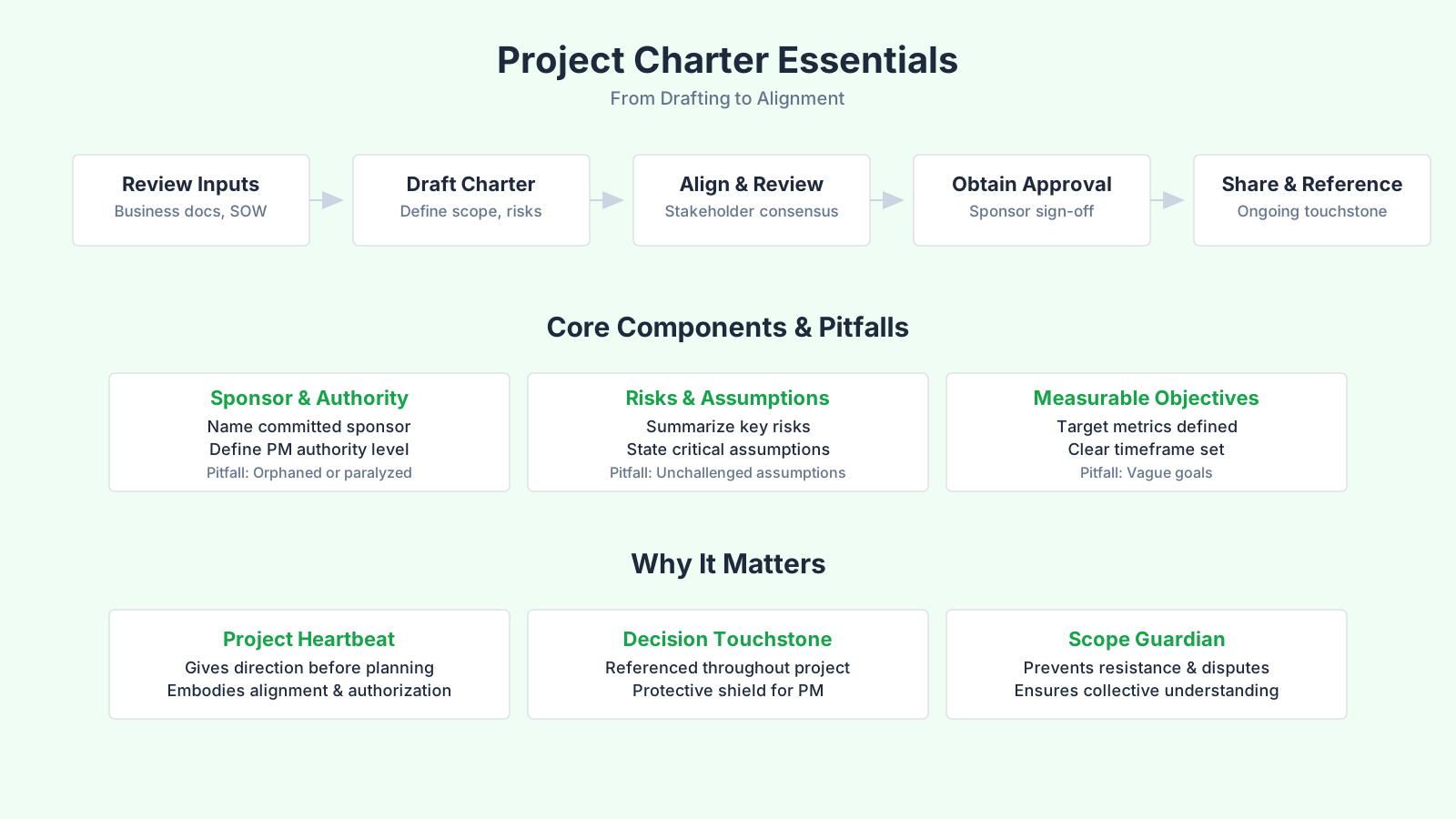
Creating a project charter marks the official birth of a project, turning a vague request or an organizational need into an authorized endeavor with a named leader and allocated resources. The Develop Project Charter process, as defined in the PMBOK Guide, exists to produce a document that formally recognizes a project or a phase and captures the initial set of requirements that stakeholders can agree upon before any detailed planning unfolds. If you have ever watched a team spin its wheels on work that no one remembers approving, you have witnessed the chaos that the project charter is designed to prevent. This single artifact communicates that the organization has decided to invest time, money, and attention, and it gives the project manager the legitimacy to ask for those things. In many ways, the charter is less about documentation and more about alignment; it records the moment when a collection of desires gets shaped into a steerable container.
Without a charter, projects drift. They become side efforts that lack clear sponsorship and often get abandoned when resources tighten. The charter’s value extends beyond the obvious authorization. It serves as a touchstone for scope decisions, a reference for stakeholder expectations, and a mechanism to surface assumptions before they harden into costly misunderstandings. The process itself forces conversations that might otherwise never happen: Is this really our priority? Who will pay for it? What does success look like? By the time the charter is approved, a project has a heartbeat and a direction, even if the details are still fuzzy. This article explores what it takes to develop that charter, from the essential inputs to the final output and the pitfalls that can sabotage the whole effort.
Quick Overview: Creating a Project Charter
| Key Concept | Summary |
|---|---|
| Project Charter | The project charter formally authorizes a project, transforming an initial concept into a sanctioned initiative with a designated project manager, explicit authority, and committed resources. |
| Process Objective | The Develop Project Charter process creates the foundational document that authorizes the project or phase, consolidating agreed-upon high-level requirements and stakeholder expectations to establish a common understanding before detailed planning begins. |
| PMBOK Context | Within the PMBOK® Guide, Develop Project Charter resides in the Initiating Process Group and is part of the Integration Management Knowledge Area. It unifies strategic intent, external agreements, and organizational capabilities into a single authoritative project declaration. |
| Charter Components | The charter documents high-level scope, measurable success criteria, and key deliverables, creating a baseline that enables the team to assess proposed changes, such as a stakeholder request for a customer loyalty feature, against the original mandate. |
| Project Manager Authority | In matrix organizations, the charter explicitly grants the project manager authority over team members for project-related tasks during the project lifecycle, providing clear decision-making accountability despite dual reporting lines. |
| Cross-Functional Mandate | Serving as an organizational directive, the charter empowers the project manager to engage and secure support from procurement, legal, finance, and other enabling functions, legitimizing cross-departmental resource allocation. |
| Scope Baseline for Change Control | Without well-defined scope boundaries in the charter, change control lacks a formal reference, making it difficult to identify scope creep or to assert that a new request constitutes additional work requiring official approval. |
| Required Inputs | Developing a robust charter demands five PMBOK-specified inputs: the project statement of work, business case, applicable contracts, enterprise environmental factors, and organizational process assets, each contributing essential strategic, contractual, and contextual information. |
The Core Function of a Project Charter
At its heart, the project charter authorization confers a mandate that separates this work from everyday departmental activities. The project manager receives formal permission to apply organizational resources, and that permission is not a casual nod but a documented decision supported by a business justification. In the PMBOK framework, Develop Project Charter sits in the Initiating Process Group and falls under Integration Management, because it knits together strategic drivers, external agreements, and internal capabilities into one coherent announcement. The charter also names the project manager, defines their authority level, and sets the boundaries within which they can operate without needing constant sign-off. This is not a small thing; it protects the project manager from political crosswinds and gives them a platform to push back when scope begins to creep.
Beyond authorization, the charter aligns stakeholders around a common understanding of what the project is supposed to accomplish. It captures high-level requirements and measurable objectives, so that six months later, when someone argues that the project should also deliver a customer loyalty app, the team can point to the charter and ask whether that fits the original mandate. That alignment is fragile, though, and it depends on the quality of the conversations that happened during charter development. A charter that was drafted in isolation and rubber-stamped by a sponsor who barely read it is worse than no charter at all. It creates a false sense of security and can lock in misunderstandings that fester until they erupt in the execution phase.
Formal Authority and Its Ripple Effects
When a charter grants authority, it does so within the context of the organization’s governance framework. That authority often comes with strings attached: spending limits, approval thresholds, communication requirements. In a matrix organization, the charter might clarify that the project manager has functional authority over team members for the duration of the project, even though those individuals report to different managers for their daily work. This small but critical detail prevents turf wars and ensures that team members know who to follow when priorities clash. The charter also sets the stage for the project manager to engage with procurement, legal, and finance departments, because those units now have a written directive to support the initiative.
Think of the charter as a key that unlocks doors across the organization. Without it, the project manager is just a colleague with an idea. With it, they become a legitimate requestor of resources, and that transformation makes all the difference when competing for scarce IT support or facilities space. The authority granted is not unlimited, but it is enough to start the engine. The charter also defines who the project sponsor is, which is another form of authority alignment. Knowing that the sponsor has put their political capital behind the document gives the project manager leverage in negotiations with resistant stakeholders.
Setting the Scope’s Outer Boundaries
A charter does not contain a detailed scope statement, but it does draw the outer fence. High-level requirements, major deliverables, and explicit exclusions appear right there in the first few pages. This is not the place to list every screen in a software application, but it is the place to state that the application will cover customer onboarding but not billing integrations. The discipline of writing down what is out of scope, even at this early stage, saves enormous amounts of time later. It also gives the team permission to say no to well-meaning additions that would otherwise bloat the effort.
Project managers who skip this step often find themselves defending against endless “small” requests because nothing in the charter said those requests were off-limits. Later, when change control kicks in, the absence of documented boundaries makes it harder to argue that a requested feature is truly new. The charter’s high-level scope acts as a baseline for the first real scope discussions during planning, and it anchors the project to the business case that justified its existence. If the business case promised a new customer portal that reduces call center volume by twenty percent, the charter’s scope should clearly point toward that outcome and not be diluted by unrelated pet projects.
Key Insights on Charter Authorization
- Formal resource authorization
- The charter formally authorizes the project manager to commit organizational resources and defines the boundaries of that authority, enabling autonomous progress without seeking constant sign-off.
- Stakeholder alignment mechanism
- By capturing high-level requirements and measurable objectives, the charter establishes a definitive reference point that allows the team to challenge scope additions that deviate from the agreed mandate.
- Authority clarity in matrix organizations
- In matrix environments, the charter specifies the project manager's direct authority over team members during the project's lifecycle, preventing conflicts when functional and project priorities compete.
Gathering the Required Inputs for a Project Charter
Before you can draft a meaningful charter, you must pull together five distinct categories of information that the PMBOK identifies as essential: the project statement of work, the business case, any applicable contract, the enterprise environmental factors, and the organizational process assets. These inputs for creating a project charter act as the raw material that shapes the document’s scope, justification, and constraints. Skipping any one of them is like cooking without all the ingredients; you might end up with something edible, but it won’t taste like what you intended. The art of charter development lies in extracting the right level of detail from each input and weaving them into a narrative that is both accurate and concise.
Some project managers treat this gathering phase as a passive collection activity, reading documents and taking notes. In reality, it should be an active interrogation. The statement of work might contain vague language that hides a hidden assumption. The business case might gloss over the risks to make the numbers look better. The contract might have penalty clauses that drastically change the project’s risk profile. By questioning these inputs early, you surface buried constraints that will later become the charter’s assumptions and risk entries. This also builds your credibility with the sponsor, who sees you not as a scribe but as a thinking partner who protects the organization’s interests.
Project Statement of Work: The Charter’s Narrative Backbone
The project statement of work (SOW) is a narrative description of the products, services, or results the project is supposed to deliver. It typically includes the business need, a product scope description, and a reference to the organization’s strategic plan. In many cases, the SOW comes from the sponsor or an external customer, and it reflects their vision of what success looks like. For instance, a marketing department might submit an SOW that says, “We need a mobile-friendly online store that integrates with our inventory system and reduces cart abandonment.” That sentence already suggests several high-level requirements that will appear in the charter.
Translating an SOW into charter content requires detective work. The SOW often leaves out crucial context, such as the fact that the existing inventory system runs on archaic mainframe technology that nobody knows how to interface with. The charter writer must gently probe behind the words, asking questions like, “When you say ‘integrates,’ what data must flow in real time, and what can be batched overnight?” These conversations produce clarifications that become the charter’s assumptions list. A common mistake is to treat the SOW as a sacred text that cannot be challenged. The charter is not a photocopy of the SOW; it is a refined interpretation that adds organizational reality to the sponsor’s wish list.
The Business Case: Why This Project Matters Economically
Every project consumes resources that could be used elsewhere, so the business case exists to prove that this investment is worth it. It describes the business need, the cost-benefit analysis, and sometimes a qualitative justification like regulatory compliance or brand protection. The charter does not reproduce the full financial model, but it must summarize the key rationale so that anyone who reads it understands the project’s strategic importance. A well-developed business case answers the question, “What happens if we don’t do this?” and the charter captures that answer as a crisp statement of purpose.
Where the business case gets tricky is in its assumptions about benefits realization. A business case might project a fifteen percent increase in sales, but that projection rests on an assumption that customers will adopt the new system within three months. The charter should highlight such assumptions, because they are the seeds of future scope changes. If adoption lags, the original justification weakens, and the project may face premature cancellation or a re-charter. The charter acts as a bridge between the business case and the execution phases, reminding everyone that the project exists to achieve a business outcome, not just to produce a deliverable. In Agile environments, this link is often maintained through a product vision statement that sits alongside the charter, but the same principle applies: the work must trace back to value.
Contractual Obligations and Their Imprint on the Charter
When a project is performed for an external customer, a contract is a vital input. The contract spells out the legally binding deliverables, payment milestones, acceptance criteria, and often penalties for late completion. The charter must reflect these terms faithfully because they become constraints that the project manager cannot negotiate away. A fixed-price contract with a firm end date, for example, imposes a hard deadline that the charter must highlight as a non-negotiable constraint. The summary milestone schedule in the charter will often mirror the contractual delivery dates, and the budget will align with the payment schedule.
It is shockingly common for project managers to sign a charter without thoroughly reading the contract. They assume someone else handled the legal details, only to discover later that the contract requires a specific testing protocol they had not planned for, or that liquidated damages kick in after a date that now looks impossible. The charter development phase is the time to bring those contractual realities into the open. If the contract says the client gets to review deliverables every two weeks, the charter should note this as a communication requirement. If the contract ties payment to a particular deliverable sign-off, that sign-off process becomes a key assumption about stakeholder engagement.
Enterprise Environmental Factors: The Unseen Shapers of Charter Decisions
Enterprise environmental factors (EEFs) refer to conditions that the project team cannot control but must navigate. These include organizational culture, governance structures, existing infrastructure, marketplace conditions, regulatory requirements, and even the geographic distribution of stakeholders. When you draft a charter, EEFs influence everything from the risk thresholds you include to the communication approach you imply. A heavily regulated industry, like pharmaceuticals, will force the charter to acknowledge compliance reviews as a gate that cannot be skipped, even if the sponsor dislikes the timeline impact.
Imagine you are about to fly a plane through a region known for sudden storms. You would study the weather patterns, even though you cannot change them, because your flight plan must account for turbulence and re-routing options. Enterprise environmental factors are that weather system for your project. You do not control the organization’s risk-averse culture, but you can reflect it in the charter by documenting a conservative approach to milestone commitments. You do not control the fact that your company’s legacy systems are brittle, but you can state as an assumption that integrations must be tested with extra lead time. By making these factors explicit, the charter becomes a realistic document rather than an aspirational wish list that ignores the environment it will live in.
Organizational Process Assets: Standing on the Shoulders of Previous Work
Organizational process assets (OPAs) are the collective memory of how projects are done in a particular company. They include historical information, lessons learned, templates, policies, and standard procedures. Using OPAs when creating a charter is not optional if you want consistency and efficiency. Most organizations have a standard charter template, and while it may feel bureaucratic, it ensures that no critical section gets omitted. More importantly, lessons learned from past projects can prevent you from repeating mistakes. If a previous project suffered because the charter failed to name a security review requirement, that lesson should shape your new charter.
There is a subtle risk here though. Templates can breed complacency. A project manager who mechanically fills in the fields without adapting to the specific project’s context might produce a charter that looks perfect but is hollow. The OPA that matters most is not the template itself but the story behind the templates—the institutional knowledge about what went wrong when certain fields were left blank. Before you start writing, take thirty minutes to ask a few senior colleagues what they wish they had put in their last charter. Those conversations will fill your document with practical wisdom that no static template can provide.
The Output: What a Project Charter Should Contain
The project charter is the single tangible output of the Develop Project Charter process, and its contents follow a widely recognized structure that has evolved from decades of practice. While formats vary between industries, a robust charter should address the project charter contents that give stakeholders a complete, high-level picture of the initiative. These include the project purpose or justification, measurable project objectives and related success criteria, high-level requirements, assumptions and constraints, a high-level risk summary, a summary milestone schedule, a summary budget, a key stakeholder list, project approval requirements, and the identity and authority of the assigned project manager.
Reading that list, you might think it sounds like a mini project plan, but the difference is in the grain size. The charter’s milestone schedule might be four or five key dates, not a detailed Gantt chart. The budget might be a single figure or a range, not a line-item cost breakdown. This deliberate vagueness is a feature, not a bug. The charter exists to authorize further expenditure on detailed planning, so it cannot possibly contain the output of that planning. Still, each section must be specific enough to guide the next steps. A charter that states “improve customer satisfaction” as a measurable objective is useless until it says that satisfaction scores will rise from 3.2 to 4.0 on a validated survey within twelve months. That specificity is what gives the project team a target to design for.
Structuring the Charter for Clarity and Actionability
Begin with a clear project title and the name of the sponsor and project manager, then immediately state the business need in one or two sentences. This opening statement should echo the business case: “This project addresses a twenty percent annual revenue loss due to customer churn in the subscription tier.” Follow that with measurable objectives that link directly to that need. The objectives are not a task list; they are the outcomes that signal success. For instance, “Reduce subscription churn from twelve percent to eight percent within eighteen months after launch.” Each objective must be written in a way that allows a dispassionate observer to verify whether it was achieved.
High-level requirements come next, and they should list the major capabilities the project must deliver. Think of these as the big boulders, not the pebbles. “A self-service account management portal,” “Integration with the billing system for real-time plan changes,” “Role-based access for three user types.” Assumptions and constraints belong in their own section, and this is where the detective work from the inputs pays off. Assumptions might include “The billing system API will be available for integration testing by Q2,” while constraints could be “The project must comply with PCI-DSS standards” or “The maximum budget is $450,000.” The risk summary should name the top risks that could derail the project, with a brief note on their potential impact. A summary milestone schedule with perhaps four to six dates, a summary budget, and a stakeholder list complete the document. Finally, the approval section should require signatures from the sponsor and any other key decision-makers, formally closing the initiation loop.
Core Takeaways on Charter Contents
- Charter as sole project output
- The project charter stands as the single tangible deliverable of the Develop Project Charter process, its content structure refined through decades of practical application.
- Complete high-level stakeholder picture
- A robust charter captures the project purpose, measurable objectives, success criteria, high-level requirements, assumptions, constraints, risks, milestone dates, budget summary, stakeholder identification, approval requirements, and the delegated authority of the project manager.
- Grain size versus project plan
- The charter differs from a full project plan by its granularity, presenting a handful of milestone dates in place of a detailed Gantt chart and a single aggregate budget figure rather than line-item cost breakdowns.
- Measurable objectives requirement
- An objective such as “improve customer satisfaction” adds no meaningful direction to a charter unless it is tied to specific, quantifiable targets, for example raising survey scores from 3.2 to 4.0 within twelve months.
- Actionable opening and constraints
- An effective charter opens with the project title, sponsor and project manager names, and a concise one- to two-sentence business need, then lists explicit assumptions and constraints such as third-party API availability or a maximum budget of $450,000.
Multi-Phase Projects and Iterative Charter Development
Not all projects begin with a single charter that carries through to the end. In multi-phase initiatives, the Develop Project Charter process is used repeatedly, not just at the start but at the beginning of each phase, to validate or refine the decisions made during the previous iteration. This iterative approach recognizes that early phases produce new knowledge that should be incorporated before committing further resources. A large construction project, for example, might have a feasibility phase that ends with a charter authorizing the design phase. That design phase then generates enough detail to update the business case, and a new charter is created for the construction phase itself. Each charter is a gate that says, “Based on what we now know, does this still make sense?”
This multi-phase project charter process prevents the sunk-cost fallacy from driving bad decisions. When a feasibility study reveals that the regulatory hurdles are far more expensive than initially assumed, the organization has a clean moment to reconsider before pouring millions into design. The charter for the next phase will capture those updated assumptions, new risk profiles, and perhaps a revised budget. In software development using iterative or Agile lifecycles, the charter might evolve into a lightweight document at the start of each major release, reaffirming the product vision and the current set of high-level capabilities. The key is that each phase’s charter ties back to the original business justification while incorporating the lessons that have emerged. This is not scope creep; it is responsible governance.
Project managers sometimes resist re-chartering because they fear it will slow things down. In practice, a well-facilitated charter review for a subsequent phase takes far less time than the initial charter effort because much of the groundwork is already laid. The team simply focuses on what has changed and whether the original constraints still hold. The resulting document becomes a concise amendment rather than a full rewrite, but it still carries the same formal authority. When executives sign that phase charter, they are not just nodding along; they are actively recommitting to the project in light of new information. That recommitment is precious because it keeps sponsorship engaged at a level that outlasts the initial enthusiasm.
Common Pitfalls When Writing the Project Charter
Even experienced project managers fall into traps that weaken the charter’s effectiveness, and the most pervasive of these is treating the document as a bureaucratic checkbox rather than a strategic alignment tool. The common project charter pitfalls start with drafting the charter in a vacuum, without meaningful input from the people who will live with the consequences. A project manager who interviews only the sponsor and ignores the heads of affected departments ends up with a charter that looks tidy but contains hidden stakeholder objections. When those objections surface during execution, the project manager has no charter language to point to because the real concerns were never discussed, let alone documented.
Confusing the charter with a project plan is another classic error. I have seen charters that include detailed work breakdown structures and task durations, as if the planning phase had already been completed. At that point, the document is no longer authorizing the project; it is pretending to have finished the project. The charter’s role is to open the door to planning, not to replace it. A related mistake is failing to distinguish between assumptions and constraints. An assumption is something you believe to be true but are not certain of; a constraint is a known limitation. Labeling a constraint as an assumption can make it seem negotiable when it is not, setting the team up for failure when they attempt to challenge an immovable boundary.
Another pitfall is scope vagueness masquerading as flexibility. Writing “the project will improve operational efficiency” as a high-level requirement is so soft that it provides no guidance. The team can interpret it in wildly different ways, and the sponsor will later claim that their definition of efficiency was not met. The charter should include enough specificity that a reasonable person can look back and say, “Yes, we achieved what we set out to do, or we fell short in a measurable way.” Even in highly uncertain environments, you can define proxies: “reduce average invoice processing time from seven minutes to four minutes” gives a concrete target where “improve efficiency” gives nothing. Finally, ignoring the sign-off ritual itself can undo all the good work. A charter that sits in an email inbox without a formal approval meeting and a wet or digital signature has no real status. The act of signing creates a psychological commitment that a casual email thread cannot replicate. Honestly, if your charter never made anyone slightly uncomfortable in an approval meeting, you probably avoided the hard conversations that the document is meant to provoke.
Key Insights on Charter Mistakes
- Charter as checkbox trap
- Reducing the charter to a bureaucratic checkbox rather than a strategic alignment tool is the single most damaging pitfall, because it strips the document of the authority needed to shape project decisions and resolve trade-offs.
- Drafting in a vacuum
- Drafting the charter without consulting the impacted department heads and other key stakeholders generates hidden objections that surface only during execution, when they can no longer be reconciled with the charter's documented commitments.
- Vague requirements offer no guidance
- Soft language like "the project will improve operational efficiency" invites contradictory interpretations, so effective charters specify measurable outcomes such as cutting average invoice processing time from seven minutes to four minutes.
Integrating the Project Charter into Governance and Value Delivery
The charter does not float in isolation; it is the first formal artifact in a chain of governance documents that guide the project from concept to closure. In a stage-gate governance model, the charter serves as the entry ticket to the planning stage, and its approval triggers the release of planning funds. This connection to project charter governance means that the document must align with the organization’s portfolio management criteria. If the portfolio review board requires that all projects demonstrate a net present value above a certain threshold, the charter’s summary of the business case should make that threshold explicit. When the charter is later used as part of a phase-gate review, the board compares actual progress against the charter’s stated objectives and can terminate the project if the gap is too wide. That power to stop work is what makes the charter a living instrument of value management, not a dust-gathering form.
In the Business Value-Oriented Project Management (BVOPM) methodology, this integration takes a particularly transparent form. BVOPM emphasizes formal stakeholder input validation and establishes a “Transparent Board of Project Issues” where any role in the organization can raise concerns before the project is authorized. This approach forces the charter development process to confront dissenting voices early, rather than pretending they do not exist. A project manager learning about BVOPM principles will recognize that the charter is not just a summary of facts but a temporary consensus that must survive the scrutiny of anyone who might later impede progress. By building that transparency into the initiation phase, the charter gains a level of organizational buy-in that a sponsor-only signature can never achieve.
PRINCE2 handles charter-like authorization through the Project Initiation Documentation (PID) and the earlier Project Brief, but the same underlying need persists: a formal mandate from the project board that empowers the project manager. Regardless of the framework, the charter must answer a few brutal questions. Are we confident the expected benefits outweigh the costs given current information? Do we have enough evidence to commit to the next level of investment? Is the authority chain clear enough that the project manager can make decisions without second-guessing? When the answers are embedded in a signed document, the project moves from a speculative discussion to a sanctioned effort. That shift is the moment when project management truly begins, and it is the reason why learning to create a strong project charter is a skill that distinguishes effective practitioners from those who merely hold the title.
The charter’s real test comes not during approval but months later, when a crisis hits. If the team can pull out the charter and use it to refocus on the original objectives and constraints, the document has done its job. If the charter provides no guidance during that crisis because it was too vague or had been forgotten, then the initiation process failed. This is why the craftsmanship of the charter matters. Every assumption you document becomes a safety net; every constraint you list becomes a decision filter. In the end, creating a project charter is not about filling out a template. It is about having the right conversations, surfacing the uncomfortable truths, and writing them down in a way that protects the project from its own enthusiasm. That is a skill worth developing, and it begins with respecting the inputs that make the charter a truthful artifact rather than a decorative one.