Every project, no matter how meticulously planned, encounters changes. Someone identifies a new regulatory requirement, a stakeholder redefines what success looks like, a vendor goes out of business, or a team member discovers a design flaw that demands immediate correction. Without a structured way to evaluate, approve, and track these shifts, projects drift into chaos. Scope balloons, baselines become meaningless, and the original business case unravels. Manage changes to the project effectively requires more than a polite nod from a steering committee; it demands a disciplined process that integrates change decisions with every dimension of the project plan. In the PMBOK framework, that process is Perform Integrated Change Control, a cornerstone of the Monitoring and Controlling Process Group within the Integration Management Knowledge Area. Its job is to review all change requests, assess their impact, and either approve or reject them while maintaining the integrity of the project baselines. When done well, change control does not strangle innovation or responsiveness; it provides a transparent, traceable path from proposal to outcome, ensuring that every alteration earns its place in the project's story.
At a Glance: Managing Project Changes
| Key Concept | Summary |
|---|---|
| Change Catalysts | Shifts in regulatory mandates, redefined stakeholder expectations, vendor non-performance, or late-stage design flaws initiate change requests that demand structured evaluation rather than impulsive remediation. |
| Integrated Governance | Robust change control embeds each decision into the project plan’s scope, schedule, cost, and quality baselines, ensuring that adjustments are never assessed in isolation. |
| Auditable Traceability | A mature system creates an unbroken, documented chain from proposal through deliberation to resolution, balancing rigorous record-keeping with the agility that preserves creative momentum. |
| Compounding Repercussions | Even minor additions, like an extra client report, can propagate through schedule compression, cost escalation, heightened risk profiles, and procurement renegotiations, magnifying downstream consequences. |
| Process Interconnections | Change control interfaces directly with risk response strategies, quality audit findings, and stakeholder feedback mechanisms, each a potential source of formal change requests. |
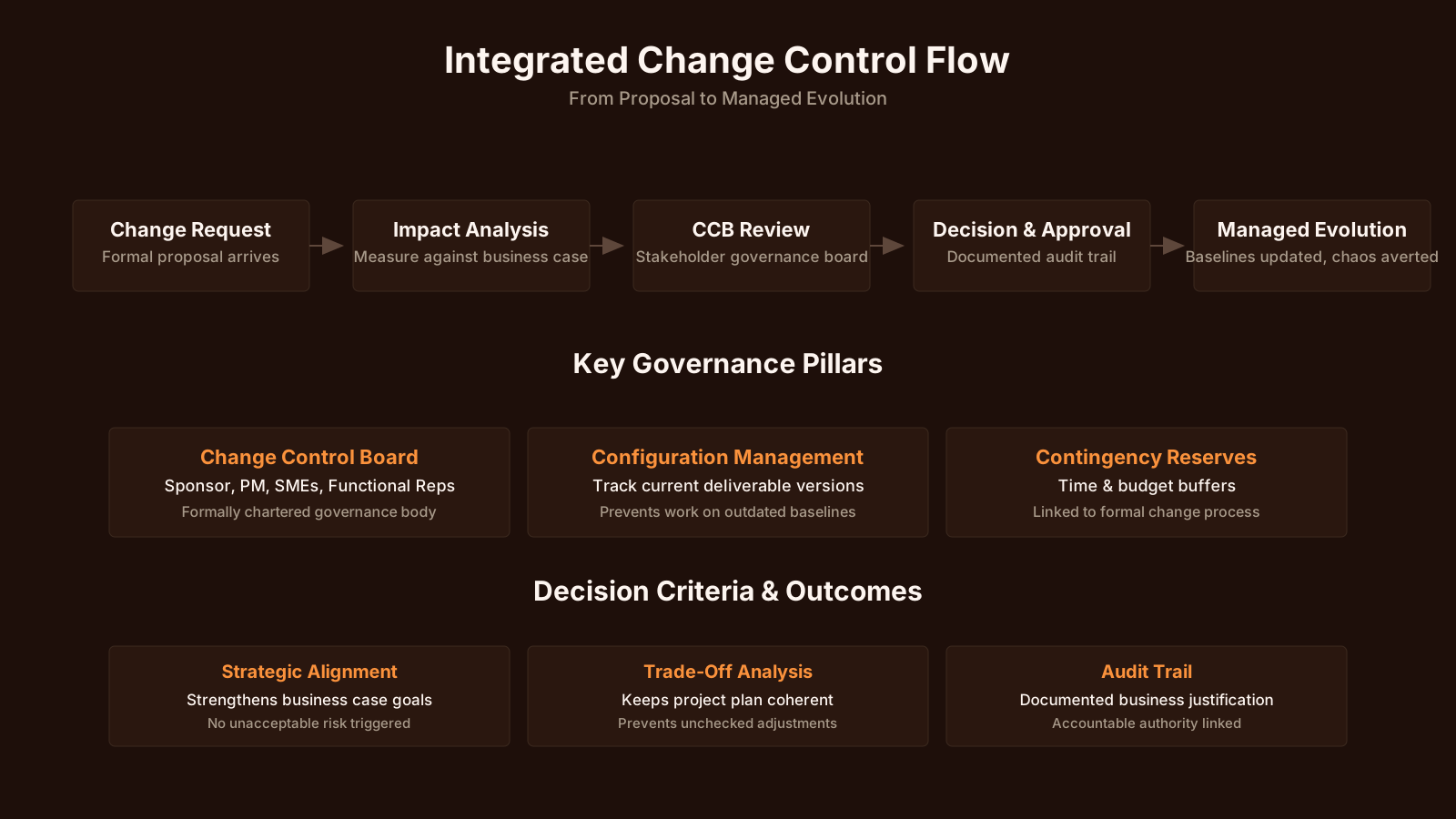
| Change Control Workflow | The sequence moves from formal request intake and multidimensional impact analysis through review by the change control board, culminating in a logged decision with assigned follow-through. |
| Lifecycle-Specific Adaptation | Adaptive life cycles channel change via prioritized backlogs and sprint-level reviews, whereas predictive frameworks impose formal, phase-gate assessments to safeguard baseline stability. |
| Decision-Making Inputs | A change’s merit hinges on real-time execution metrics (schedule variance, cost performance) and institutional assets (policies, lessons learned, risk appetite) that collectively gauge its feasibility. |
Understanding the Formal Structure of Integrated Change Control
Perform Integrated Change Control sits at the intersection where proposals meet governance. The process is not just an administrative checkpoint; it is the mechanism that keeps the project aligned with its authorized scope, schedule, and cost even as the environment shifts. In the PMBOK process classification, it belongs to the Monitoring and Controlling Process Group because it continuously evaluates proposed modifications and their ripple effects across all knowledge areas. That integration label is critical. A change that seems trivial in the scope baseline, for instance, when a client asks for an extra report, can cascade into schedule delays, budget overruns, additional risk, and procurement complications. Integrated change control forces the project manager and key stakeholders to examine those links before a decision is made. It connects with every other process that generates a change request, from risk response planning that triggers preventive actions, to quality inspections that uncover defect repairs, to stakeholder engagement that surfaces new requirements. The process also feeds into and pulls from configuration management, ensuring that the approved configuration of deliverables remains documented and verifiable.
At its core, integrated change control operates on a simple principle: no change to any project baseline should occur without deliberate review. This principle can feel heavy in environments that prize speed, but it serves as a protective layer. Without it, the team might implement dozens of micro adjustments that collectively fracture the business case without anyone noticing until it is too late. The process defines a clear workflow: a change request is submitted, impacts are analyzed, the change control board or equivalent body reviews the analysis, and a decision is recorded. Regardless of whether the change is approved, rejected, or deferred, the outcome must be communicated and documented. This closed loop is what differentiates mature project management from ad hoc firefighting. Even in adaptive life cycles, where change is expected, a scaled version of integrated change control exists through product backlog management and sprint reviews, but in predictive projects, the rigor is more pronounced.
PRINCE2 treats change through its Change theme, which uses a similar issues and change control procedure. A change request becomes an issue that is logged, assessed, and either implemented within tolerances or escalated. The language differs, but the intent is nearly identical: maintain the viability of the project’s products and the business case. In both frameworks, the project manager rarely makes unilateral decisions about baseline changes; authority typically rests with a project board or sponsor, while the project manager coordinates the analysis and facilitation. This separation of duties prevents the person closest to the operational pressures from inadvertently committing the project to something the sponsor would never approve. The process also integrates with the direct and manage project work execution processes, because approved changes then flow into work authorization, and rejected changes are simply closed.
Core Insights on Change Control
- Governance at the intersection of proposals
- Perform Integrated Change Control functions where change proposals converge with project governance, mandating that any adjustment to baselines is vetted by the project manager and key stakeholders before approval.
- Ripple effects across all knowledge areas
- The process compels stakeholders to examine how a seemingly minor scope change, such as an extra client report, can propagate into schedule delays, budget overruns, heightened risk, and procurement challenges, demanding a cross-disciplinary impact analysis before any decision.
- Defined workflow for change decisions
- A defined workflow channels each change request through submission, impact analysis, board review, and recorded decision; adaptively, this is reflected in backlog management and sprint reviews, maintaining rigor without excessive ceremony.
Key Inputs That Inform Change Decisions
Change management inputs are the raw intelligence that the process consumes to weigh each proposal. The first and most critical input is the project management plan itself, which contains all subsidiary plans and baselines. When a change request arrives, the project manager must pull out the scope baseline to see if the change adds, removes, or modifies deliverables. The schedule baseline reveals whether the change will stretch critical path activities or require resource reallocation. The cost baseline shows the budget impact, including any contingency reserves that might be tapped. The performance measurement baseline, which integrates scope, schedule, and cost, becomes the yardstick against which the change’s ramifications are measured. If the change alters a procurement strategy, the procurement management plan speaks to how contracts would need to be amended. The stakeholder engagement plan hints at who needs to be consulted and how their expectations might shift. Without a current, approved project management plan, the evaluation of any change becomes guesswork, because there is no fixed point of reference.
Work performance information provides the reality check. It is the data gathered from project execution: status of deliverables, actual costs, schedule variance, earned value metrics, technical performance measures, and realized risks. Before assessing a change, the project manager must understand the project’s current health. A request to add a new feature when the project is already three weeks behind schedule and burning contingency reserves faster than planned carries a different weight than the same request made when the project is running ahead of schedule and under budget. Work performance information often surfaces the need for change in the first place. For example, a trend in defect rates might reveal that a particular component requires a design change to meet quality standards. The incoming data is therefore both a trigger and a context setter. Without it, the change control board would be making decisions in a vacuum, which is exactly how small requests snowball into unmanageable crises.
Change requests themselves are the formal proposals that drive the process. In the PMBOK lexicon, they fall into three categories: corrective actions that realign performance with the plan, preventive actions that ensure future performance stays aligned, and defect repair that fixes nonconforming products. Additionally, updates to formally controlled project documents or baselines qualify as change requests. A change request might originate from any stakeholder, a team member discovering an obstacle, a risk owner activating a response, or an auditor flagging a compliance gap. The request should describe what the change is, why it is needed, and what alternatives were considered. The level of formality scales with project complexity. In a large infrastructure project, a change request might be a multi-page document with detailed technical appendices; in a small internal IT project, it could be a concise email that follows a standard template. The key is that the request must be documented and traceable. Verbal requests that never get logged are the primary source of scope creep and later disputes.
The enterprise environmental factors and organizational process assets shape how the change control process operates in a specific organization. Environmental factors include the governance structures in place, the organization’s risk appetite, market conditions that may force accelerated changes, and legal or regulatory constraints. For example, a pharmaceutical company developing a new drug will have change control procedures heavily influenced by FDA regulations, where any alteration to a validated manufacturing step requires revalidation. Organizational process assets encompass the change control policies themselves, standardized templates for change requests, defined approval levels tied to financial thresholds, the change log format, and lessons learned from past projects where poorly managed changes led to failure. Many organizations maintain a configuration management system that links change requests to specific configuration items and tracks version histories. This infrastructure, if it exists, makes the project manager’s job far easier because stakeholders already understand the rules and the rhythm of change control meetings.
Tools and Techniques That Drive Evaluation
Expert judgment and change control meetings are the engine room of integrated change control. Expert judgment is not a euphemism for the project manager’s gut feeling; it is the deliberate solicitation of specialized knowledge from people who understand the technical, financial, legal, and operational dimensions of the proposed change. On a software project, that could mean sitting down with the lead architect to assess how adding a single field to a database table might ripple through the service layer, API contracts, and user interface. On a construction project, it might involve consulting a structural engineer to confirm that a requested design alteration does not compromise load bearing capacity. Expert judgment can be applied by the project management team itself, by consultants, by subject matter experts from business units, and by external regulators if the change touches compliance boundaries. The project manager’s role is to gather these perspectives, synthesize them without bias, and present a balanced impact assessment to the change control board.
Change control meetings are where the decision rubber meets the road. These meetings, often convened as a change control board or CCB, bring together the individuals authorized to approve or reject changes. The composition of the CCB varies; a typical configuration includes the sponsor, key stakeholders representing business interests, the project manager, functional or technical leads, and sometimes a representative from contracts or legal. The project manager presents the change request, the impact analysis, and a recommendation. The CCB then deliberates, weighing the benefits against the costs, schedule impact, risk exposure, and alignment with strategic objectives. A decision might be straightforward, or it might trigger a heated debate when scarce resources must be reallocated. In some organizations, the CCB is a standing committee that meets weekly; in others, urgent changes trigger an ad hoc review. The outcome is not always binary. A change can be approved, rejected, deferred pending more information, or approved conditionally with caveats that certain risk mitigation actions be taken first. The minutes of these meetings become part of the project record, providing an audit trail that justifies why a particular change was accepted or turned down.
While expert judgment and the CCB are the named tools, the process implicitly relies on other supporting techniques. Variance analysis from work performance information often drives the initial realization that a change is needed. Alternative analysis, where the team explores different ways to achieve the same outcome without a baseline change, can be a powerful precursor to submitting a formal request. Many practitioners find that a quick alternatives brainstorming session with experts can defuse unnecessary change requests, simply because someone spots a constraint or a workaround that was not previously considered. Additionally, decision making techniques like multi-criteria decision analysis can help the CCB when faced with several mutually exclusive change options. The process also leans on the configuration management system to verify what version of which artifact the change would affect. All of these stay in the background, but their disciplined application is what separates a well-run CCB from a rubber stamp committee.
Key Takeaways on Change Control
- Expert judgment, not intuition
- Expert judgment involves methodically sourcing specialized insights from professionals with technical, financial, legal, and operational expertise, rather than substituting for the project manager's intuition.
- Diverse expert sources
- Project management teams, consultants, business unit subject matter experts, and external regulators all contribute essential expert judgment, especially when changes intersect with compliance requirements.
- Change control board role
- The Change Control Board convenes authorized decision makers such as the sponsor, key stakeholders, the project manager, technical leads, and legal representatives to formally review and resolve proposed changes.
- Four decision outcomes
- After evaluating benefits against costs, schedule impact, risk exposure, and strategic alignment, the CCB may approve, reject, defer, or conditionally approve a change, stipulating required risk mitigation actions.
Outputs That Cement Decisions into the Project
Change request status updates represent the immediate, transactional output that feeds back to the originator and to the project team. Every change request, whether submitted via a formal system or captured in a log, receives a status: approved, rejected, deferred, or canceled. The act of updating that status and communicating it closes the loop for that particular request. It prevents the common nightmare scenario where a stakeholder assumes a change was accepted, and six weeks later discovers that no action was taken, leading to acrimony and rework. The status update often includes a rationale, especially when a request is rejected, so that the requestor understands the constraints and can perhaps come back with a revised, more feasible proposal in the future. This transparent communication builds trust; stakeholders feel heard even when their request does not go through. It also creates historical data that can be analyzed later for trends, such as a department that repeatedly submits scope expansions, pointing to a deeper misalignment in requirements gathering.
Project management plan updates occur whenever an approved change alters any component of the plan or its baselines. If the change adds a deliverable, the scope baseline must be revised. If it extends the timeline, the schedule baseline gets a new version. Budget adjustments are reflected in the cost baseline. More subtly, changes can affect management plans themselves. A new risk that emerges from the change might need to be added to the risk management plan, and response strategies updated. If the change introduces a new procurement need, the procurement management plan must be amended to reflect how the vendor will be selected and managed. These updates are not optional paperwork; they ensure that the integrated set of documents that guide the project remain coherent. When a project manager skips updating the baselines after an approved change, future performance reporting becomes misleading because the actual work diverges from the documented plan. Variance analysis then flags non existent problems, eroding confidence in the project’s reporting integrity.
Project document updates extend beyond the management plan. The change log is the obvious recipient, but many other documents absorb the consequences of a change. Requirement documentation must be revised to capture new or modified requirements. The assumption log might need to be adjusted because the change invalidates an earlier assumption. The risk register may see new risks identified and existing risks reprioritized because the change shifted their probability or impact. The stakeholder register could reflect new stakeholders who now have a vested interest because of the change. Team assignments might shift, requiring updates to the resource calendars. In essence, the output of integrated change control is a cascade of updates that keeps the entire project information system consistent. Configuring a project management information system to flag dependent documents when a change is approved reduces the manual effort of hunting down every artifact that needs revision. In smaller projects, the project manager simply walks through a mental checklist, but the discipline remains the same.
The Change Control Board as a Living Governance Mechanism
A change control board is not merely a meeting; it is the formal authority that safeguards the project’s business case. The composition of the board should mirror the project’s stakeholder landscape. In a product development project, it might include the product owner, the head of engineering, a representative from marketing, and the program manager. In a government infrastructure project, you might see representatives from the funding agency, the end user department, the regulatory body, and the prime contractor. The board’s charter defines the thresholds for authority: changes below a certain cost or schedule impact may be delegated to the project manager without a full board review, while major scope changes that affect the business case always go to the board. This tiered approach prevents bottlenecking and allows the board to focus on strategic decisions. Some organizations link change authority levels to tolerances set in the project charter. Others use a change authority matrix that maps roles to financial limits. Without such clarity, the CCB either becomes a rubber stamp because everything is escalated, or it becomes a barrier because the project manager is afraid to act on small, necessary tweaks.
The CCB’s effectiveness rests on the quality of the impact analysis it receives. A rushed, superficial analysis leads to decisions that look good in the meeting but turn disastrous during implementation. Conversely, analysis paralysis, where the project manager demands exhaustive documentation for every minor request, bogs down progress. The sweet spot is a fit-for-purpose analysis that identifies the primary effects on scope, schedule, cost, quality, risk, and stakeholder satisfaction, and then calls out any irreversible consequences. For example, if a change requires ordering a long-lead-time component, the analysis must quantify the schedule delay without room for ambiguity. The CCB can then decide whether the delay is acceptable against the benefit. In projects that use earned value management, the impact analysis often translates the change into revised performance metrics, so the board can see how the cost performance index and schedule performance index would shift. That quantitative grounding makes the decision far more defensible than qualitative arguments about “this would be nice.”
Interestingly, the CCB’s function sometimes reveals deeper organizational issues. If the board consistently rejects changes that later prove necessary, it may signal that the original requirements were poorly defined. If it approves far-reaching scope changes without adjusting funding, the project will inevitably overrun, and the business case becomes fiction. A mature organization uses the CCB’s decision history as a feedback loop into portfolio governance. Patterns of change in certain types of projects might justify adjusting estimating assumptions or increasing contingency reserves at the portfolio level. The CCB also plays a subtle cultural role. When stakeholders observe that changes follow a transparent, fair process, they are less likely to bypass the system and pressure the project team directly. The board’s existence reinforces the norm that the project is governed, not a personal fiefdom of any single executive.
Key Insights on CCB Governance
- Formal authority for business case
- The Change Control Board exercises formal governance, acting as the sole body authorized to validate deviations from the project’s business case through disciplined deliberation rather than routine administrative review.
- Board composition varies by context
- Product development CCBs typically seat the product owner, head of engineering, marketing representative, and program manager, while government infrastructure boards draw required representation from the funding agency, end-user department, regulatory body, and prime contractor.
- Tiered thresholds prevent bottlenecking
- The CCB charter codifies cost and schedule authority limits, delegating minor changes to the project manager and reserving full board review exclusively for material scope modifications that alter the business case.
- Clarity prevents rubber stamping
- Without clearly defined authority boundaries, the CCB either becomes a rubber stamp that escalates all decisions indiscriminately, or a bottleneck that inhibits project managers from making timely, low-risk adjustments.
- Fit-for-purpose change analysis
- Effective change analysis examines primary impacts on scope, schedule, cost, quality, risk, and stakeholder satisfaction, and explicitly flags irreversible consequences such as schedule delays introduced by long-lead-time components.
Adapting Change Management in Agile and Hybrid Environments
Adaptive change management approaches recognize that in environments of high uncertainty, freezing requirements at the start is counterproductive. Agile frameworks intentionally welcome changing requirements, even late in development, because they deliver value incrementally and gather feedback continuously. The mechanism for managing change, however, is distinct from the formal change control process in predictive projects. In Scrum, the product backlog is the living artifact that contains all desired work. The product owner has the authority to reprioritize items and clarify requirements at any time. Individual sprint backlogs remain stable during the sprint to allow the team focus, so changes are folded into future sprint planning. A significant new stakeholder request does not trigger a CCB meeting; instead, the product owner collaborates with the team to understand effort and then reorders the backlog. The sprint review provides a natural cadence for inspecting the product and adapting the backlog based on stakeholder feedback. This rapid cycle reduces the need for a separate change control board because the product owner acts as the single wringer of business value.
Hybrid projects, which blend predictive phases with iterative development, face a more complex challenge. The upfront predictive planning creates baselines that may be used for contractual or regulatory commitments. Changes to those baselines still require a formal integrated change control process, while changes within an iteration are handled by backlog management. The trick is defining the boundary. The project charter or governance plan should specify which types of changes trigger a full CCB review. For example, any change that alters the contracted scope or affects a committed milestone might require CCB approval, while internal design refinements that stay within the approved feature set can be decided by the product owner and team. Without this explicitly defined boundary, teams can inadvertently breach contractual baselines, and project managers can stifle adaptive refinement by forcing every small adjustment through a cumbersome board. The key is to integrate the two approaches: use the CCB for governance-level changes and Agile ceremonies for operational-level adaptation.
This does not mean that Agile teams operate without discipline. Many scaling frameworks like SAFe introduce a form of change control at the program level. When a feature requires significant additional investment or impacts a release train’s objectives, it may be escalated to a program backlog refinement session with higher-level product management and architecture. The decision is still rapid, but it acknowledges that some changes have cross-team ripple effects that demand a broader perspective. In regulated industries, Agile teams still document the rationale for changes and maintain traceability from requirements to tests, often through tooling that automates part of the change approval. The principle remains consistent: the level of governance should match the level of risk and the need for stakeholder alignment. What Agile rejects is not control, but the illusion that all changes can be predicted and frozen months in advance.
Common Pitfalls in Change Control and How to Overcome Them
Change management challenges frequently arise not from the process design itself but from human behavior and organizational culture. The most pervasive pitfall is scope creep, the slow, unauthorized expansion of project scope through small, unapproved changes. A stakeholder asks the developer to “just add this one button,” a team lead agrees to a cosmetic tweak because it seems harmless, and after six months the product has dozens of undocumented deviations from the baseline. The project manager might never know until integration testing reveals inconsistencies, or until the sponsor sees a bill for work that was never approved. The antidote is a cultural insistence that all changes, regardless of size, must be logged as change requests. The team should be trained to politely redirect informal requests to the process. This does not require a burdensome form; a simple entry in a shared log suffices, but the act of logging creates visibility and accountability.
Another common trap is the CCB that becomes a bottleneck. When every change, including trivial administrative adjustments, must wait for a monthly board meeting, the project’s momentum suffers. Project teams learn to fear the board and start working around it, which defeats the purpose. The solution is tiered authority. Define clear thresholds so that the project manager can approve changes with minimal impact, while reserving major scope, schedule, or budget changes for the CCB. Some organizations introduce a fast-track pathway for urgent changes, where the sponsor can approve via email or a quick ad hoc call, with full retrospective documentation to follow. The balance is to maintain control without killing responsiveness. If a project is in a crisis where immediate action is needed to avoid catastrophic failure, the project manager should have authority to act and then seek ratification, but this must be a rare exception, clearly documented and communicated.
Analysis-paralysis is a third pitfall. A project manager trying to be thorough might commission endless studies to pin down every ripple effect, delaying a decision that could be made with an 80% confidence level. During that delay, the opportunity window closes, or the problem worsens. Expert judgment should be time-boxed. The change request form can include a section for “known unknowns” so the CCB understands the residual uncertainty and can approve the change with approved contingency. In many cases, a pilot or a phased rollout is a better decision than a blanket approval. The project manager can then monitor the early results and bring a more informed analysis for the full rollout. This approach embraces the reality that not all impacts can be perfectly predicted, while still applying governance.
Core Insights on Change Control Pitfalls
- Scope creep driven by small, unapproved changes
- Trivial, unprompted adjustments like adding a button or refining a visual detail accumulate silently, creating undocumented design drift that surfaces only during integration testing or in unexpected billing reconciliation.
- Log every change, no matter how small
- Embedding a mandatory shared log into the team’s culture is a critical safeguard, delivering immediate transparency and clear accountability without the friction of a formal change request form.
- Leverage thresholds and fast-track approval paths
- Set sharp approval thresholds so project managers can authorize low-impact modifications on the spot, reserve high-impact decisions for the change control board, and enable urgent approvals via email or ad hoc calls with retrospective documentation for a complete audit trail.
The Hidden Organizational Toll of Uncontrolled Changes
Invisible process damage often accumulates when change control is weak or bypassed, a concept that resonates with the BVOPM perspective on project health. Business Value-Oriented Project Management recognizes that the harm caused by poorly handled changes extends beyond missed deadlines and budget overruns. Each time a team pivots without a formal analysis, resources are shifted, context is lost, and individuals experience cognitive overload. Over time, this manifests as what BVOPM calls process damage: the erosion of team morale, the degradation of quality practices, and the loss of institutional knowledge because no one documents why a certain approach was abandoned. A team that constantly chases unplanned changes without protecting its core workflow starts cutting corners on testing, documentation, and peer reviews. The project’s business value point trajectory, if tracked, would show a persistent decline even when individual deliverables appear to be met, because the underlying processes have become unsustainable.
BVOPM also categorizes waste stemming from change mismanagement in ways that go beyond the usual triple constraints. Overwork waste results from endless revisions that never get formally approved or rejected, leading to cycles of rework that exhaust the team without delivering stakeholder value. Perfectionism waste appears when a change request triggers an extreme reaction, the team invests disproportionate effort to polish a feature that would have been acceptable in its simpler form, purely because a single stakeholder’s comment was escalated without proper triage. Rejected acceptable work waste occurs when a change is imposed mid-stream, and the partially completed deliverables are discarded even though they met the original acceptance criteria. These are not captured by typical earned value metrics, yet they quietly consume the project’s reserves and erode the sponsor’s confidence. The prevention is not a heavier process but a more intelligent one that connects change decisions explicitly to business value assessment and tolerates an appropriate level of uncertainty rather than pretending every change must be perfect.
Recognizing this hidden toll shifts the conversation about change control from a policing function to a value protection function. The CCB is not there to stop change; it is there to ensure that change does not silently destroy what has already been built. Project managers who communicate the cumulative cost of uncontrolled changes to stakeholders in terms they care about, lost time to market, degraded user experience, team burnout risk, often find more support for disciplined change management than when they present it purely as an administrative compliance exercise. This framing also aligns with the program and portfolio view, where patterns of excessive change across multiple projects may indicate deeper strategic misalignments that need executive attention. A well-functioning change control process, therefore, becomes an early warning system, and the project manager who runs it with this broader awareness acts more as a steward of organizational capability than a gatekeeper.
