Defining the project scope is one of those tasks that sounds straightforward but quickly reveals layers of complexity once you sit down to actually do it. You are not just writing a list of deliverables. You are synthesizing high-level aspirations, detailed stakeholder expectations, organizational habits, and risk sensitivities into a coherent boundary document. The process, formally known as Define Scope in the PMBOK framework, sits squarely in the Planning Process Group and belongs to the Project Scope Management Knowledge Area. It transforms the vague charter mandates and collected requirements into a precise project scope statement. That statement becomes the reference point against which every future change request is measured, every team decision is tested, and every stakeholder alignment is maintained. Getting it right demands a disciplined approach to inputs and a sharp sense of where expert insight ends and groupthink begins. When I talk to practitioners who have managed dozens of complex initiatives, they often remark that the most expensive mistakes trace back to scope statements that were either too ambiguous or too ambitious. So the question "how do I define the project scope" is really about mastering the flow from authorization documents through organizational memory and expert analysis to a deliverable-focused description that leaves no room for creative reinterpretation.
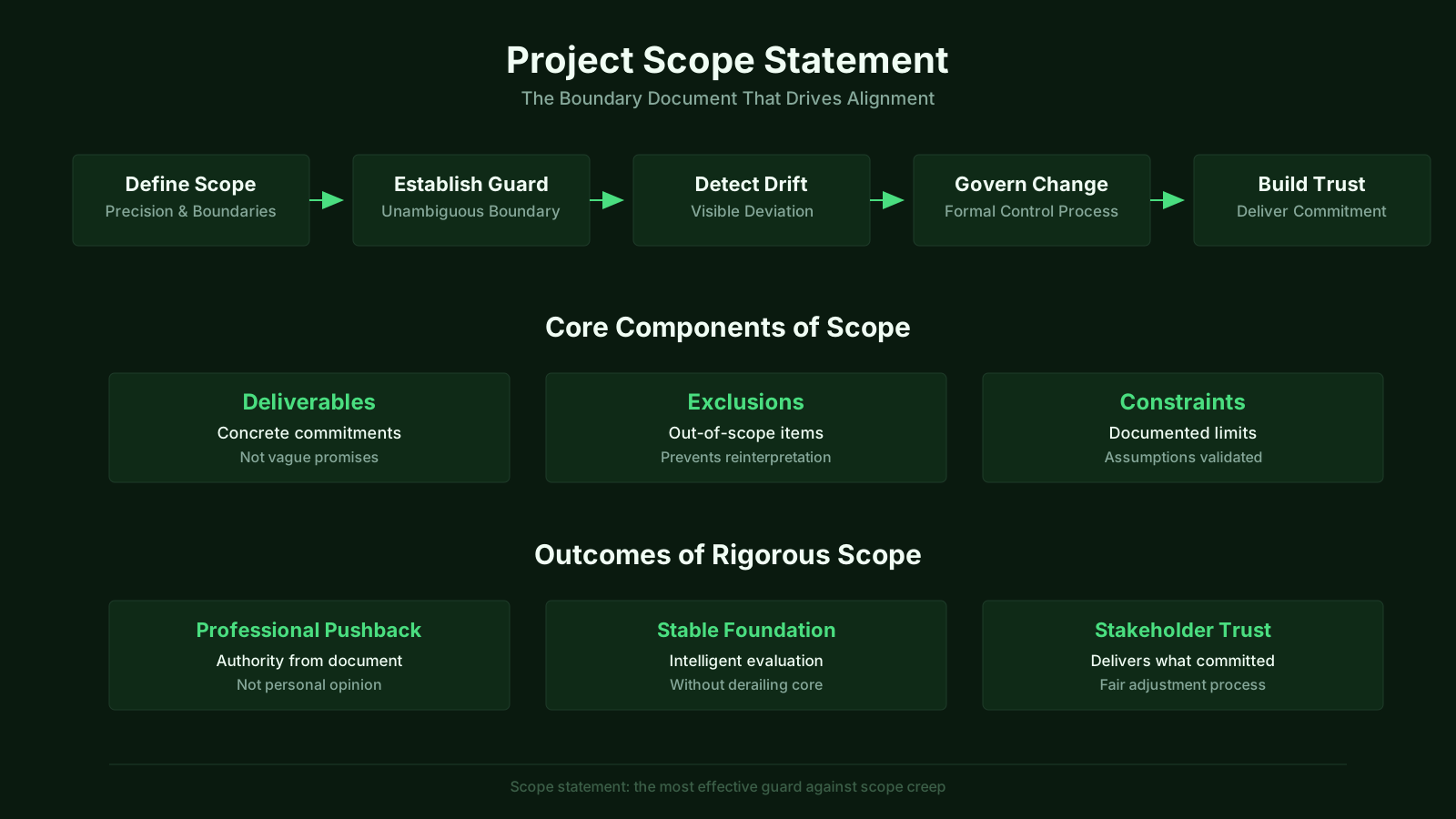
Project Scope Definition: Key Topics Overview
| Key Concept | Summary |
|---|---|
| Define Scope | The Define Scope process, within the Planning Process Group and Project Scope Management, translates high-level requirements into a formal scope statement that precisely outlines deliverables, exclusions, and acceptance criteria, anchoring stakeholder expectations. |
| Project Charter | The project charter grants formal authorization and establishes initial boundaries, objectives, and constraints. When missing, equivalent detail must be rigorously assembled from stakeholder interviews, business cases, or feasibility studies to prevent early scope ambiguity. |
| Requirements Analysis | Requirements analysis converts broad ambitions into targeted investigations of functional depth, user profiles, system integration demands, and measurable performance benchmarks, ensuring strategic alignment and design clarity. |
| Scope Pitfalls | Ambiguous or excessively broad scope statements trigger costly rework and schedule erosion. A frequent trap is charters that bundle multiple unrelated initiatives under one diffuse declaration, concealing hidden complexity and resource conflicts. |
| Organizational Assets | Historical project records, a key organizational asset, often reveal latent constraints such as vendor onboarding lead times, compliance requirements, and technical debt that critically shape realistic scope boundaries. |
| Expert Judgment | Expert judgment is essential for uncovering technical feasibility and nuanced risks, but teams must systematically differentiate evidence-backed insights from unchallenged groupthink to avoid blind spots. |
The Role of Project Charter and Requirements in Scope Definition
Every detailed scope definition effort starts with the project charter, not because it is a perfect document but because it carries the initial authorization and the high-level boundaries. The charter provides a summarized project description and outlines product characteristics, approval requirements, and often the first pass at assumptions and constraints. If an organization does not use a formal charter, comparable information must be gathered or developed through stakeholder interviews, sponsor directives, or feasibility studies. Without that reference, the planning team is essentially navigating without coordinates. In practice, the charter often contains statements like "implement a customer self-service portal" or "build a regional distribution center." These are not yet scoped; they are ambitions. The Define Scope process takes that ambition and asks: what exactly does the portal do, which customer segments, what backend integrations, what browsers, what security certifications, what uptime guarantees. The charter sets the strategic intent, and project scope definition inputs from the charter cascade into the detailed analysis. However, charters can also contain hidden risks. I’ve seen charters that bundle multiple loosely related initiatives under one broad statement, assuming that the planning team will sort it out. That almost guarantees scope renegotiation later, because stakeholders read the charter and believe everything mentioned is in scope, while the team interprets it more narrowly. So the first act of scope definition is almost always a careful reading of the charter to extract explicit deliverables and to flag implicit expectations that need prompt clarification.
The requirements documentation is the second critical input, and it arrives from the Collect Requirements process that typically runs in parallel or just prior. Requirements can be functional, non-functional, quality-related, or transition-related. They represent the voice of the customer and the needs of internal operations. In Define Scope, the requirements are not simply transcribed into the scope statement. Instead, they are analyzed for interdependencies, conflicts, and alignment with the charter’s intent. A common mistake is to treat all requirements as equally binding. Practitioners quickly learn that some requirements are aspirational, others are mandatory, and a few are contradictory. The scope statement must resolve these tensions by elevating mandatory requirements into explicit scope items and either deferring or excluding others with documented justifications. When a stakeholder demands a feature that doubles the development timeline but is not mentioned in the charter, the definition process becomes a negotiation. Having the charter and requirements documentation side by side helps the project manager facilitate that conversation with evidence rather than opinion. Both inputs are living references in the sense that as more becomes known, the scope statement may need to revisit and revalidate portions of what was originally assumed. But that iterative tightening is precisely what the planning phase is designed to do.
Core Takeaways: Charter and Requirements
- Charter starts scope definition
- Every scope definition effort begins with the project charter, because it provides the initial authorization and high-level boundaries that shape subsequent refinement.
- Charter content elements
- The charter includes a concise project description, key product characteristics, approval requirements, and a preliminary assessment of assumptions and constraints.
- Charter substitute sources
- Where no formal charter exists, organizations must gather equivalent information through stakeholder interviews, sponsor directives, or feasibility studies.
- Broad charters invite renegotiation
- When a charter bundles multiple loosely related initiatives, stakeholders assume that everything listed is in scope, while the team interprets the boundaries narrowly, virtually ensuring need for scope renegotiation.
- Requirements as second input
- Requirements documentation from the Collect Requirements process provides the second critical input to scope definition and typically arrives in parallel with the charter or just before scope refinement begins.
Leveraging Organizational Process Assets for Better Scope
Organizational process assets, often abbreviated as OPAs, might seem like administrative overhead, but they are where institutional memory lives. These assets include policies, procedures, and templates specifically designed for creating project scope statements. They also encompass project files from previous, similar undertakings, along with lessons learned from earlier phases or entirely different projects. When a project manager sits down to define scope, organizational process assets for scope provide a rich, pre-validated starting point. For instance, a template for a scope statement in an IT organization might prompt the team to specify interfaces, data migration requirements, and disaster recovery tier, all of which could easily be forgotten by a first-time team. Ignoring these assets is a frequent pitfall, particularly among experienced managers who believe they already know what to include. But the consequence is often a scope statement that omits categories of work that the organization, through hard experience, has learned to document explicitly.
Project files from previous projects are especially valuable when the current initiative shares technology, regulatory environment, or customer base with past work. A quick review of those files can reveal hidden constraints: that a certain integration partner always requires six weeks of lead time, or that the legal department invariably returns with additional compliance clauses if the project touches customer data. By incorporating these lessons directly into the scope statement, the team avoids the costly cycle of late-stage discovery. Lessons learned repositories, when kept current, act as a checklist of what not to repeat. I remember a scenario where a team reused a scope template but ignored the attached lessons learned document, which explicitly stated that a previous similar project had underestimated infrastructure provisioning by three months. The new project repeated the exact same optimism, and the scope statement failed to reflect that historical reality. So while OPAs are often reduced to a bullet point in methodology discussions, in practice they are a defense mechanism against organizational amnesia.
Expert Judgment in Developing the Project Scope Statement
Expert judgment is not about hiring a single guru to tell the team what to do. It is a disciplined technique of gathering and analyzing insights from multiple knowledgeable sources to shape the scope statement with technical credibility and practical foresight. The PMBOK framework identifies several sources: other units within the organization, consultants, stakeholders including customers and sponsors, professional and technical associations, industry groups, and subject matter experts. The purpose is to fill the gaps that templates and requirements documents inevitably leave. No matter how thorough the charter or how exhaustive the requirements list, there will always be areas of ambiguity that only experience can resolve. When the team is deciding, for example, whether a pharmaceutical project’s scope should include a particular stability testing protocol, expert judgment technique from a regulatory affairs specialist may be the only reliable way to determine if the protocol is mandatory for the intended market. Without that input, the scope might either exclude critical work or inflate with unnecessary testing.
When Internal Expertise Falls Short
A common pattern in organizations is to default to internal experts, which seems cost-effective but can introduce blind spots. Internal experts often share the same assumptions as the project team, having been shaped by the same culture and past successes. Consultants and industry groups bring an external perspective that might question whether a standard approach is even appropriate for the current challenge. I’ve seen projects where internal engineers insisted that a certain component must be built from scratch because that was their tradition, only to have an external consultant point out a reliable off-the-shelf solution that slashed the scope and timeline. That kind of contribution is not always welcomed, but it is precisely why expert judgment is a defined technique rather than a casual conversation. The project manager’s role is to curate these inputs, assess their credibility, and integrate them without letting any single voice dominate. The scope statement becomes a product of collective reasoning, not a collection of preferences.
Structuring Expert Input
One practical way to structure expert judgment is to convene focused sessions where each expert is asked to review a draft scope statement and highlight missing elements, unrealistic assumptions, or technical impossibilities. The output is a set of comments that the planning team then adjudicates. This approach prevents the common scenario where a project manager interviews experts individually and receives conflicting advice without a mechanism to resolve the contradictions. By having all expert feedback visible in a single version of the scope document, the team can see where one expert says “include user acceptance testing in scope” and another says “user acceptance testing is the sponsor’s responsibility” and facilitate a decision. Over time, organizations that do this well develop a sixth sense for which experts to consult for which type of project, reducing the overhead while preserving the quality of the scope definition.
Core Takeaways on Expert Judgment
- Multi-source insight gathering
- Expert judgment synthesizes perspectives from internal teams, consultants, stakeholders, industry bodies, and subject matter experts to triangulate insights and reduce the risk of single-advisor bias.
- Filling requirement gaps
- This technique resolves ambiguities that charters and formal requirement documents leave unaddressed, such as confirming whether a stability testing protocol is mandatory for a pharmaceutical product's target market.
- Structured scope reviews
- Convening focused sessions where experts scrutinize a draft scope statement uncovers missing elements, unrealistic assumptions, and technical infeasibility early, surfaces conflicting viewpoints, and sharpens decision-making before commitments are finalized.
Product Analysis as a Scope Definition Technique
For projects that produce a tangible product or a well-defined service, product analysis is a powerful technique that shifts the focus from what the project will do to what the product must be. It involves decomposing the product into its constituent parts and analyzing each part’s requirements, behaviors, and interactions. This can include techniques like systems engineering, value analysis, functional analysis, and product breakdown. The goal is to ensure that the project scope statement accurately reflects the product’s technical boundaries and that no essential subsystem is overlooked. When a project manager defines scope for a new medical device, for instance, product analysis for scope definition might involve examining the device’s electrical components, software, housing, and sterilization compatibility to make sure all are explicitly mentioned in the scope. If the scope statement simply says “develop a hand-held diagnostic tool,” the omission of sterilization requirements could later derail the entire regulatory submission.
Product analysis also reveals dependencies that might not be obvious from the charter. A building construction project might initially scope the structure and the basic finishes, but a product breakdown that includes the HVAC system will quickly show that the scope must include not just the equipment but the ductwork, the controls, the commissioning, and the operator training. Without this level of detail, the project’s work breakdown structure will have significant gaps, and those gaps will translate into missing cost and time estimates. The technique serves as a bridge between the product vision and the project plan, ensuring that the scope statement is not just a narrative but a technically verified list of deliverable components. Many experienced project managers will run a product analysis workshop early in the planning phase, inviting engineers, designers, and even end-users to participate, precisely because the discussion often uncovers hidden assumptions about what the product is supposed to do.
Common Pitfalls in Defining Project Scope
Even with all the right inputs and techniques, scope definition can go wrong in ways that are painfully predictable. One of the biggest traps is scope creep by passive consent. The team produces a detailed scope statement, but then during execution, small additions are made without formal change control because they seem too minor to justify the process. Over a few months, these micro-decisions can add up to an unrecognizably larger project. Scope definition pitfalls like this almost always stem from a well-intentioned desire to be helpful, but they undermine the entire governance structure. Another classic mistake is writing scope statements that are verbose but vague. A document might spend two pages describing the business context and strategic alignment, but then hand-wave the actual deliverables with a phrase like “a scalable platform.” When the developers ask what scalable means, confusion sets in. The scope statement must be specific enough that a future team member joining the project mid-stream can read it and know precisely what is and is not included.
Equally destructive is scope defined by exclusion without clear boundaries. I have seen teams try to pin down scope by listing what is out of scope, hoping the remainder will be obvious. The problem is that stakeholders often interpret an exclusion list as the only thing not being done, and they assume everything else is in. That misunderstanding can generate expectations that are impossible to meet. A far better approach is to state the positive scope first and then list exclusions only to clarify uncertainties at the edges. Finally, many projects suffer from what I call the “expertise homogeneity” trap, where the scope is defined entirely by one function, such as IT, without input from operations or compliance. The result is a scope statement that technically works but is non-viable in the real organizational environment because nobody considered the operational handover requirements or the regulatory filings that need to happen after delivery. These pitfalls are avoidable, but they require the project manager to actively test the scope statement against organizational reality, not just technical feasibility.
Core Scope Definition Pitfalls
- Scope creep through passive consent
- Informally permitted incremental changes, accepted without formal change control, silently accumulate over weeks and months, distorting the original project baseline beyond recognition and eroding budget and schedule integrity.
- Verbose but vague scope statements
- Documents that dwell extensively on business context yet define deliverables with fuzzy terms like “a scalable platform” fail to communicate the concrete outcomes needed for accurate estimation and shared accountability.
- Missing deliverable specificity
- An effective scope statement must be exact enough that any team member joining mid-project can immediately grasp the definitive inclusions and exclusions, eliminating ambiguity that fuels disputes and rework.
- Expertise homogeneity trap
- When scope is shaped solely by a single discipline such as IT, without integrating operations and compliance insights, the resulting specification may be technically valid yet operationally unworkable within the real organizational environment.
Navigating Assumptions, Constraints, and Risks During Scope Definition
Assumptions, constraints, and risks do not sit in a separate corner of the project plan; they are woven into the scope definition itself. The initial assumptions documented during initiation are analyzed for completeness, and additional ones are added as more information surfaces. An assumption might be that a third-party vendor will deliver a component by a certain date. That assumption, if false, could invalidate the entire scope timeline. Therefore, scope assumptions and constraints must be explicitly stated in the scope statement so that any later change in those conditions triggers a formal re-evaluation of scope. Constraints, such as a fixed budget or a regulatory deadline, similarly impose hard edges on what can be included. During scope definition, the team may need to make trade-offs, consciously excluding features that would overrun the constraint. If those constraints are not documented alongside the scope, later stakeholders might challenge the exclusion without understanding the rationale.
Risks play a slightly different role. As the team analyzes the scope, they may identify that a certain deliverable carries a high risk of technical failure. That risk may not be eliminable, but its presence can lead to a scope decision to include a proof-of-concept phase or to procure an insurance component instead of building one internally. In this way, scope and risk management are deeply intertwined. When I work with project managers who are defining scope, I encourage them to maintain a running list of assumptions and to treat each assumption as a potential risk event. If an assumption about resource availability is recorded and then proves false, the project does not have to scramble; the scope statement already anticipated the dependency and can be adjusted through the integrated change control process. This proactive marriage of scope definition with risk awareness prevents the frantic rescoping that happens when an unstated premise collapses mid-project.
Connecting Scope Definition to Other Project Management Processes
Scope definition does not happen in isolation. It directly feeds the creation of the work breakdown structure (WBS), which decomposes the scope statement into manageable work packages. If the scope statement is vague, the WBS will be inaccurate, and that inaccuracy cascades into cost estimates, scheduling, resource planning, and quality metrics. The chain of logic is unforgiving. Scope definition integration also reaches backward into the Collect Requirements process and forward into the Validate Scope and Control Scope processes. During Validate Scope, the deliverables are inspected against the scope statement to gain formal acceptance. If the scope statement lacks clarity, acceptance becomes a subjective judgment call, often leading to disputes and rework. Similarly, during Control Scope, any proposed change is evaluated against the baseline scope statement. Without a well-defined baseline, the change control board has no objective criteria for approving or rejecting modifications.
In larger programs, the scope statement of a project influences the program scope. A program manager relies on individual project scope definitions to ensure that no overlaps or gaps exist between projects. For example, if two projects in a program both assume responsibility for the same integration layer, that duplication will surface only if both scope statements are detailed enough to reveal it. This interconnectedness explains why organizations that invest heavily in their Define Scope process tend to have fewer integration surprises. They also often use the scope statement as the foundation for procurement documents, as it tells potential sellers exactly what needs to be delivered. A weak scope statement leads to vague statements of work, which in turn lead to supplier confusion and claims of scope creep. On the other hand, a precise scope statement protects the organization from being held liable for work it never intended to outsource, a protection that is especially valuable in fixed-price contracts where ambiguity can be very expensive.
Key Insights on Scope Integration
- WBS accuracy depends on scope clarity
- A well-articulated scope statement enables the work breakdown structure to faithfully decompose the project into precise work packages, establishing a reliable foundation for performance measurement and resource allocation.
- Vague scope cascades into downstream errors
- Ambiguity in the scope statement distorts the WBS, and those inaccuracies proliferate through cost estimates, timelines, staffing plans, and quality thresholds, multiplying the margin for error at each phase of project delivery.
- Connects requirements and scope processes
- Scope definition forms the essential junction between Collect Requirements and the Validate and Control Scope processes, ensuring that every stakeholder need is converted into verifiable deliverables and that progress is measured against an unambiguous reference point.
- Clear baseline enables objective acceptance
- With a sharply defined scope baseline, Validate Scope inspections become objective verifications against documented criteria, eliminating subjective judgments and minimizing rework, disputes, and unintended scope expansion.
- Program coordination and contract protection
- A rigorously defined scope gives the change control board quantifiable standards for evaluating modifications, allows program managers to detect overlaps or omissions across related projects, and shields the organization from financial liability in fixed-price contracts.
Modern Adaptations and Evolving Practices in Scope Definition
Traditional project management methodologies prescribe a sequential, plan-driven approach to scope definition, but adaptive and hybrid environments have introduced different rhythms. In Agile, scope is not defined once at the beginning; instead, a high-level product vision and a prioritized backlog replace the monolithic scope statement. Yet even Agile teams benefit from a disciplined initial definition that clarifies what the product is fundamentally about before sprints begin. The shift is one of timing and granularity rather than an abandonment of scope clarity. Modern scope definition practices increasingly acknowledge that changes in scope are not failures of planning but feedback from a complex reality. This is where approaches like Business Value-Oriented Project Management (BVOPM) add a distinct layer of thinking. BVOPM uses a five-level scope scale ranging from Definite to Unlikely, allowing the team to categorize items based on certainty and treat scope change as user feedback rather than a sign of poor initial scoping. It also employs relational effort points instead of absolute estimates, recognizing that scope sizing is inherently imprecise and that a WBS can be inaccurate even when the scope statement is well-written.
These modern adaptations do not invalidate the traditional inputs and techniques. The project charter and requirements documentation remain as important as ever, but the process of analyzing them can become more iterative. In some organizations, the scope statement is now a living document updated at predetermined checkpoints, blending the rigor of a baseline with the adaptability of an Agile mindset. The risk, of course, is that constant updating erodes the baseline concept, making it impossible to track performance. The balance point seems to be a scope statement that is detailed enough to govern near-term work and sufficiently high-level in later phases to accommodate learning. Many practitioners also report that involving the team in scope definition, rather than having a project manager write it in isolation, dramatically improves buy-in and reduces the number of missed details, because the people who will do the work understand the technical and operational nuances that management may overlook. As project environments become more complex and stakeholder networks more distributed, the ability to define scope clearly but flexibly is evolving into a core competency that separates consistently successful delivery from the chaotic alternative.