When you ask how to conduct a stakeholder analysis, you are really asking how to systematically dissect the human landscape of your project before it has a chance to surprise you. Stakeholder analysis is a technique of systematically gathering and analyzing quantitative and qualitative information to determine whose interests should be taken into account throughout the project. It goes far beyond a simple name-and-role list, because it identifies the interests, expectations, and influence of the stakeholders and relates them to the purpose of the project. Doing this early also helps you identify stakeholder relationships that can be leveraged to build coalitions and potential partnerships, enhancing the project’s chance of success in ways that pure task-planning never can. The technique sits squarely inside the Project Stakeholder Management knowledge area in PMBOK, specifically within the Identify Stakeholders process that belongs to the Initiating Process Group. In PRINCE2 environments, the same conceptual work happens under the Organization theme, where the project management team maps out those who have an interest or role. Both frameworks treat stakeholder analysis as a foundational activity, not a one-time formality. What often gets missed is that this analysis is not a single meeting but a continuous, iterative practice that refines itself as the project unfolds.
Stakeholder Analysis: Key Steps Summary
| Key Concept | Summary |
|---|---|
| Stakeholder Analysis | Systematically collecting quantitative and qualitative data about individuals and groups enables project managers to anticipate conflicts and calibrate communication strategies to genuine influence networks. |
| Failure Consequences | The price of bypassing stakeholder analysis surfaces when an unidentified department head who holds both intense interest and unilateral authority vetoes a critical deliverable at the final stage. |
| Dynamic Influence | Influence is seldom static, and stakeholder interests shift as project outputs begin to reshape daily workflows and operational realities. |
| Hidden Stakeholders | Teams frequently overlook groups that lack formal authority yet bear the heaviest operational burden, including support staff, remote end-users, and compliance officers. |
| PMBOK Timing | The PMBOK framework places Identify Stakeholders within the Initiating Process Group because missing a key player at this phase produces baselines that lack essential organizational commitment. |
| Agile Refinement | In iterative environments, stakeholder analysis is conducted before the first sprint and refined continuously during sprint reviews, where emerging feedback reveals concerns that initial discovery work missed. |
| Continuous Monitoring | Astute project managers detect shifting power dynamics through steering committee interactions and informal exchanges, updating their stakeholder analysis well before formal review cycles require it. |
| Classification Value | Without classification, a project manager risks investing equal effort in a vocal but powerless stakeholder while neglecting a reserved executive whose quiet approval determines the project's outcome. |
What Is Stakeholder Analysis and Why Does It Matter?
The core purpose of stakeholder analysis is to transform a vague sense of “who cares about this project” into a structured, actionable map. By gathering and analyzing information, you determine not just who your stakeholders are, but how they might react, what they expect, and where their power truly lies. Systematically gathering quantitative and qualitative information about these individuals and groups lets you anticipate conflicts before they escalate and align communication strategies with real influence patterns. Without this step, project managers often default to broadcasting the same message to everyone, which reliably alienates both powerful decision-makers and frontline users who need different kinds of attention. The value of stakeholder analysis becomes painfully clear when you see a critical department head veto a deliverable at the last minute simply because nobody recognized that their interest was high and their power was absolute. It is not a theoretical exercise; it directly shapes how you allocate your limited time for relationship-building, reporting, and negotiation.
A common mistake is treating stakeholder analysis as something you “finish” early in the project and then file away. In practice, stakeholder dynamics shift. A supporter can become a blocker when their operational priorities change, and a low-interest observer can suddenly gain power through an organizational restructuring. The initial analysis provides a baseline, but revisiting it during project reviews, phase gates, or even informal check-ins keeps your engagement strategies relevant. Seasoned program managers often keep a lightweight stakeholder register that they update with observations from every governance meeting, not just at the start. They know that influence is rarely static and that interests evolve as the project begins to produce tangible outputs that affect people’s daily work.
The process also carries a subtle but important ethical dimension. When you map out stakeholders, you must decide whose interests you are formally documenting. Teams sometimes inadvertently exclude groups that lack direct power but will experience the deepest operational impacts, such as support staff, end-users far down the chain, or compliance officers who only surface after a go-live. Good stakeholder analysis deliberately casts a wide net and then prioritizes, rather than letting the loudest voices define the initial list. Doing otherwise creates blind spots that later manifest as costly rework or outright project rejection during user acceptance phases.
Key Insights on Stakeholder Analysis
- Structured stakeholder mapping
- Stakeholder analysis transforms an organization's diffuse awareness of project interests into a rigorous, actionable map that reveals expectations, relational tensions, and the actual distribution of influence.
- Anticipating conflicts and targeting communication
- Combining quantitative data with rich qualitative insights equips project managers to foresee conflicts before they escalate and to align communication strategies with genuine influence structures, not just formal reporting lines.
- Continuous process, not one-time task
- Stakeholder analysis must be treated as a living process, revisited at project reviews, phase gates, and informal conversations, because influence rarely remains fixed and interests evolve once tangible outcomes begin to emerge.
- Include low-power, high-impact stakeholders
- Teams frequently overlook groups with little formal power but significant operational exposure, such as frontline support staff, downstream end-users, and compliance officers, whose issues often surface only after go-live.
When to Perform Stakeholder Analysis in the Project Lifecycle
Stakeholder analysis begins as early as the project charter or business case development and intensifies during the initiation stage. Before a project manager even has a fully formed team, there is already a need to understand who will fund, sponsor, resist, or depend on the outcome. Early stakeholder identification during project initiation ensures that risks related to political misalignment are surfaced before major commitments are locked in. The PMBOK framework places Identify Stakeholders in the Initiating Process Group precisely because missing a key player at this point leads to baselines that lack the necessary buy-in. In iterative environments, such as those following Scrum or other Agile methods, stakeholder analysis happens before the first sprint and then gets refined in sprint reviews where feedback reveals new stakeholder concerns that were previously invisible.
You should also conduct a formal refresh of the analysis at every major milestone or phase transition. When a project moves from design to construction, or from development to testing, different stakeholder groups become relevant. The procurement department may have been peripheral during requirements gathering but suddenly becomes central when vendor contracts need to be negotiated. Similarly, legal and compliance stakeholders often emerge late in projects, and discovering their requirements only then can cause severe delays. Pragmatic project managers schedule a dedicated stakeholder review session as part of their stage-gate or phase-end checklist, treating it with the same discipline as a risk reassessment workshop.
There are also trigger events that demand an unscheduled re-examination of your stakeholder landscape. Mergers, acquisitions, leadership changes, or sudden shifts in market conditions can completely alter who has influence and what their interests now are. When a new executive sponsor arrives with different strategic objectives, the power/interest grid you built six months ago may be obsolete. Smart project managers do not wait for the next formal review; they pick up signals from steering committee dynamics and informal conversations, and they update their analysis accordingly. This responsiveness often distinguishes projects that adapt and survive from those that rigidly follow an outdated engagement plan.
Step 1: Identify All Potential Project Stakeholders and Relevant Information
The first concrete step is to identify all potential project stakeholders and the relevant information about them, such as their roles, departments, interests, knowledge levels, expectations, and influence levels. Key stakeholders are usually easy to spot because they occupy visible decision-making or management roles that are directly impacted by the project outcome. These include the sponsor, the project manager, and the primary customer or client. The challenge begins when you need to move beyond the obvious names and uncover the hidden stakeholders whose absence from your analysis could later derail progress. An effective technique is to start with the known stakeholders and interview them, asking a simple question: “Who else will be affected by what we are building, and who else might have an opinion on how we should do it?”
During these identification conversations, you are not just collecting names. You are gathering the raw material for later classification: the nature of their interest, whether it is financial, operational, reputational, or personal; the depth of their knowledge about the project’s subject matter; and their initial expectations. A department head might tell you that they care about the project because it will integrate with a legacy system they maintain, and that they are concerned about data migration timelines. That single statement gives you their interest, their underlying expectation, and a hint of their current anxiety level. Recording these qualitative details while you identify stakeholders prevents you from having to reconstruct them later when priorities are already competing for your attention.
Many projects under-identify because they limit themselves to the organizational chart. Suppliers, regulators, industry bodies, and even community groups can be stakeholders depending on the nature of the work. In infrastructure or public-sector projects, external entities often carry influence that outmatches internal managers. Mapping these external forces requires looking at contractual relationships, regulatory filings, and even media coverage that indicates who cares about outcomes similar to yours. The identification step is iterative. You expand the list until you are confident that every potential stakeholder is included, even if some will later be deprioritized. There is no harm in listing someone with minimal interest, but failing to list someone with hidden power can be catastrophic.
Key Insights on Stakeholder Discovery
- Gather complete stakeholder information
- The foundational step involves systematically mapping all stakeholders while documenting their roles, functional areas, interests, knowledge depth, initial expectations, and level of influence.
- Uncover hidden stakeholders
- Hidden stakeholders beyond the obvious decision-makers, such as the sponsor, project manager, and primary customer, require deliberate discovery through interviews; leaving them unidentified can derail project momentum.
- Ask who else is affected
- Systematically asking each known stakeholder who else may be impacted or might hold relevant views generates essential qualitative data on interests, knowledge depth, and initial expectations.
- Record qualitative details early
- Recording specific concerns early, such as a department head’s worry about legacy system integration and data migration timelines, reveals underlying interests, expectations, and anxiety levels before competing priorities can obscure them.
Step 2: Classify Stakeholders Using Impact, Support, and Influence Models
Once you have a comprehensive list, the next step is to identify the potential impact or support each stakeholder could generate and classify them to define an approach strategy. In large stakeholder communities, prioritizing is not optional; it is the only way to ensure the efficient use of effort to communicate and manage expectations. Without classification, a project manager risks spending equal time on a vocal but powerless stakeholder while neglecting a silent but influential executive whose approval is critical at the next gate review. Multiple classification models exist, and they all serve the same fundamental purpose: to segment stakeholders so that your engagement plan allocates resources proportional to risk and opportunity.
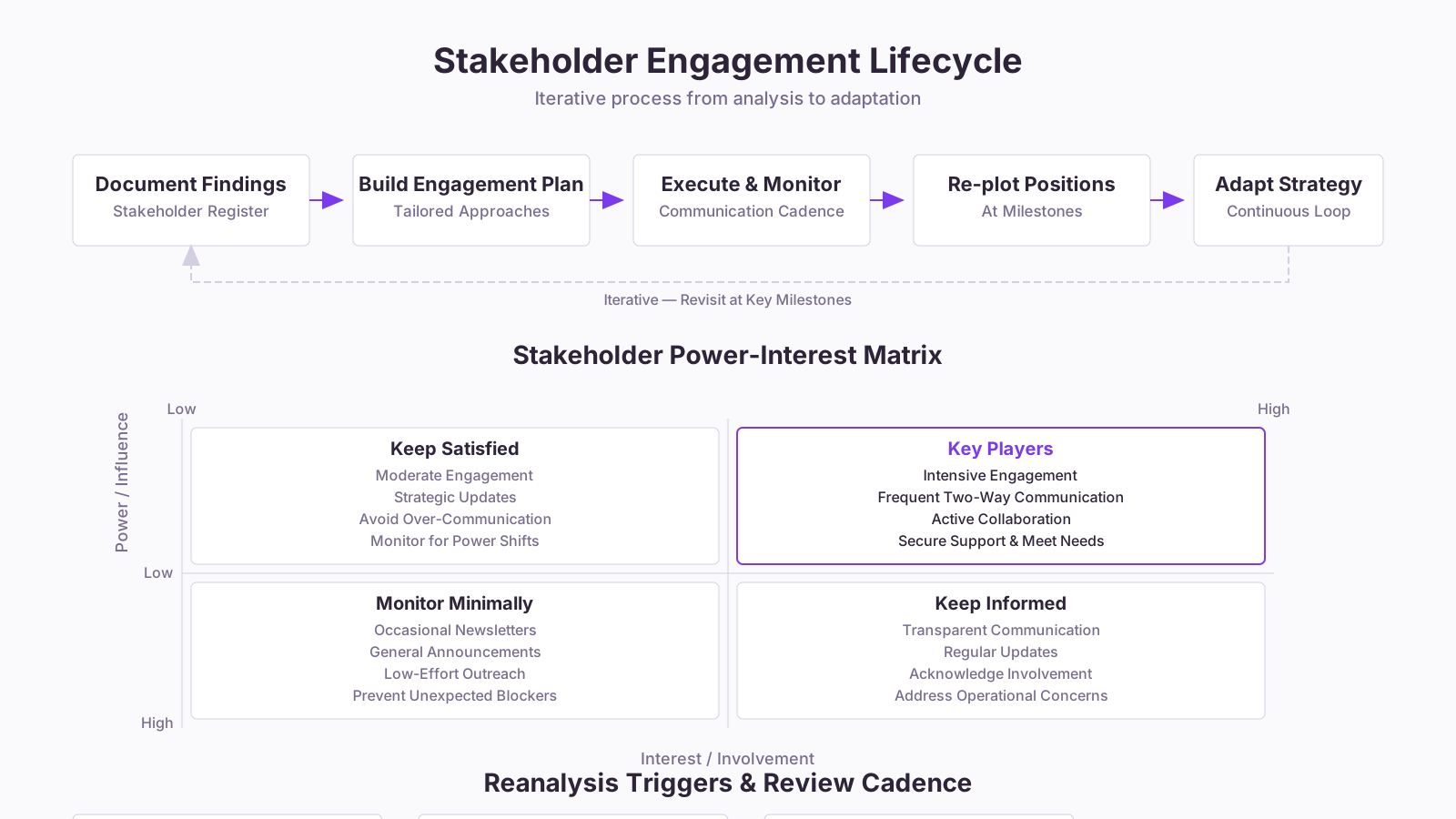
The power/interest grid is perhaps the most widely taught and immediately intuitive model. It groups stakeholders based on their level of authority, which is power, and their level of concern or curiosity regarding the project outcomes, which is interest. Stakeholders with high power and high interest must be managed closely, with frequent, in-depth interactions that address their concerns and harness their influence. Those with high power but low interest require a keep satisfied strategy, which often means providing summaries that reassure them the project is on track and their key expectations are being met, without overwhelming them with detail. Low-power, high-interest stakeholders need to be kept informed, as their enthusiasm can be cultivated into valuable advocacy, while low-power, low-interest groups can be monitored with minimal effort until circumstances change. It is a deceptively simple tool that, when applied rigorously, reveals exactly where your communication energy should flow.
The power/influence grid shifts the second dimension from passive concern to active involvement. Here, influence refers to the stakeholder’s capacity to affect the project’s direction through informal networks, persuasion, or technical authority, even if they lack formal hierarchical power. A senior architect who does not manage a large team but whose technical opinions guide technical direction can be highly influential. Misclassifying such a person as low-power because they lack direct reports is a classic error. The influence/impact grid, on the other hand, focuses on active involvement again, but pairs it with the stakeholder’s ability to effect changes to the project’s planning or execution. This grid is particularly useful when you suspect that a stakeholder’s influence is not matched by an equal ability to actually alter baselines; you avoid over-investing in someone who talks a lot but cannot shift resources or scope.
The salience model adds a layer of sophistication by describing classes of stakeholders based on the intersection of three attributes: power (ability to impose their will), urgency (need for immediate attention), and legitimacy (whether their involvement is appropriate). A stakeholder who possesses all three attributes is definitive and demands immediate, sustained engagement. Those with only two attributes form expectant, dangerous, or dominant groups, each requiring a tailored strategy. The advantage of the salience model is that it forces the project manager to consider whether a stakeholder’s claim is actually legitimate or simply loud. Sometimes a person urgently demands attention but has no real legitimacy in the project context, and investing time in them would be wasteful. The model provides a vocabulary to discuss these nuances with sponsors and team members who may be unfairly swayed by noise.
Choosing which grid or model to use depends on the complexity of the stakeholder environment and the culture of the organization. In a highly political setting, the salience model often reveals uncomfortable truths that a simple power/interest grid obscures. In a straightforward internal project with clear hierarchies, the power/interest grid may be completely sufficient. The key is not to treat any model as a rigid prescription but as a lens through which to evaluate and document your stakeholder landscape. Whichever model you select, the output should be a clear, visual representation that can be shared and discussed, turning an abstract social reality into a concrete planning artifact.
Step 3: Assess Likely Stakeholder Reactions and Plan Adaptive Engagement
After classification comes the nuanced work of assessing how key stakeholders are likely to react or respond in various situations, so you can plan how to influence them to enhance their support and mitigate potential negative impacts. Anticipating stakeholder reactions to project events is an inherently judgment-based activity, but it can be grounded in past behavior, expressed concerns, and the alignment between their interests and the project’s direction. For a stakeholder classified as high power and high interest, you might ask: “If a key milestone slips, will they escalate, withdraw support, or offer help?” The answer shapes whether your mitigation plan involves early warnings, additional resourcing commitments, or face-to-face reassurance meetings before the slippage becomes public.
This assessment also reveals latent conflicts between stakeholders. One stakeholder may support an aggressive timeline because it accelerates a departmental benefit, while another may resist it because it risks quality. By mapping these tensions, you can proactively design engagement strategies that address the conflict rather than letting it fester until a steering committee meeting where it erupts publicly. Smart project managers seed informal conversations where the conflicting parties can hear each other’s constraints in a low-pressure setting, often facilitated by the sponsor. This transforms the stakeholder analysis from a passive mapping tool into an active conflict-resolution instrument.
Another critical output of this step is a set of tailored messages and communication cadences. The high-power, low-interest executive who falls into the “keep satisfied” quadrant does not need weekly detailed status reports. They need a quarterly executive summary that highlights progress against their top three concerns and flags any decisions required from them. The low-power, high-interest operational staff members in the “keep informed” quadrant might benefit from a monthly newsletter or a brief demo session where they can see tangible progress and feel heard. Failing to differentiate these approaches leads to communication fatigue on one end and perceived neglect on the other. Effective stakeholder engagement is not about sending more information; it is about sending the right information to the right people at the right frequency.
Key Takeaways on Adaptive Engagement
- Grounded judgment-based reaction assessment
- Predicting stakeholder reactions draws on past behavior, voiced concerns, and the alignment of their interests with the project trajectory, turning intuition into a disciplined, evidence-based judgment.
- Mitigation shaped by likely responses
- When a milestone slips, evaluating whether a high-power, high-interest stakeholder will escalate, withdraw support, or offer help directly determines the mitigation approach, whether that means early alerts, added resources, or confidential reassurance sessions.
- Adaptive engagement across stakeholder types
- Conflict mapping enables informal, sponsor-led conversations that defuse tensions, and communication frequency is tailored by quadrant, with keep satisfied executives receiving concise summaries while keep informed operational staff are updated through newsletters or demos.
Tools and Techniques for Comprehensive Stakeholder Identification
Moving from theory to practice, the question becomes: how do you populate that initial stakeholder list in a way that avoids the obvious gaps? The most reliable approach combines structured brainstorming with expert judgment. Leveraging expert judgment for stakeholder identification means tapping into individuals or groups with specialized training or knowledge of the subject area. This goes well beyond asking the sponsor for a list of names. You seek input from senior management who understand strategic implications, from other units within the organization that have interfaced with similar initiatives, and from identified key stakeholders themselves who often know the informal power structures that no org chart captures. You also consult project managers who have worked on projects in the same area, either directly or through lessons learned repositories, because they have already experienced the pain of missing a critical stakeholder and can warn you about it.
Subject matter experts (SMEs) in the business or project area are another rich source. A seasoned SME knows which regulatory bodies silently approve permits, which internal audit groups can freeze budgets, and which external consultants hold sway over executive decisions. Industry groups and consultants, as well as professional and technical associations, can provide external perspectives that internal teams rarely consider. In a project that deploys a new technology, the vendor’s technical account manager might warn you that the enterprise architecture team, though not listed in the project charter, has veto power over integration patterns. That insight saves months of rework. Expert judgment can be obtained through individual consultations such as one-on-one meetings or interviews, or through a panel format including focus groups and surveys, depending on the number of people you need to involve and the sensitivity of the topics being discussed.
An underused technique is to review the lessons learned from previous, similar projects. Those documents rarely state “we failed because we missed stakeholder X” in those exact words, but a careful reading often reveals symptoms: repeated scope changes from a department that was never consulted, last-minute quality objections, or funding freezes that originated from an overlooked budget holder. By extracting stakeholder-related root causes from past projects, you can create a checklist of categories to explore. This transforms tribal knowledge into a repeatable method, reducing the risk that a new project manager must learn the same painful lesson again.
Common Pitfalls in Stakeholder Analysis and How to Avoid Them
Despite clear methodologies, stakeholder analysis routinely fails in predictable ways that experienced practitioners learn to guard against. Overreliance on a single classification grid is one such pitfall. A project manager who uses only the power/interest grid may miss the subtlety that a stakeholder has low formal power but extremely high influence due to personal relationships with the CEO. That stakeholder ends up in the “monitor” quadrant when they should be managed closely. Using a second model, like the salience model, as a cross-check catches these discrepancies. The slight extra effort pays off when you avoid being blindsided by an influence-based intervention that you did not anticipate.
Another common failure is treating stakeholders as static entities. People’s interests change as the project reveals its real impact. A department that initially supported a new system because it promised headcount reduction may turn hostile when they realize that the reduction will come from their own team. If you never revisit your initial analysis, you will continue to engage them as supporters long after they have become actively resistant. Building a lightweight review cycle, perhaps every two months or at every major deliverable acceptance, allows you to detect these shifts early. It also sends a signal to stakeholders that you are paying attention to their evolving concerns, which in itself is a trust-building activity.
There is also a cognitive bias worth acknowledging: project managers tend to overestimate the interest of stakeholders who are vocal and underestimate the power of those who are silent. The quiet compliance officer who never speaks in meetings but can issue a stop-work order is far more dangerous than the middle manager who complains weekly. Good stakeholder analysis deliberately seeks out the silent powerful, using organizational knowledge and behind-the-scenes conversations to surface them. It takes courage to spend time on a stakeholder who does not demand it, but that is precisely the discipline that separates reactive management from proactive leadership.
Key Insights on Stakeholder Pitfalls
- Cross-check with multiple models
- Evaluating stakeholders solely through a power/interest grid can misclassify those with limited formal authority but considerable informal clout; cross-checking with a second lens, such as the salience model, highlights these hidden discrepancies.
- Review stakeholder attitudes regularly
- Stakeholder stances can change abruptly, as when a department becomes hostile after headcount reductions affect its own team, so a quick review every two months or at major milestones is critical.
- Beware the vocal stakeholder bias
- Project managers often overvalue the input of vocal stakeholders and undervalue silent authority figures, like a compliance officer with stop-work power, leaving critical voices dangerously overlooked.
- Invest in quiet stakeholders proactively
- Engaging stakeholders who rarely speak up takes deliberate discipline, and that proactive investment is what elevates a project manager from reactive responder to strategic leader.
The Role of Stakeholder Analysis in Broader Project Management Frameworks
Stakeholder analysis is not an isolated exercise; it feeds into virtually every other process in project management. In PMBOK, the Stakeholder Register that emerges from this analysis is a key input to the Plan Stakeholder Engagement process, which then informs the Communications Management Plan and the Risk Register. Integrating stakeholder analysis with communication planning ensures that your message distribution is not based on guesswork but on a validated understanding of who needs what information, when, and in what format. For instance, the high-power, low-interest stakeholder’s preference for a quarterly dashboard directly shapes the communications calendar, while the high-power, high-interest stakeholder’s need for weekly detailed status updates dictates the reporting rhythm. Without the analysis, communications become generic and ultimately ineffective.
In PRINCE2, the stakeholder analysis informs the Communication Management Strategy, which is part of the Organization theme. The project board and other stakeholders are mapped not just by role but by their information needs and the frequency of engagement. PRINCE2’s emphasis on management by stages means that stakeholder analysis must be reviewed at each stage boundary, aligning with the principle of continued business justification. If a stakeholder’s interest has waned to the point where they no longer see value, that may signal a broader issue that the project board needs to address. The connection between stakeholder sentiment and business case viability is often underestimated until a project loses its sponsor’s attention.
Agile and Scrum environments treat stakeholder analysis through the lens of continuous feedback. The Product Owner role is fundamentally a stakeholder proxy, responsible for understanding the needs of customers, users, and other interested parties, and prioritizing the Product Backlog accordingly. However, even in Scrum, a formal stakeholder analysis outside the Product Owner’s personal network can reveal groups that the Product Owner has inadvertently neglected. Sprint Reviews are an excellent forum for testing the accuracy of your stakeholder map, because you observe who shows up, who asks questions, and who seems disengaged. These observations feed back into the analysis, making it a living artifact that evolves with the product. Some Scrum teams maintain a simple stakeholder persona map that they update based on Sprint Review feedback, keeping the entire Scrum team aligned on who they are building for and why.
From a Business Value-Oriented Project Management (BVOPM) perspective, stakeholder analysis connects directly to the principle of transparent documentation that is accessible to all roles, including new joiners. BVOPM mandates that planning documents be brief and readable by everyone, which means your stakeholder engagement plan cannot become a bloated, inaccessible artifact. It also introduces hiring-and-training-based dependency analysis, where the availability of skilled people in stakeholder organizations becomes a factor in engagement planning. If a key stakeholder’s department is undergoing restructuring and losing critical knowledge workers, your assumption about their ability to support the project must be adjusted. This adds a human-capacity lens to the usual power-interest calculations.
Practical Application of Stakeholder Analysis in Different Project Types
The way you conduct stakeholder analysis shifts depending on the project’s scale, complexity, and sector. In a small internal software improvement project, the analysis might happen in a single two-hour workshop with the core team, resulting in a simple power/interest grid on a whiteboard. The emphasis is on speed and practicality; you do not need a salience model for a project with eight stakeholders. In contrast, a large public infrastructure program involving regulators, community groups, politicians, and multiple contractors demands a much more formal, documented process. Tailoring stakeholder analysis to project complexity means that you scale the rigor up or down without abandoning the core logic of identification, classification, and reaction assessment. The same mental steps apply, but the tools and the depth of documentation vary.
For programs that span multiple projects, stakeholder analysis operates at multiple levels. At the program level, you analyze stakeholders whose interests cut across all component projects, such as the program steering committee and the portfolio governance body. Then each component project performs its own analysis, focusing on local stakeholders while inheriting the program-level map. The program manager must reconcile overlapping engagements so that a stakeholder is not receiving conflicting messages from two different project teams. This requires a consolidated stakeholder register at the program level and regular cross-project briefings where communication plans are aligned. Without this coordination, a powerful stakeholder might be classified as low-interest by one project’s team and high-interest by another’s, leading to inconsistent treatment that erodes trust.
In highly regulated industries like pharmaceuticals or financial services, stakeholder analysis must explicitly include compliance and audit stakeholders who may not be involved in day-to-day operations but hold veto power at key approval gates. These stakeholders often have zero interest in the project’s technical achievements but extremely high power when it comes to sign-offs. A stakeholder analysis that lumps them into “monitor” because they show low interest is dangerously incomplete. They require a keep-satisfied approach, with proactive regulatory briefings and early sharing of evidence that will be required for approvals. The cost of missing this nuance can be measured in months of delay and millions in lost revenue.
Key Takeaways on Tailoring Analysis
- Scale rigor to project complexity
- Small internal projects can be effectively managed through brief workshops and a simple power/interest grid, while major programs require formal, documented processes that scale analytical depth in proportion to the project’s complexity.
- Program-level coordination prevents stakeholder conflicts
- Program managers must unify stakeholder registers and coordinate communication plans across projects to prevent high-power stakeholders from encountering conflicting messages or inconsistent treatment from different teams.
- Include compliance stakeholders in regulated sectors
- In regulated industries such as pharmaceuticals and financial services, stakeholder analysis must explicitly identify compliance and audit stakeholders who, though rarely involved in daily activities, hold veto authority at critical approval gates.
Developing a Stakeholder Engagement Plan from the Analysis
The stakeholder analysis is not the end product; it is the analytical engine that drives the stakeholder engagement plan. Once you know each stakeholder’s classification and likely reactions, you can define specific engagement strategies and actions for each segment. For a high-power, high-interest stakeholder, the plan might include weekly one-on-one touchpoints, an explicit role in change control board meetings, and a quarterly satisfaction survey to detect shifts in their support. For a low-power, high-interest stakeholder, the plan could involve bi-weekly demo sessions where they can ask questions and feel included, plus a quarterly newsletter highlighting upcoming features that matter to them. The engagement plan transforms abstract classification into a calendar of concrete activities with assigned owners, typically the project manager, sponsor, or workstream leads.
What often gets overlooked is the need to include the sponsor in the execution of the engagement plan. The sponsor is uniquely positioned to manage high-power stakeholders, especially those who are peers or superiors in the organizational hierarchy. A project manager cannot effectively manage closely a CFO who has high power and high interest; that relationship must be owned by the sponsor or an executive champion. The stakeholder analysis makes this visibility possible, because it flags which stakeholders fall outside the project manager’s span of influence. Explicitly assigning sponsor-led engagement actions to these individuals ensures that they do not become communication black holes. This upstream delegation is a mark of mature stakeholder management.
The engagement plan also incorporates metrics to gauge effectiveness. Rather than simply measuring whether meetings were held, you track indicators like the number of unresolved concerns raised in steering committees, the speed of decision-making on change requests, and the recurrence of previously addressed objections. If a stakeholder repeatedly raises the same issue despite multiple engagements, that signals a fundamental misalignment that your classification may have missed. This feedback loop closes the circle, allowing the engagement plan to be refined based on evidence, not just intuition. In this sense, stakeholder analysis and engagement planning become a continuous improvement cycle rather than a one-off deliverable.
Stakeholder Analysis as a Risk Management Enabler
There is a deep but often unstated connection between stakeholder analysis and risk management. Every stakeholder represents a potential source of risk, either as a threat if they oppose the project or as an opportunity if they champion it. Using stakeholder analysis to inform risk identification means that when you map a stakeholder’s likely reaction to certain scenarios, you are effectively cataloguing triggers for risk events. A stakeholder who the analysis reveals will escalate aggressively if the project exceeds budget by ten percent becomes the basis for a financial risk that you log in the risk register with a specific owner and response strategy. This integration between stakeholder and risk registers eliminates duplicated effort and ensures that risk responses are socially plausible, not just technically sound.
Conversely, positive risks, or opportunities, often arise from stakeholders whose influence can be harnessed to accelerate adoption, secure additional funding, or remove bureaucratic barriers. The stakeholder analysis identifies these potential allies, and the engagement plan then deliberately cultivates them. Perhaps you invite a supportive department head to co-present the business case at the next portfolio review, leveraging their credibility. These upside risks are just as important as downside threats, and failing to link stakeholder analysis to risk management means you treat supporters as passive recipients of information rather than as active agents who can shift project trajectory.
At the program level, the cumulative stakeholder risks across projects can reveal systemic issues. If three projects independently identify the same regulatory stakeholder as likely to impose delays, the program manager can escalate a coordinated regulatory strategy rather than each project fighting its own battle. This aggregation only works if the stakeholder analyses across the program are consistent and shared. Siloed stakeholder analyses lead to fragmented risk responses and wasted effort. Therefore, establishing common classification criteria and a shared taxonomy across projects is an investment that pays off in the risk management efficiency of the program.
Key Takeaways on Stakeholder Risk
- Stakeholders as risk sources
- Stakeholders inherently carry risk: they can become threats by opposing the project or opportunities by championing its success.
- Scenario mapping catalogs triggers
- By mapping each stakeholder's probable responses to different scenarios, you systematically identify the triggers that should be recorded as risk events in the register.
- Integrated registers reduce duplication
- Integrating the stakeholder and risk registers reduces redundant work and ensures that risk responses are both socially feasible and technically sound, rather than overlooking the human dimension.
- Upside risks from supporters
- Upside risks emerge from supportive stakeholders whose influence can be leveraged to speed up adoption, unlock extra funding, or dismantle bureaucratic obstacles.
- Shared taxonomy enables coordination
- Using consistent classification criteria and a common taxonomy across projects enables program managers to elevate coordinated strategies, such as orchestrating a unified response to regulatory challenges.
Maintaining and Updating the Stakeholder Analysis Over Time
A static stakeholder analysis is barely better than no analysis at all. Projects are organic, and the people surrounding them change roles, attitudes, and priorities constantly. Maintaining a living stakeholder register through iterative updates requires a lightweight process that does not become bureaucratic overhead. The simplest approach is to attach a stakeholder review agenda item to existing recurring meetings such as weekly core team syncs or monthly steering committee prep sessions. Ask a simple trigger question: “Has anything changed in the last month that might affect a stakeholder’s power, interest, or attitude?” The answers may come from unexpected sources; a team member might mention that a key department head just announced retirement, instantly altering the power landscape.
When updating, you must also re-evaluate your communication approaches. A stakeholder whose interest has spiked due to a recent operational problem may need to be moved from “keep informed” to “manage closely” for a period, with a temporary increase in interaction frequency. Failure to adjust can make you appear tone-deaf. Some project managers resist these changes because they imply the original analysis was incomplete, but that perspective is misguided. Changes in stakeholder dynamics are not a reflection on the quality of the initial analysis; they are a natural consequence of organizational life. Mature practitioners expect and welcome them as signs that they are paying attention.
One of the most valuable but difficult updates is removing stakeholders who have genuinely exited the project’s sphere of influence. People change jobs, departments get reorganized, and some individuals simply lose relevance. Keeping them in the register clutters the engagement plan and wastes effort. However, you must be certain they are truly out of scope; severing a stakeholder relationship prematurely can cause bitter feelings if they later discover they were ignored. A safe practice is to confirm the change through a brief conversation or by observing a formal role change announcement before archiving their record. The stakeholder register then stays clean and actionable.
Connecting Stakeholder Analysis to Organizational Culture
No stakeholder analysis method works in a cultural vacuum. Organizations with a high power-distance culture might resist the open discussion of influence that the salience model requires, preferring instead to operate through unwritten rules that everyone knows but nobody documents. Adapting stakeholder analysis to organizational culture means you must sometimes be indirect. Instead of labeling someone as “high power” in a shared document, you might use softer language like “key decision-maker” and discuss power dynamics orally in confidential sessions with the sponsor. The goal is to protect the integrity of the analysis while respecting the cultural norms that could trigger defensiveness if violated.
In highly collaborative, flat organizations, stakeholder analysis can be conducted more transparently, even with the stakeholders themselves. You might run a stakeholder mapping workshop where participants place themselves and others on a power/interest grid, discussing openly why they see certain groups as influential. This builds collective understanding and often surfaces hidden dependencies that no single person would have articulated. The facilitator must manage the potential for posturing, but the outcome is a richer, more shared map that carries immediate buy-in rather than being perceived as a secretive management tool.
Irrespective of culture, the stakeholder analysis should never become a political weapon. Labeling someone as “blocker” or “detractor” can leak into informal conversations and damage relationships. The language of classification models, such as “manage closely” or “keep satisfied,” is deliberately neutral and action-oriented. It describes the required engagement strategy, not moral judgment about the person. Defending this neutrality is part of the project manager’s ethical duty and preserves the trust needed for honest stakeholder interactions over the long haul.
Core Insights on Culturally Adapted Analysis
- Cultural adaptation is mandatory
- Stakeholder analysis fails when applied uniformly across cultures; project managers must adapt their techniques to align with the organization’s prevailing norms and communication styles.
- High power-distance sensitivity
- In high power-distance settings, stakeholders avoid overt discussions of influence and rely instead on unwritten hierarchies, making conventional power mapping far less effective.
- Soft language and confidential dialogue
- Sensitive power dynamics are best captured by using neutral labels such as "key decision-maker" in formal documents, while reserving candid discussions of real influence for confidential, one-on-one conversations with the sponsor.
- Transparent workshops for flat cultures
- In egalitarian, flat cultures, interactive stakeholder mapping workshops enable participants to self-place on a power/interest grid, revealing hidden dependencies and fostering immediate collective ownership of the analysis.
- Neutrality preserves long-term trust
- Maintaining strict neutrality is both an ethical imperative and a practical necessity, as it preserves the trust that underpins candid, long-term stakeholder dialogue.
Leveraging Technology and Data for Stakeholder Analysis
Modern project management information systems can support stakeholder analysis in ways that go beyond static spreadsheets. While the core thinking remains human, using digital tools to map stakeholder networks can visualize relationships that are otherwise hard to track. Some platforms allow you to create stakeholder maps with connections showing who reports to whom, who influences whom, and who shares common interests. These visualizations become powerful when you need to explain to a new team member why a seemingly minor stakeholder is actually central because of their bridging role between two powerful groups. The visual map communicates structural importance instantly.
Data from communication tools can also inform the analysis. If your organization uses enterprise social networks or collaborative platforms, you can sometimes observe which stakeholders actively engage with project content, who shares it, and who ignores it. This behavioral data provides a reality check against self-reported interest levels. A stakeholder whose classification says “high interest” but who never clicks on any project update link might actually be indifferent, and you may be over-serving them while under-serving others. Ethical considerations apply, of course; monitoring engagement should be transparent and used only for aggregate pattern recognition, not for individual surveillance.
Another technological aid is the automated stakeholder feedback cycle. After key milestones, you can use survey tools to pulse stakeholder sentiment and feed the results back into the analysis. A persistent decline in satisfaction from a previously supportive group can be detected earlier than by waiting for face-to-face encounters. This does not replace personal relationships, but it provides a safety net for busy project managers who cannot meet everyone as often as they would like. The combination of periodic surveys, communication analytics, and visual mapping elevates stakeholder analysis from a manual, episodic activity to a continually informed practice.
Teaching Stakeholder Analysis to Project Teams
One of the lasting benefits of conducting a stakeholder analysis is that it educates the entire project team about the social reality of their work. Technical team members often underestimate how much of a project’s success depends on human factors, and participating in the analysis opens their eyes. Building stakeholder awareness within the project team starts with a simple workshop where you walk through the identified stakeholders, their interests, and the engagement strategies. As soon as a developer understands that the QA manager she never met has high power to reject a release, her behavior changes. She begins to include testability considerations earlier, not because a process told her to, but because she now sees the person behind the requirement.
This team-level education also distributes the responsibility for stakeholder management. The project manager cannot be the only person nurturing relationships; workstream leads and senior team members must engage their counterparts in stakeholder organizations. Giving them a structured understanding of which stakeholders fall into which quadrant empowers them to adjust their own interactions. They learn that when they are asked to demo a feature to a high-power, high-interest user group, they should be prepared for detailed scrutiny and should report any concerns back immediately. This distributed intelligence reduces the burden on the project manager and builds a network of stakeholder sensors that catches early warnings.
Over time, teams that are repeatedly involved in stakeholder analysis develop a kind of organizational intuition. They begin to ask, during sprint planning or design sessions, “Have we checked with the compliance stakeholder about this?” without being prompted. This cultural shift is the ultimate measure of stakeholder analysis maturity, because it means the practice has moved from a formal process step to an ingrained habit of mind. When a team collectively owns stakeholder awareness, the project becomes far more resilient to political and social turbulence.
Building Team-Wide Stakeholder Awareness
- Education through analysis
- Engaging technical team members directly in stakeholder analysis reveals how profoundly interpersonal dynamics and hidden interests shape project outcomes, often outweighing purely technical considerations.
- Workshops change developer behavior
- A concise workshop that maps stakeholder power and core concerns helps developers see the people behind every requirement, enabling them to anticipate needs and adjust their deliverables before friction arises.
- Distributed stakeholder engagement
- Workstream leads and senior contributors can use the quadrant framework to strategically manage counterpart relationships, tailoring communication frequency and depth to each stakeholder’s influence and interest profile.
- Network of stakeholder sensors
- Team-wide fluency in stakeholder dynamics creates a distributed early-warning system that catches subtle shifts in expectations, relieving the project manager from being the sole radar and hardwiring continuous stakeholder sensing into daily habits.