Identifying project stakeholders is one of those activities that feels straightforward at first glance, yet consistently trips up even experienced project managers. You sit down with the project charter, scan through some procurement files, and start listing names. But the real challenge isn’t making the list; it’s knowing where to look and what to document once you’ve found the right people. The Identify Stakeholders process, as outlined in standard project management frameworks, is the systematic effort to pinpoint every person, group, or organization that can affect or be affected by the project, and then record their interests, their expected level of involvement, and the degree to which they might influence outcomes. It sounds like simple data gathering, but in practice it’s an exercise in organizational archaeology. You have to dig through formal documents, read between the lines of contracts, and pick up on unstated assumptions that the project charter simply cannot spell out. If you skip that depth, you end up with a stakeholder list full of the obvious players and none of the peripheral ones who can quietly redirect your budget or kill your timeline with a single email.
Key Topics: Identify Stakeholders & Document Interests
| Key Concept | Summary |
|---|---|
| Identify Stakeholders | A systematic effort to discover all individuals and groups who can influence or be impacted by the project, capturing their interests, level of involvement, and influence to inform engagement strategies. |
| Stakeholder Register | The primary output is a comprehensive stakeholder register that documents each party’s name, role, contact details, interests, expectations, and assessed influence level, creating a foundation for tailored communication and management. |
| Dynamic Baseline | The register evolves continuously; it is reviewed and refreshed throughout planning, execution, and closure to reflect new influencers, shifting priorities, and changing power dynamics. |
| Procurement Documents | Procurement documents formally engage external entities, expanding the stakeholder landscape to include contract managers, vendors, and supplier organizations’ internal stakeholders, each introducing distinct interests and risks. |
| PRINCE2 Approach | Under PRINCE2, a comparable stakeholder identification activity is embedded within project startup and initiation, where the project board and senior user role ensure that end users’ perspectives are adequately represented. |
| Agile Approach | Agile practices often concentrate stakeholder identification in the product owner role, yet teams must broaden their focus to include procurement, regulatory compliance, and infrastructure groups that are frequently overlooked but essential for delivery. |
| Assumption Risk | Neglecting deep stakeholder analysis leads the project manager to operate on an idealized plan disconnected from the organization’s actual political and operational realities, inviting resistance and unforeseen obstacles. |
| Sponsor and Departments | While the executive sponsor is readily identifiable, the business case typically references internal departments whose managers, end users, and support personnel will experience operational changes, making their early identification crucial for effective change management. |
What Exactly Is the Identify Stakeholders Process?
The Identify Stakeholders process sits at the very beginning of the project lifecycle, typically inside the Initiating process group and the Project Stakeholder Management knowledge area in PMBOK‑aligned frameworks. Its core output is a stakeholder register that captures names, roles, contact points, and a structured assessment of each stakeholder’s interests, expectations, and potential impact. The process doesn’t assume you’ll get everything perfect on day one. Instead, it sets up a dynamic baseline that you’ll revisit during planning, execution, and even closing when new influencers emerge or when someone’s priorities shift. The inputs mentioned explicitly include the project charter and any available procurement documents, and these two sources often contain more information than people realize. A project charter names the sponsor, outlines high‑level risks and constraints, and describes the business case. Procurement documents, on the other hand, bind external organizations to the project, creating a web of interests that range from contract managers and legal teams to suppliers’ own internal stakeholders who may never show up on a project org chart.
In a PRINCE2 environment, the equivalent activity is folded into the “Starting Up a Project” and “Initiating a Project” processes, where the project board is defined and the senior user role ensures the end‑user perspective is represented. Agile teams often compress this into the product owner role, who acts as the voice of the customer, but even the most Scrum‑purist team will need to expand that view when they interact with procurement, compliance, or infrastructure groups that sit outside the immediate product family. What all approaches share is the recognition that skipping proper stakeholder identification creates an information vacuum. When that vacuum fills with assumptions, the project manager ends up managing a version of the project that exists only in their head, not the messy, multi‑dimensional reality of organizational life.
The source material underscores that the process is about documenting relevant information regarding interests, involvement, and impact on project success. That little word “relevant” does a lot of heavy lifting. Not every stakeholder detail belongs in the register. You filter for what will actually inform engagement strategies, risk planning, and communication frequency. A stakeholder’s family background or their preference for morning meetings is irrelevant unless it directly affects how they interact with the project. Keeping the documentation lean is a survival skill, because bloated registers become obsolete faster than anyone can update them.
Core Insights on Stakeholder Identification
- Early project lifecycle process
- The Identify Stakeholders process is positioned at the project's inception, as part of the Initiating process group and the Project Stakeholder Management knowledge area in PMBOK-aligned frameworks.
- Stakeholder register as core output
- The process yields a stakeholder register that captures each stakeholder's name, role, contact details, interests, expectations, and potential impact on the project.
- Dynamic baseline revisited often
- The initial assessment is treated as a living baseline that undergoes continuous refinement throughout planning, execution, and closing as new influencers emerge and priorities shift.
- Charter and procurement inputs
- The project charter identifies the sponsor and highlights key risks and constraints, while procurement documents expose external entities and informal stakeholder networks often absent from organizational charts.
- Approaches vary across frameworks
- PRINCE2 integrates stakeholder identification into its project startup procedures, centered on a clearly defined project board, whereas Agile methodologies often consolidate this responsibility within the product owner role, while still requiring deliberate attention to external functions such as procurement and compliance.
How the Project Charter Drives Stakeholder Discovery
The project charter is often the first official document to see daylight, and it acts as a critical input for stakeholder identification because it contains the project’s fundamental DNA. The sponsor is named, the high‑level objectives are stated, and the key assumptions and constraints are listed. Each of those elements points directly toward someone who has skin in the game. The named sponsor is the most obvious stakeholder, but the charter’s description of the business case usually references internal departments or customer segments that will benefit from the outcome. Those departments are rarely monolithic; they contain managers, end users, and support staff whose daily work will be reshaped by whatever the project delivers.
Decoding the Charter for Hidden Stakeholders
The charter’s high‑level risk section is another goldmine. When a charter states that “regulatory compliance is a potential risk,” you immediately know that the legal department, compliance officers, and possibly external auditors are stakeholders who need a voice. The schedule milestones and budget constraints mentioned in the charter also imply stakeholders. Finance controllers, procurement approvers, and even the executives who sign off on phase gates become part of the web because their decisions are tied to those constraints. A common oversight is to treat the charter as a static approval document rather than a map of relationships. Read with a stakeholder lens, it can reveal who will care if the budget slips, who will celebrate if the timeline holds, and who will panic if the scope drifts.
Consider a charter for a software rollout that mentions integration with an existing legacy system. That single phrase means the legacy system’s maintenance team, the database administrators who support it, and the business analysts who understand its data flows all have an interest. They may not appear anywhere else in early documentation, but the charter has already signaled their existence. The project manager who underlines that phrase and then walks over to the legacy team’s floor will uncover several layers of stakeholders well before the first formal planning meeting.
Using Procurement Documents to Identify External Stakeholders
Procurement documents extend the stakeholder map beyond the organization’s walls. A request for proposal, a statement of work, or an existing supplier contract names specific companies and often individuals who will deliver products or services. These documents hint at external stakeholder groups hiding in procurement documents that internal planning might otherwise miss. A vendor’s project manager, their technical lead, their quality assurance coordinator, and even their key subcontractors all represent nodes in a network of dependencies. If the project depends on a vendor’s delivery, then every person in that vendor’s chain who can delay, accelerate, or alter the deliverable qualifies as a stakeholder worth documenting.
Tracing the Ripples in Supply Agreements
Procurement documents also reveal something less obvious: the stakeholders within your own organization who handle the contractual relationship. The procurement officer who negotiated the terms, the legal counsel who reviewed liability clauses, and the accounts payable team that will process invoices are all stakeholders whose interests are directly tied to the contract’s execution. Their involvement may seem administrative, but a dispute over payment terms can halt progress faster than a technical fault. Furthermore, the acceptance criteria defined in procurement documents create a group of evaluators. Anyone who will test, review, or formally sign off on a vendor deliverable has a vested interest in the project’s quality outcomes and should appear in the stakeholder register with a clear note about their acceptance role.
External regulatory bodies sometimes surface through procurement language as well. A contract that stipulates adherence to environmental standards, data protection laws, or industry certifications pulls in auditors and certification agencies who may need to inspect outputs or processes. Ignoring these external overseers until they show up uninvited can lead to rushed compliance fixes and strained relationships. Documenting them early, even if their interactions are infrequent, gives the project manager the lead time to schedule reviews or prepare evidence packs well in advance.
Core Insights on Procurement Stakeholder Mapping
- Vendor teams as dependency nodes
- Procurement documents surface external companies and their key contacts, including vendor project managers, technical leads, quality assurance coordinators, and subcontractors, whose influence over delivery schedules and outcomes warrants their inclusion as stakeholders.
- Internal contract relationship handlers
- The procurement officer, legal counsel, accounts payable team, and anyone responsible for testing, reviewing, or formally signing off on vendor deliverables are internal stakeholders whose interests are directly tied to contract execution.
- Compliance-driven external reviewers
- Contracts imposing environmental standards, data protection laws, or industry certifications add auditors and certification bodies to the stakeholder register, as their authority to inspect outputs or processes directly influences project compliance and sign-off.
- Early documentation for lead time
- Recording these procurement-derived stakeholders early, even when their involvement is infrequent, gives the project manager the lead time needed to schedule reviews and prepare comprehensive evidence packs well in advance.
How to Document Stakeholder Interests and Impact
Documentation is where the thoughtful analysis crystallizes into something usable. The stakeholder register is the central artifact for documenting stakeholder interests and influence, and it needs to go beyond a simple contact list. For each stakeholder or group, you want to capture their expectations, their level of influence over decisions, their attitude toward the project, and any interdependencies with other stakeholders. This information guides communication planning. A stakeholder who is highly influential but skeptical about the project requires a different engagement strategy than one who is supportive but lacks formal authority.
Structuring the Stakeholder Register for Clarity
A practical register includes a classification that helps you prioritize effort. Many project managers use a power‑interest grid, plotting stakeholders on axes of influence and concern. Those with high power and high interest need close management; those with low power and low interest need only monitoring. The register text should explain why someone landed in a particular quadrant, not just label them. For instance, the finance director might have high power due to budget control and high interest because the project affects quarterly reporting, so a brief annotation in the register clarifies that connection. Without that rationale, someone picking up the register later won’t know whether a stakeholder’s classification was based on evidence or guesswork.
Beyond power and interest, it’s valuable to document specific information needs. A compliance officer doesn’t care about sprint velocity; they need to see audit trails and test results. A marketing director wants to know go‑live dates and feature descriptions. Recording these in the register prevents the project manager from defaulting to a one‑size‑fits‑all status report that satisfies nobody. The register then becomes a living document that adapts as people’s roles evolve or as the project moves through phases. When a stakeholder’s influence shifts because of an organizational restructuring, the register should reflect that and trigger a review of engagement activities.
Creating a Stakeholder Register That Works
The stakeholder register’s real value lies in its usability. A well‑structured stakeholder register is concise enough to scan quickly but detailed enough to guide action. If the register grows into a multi‑page spreadsheet with dozens of columns, it becomes a burden to maintain and loses credibility. The best registers I’ve seen stick to essential fields: name, role, contact details, interest summary, impact assessment, communication frequency, and the preferred channel. That minimal structure forces the project manager to distill what truly matters about each person or group instead of dumping raw interview notes into an endless text block.
One pattern that undermines the register’s usefulness is the habit of listing only named individuals. Groups, departments, and even the general public can be stakeholders. Documenting them as collective entities with identified representatives keeps the register clean while still acknowledging their presence. For example, “End‑user department: Billing Team (represented by Jane Smith)” captures both the group’s interest in process efficiency and Jane’s role as the communication conduit. If Jane leaves, you update the representative without re‑evaluating the entire stakeholder entry because the group’s fundamental interests remain stable.
Updating frequency matters more than most people admit. A register that sits untouched for six months is effectively useless. The project manager should schedule a brief review at the end of each phase or whenever a major change request is approved. Some teams treat this as a five‑minute agenda item in steering committee meetings: “Has anyone new surfaced? Have any priorities shifted?” That small habit catches the quiet stakeholder who was missed initially or the newly hired director who just inherited a project dependency.
Core Takeaways for Register Design
- Usability defines real value
- A stakeholder register justifies its existence only when it balances scannable brevity with the substance required to prompt meaningful action.
- Avoid bloated spreadsheets
- Registers that swell into multi-page documents crammed with dozens of columns become maintenance liabilities and quickly erode the team's confidence.
- Limit to essential fields
- The most effective registers restrict themselves to name, role, contact information, a concise interest summary, impact assessment, communication frequency, and preferred channel.
- Force distillation of data
- A lean field layout compels the project manager to synthesize only the information that truly matters, rather than transcribing raw interview notes.
- Represent groups with contacts
- Representing collective entities by named contacts, such as 'Billing Team (represented by Jane Smith)', keeps entries uncluttered and allows for straightforward personnel updates without reworking the entire register.
Overcoming Common Stakeholder Identification Pitfalls
The most damaging stakeholder identification mistake is omitting the indirect stakeholders who experience the project’s second‑order effects. When a manufacturing plant installs a new production line, the operators are obvious stakeholders, but the maintenance crew, the safety committee, and the union representative may go unnoticed until their concerns surface as resistance or work stoppages. Another frequent error is treating stakeholder identification as a solo activity. A project manager sitting alone with the charter and procurement documents will naturally miss perspectives. Gathering a small group of knowledgeable people—a sponsor, a senior user, a technical lead—and spending thirty minutes brainstorming the question “Who else cares?” can unearth names that a single viewpoint would never find.
Over‑identifying is a quieter but still real problem. When the register includes anyone who has ever sent an email about the project, it becomes noise. Stakeholders need to be people or groups with a genuine stake, not just recipients of informational broadcasts. Distinguishing between those two categories requires a clear definition: a stakeholder has the ability to influence, the potential to be impacted, or a decision‑making role that touches the project’s objectives. If someone falls into none of those categories, they belong on a distribution list, not in the register. Keeping this boundary sharp prevents stakeholder fatigue and protects the credibility of the engagement process.
Honestly, this is where many project managers trip up—they treat stakeholder identification as a box‑ticking exercise and then wonder why they get blindsided later when a regulatory agency demands a review or a facilities manager stops a deployment because no one told them about a space requirement. The formal inputs like the charter and procurement documents provide the skeleton, but human conversation fills in the muscles. Walking the floor, asking open‑ended questions, and noticing who gets copied on emails can reveal stakeholders that no document ever mentions by name.
The BVOP Approach to Stakeholder Involvement
Business Value‑Oriented Project Management introduces a pragmatic twist to stakeholder documentation, emphasizing that planning documents, including the stakeholder register, must be brief enough that a new team member can read and understand them without a lengthy onboarding session. This aligns with the BVOPM principle that concise stakeholder planning documents enable faster alignment and reduce the hidden costs of information handoffs. In practice, that means resisting the temptation to turn the register into an exhaustive thesis. Every field should earn its place by answering a direct question: “What does the next person need to know to engage this stakeholder effectively?” If a column doesn’t serve that purpose, it gets cut.
BVOPM also broadens the dependency analysis lens. Instead of only mapping contractual or technical dependencies, it encourages project managers to consider hiring and training dependencies when assessing stakeholder interests. For example, if a project output will require new skills from the operations team, then the training department, the HR recruitment lead, and the team leads who will lose staff time to training all become stakeholders with a direct interest in the project’s timing and success. This insight extends the traditional procurement‑focused stakeholder map into areas that many projects overlook until the last minute, when the system is ready but the people to run it are not.
Key Insights on BVOP Stakeholder Planning
- Concise documents reduce handoff costs
- BVOPM promotes stakeholder registers that are intentionally lean so incoming team members can internalize them in minutes, directly lowering the hidden tax of information transfer and fostering rapid cross-team alignment.
- Every field must earn its place
- Each register column is designed to answer a specific engagement question for the next person who will use it, and any field that fails that criterion is removed to preserve a sharp focus on actionable intelligence.
- Dependencies include hiring and training needs
- BVOPM extends dependency analysis beyond traditional contractual and technical ties to capture gaps in staffing and skills, which means HR, learning and development, and team leads are treated as essential stakeholders when project outputs call for new capabilities.
Evolving Stakeholder Identification Throughout the Project Lifecycle
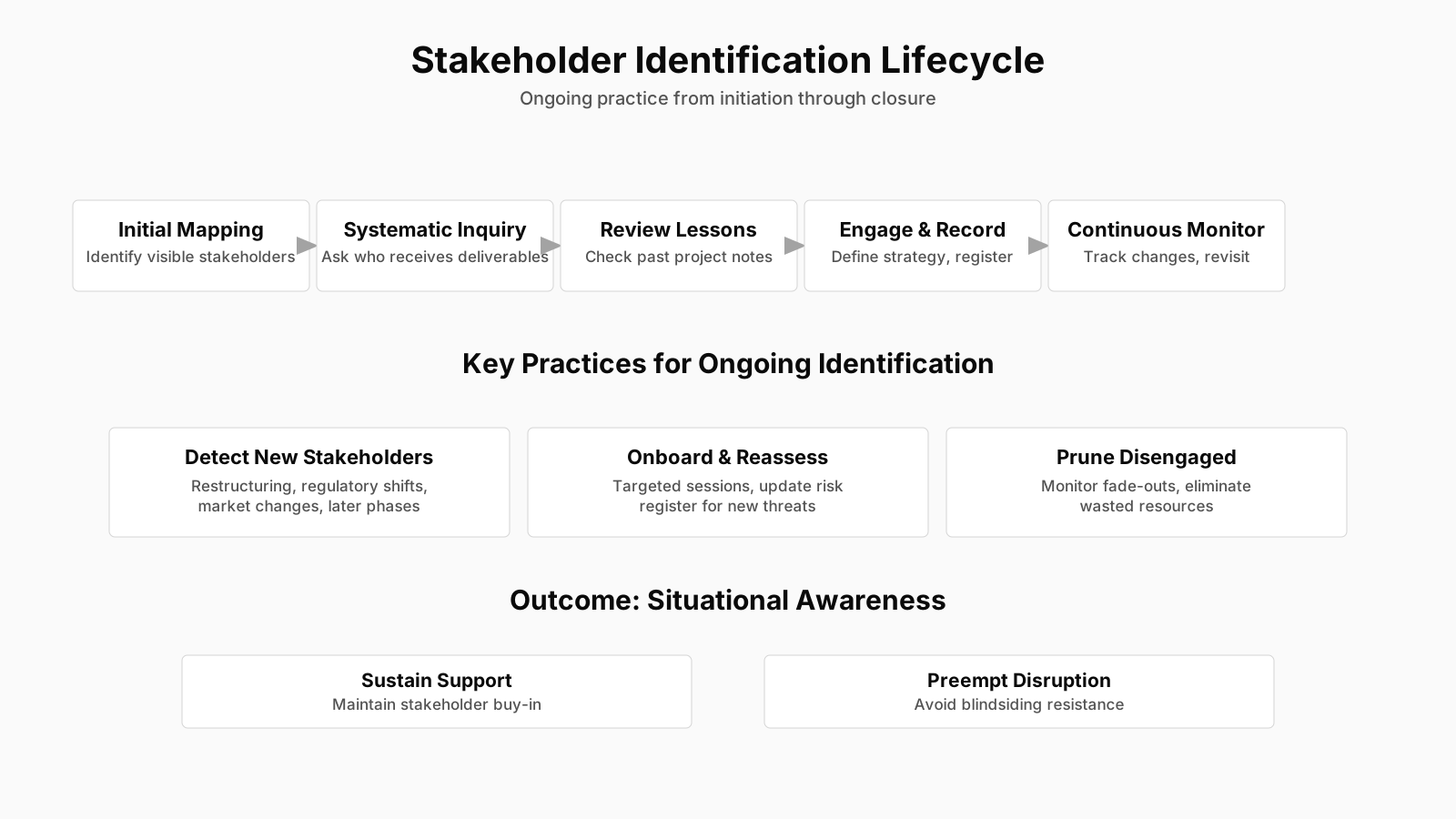
Stakeholder identification is never truly finished. As the project shifts from planning into execution, new stakeholders surface, and some existing ones fade from relevance. An ongoing stakeholder identification effort requires lightweight but intentional reviews. During the project’s execution, procurement activities often generate new contracts, and each new vendor introduces a fresh set of stakeholders. Similarly, organizational changes—mergers, leadership departures, restructuring—can instantly rewrite the power map. The stakeholder register must keep pace, or the communications plan will start speaking to people who no longer hold influence while missing those who do.
Agile projects handle this fluidity naturally through regular retrospectives and sprint reviews, where the team discusses not just what got done but who interacted with the process. If a previously unknown department started requesting access to sprint demos, the product owner and scrum master can add them to the stakeholder list and adjust engagement strategies for the next sprint. Waterfall projects need a more explicit governance trigger, such as a mandatory stakeholder review at each phase gate. The mechanism matters less than the habit; the important thing is that updating the stakeholder picture gets the same disciplined attention as updating the risk register or the schedule baseline.
Closing a project brings one final wave of stakeholder considerations. The operational teams who will inherit the deliverables become primary stakeholders at handover, and their interests center on support documentation, training, and transition plans. Procurement contracts require closure activities that involve the same procurement officers and vendor representatives who were identified at the start, now focused on acceptance signoffs and final payments. Documenting these shifting interests closes the loop, ensuring that the project doesn’t leave behind unresolved dependencies that fester into operational headaches months later.