Creating a stakeholder management strategy is not a bureaucratic exercise that simply fills a template with names and roles. It is the mechanism through which a project manager shapes the human environment around a project, directing attention, energy, and resistance in ways that either accelerate progress or quietly undermine it. Every project, regardless of industry or methodology, exists within a dense network of individuals and groups whose interests rarely align perfectly. Some stakeholders will champion the effort, some will hold the power to kill it outright, and many will hover in between, waiting to see which way the wind blows. A well-constructed strategy does more than just list these players; it provides a logic for understanding who matters, how they matter, and what the project team can realistically do to tilt the balance toward support rather than obstruction over the entire project life cycle.
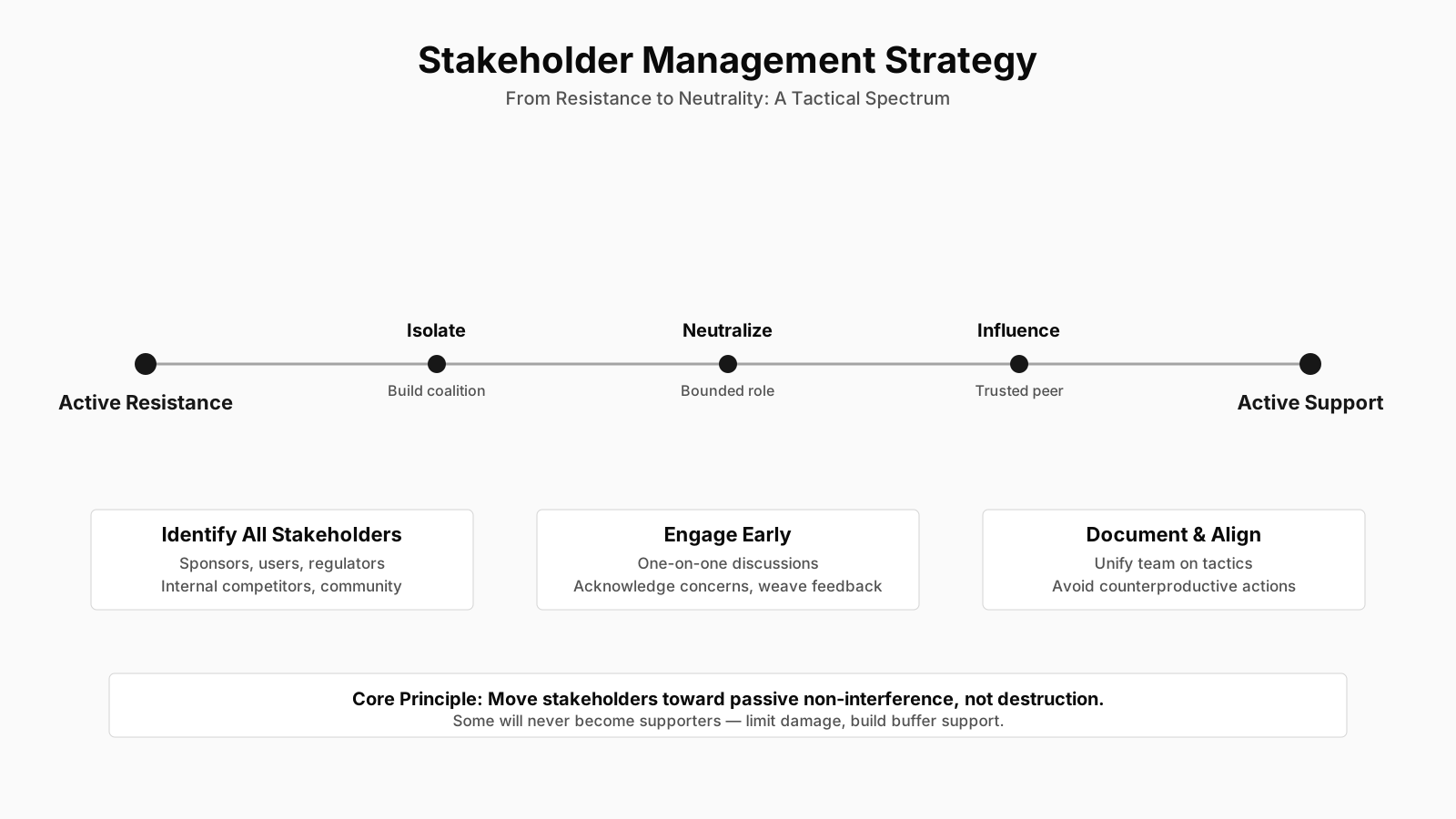
Your Stakeholder Strategy at a Glance
| Key Concept | Summary |
|---|---|
| Strategic Rationale | A well-designed stakeholder strategy reveals the critical players, their influence dynamics, and the levers that cultivate advocacy while mitigating resistance across the entire project lifecycle. |
| Engagement Intent | High-level intent crystallizes targeted engagement: identifying which stakeholders to convert into champions, which opposing forces to neutralize, and how coalition building creates a momentum of support. |
| Political Dynamics | Shifting from a static stakeholder inventory to dynamic analysis separates projects that passively report status from those that actively reshape their political environment. |
| PMBOK Integration | Aligned with PMBOK’s Plan Stakeholder Engagement process, early strategic thinking prevents reactive crisis management by embedding foresight into project governance. |
| Intelligence Lens | Approaching stakeholder strategy as intelligence gathering, not a procedural checklist, uncovers hidden alliances and latent vulnerabilities that formal org charts fail to surface. |
| Targeting Criteria | Structured identification scrutinizes individuals who wield formal authority, control critical resources, possess specialized expertise, or can mobilize public sentiment to sway project outcomes. |
| Influence Beyond Titles | Influence often diverges from hierarchy: a community group without contractual authority can stall permits, while a mid-level IT architect may hold more sway than a detached executive. |
| Hidden Gatekeepers | Analysts, administrators, and union representatives can silently obstruct progress without ever appearing on a formal stakeholder register, quietly controlling operational throughput. |
Understanding the Purpose of a Stakeholder Management Strategy
The core purpose revolves around deliberately increasing the support and minimizing the negative impacts of stakeholders from initiation through closure. This is not a passive monitoring activity but an active design process that identifies leverage points within the stakeholder ecosystem. A stakeholder management strategy defines the approach the project will take to engage the people and organizations that can significantly influence outcomes. It does not yet specify the detailed weekly communications schedule or the exact meeting cadence; those are tactical elements of an engagement plan. Instead, the strategy sets the high-level intent: who needs to be brought on board, who needs to be neutralized, and which coalitions of interest groups can be cultivated to create a supportive mass.
Many practitioners confuse the strategy with a simple contact list or a RACI chart, but the difference is fundamental. A contact list states that a particular executive must be informed. The strategy asks why that executive might resist, what kind of influence she wields, and whether a direct appeal or an indirect influence through a trusted lieutenant would be more effective. This shift from static identification to dynamic analysis is what separates projects that merely report status from those that actively reshape their political landscape. Project management frameworks like PMBOK position this under the Plan Stakeholder Engagement process within the Stakeholder Management knowledge area, recognizing that early strategic thinking prevents reactive firefighting later.
It is easy to underestimate the emotional dimension here. A stakeholder who feels her concerns have been ignored during strategy formation will often harden into active opposition, not because the project is technically flawed but because the relationship has been damaged. The strategy, therefore, serves a relational purpose, mapping not just formal authority but also informal networks, personal motivations, and hidden agendas. If the project manager treats the strategy as an intelligence-gathering exercise rather than a checkbox task, the resulting insights often reveal surprising alliances and vulnerabilities that never appear on an organizational chart.
Think of it as placing bets on human behavior. You cannot control a senior sponsor’s sudden change of heart, but you can identify the conditions that make that change more or less likely and prepare alternative pathways. The strategy documents those conditions and the planned responses, giving the team a shared mental model when turbulence hits.
Key Insights on Stakeholder Strategy
- Active influence design
- Rather than simply monitoring sentiment, it proactively shapes stakeholder perceptions by sequencing advocacy and mitigation efforts across all project phases, guiding the project’s trajectory with deliberate interventions.
- Strategic intent over tactics
- It establishes the high-level outcomes required, specifying who must be engaged, whose opposition must be neutralized, and where coalitions should be cultivated, then delegates all cadence and scheduling details to the tactical engagement plan.
- Dynamic analysis beyond lists
- Unlike a static contact list or RACI chart, it probes the root causes of resistance, maps informal influence networks, and selects either direct engagement or indirect appeals based on each stakeholder’s specific leverage and mindset.
- Intelligence gathering advantage
- Framed as a structured intelligence process, it uncovers hidden coalitions, vulnerabilities, and influence flows, enabling pre-planned interventions that avert last-minute crisis management and keep the project out of a reactive cycle.
Identifying and Prioritizing Key Stakeholders
Before any meaningful strategy can be crafted, the project manager must separate the critical few from the trivial many. Key stakeholder identification is not simply a matter of scanning a distribution list; it requires a structured examination of who can significantly impact the project’s objectives—either through formal authority, control over resources, subject matter expertise, or the ability to mobilize public opinion. In a large infrastructure project, for example, the local community may hold no contractual power, but its ability to delay permits makes it a key stakeholder. Similarly, a mid-level IT architect who understands legacy system dependencies may be more critical than a C-suite executive who signed the charter but remains hands-off.
The common pitfall here is to focus only on hierarchical position. Project managers who equate influence with job title frequently miss the operational gatekeepers—the analysts, administrators, or union representatives who can quietly stall progress without ever saying no in a meeting. Effective identification digs into the informal networks, asking questions like: Who do people go to when they need an exception? Whose opinion, if voiced negatively in the breakroom, causes others to hesitate? These individuals may not appear on any formal stakeholder register, yet they often determine whether a deliverable gets accepted smoothly or buried in endless revision cycles.
Once a broad list is compiled, prioritization becomes essential. Not all stakeholders require the same level of strategizing. Power and interest grids are a well-known tool here, but the mapping should also consider urgency and legitimacy. A stakeholder with high power but low interest can be managed with periodic assurance; someone with high interest but low power might need careful expectation management to prevent them from becoming a vocal detractor who influences others. The key is to avoid spreading effort evenly. Treating every stakeholder as equally important dilutes the energy available for the few who genuinely shape the project’s fate.
Assessing Stakeholder Interests and Impact
Once the key players are identified, the next layer involves a rigorous assessment of what each stakeholder specifically wants from the project and the nature of the impact they could have. A stakeholder impact assessment goes beyond a simple high-medium-low rating. It examines the mechanisms through which a stakeholder can affect scope, schedule, budget, quality, or team morale. For example, a regulatory agency’s impact is not merely “high”; it manifests as the ability to halt construction if compliance documentation is incomplete. Understanding that mechanism points directly to a mitigation strategy: pre-submission reviews and relationship-building with inspectors.
Interests are rarely monolithic. A department head might support the project because it promises to modernize her team’s tools, but she might simultaneously resist the implementation timeline because it clashes with year-end reporting cycles. Disentangling these layered motivations is critical. The stakeholder management strategy should capture not just the stated interest but also the underlying, sometimes unspoken, drivers. A sponsor who repeatedly pushes for more features may be motivated less by user needs and more by a desire to be seen as an innovator in front of the board. Addressing that underlying driver, perhaps by creating highly visible early wins, can be more effective than endless scope negotiations.
Impact assessment also involves a forward-looking dimension. It is not enough to know how a stakeholder can impact the project today; the strategy must anticipate how that influence might shift as the project moves through different phases. A subject matter expert who is indispensable during requirements definition may hold far less sway during user acceptance testing. Recognizing these phase-specific shifts allows the project manager to adjust engagement intensity over time rather than maintaining a constant, inefficient relationship cadence.
Key Insights on Stakeholder Impact
- Mechanism-based impact analysis
- Instead of relying on generic high, medium, or low ratings, a mechanism-based assessment traces the specific causal pathways through which a stakeholder can alter scope, schedule, budget, quality, or team morale.
- Mitigation strategies from mechanisms
- Identifying exactly how a stakeholder exerts influence, such as a regulator who can halt construction, directly unlocks concrete mitigation tactics like pre-submission compliance reviews and deliberate relationship-building with inspectors.
- Mixed stakeholder motivations
- A single stakeholder often champions the project’s goal while resisting its execution, as when a department head endorses tool modernization but pushes back on the timeline because of year-end reporting conflicts.
- Underlying psychological drivers
- A sponsor’s push for extra features frequently stems from a desire for boardroom visibility rather than genuine user demand, so creating visible early wins can prove far more effective than protracted scope negotiations.
- Phase-dependent stakeholder influence
- Stakeholder leverage is not static; an essential requirements expert who is critical early on may hold far less sway during user acceptance testing, making it necessary to recalibrate engagement intensity as the project moves through phases.
Developing Strategies for Gaining Support and Reducing Obstacles
With interests and impacts mapped, the strategy translates analysis into action by defining specific approaches for each key stakeholder or stakeholder group. Developing stakeholder support strategies requires creativity, not just process. For those who are neutral or mildly supportive, the approach might focus on education and demonstrating quick value to convert passive acceptance into active advocacy. For those who are resistant, strategies might involve addressing the root causes of their concerns, finding compromises, or, in some cases, constructing counterbalancing alliances that reduce the resistor’s relative power.
There is a delicate art to this. Directly confronting a powerful opponent rarely works unless you have equally powerful backing, which most project managers do not. More often, effective strategies are indirect. You might engage a respected peer of the resistant stakeholder to champion the project’s benefits within their shared network. Or you might sequence the delivery so that the stakeholder’s pet feature arrives early, satisfying a personal priority and reducing overall friction. The potential strategies documented in the analysis matrix are hypotheses that the project manager tests and refines throughout the project, not commands that guarantee compliance.
It is worth acknowledging that some obstacles cannot be reduced through engagement alone. A stakeholder whose job will be eliminated by the project’s outcome has a fundamentally irreconcilable interest. In such cases, the strategy shifts from seeking support to containing damage, managing the departure with dignity, and ensuring that the individual’s influence does not poison the well for others. The strategy document must be honest about these realities, even if that honesty remains within a tightly controlled distribution list.
Designing the Stakeholder Analysis Matrix
A common way of representing the stakeholder management strategy is through a stakeholder analysis matrix, which functions as both an analytical tool and a communication artifact for core team members. A stakeholder analysis matrix template typically organizes information into columns that capture the stakeholder’s name, their interests in the project, an assessment of their impact, and the potential strategies for gaining support or reducing obstacles. The simplicity of this structure is deceptive, because the quality of the content within those cells determines whether the matrix becomes a living guide or a forgotten file on a shared drive.
In practice, the matrix must be treated as a working document that evolves with the project. A construction project manager might initially list the local planning authority’s interest as “expediting permits while ensuring code compliance,” with an impact of “high—can delay excavation.” The strategy column might note: “Submit pre-application packages early, assign a dedicated liaison, and invite inspectors to bi-weekly progress walks.” As the project advances, the interest may shift to “minimizing public disruption from construction noise,” and the strategies must adapt accordingly.
One frequent mistake is to fill the matrix with vague, unactionable entries. Writing “keep informed” as a strategy is almost useless unless it specifies what kind of information, delivered by whom, at what frequency, and for what intended effect. The same applies to impact assessments that merely state “high.” Without describing the mechanism of impact, the strategy column has no anchor. The matrix forces a discipline of specificity that exposes gaps in the team’s understanding. If you cannot describe how a stakeholder could block progress in concrete terms, you probably do not yet understand their real leverage.
The matrix also highlights interdependencies among stakeholders. When you list strategies that involve leveraging one stakeholder to influence another, those relationships become visible, making the entire strategy more coherent. It is not uncommon to discover that the strategy for stakeholder A inadvertently antagonizes stakeholder B, prompting a revision before any damage is done.
Key Takeaways on Matrix Design
- Dual-purpose management tool
- The stakeholder analysis matrix serves simultaneously as an analytical framework for strategic planning and as a communication artifact that aligns the core team on a unified approach to managing each stakeholder.
- Four essential matrix columns
- A standard template records each stakeholder’s name, their project-related interests, an impact-level assessment, and actionable strategies for building support or overcoming potential obstacles.
- Content quality determines value
- The matrix becomes a living guide only when its cells contain substantive, well-developed information; superficial entries relegate it to an overlooked file on a shared drive.
- Dynamic evolution of strategies
- Because stakeholder interests and priorities shift as the project evolves, the matrix must be continuously maintained as a working document with strategies that are regularly reviewed and adapted.
- Precision beats generic phrasing
- Vague entries like “keep informed” are practically useless unless they specify the information to share, the designated communicator, the frequency, and the intended communication outcome.
Managing Stakeholder Groups as Units
While individual stakeholder analysis is necessary, many situations call for managing collections of stakeholders as groups. This group stakeholder management approach recognizes that certain stakeholders share common interests, communicate through the same channels, or respond to the same types of influence. A project impacting multiple retail store locations, for instance, may need to manage all store managers not as forty separate relationships but as a single community with representative leaders and common concerns about staffing and disruption.
Grouping saves effort and prevents fragmentation, but it carries the risk of overlooking sub-group differences that can fester into organized resistance. The strategy must therefore identify not just the groups themselves but also the internal dynamics: who the informal opinion leaders are, how dissent typically spreads, and what past experiences might color the group’s perception of the project. A union workforce that has endured poorly managed technology rollouts in the past will approach a new system implementation with suspicion that cannot be addressed through generic town hall meetings. The group strategy might need to include early, transparent involvement of shop stewards in testing and feedback loops, acknowledging past failures explicitly.
It can be helpful to think of stakeholder groups as having their own culture, almost like a mini-organization within the broader project ecosystem. That culture dictates what forms of communication are trusted and what kinds of promises are believed. A group of frontline nurses, for example, may trust peer champions far more than executive presentations. The stakeholder management strategy should lean into that reality, designing engagement approaches that work with the group’s existing social fabric rather than trying to impose an external, corporate-style communication plan.
Determining Desired Participation Levels
For every stakeholder identified, the strategy must articulate the level of participation that the project team actually desires from that individual or group. Stakeholder participation planning clarifies expectations on both sides. Does the project need the finance director to actively co-create the budget tracking model, or is it enough that she approves the final numbers? Misalignment here causes two common problems: over-involving people who then feel their time is wasted, and under-involving people who later complain they were never consulted.
Desired participation is not a fixed property. A technical architect might need deep involvement during the design phase but only light review during construction. The strategy can specify a participation curve that illustrates how involvement should ramp up and down. This prevents the scenario where a stakeholder, accustomed to daily stand-ups during design, feels suddenly shut out when the team shifts to execution, interpreting the reduced communication as secrecy rather than a natural phase transition.
There is also a psychological dimension. Some stakeholders want to be deeply involved because they equate involvement with status or because they genuinely enjoy the problem-solving. Others view any participation beyond a signature as an unwelcome burden. The strategy should reflect these preferences where possible, aligning the ask with what the stakeholder is willing to give. Forcing a busy executive into lengthy working sessions may damage the relationship more than it helps the project, even if her input would theoretically be valuable. A skilled project manager sometimes has to accept a lower level of participation than ideal because the cost of pursuing it outweighs the benefit.
Key Insights on Participation Planning
- Clarify participation expectations upfront
- Setting explicit participation expectations for each stakeholder early on prevents both over-involvement, which wastes time and breeds resentment, and under-involvement, which fuels later complaints of being overlooked.
- Participation needs shift across phases
- Because a stakeholder's desired level of involvement changes throughout the project, the team should plan for deeper engagement during certain stages and lighter review during others, much like a technical architect who contributes intensively during design but only requires brief updates during construction.
- Balance ideal involvement with cost
- Managers should occasionally accept a participation level below the ideal when the expense of securing deeper involvement, for example overloading a busy executive with lengthy working sessions, outweighs the value it would deliver.
Handling Sensitive Information with Discretion
Some of the most useful strategic insights are also the most politically charged. Documenting that a particular director’s resistance stems from a fear of losing headcount, or that a sponsor’s support is conditional on personal credit, creates a record that could be devastating if it fell into the wrong hands. Handling confidential stakeholder data therefore becomes a critical aspect of the overall strategy. The project manager must exercise judgment not only about what information to capture but also about where and how it is stored and who has access to it.
This judgment often leads to a practice of maintaining two tiers of documentation. The formal, shared stakeholder analysis matrix contains sanitized, professional language that would not embarrass anyone if made public. Parallel to that, the project manager may keep personal notes, perhaps in a secured notebook or an encrypted file, that capture the unvarnished assessments necessary for candid decision-making. This is not duplicity; it is professional discretion. A matrix that reads “VP of Operations: skeptical due to prior project failures, needs regular evidence of progress” is both true and unlikely to cause a political incident. The private note might add “believes IT overpromises; do not use optimistic language, always under-commit.”
The level of detail included in shared documents must also consider organizational culture. In some companies, blunt assessments are normal and expected; in others, a single poorly phrased comment can trigger weeks of fallout. Modern value-oriented methodologies like BVOP emphasize brief planning documents that everyone, including new joiners, can read and quickly understand. This approach indirectly addresses the sensitivity challenge, because the very act of compressing the strategy into concise, plain-language statements naturally filters out gratuitous commentary and focuses on actionable insights. If you cannot say it in a way you would be comfortable having the stakeholder read, perhaps it does not belong in the shared artifact.
Practical Pitfalls and Implementation Advice
Even well-intentioned strategies fail in execution when they ignore the fluid nature of human relationships. One of the most pervasive stakeholder strategy pitfalls is treating the analysis as a one-time activity completed during initiation and then filed away. A stakeholder’s interests, power, and attitude shift continuously as the project progresses and as external conditions change. The strategy must be revisited regularly, not as a bureaucratic review but as an honest reassessment. What was true during the business case might be obsolete by the time the first prototype is demonstrated.
Another mistake is confusing communication frequency with strategic engagement. Sending a weekly newsletter to one hundred stakeholders does not constitute a management strategy for any single one of them. The strategy lives in the tailored, often face-to-face interactions that address specific concerns. Project managers who spend more time crafting status slides than having informal conversations with key influencers are practicing reporting, not stakeholder management. The slide might satisfy a PMO audit, but it will not detect that a critical sponsor’s enthusiasm is quietly cooling until it is too late.
There is also a subtle trap in over-reliance on rational persuasion. Many project managers assume that if they present a compelling business case, stakeholders will logically align. But decisions are shaped by emotion, identity, and social pressure as much as by data. The strategy should therefore include appeals that acknowledge these factors. Helping a stakeholder see how the project makes her team’s daily work less frustrating can be more powerful than showing a net present value calculation. Understanding what keeps a stakeholder up at night and linking project outcomes to relief of that specific anxiety transforms the conversation from a transaction into a partnership.
Agile environments add another layer of nuance. Continuous delivery models mean stakeholders see tangible increments frequently, which can either build confidence or amplify anxieties if early increments are rough. The stakeholder management strategy in such contexts must include frequent checkpoints that are as much about relationship maintenance as about product feedback. The product owner’s role becomes central, acting as a conduit between the team and the broader stakeholder community, but the project manager—or scrum master, depending on the setup—still needs to maintain awareness of the political dynamics that the product owner alone may not fully grasp.
Finally, a strategy is only as good as the team’s collective commitment to it. If only the project manager knows the plan, it cannot influence how team members interact with stakeholders in day-to-day encounters. Briefing the core team on key strategies, particularly those that involve sensitive handling of certain individuals, equips everyone to reinforce the desired influence patterns rather than accidentally undermining them. A developer who knows that a particular business analyst is insecure about her technical knowledge can avoid jargon and offer to walk through designs patiently, turning a potential source of friction into a collaborative relationship. That level of orchestration only happens when the strategy escapes the project manager’s head and becomes part of the team’s shared operating model.
Key Insights on Stakeholder Engagement
- Revisit analysis regularly
- Stakeholder interests, influence, and attitudes evolve constantly; therefore, the engagement strategy demands frequent, honest reassessment rather than being archived after kickoff.
- Prioritize informal conversations
- Formal status reports satisfy audits but rarely capture early warning signals; project managers need informal, trust-based conversations with key influencers to sense declining support before it hardens into active resistance.
- Address personal anxieties
- Identifying a stakeholder's deepest concerns and linking project deliverables directly to alleviating those anxieties elevates the relationship from mere transaction to genuine partnership.
- Watch continuous delivery reactions
- Frequent, tangible deliverables can build stakeholder confidence, but rough early increments risk amplifying doubts; therefore, continuous monitoring of reactions is essential to adjust course swiftly.
- Share political awareness duties
- While the product owner serves as the primary liaison to stakeholders, the project manager or scrum master must remain attuned to political undercurrents and adapt communication styles, for example, simplifying language to ease a stakeholder's discomfort with technical jargon.
