If you have ever managed a project of any meaningful size, you know that change is inevitable. Stakeholders think of new features, risk responses evolve, and external conditions shift. So the question of how change requests get reviewed and approved on a project is not just an academic exercise; it is the heartbeat of project control. Without a structured way to evaluate and decide on modifications, projects drift, baselines lose meaning, and teams end up delivering something unrecognizable. The process that governs this entire effort is called Perform Integrated Change Control, and it sits squarely in the Monitoring and Controlling Process Group in most traditional project management frameworks. But the mechanics of it, the daily rhythm of evaluating, analyzing, and either accepting or rejecting changes, are often misunderstood and underappreciated. This article walks through exactly how this works, from the moment someone suggests a tweak to the final update of the project plan.
Key Steps in Change Request Review and Approval
| Key Concept | Summary |
|---|---|
| Change Control | Perform Integrated Change Control delivers a disciplined governance structure for evaluating, authorizing, and directing all change requests, ensuring each aligns with project objectives and stakeholder expectations. |
| Baseline Integrity | The process safeguards approved baselines by releasing only formally sanctioned changes for implementation, thereby preventing unauthorized scope expansion, schedule erosion, and cost overruns. |
| Monitoring Role | It functions continuously within the Monitoring and Controlling Process Group, intersecting every knowledge area because a modification in one dimension inevitably cascades into others, demanding integrated oversight. |
| Change Triggers | Requests arise from any stakeholder such as sponsors, clients, team members, or regulators and are often sparked by external market shifts, regulatory updates, risk discoveries, or internal performance gaps. |
| Formal Documentation | Each request must be captured in writing and logged in a change or configuration management system before evaluation, a gate that filters out vague notions and ensures only actionable proposals advance. |
| Impact Analysis | Requests undergo holistic review of schedule, cost, resource, quality, and risk implications, enabling decision makers to weigh the full trade-offs and second-order effects before acting. |
| Prompt Decisions | Timely adjudication is essential; decision latency can close the opportunity window, transforming a beneficial change into an irrelevant or disruptive force that erodes project momentum. |
| Undocumented Drift | Uncontrolled, unrecorded modifications accumulate silently, erasing the audit trail and making it impossible to explain cost deviations, schedule delays, or why deliverables diverge from approved scope. |
| Process Integration | The process interconnects with risk, scope, schedule, and stakeholder management, requiring that every change be assessed against the entire project's constraints rather than treated in a silo. |
| Decision Rationale | Documenting the reasoning behind approvals and rejections embeds institutional knowledge, reinforces accountability, and gives stakeholders a clear lens into the trade-offs shaping each outcome. |
The Perform Integrated Change Control Process at a Glance
The Perform Integrated Change Control process provides the structured framework for reviewing and approving change requests from project inception all the way through completion. It is not something you do once and then ignore. It is a persistent monitoring function that ensures the project does not stray from its approved direction without conscious, deliberate decisions. In the PMBOK Guide, this process sits in the Monitoring and Controlling Process Group, but it touches every knowledge area because a change in one dimension almost always ripples into others. The process is responsible for reviewing all change requests, approving or rejecting them, and managing the incorporation of approved modifications into the project management plan, project documents, and deliverables. That means every tiny adjustment to the scope statement, the schedule, the budget, or the resource plan must pass through this gauntlet. The goal is simple but profound: maintain the integrity of the baselines by ensuring that only formally approved changes are executed. Any change that slips through without this review is uncontrolled and can cascade into bigger problems, like scope creep, budget overruns, and misaligned stakeholder expectations.
At a high level, the process includes several distinct but interconnected activities. The first is influencing the factors that circumvent change control so that only approved changes are implemented. This is less about policing and more about building a culture where the team respects the baseline but also understands that changes are allowed if they go through the proper channels. Then there is the prompt review, analysis, and decision on change requests. Speed matters here because a slow decision can itself become a source of delay and cost. Managing the approved changes, coordinating them across the entire project, and maintaining the integrity of baselines by releasing only approved changes for incorporation round out the core responsibilities. There is also a critical documentation component: every change request, its impact assessment, and its final disposition must be recorded in the change management system. This is not just for audit purposes. It builds an institutional memory that helps the project team and future projects understand how decisions were made and what the consequences were.
Interestingly, this process is not isolated. It feeds into and pulls from nearly every other process in project management. For example, when a risk response triggers a change to the schedule, the Perform Integrated Change Control process evaluates that change holistically, looking at cost implications, resource shifts, and even the quality impacts. Similarly, when a stakeholder request arrives out of scope, the process does not simply reject it. Instead, it analyzes the request against the project charter and scope statement, considers alternatives, and documents the rationale for rejection so that stakeholders understand the trade-offs. This integrative nature is what gives the process its name. Without it, project management would disintegrate into a collection of siloed domain adjustments that create confusion and conflict downstream.
What Triggers a Change Request and How It Gets Documented
A change request can originate from any stakeholder involved with the project. That includes the sponsor, the customer, end users, team members, suppliers, or even regulators. Sometimes the trigger is an external event: a new regulation, a market shift, or a technology update. Other times it is internal: a team member realizes that the current design will not meet performance requirements, or the sponsor wants to add a feature based on early feedback. These requests may start verbally. A hallway conversation, an offhand comment in a meeting, or a phone call can plant the seed. However, the process demands that every change request be formally recorded in written form and entered into the change management or configuration management system before it can be considered. This step alone filters out many poorly thought-out ideas because having to write down the rationale, the expected benefit, and the initial impact forces a moment of reflection. The project manager or a change coordinator typically helps the requester formalize the request, using a standard template that captures the description, the reason, the priority, and an initial estimate of time and cost implications if available.
Documentation is not a bureaucratic nuisance. It serves multiple purposes. It creates a clear record for the Change Control Board or decision maker to evaluate. It also ensures that the requester takes ownership of the idea, rather than simply throwing suggestions over the wall. In more mature organizations, the change management system is integrated with the configuration management system so that the history of every documented change, its status, and its impact on configuration items is traceable. This is particularly important in projects that produce complex products where multiple versions and baselines coexist. If a change affects a component that is under configuration control, the system links the change request to the specific configuration item, and the subsequent approval can trigger a formal baseline update. This integration reduces the risk of delivering a product that does not match its own documentation. For large projects, the system may require information on estimated time impacts and estimated cost impacts before the request can even move forward, because without that data, the decision makers are operating blind.
A curious thing happens when change requests are not documented: informal decisions pile up. An engineer tweaks something here, a stakeholder nudges a requirement there, and six weeks later the project is building something that nobody officially approved. The lack of written record makes it nearly impossible to figure out why the project is over budget or late. That is why the process insists that even urgent changes go through documentation, albeit in an expedited fashion. A verbal agreement is never enough. If the change is critical, the documentation can follow quickly, but it must follow.
Reviewing Change Requests: From Analysis to Decision
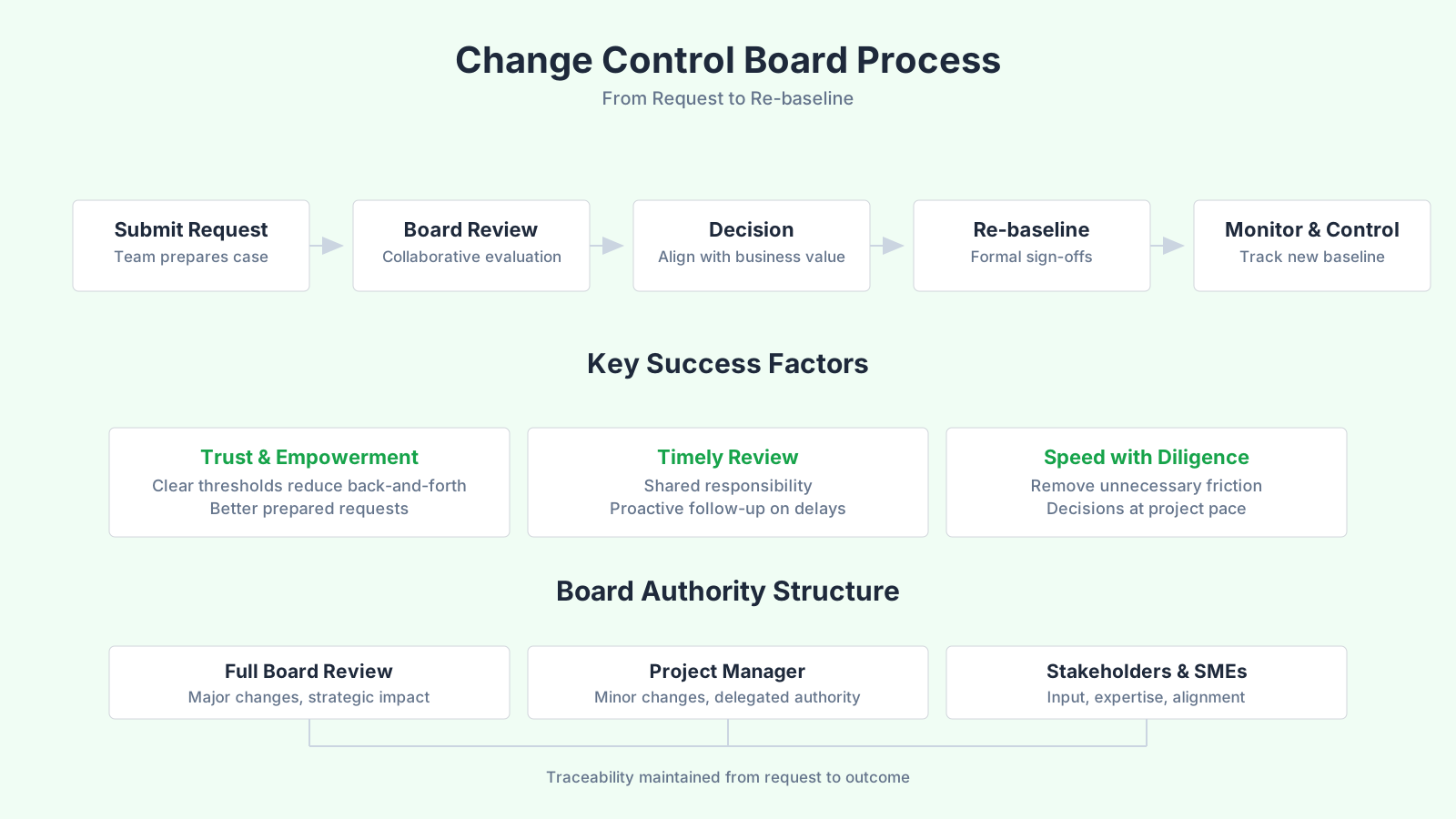
Once a change request is properly documented, the review and analysis phase begins. Promptness here is essential. The source material notes that a slow decision may negatively affect time, cost, or the feasibility of a change. Imagine a change that would save the project a significant amount of money if implemented within a certain window. If the review board takes three weeks to meet and deliberate, that window may close, rendering the change useless or even harmful. So the process encourages that change requests be reviewed, analyzed, and a decision rendered without unnecessary delay. How that happens depends on the project's governance structure. Sometimes the project manager alone has authority to approve certain low-impact changes, as defined in the project's roles and responsibilities documentation. For instance, a trivial adjustment to a work package that does not affect the critical path or the budget may be within the project manager's approval threshold. This keeps things moving without clogging up the formal board.
However, any change that could meaningfully shift baselines or introduce new risks requires a broader analysis. The reviewer, whether an individual or a board, must evaluate the impact on at least five dimensions: scope, schedule, cost, risk, and quality. A proposed schedule acceleration, for example, may increase costs dramatically and introduce quality risks if testing is squeezed. The process must tease out these interdependencies and present a holistic picture. Sometimes a seemingly beneficial change, like adding a minor feature, turns out to require a cascading set of modifications to the architecture, the user documentation, the training program, and the deployment plan. Without rigorous analysis, the true cost remains hidden until it is too late. That is why the Perform Integrated Change Control process explicitly includes coordinating changes across the entire project. A change that looks good on paper might unravel the team's resource plan, delay an important milestone, or invalidate a previously approved risk response. The analysis phase is where these hidden connections surface.
Often, the person or team conducting the analysis will consult with subject matter experts. For a technical change, they might pull in the lead architect. For a regulatory change, the compliance officer. The goal is not to simply rubber-stamp or reject requests but to understand the full implications so that the decision maker can make an informed trade-off. The analysis may produce several options: accept the change as proposed, accept it with modifications, defer it to a later phase or release, or reject it outright. Each option carries its own set of consequences, and those must be laid out plainly. The project manager plays a key role here, ensuring that the analysis is balanced and free from undue optimism or pessimism. If the change was proposed by a powerful stakeholder, there may be pressure to downplay negative impacts. The disciplined process pushes against that by demanding a documented, transparent assessment.
The Change Control Board and Approval Authority
Every documented change request must be approved or rejected by some authority within the project management team or, occasionally, by an external organization. In many projects, a Change Control Board, commonly referred to as a CCB, is the designated body for making these decisions. The roles and responsibilities of the CCB are clearly defined within the configuration control and change control procedures, and these are agreed upon by the appropriate stakeholders before the project execution really ramps up. A CCB is typically a cross-functional group that includes representatives from the key areas affected by the change. You will often see the project manager, the sponsor or a delegate, a technical lead, a customer representative if the project is under contract, and perhaps a quality assurance lead. The board does not need to meet for every single request. Most well-defined change control systems set up threshold levels. Low-impact changes that fit within pre-established tolerances might be approved by the project manager alone or by a small subset. Medium-impact changes might go to a subset of the CCB. Only the most significant changes, those that would alter the project's scope, schedule, or budget beyond a certain percentage, trigger a full board review.
Many large organizations structure their CCBs in a multi-tiered fashion, separating responsibilities among different boards. A technical review board might screen changes for feasibility and alignment with technical standards before they ever reach the project-level CCB. A business governance board might review changes that have enterprise-wide implications. This tiered approach prevents a single board from becoming a bottleneck while still applying appropriate scrutiny. If the project is being executed under a contract, the customer often retains final approval authority for certain types of changes, as specified in the contract. For example, any change that would affect a contractual deliverable or milestone might require the customer's signature. This external approval loop adds time but protects both parties from disputes later. Regardless of the structure, the CCB's decisions must be documented and communicated, not just to the requester but to all stakeholders who will be affected by the change. A rejection, just as much as an approval, needs to be explained. The requester deserves to know why their idea was turned down, and that rationale should be constructive, pointing perhaps to alternative approaches or a future phase where the change might make more sense.
One common misconception is that the CCB is there to say no. In practice, an effective CCB functions more like an investment committee. It weighs the value of a change against its cost and risk, and if the value justifies the disruption, it says yes. The board also ensures that approved changes do not pile up unmanaged. Once a change is approved, it enters the implementation pipeline, and the CCB monitors its progress and confirms that the intended benefits are realized. Some project managers make the mistake of treating the CCB as a formality, holding meetings that simply approve everything because the sponsor or a vocal stakeholder dominates the conversation. That defeats the whole purpose. The board needs sufficient independence and backbone to push back when a change is not in the project's best interest, even if the requester is senior. That is why the roles and responsibilities documentation must clearly state the board's authority and the criteria it will use to evaluate requests. A well-chartered CCB protects the project from runaway scope and helps maintain stakeholder trust, because everyone knows that changes are evaluated fairly and transparently.
Key Insights: Integrated Change Control
- Persistent monitoring function
- The process provides continuous oversight from project initiation through completion, never a one-time check, ensuring that any shift from the approved direction is only by deliberate, formally reviewed decisions.
- Holistic cross-knowledge-area evaluation
- Because a change in one area inevitably triggers effects across others, every request is systematically reviewed for its impact on scope, schedule, budget, resources, and quality, spanning all project knowledge areas without omission.
- Formal documentation requirement
- All change requests, including those that emerge from informal conversations, must be formally documented and logged in the change management system before review, guaranteeing a complete and auditable record.
- Baseline integrity protection
- By restricting updates to the project plan, documents, and deliverables exclusively to formally approved changes, the process safeguards baseline integrity and prevents scope creep, budget overruns, and misalignment of stakeholder expectations.
Integrating Approved Changes into Baselines and Documents
The approved change requests must then be released for incorporation into the project management plan and related documents in a controlled manner. This is where the process transitions from decision making to implementation. An approved change request is not just a permission slip. It is a directive that triggers a series of updates: cost estimates may need revision, activity sequences may shift, schedule dates get recalculated, resource requirements change, and risk response plans get adjusted. The project manager works with the team to flesh out the detailed implementation plan for the change. This often involves revising the work breakdown structure to include new work packages or modifying existing ones. The project schedule is updated to reflect the new work and any revised dependencies. The cost baseline is adjusted to account for the budgetary impact. If the change introduces new risks, the risk register gets updated, and risk response plans are developed or modified. In short, the ripple effects are mapped and baked into the project artifacts.
Maintaining the integrity of baselines is a core objective. The process insists that only approved changes are released for incorporation. This means that the project manager or the configuration management librarian must ensure that the baseline versions are formally updated through the configuration control system. No one can simply edit the baseline on their own. This discipline ensures that the project baselines always reflect the true state of approved work. When a stakeholder asks whether the project is on track, the baseline plus the accumulation of approved changes provides an accurate answer. Without this control, the baseline becomes a fiction, and performance reporting becomes misleading. The project might appear to be on schedule and on budget only because the original baseline was never adjusted to include the mountain of small additions that crept in. When the final product is delivered, the disconnect becomes obvious and often leads to blame and finger-pointing.
Documenting the complete impact of change requests is another ongoing activity. Each approved change should leave an audit trail that includes the original request, the analysis, the decision, the implementation steps, and any verification that the change was correctly executed. This documentation is a form of organizational process asset that future projects can use. If a similar change request appears on another project, the team can look back and see what happened last time. It also supports lessons learned at the end of the project. The change log becomes a narrative of how the project evolved in response to new information and shifting conditions. It captures the decision rationale at the time, which is invaluable because memories fade and the politics around a decision can become distorted. When an executive asks, six months after delivery, why a particular feature was cut, the change log provides a dispassionate answer, complete with the trade-offs that were considered.
Updating the Project Management Plan and Artifacts
When an approved change is significant enough, the project management plan itself must be revised. This is not just a matter of updating a schedule detail. The project management plan is a composite document that includes the subsidiary management plans for scope, schedule, cost, quality, resources, communications, risk, and procurement, among others. A change that alters the procurement strategy, for example, would require updates to the procurement management plan, the contracts themselves, and possibly the make-or-buy analysis. The project manager ensures that all affected components are revised and re-baselined as necessary. This often triggers a cascading set of communication activities because stakeholders need to know about the new direction. The revised plan is then re-approved by those with the appropriate authority, sometimes through the same governance channels that approved the change in the first place. This ensures that the plan remains a reliable roadmap. Nothing is more frustrating for a team than working from a plan that no one has officially updated, leaving them uncertain about which version is current.
Project documents beyond the plan also need updating. The requirements documentation may change. The risk register may need entries adjusted or new risks added. The assumption log might need revision if the change invalidates an earlier assumption. The lessons learned register may capture what was learned from analyzing the change. Even the stakeholder register can be affected if the change brings new stakeholders into the fold or alters the influence of existing ones. The process does not stop at simply approving the change. It ensures that the entire document ecosystem stays consistent. This is often where projects stumble. A change gets approved, a schedule update is made, but the risk register remains frozen in the past, and six risks that were rendered irrelevant by the change still show up in status reports, confusing everyone. A disciplined integrated change control process avoids this by mandating a thorough review of all related documents as part of the implementation.
Coordinating Changes Across the Entire Project
No change exists in isolation. A proposed schedule change will often affect cost, risk, quality, and staffing. The source material notes that coordinating changes across the entire project is an explicit activity of this process. When the team decides to crash the schedule by adding more resources, the immediate thought might be about the extra cost. But then you also have to consider the risk of communication breakdowns with a larger team, the quality risk if new members are not properly trained, and the impact on existing staff morale if overtime becomes necessary. The coordination effort involves bringing together the right people to think through these connections. The project manager often facilitates a cross-functional review where team leads from different areas walk through the proposed change and identify all the touchpoints. This is not just about avoiding negative impacts. It can uncover opportunities. A schedule extension requested by one workstream might free up resources to tackle a low-priority risk elsewhere, improving overall project resilience.
Sometimes coordination means sequencing the implementation of multiple changes. If three change requests are approved around the same time, they may conflict with one another or create complex interdependencies. The process must assess whether implementing Change A before Change B yields a different outcome than the reverse. These are the kinds of details that separate mature project management from ad hoc decision making. The project manager maintains a change log that not only tracks statuses but also maps dependencies between changes. This allows the team to see the big picture and avoid thrashing. For example, if a scope change requires a new software module, and a separate risk response change requires faster delivery of that same module, the dependency becomes clear, and the team can plan accordingly. Without this coordination, the left hand may not know what the right hand is doing, and the project ends up in a reactive scramble.
Challenges and Nuances in the Change Approval Process
The hidden costs of poor change control often manifest as invisible organizational damage that accumulates over time. Even when the formal process is followed on paper, the real-world execution can be fraught with problems. One major challenge is the speed-versus-rigor trade-off. Urgent changes, like those required by a regulatory shift or a sudden technical failure, cannot wait for a formal CCB meeting that is scheduled two weeks out. The process must accommodate expedited handling, perhaps through a smaller, empowered subgroup that can meet quickly. But expedited does not mean sloppy. The same thoroughness of impact analysis must be applied, just compressed into a shorter timeframe. This is exhausting for teams but necessary. A common pitfall is that managers, under pressure, bypass the process entirely to "save time," only to discover later that the change they approved on the fly had devastating ripple effects that could have been caught. The temptation to cut corners is always there, and it takes strong project leadership to resist it.
Another subtlety involves the psychology of change request submitters. Some stakeholders treat change requests like a wish list, flooding the system with low-value ideas because they perceive no cost to submitting them. This can overwhelm the review process and dilute attention from truly impactful changes. A healthy change control culture manages this by requiring a minimum level of analysis from the requester, enough to make them think twice before tossing in a half-baked idea. Some organizations even track the acceptance rate of change requests by stakeholder, not to penalize but to identify patterns of misalignment. If a particular department has a 90% rejection rate, there may be a deeper issue with how requirements were gathered in the first place. The project manager can then address that root cause instead of just processing the rejections individually.
Process damage, a concept highlighted in modern business value-oriented project management thinking, refers to the organizational harm that occurs not from a single bad decision but from the accumulation of small, seemingly minor bypasses of the change control process. When a junior developer skips the approval step for a minor interface modification, and nothing bad happens immediately, it sets a precedent. The next time, another team member might skip a slightly larger change. Over time, the project drifts away from its baselines, and the cost of rework and realignment grows quietly. This kind of damage is invisible to traditional metrics until it is severe. The integration of change control with value tracking, sometimes expressed through business value points, can help detect such drift earlier. If the expected value from a project begins a persistent decline after a series of small, uncatalogued adjustments, that is a signal that the change control process is not functioning properly and may need reinforcement. Recognizing this pattern requires a mindset that goes beyond just checking off process steps and instead examines the aggregate effect of many decisions.
Avoiding the Slippery Slope of Uncontrolled Change
Scope creep does not usually arrive announced. It sneaks in through a series of well-intentioned, minor adjustments that never went through formal review. A stakeholder suggests a minor tweak to a report format during a demonstration. The team agrees because it seems trivial. Then another stakeholder asks for one extra field on a screen. Again, the team obliges. Before long, the project has absorbed dozens of small changes, none of which were evaluated against the baselines. The integrated change control process counteracts this by insisting that no change, no matter how small, is too trivial to document and route through the system. That may sound extreme, but in practice, it means having a very lightweight path for low-impact changes so that the overhead does not become a barrier. The process does not have to be heavy to be effective. A simple electronic form and a designated approver, often the project manager for micro-changes, can handle these cases in minutes. The key is that the decision is recorded and the baseline is updated, even if the update is a few minutes of work. That tiny additional cost pays for itself many times over by preventing the accumulation of unbudgeted effort.
When projects operate under contract, uncontrolled changes become even more dangerous. A change that the team implements without customer approval could be considered a breach of contract or, at minimum, a source of dispute over payment. The process acts as a protective mechanism, ensuring that any modification that affects contractual scope is reviewed by the customer and approved in writing. This protects both sides. The customer knows exactly what they will receive and pay for, and the contractor avoids delivering something that the customer did not formally request. This contractual dimension often adds a layer of formality that some agile practitioners find cumbersome, but it is a reality of many large-scale initiatives. The process can still be efficient if the contract includes clear change order procedures and fast-track approval mechanisms for routine adjustments.
Maintaining Baseline Integrity Over the Long Haul
As a project moves through its lifecycle, the volume of changes can obscure the original intent. The Perform Integrated Change Control process is the custodian of baseline integrity. It ensures that each time a baseline is updated, the new version is clearly labeled and all prior versions are preserved. The project management plan, the scope statement, and other deliverables are maintained by carefully managing changes, either by rejecting them or by approving them and incorporating only approved changes into a revised baseline. This is not just an archival exercise. It allows the project team to compare the current state to any previous state and to understand the trajectory of the project. If a stakeholder questions why the budget is now twenty percent higher than at the original approval, the team can trace back through every approved change that contributed to that increase. This traceability is a powerful communication tool and a deterrent against arbitrary scope expansion. When stakeholders see that every addition comes with a visible cost and a formal decision record, they tend to be more judicious with their requests.
A related nuance is the interaction between integrated change control and configuration management. While change control focuses on the decision to change, configuration management focuses on the identification, control, and auditing of the product's functional and physical characteristics. The two processes are tightly coupled. When a change request is approved that affects a configuration item, the configuration management system must be updated and the new configuration baselined. This ensures that the product produced matches the documented configuration. For projects delivering complex hardware or software systems, this coupling is essential to avoid the nightmare of delivering a product that does not match its own design documents. The integrated change control process provides the approval governance, and the configuration management system provides the technical control. Neither works well without the other.
Core Insights on Change Approval Nuances
- Speed vs. Rigor Trade-off
- Expedited approval paths for urgent changes should rely on empowered subgroups, yet compressed timelines still demand thorough impact analysis; bypassing this rigor to save time can trigger cascading downstream failures that outweigh any schedule gains.
- Process Damage from Minor Bypasses
- Skipping minor approvals may seem harmless when no immediate consequences arise, but each bypass establishes a norm that slowly erodes project baselines; tracking cumulative value trends exposes this invisible drift before rework costs spiral.
- Managing Low-Value Change Requests
- Requiring requestors to submit a baseline analysis discourages wish-list submissions, while tracking acceptance rates by stakeholder uncovers systemic gaps in requirements gathering that individual rejections alone would conceal.
Practical Considerations for Project Managers
The change approval process must be tailored to the project's size, complexity, and stakeholder environment. A small internal project with a tight-knit team does not need the same level of formality as a multi-million-dollar contract with a government agency. The art of project management lies in scaling the process appropriately. The PMBOK framework acknowledges this by defining the process at a high level and leaving the detailed procedures to the project management team. What matters is that the principles are upheld: every change gets documented, analyzed, decided upon by an appropriate authority, and then integrated into the baselines and documents with full coordination. How you get there is up to you. Some teams use simple spreadsheets and email approvals. Others invest in sophisticated change management modules within their project management information systems. The tool is less important than the discipline. A project manager who personally ensures that every hallway conversation about a change ends with a written request and a logged decision will outperform one who relies on a fancy tool but never reinforces the behavior.
Another practical consideration is the timing of CCB meetings. If the CCB meets too infrequently, change requests pile up and decisions are delayed, frustrating the team and potentially costing the project money. If it meets too often, the overhead can become a drag. A rhythm that mirrors the project's pulse, perhaps weekly for active phases and biweekly during slower periods, works well for many projects. The agenda should be published in advance with the change requests that will be reviewed, along with their impact analyses. This allows CCB members to come prepared, which shortens the meeting and improves decision quality. The chair of the CCB, often the project manager or a senior sponsor, must be skilled at keeping discussions focused on the criteria: value, cost, risk, and alignment with objectives. Personal preferences and pet projects should be redirected to a separate discussion about future phases, not crammed into the current scope under the guise of a change request.
On the human side, project managers must manage the emotional fallout of rejections. A stakeholder whose change request is denied may feel unheard or undervalued. This can poison the relationship and reduce their engagement. The process should include a respectful and prompt communication of the decision, ideally with a brief meeting or phone call to explain the reasoning. The project manager might say, “We analyzed your request to add the reporting dashboard. The cost and schedule impact would push our delivery date by three weeks, which conflicts with the regulatory deadline. I am documenting this so that we can include it in the next release, which starts right after this one.” That kind of response keeps the stakeholder invested and turns a rejection into a forward-looking commitment. The change log becomes not a graveyard of dead ideas but a repository of future enhancements. This approach, while not explicitly in the PMBOK process steps, is a hallmark of experienced practitioners who understand that project success depends as much on stakeholder relationships as on formal controls.
Connecting Change Control to Risk and Quality Management
Change control lives at the intersection of scope, risk, and quality. Every time a change is considered, the process must revisit the risk register and the quality management plan. A change that adds new features may introduce new technical risks that were not previously assessed. It may also alter the quality metrics, because the test coverage must expand to accommodate the new scope. The process therefore drags in the risk management plan and the quality management plan. This is not optional. If these plans are not updated, the project continues with outdated controls, potentially missing new failure modes. In some methodologies, the linkage is even more explicit. For example, in a project using a phase-gate approach, each gate review might evaluate the accumulated changes and their aggregate impact on risk and quality before authorizing the next phase. The integrated change control process provides the raw material for that evaluation: a complete log of decisions, their impacts, and the associated residual risks.
The quality dimension deserves particular attention because it is often the first to suffer when changes are made under pressure. Suppose a change request to add a feature is approved with a tight deadline. The team may cut corners on testing to meet the date. The integrated change control process, if it is doing its job, will have flagged that trade-off during the analysis. The CCB decision might have explicitly noted that quality risk is accepted for this change, and that a separate risk response, like targeted regression testing, will be funded. Without that explicit acknowledgment, the test team would simply be told to hurry up, and the eventual defect rate becomes a nasty surprise. By incorporating risk and quality explicitly into change evaluation, the process forces the necessary conversations upfront.
When a Change Control Board Is Not Enough: Multi-Tier Governance
On larger programs, a single CCB becomes a bottleneck, and the approval authority is decomposed into tiers. The lowest tier might be the project manager, who can approve changes within a limited budget and schedule tolerance. The next tier might be a functional review board that looks at changes from a technical architecture perspective. Above that, a program change control board evaluates changes that affect multiple projects or the program’s overall business case. At the top, an executive steering committee might approve changes that alter the program’s strategic alignment or require significant additional funding. This hierarchical structure ensures that each change is reviewed at the appropriate level of authority. The criteria for escalating a change are usually defined quantitatively: if the estimated cost impact exceeds a threshold, or if the schedule delay surpasses a certain number of days, the change moves up. This multi-tier structure also provides a check-and-balance system. A lower-tier board cannot approve a change that violates enterprise standards, because the higher tier will catch it if the change is escalated. However, the complexity of such a system can slow things down, so clear escalation rules and fast-track procedures for truly urgent items are critical.
The boundaries between tiers sometimes blur, causing confusion. A change might be sent to a higher tier because someone estimated the cost impact incorrectly, only for the higher tier to send it back down, resulting in weeks of delay. Good planning at the start of the project sets the thresholds and also defines a dispute resolution mechanism. If a lower-tier board and a requester disagree on whether a change reaches a threshold, a designated authority resolves the disagreement quickly. The last thing a project needs is a procedural battle over classification. The focus should remain on the substance of the change and its impact. This is where the procedural discipline of a defined change control system pays off. When everyone knows the rules, the game is fair, even if some decisions don't go their way.
The Human Element and Organizational Culture
The effectiveness of change request review and approval depends heavily on organizational culture and individual behaviors. A process that looks perfect on paper can fail miserably if the culture rewards bypassing it. In some organizations, the hero is the person who "makes things happen" by circumventing formalities. That might produce short-term gains, but it erodes trust in the baselines. Over time, nobody knows what the real plan is, and the project manager loses the ability to forecast. Building a culture that respects the process without being paralyzed by it is a delicate balance. One approach is to celebrate the decisions, not just the execution. When a change request is approved and successfully integrated, the team should see that as a positive adaptation, not a sign of poor planning. When a change request is rejected for good reason, the team should understand the rationale and appreciate that their interests are protected. The project manager is the primary driver of this culture, modeling the behavior by always submitting their own change requests through the same system and never pulling rank to push through a pet change.
Training also plays a role. Team members need to understand why the process exists and how to use it efficiently. If the change request form is buried in a shared folder that no one can find, people will revert to email. Usability matters. The process should be as frictionless as possible while still providing the necessary rigor. Some organizations embed change request capabilities directly into their collaboration tools, so that a developer can initiate a change request from within the work management platform without jumping to a separate system. This integration reduces the perceived overhead and increases participation. The approval workflow can then be automated, routing the request to the appropriate approver based on predefined rules, collecting comments, and updating the log automatically. Automation is not a substitute for thought, but it removes the administrative burden that often leads to corner-cutting.
Ultimately, the review and approval of change requests is a decision-making framework. It does not make decisions for people; it structures the information so that people can make better decisions. The quality of those decisions depends on the expertise and honesty of the participants. A well-run process will expose bad ideas early, limit the damage of necessary changes, and keep the project coherent. But it cannot compensate for a lack of leadership or a toxic culture that fears transparency. That is why experienced project managers treat the change control process not as a set of hoops to jump through but as a living agreement among stakeholders about how they will collectively manage the unexpected. When that agreement is honored, change becomes a manageable stream rather than a destructive flood.
Culture Shapes Change Control Outcomes
- Culture governs process success
- A change control process collapses when the organization tacitly rewards circumvention, so project managers must visibly celebrate sound decisions and consistently model disciplined adherence.
- Usability drives team participation
- Team members default to informal channels when the change process is hidden or cumbersome; embedding requests into familiar tools and automating workflows raises participation and removes the incentive to bypass formal steps.
- Framework supports, not replaces, leadership
- A review process structures information for sound decisions yet cannot compensate for weak leadership or a culture that punishes transparency.