Understanding Communication Requirements Analysis
Project managers often ask: “How do I determine the communication needs of my project stakeholders?” The answer lies not in sending more emails or holding extra meetings but in a deliberate practice known as communication requirements analysis. This analysis defines exactly what information stakeholders need, when they need it, and in what format, all while filtering out anything that doesn’t contribute to project success or prevent failure. The discipline falls squarely within the Plan Communications process, part of the Project Communications Management knowledge area in PMBOK. In PRINCE2 environments, the equivalent thinking appears in the Communication Management Strategy, though the underlying logic is the same: spend communication effort only where it delivers value.
Practitioners sometimes confuse this with simply asking people what they want, but that’s a trap. Stakeholders often overestimate their information appetite or ask for reports they never read. The analysis therefore forces a hard look at the type and format of information alongside an explicit judgment of its usefulness. If a weekly status report contains fifteen data points but only two drive decisions, the other thirteen consume resources with no return. This evaluation isn’t about being stingy; it’s about respecting that every hour spent crafting a slide deck is an hour not spent solving a design problem or testing a deliverable.
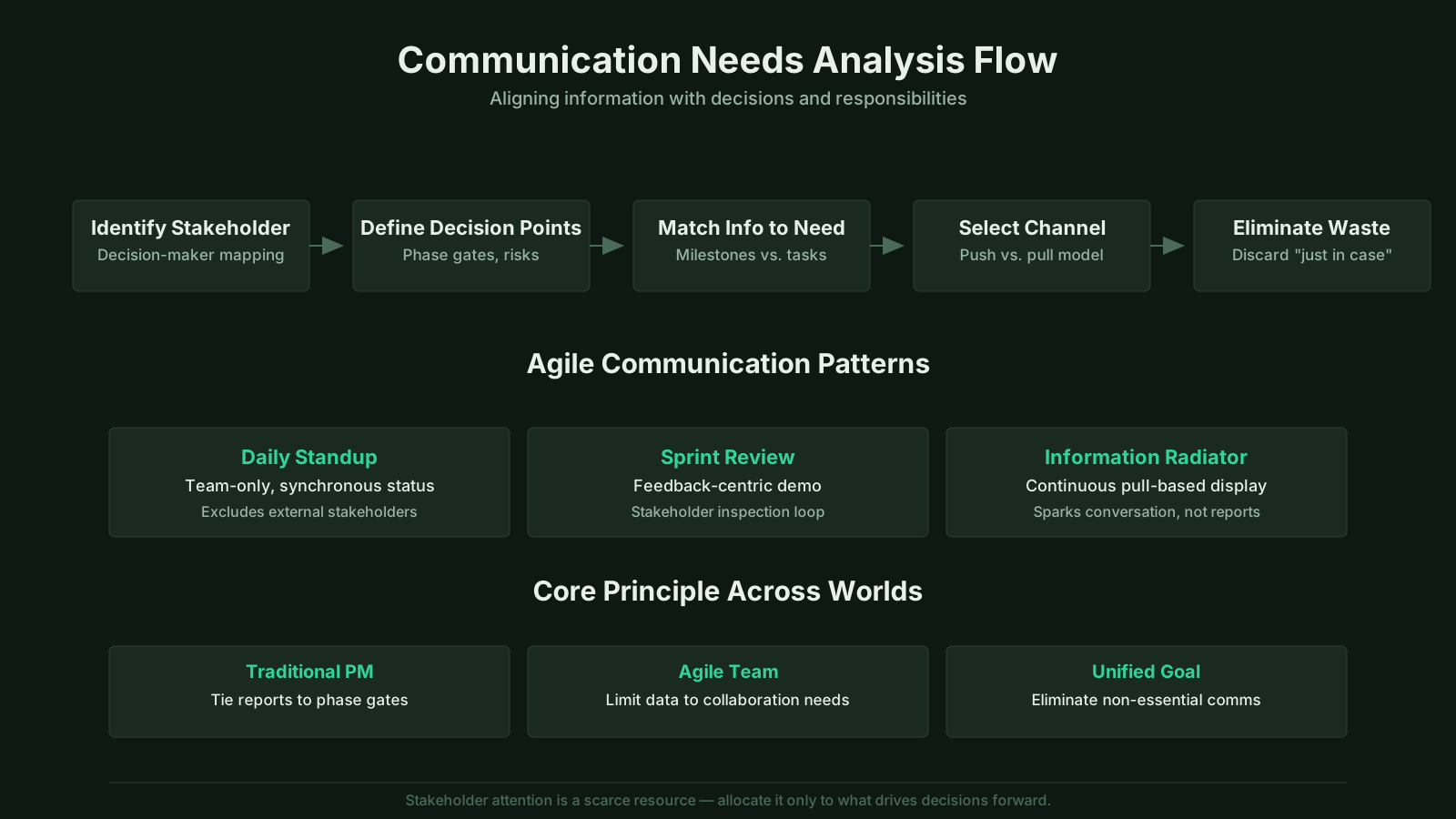
The process feels almost too obvious until you work on a project where nobody defined these thresholds. In that vacuum, communications proliferate like weeds. A business analyst updates a risk log and sends it to twenty people because “they might need it.” A vendor emails the project manager a raw schedule extract that nobody requested. Pretty soon the sheer volume of information buries the signals that matter. Communication requirements analysis sits upstream of this chaos. It sets boundaries and forces the team to ask: does this communication activity increase the probability of success, or would its absence increase the chance of failure? If neither is true, the activity doesn’t belong in the plan.
The same idea surfaces in Agile methods, though the vocabulary differs. Daily standups, sprint reviews, and information radiators are all carefully curated communication channels with specific audiences and value propositions. An Agile team doesn’t write a lengthy document about their communication strategy, but they implicitly perform the same analysis when they decide who attends the review and what artifacts are visible on the team board. The discipline is universal, even when it operates under different labels.
At a Glance: Stakeholder Communication Needs Summary
| Key Concept | Summary |
|---|---|
| Communication Requirements Analysis | Communication requirements analysis identifies the precise information each stakeholder requires, the timing of delivery, and the optimal format, systematically eliminating extraneous details. |
| Opportunity Cost of Communication | Time allocated to preparing communication materials directly reduces time available for core project tasks, requiring that the analysis weigh the full opportunity cost of each update. |
| Agile Communication Practices | Agile teams implicitly conduct equivalent analysis through deliberate curation of channels like daily standups, sprint reviews, and information radiators, each tailored to distinct audiences and objectives. |
| Stakeholder Negotiation | Once stakeholders grasp the resource implications of their requests, they typically agree to streamlined alternatives, such as a weekly summary in lieu of a bespoke report. |
| Interruption Impact on Error Rates | Even short interruptions can double the rate of errors, underscoring the necessity of shielding deep work periods from extraneous communication disruptions. |
| Channel Streamlining | Auditing a communication matrix frequently uncovers overlapping channels that deliver similar content to identical audiences, highlighting immediate opportunities for consolidation. |
| Data Sources for Analysis | The analysis synthesizes inputs from organizational charts, stakeholder registers, management strategies, departmental structures, logistical considerations, and both internal and external information requirements. |
| Reporting Line Omissions | If reporting relationships are omitted from the communication plan, stakeholders such as functional managers may default to worst-case assumptions and withdraw resources prematurely. |
Prioritizing Communication Value Over Volume
Once the definition of information needs is clear, the next move is to assess the value of each communication activity. The source material frames this as combining the type and format of information with an analysis of its value. That’s a deceptively simple statement. It implies that you cannot determine requirements solely from what stakeholders request; you must also weigh whether fulfilling that request generates enough benefit to justify the effort. A project sponsor might demand a daily financial summary, but if the project burns through cash at a predictable monthly rate, daily reporting might be valueless noise.
Many project managers skip this step because it feels confrontational. Telling a senior stakeholder that their requested report is low-value can seem politically unwise. The smarter approach is to frame the conversation around opportunity cost. “We can absolutely produce that daily summary, but it will pull a specialist away from testing for two hours a day. Is that trade-off acceptable?” In most cases, the stakeholder didn’t realize the resource impact, and they’ll happily accept a weekly summary instead. The value analysis thus becomes a negotiation tool, not a rejection slip.
Waste in communication takes many forms. There’s the obvious waste of producing unread documents, but there’s also the hidden waste of distracting knowledge workers with low-signal pings. A study in cognitive psychology—without needing to cite a specific source, just drawing on well-known principles—shows that even brief interruptions can double error rates. When a project team receives twenty irrelevant CCs a day, the mental context-switching drains cognitive capacity. The communication plan, therefore, doesn’t just protect the budget; it protects brainpower. This is exactly where BVOPM’s thinking on waste reduction resonates. BVOPM categorizes waste as including overwork, perfectionism, and rejected acceptable work. Pushing out overly polished status reports that nobody reads falls squarely into the perfectionism bucket. Keeping your communication lean isn’t just efficient; it’s a direct application of value-oriented project management.
Another nuance is that value shifts over the project lifecycle. During initiation, broad conceptual updates might be high-value because they align expectations. During execution, detailed technical specs become high-value for the development team but low-value for external stakeholders. During closure, lessons-learned workshops deliver immense value for the organization even if they feel like an afterthought to tired team members. A static communication plan that doesn’t re-evaluate value at each phase boundary will inevitably slip into irrelevance. Smart project managers treat the value analysis as a recurring checkpoint, not a one-time event.
It’s also important to separate value from volume. Some practitioners think a communication plan with more touchpoints is better. That’s exactly backwards. A dense plan often signals unresolved anxiety about control, not thoughtful design. The goal is the fewest possible communication events that still hit the critical information targets. When you stare at a draft communication matrix and notice that five different channels serve essentially the same audience with similar content, you’ve found a consolidation opportunity. The discipline of saying “no” to redundant communications is what separates rigorous planning from checkbox culture.
Core Insights on Communication Value
- Assess value after defining needs
- Once information needs are clear, evaluate each communication activity by examining whether its format and type deliver sufficient value to justify the required effort.
- Challenge unexamined stakeholder requests
- Communication requirements must not rest solely on stakeholder demands, because a sponsor’s daily financial summary becomes mere noise when cash burn follows a predictable monthly pattern.
- Frame low-value feedback diplomatically
- While telling a senior stakeholder their report is low-value may seem politically unwise, most will readily accept a weekly summary once they recognize the resource drain it creates.
- Count hidden distraction costs
- Low-value communication squanders more than unread documents, since distracting knowledge workers with low-signal alerts drains cognitive capacity and even brief interruptions can double error rates.
- Include lessons-learned in value assessment
- Lessons-learned workshops deliver enormous organizational value at project closure, even when fatigued team members treat them as an afterthought.
Key Information Sources for Determining Stakeholder Needs
You can’t analyze what you don’t see, so the first practical motion is to gather the key information sources that reveal who needs what. The source material lists these clearly: organization charts, project organization and stakeholder responsibility relationships, the various disciplines and departments involved, logistical factors like headcount and locations, internal information needs, external information needs, and the stakeholder register along with the stakeholder management strategy. Each of these contributes a different lens, and missing any one lens often leads to blind spots.
Using Organization Charts to Determine Communication Needs
Organization charts might feel like wallpaper—something you glance at once and then ignore—but they contain structural clues that directly shape communication requirements. A hierarchical chart shows reporting lines, which implies vertical information flows: upward for escalations and summaries, downward for directives and context. A matrix organization chart reveals cross-reporting relationships that demand lateral communication. If a team member reports to both a functional manager and a project manager, both nodes need tailored information, and the project manager must design a communication channel that prevents conflicting messages. This isn’t just theory. I’ve seen matrixed projects where the functional manager wasn’t receiving sprint progress updates, assumed the project was behind, and began pulling resources, all because nobody mapped the reporting line into the communication plan.
Leveraging the Stakeholder Register to Determine Communication Needs
The stakeholder register is the most direct source for determining communication needs. It captures each stakeholder’s role, expectations, influence level, and sometimes their communication preferences. The stakeholder management strategy goes a step further, outlining how the project will engage each stakeholder group. Together, these artifacts let you segment audiences and assign communication requirements that match their stakes. A high-power, high-interest stakeholder needs detailed decision-support information; a low-power, low-interest stakeholder might only need a quarterly awareness memo. The register also flags cultural or language considerations that affect format choices. If a key supplier operates in a different time zone with different working hours, asynchronous documentation becomes non-negotiable.
Internal vs. External Information Needs in Communication Planning
The boundary between internal and external needs is another dimension that becomes obvious only when you forget it. Internal needs usually revolve around coordination, progress tracking, and issue resolution within the project team and immediate organizational units. External needs might involve regulatory compliance, public relations, or contractual obligations. A pharmaceutical project may need to communicate adverse event data to health authorities in a specific format within tight time windows. That requirement isn’t optional; it’s a regulatory necessity. Distinguishing between internal and external needs early prevents the project from treating all stakeholders with the same generic approach, which usually means external parties get too little information or the wrong kind, while internal audiences get buried under too much.
Logistics is another information source that often gets short shrift. The number of persons involved and their locations drive complexity. A three-person co-located team practically doesn’t need a formal communication plan; they can see each other’s screens. But a hundred-person team spread across five time zones requires deliberate design. The source material mentions logistics specifically because distance breaks informal communication channels. When you can’t walk over to someone’s desk, you need a documented handoff protocol, a shared knowledge repository, and maybe a daily virtual standup. These requirements stem directly from the logistics data, not from stakeholder preference surveys.
Managing Communication Channels and Project Complexity
The number of potential communication channels is a classic, almost mathematical way to sense-check the complexity of your stakeholder network. The formula is n(n-1)/2, where n is the number of stakeholders or participants in a communication network. Ten people create forty-five potential channels; twenty people create one hundred ninety. The figure climbs fast, and while the theory is that each channel could generate noise, the real insight is that you must proactively limit who communicates with whom. The source material treats this as a key planning step: determine and limit the communication pathways, not just define information needs.
New project managers sometimes misinterpret this as a command to restrict conversation, but it’s about intentional design. If a junior developer starts receiving direct queries from a client’s legal team, that’s a channel that should probably be closed or routed through a contract manager. Left open, it creates risk of unauthorized commitments and information inconsistency. Limiting channels isn’t about stifling collaboration; it’s about ensuring that every communication link serves a defined purpose and has a clear owner. In Agile contexts, the product owner acts as a nexus, funneling external stakeholder input toward the team and protecting developers from fragmented requests. That’s a deliberate channel limitation strategy.
A common mistake is to treat the channel count as a static number. As the project progresses, stakeholders join and leave, and channels multiply. A robust communication plan includes triggers for when to reassess the network. If the project enters a new phase that involves a compliance team, that’s a trigger to add and restrict relevant channels. Some organizations use responsibility assignment matrices—RACI or RASCI charts—to formalize communication roles. The “Consulted” and “Informed” columns essentially map predefined channels. This connection between responsibility modeling and communication planning often goes unnoticed, but it’s a powerful shortcut. Instead of starting communication planning from scratch, you can reverse-engineer a lot of it from a well-constructed RACI.
Limiting channels also means deciding who will not receive certain information. That’s countercultural in many organizations where the default is to copy everyone. But withholding information can be a form of protection. A steering committee doesn’t need the raw bug list; they need a summary of critical items and business impact. Pushing the raw data onto them creates misinformed opinions and invites micromanagement. The communication plan defines these exclusions clearly, so nobody feels slighted when they’re removed from a distribution list. They appreciate the clarity, once they understand the reasoning.
Key Insights on Channel Governance
- Channel count signals complexity
- Each new stakeholder multiplies the number of possible communication channels, a rapid growth that underscores why channel count is a reliable proxy for network complexity.
- Intentional design over restriction
- Rather than stifling collaboration, channel governance emphasizes intentional design, ensuring every communication link serves a defined purpose and has a clear owner to prevent ambiguity.
- Route queries through the right owner
- Direct inquiries from a client's legal team to a junior developer should be routed through the contract manager, which prevents unauthorized commitments and preserves message consistency.
- Use roles and formal charts
- In Agile settings, the product owner acts as the conduit for external stakeholder input, and RACI or RASCI charts formalize communication roles, clarifying responsibilities across the project.
Inputs to the Plan Communications Process
The Plan Communications process draws from four main input categories: the stakeholder register, the stakeholder management strategy, enterprise environmental factors (EEFs), and organizational process assets (OPAs), especially lessons learned. Each category contributes a different layer of insight, and effective communication planning blends all of them. Skipping one category yields a plan that might look complete on paper but fails under real-world conditions.
Stakeholder Register and Management Strategy as Inputs
The stakeholder register provides the raw data: names, roles, expectations, influence, and communication requirements. The stakeholder management strategy builds on that data by prescribing engagement levels and approaches. When you feed both into the Plan Communications process, the output is a communication plan that aligns engagement strategy with information delivery. For instance, if the management strategy says a particular stakeholder group needs to be “supportive” and currently they’re “neutral,” the communication plan might include additional persuasive content like business case updates or user testimonials, not just status reports. That’s a direct leap from input to tailored communication.
Applying Lessons Learned to Determine Communication Needs
Organizational process assets, especially historical information and lessons learned, are gold mines for determining communication needs without reinventing the wheel. The source material stresses that these assets “can provide insights on both the decisions taken regarding communications issues and the results of those decisions in previous similar projects.” That’s practically a mandate to review past project post-mortems before writing a new communication plan. If three earlier projects reported that insufficient communication with the procurement department caused delays, that’s a clear signal to beef up vendor communication in the current plan. Conversely, if a past project found that a monthly newsletter to internal staff was never opened, you can confidently cut it from the new plan.
Factoring Enterprise Environmental Factors into Communication Needs
Enterprise environmental factors encompass everything from organizational culture and hierarchy to regulatory requirements and geographic dispersion. The source material explicitly notes that “communication must be adapted to the project environment.” This isn’t a minor concern. In a culture where face-to-face interaction carries more weight than written documentation, a communication plan reliant on email updates will fail. The project manager must read the environment and adjust formats accordingly. If the company has strict IT security protocols that block certain collaboration tools, those constraints become communication requirements by default. Adapting to the environment also means respecting political realities. If a powerful executive wants a personal briefing every Friday, even if rationally that briefing provides marginal value, the environmental factor of power dynamics might make it a de facto requirement. The art is to minimize such waste while still acknowledging the reality.
One nuance worth highlighting is that EEFs are not always constraints; sometimes they’re enablers. A company that already uses a mature enterprise social network has a ready-made channel for quick project announcements. A regulatory requirement for audit trails could push the project to adopt a documentation tool that also improves team knowledge sharing. The communication planner should audit the environment not just for barriers but for latent infrastructure that can be repurposed.
Practical Steps to Map Communication Requirements
Turning all this analysis into an actionable plan involves a sequence that many project managers internalize over years. The first step is to map communication requirements to specific stakeholders or stakeholder groups using the stakeholder register as a baseline. This means creating a matrix—formally or informally—that lists each stakeholder, their information need, the format, frequency, and responsible party. The second step is to validate those requirements with the stakeholders themselves. Validation isn’t a democratic vote; it’s a check for blind spots and unrealistic expectations. A stakeholder might agree to a monthly report, but they might not have considered that certain month-end financial close processes delay the data by a week, making a meaningful report impossible until the second week of the following month. The validation conversation surfaces these real-world wrinkles.
After validation, the project manager should apply the value filter aggressively. This is the moment to challenge every requirement that seems disproportionate to its benefit. A trick that works well is to ask: “If we didn’t provide this information, what would break?” If the answer is “nothing, but I’d feel better knowing,” that’s a candidate for elimination or consolidation. Then, determine the communication channels and explicitly limit them, as discussed earlier. Finally, document the plan in a form that can be easily updated, not as a static artifact. A one-page summary with hyperlinks to detail works far better than a twenty-page word document that nobody reads after initial approval. BVOPM’s insistence on brief planning documents that everyone including new joiners can read aligns perfectly with this approach. When a new team member can absorb the communication plan in five minutes, you’ve done something right.
At this point, the plan still needs a feedback mechanism. Communication plans fail silently; nobody complains about a lack of communication until something goes wrong. Build in a lightweight survey or a standing agenda item in team meetings to ask: “Are you getting the information you need? Is anything redundant or missing?” This transforms the plan from a bureaucratic document into a living instrument.
Core Steps in Communication Mapping
- Stakeholder-to-requirement matrix
- Construct a matrix from the stakeholder register that maps each stakeholder to their information needs, preferred formats, delivery cadence, and the accountable owner.
- Validation uncovers practical constraints
- Validation discussions should surface real-world constraints, such as month-end closing delays that would make the proposed reporting schedule unworkable.
- Value filter and brevity win
- Test each report by asking what would break without it, then favor concise one-page summaries with embedded links over lengthy documents that go unread.
Common Communication Planning Pitfalls
Even with a solid methodology, communication planning pitfalls show up in predictable patterns. The most pervasive is assuming that more communication is always better. A project team drowning in status emails, dashboards, and meetings isn’t better informed; they’re overwhelmed. Another pitfall is ignoring the informal communication network. Formal plans define official channels, but every organization has an undercurrent of hallway conversations and instant messages. The plan can’t control those, but it should acknowledge and leverage them. Smart project managers seed the informal network with early, accurate information so that when gossip circulates, it’s at least rooted in fact.
Another classic misstep is designing the plan around a single perfect state of the project, without accounting for turbulence. Crises compress communication timelines. If a risk becomes an issue, stakeholders who normally receive a monthly update suddenly need hourly bulletins. A rigid plan breaks under that pressure. The fix is to define escalation protocols and flexible thresholds. When a risk exceeds a certain probability-and-impact threshold, the communication protocol shifts automatically to high-frequency mode. This isn’t a new idea, but it’s rarely baked into the initial communication plan, so teams scramble when the pressure hits.
Overreliance on a single communication technology is another trap. Email is the default, but it’s a terrible medium for urgent alerts because inboxes are black holes. Instant messaging platforms solve immediacy but create fragmented, unsearchable records. A balanced plan uses multiple channels, each matched to its purpose. Urgent issues go through push channels like SMS or pager alerts for on-call ops; standard updates live in a collaborative workspace like a wiki or shared document repository; face-to-face or video meetings handle high-context discussions. The plan doesn’t just say “weekly meeting”; it specifies the objectives, agenda template, and expected preparation so that the meeting earns its cost.
Finally, a subtle pitfall is treating communication planning as a purely rational exercise, ignoring emotional needs. Stakeholders, especially in high-stakes projects, need reassurance and context that go beyond data. A project manager who only delivers dry status metrics might meet the formal plan but still fail to manage anxiety. Including a brief narrative—a paragraph of interpretation with the numbers—often addresses the underlying emotional need for confidence. This doesn’t require extra effort; it’s a framing choice that transforms a data dump into a trusted update.
Adapting Communication Strategies to the Project Environment
The need to adapt to the project environment runs through every input category, but it deserves its own spotlight. Enterprise environmental factors like organizational culture, regulatory landscape, and geographic dispersal aren’t just constraints; they are the raw terrain on which communication either flows or gets blocked. When the culture favors oral briefings over written reports, building a communication plan around detailed documentation fights the current. Instead, you might schedule a five-minute standup with key stakeholders and record the session for absent members, satisfying both the oral preference and the need for a record. The adaptation isn’t a compromise; it’s a bridge.
Geographic dispersal demands adaptation that goes beyond scheduling across time zones. Language differences, even among teams sharing a common corporate language, introduce nuance gaps. A communication plan might specify that all written updates use plain language with jargon explanations, or that complex technical discussions are summarized verbally with a buddy system pairing native and non-native speakers. These micro-adaptations prevent the death-by-misunderstanding that plagues distributed projects.
Regulatory environments force adaptation to specific formats, approval chains, and retention periods. A project in the financial sector might need to archive all project communications related to product changes for seven years. That requirement directly shapes the choice of communication tools—email might need to be integrated with an archiving system, or the team might switch to a platform with built-in compliance features. The communication plan must document not just what information goes where, but also how it’s captured, stored, and destroyed, because failing to do so creates legal risk.
The project management methodology itself is part of the environment. A hybrid project blending predictive and agile elements creates a communication tension. The predictive side expects formal status reports and phase gate reviews; the agile side pulls toward informal daily coordination and demos. The communication plan must bridge these worlds, perhaps by having a weekly formal report that aggregates sprint metrics alongside milestone progress, and a separate lightweight daily chat channel for the agile sub-team. Adaptation here is about integration, not segregation.
Core Takeaways on Environmental Adaptation
- Culture determines communication format
- In settings where verbal briefing is the cultural norm, integrating short daily standups with automated session recordings harmonizes the preference for spoken exchange with the need for persistent documentation.
- Geography creates language nuance gaps
- Even when teams share a common corporate language, subtle regional variations in phrasing and technical vocabulary can cause misunderstanding; specifying plain English for written communications and pairing native with non-native speakers during complex technical dialogues helps bridge these nuanced gaps.
- Regulations shape tool selection
- Stringent regulatory standards for document formatting, signature workflows, and data retention frequently drive the choice between integrating email with archiving solutions or leveraging collaboration platforms with native compliance controls, leading practitioners to pair a weekly formal compliance report with a low-friction daily chat channel for operational agility.
How to Determine the Communication Needs of Your Project Stakeholders
This entire discussion converges on a practical answer to the central question: how to determine the communication needs of your project stakeholders is not a single-step formula but a structured mindset. Start with the stakeholder register and management strategy to build a baseline map of individuals and groups, their expectations, and their engagement levels. Overlay organizational charts and responsibility matrices to see reporting relationships and decision-making nodes. Inject logistical data about headcount and locations to gauge channel complexity. Then, separate internal needs—coordination, problem-solving—from external needs like regulatory compliance or public relations.
After mapping, you run a value assessment on every identified communication requirement. Challenge each piece rigorously: does this information move the project forward or prevent a failure? If the answer is uncertain, err on the side of cutting it, because communication noise is a form of project debt that compounds. Then, design channels deliberately, limiting the number of pathways and assigning clear owners. Use the communication channels formula not as a forecast but as a heatmap; if the number looks daunting, that’s a signal to consolidate stakeholder groups or create gatekeepers.
The input side of the Plan Communications process is your quality check. The stakeholder register gives you who. The management strategy gives you how closely to engage. Enterprise environmental factors ground the plan in real organizational texture. Organizational process assets, particularly lessons learned, give you foresight about what has failed before. When all these inputs inform the plan, the result is a communication design that’s neither overbuilt nor fragile. It breathes with the project, adapting at phase gates and during shocks.
One final thought that often goes unspoken: determining communication needs is inherently iterative. The first version of your communication plan will be wrong in some ways. Treat it as a hypothesis and test it during the first reporting cycle. Ask stakeholders directly whether they received what they needed. If they didn’t, adjust. If they received too much, trim ruthlessly. Over time, the plan becomes a finely tuned instrument, but only if you treat it as a living document rather than a compliance artifact. That mindset shift—from plan as product to plan as experiment—is what separates projects where communication is a predictable asset from those where it’s a recurring pain point.