Every project manager eventually faces the uncomfortable reality that no plan survives contact with the execution world unscathed. Recognizing that truth early is what separates professionals who constantly fight fires from those who calmly steer their projects through turbulence. Developing a risk management plan is not a bureaucratic tick-box exercise; it is the deliberate act of deciding, before the chaos begins, exactly how the team will identify, analyze, and respond to uncertainty. The process, as mapped out in standard frameworks like the PMBOK Guide, sits squarely in the Planning Process Group and belongs to the Risk Management Knowledge Area, but its influence reaches into every other dimension of project control. The moment a project charter emerges and the scope begins to take shape, the thinking behind risk planning should already be firing up. Waiting until the first crisis hits is a recipe for reactive decision-making that burns through contingency reserves and stakeholder goodwill. In the following exploration, we will unpack the real mechanics of constructing this plan, starting with the foundational inputs and moving through the analytical techniques that turn raw uncertainty into a structured management framework.
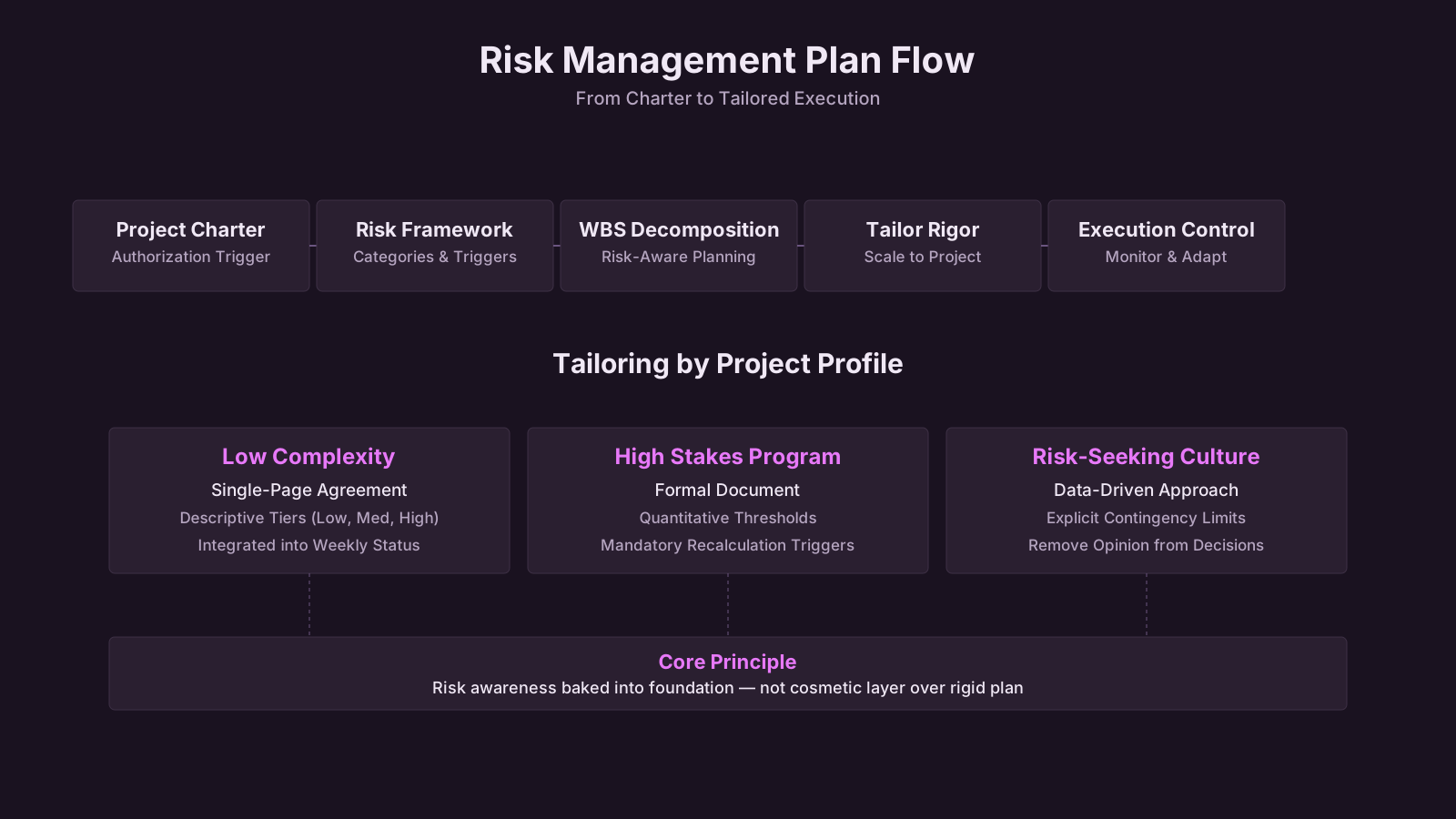
Key Topics: Developing a Project Risk Management Plan
| Key Concept | Summary |
|---|---|
| Risk Planning Purpose | The risk management plan serves as the project's deliberate, proactive framework for identifying, analyzing, and responding to uncertainty, executed before turbulence arises rather than becoming a reactive, bureaucratic overhead. |
| PMBOK Context | Rooted in the Planning Process Group within the Risk Management Knowledge Area, this foundational document exerts formative influence over every dimension of project control, including cost, schedule, and scope. |
| Proactive Integration | Systematically embedding risk analysis into the project lifecycle from inception ensures that critical decisions on scope, resources, and timelines are underpinned by a quantified view of potential volatility. |
| Plan vs. Register | While the risk management plan defines the governance framework, stakeholder roles, and operational ground rules, the risk register functions as a real-time inventory of specific threats and corresponding response actions. |
| Response Calibration | Predefined response strategies activate automatically when risks breach predefined probability and impact thresholds, eliminating reactionary decision-making and preserving team focus during execution. |
| Iterative Delivery | Agile methodologies mitigate certain uncertainties through frequent inspection and adaptation but introduce emergent risks such as backlog volatility, technical debt accumulation, and fragmented cross-sprint stakeholder alignment. |
| Risk Profile Variation | Each initiative carries a fundamentally distinct risk profile determined by technological maturity, contextual constraints, and systemic complexity, requiring vastly different planning for a machine learning prototype versus routine highway engineering. |
| Scope and Assumptions | When scope statements and risk registers become disconnected, untested assumptions drift and can silently erode the business case; adaptive methods like rolling-wave planning maintain alignment through progressive elaboration. |
The Strategic Importance of Proactive Risk Planning
Many organizations treat risk management as a rearview mirror activity, something tacked onto the project plan after the schedule and budget are locked. That approach completely misses the point. Proactive risk planning involves embedding risk considerations into the project's DNA from the outset, ensuring that every subsequent decision about scope, resources, and timeline is informed by a clear-eyed view of what could go wrong. The risk management plan is not the same as the risk register; the register contains specific identified risks and response actions, while the plan spells out the methodology, roles, and operational ground rules that will govern how the team engages with risk throughout the lifecycle. When done right, this document acts as a governor on unrealistic optimism. It forces stakeholders to acknowledge that the baseline projections are not deterministic, and it creates a shared language for discussing uncertainty without descending into blame. Without this up-front discipline, project teams tend to default to either ignoring risks entirely or overreacting to every blip on the radar.
Consider the dynamic at play in a typical infrastructure project. The engineers and quantity surveyors have produced detailed cost estimates and a work breakdown structure that promises a precise end date. The sponsor looks at the numbers and asks for a commitment. If no risk management plan exists, the project manager has no structured way to say "the finish date depends on assumptions that may not hold, and here is how we will track those assumptions." The conversation becomes binary and political. A well-developed risk management plan changes that dynamic by predefining how contingency reserves will be calculated, who has authority to draw on them, and what conditions trigger escalation. That clarity alone saves countless hours of anxious meetings. It also helps the team calibrate their effort; they know that if a risk falls into a certain probability-impact zone, a predefined response strategy will kick in rather than requiring an emergency brainstorming session.
Agile environments manifest this need differently but no less urgently. While iterative delivery reduces some forms of uncertainty through frequent inspection, it introduces others, such as risks around fluctuating product backlogs, technical debt accumulation, and stakeholder alignment across sprints. In that setting, the risk management plan might define how the team uses daily standups to surface emerging risks and how the retrospective provides a regular cadence for risk review. The principles remain the same: decide the "how" before you need the "what." The plan becomes a part of the team's working agreements rather than a dusty document on a shared drive.
Core Takeaways on Proactive Planning
- Proactive versus reactive risk management
- Proactive risk planning embeds uncertainty evaluation into the project's initial design, rather than treating risk management as an afterthought applied once the plan is finalized.
- Plan differs from risk register
- The risk management plan establishes the framework, including methodologies, roles, and decision making protocols, whereas the risk register serves as a living inventory of identified risks paired with concrete response measures.
- Governor against unrealistic optimism
- A robust risk management plan pushes stakeholders to accept that baseline forecasts are nondeterministic and establishes a common language for uncertainty that discourages blame.
- Contingency and escalation governance
- The plan predefines how contingency reserves are sized, who can authorize their use, and which conditions mandate escalation, thereby preventing both complacency and excessive reactivity.
- Predefined responses and iterative risks
- Predefined response strategies linked to probability-impact thresholds enable rapid, consistent action, while iterative delivery models add complexity through shifting backlogs, accumulating technical debt, and dynamic stakeholder expectations.
The Critical Inputs That Shape Your Risk Planning
Building a risk management plan without understanding the project's boundaries is like designing a drainage system without knowing the terrain. The project scope statement, cost management plan, and schedule management plan provide the fundamental parameters that determine just how extensive the risk management effort must be. These inputs do not exist in isolation; they form a network of constraints and baseline aspirations that the risk plan must navigate. The scope statement, in particular, reveals the range of possibilities inherent in the project's deliverables and the underlying assumptions that, if invalidated, could unravel large sections of the work. A project that promises a cutting-edge machine learning module integrated into a legacy banking system carries a fundamentally different risk profile from one that involves repaving a familiar stretch of highway. The scope statement's explicit and implicit assumptions, about technology maturity, regulatory approval, or user adoption, set the stage for everything the risk management plan will eventually contain.
Project Scope Statement: The Range of Possibilities
The scope statement serves as the anchor for risk planning because it articulates what the project will and will not deliver, along with the conditions that the team believes to be true. When you read the assumptions log attached to the scope, you are essentially looking at a pre-filled list of potential risk triggers. If the project assumes a certain vendor API will remain stable throughout development, that assumption is a risk waiting to crystallize. The risk management plan must therefore define how assumptions will be monitored and at what point they will be treated as issues. This linkage is often overlooked. Teams write a scope statement and later create a risk register without explicitly connecting the dots, leaving assumptions to drift until they silently invalidate the business case. By using the scope statement as an input to the risk planning process, the project manager ensures that the methodology for risk identification will systematically revisit those foundational beliefs.
The level of detail in the scope also influences the rigor of the risk management effort. A vaguely defined scope that allows for significant elaboration during the project's life demands a more adaptive risk approach, perhaps one that uses rolling-wave planning for risk identification alongside the progressive elaboration of requirements. If the scope is highly detailed and fixed, a more traditional, upfront risk assessment may suffice, but even then, the plan must account for the possibility that the fixed scope itself becomes the source of risk when business needs shift. In a fixed-price contract scenario, the scope statement's precision directly correlates with the financial risk exposure, so the risk management plan must clearly define thresholds for scope change requests that would trigger risk reassessment.
Cost Management Plan: Defining How Reserves Are Handled
Money is where risk management gets tangible. The cost management plan specifies how risk budgets, contingencies, and management reserves will be reported and accessed, and this specification creates the economic framework for all risk response decisions. If the cost management plan dictates that contingency reserves are held at the project level and can be drawn down by the project manager without escalation, the risk management plan can empower more agile decision-making. Conversely, if management reserves require a formal change request to the steering committee, the risk plan must build in lead times and communication protocols that align with that reality. The interface between these two plans is so tight that some organizations integrate them into a single decision-making framework.
A common pitfall arises when the cost plan treats contingency as a flat percentage of the total budget without a risk-driven justification. The risk management plan can counteract that tendency by prescribing an analytical approach, such as expected monetary value analysis or Monte Carlo simulation, to determine the appropriate reserve levels. It also defines how those reserves will be tracked so that the team can see whether risk mitigation is actually consuming the planned buffers at the expected rate. If a project is burning through its contingency twice as fast as the risk model predicted, that signals either a flawed risk identification process or an execution issue that needs management attention. The cost management plan provides the mechanics; the risk management plan provides the strategic overlay that makes those mechanics meaningful.
Schedule Management Plan: Contingency in the Timeline
Time is the other primary dimension of project risk, and the schedule management plan explains how schedule contingencies will be reported and assessed. If the schedule plan uses a critical path method with added buffers at strategic points, the risk management plan must clarify whether those buffers are sized based on historical data, expert judgment, or a quantitative schedule risk analysis. The two plans need to speak the same language. For example, if the schedule plan identifies a three-week buffer after the testing phase, the risk management plan should detail which specific risks that buffer is intended to cover, because otherwise, the buffer becomes a generic "catch-all" that gets consumed by Parkinson's Law.
Another subtle connection concerns the reporting cadence. A schedule management plan that requires weekly milestone variance reports will funnel data into the risk management process. The risk plan can then specify that any milestone slippage beyond a certain threshold automatically triggers a risk review session, regardless of whether a formal risk control meeting is scheduled. This creates a feedback loop that keeps risk identification alive throughout execution rather than relegating it to a quarterly checkpoint. In large-scale construction or aerospace projects where schedule delays cascade through linked contracts, this integration becomes a contractual necessity. The risk management plan might even define the approved use of lead and lag time adjustments as response strategies, provided they stay within the boundaries set by the schedule plan.
Harnessing Organizational Context: Enterprise Environmental Factors and Process Assets
No project exists in a vacuum, and the raw materials for risk planning are often already scattered around the organization. Enterprise environmental factors and organizational process assets shape the risk landscape in ways that are sometimes more powerful than the project-specific technical challenges. Environmental factors include the organization's risk appetite and tolerance, which are essentially the cultural and policy-driven boundaries within which the project must operate. Some enterprises pride themselves on being risk-takers, pushing into new markets with a willingness to absorb significant financial exposure. Others are deeply conservative, operating in heavily regulated industries where a single compliance failure could threaten the company's license to operate. The risk management plan must calibrate its thresholds for action to these realities. If the corporate risk policy states that any risk with a potential financial impact exceeding a certain dollar amount must be reported to the board, the project's plan simply cannot set a higher threshold no matter how urgent the operational need.
Organizational process assets are the accumulated wisdom and infrastructure that can either accelerate risk planning or become a trap if applied unthinkingly. These assets include risk categories, which provide a predefined taxonomy such as technical risks, external risks, organizational risks, and project management risks. Using a standard risk breakdown structure from past projects ensures consistency and allows for portfolio-level aggregation, but it can also blind a team to novel risks that do not fit neatly into existing buckets. The project manager developing the risk management plan should review the categories critically, asking whether the project's unique nature demands new branches or subcategories. For instance, a digital transformation project introducing artificial intelligence might need a dedicated category for algorithmic bias or data provenance risks that earlier IT infrastructure projects never considered.
Other process assets are equally foundational. Common definitions of concepts and terms ensure that when someone says "high probability," the entire team interprets it the same way. A mature organization will have standard probability scales, like "very unlikely: less than ten percent, unlikely: ten to thirty percent, moderate: thirty to fifty percent," and so on. Adopting these scales directly into the risk management plan saves time and prevents the miscommunication that arises when one stakeholder's "likely" is another's "rare." Similarly, standard risk statement formats, often structured as "If [cause] occurs, then [consequence] will result," force discipline in how risks are described. Templates for risk management plans themselves, refined over multiple projects, provide a starting skeleton that prevents the team from forgetting essential elements like roles and responsibilities or authority levels for decision-making. The danger is filling in the template without thought, producing a document that is formally complete but intellectually empty. The plan must draw on the assets while customizing them to the project's heartbeat.
Lessons learned repositories are arguably the most underutilized asset. A new project manager might dive into risk planning without ever reading the post-project reviews of similar past efforts, and then they are shocked when the exact same vendor relationship implodes or the same testing bottleneck appears. The risk management plan should explicitly reference the process by which historical lessons will be incorporated during risk identification workshops. It might stipulate that a dedicated session be held to review relevant lessons learned and translate them into current context. Stakeholder registers from past projects also provide clues about which individuals or groups historically amplified risks through indecision or political maneuvering. While the current project's stakeholder register is an input, examining the pattern across multiple registers reveals systemic risk sources that a single snapshot cannot capture.
Context Shapes Every Risk Plan
- Context shapes every risk plan
- Because enterprise environmental factors and organizational process assets often exert deeper influence than project-specific technical challenges, every risk plan is embedded in a broader organizational reality that must be addressed from the start.
- Risk appetite sets boundaries
- An organization's risk appetite and tolerance establish the cultural and policy-driven limits that directly constrain how projects perceive and respond to uncertainty, whether the enterprise pursues aggressive growth or mandates strict regulatory adherence.
- Policy thresholds impose firm limits
- When corporate policy mandates board-level reporting for risks above a defined financial impact, the project cannot adopt a more lenient threshold, regardless of operational urgency, because these constraints are non-negotiable.
- Historical structures aid and constrain
- Standard risk breakdown structures ensure consistency and enable portfolio-level aggregation, but they may conceal novel risks that resist categorization; therefore, managers must apply critical review to adapt these frameworks without introducing blind spots.
- Templates prevent costly omissions
- Refined risk management plan templates offer a proven starting framework that prevents critical oversights, ensuring that essential elements such as roles, responsibilities, and decision-making authority are explicitly defined and not forgotten.
Facilitating Effective Planning Meetings and Analysis
The actual heart of developing the risk management plan is the planning meeting, but calling it a meeting undersells what needs to happen. Planning meetings and analysis workshops are where the team translates abstract inputs into concrete risk management processes. The composition of these sessions is critical. If only the project manager and a few senior engineers show up, the resulting plan will reflect a narrow perspective that misses risks visible to procurement, legal, operations, and end-users. A well-run risk planning meeting brings together a cross-functional group that includes the project sponsor or a representative with budgetary authority, key team leads, subject matter experts, and often a facilitator skilled in risk techniques. The facilitator's role is not to dictate content but to guide the group through a structured sequence of decisions: choosing the overall risk methodology, setting scales for probability and impact, defining the risk appetite thresholds that align with organizational policies, and establishing the cadence for risk reviews.
The agenda for these sessions typically starts with a review of the project scope and constraints to ground everyone in reality. Then the group tackles the methodology question: will the project rely primarily on qualitative risk analysis using a probability-impact matrix, or does the complexity and investment level justify quantitative techniques like decision tree analysis or Monte Carlo simulation? The decision does not need to be binary; many projects use qualitative analysis for screening and quantitative for high-priority risks. The risk management plan must be explicit about when and how each technique will be applied so that the team does not later waste time arguing about methods while risks are materializing. The facilitator will also lead a discussion on risk categories, perhaps starting with a standard taxonomy and then soliciting additions that reflect the project's unique context. This collaborative approach to category definition builds ownership and uncovers blind spots that a solitary planner would miss.
One of the most delicate parts of these meetings is negotiating the risk thresholds. A project sponsor might want zero tolerance for schedule delays, but the technical experts know that the underlying technology has a ten percent defect rate in early releases. The facilitator must bridge that gap, helping the group define levels of acceptable variation and corresponding escalation triggers. The conversation often surfaces hidden assumptions: perhaps the sponsor assumed a parallel testing environment that the budget did not fund. Those discoveries are exactly why the planning meetings are worth the time. The output is not just a document; it is a social contract about how the group will handle the fact that not everything will go according to plan.
The Comprehensive Risk Management Plan: Defining How You Will Manage Risks
The primary output of the entire planning process is the risk management plan itself, a document that serves as the constitution for all subsequent risk activities. A thorough risk management plan document defines the methodology, roles, budgeting, timing, and risk categories that will govern the project's approach to uncertainty. It does not list individual risks, that is the risk register's job, but it creates the machinery for populating and updating that register consistently. The methodology section clarifies whether the team will follow a PMBOK-aligned process, a PRINCE2 risk theme, or a hybrid agile approach, and it spells out the specific tools that will be used, such as a probability-impact matrix with a defined scoring system. It might state that for each identified risk, the team will assign probability and impact scores on a scale of 0.0 to 1.0 and then calculate an expected monetary value for cost-related risks. This precision eliminates ambiguity when different team members assess the same risk later.
Roles and responsibilities form another critical component. The plan must identify who owns the risk management process overall, typically the project manager, and who is responsible for monitoring specific risk response actions. Larger projects might designate a risk coordinator or a risk management team. It also clarifies the authority levels for decision-making regarding contingency use, a point that is often left vague until a crisis erupts. If the plan states that the project manager can authorize contingency draws up to a certain amount but must escalate beyond that, it creates a clear governance boundary. The budgeting section addresses how risk management activities themselves will be funded and how contingency reserves will be managed, drawing directly from the earlier alignment with the cost management plan. It might specify that a certain percentage of the project budget is allocated to risk response implementation and will be tracked as a separate line item.
Timing is the element that keeps the plan alive. The document should define when risk identification will occur, not just as an upfront exercise but at regular intervals, at key milestones, and whenever a major change request is approved. It might prescribe a weekly risk review during the execution phase, a monthly deep dive for the steering committee, and a comprehensive reassessment before each phase gate. The risk categories, often represented as a risk breakdown structure, provide the mental framework for ensuring comprehensive coverage. A typical RBS might branch into technical risks, management risks, commercial risks, and external risks, each with further subcategories. By requiring that risk identification efforts consider every category, the plan prevents the team from fixating on obvious technical problems while ignoring, say, supplier financial stability or regulatory changes. Finally, the plan defines the formats and templates for risk reporting, ensuring that information flowing to different stakeholders is appropriately tailored. The sponsor needs a dashboard of top risks with trend arrows; the project team needs a detailed register with response plans and ownership; the client may need a subset of risks that impact their business operations.
Core Takeaways on the Risk Plan
- Governing constitution for risk activities
- As the principal deliverable of the planning phase, the risk management plan defines the methodology, roles, budgeting, timing, and risk categories that constitute the governance framework for all subsequent risk work.
- Process, not individual risks
- Rather than listing individual risks (a function reserved for the risk register), the plan establishes the consistent processes and criteria used to populate and maintain that register over time.
- Methodology and assessment tools
- The methodology section clarifies which standard or framework guides risk activities, such as PMBOK, PRINCE2, or a hybrid agile approach, and details the analytical tools in use, including probability-impact matrices with explicit scoring scales (e.g., a 0.0 to 1.0 continuum) for expected monetary value calculations.
- Ownership and authority levels
- It designates the process owner (usually the project manager), assigns responsibility for monitoring response actions, and clearly defines the authority thresholds for contingency use decisions well in advance of any crisis.
- Funding, timing, and risk categories
- The plan details the funding mechanisms for risk activities and contingency reserves, mandates risk identification at recurring intervals, major milestones, and change approvals, and enforces a comprehensive category framework to prevent the team from overlooking critical areas such as supplier stability or regulatory shifts.
Navigating Implementation Challenges and Ensuring Plan Vitality
Creating the risk management plan is intellectually satisfying, but ensuring it influences real behavior is a different challenge altogether. Implementing the risk management plan effectively requires breaking the pattern of treating it as a static artifact that gets filed after the kickoff meeting. One of the most common failures occurs when the plan prescribes a rigorous risk review cadence that collapses under the pressure of day-to-day delivery. The project manager schedules the first risk review for week four, but by week three the team is behind on deliverables and the meeting gets postponed, then quietly dropped. The solution is not to make the plan less demanding but to integrate risk discussions into existing ceremonies. If the project already has a weekly status meeting, the risk management plan can specify that the first fifteen minutes are reserved for a top-risk review using a predefined agenda. In agile contexts, the daily standup can include a brief risk flag check, and the sprint retrospective can dedicate a segment to emerging risks. The key is to weave risk management into the operational rhythm rather than bolting it on as an extra chore.
Another pervasive issue is the confusion between the risk management plan and the risk register. Teams sometimes update the risk register diligently but never revisit the plan that defines how the register should be used. As a result, the probability and impact scales might drift in meaning, thresholds for escalation might be ignored, and the original analytical rigor degrades into gut-feel assessments. The plan itself needs a version history and a schedule for review, just like any other project artifact. A good practice is to include a "plan refresh" trigger in the plan: if a major risk actually occurs, the team should examine whether the planned methodology was adequate and whether the definitions need recalibration. This creates a self-improving system. For example, if a risk that was categorized as "low probability" materializes and the team realizes the probability scale was poorly calibrated, the risk management plan can be updated to anchor the scale descriptions more concretely, perhaps with specific frequency data from the industry.
The disconnect between risk appetite as declared in the plan and risk tolerance as demonstrated in decisions is a subtler but more corrosive problem. An organization might state that it is risk-seeking in technology innovation, but when the first prototype fails, the project sponsor panics and shuts down exploration. The risk management plan cannot fix cultural hypocrisy, but it can include a mechanism for calling it out. By documenting the agreed-upon risk thresholds and requiring that any deviation be formally recorded with rationale, the plan creates a paper trail that makes it harder for stakeholders to abandon the agreed-upon strategy without a conscious, documented decision. This also protects the project manager from being held responsible for the consequences of decisions that contradict the plan's governance framework.
Aligning Risk Management with Broader Project Management Practices
Risk management does not occur in a silo, and the strength of a risk management plan often depends on how well it interlocks with communications management, procurement management, and quality management. Integrating risk management with cost and schedule planning ensures a unified control framework that avoids the fragmentation of seeing scope, time, cost, and risk as separate domains. The communications management plan defines who needs what information and when, and the risk plan feeds directly into that by specifying the risk reporting needs of each stakeholder group. If the communications plan says that the project sponsor receives a monthly high-level report, the risk plan can state that this report must include a risk heat map and a summary of top-five risks with trend analysis. This makes the connection explicit rather than leaving it to chance. Procurement risks are often the project's largest external uncertainty. The risk management plan should prescribe how supplier risks are identified and managed, possibly referencing the procurement plan's vendor evaluation criteria and contract types. A fixed-price contract transfers certain cost risks to the supplier, but it introduces new risks around quality and delivery enforcement that the risk plan must address.
From a business value-oriented perspective, some organizations adopt practices where risk management is closely tied to product-level value assessment. In the BVOPM framework, product risk management is treated separately with quantified loss size units and dynamic filtering of risks based on business value impact. When developing the risk management plan, project managers can benefit from this mindset by ensuring that risk categories explicitly include value delivery risks, such as risks that the product will not generate the expected user adoption or that market conditions will shift the value proposition. Defect analysis in such environments often uses predefined root-cause categories that feed back into the risk identification process, creating a continuous loop between quality failures and risk awareness. This is a more integrated approach than traditional project management, where quality defects are often handled in a separate quality log. The risk management plan can borrow from that philosophy by defining how quality-related incidents automatically trigger a risk review to assess whether the underlying risk profile has changed.
Agile and hybrid methodologies bring further alignment opportunities. In a Scrum environment, the risk management plan might define how the product owner uses the product backlog to manage risk-adjusted priorities, placing high-risk items in early sprints to reduce uncertainty as quickly as possible. The plan might also address the concept of a "risk spike," a time-boxed investigation aimed at resolving a specific technical or business uncertainty, and how that spike's outcome feeds back into the risk register and potentially alters the release plan. This kind of integration ensures that risk management is not a parallel track but an embedded thread in the project's execution fabric. When the risk management plan explicitly references the dynamics of the selected development methodology, it becomes a living document that adapts as the project adapts, rather than a static set of rules that the team must translate on the fly.
The final pieces of alignment involve the broader governance structure. Portfolio-level risk aggregation relies on consistent reporting from individual projects, and the risk management plan should be designed with that upward flow in mind. If the portfolio management office expects monthly risk data in a specific electronic format, the project's plan should incorporate that format into its reporting specifications. This reduces the rework of translating data later and makes the project's risk status visible in the organizational dashboard. Similarly, program-level dependencies introduce risks that a single project cannot see. The risk management plan should designate who will attend program risk review meetings and how program-level risks that impact the project will be cascaded down and managed within the project's own boundaries. This vertical and horizontal integration transforms the risk management plan from an isolated project document into a node in a larger organizational risk management network.
Core Takeaways on Integrated Risk Planning
- Unified control framework
- Integrating risk into cost and schedule baselines ensures that threats to scope, time, and budget are managed holistically rather than in isolated silos.
- Communications plan alignment
- The risk plan explicitly defines stakeholder risk reporting requirements and directly informs the communications plan, for instance by embedding consolidated risk heat maps into monthly sponsor updates.
- Supplier and contract risk
- Risk planning must confront procurement decisions such as fixed-price contracts; these transfer cost risk to suppliers yet create fresh exposure in quality assurance and schedule enforcement.
- Value delivery risk categories
- Risk breakdown structures must explicitly capture product value risks like low user adoption or evolving market demand, a perspective grounded in the BVOPM framework.
- Agile risk management practices
- Within Scrum environments, the plan should establish risk-adjusted backlog ordering and introduce time-boxed spikes to proactively resolve technical or business uncertainties.
