The key processes in project human resource management determine how a project team is planned, assembled, developed, and managed. Before team members and their competency levels are identified, activity durations, budgets, scope, and other plans that were estimated earlier may be subject to change. This connection is easy to overlook. A project manager can create a detailed schedule and cost baseline, then realize those numbers depend on having specific people with specific skills, and the whole plan shifts once actual availability becomes clear.
Project human resource management includes four processes: Develop Human Resource Plan, Acquire Project Team, Develop Project Team, and Manage Project Team. Each process has distinct inputs, tools and techniques, and outputs. Understanding these processes matters because people deliver projects, and any failure in staffing or team performance ripples into schedule, cost, quality, and stakeholder expectations.
Summary of Key Processes in Project Human Resource Management
| Key Concept | Summary |
|---|---|
| Early Planning | Effective resource planning begins during project initiation because schedule, cost, and scope estimates depend on confirmed access to the specific people and skills required. |
| Availability Shifts | Actual staff availability often diverges from initial assumptions after team acquisition, requiring the project manager to update resource assignments, schedules, and delivery forecasts accordingly. |
| Team Development | When acquired personnel have less experience than planned, the Develop Project Team process must compensate through targeted training, mentoring, and more frequent performance monitoring. |
| Performance Impact | Staffing gaps or underperformance directly affect schedule adherence, cost control, quality outcomes, and stakeholder confidence, making workforce management a critical project control point. |
| Enterprise Factors | Organizational culture, current workforce capabilities, labor market conditions for specialized roles, and personnel policies act as enterprise environmental factors that constrain and inform human resource planning. |
| Market Shortages | Scarcity of specialized talent in the labor market may require longer acquisition timelines, higher contracting budgets, or the use of distributed and virtual team models. |
| Organizational Assets | Historical hiring lead times, approval gate requirements, and documented responses to prior talent shortages serve as organizational process assets that improve planning accuracy. |
| Networking Insights | Informal networks often reveal hidden constraints, such as a key specialist nearing departure or competing project demand, that formal resource charts typically overlook. |
The Key Processes in Project Human Resource Management
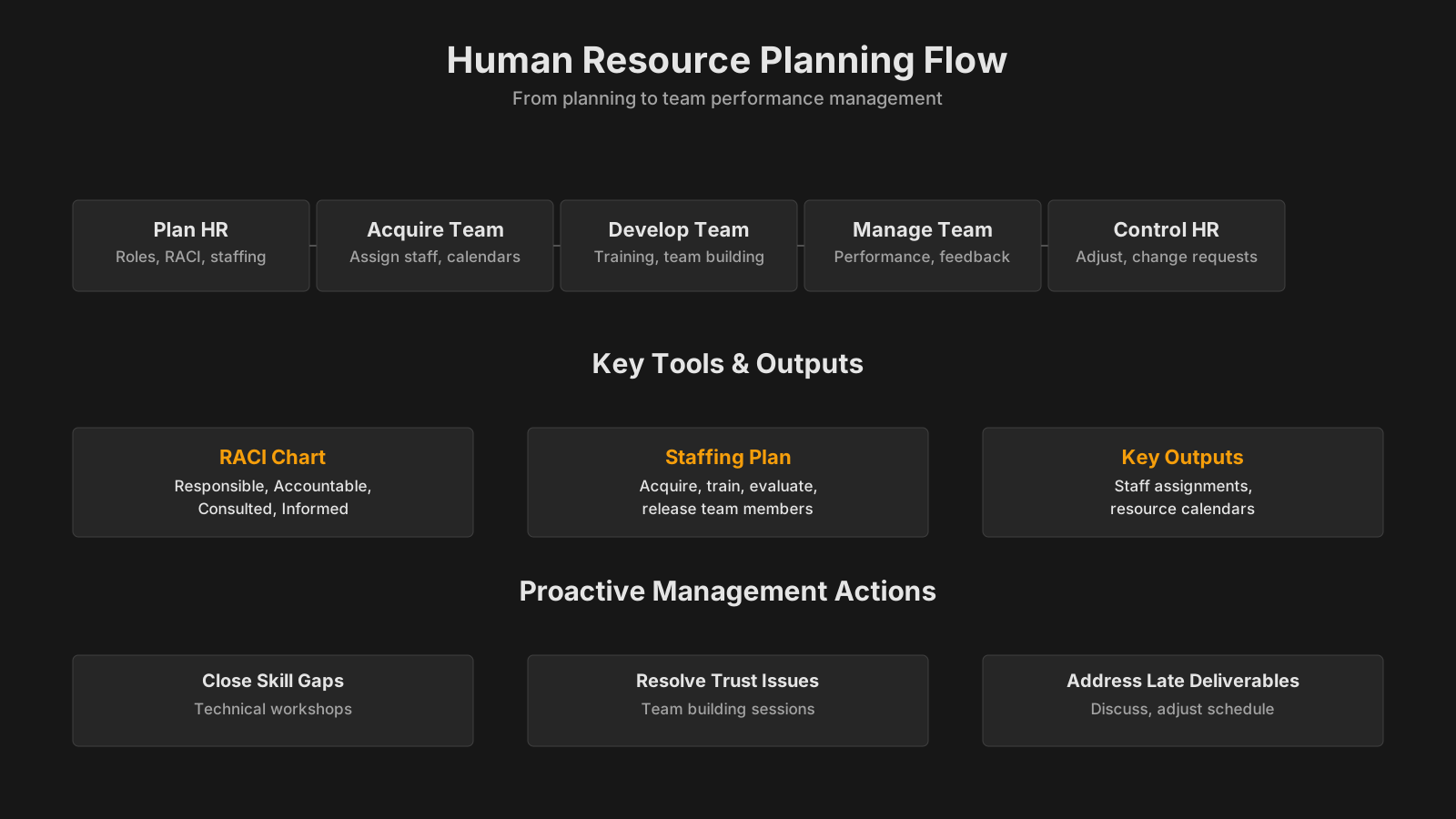
The project human resource management key processes form a sequence from planning through execution and control, but they are not purely linear. In practice, a project manager may revisit the human resource plan after acquiring the team, because the people actually available rarely match the original assumptions exactly. That is normal, but it means the processes are iterative. The four processes share the same objective: to ensure the project has the right people, with the right skills, in the right roles, at the right time.
In the PMBOK framework, Develop Human Resource Plan belongs to the planning process group, while Acquire Project Team, Develop Project Team, and Manage Project Team are part of executing. This placement reflects a simple reality: you cannot acquire or develop a team until you know what you need. The planning process produces a human resource plan that guides staffing decisions, role definitions, and performance expectations.
Mapping the Four Key Processes in Project Human Resource Management
The four processes connect to each other through shared outputs. The human resource plan from the first process becomes an input, directly or indirectly, to team acquisition and development. Project staff assignments from Acquire Project Team feed into Develop Project Team and Manage Project Team. Team performance assessments from Develop Project Team then support the Manage Project Team process, where performance issues can trigger change requests.
This interconnected structure is important because it prevents human resource management from becoming a series of isolated administrative tasks. A change in one process naturally affects the others. For example, if the acquired team includes a less experienced developer than planned, the Develop Project Team process may need more training, and the Manage Project Team process may need closer performance tracking. The processes form a continuous loop rather than a one-way pipeline.
Why Human Resource Planning Comes Early
The source material highlights a crucial dependency: before identifying all project team members and their competency levels, any activity durations, budgets, scope, or plans that were estimated or planned may be subject to change. This is not a minor caveat. It means the human resource plan is not something you can postpone until after the schedule is approved. If you do, the approved schedule may be built on assumptions about available skills that do not survive contact with reality.
A small example makes this concrete. A construction project estimates ten weeks for electrical work because the plan assumes three licensed electricians. If the organization can only assign one licensed electrician and the others must be hired or contracted, that ten-week estimate may need to change. The human resource plan should surface this gap early, before the cost baseline and schedule are finalized.
This early planning also reduces firefighting later. When project managers wait until execution to think about staffing, they often end up negotiating with functional managers under time pressure. That pressure leads to accepting suboptimal resources or overloading existing team members. Early human resource planning gives the project manager time to negotiate properly, build a business case for external hiring, or adjust the plan in a controlled way.
Core Insights on HR Processes
- Iterative, not purely linear
- Although these processes are presented as a sequence, they are frequently revisited in practice because the people actually available rarely match the assumptions made during planning.
- One shared objective
- Together, all four processes ensure the project has the right people, with the right skills, in the right roles, at the right time to perform effectively.
- PMBOK process placement
- Develop Human Resource Plan sits within the planning process group, whereas Acquire Project Team, Develop Project Team, and Manage Project Team belong to the executing process group, with the plan serving as an essential input to team acquisition and development.
Develop Human Resource Plan Process
The develop human resource plan process produces the human resource plan, the foundational document for all other team-related activities. Its role is to define roles, responsibilities, required competencies, and the overall staffing approach. Without this process, project managers end up with vague job titles and no clear mechanism for acquiring or developing people.
Inputs to the Develop Human Resource Plan Process
The process begins with three inputs: activity resource requirements, enterprise environmental factors, and organizational process assets. Activity resource requirements specify the types and quantities of resources needed for each activity. These requirements emerge from activity resource estimating, which is part of the schedule management work. Enterprise environmental factors include the organizational culture, existing human resources, marketplace conditions for specialized skills, and personnel administration policies. Organizational process assets provide templates, historical information, lessons learned, and escalation procedures that shape how the human resource plan is developed.
Each input affects a different layer of planning. Activity resource requirements answer what the project needs. Enterprise environmental factors answer what the organization can currently provide or what constraints exist in the external labor market. Organizational process assets answer how similar work has been staffed before and what templates the organization expects. Overlooking any one of these leads to a human resource plan that may look good on paper but cannot be executed.
Activity resource requirements can be more detailed than many project managers expect. For a software project, they might include the number of backend developers, the required years of experience, the length of involvement, and the timing of peak workload. This specificity helps the human resource plan avoid vague statements like "we need some developers" and instead specify exactly what the gap is.
Enterprise environmental factors bring external reality into the plan. For example, if the local labor market has a shortage of data engineers, the human resource plan may need to include a longer acquisition timeline, a higher budget for contracting, or a decision to use virtual teams. Organizational process assets then provide the organization's own historical patterns, such as how long it takes to hire a developer, what approval process is needed for a new position, and how previous projects handled similar shortages.
Tools and Techniques for Human Resource Planning
The tools and techniques for this process are organization charts and position descriptions, networking, and organizational theory. Organization charts and position descriptions help communicate roles visually or textually. A responsibility assignment matrix, such as a RACI chart, can show who is responsible, accountable, consulted, and informed for each deliverable. Position descriptions go further by defining the authority, responsibilities, and competencies associated with each role.
Networking is the informal side of planning. Project managers talk with peers, functional managers, professional associations, and sometimes external partners to understand resource availability and skill levels. Organizational theory provides a conceptual lens for how people and teams behave within the organization, including motivation, authority, and reporting relationships. This theory helps a project manager anticipate how the proposed structure might actually function once the project starts.
Here is a small but telling gap. Many project managers treat organization charts as the only planning tool and skip networking until they need a favor. Actually, networking often reveals constraints that no formal chart will show, such as a key specialist planning to leave the organization or a competing project that is about to consume the same resource pool.
Organization charts can take several forms. A hierarchical chart shows reporting relationships. A matrix-based chart shows where people are assigned to multiple projects or functional areas. Text-oriented descriptions provide detailed role definitions. The right mix depends on the complexity of the project and the organization's culture. A highly matrixed organization may need a RACI chart to clarify decision rights, while a small co-located team might only need a simple responsibility list.
Organizational theory is often underused because it sounds academic. In practice, it helps a project manager understand why certain structures create conflict or why some reporting relationships slow down decisions. When the human resource plan reflects this understanding, it is less likely to propose a structure that looks efficient on an org chart but fails in daily operation.
Outputs of the Develop Human Resource Plan Process
The only output from this process is the human resource plan. That plan typically includes roles and responsibilities, a project organization chart, and a staffing management plan. The staffing management plan describes how and when team members will be acquired, how they will be released, training needs, recognition approaches, compliance requirements, and safety considerations.
A well-structured human resource plan is not a static document. It can be updated as acquisition and team development reveal new information. But the initial version should be comprehensive enough to guide the next process, Acquire Project Team. If the human resource plan lacks clear role definitions or ignores release criteria, the acquisition process becomes reactive and chaotic.
The staffing management plan also addresses the often-forgotten element of team release. Projects end, and people need to be transitioned back to their functional roles or to new projects. Without release criteria and transition plans, team members may linger on the project longer than needed, inflating costs and creating confusion about accountability.
Acquire Project Team Process
The acquire project team process turns the human resource plan into actual staff assignments and resource calendars. It is where planning meets reality. Even the most detailed plan cannot force people to become available, so this process often involves negotiation, adjustment, and sometimes hiring or contracting.
Inputs to the Acquire Project Team Process in Project Human Resource Management
The inputs are the project management plan, enterprise environmental factors, and organizational process assets. The project management plan contains the human resource plan and other subsidiary plans that influence staffing, such as schedule and risk management plans. Enterprise environmental factors include the availability of people within the organization, marketplace conditions, and organizational hiring policies. Organizational process assets provide standard procedures for requesting staff, negotiating with functional managers, and onboarding new hires.
One common mistake is treating acquisition as a purely administrative step. In reality, the availability and quality of people can change the project's scope, schedule, and cost. If a highly experienced engineer is not available, the project may need to adjust its approach, add training, or accept a higher risk profile. The acquisition process is therefore not just about filling seats; it is about securing the capability the project needs.
The project management plan input is especially important because it links acquisition to other knowledge areas. The schedule baseline may assume certain resources are available by a specific date. The risk management plan may include responses for resource gaps. When acquisition reveals a mismatch, those other plans must be updated through formal change control. Ignoring this connection leads to an unrealistic schedule that the project team cannot execute.
Tools and Techniques for Acquiring the Project Team
The tools and techniques include pre-assignment, negotiation, acquisition, and virtual teams. Pre-assignment occurs when specific people are named in the project charter or because their unique skills make them necessary for the project. Negotiation involves working with functional managers, other project teams, or external vendors to secure the right people at the right time. Acquisition refers to hiring new employees or contracting external resources. Virtual teams allow project work to be performed by people in different locations, time zones, or organizations.
Negotiation deserves particular attention because it is often the least formalized but most decisive technique. A project manager may negotiate with a functional manager for a senior designer part-time for three months. The functional manager may counter with a junior designer full-time. The project manager then has to decide whether to accept lower experience, adjust the schedule, or escalate the issue. This negotiation can directly impact the project's quality and risk profile.
Pre-assignment can be a double-edged sword. It provides clarity and reduces acquisition time, but it can also lock the project into a specific person whose availability may change. Sometimes pre-assignment is based on political considerations rather than pure competency, which creates a different kind of risk. The project manager should still validate that the pre-assigned person has the necessary skills and capacity.
Acquisition through hiring or contracting is often more expensive and slower than internal negotiation. However, it may be the only way to secure specialized skills that do not exist inside the organization. When acquisition is necessary, the project manager needs to account for recruitment lead time, onboarding, and the risk that the new hire may not fit the team culture.
Virtual teams have expanded significantly as organizations embrace distributed work. They introduce communication and coordination challenges, but they also open access to talent that would otherwise be unavailable. A successful virtual team requires clear communication protocols, appropriate technology, and explicit expectations about availability and response times. Without those elements, virtual team members can feel disconnected and performance can slip.
Outputs of the Acquire Project Team Process
The outputs are project staff assignments, resource calendars, and project management plan updates. Project staff assignments document who is working on the project, in what role, and at what level of effort. Resource calendars show when each team member is available, which feeds directly into schedule development and resource leveling. Project management plan updates occur when the actual staffing situation requires changes to the schedule, cost, risk, or human resource plan.
Resource calendars are particularly important. A person may be assigned to the project but only available three days per week because of operational duties. If the schedule does not reflect this limited availability, task durations and milestone dates will be unrealistic. Resource calendars also help project managers avoid double-booking people across multiple projects, a common source of conflict in matrix organizations.
Project staff assignments are more than a list of names. They should capture the level of effort, the reporting relationship, and any conditions attached to the assignment. This clarity prevents later confusion about who is responsible for what and supports the Manage Project Team process when performance issues arise.
Key Insights on Acquiring Teams
- Plan alone cannot guarantee availability
- The Acquire Project Team process translates the human resource plan into actual staff assignments, but no plan can guarantee that the required people will be available when needed, so successful acquisition typically depends on negotiation, adjustment of scope or schedule, external hiring, or contracting.
- Pre-assignment and virtual teams
- Pre-assignment commits specific individuals to the project either because they are named in the project charter or because their distinctive expertise is essential to the work, while virtual teams allow project activities to proceed across different locations, time zones, or organizational boundaries.
- External conditions shape staffing outcomes
- Enterprise environmental factors, including the availability of qualified personnel, prevailing market conditions, and internal hiring policies, work together with organizational process assets for requesting and onboarding staff to determine how the project actually acquires its team.
Develop Project Team Process
The develop project team process focuses on improving competencies, team interaction, and the overall team environment. Its purpose is not just to make people happy but to increase the likelihood that the project will meet its objectives. A high-performing team can absorb more technical challenge, adapt to change, and communicate more effectively with stakeholders.
Inputs to the Develop Project Team Process
The inputs are project staff assignments, the project management plan, and resource calendars. Project staff assignments tell you who is on the team and what competencies they already possess. The project management plan provides the context for team development, including the human resource plan, training requirements, and performance expectations. Resource calendars show when people are available for training, team-building activities, and collaborative work.
These inputs may seem straightforward, but they contain a hidden complexity. Team development depends on knowing both the current capability of each person and the desired capability needed for the project. The gap between these two states is what training and team-building activities must close. If the project manager does not understand the current baseline, development efforts may be misdirected or insufficient.
Resource calendars are often overlooked in team development. A team may be scattered across time zones or partially allocated to operational work. Scheduling a training session or a co-location workshop becomes much harder when calendars conflict. The project manager needs to use resource calendars to find windows where the whole team can participate without disrupting critical project work.
Tools and Techniques for Developing the Project Team
The tools and techniques are interpersonal skills, training, team-building activities, ground rules, co-location, and recognition and rewards. Interpersonal skills include empathy, influence, creativity, and group facilitation. Training can be formal or informal and can focus on technical, managerial, or soft skills. Team-building activities range from structured workshops to informal events, but their true value lies in building trust and improving collaboration.
Ground rules are explicit expectations about how the team will work together. They cover meeting behavior, decision-making, conflict resolution, and communication. Co-location places team members in the same physical location to improve communication and reduce misunderstandings. Recognition and rewards reinforce desired behaviors and outcomes, but they must be aligned with what the team actually values.
From a Business Value-Oriented Project Management perspective, cross-functional teams are treated as a core success factor, and tools created by employees can be valued as formal products. This view shifts team development from a soft activity to a strategic investment in the project's value delivery capability.
Here is where many project managers get caught. They schedule a team-building event and expect it to fix communication problems. Without clear ground rules and ongoing interpersonal skill development, a single event rarely changes established patterns. Team development is continuous, not a one-time intervention.
Training can be targeted to close a specific competency gap. For example, if the acquired team lacks experience with a new testing tool, a short technical workshop may improve performance more than a generic communication seminar. The project manager should link training directly to the project's needs rather than relying on a generic catalog of courses.
Recognition and rewards require some nuance. A reward that works for one team may not work for another. Some teams value public recognition, others prefer flexible work hours, and still others want more challenging assignments. The project manager needs to understand individual and team motivations before designing a reward system. Misaligned rewards can actually reduce morale if they seem arbitrary or unfairly distributed.
Outputs of the Develop Project Team Process
The outputs are team performance assessments and enterprise environmental factors updates. Team performance assessments evaluate the team's effectiveness, including technical performance, collaboration, communication, and conflict resolution. Enterprise environmental factors updates reflect changes in the organization's culture, skill base, or available resources resulting from team development activities.
Team performance assessments feed into the Manage Project Team process, where they become a baseline for evaluating individual and team performance. They also provide input for future project planning, because lessons about what worked and what did not can inform the human resource plan on the next project. Without this feedback loop, the organization repeats the same team development mistakes.
Enterprise environmental factors updates are easy to overlook but valuable. A project that successfully develops a new technical skill in its team members changes the organization's overall capability. Documenting that change helps future projects know that the skill now exists internally, which may reduce the need for external acquisition. It also captures shifts in team culture that may affect how future projects are staffed.
Manage Project Team Process
The manage project team process is about tracking performance, providing feedback, resolving issues, and managing changes to optimize project outcomes. It is the most day-to-day of the four processes because it happens continuously as the project executes. While Develop Project Team focuses on improving capability, Manage Project Team focuses on steering that capability toward project goals.
Inputs to the Manage Project Team Process
The inputs are project staff assignments, the project management plan, team performance assessments, performance reports, and organizational process assets. Project staff assignments identify who is responsible for what work. The project management plan defines the performance expectations and control thresholds. Team performance assessments provide the qualitative picture of team dynamics. Performance reports provide quantitative data on schedule, cost, quality, and other metrics. Organizational process assets include the organization's performance appraisal procedures, conflict escalation paths, and issue management systems.
This combination of qualitative and quantitative inputs is important. A team can be meeting its schedule targets while suffering from unresolved conflict or burnout. Conversely, a team with strong collaboration can still miss deadlines if workloads are unrealistic. The Manage Project Team process must consider both sides.
Performance reports come from the monitoring and controlling processes and include data on earned value, milestone completion, defect rates, and other metrics. These reports give the project manager an objective basis for performance conversations. Rather than relying on impressions, the project manager can point to specific variances and ask why they are occurring. This makes feedback more constructive and less personal.
Organizational process assets often include formal appraisal templates and escalation procedures. In a matrix organization, the project manager may not have direct authority over a team member's career progression. The appraisal process then requires coordination with the functional manager. Understanding these organizational assets in advance helps the project manager navigate performance issues without creating tension between project and functional priorities.
Tools and Techniques for Managing the Project Team
The tools and techniques are observation and conversation, project performance appraisals, conflict management, an issue log, and interpersonal skills. Observation and conversation help the project manager detect emerging problems before they become formal issues. Project performance appraisals assess individual and team performance against agreed criteria, often in collaboration with functional managers. Conflict management addresses disagreements fairly and constructively. The issue log records problems, assigns ownership, and tracks resolution. Interpersonal skills enable the project manager to influence, negotiate, and facilitate difficult conversations.
Conflict management deserves a careful look. Conflict is not always negative. Constructive conflict can reveal flaws in assumptions and lead to better decisions. The goal is not to eliminate conflict but to manage it so that it does not become destructive. Avoidance, accommodation, compromise, collaboration, and forcing are common approaches, and the right choice depends on the situation, the urgency, and the relationships involved.
The issue log acts as a control mechanism. A team member raises an issue, the project manager logs it, assigns an owner, and sets a target resolution date. This prevents small problems from being forgotten or repeatedly discussed without action. The issue log also creates a historical record that can be reviewed to identify recurring patterns or systemic problems.
Observation and conversation are more than casual check-ins. The project manager should watch for signs of disengagement, overload, or interpersonal friction. A short conversation with a team member can reveal that they are blocked by a dependency or frustrated by unclear priorities. These early signals may not appear in any report, but they matter because they affect future performance.
Project performance appraisals can be tricky in a project environment. The project manager may not have formal HR authority, so the appraisal often requires input from functional managers or line supervisors. The appraisal should focus on agreed project-specific criteria, not generic personality traits. This keeps the conversation objective and tied to the project's success.
Outputs of the Manage Project Team Process in Project Human Resource Management
The outputs are enterprise environmental factors updates, organizational process assets updates, change requests, and project management plan updates. Enterprise environmental factors updates reflect changes in organizational culture, skills, or policies resulting from team management actions. Organizational process assets updates include new lessons learned, updated templates, or revised issue management procedures. Change requests arise when performance issues indicate that the project management plan needs adjustment, such as added training, revised assignments, or schedule changes. Project management plan updates then incorporate the approved changes.
This output set shows that managing a team is not just about people. It also produces formal project documentation. A performance gap can become a change request that triggers a schedule update, a budget adjustment, or a risk response. The human side and the control side are tightly linked.
Enterprise environmental factors updates from this process often capture changes in team morale, conflict resolution norms, or the development of new leadership skills. These changes may not be immediately visible, but they affect how the organization operates on future projects. Organizational process assets updates, such as a refined issue escalation path or a new conflict management template, make the organization more capable over time.
Change requests from the Manage Project Team process are a healthy sign, not a failure. They indicate that the project manager is responding to performance data in a structured way instead of letting the plan drift. A common but unhelpful pattern is to ignore performance gaps because changing the plan feels like admitting a mistake. That reluctance often leads to larger problems later, when the gap has widened and corrective action is more expensive.
Manage Project Team: Key Insights
- Steering team capability toward goals
- Manage Project Team builds on the capabilities created in Develop Project Team and directs them toward project objectives through performance tracking, structured feedback, issue resolution, and change management.
- Inputs include reports and process assets
- The process draws on project staff assignments, the project management plan, team performance assessments, performance reports that include quantitative metrics, and organizational process assets such as appraisal procedures and conflict escalation paths.
- Quantitative metrics versus team health
- A team can meet schedule targets while still suffering from unresolved conflict or burnout, and a collaborative team can miss deadlines because of unrealistic workloads, so managers must combine observation, appraisals, conflict management, and an issue log to balance quantitative performance with team health.
Common Pitfalls in Project Human Resource Management
The common pitfalls in project human resource management can undermine even the best technical plan. One of the most frequent is treating the human resource plan as a one-time deliverable rather than a living document. As the team is acquired and performance data emerges, the plan should be updated. Another pitfall is delaying acquisition until after the schedule is baselined, which often triggers rework when actual availability does not match assumptions.
Another common issue is failing to distinguish between developing the team and managing the team. Development builds capability; management directs that capability. Some project managers overinvest in training and team-building while ignoring performance problems, or they focus on monitoring and conflict but skip the relationship-building that prevents many conflicts in the first place.
Virtual teams introduce a specific set of pitfalls. Without deliberate communication protocols, remote team members can feel isolated and performance can slip unnoticed. Resource calendars may be updated late, causing scheduling conflicts. Conflict management becomes harder when body language and informal hallway conversations are absent. The project manager must compensate for these gaps with structured communication and regular one-on-one check-ins.
Finally, many organizations undervalue the enterprise environmental factors updates that result from team development and management. These updates capture changes to the organization's skill base, culture, and resource availability. Ignoring them means losing useful organizational learning that could improve future projects. The most effective project managers treat human resource management outputs as assets for the whole organization, not just as project artifacts.
Across all four processes, the human element is both a constraint and a source of flexibility. Plans change when people change, but skilled team members can also solve problems that no plan anticipated. That is why project human resource management remains one of the most practical and consequential knowledge areas in project management.