In any organization, someone eventually asks the question: how do projects differ from ongoing operations? It might seem like a purely academic distinction, but the answer shapes how resources are allocated, how success is measured, and whether a team ever gets to declare victory and go home. Projects and operations share a surprising number of characteristics, yet they diverge in one fundamental way that touches every aspect of management practice. Grasping that difference directly affects whether strategic plans translate into sustained business results.
Consider a product redesign initiative. A project manager assembles a temporary team, sets a deadline for prototype delivery, and works with operational managers from manufacturing, marketing, and distribution. Those operational managers, however, are not going anywhere when the project wraps up. They will still be running production lines, tracking inventory, and responding to customer demand long after the new product launches. This everyday scenario illustrates the central tension: projects end, but operations persist.
The PMBOK Guide defines a project as a temporary endeavor undertaken to create a unique product, service, or result. Operations, on the other hand, are ongoing activities that produce repetitive outputs and sustain the organization. While both are executed by individuals and constrained by resources, the temporary nature of a project means it has a defined beginning and a definitive end. Operations continuously evolve to meet new strategic directions but never reach a natural termination point; they are the steady heartbeat of the business. That heartbeat continues even when every project in the portfolio has been closed, because operations are what keep the lights on, customers served, and revenue flowing.
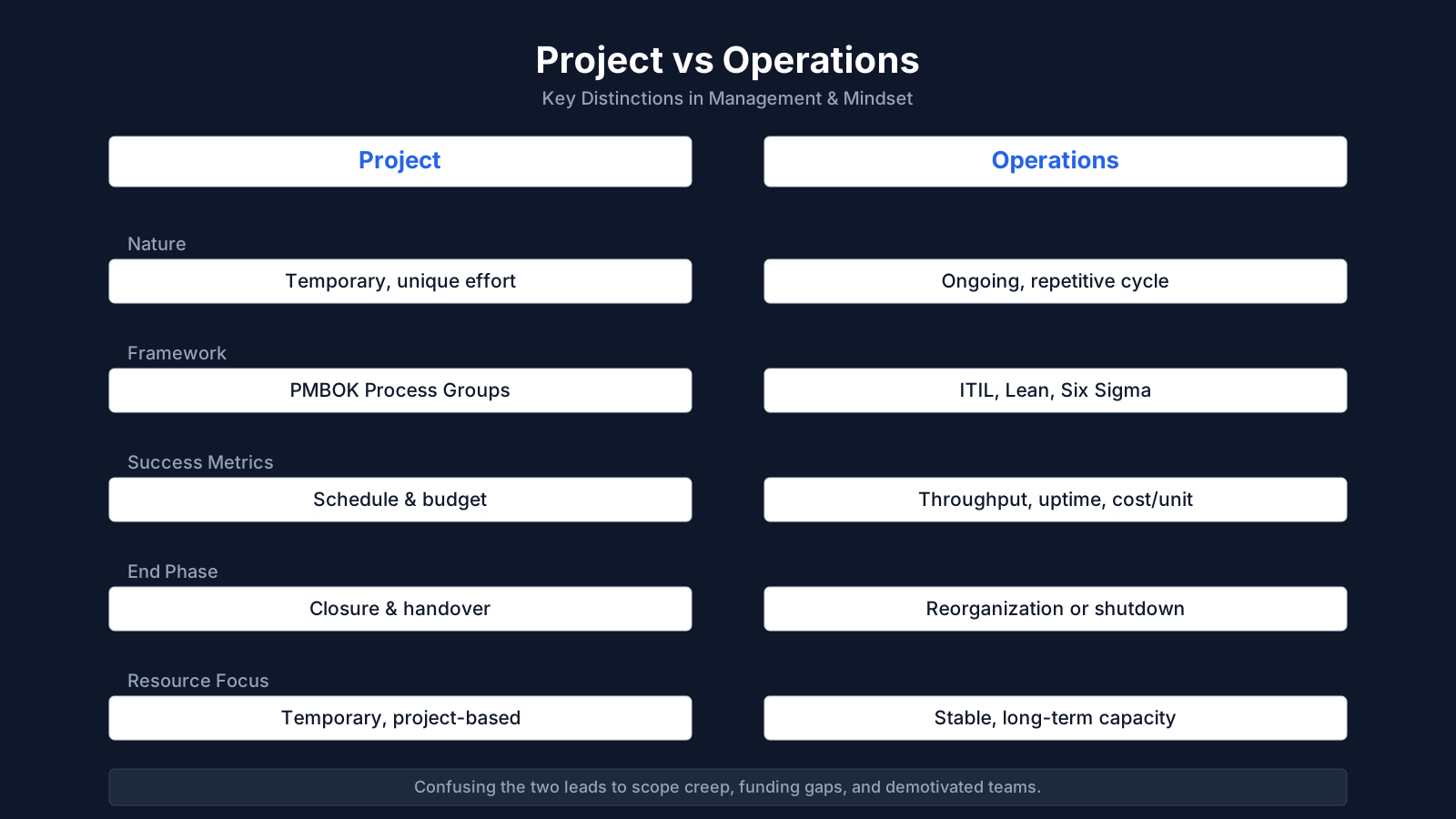
At a Glance: Projects vs. Ongoing Operations Summary
| Core Distinction | Summary |
|---|---|
| Finite vs Continuous Endeavor | The fundamental dichotomy between time-bound and perpetual work drives nearly every practical difference in governance, resourcing, and performance measurement between a project and an operation. |
| Projects | A project convenes a temporary, cross-functional team with a specific mandate, operates under a defined timeline and budget, and progresses through a structured life cycle of initiation, planning, execution, monitoring, and formal closure, delivering unique outputs before disbanding. |
| Operations | Operations continuously adapt to strategic shifts and pursue incremental improvement but never terminate; they function as the organization's stable, ongoing rhythm, sustaining core business functions and service delivery without a predetermined conclusion. |
| Resource and Success Metrics | This distinction dictates resource allocation models, performance measurement criteria, and the nature of closure: projects terminate upon delivering objectives, while operations demand sustained resourcing and ongoing efficiency metrics. |
| Operations Governance | Operations rely on recurring budget cycles, maintain permanent staffing structures, and gauge success through process stability, throughput consistency, and incremental efficiency gains rather than one-time deliverables. |
| PMBOK Frameworks | Within PMBOK, Integration Management governs project closure and the formal transfer of deliverables to operational sustainment; operations, in turn, depend on continuous process management frameworks to preserve stability and optimize ongoing value. |
| PRINCE2 Approach | PRINCE2's 'manage by stages' principle enforces a finite commitment through controlled phase gates, ensuring that projects have explicit start-up, delivery, and closure stages with defined go/no-go decisions at each boundary. |
| Temporal Risk Dynamics | Projects face escalating cost of change and risk as deadlines approach, demanding rigorous resource optimization and proactive mitigation; operations, in contrast, must ensure long-term process resilience, where systemic reliability and steady evolutionary improvement drive sustained value. |
Understanding How Projects Differ from Ongoing Operations
At its core, temporary versus ongoing is the dividing line that causes most of the practical differences between a project and an operation. A project is authorized to achieve a specific objective and then close. The team disbands, the budget closes, and the deliverables transition to whoever will use or support them. Operations budget annually or cyclically, staff in permanent roles, and measure success through consistent output levels or service stability. In PMBOK, Integration Management handles project closure and the formal transfer of deliverables to operations, while operations rely on ongoing process management frameworks to maintain stability.
That temporary nature forces project managers to think in terms of finite lifecycles. Every project passes through initiating, planning, executing, monitoring and controlling, and closing, regardless of whether the delivery approach is predictive, iterative, or hybrid. Operations do not follow such a lifecycle; they may undergo improvement cycles, but there is no closing process group for a department that is expected to keep functioning. The closest analogy in operations is a major restructuring or process reengineering, which is itself often run as a project precisely because it is temporary and has a clear endpoint.
The distinction also shows up in how authority is structured. A project manager is handed authority for the duration of the project and that authority evaporates when the project is closed. An operations manager holds enduring authority over a functional area. This has profound consequences for team loyalty and career paths. Project team members know they will move on, which can foster intense focus but also anxiety. Operations staff expect to grow within a stable hierarchy, deepening their expertise over years.
In PRINCE2, the principle of managing by stages emphasizes that a project is a finite commitment with controlled start, middle, and end points. Each stage boundary includes a decision to continue or stop, which reinforces the idea that the initiative is not meant to become a permanent fixture. That same gatekeeping mindset rarely applies to operations, where the default is to sustain activity unless a strategic review dictates otherwise. Even when an operation is redesigned, the redesign is typically executed as a project that will then hand over to a renewed operational state.
The Temporary Nature of Projects vs. Ongoing Operations
Projects have start and end dates. That might sound obvious, but the implications are enormous. A defined endpoint means that every resource commitment, every risk taken, and every stakeholder expectation must be calibrated against a shrinking window of time. When a project misses its deadline, the consequences ripple through dependent initiatives and operational plans. Operations, lacking a natural endpoint, face different pressures: they must sustain performance indefinitely, which makes reliability and incremental improvement far more important than hitting a single milestone.
From a team perspective, temporary work changes behavior. Team members on a project often experience a ramp-up phase, a period of peak productivity, and a wind-down as delivery approaches. The psychology of proximity to the end can create bursts of energy, but also scope neglect if people start disengaging early. In operations, the rhythm is steadier; the goal is not to finish but to maintain. This difference in tempo is one reason why assigning purely operational staff to a short-duration project without adjusting their mindset can lead to frustration.
Even in Agile environments where delivery is iterative and value is released frequently, the underlying initiative still has boundaries. A product development effort may be organized as a project with a defined vision and a timebox, or it may evolve into a continuous product operating model. The moment a team shifts from project funding to a persistent product team funded as an operational unit, the classification changes: they are now performing ongoing operations, not a project. Recognizing this shift helps avoid governance mismatches.
How Projects Differ from Ongoing Operations in Resource and Team Dynamics
Resource allocation follows directly from the temporary-permanent distinction. Projects draw resources—people, equipment, budget—for a limited period, after which those resources are released back to the organization or to other projects. Operations hold resources indefinitely, adjusting capacity through hiring, attrition, and capital investment cycles. A project manager negotiates for scarce talent from functional managers, often in a matrix structure, while an operations manager has direct line authority over a dedicated pool.
This creates a natural tension. Functional managers are responsible for maintaining operational capacity, so lending their best people to a project can threaten day-to-day performance. Project managers, meanwhile, need the right skills at the right time and cannot afford to train someone who will return to operations before the learning curve pays off. The amount of resources supplied from operations varies from project to project, as the source notes indicate. In some cases, individuals from operations join the project full-time; in others, they contribute part-time while still handling operational duties.
The team dynamic also affects knowledge retention. When a project ends, the team disbands and tacit knowledge can evaporate unless it is deliberately captured and transferred to the operational group that will support the product. Operations, by their nature, accumulate institutional memory over time. That is why post-project handoffs are so critical and so frequently mishandled. If the operational support team never interacted with the project team during execution, they inherit a deliverable they do not fully understand.
How Projects Differ from Ongoing Operations in Delivery and Handoff
A project produces a unique output—a new software application, a redesigned manufacturing line, a relocated office—and then that output is handed over to operations. The project team’s job is done when the acceptance criteria are met and the closing process is complete. Operations must then absorb the new asset into their daily routines, ensuring it continues to deliver value. The handoff is often where the distinction between project and operations becomes painfully visible, because operational readiness was underestimated.
In the PMBOK framework, the Closing process group includes activities to transition the final product, service, or result to the customer or to operations. This formal transfer is what truly marks the end of the project’s responsibility. From that point forward, any issues are operational matters, unless a warranty period or post-project support agreement specifies otherwise. The source notes describe how a product redesign project requires the project manager to interface with operational departments to determine manufacturing capacity and the appropriate time to transition production lines. That interaction is the practical enactment of the handoff.
Operations, by contrast, do not deliver a single discrete output and then stop. They produce the same type of output repeatedly—processing invoices, assembling products, answering customer calls. Even when an operation adopts a new tool delivered by a project, the core activity continues; the tool is just an enabler. This means operational success is measured by consistency, uptime, and efficiency, while project success is measured by delivering the specified scope on time and within budget. Both are valid, but they require completely different management cadences.
Core Takeaways: Projects vs. Operations
- Temporary versus ongoing divide
- Projects are defined by a definitive endpoint, while operations must sustain indefinitely. This single distinction shapes nearly every practical contrast between the two.
- Lifecycle versus process management
- Projects follow a structured lifecycle: initiating, planning, executing, monitoring, and closing. Operations, by contrast, have no closing stage and rely on continuous process management to sustain performance.
- Mindset and tempo mismatch
- Project teams continually allocate resources and manage risks within a finite time horizon, while operational teams focus on reliability and gradual refinement. This explains why operational staff often struggle when assigned to time-bound projects without an intentional mindset shift.
Shared Ground: What Projects and Operations Have in Common
Despite the foundational difference, projects and operations share several organizational objectives and strategic plans, which sometimes blurs the line between them. Both are performed by individuals, constrained by limited resources, and require planning, execution, monitoring, and control. An operations manager creates a staffing schedule and monitors production metrics; a project manager creates a project schedule and tracks earned value. The management disciplines overlap, even if the time horizons differ.
Both also exist to advance the organization’s strategic goals. A project implements a new capability that the strategy demands, and operations then exploit that capability to generate ongoing returns. Without projects, the organization stagnates. Without operations, the benefits of past projects evaporate. This interdependence means that senior leadership must govern both domains with a unified portfolio view, even though the tools and rhythms differ. Strategic planning processes typically allocate funds to both capital projects and operational budgets, recognizing that one fuels innovation and the other sustains the core.
The constraints that limit projects—budget, time, quality, scope—are also present in operations, but they are applied differently. An operation has an annual budget that may be revised, but it is not a fixed funding envelope that gets closed out; it is a recurring allocation. Time in operations is measured in cycles and shifts, not a project deadline. Quality targets may be similar, but a project may accept a trade-off to meet a launch date, while an operation cannot afford to let quality slip without risking customer churn. Recognizing that the same constraint categories play out over different durations helps practitioners avoid applying the wrong governance model.
The Interplay Between Projects and Operations
The interaction between projects and operations is constant and necessary, because projects rarely exist in a vacuum. As the source material explains, there is generally significant interaction between operations departments and the project team. When a project is created to redesign a product, the project manager may work with multiple operational managers to research consumer preferences, draw up technical specifications, build a prototype, test it, and begin manufacturing. Those operational managers bring deep domain knowledge that no temporary team could replicate on its own.
This interdependence means that project success often hinges on the quality of operational engagement. If the manufacturing engineers are not consulted early, the prototype may be impossible to produce at scale. If the customer service team is not trained before launch, the new product will generate support calls that overwhelm the help desk. Smart project managers treat operational stakeholders not as bystanders but as critical resources whose expertise and capacity must be negotiated and respected. This is why stakeholder identification in PMBOK includes both project-internal and operational roles.
At the same time, operations must plan for the disruption that projects introduce. A production line might need to be temporarily shut down during a factory upgrade project. Experienced operators may be pulled away from their regular duties to serve on a project team, leaving gaps that must be backfilled. The amount of resources supplied from operations varies with each project, but the negotiation is always a balancing act. Operations managers risk losing their best talent to an exciting project, while project managers risk getting only the people the operation can spare.
When this interplay is managed poorly, both sides suffer. A project that ignores operational constraints delivers a product that cannot be supported, and an operation that refuses to release resources may starve the project of the expertise it desperately needs. The most mature organizations institutionalize the handshake between project and operations through formal transition agreements, early involvement of operational support teams, and post-project benefit reviews that hold both sides accountable for sustained results.
Key Interdependence Insights
- Constant operational collaboration
- Successful project delivery hinges on ongoing collaboration with operational managers, whose deep domain expertise cannot be replicated by transient project teams.
- Early engagement drives success
- Involving operational teams early, for instance by integrating manufacturing engineers during design reviews or training customer service before launch, prevents expensive rework and accelerates time to value.
- Institutionalized project operations handshake
- Mature organizations formalize this interdependence with transition agreements, early integration of support teams, and post-project benefit reviews that enforce accountability for sustained results.
Metric Mindsets: Measuring Success Differently
In Business Value-Oriented Project Management, operations are assessed using Business Value Points that reflect ongoing value flows, while projects are evaluated against a finite delivery promise. A persistent decline in Business Value Points inside an operation may indicate process damage—a form of invisible organizational harm—that requires intervention to restore health. For a project, a similar downward value trend might trigger an early closure decision if the original business case no longer holds, because the project’s existence is conditional, not presumed permanent. This distinction acknowledges that operations and projects live in different accountability ecosystems.
Traditional project metrics like schedule variance, cost performance index, and scope completion percentage naturally lose relevance once the project is closed. At that point, the conversation shifts to operational metrics: mean time to repair, customer satisfaction scores, production yield, and revenue per unit. A project that delivers on time and under budget but produces an unreliable product has failed in the eyes of operations. The project team may have celebrated a successful closing, but the operational staff are left with a daily headache. That disconnect is why measuring project success solely by the triple constraint is incomplete.
Operations managers, meanwhile, can learn from the disciplined milestone focus of project management. When an operation drifts without clear improvement targets, it can become complacent. Borrowing the concept of finite improvement sprints—timeboxed efforts with defined goals—can inject project-like urgency into operational excellence initiatives. The trick is not to turn the entire operation into a project, but to use project methods selectively for transformational changes while letting ongoing processes run with their own stable cadence.
Common Pitfalls When Projects Are Mistaken for Operations
A common mistake is treating a project like an ongoing operation by never formally closing it, allowing scope to creep indefinitely and the team to morph into a permanent support function. What began as a website redesign project can quietly become the “web team,” still funded by project dollars but performing routine updates. This creates audit risks, misallocated capital, and confusion about accountability. PMBOK is explicit that every project must close, and part of that closure is releasing resources back to the organization. Failing to do so starves other potential projects of talent and budget.
The reverse mistake is equally damaging: managing an operation as if it were a project with a deadline. Trying to “complete” a customer service department by a certain date makes no sense, because the work never ends. Yet leaders sometimes demand project-style milestones for ongoing functions, pressuring operational managers to cut corners or overwork teams to hit arbitrary dates. The result is burnout and degraded service quality. Understanding the difference prevents these governance errors.
Another pitfall arises during strategic planning when executives treat all work as projects, ignoring the operational capacity needed to absorb project outputs. They approve a portfolio of initiatives without considering that each new deliverable will require operational support, training, and maintenance. The operational side becomes overloaded, leading to failed transitions and value leakage. A mature organization models both project and operational resource demand as part of portfolio management, recognizing that the two are inextricably linked.
In matrix structures, the confusion is amplified. A team member might report to a functional manager for daily operations while temporarily assigned to a project. If the project’s temporary nature is not reiterated, the individual may start treating project work as a permanent assignment, resisting reassignment when the project ends. Clear communication about the finite tenure of a project role, reinforced by formal closure and recognition, helps mitigate this. Without it, the organization drifts toward a structure where nothing ever finishes and everything becomes an undefined blend of project and operation.
Key Takeaways on Project Misclassification
- Unclosed projects become permanent teams
- Failing to formally close a project lets scope drift indefinitely, turning a temporary team into an ongoing support function and creating audit exposure and blurred accountability.
- Operations forced into artificial deadlines
- Treating continuous operations, such as customer service, as projects with fixed end dates drives managers to either cut corners or push teams beyond sustainable limits to hit arbitrary milestones.
- Planners overlook operational capacity needs
- Portfolio approvals that neglect the operational support, training, and maintenance each deliverable demands risk overburdening the organization, and when the temporary nature of project roles is not reinforced, individuals often resist moving to new assignments.
Strategic Alignment: Why Both Are Indispensable
Both projects and operations exist to fulfill strategic plans, and neither can deliver on organizational objectives alone. Strategic plans typically articulate a desired future state that requires new capabilities—projects create those capabilities. The same plans also demand that current operations meet performance targets to fund the journey. If operations falter, the cash flow needed to invest in projects dries up. If projects fail to deliver, the organization cannot adapt to market shifts, and eventually the operations become obsolete.
The source material emphasizes that operations work does not terminate when its current objectives are met; instead, it follows new directions to support the organization’s strategic plans. That is the essence of operational agility. A manufacturing operation might shift from producing one product line to another as strategy evolves, but the operation itself continues. It morphs rather than ends. A project, in contrast, terminates when its specific objective is achieved, and a new project may be chartered to address the next strategic need.
Executive governance must therefore balance the portfolio. Too many projects at once can drain operational resources and destabilize the core business. Too few projects can leave the organization vulnerable to disruption. This tension is why many organizations establish a PMO for project governance and an operational excellence function for process improvement, with a strategic planning office bridging the two. The art of senior leadership lies in pacing change—using projects to inject innovation while protecting the operational stability that pays today’s bills.
The BVOPM perspective reinforces this dual focus by tracking non-financial program benefits such as employee engagement and future risk reduction, alongside traditional financial returns. Those benefits often accrue in operations long after projects close. A project that introduces better safety equipment, for example, may not boost revenue directly but reduces operational risk for years. Recognizing that the true payoff of many projects materializes in the operational realm encourages more thoughtful business case development and post-project reviews that span the transition boundary.
When organizations truly internalize the difference between projects and ongoing operations, they stop treating all work with the same template. They set up temporary structures with clear authority and closure criteria for one-off efforts, and they invest in sustainable processes and people development for the long haul. They align funding models accordingly, using capital expenditure for project investments and operating expenditure for ongoing costs. They also build a culture where handing over a deliverable to operations is a celebrated milestone, not an afterthought. The result is a rhythm of delivery and absorption that allows the organization to evolve without breaking its operational backbone.
In the end, the distinction is not about drawing rigid walls between two types of work but about giving each the governance it deserves. Projects need the discipline of a beginning and an end to avoid becoming permanent and unfocused. Operations need the freedom to run without artificial deadlines to maintain excellence. When those two mindsets coexist and interact with mutual respect, the organization gains the best of both worlds: the energy and focus of temporary endeavors combined with the reliability and depth of ongoing operations. That balance, more than any single methodology, is what keeps a business moving forward.