Distinguishing between project management and operations management can feel like an academic exercise until you face a resource conflict where both sides claim priority. The reality is that organizations rely on both disciplines to survive and grow, yet they operate on fundamentally different principles. Understanding the fundamental difference between project management and operations management is essential for allocating resources, structuring teams, and defining success criteria. Without this clarity, you end up applying temporary project controls to ongoing factory work or expecting a project team to optimize for long-term efficiency when their mandate is to deliver something new and then disband.
Operations are the heartbeat of an organization. They are the permanent, ongoing execution of activities that generate the same product or provide a repetitive service. When you hear someone talk about production operations, manufacturing operations, or accounting operations, they are describing functions that never really stop. The people assigned to these operations do essentially the same set of tasks day after day, following procedures that have been institutionalized over the life of the product or service. You might think of a car assembly line that cranks out vehicles, a payroll department that processes salaries every two weeks, or a data center that runs server maintenance round the clock. None of these are going away unless the company decides to shut down that product line or outsource the function. Their predictability is their strength.
Projects, by contrast, are temporary. They are launched with a specific goal, a fixed budget, and a clear endpoint. The moment the new software module is deployed, the bridge is opened, or the merger integration is complete, the project team winds down. The resources assigned to it, whether they are people, equipment, or budget lines, either return to operational roles or move to the next project. This temporariness is not a flaw. It is the defining feature that allows organizations to channel focused effort into creating something that did not exist before, something that will eventually be handed over to operations to maintain and extract value from. The confusion begins when managers treat routine operational improvements as projects or force operations staff to work under project governance frameworks designed for novelty and uncertainty.
I have seen companies where everything becomes a project, which sounds progressive until you realize that labeling ongoing customer support as a “project” every quarter just adds unnecessary bureaucracy. On the flip side, treating a genuinely novel initiative, like launching a new product line, with the same laid-back process controls used for steady-state manufacturing is a recipe for missed deadlines and budget overruns. The distinction matters because the management toolkit you reach for in each case is fundamentally different. Project management relies on initiating, planning, executing, monitoring and controlling, and closing processes, all tailored to handle unknowns. Operations management leans on process optimization, continuous improvement, and stability.
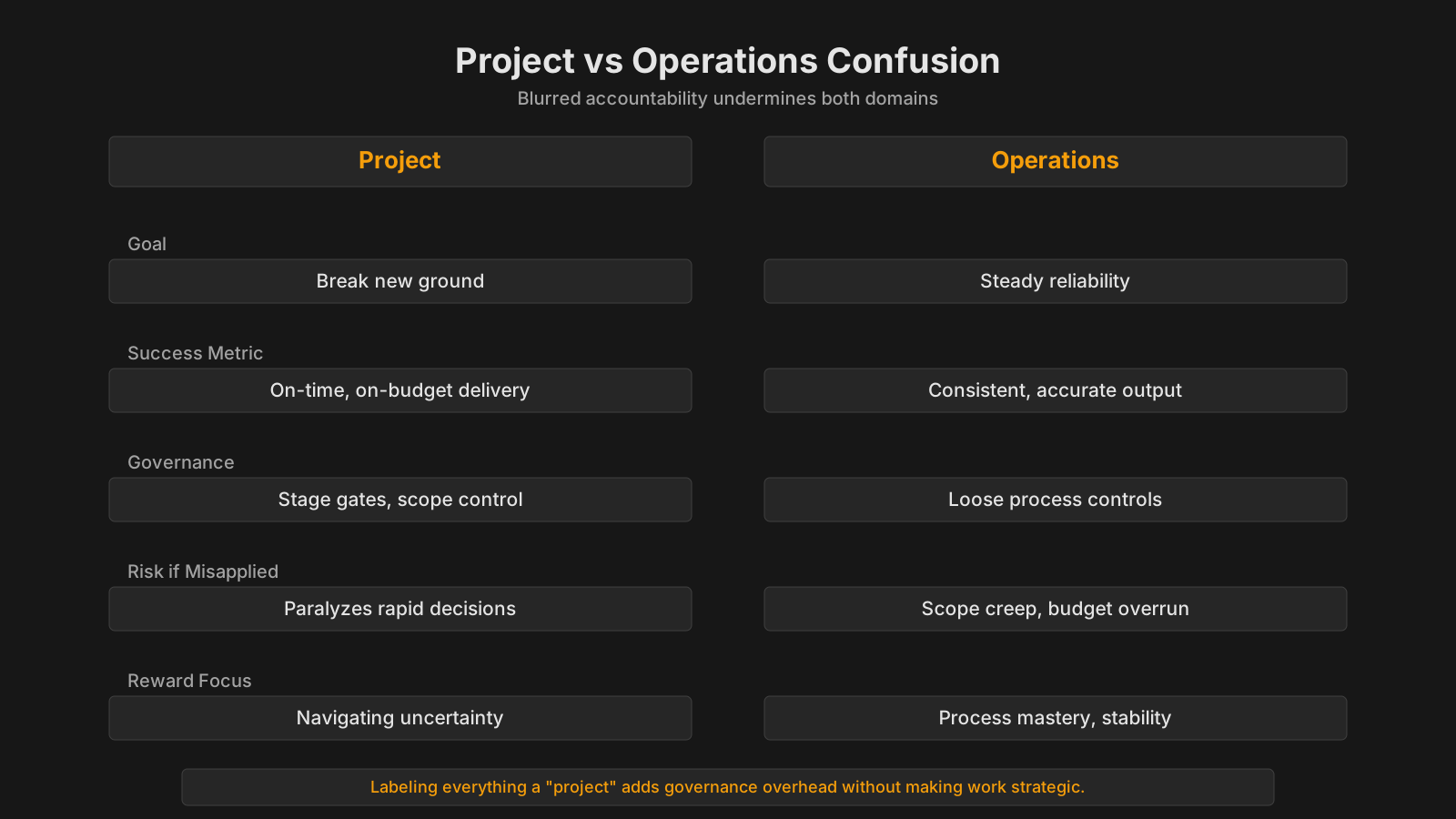
Project vs Operations Management: Summary of Key Differences
| Key Concept | Summary |
|---|---|
| Operational vs. Project Management | The distinction between project and operations management sharpens in resource constrained environments where competing priorities demand clear trade offs. |
| Operational Activities | Operations encompass continuous, repetitive activities such as assembly line production and payroll processing that maintain steady state business delivery. |
| Project Characteristics | Projects are finite, unique ventures with a defined conclusion point, producing new capabilities that operations teams later sustain and optimize. |
| Governance Misalignment | Applying project governance to operational roles or elevating routine tasks to project status creates unnecessary bureaucracy, slows responsiveness, and increases overhead. |
| Risk of Rigid Controls | Imposing standard operational controls on a novel initiative, such as a strategic product launch, stifles adaptability and frequently leads to missed milestones and cost overruns. |
| Contextual Uniqueness | Even familiar deliverables like bridges demand bespoke planning every time, shaped by distinct site conditions, evolving regulations, and unique stakeholder landscapes. |
| Project Manager’s Strategic Role | The project manager orchestrates resource trade offs and ensures that seconded talent returns to operations equipped with expanded competencies and actionable insights. |
The Temporary Endeavor: A Defining Characteristic of Projects
A project is, at its core, a temporary endeavor undertaken to create a unique product, service, or result. The word “temporary” does not mean the outcome is short-lived; it means the work effort has a definite start and finish. The product itself, like a new office building or a software platform, can endure for decades, but the project to deliver it ends when the criteria for completion are met. This finite nature flips the psychology of the team. In operations, you look for ways to streamline and stabilize so the machine runs forever. On a project, you look for ways to mobilize, execute, and exit quickly while leaving behind something that works. This is why project managers obsess over deadlines, milestones, and closure phases in a way that operations managers do not.
The PMBOK Guide describes projects as vehicles for change, driving organizations from one state to another. Because each project has a unique output, the work involved often contains tasks the team has never performed in quite the same combination before. That novelty introduces uncertainties, which demands more dedicated planning upfront. You cannot rely solely on institutionalized procedures when the ground keeps shifting beneath your feet. A civil engineering firm might build dozens of bridges, yet each bridge project faces distinct site conditions, regulatory hurdles, and stakeholder requirements, so the team must replan the approach each time. That planning overhead would be wasteful in a factory that stamps out identical metal parts, where the processes are already optimized and repeatable.
Assigning resources to a project also means pulling them away from operational duties. This tension is a constant source of organizational friction. A senior engineer might be 80% allocated to a critical project for six months, causing delays in the maintenance requests she normally handles. The organization must accept that temporary sacrifice because the project’s output, perhaps a new automation tool, will eventually reduce the maintenance burden. The project manager’s job includes negotiating that resource trade-off and ensuring the borrowed talent returns to operations smoothly, with new skills and knowledge that benefit the ongoing function. Without that temporary mindset, resource hoarding and burnout become rampant.
Common pitfalls arise when managers treat something as a project but never define a clear end condition. I once watched a “digital transformation project” drift for two years because the sponsor kept adding scope without ever closing the previous phase. The team burned out, and the intended operational owners never took ownership because the project never officially ended. That limbo state is where the line between project and operations blurs dangerously. Recognizing when to close a project and transition it to operations is as crucial as the initial chartering, yet many organizations skip it because they fear losing momentum or visibility. In reality, a crisp handoff preserves the value created.
Essential Insights on Temporary Endeavors
- Temporary effort, lasting outcomes
- While a project is defined by a clear start and end, its outputs, such as buildings or software platforms, often deliver value long after the project team has disbanded.
- Projects differ from operations
- Operations focus on continuously streamlining and stabilizing enduring processes, whereas projects are structured to rapidly mobilize, deliver a distinct result, and then conclude, leaving behind a fully functioning asset.
- Vehicles for organizational change
- As catalysts for organizational change, projects require bespoke planning for each unique transition, compelling project managers to constantly balance resource trade-offs and ensure that team members return to operational roles with enhanced capabilities.
Ongoing Operations and Repetitive Processes
Operations management deals with activities that are permanent and produce the same output repeatedly, which means ongoing operations produce repetitive outputs according to institutionalized standards. In a manufacturing plant, the production line runs the same assembly steps for each unit. In a call center, agents follow fixed scripts and escalation paths. Even in knowledge work like accounting, monthly closing follows a predictable sequence of reconciliations and reporting. This repetitiveness allows operations to optimize for efficiency, quality consistency, and cost control. The processes are baked into the product life cycle, and any deviation is usually a sign of a problem that needs correction, not an opportunity for innovation.
Because operations are permanent, the management approach emphasizes stability and incremental improvement rather than breakthrough change. You will hear terms like lean, Six Sigma, and continuous improvement in operations contexts, all aimed at reducing variation and waste in a stable process. In project management, you might use similar analytical tools during the planning phase, but the overall mindset is about managing uncertainty and delivering something unique. An operations manager thinks in terms of throughput, cycle time, and defect rates over the long haul. A project manager thinks in terms of scope, schedule, and budget for a single unique initiative. The two worlds speak different dialects, which is why handing a project deliverable over to operations can be so fraught if the transition is not carefully managed.
The fixity of operations also means that resources are permanently assigned to do basically the same tasks. This creates a deep pool of expertise, but it also makes operations resistant to sudden change. When a project team swoops in with a new system that disrupts those routines, the friction is predictable. The operations staff may not understand the new tool, and they might perceive the project team as outsiders who do not appreciate the complexities of the daily workflow. This is why knowledge transfer, training, and early involvement of operations stakeholders are essential, points the source material highlights when discussing the transfer of deliverables and knowledge at various points in the product life cycle.
It is tempting to think of operations as the boring, steady part of the business while projects represent the exciting stuff, but that undervalues the role of operations in sustaining the organization’s cash flow. Without reliable manufacturing, sales operations, or customer service, there would be no revenue to fund projects. Skilled operations managers are every bit as strategic as project managers. They just express their strategy through capacity planning, process design, and long-term asset utilization rather than through temporary, goal-oriented sprints. Recognizing this parity helps build mutual respect when project and operations teams must collaborate.
How Project Management Handles Uncertainty and Planning Needs
Because projects involve new tasks and evolving conditions, uncertainties and dedicated planning become central to project management in ways they never are in operations. When an accounting department closes the monthly books, the steps are known, the inputs are predictable, and the timeline is set by the calendar. But when you launch a project to implement a new ERP system, you face unclear user requirements, vendor delays, data migration surprises, and stakeholder resistance. The project manager cannot simply pull the standard operating procedure off the shelf; she must create the plan iteratively, updating it as unknowns become known. This is why project management dedicates entire process groups to planning and risk management.
Agile methodologies take this to an extreme by embracing uncertainty and shortening feedback loops, but even traditional waterfall approaches assume that initial plans will require refinement. The notion of progressive elaboration, where plans become more detailed as information emerges, is a fundamental project management concept. In operations, you rarely need progressive elaboration because the process is already fully defined. You might refine a procedure after a defect trend, but that is a controlled change, not a response to daily unknowns. The difference manifests in meeting rhythms: project status meetings focus on what has changed and what risks are looming, while operational stand-ups focus on adherence to the daily plan and immediate blockers.
One practical consequence is that project teams often require more cognitive flexibility and cross-functional communication skills. You might staff a project with people who have never worked together, asking them to figure out how to integrate their pieces quickly. That demands strong facilitation and a tolerance for ambiguity. In operations, the preference is for specialists who can execute their defined role with precision. This does not make project people smarter, just differently oriented. A great operations specialist might struggle on a chaotic project, while a brilliant project coordinator might flounder in the monotony of a repetitive role. Good organizations match people to the nature of the work.
The source material underscores that ongoing work efforts are generally repetitive because they follow existing procedures, while projects involve uncertainties and new tasks. That simple observation explains why project management offices (PMOs) often require rigorous documentation of assumptions, constraints, and risk registers. You cannot manage what you do not acknowledge. When an operations manager hears a project manager agonizing over a risk that has a 5% probability of occurrence, the operations manager might roll her eyes, but in the project world, even low-probability events can crater a six-month schedule. The dedicated planning exists because the stakes of getting it wrong early are high.
Navigating Uncertainty in Project Planning
- Uncertainty defines project work
- While operations depend on known procedures and predictable inputs, projects are characterized by novel tasks and shifting conditions that make uncertainty and deliberate planning central to a project manager’s role.
- Iterative planning replaces fixed procedures
- Project managers cannot simply adopt a standard operating procedure from a shelf; they must devise and continuously refresh their plans as unknowns gradually become known.
- Progressive elaboration sharpens project plans
- In both agile and waterfall contexts, initial plans are treated as provisional, and progressive elaboration transforms them into increasingly precise and actionable roadmaps as new information surfaces.
- Meeting rhythms reveal uncertainty focus
- Project status meetings concentrate on what has recently shifted and which risks are emerging, whereas operational stand-ups emphasize daily plan adherence and the resolution of immediate blockers.
Intersections Where Projects and Operations Overlap
Projects do not operate in a vacuum. They intersect with operations repeatedly throughout the product life cycle, and understanding these intersection points between projects and operations is critical for a seamless workflow. The source material identifies several key moments: at each closeout phase, when developing a new product, upgrading a product, or expanding outputs, during improvement of operations or the product development process, and finally until the divestment of the operations at the end of the product life cycle. These intersections are where the temporary world hands off value to the permanent world, or where operations trigger a new project to evolve.
Consider a new product development project. The project team designs, prototypes, and tests the product, then hands the final specifications and production tooling over to manufacturing operations. That handoff is not a casual email. It involves validating that the operations team can produce the product at scale, transferring technical knowledge, and sometimes physically moving equipment. If the project rushes this closeout phase, operations will stumble, quality will dip, and the project’s business case may never materialize. That is why smart project managers include operational readiness criteria in their project scope and involve operations representatives early in the project lifecycle, not at the last minute.
Similarly, when operations encounter persistent quality issues or capacity constraints, they may initiate a project to upgrade a product or expand outputs. Here the flow reverses: operational knowledge about real-world performance flows into the project’s requirements. The project then delivers an upgraded production line or an expanded facility that integrates back into operations. After the upgrade, operations staff may need retraining, and the project team must document any changes to standard operating procedures. This cyclical dance between projects and operations continues throughout the life of the product line, occasionally punctuated by improvement initiatives that aim to refine the operations themselves or the product development process that feeds them.
Even at the very end of a product’s life, when the decision is made to divest operations, a project is often launched to decommission facilities, migrate customers, or archive data. The closure project draws on operational knowledge of what exists and must be unwound, and its deliverable is the successful cessation of operations without legal or environmental fallout. So from birth to death of a product, projects and operations are intertwined, each feeding the other. Ignoring these intersections leads to orphaned deliverables, unused capabilities, and frustrated teams.
Transfer of Resources and Knowledge at Transition Points
The success of any intersection hinges on the transfer of deliverables and knowledge. The source material explicitly states that at each point, deliverables and knowledge are transferred between the project and operations for implementation of the delivered work. This can happen when project resources move to operations toward the end of the project, or when operational resources move to the project at the start. In practice, a software development project might assign a developer to join the IT operations team for a few weeks to support the go-live, transferring tacit knowledge about the code and configuration. Conversely, an operations subject matter expert might be pulled into a project during initiation to ensure the requirements reflect real constraints.
Knowledge transfer is not just about documentation. It includes the mental models, the undocumented workarounds, and the contextual understanding that only comes from living with the system. I have seen projects where the team created beautiful runbooks, but the operations staff still struggled because the runbooks did not capture the judgment calls needed when something went slightly off-script. The real transfer happens when people talk, pair up, and jointly troubleshoot. This is why many organizations now mandate a hypercare period after a major release, where project members remain on call to support operations while the new process stabilizes. That is a direct manifestation of the knowledge transfer principle.
Resource transfer, especially of people, can be politically tricky. Operations managers may resist giving up their best performers to a project because it hurts their daily metrics. Project managers may delay releasing people back to operations because they fear losing control. Good governance resolves this by planning the transitions upfront. A resource management plan should spell out exactly when team members will transition and what knowledge they must capture before they go. This is not just a nice-to-have; it is a risk mitigation strategy. If the lone expert on a critical module leaves without transferring her understanding, the organization inherits a single point of failure that can bite months later.
Another angle is the transfer of deliverables themselves. Deliverables like a new software application, a renovated facility, or a redesigned process must be accepted by operations. Acceptance criteria should be defined early, and operational owners should be given the authority to reject the deliverable if it does not meet the agreed-upon standards. This prevents the project from declaring victory and moving on while operations is left holding a broken promise. The closing process group in PMBOK explicitly covers this, including obtaining formal acceptance from the customer or sponsor, who often represents the operational side of the business.
Key Insights on Transition Knowledge Transfer
- Deliverables and knowledge transfer
- Every transition point requires transferring not only tangible deliverables but also the embedded knowledge project teams have accumulated, ensuring operations teams can effectively deploy and sustain the new capabilities.
- Bidirectional resource movement
- Knowledge transfer flows in both directions: project resources embed with operations toward the end to streamline handover, while operational experts engage early in project initiation so that requirements are grounded in practical realities and operational constraints.
- Tacit knowledge is difficult
- Tacit knowledge encompasses mental models, undocumented workarounds, and a deep contextual understanding gained only through direct system experience, which resists capture in conventional documentation and poses a persistent transfer challenge.
- Hypercare periods mitigate transition risk
- Organizations commonly enforce a hypercare window after major releases, during which project team members remain on standby to troubleshoot issues and stabilize the new process before full operational ownership is assumed.
- Single point of failure
- When a single expert on a critical module departs without transferring their tacit knowledge, the organization inherits a latent vulnerability that may only surface months later; PMBOK's closing process group addresses this risk by requiring formal acceptance from the customer or sponsor to confirm that critical knowledge has been secured.
Frameworks and Standards Clarifying the Distinction
PMBOK and PRINCE2 clarification of the project-operations divide helps practitioners apply the right governance. The PMBOK Guide explicitly defines projects as temporary endeavors and distinguishes them from ongoing work, placing project management within five process groups and ten knowledge areas that address initiation through closing. Operations management, while acknowledged as a related but separate discipline, falls outside the scope of PMBOK’s core processes, though it intersects heavily in the closing and benefits realization domains. PRINCE2 similarly draws a line by emphasizing that a project is a temporary organization created for the purpose of delivering business products according to an agreed business case, whereas operational work is managed through line management and business-as-usual structures.
Agile frameworks do not use the same vocabulary, but the distinction remains. In Scrum, a product has a continuous lifecycle managed by a Product Owner who balances development Sprints (temporary iterations) with ongoing product maintenance and support. The development team’s work is project-like in its timeboxing, but the product itself persists in operations. The concept of a “Definition of Done” often includes operational readiness criteria, ensuring that the increment can be released to users without a massive handoff chasm. The boundary blurs in DevOps environments where development and operations merge into a continuous flow, but even there, initiatives like feature development still constitute temporary efforts with a defined outcome, even if the teams never formally disband.
The Business Value-Oriented Project Management (BVOPM) methodology adds another layer by explicitly tracking value delivery across the transition. When a project closes and hands off to operations, BVOPM’s emphasis on monitoring Business Value Points does not stop at closure; it extends into the operational phase to confirm that the promised benefits materialize. This includes non-financial benefits like improved employee engagement or reduced future risk, which traditional project closure reports often ignore. BVOPM also allows for program realization sets where different projects within a program can choose their own methodologies, acknowledging that some may be more operations-like while others are highly experimental. This flexibility is useful when multiple intersections exist across a product life cycle.
Regardless of the framework, the core message is consistent. Projects and operations require different mindsets, metrics, and management approaches. Confusing them leads to applying risk registers to routine payroll processing or skipping closing procedures because “the work just continues.” When a practitioner understands where their work falls on the project-to-operations spectrum, they can select the appropriate toolkit, tailor their documentation, and set realistic stakeholder expectations. This clarity is not just academic; it directly impacts budget approval, headcount allocation, and career pathing within the organization.
Practical Management Implications for Organizations
Organizations that fail to separate project management from operations management often suffer from misaligned incentives and chronic resource conflicts. The practical implications of managing both disciplines become painfully clear when a functional manager is asked to both deliver a transformative IT project and maintain 99.9% service uptime with the same team. The project demands innovation and rapid decision-making, while operations demands stability and caution. Without a dedicated project manager and a clear charter that temporarily shifts authority, the functional manager will almost always prioritize operations because that is where the immediate pain lives. The project starves, and the organization misses strategic opportunities.
Structurally, many organizations solve this by creating a Project Management Office (PMO) that sits alongside operational departments. The PMO provides project managers, standardized methodologies, and portfolio oversight, while operations managers focus on line functions. This separation creates a healthy tension where project requests must be justified with a business case and compete for resources against other projects, not against day-to-day operational needs. The PMO also serves as a guardian of project closure, preventing projects from lingering indefinitely and ensuring that lessons learned are captured before the team dissolves. Without that function, projects gradually morph into permanent operations that nobody planned for, bloating headcount and obscuring true costs.
On a smaller scale, even a single team must learn to compartmentalize. A marketing team might run a campaign as a project with a clear start and end, while continuously managing the company’s social media presence as an operation. The campaign gets a timeline, a specific budget, and success metrics distinct from the ongoing engagement metrics of the social media operation. The team members may be the same people, but they switch mental models when they step into campaign planning mode. Teaching teams to recognize which hat they are wearing at any given moment prevents burnout and clarifies priorities. It also helps with performance evaluations, because you cannot hold a person accountable for project outcomes using the same criteria you use for steady-state operational tasks.
Ultimately, the project-operations distinction is not about building walls; it is about understanding lifecycles. Every product, every service, and every capability goes through a cycle where it is created by a project and then maintained by operations until it is retired by another project. Healthy organizations design their governance, resource management, and knowledge transfer processes around that rhythm. They accept that friction at the handoffs is normal and they invest in the practices that smooth it: early involvement, clear acceptance criteria, dedicated transition periods, and a culture that respects both the builder and the caretaker. In the end, the organizations that thrive are those that can simultaneously launch new things and sustain what they already have, without confusing one for the other.
Core Insights on Separating Project and Operations
- Dedicated project leadership required
- Without a dedicated project manager and a clear charter that transfers authority, functional managers inevitably prioritize ongoing operations because immediate pressures take precedence.
- PMO creates healthy resource tension
- By requiring rigorous business cases, the PMO shifts resource competition from daily operational urgencies to structured evaluations of strategic value across the project portfolio.
- Guard project closure and handoffs
- The PMO enforces disciplined project closure, ensures lessons learned are captured, and orchestrates seamless handoffs that respect the distinct strengths of both delivery teams and operational stewards.
