As a project manager, one of the first questions that keeps you up at night is how do I get the right people on my project team? The question sounds simple enough, but the answer sits right at the intersection of organizational politics, resource constraints, and the cold reality that the perfect candidate rarely just appears when a project charter gets signed. The Acquire Project Team process spells out the mechanics of confirming human resource availability and actually obtaining the individuals who will carry out the project work. Still, anyone who has managed a project in a matrix organization or relied heavily on subcontractors knows that the gap between process documentation and lived experience can be vast. What follows is a deep dive into the strategic, tactical, and sometimes messy human side of staffing a project team, with enough practical grounding that you can walk away ready to negotiate, influence, and plan around the constraints you will inevitably face.
The source material anchors us in a clear reality: the project management team may or may not have direct control over team member selection. Collective bargaining agreements, subcontractor personnel usage, matrix reporting relationships, and internal hierarchies can all snatch the staffing pen out of your hand. Yet the need to get the right people remains non-negotiable if you want schedule adherence, budget predictability, and stakeholder confidence. Let’s unpack exactly what it takes to move from a resource wish list to a functioning team that can deliver.
At a Glance: How to Get the Right People on Your Project Team
| Key Concept | Summary |
|---|---|
| Team Competence | The right people are the single most critical asset; even well-funded, meticulously planned projects collapse when essential competencies are missing. |
| Matrix Environment | In functional and weak matrix organizations, securing top talent demands a persuasive, value-driven case that aligns project priorities with functional managers’ competing obligations. |
| Negotiation Preparation | Entering a resource discussion with a staffing management plan that specifies skill profiles, dates, and business impact converts a simple request into a strategic necessity, strengthening your negotiating power. |
| Hybrid Staffing | When full-time senior expertise is not feasible, a hybrid model combining a part-time senior advisor with a mid-level executor keeps high-risk work on track while building internal capability. |
| Substitution Risk | Replacing an experienced resource with someone who lacks deep institutional knowledge invites compliance breaches and legal exposure, particularly for regulatory deliverables where tacit understanding is irreplaceable. |
| Alternative Resources | A lower-competency alternative can fill a gap only if it meets all non-negotiable legal, regulatory, and mandatory criteria; rigorous validation is essential to avoid downstream liability. |
| Resource Scarcity | Persistent resource scarcity is the baseline in portfolio-driven settings; first-choice candidates are typically committed elsewhere, making proactive capacity planning and flexible sourcing vital. |
| Procurement Leverage | A strong, collaborative relationship with procurement unlocks short-term extensions of existing agreements, bypassing lengthy vendor selections and preserving project momentum. |
Why Getting the Right People on Your Project Team Matters More Than Any Other Resource
You can have a generous contingency reserve, a beautifully modeled critical path, and the most supportive sponsor in corporate history, but if the people actually doing the work lack the right competencies, everything unravels. The source material points out that failure to acquire the necessary human resources for your project may directly affect schedules, budgets, customer satisfaction, quality, and risk exposure. That cascading effect is not rhetorical. When a key developer is replaced by a significantly less experienced one, unit testing might take twice as long, defect rates creep up, and the go-live date starts sliding to the right week after week. Quality suffers, which angers the sponsor, which then triggers a risk review that might freeze further funding. You can trace most project crises back to a moment when a staffing decision was made for expediency rather than fitness.
Beyond the immediate metrics, the composition of the team shapes the entire rhythm of project execution. A group of skilled people who collaborate well can absorb late-breaking changes without panic. They self-organize around problems. A team cobbled together from available but mismatched individuals often falls into coordination paralysis, where every decision escalates upward and meeting hours balloon. The source material makes a sobering point: severe resource shortfalls could even decrease the probability of project success and ultimately result in cancellation. When executives look at a project that keeps missing milestones and burning cash, they rarely drill down to the origination of the staffing failure. They just pull the plug. Getting the right people is not a nice-to-have; it is a survival imperative.
There is also a subtler cost that rarely makes it into a lessons-learned register. When a project limps along with underqualified team members, morale among the competent few erodes quickly. High performers end up mentoring and reworking others’ outputs, often uncredited, until they disengage or leave the organization altogether. So while the project may technically finish, the organizational damage lingers in the form of attrition and a culture that accepts mediocrity. None of that shows up on a Gantt chart, but it influences every subsequent project this team touches.
Key Takeaways on Staffing Priorities
- Wrong hires derail every metric
- Assigning underqualified personnel damages every critical dimension of a project: schedules slip, budgets inflate, customer satisfaction erodes, and defect rates rise; replacing a seasoned developer with a novice, for instance, can double testing time and multiply defects.
- Expediency invites project crises
- Most project failures stem from staffing decisions that prioritize speed or convenience over genuine suitability, as a mismatched team quickly succumbs to coordination paralysis while a capable one absorbs late changes without losing momentum.
- Shortfalls can doom the project
- Severe resource gaps can push a project's chance of success so low that cancellation becomes unavoidable, yet executives rarely trace the root cause back to the staffing failures that triggered the decline.
The Acquire Project Team Process Is About Influence, Not Just Assignment
In PMBOK’s Executing process group, Acquire Project Team is formally about confirming resource availability and assembling the group that will execute the work. The tricky part is that the project manager often acts as an acquirer, not an assigner. The source notes explicitly that negotiators and influencers are needed to secure human resources because direct control is frequently absent. If you manage in a functional or weak matrix environment, functional managers hold the staff, and you have to persuade them to release their best people for your project, even if those same people are also needed for operational tasks or other strategic initiatives.
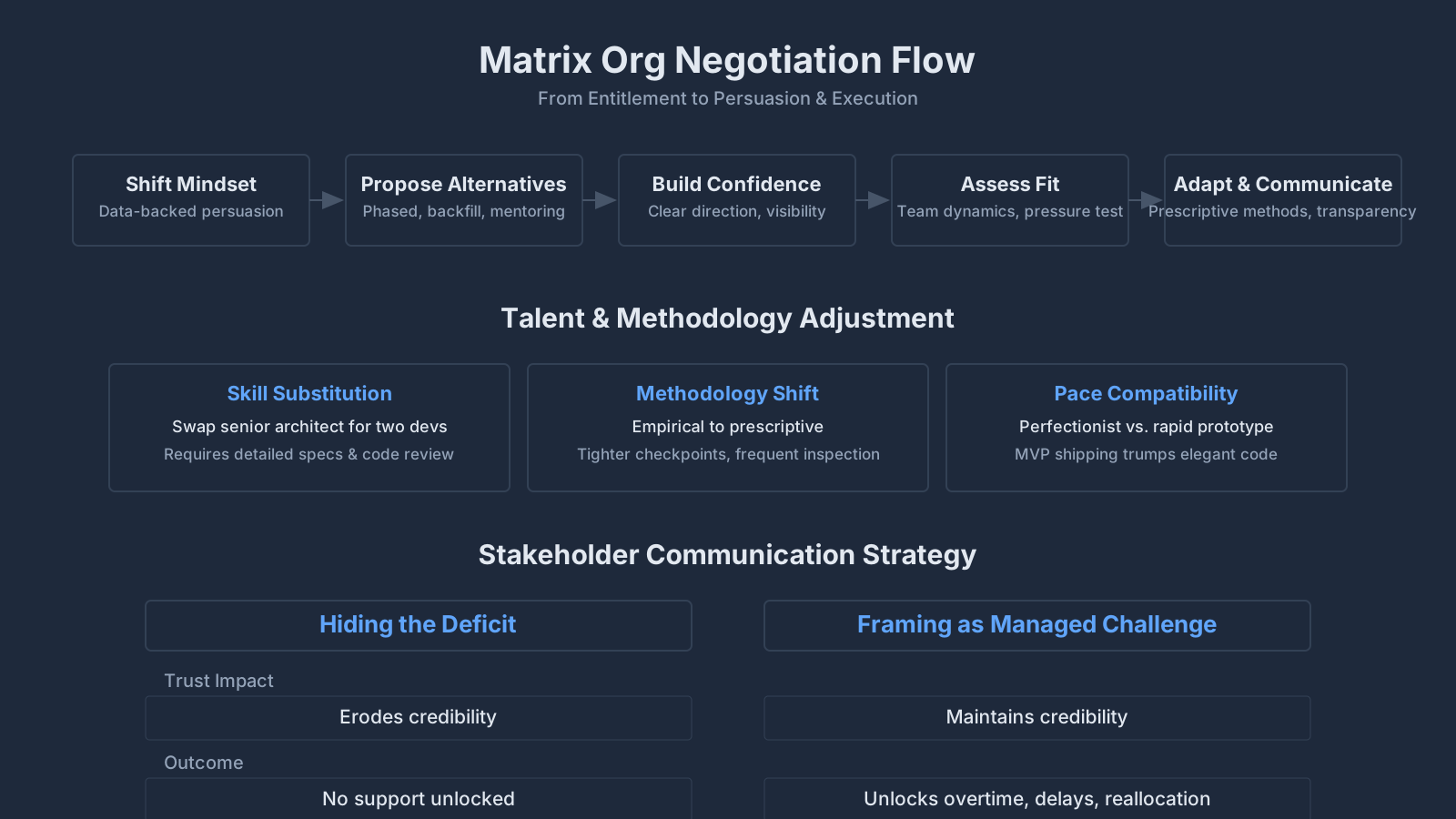
This is where negotiation skills become as critical as any technical planning competency. You may walk into a resource negotiation meeting armed with a staffing management plan that shows the exact skill profiles required, the dates needed, and a justification tied to business objectives. But the functional manager may counter with a seemingly reasonable alternative: a junior person who is available now, or an experienced person who can only give you forty percent of their time. Your job is to influence that decision without executive escalation, because burning political capital on every staffing dispute leaves you with no allies for future phases. Sometimes the right move is to accept a hybrid arrangement where you get the senior resource part-time but supplement with a mid-level resource who can offload routine tasks, keeping the senior talent focused on high-risk deliverables.
The source also mentions that subcontractor personnel and collective bargaining agreements add layers of complexity. If you are procuring contract staff, you need to align with procurement processes and possibly pre-approved vendor panels. Union rules might dictate that certain roles must be filled internally before any external hiring can occur. Ignoring these constraints can land a project manager in a legal and reputational quagmire. So the influence doesn’t stop at functional managers; it extends to procurement officers, legal advisors, and even the HR department when relocation or retraining is on the table.
How to Secure the Right People on Your Project Team When Authority Is Limited
In many organizations, the project charter grants a certain level of authority, but that rarely translates into being able to pick anyone you want from across the company. Securing the right people on your project team often requires building a business case for each requested resource that shows exactly what value that person brings and what risk you mitigate by having them. A common technique is to map each skill requirement to a deliverable or work package and then attach a complexity rating. If the deliverable is a regulatory compliance module that requires deep institutional knowledge, substituting a new hire from outside the industry isn’t just inconvenient; it creates a compliance risk that could have legal consequences. When you frame it that way, decision-makers tend to pay attention.
Another practical angle is to start early relationship building with the middle managers who control the resources you will need later. Long before you file a formal request, have a coffee with the engineering director and describe the upcoming project’s potential impact on their team’s portfolio. Offer to sequence your needs so they don’t conflict with their department’s peak periods. This is not manipulation; it is orchestration. Functional managers appreciate project managers who treat their resource pool as a shared asset rather than a vending machine. Over time, this approach builds the kind of trust that makes negotiation feel less like a zero‑sum battle and more like joint problem‑solving.
When you cannot get the exact profile you want, the source material explicitly allows for alternative resources with lower competencies, provided there is no violation of legal, regulatory, or mandatory criteria. This is a pragmatic escape hatch. But pragmatism requires you to adjust your plans accordingly. Lower competency often means more oversight, more frequent quality checks, longer ramp‑up time, and a higher probability of rework. So before you accept that alternative resource, recalculate your schedule and budget buffers. Communicate the trade-off to your sponsor so that nobody is surprised when milestones shift. If you silently absorb a lesser‑skilled team member and pretend the baseline still holds, you are setting yourself up for a credibility collapse later.
Overcoming Resource Scarcity to Get the Right People on Your Project Team
Resource scarcity is the default state in most portfolio‑driven environments, and the source acknowledges that constraints, economic factors, or previous assignments to other projects may render your first‑choice candidates unavailable. Finding ways to get the right people on your project team in this situation starts with a brutal prioritization session. You break down the project’s work into must‑have, should‑have, and nice‑to‑have deliverables. Then you map scarce high‑skill resources exclusively onto the must‑have scope. The should‑have and nice‑to‑have work gets staffed with whatever is left, or gets deferred. This constraint‑driven triage aligns expectations and makes it clear to stakeholders that if they want full scope, they must free up capacity somewhere else.
What often surprises newer project managers is how frequently economic factors can shift the availability landscape mid‑project. A hiring freeze might be announced three months into execution, or a sudden change in exchange rates might make contract resources prohibitively expensive. The remedy is not to panic but to have a contingency plan that identifies what internal cross‑training you can activate and which deliverables can be de‑scoped the fastest. If you have already built a solid relationship with the contracting procurement office, you might be able to negotiate short‑term extensions of existing agreements without triggering a full new‑vendor selection process, buying you time to rebalance the team.
Negotiation Tactics That Actually Get the Right People on Your Project Team
Effective negotiation for project team acquisition is rarely about demanding authority; it is about framing mutual benefit. When you approach a functional manager, the ability to negotiate and influence for the right people on your project team improves drastically if you bring data. Show them how the person you want will develop a skill during the project that directly benefits the home department after the project ends. That immediately transforms the request from “give me your star” into “I will return your star sharper and more marketable.” Many functional managers will release their best if they see a clear upskilling path that they don’t have budget for in their own operational plan.
Confusing negotiation with demand is a mistake. If you file a resource requisition and then escalate the first refusal to a vice president, you might get the person on paper, but you will have a disengaged team member who knows they were forced onto a project they had no interest in. Their functional manager will be resentful, and future requests will be met with obstruction. So instead, approach it as a dialogue. Present the resource need alongside a few alternative solutions you have already considered, showing that you are not just shooting from the hip. This signals professionalism and makes the functional manager more open to creative staffing patterns like job‑sharing, rotating assignments, or remote part‑time engagement.
There is also the under‑explored power of making the project itself attractive. If the project has high visibility, works with a new technology stack, or directly serves a strategic client, many high‑performers will want to be part of it. Early in the planning cycle, brief potential team candidates informally about the project’s purpose and their potential role. When the formal request lands, you already have internal pull. This grassroots influencing technique sidesteps the gatekeepers by building bottom‑up demand that makes functional managers look supportive rather than resistant if they approve it.
Core Insights on Securing Project Talent
- Build a business case per resource
- Justify each requested team member by clearly articulating the unique value they deliver and the operational or strategic risks their absence would create.
- Map skills to deliverables
- Tie every required skill to a specific work package and assign a complexity rating to each, so you can immediately identify where substituting a resource would introduce unacceptable compliance or legal vulnerabilities.
- Cultivate manager relationships early
- Proactively engage with resource-owning middle managers long before submitting a formal request, transforming potential conflicts into collaborative problem-solving conversations that acknowledge shared project objectives.
- Accept alternatives with lower competencies
- If your preferred expert is unavailable because of market scarcity or competing commitments, consider less seasoned professionals who still satisfy all mandatory legal, regulatory, and safety criteria without compromising project integrity.
Handling Constraints and Fallback Positions When You Cannot Get the Right People
Constraints on human resource acquisition are not theoretical edge cases; they are the norm. The source material explicitly states that constraints, economic factors, or previous assignments to other projects can make your ideal team unattainable. The project manager must then decide whether to accept alternative resources, possibly with lower competencies, while ensuring no violation of legal, regulatory, or mandatory criteria. This is not a sign of managerial weakness; it is a rational repositioning of the project within its actual resource envelope. The key is to make that decision transparently and with full awareness of the downstream effects.
When you do assign an alternative resource with lower competency, you are essentially accepting a technical debt that will need to be repaid in the form of additional supervision, training, or extended timelines. Many organizations have no formal way to account for this, so project managers often end up working overnight to compensate for a skills gap that was never written into the risk register. A healthier approach is to log the resource substitution as a risk event with an estimated impact in days or dollars, and present it at the next steering committee meeting. This does two things: it protects you from being held solely responsible for delays, and it puts pressure on the organization to better align resource supply with project demand in the future.
There are also times when legal or regulatory constraints forbid certain substitutions. In pharmaceutical projects, certain validation roles require specific certifications; using an uncertified person would invalidate the entire submission. In such cases, the project manager has zero flexibility and must halt or descope the relevant work until the right resource becomes available. The source material warns that these factors should be considered and planned for in the planning stages of the project. If you wait until execution to discover a hard compliance staffing requirement, you are already in crisis mode. Good planning surfaces these mandatory constraints early and either secures the necessary resources or adjusts the milestone timeline accordingly.
Planning Early So You Can Actually Get the Right People on Your Project Team
The note that these factors should be considered in the planning stages is not a throwaway line. It points to a gap between how we train project managers and how projects actually unfold. Too many project plans treat human resources as a line item in a staffing management plan that gets filled in a few weeks before execution starts. But early planning to get the right people on your project team means doing scenario analysis during scope definition. You ask: if our first‑choice data architect is tied up on a regulatory remediation project until quarter three, what skill combinations can we use as a bridge? If the labor market for machine learning engineers tightens, do we have an upskilling path for our internal analysts?
This kind of planning also involves mapping the full decision‑making chain. Knowing who holds budget for contract resources, who approves internal transfers, and what lead times HR requires for any hiring gives you a realistic schedule for staffing activities. Often, the most painful delays come not from resource unavailability but from procurement and onboarding bottlenecks that no one thought to de‑risk in the planning phase. When the plan includes these lead times as dependencies with their own float, the schedule becomes a far more honest document. It also gives you the ammunition to argue for earlier commitment from functional managers, because you can show that a late approval cascades into a six‑week onboarding delay, not a two‑day inconvenience.
From a BVOPM perspective, the emphasis on cross‑functional teams as a core success factor becomes particularly relevant here. When you build a team, you aren’t just looking for individual rock stars; you need people from different disciplines who can overlap and cover gaps. If your project plan assumes a strict, single‑skilled staffing model, you are already building fragility into the team. Planning for a slightly redundant skill set, where each critical knowledge area has at least one secondary person who can maintain momentum if the primary is pulled away, drastically reduces the risk of a single‑resource bottleneck. That cross‑functional mindset starts during planning, not when the first resource crisis hits.
Real-World Pitfalls That Undermine Your Effort to Get the Right People
Even when you follow the Acquire Project Team process diligently, some common mistakes can silently sabotage the whole effort. The first is treating resource negotiation as a one‑time event. You secure a commitment from a functional manager months in advance, assume it is set in stone, and stop scanning the environment. Then a week before kickoff, the assigned individual gets pulled into a high‑priority operational incident, and suddenly you have no team. Avoiding these real-world pitfalls in getting the right people means maintaining ongoing communication with resource providers and having a short list of alternates whom you have pre‑vetted for availability. It is not paranoia; it is portfolio awareness.
Another pitfall is confusing title with competence. A person with a senior title might have deep experience in a technology stack that is irrelevant to your project’s architecture, while a mid-level person who has been working on a side project using the exact tools you need might be far more effective. Many project managers fixate on grade levels because they are easy to request and easy to justify to sponsors who equate seniority with output. But a honest skill assessment during the staffing negotiation, ideally with a brief technical conversation or portfolio review, can reveal that the real “right person” is not the most obvious one on paper. The source’s mention of assigning alternative resources with lower competencies does not automatically mean junior people; it can equally refer to highly competent individuals who happen not to fit the preconceived role profile. Look past the label.
The third pitfall is failing to account for cultural and team dynamic fit. A team composed entirely of technically brilliant but abrasive individuals can generate enough friction that productivity collapses. When negotiating for resources, you need to consider collaboration skills just as carefully as technical ones. A project manager might successfully lobby for a domain expert who then spends two days a week in conflict with the design lead, effectively stealing hours from the project’s critical path. Getting the right people means getting people who can work together, not just a collection of individual resumes. This is why many organizations now include behavioral interviewing or team‑compatibility checks in their staffing selection, and why you should advocate for that even when you lack formal authority over hiring.
Key Insights on Avoiding Staffing Pitfalls
- Negotiation demands ongoing communication
- Resource negotiations that are handled as a single point-in-time agreement often collapse when commitments shift; consequently, maintain continuous dialogue with resource providers and keep a shortlist of vetted backup candidates on hand.
- Relevant skills beat senior titles
- A senior professional with deep expertise in an unrelated technology stack can be dramatically less effective than a mid-level specialist who brings direct, hands-on experience with the precise tools your project architecture demands.
- Honest assessment beats grade fixation
- Project managers tend to fixate on grade levels because they are easy to justify to sponsors, but a brief technical interview, a portfolio review, or a short trial task often uncovers that the real best-fit individual is not always the most obvious choice on paper.
- Interpersonal conflicts drain project hours
- A domain expert whose working relationship with the design lead generates conflict two days a week can silently erode critical-path hours; therefore, evaluate interpersonal dynamics with the same rigor as technical credentials during staffing decisions.
Linking Team Acquisition to the Broader Project Management Landscape
The Acquire Project Team process doesn’t exist in a vacuum. It draws from a human resource management plan developed earlier and feeds directly into Develop Project Team and Manage Project Team processes. When you have a team of individuals who came on board with lower competencies than originally planned, your development activities necessarily shift from performance optimization to skill‑gap bridging. That has cost and schedule implications that ripple through the cost baseline and schedule baseline. So team acquisition decisions shape the entire execution trajectory of your project in ways that a simple staffing plan rarely captures.
In Agile environments, the concept of acquiring a team is often replaced by the idea of forming a stable, long‑lived cross‑functional squad. The product owner and Scrum Master don’t so much “acquire” people as they do align with a dedicated team that already exists or is assembled by the organization with minimal churn. However, even in Agile contexts, the underlying principles of the source material still apply. If a key developer leaves and a replacement has lower competency in test‑driven development, the team’s velocity drops, and the product backlog refinement meetings become longer while knowledge transfer occurs. The planning phase in Agile might mean negotiating for a stable team commitment for at least a few sprints rather than pulling people on and off each iteration. The same negotiating and influencing muscles are required, just with different organizational vocabulary.
In PRINCE2, the team structure is more formalized through a Project Board and Team Manager, but the practical challenge of getting the right people still manifests. The Team Manager might report to a functional line outside the project, and the project manager must engage through that line to obtain the necessary specialists. The principle of management by exception helps here: if the Team Manager cannot provide the required resources, they escalate to the Project Board, which then resolves the constraint. However, relying on escalation as a primary strategy erodes trust, so the project manager still benefits enormously from the same pre‑negotiation influencing that the source describes. The methodologies differ, but the human dynamics do not.
When Substituting Resources Is the Only Viable Path
Sometimes, despite all your negotiating, the perfect candidate simply cannot be made available. The source material’s guidance is clear: the project manager or project team may be required to assign alternative resources, perhaps with lower competencies, provided there is no violation of legal, regulatory, or other specific criteria. This is not failure; it is a strategic pivot. Making resource substitution work for your project team requires that you immediately adjust your management approach to the new reality. Pair the less‑experienced person with a more seasoned team member, even if that senior member is only available for code review or design critiques. Convert some of the training budget into coaching time. And, crucially, re‑baseline your quality metrics to reflect what is achievable with the actual team, not the aspirational team you planned for.
Resource substitution without a corresponding adjustment to expectations is the root cause of a lot of hidden overtime and burnout. Project managers who try to absorb a competency gap without modifying the schedule or scope end up pushing the team to work unsustainable hours. Over the medium term, this backfires spectacularly: errors multiply, conflict increases, and your originally acceptable alternative resource now becomes a flight risk. The more sustainable route is to face the steering committee, present the substitution and its impact, and negotiate a realistic revised baseline. That conversation is hard, but it is far less damaging than a quiet death march that eventually becomes visible in the post‑mortem.
The BVOPM concept of waste reduction also comes into play here. When you force a lower‑competency team member to produce work that is rejected multiple times because it doesn’t meet an unchanged quality standard, you are generating rework waste that could have been avoided by adjusting acceptance criteria. A practical middle ground is to define a graduated quality threshold: the core safety‑critical modules still meet the original stringent bar, while auxiliary reporting modules might accept a slightly lower formal verification level, with a documented plan to harden them in a subsequent phase when the team’s skills have matured. This is not abandoning quality; it is matching quality investment to actual capability and risk.
Key Insights on Resource Substitution
- Realign management to the new reality
- When lower-competency staff replace original resources, immediately re-baseline quality metrics to what the current team can realistically deliver, preventing the wasted effort and morale damage of chasing unattainable aspirations.
- Pair juniors with senior mentors
- Pair the less-experienced substitute with a seasoned team member, even if that senior can only contribute through code reviews or design critiques, to accelerate skill transfer and reduce error repetition.
- Unchanged expectations cause burnout
- Insisting on unchanged standards for a lower-competency team without adjusting schedule or scope inevitably drives unsustainable overtime, multiplies errors, intensifies conflict, and significantly raises the risk of losing key team members to attrition.
- Set graduated quality thresholds
- Adopt a graduated quality model that maintains the original stringent bar for safety-critical modules, while allowing auxiliary modules a slightly relaxed verification threshold, with a documented timeline to harden them later and balance near-term delivery with long-term integrity.
Building Organizational Resilience So You Can Get the Right People Next Time
Every staffing challenge leaves behind lessons that can strengthen the next project’s acquisition strategy. The most effective project managers treat resource negotiation as a continuous improvement loop. After a project closes, they document which functional areas were most responsive, which roles were hardest to fill, and what alternative sourcing channels (internal mobility, gig platforms, cross‑training programs) actually delivered. That information, fed into the organization’s resource management database, improves the ability to get the right people for future projects by creating a closed feedback loop between project execution and portfolio resource planning.
There is also a systemic angle. If your organization repeatedly struggles to staff projects with the right competencies, the root cause often sits at the strategic level: a disconnect between the project portfolio roadmap and the talent acquisition or development strategy. Project managers can advocate for a formal resource capacity planning function that sits above individual projects, forecasting demand across the portfolio and triggering early recruitment or retraining programs. The source material’s observation that failure to acquire necessary human resources may decrease probability of success and result in cancellation is a warning that should echo all the way up to the C‑suite. When projects fail because of chronic understaffing, the organization is not failing at project management; it is failing at workforce planning.
On a smaller scale, building bench strength within your own sphere of influence can help. If you identify junior staff who show potential, you can negotiate for a small portion of their time as a “learning resource” on low‑risk tasks, effectively growing your own future team members. This does not solve immediate resource crises, but it builds a pipeline that makes the next acquisition cycle less desperate. And functional managers often appreciate having their people developed in a real project context, which strengthens your position when you later request their more experienced staff.
Reading the Organization to Anticipate Staffing Roadblocks
One under‑taught skill in project management is organizational literacy: understanding the informal power dynamics, the unwritten rules about who gets which resources, and the seasonal rhythms that affect availability. Reading your organization’s staffing landscape to get the right people means knowing, for example, that finance department resources are impossible to get during month‑end close, that the lead architect is planning a sabbatical in six months, or that a specific business unit is under a hiring freeze because of merger integration. This information rarely appears in any resource management system, yet it is often the difference between a staffing plan that works and one that collapses.
You gather this intelligence through informal conversations, regular attendance at portfolio review meetings, and by building a network of peers who share staffing intelligence. When you know that a certain function is about to undergo a reorganization, you can accelerate your resource requests to get commitments before people get reassigned. Or you may learn that a particular contractor firm has just lost several key consultants and is scrambling, so relying on them for a critical role is now riskier. This kind of situational awareness transforms you from a reactive order‑taker into a strategic resource planner.
None of this is in the official process documentation, and yet it is what senior project managers do instinctively. They treat resource acquisition not as an administrative transaction but as an ongoing intelligence operation. The source material’s emphasis on negotiation and influence is really a call to engage deeply with the organizational ecosystem, not just fill out a request form and wait. If you only use formal channels, you will consistently lose out to project managers who have done the informal groundwork.
Key Insights on Staffing Intelligence
- Organizational literacy defined
- Mastering the invisible web of influence, unspoken resource constraints, and seasonal staffing rhythms is essential for project success yet rarely taught in formal training.
- Hidden staffing constraints
- Real-world limitations like finance teams locked in month-end closes, planned sabbaticals, or merger-induced hiring freezes often stay invisible to official resource management systems.
- Informal intelligence gathering
- Savvy project managers build staffing awareness through casual conversations, consistent attendance at portfolio review meetings, and peer networks that circulate resource intelligence ahead of formal reports.
- Proactive commitment strategies
- By picking up early signals of reorganizations or contractor instability, managers can accelerate critical resource requests or pivot away from fragile commitments before disruptions cascade through the project.
- Strategic planner mindset
- Framing resource acquisition as a continuous intelligence effort rather than an administrative task transforms a reactive order-taker into a forward-thinking strategic planner.
Legal and Compliance Boundaries You Must Respect
While you push to get the best people, you cannot cross legal lines. The source material underscores that alternative resource assignments must not violate legal, regulatory, mandatory, or other specific criteria. This means that if a contract stipulates that certain roles must be performed by personnel with specific certifications or security clearances, you cannot substitute a less‑qualified person even if they are available and enthusiastic. Doing so could void contractual protections, expose the organization to regulatory penalties, or even create personal liability for the project manager in highly regulated industries like defense, healthcare, or finance.
Compliance constraints also emerge from labor laws. Using interns or temporary workers to perform duties that legally require full‑time employees, or ignoring collective bargaining agreements that mandate a hiring hierarchy, can lead to grievances, lawsuits, and reputational damage. The project manager must collaborate with legal and HR to interpret these boundaries correctly. That collaboration becomes part of the acquiring project team process, not a separate administrative hurdle. The earlier you surface these constraints, the more time you have to find a compliant way to staff the critical work, or to restructure the work breakdown structure so that constrained roles are isolated and their deliverables are sequenced to align with limited availability.
Making the Business Case for Better Resources
When you need a resource that seems too expensive or too senior for the project’s perceived scale, you need a compelling business case that links the resource to strategic value. Building a business case to get the right people involves quantifying the risk reduction and acceleration benefits. For instance, if a senior UX researcher can shorten the design validation cycle by three weeks and reduce post‑launch redesign costs by an estimated twenty percent, that is a tangible return that outweighs their higher billing rate. Present that analysis in the language that your sponsor and finance stakeholders care about, not in project management jargon. Return on investment, net present value, and risk‑adjusted schedule impact are the metrics that open budget doors.
In some organizations, the biggest hurdle is not cost but internal chargeback mechanisms. When a project is charged a high internal rate for a top performer, the project’s profit margin looks poor, even if the overall organization benefits. Savvy project managers work with the PMO to create a shadow business case that shows the total organizational impact, not just the project’s book profit. This helps the steering committee make a more holistic staffing decision. And if the organization cannot see past the internal rate, then you may need to accept a lower‑cost resource and adjust project ambition accordingly. The source’s allowance for alternatives is not a loophole; it’s an acknowledgement that every staffing decision is a trade‑off within a constrained system.
There’s also a less formal but highly effective business case technique: the “resource trial.” You negotiate a short‑term assignment of the desired resource for a proof‑of‑concept phase, demonstrating exponential value. Once the sponsor sees velocity and quality spike, continuing the arrangement becomes a much easier sell. This reduces the perceived risk for the resource owner as well, because they haven’t committed their person for an entire multi‑year project without evidence of benefit. The approach aligns perfectly with Agile’s iterative delivery mindset, even if the rest of your methodology is traditional waterfall.
Key Insights on Resource Justification
- Quantify Strategic Value
- To justify expensive resources, link their contribution directly to measurable outcomes such as accelerated delivery milestones and reduced post-launch maintenance costs.
- Speak the Language of Financial Stakeholders
- Framing the analysis with ROI, NPV, and risk-adjusted schedule impact demonstrates financial discipline and secures sponsor and finance team buy-in.
- Create Shadow Business Cases
- Building a shadow business case with the PMO reveals the full organizational benefit of a high performer, even when a high internal charge rate distorts project-level profitability.
- Embrace Trade-Off Alternatives
- If decision-makers remain focused on a resource’s internal rate, proposing a lower-cost option with recalibrated scope demonstrates strategic pragmatism, since staffing always requires balancing constraints and competing priorities.
The Emotional Dimension of Assembling Your Project Team
Amid all the processes, negotiations, and compliance checks, it is easy to forget that acquiring a project team is fundamentally about people making decisions that affect their careers, daily work life, and sense of purpose. The individuals you are trying to bring onto your team have their own aspirations, fears, and preferences. Understanding the human side of getting the right people means recognizing that a forced assignment, even if technically optimal, can result in a disengaged contributor who mentally checks out. Whenever possible, involve the potential team member in the decision. A quick conversation that explains the project’s mission, the challenges they will face, and the support they will receive can turn a reluctant nominee into a motivated participant.
This emotional layer also extends to the functional managers who control the resources. They are not just gatekeepers; they are people who care about their team’s workload, development, and morale. If you can show empathy for their situation while advocating for your project’s needs, you create a collaborative dynamic that outlasts any single staffing negotiation. Sometimes the functional manager simply needs a promise that you will not abuse the resource with endless overtime, or that you will release them promptly if a departmental crisis emerges. Giving that assurance costs you nothing but builds immense goodwill. The source material’s call to negotiate and influence works far better when it is grounded in genuine relationship, not transactional power.
Burnout is another emotional dimension that directly affects resource availability. If the organization’s best people are constantly over‑allocated across multiple projects, they will eventually leave or become ineffective. As a project manager, part of getting the right people is also ensuring that the people you get are not already on the brink of exhaustion. In your negotiations, explicitly ask about the individual’s current workload and stress levels. If the answer reveals overload, collaborate with the functional manager on a phased engagement that starts at a lower intensity and ramps up as other commitments wind down. This not only protects the resource’s well‑being but also increases the probability that they can actually deliver at the level you need.
Connecting Team Acquisition to Benefits Realization and Program Success
At the program level, acquiring the right people for each component project becomes a multi‑variable optimization problem. A program manager must decide how to allocate scarce expert resources across projects with conflicting priorities, while maintaining the overall program’s benefits trajectory. The source material’s warning that resource failure can affect customer satisfaction, quality, and ultimate cancellation is magnified at the program scale, because a single under‑skilled team in one project can create a bottleneck that delays an entire integrated release. Program‑level planning to get the right people across multiple project teams requires resource levelling that goes beyond individual project plans and considers cross‑project dependencies, shared specialist pools, and long‑term workforce development.
In many organizations, program managers establish a program‑level resource board that meets regularly to reprioritize resource allocation based on evolving strategic priorities and project health metrics. This board can override individual project staffing decisions to optimize for the whole, but it should operate transparently, with clear criteria. When a project manager understands the board’s logic, they can better time their resource requests or build a case that their project’s resource need aligns with program strategic objectives. It also reduces the temptation to hoard resources or exaggerate needs, because the board has visibility into actual utilization. The result is a more efficient market for human capital within the program.
From a benefits realization standpoint, the people you acquire directly influence whether the intended business outcomes materialize. If the project is supposed to deliver a new customer analytics platform that drives a ten percent revenue increase, but the team lacks the data engineering depth to build scalable pipelines, the benefit never appears, no matter how well the project meets its internal milestones. So the staffing plan should explicitly trace back to the benefits map. This alignment makes it far easier to justify specific resources, because the decision becomes one of benefit enablement, not just headcount. When executives see the causal chain from a particular hire to a quantifiable revenue lift, resource approval rates climb.
Key Takeaways on Program Resource Allocation
- Program-level resource optimization
- Program managers should approach team staffing as a multi-criteria optimization challenge, allocating scarce subject-matter experts across competing projects to safeguard the program's entire benefits trajectory.
- Cross-project bottleneck risk
- A single under-skilled team can become a bottleneck that stalls an entire cross-project release, multiplying the cost of poor resourcing far beyond what any standalone project would experience.
- Program-level resource boards
- Leading organizations convene program-level resource boards that reprioritize staffing across projects using strategic alignment and project health data, and are empowered to override project-level decisions.
- Skills and benefits realization
- Delivering internal milestones is not enough: teams must possess the technical depth required to generate the quantifiable business benefits that justify the investment, and executives approve critical hires far more readily when they see a direct chain from staffing levels to revenue or cost impact.
When Everything Goes Wrong: Salvaging a Team That Wasn’t the First Choice
Despite all your meticulous planning and influencing, you may still end up with a team that feels like a collection of misfits. A weak business analyst, an absentee quality lead, a developer who struggles to meet basic coding standards. Salvaging a less‑than‑ideal project team is a test of true project leadership. The first step is to stop mourning the fantasy team and start optimizing the real one. Identify each person’s actual strengths, even if they are not the ones you planned for. Maybe the weak business analyst has extraordinary stakeholder relationship skills; pivot them toward communication and requirements facilitation rather than detailed documentation, and backfill the analytical gap with a part‑time team member or a contracted expert anyway.
Next, relentlessly protect the team from scope creep and executive interference. A suboptimal team already operates at reduced capacity; adding unplanned features or changing requirements mid‑sprint will break them entirely. Be the buffer that absorbs organizational chaos and translates it into a manageable backlog of clearly prioritized items. This old‑school servant leadership approach can sometimes coax performance from a mediocre team that surprises everyone. The team may not deliver world‑class results, but they can deliver reliably if the environment is stable and expectations are realistic.
Also, accelerate skill development in targeted micro‑bursts. Instead of a generic two‑day training course, arrange for the struggling developer to pair‑program with a more experienced contractor for two afternoons on the exact module that is causing trouble. This just‑in‑time learning is often more effective because the context is immediate and the need is pressing. The source material’s acceptance of lower competencies doesn’t mean abandoning growth; it means building a bridge of support until the competency gap narrows or the project ends. Either way, the team member gains something, and the project inched forward.
Eventually, you might need to make a difficult call and recommend removing someone who is actively damaging team morale or output. This is an escalation of the Acquire Project Team process in reverse. It requires the same negotiation and influencing skills, because firing a contractor or reassigning an internal resource involves contracts, functional managers, and possibly legal review. Do it cleanly and with compassion. A swift decision handled professionally is less disruptive than dragging out a painful situation that poisons the entire effort.
The Uncomfortable Truth About Getting the Right People Every Time
If there is one thing the source material implies but doesn’t state outright, it is that you will never have the perfect team for an entire project lifecycle. Even if you start with a dream team, people get promoted, leave, fall ill, or just get bored and disengage. The truly resilient project manager does not just aim to get the right people; they also design the project so that it can survive losing some of them. That means modularizing deliverables, avoiding knowledge silos, and documenting critical decisions in a way that a new person can ramp up in days, not weeks. Getting the right people for your project team is about building a system that stays right even as the people inside it change.
This resilience mindset changes how you plan. You start asking not only “Who do I need?” but also “What happens if I lose them?” This leads to deliberate knowledge transfer activities, shadowing arrangements, and a clear onboarding kit for every role. It also leads to a more honest conversation with sponsors: “We have a strong team now, but these three roles are single points of failure. If any of them leave, the schedule impact is four weeks. I recommend we invest in cross‑training now, or we accept that risk.” That conversation moves the project from a fragile staffing model to a robust one.
Ultimately, getting the right people on your project team is a continuous, adaptive practice, not a single event. It blends the formal Acquire Project Team process with deep organizational savvy, genuine relationship building, and the courage to accept reality and adjust. The project manager who masters this becomes someone who can walk into almost any organization and deliver results, regardless of how messed up the resource landscape appears on day one. And that, more than any certification, is what separates the professionals who thrive from those who just survive.
Core Insights on Team Resilience
- Perfect teams are temporary
- Team composition naturally shifts throughout a project as members earn promotions, depart for new opportunities, take leave, or lose engagement, preventing any group from staying ideal indefinitely.
- Design for inevitable turnover
- Resilient project managers break work into modular components, distribute expertise across the team to prevent silos, and document critical decisions in a way that enables newcomers to contribute within days instead of weeks.
- Confront single points of failure
- Effective leaders proactively discuss role vulnerabilities with sponsors and establish structured knowledge transfer processes, shadowing protocols, and onboarding kits to maintain momentum even as team members transition.