Distributing project information as planned sits at the heart of project communications. It is the moment when the carefully crafted communications management plan transforms from intention into action, pushing data, status updates, and insights into the hands of stakeholders who need them to make decisions, stay aligned, and support the project’s progress. In the PMBOK framework, this process falls squarely within the Executing Process Group and the Communications Management Knowledge Area, carrying the official name Distribute Information. The process is deceptively straightforward: take the project management plan, the performance reports, and the organizational process assets, and then deliver information to the right people at the right time, updating those same assets as you go. Yet the simplicity of those three inputs and one output masks a web of practical challenges, judgment calls, and feedback loops that determine whether the distribution actually achieves its purpose or merely clogs inboxes.
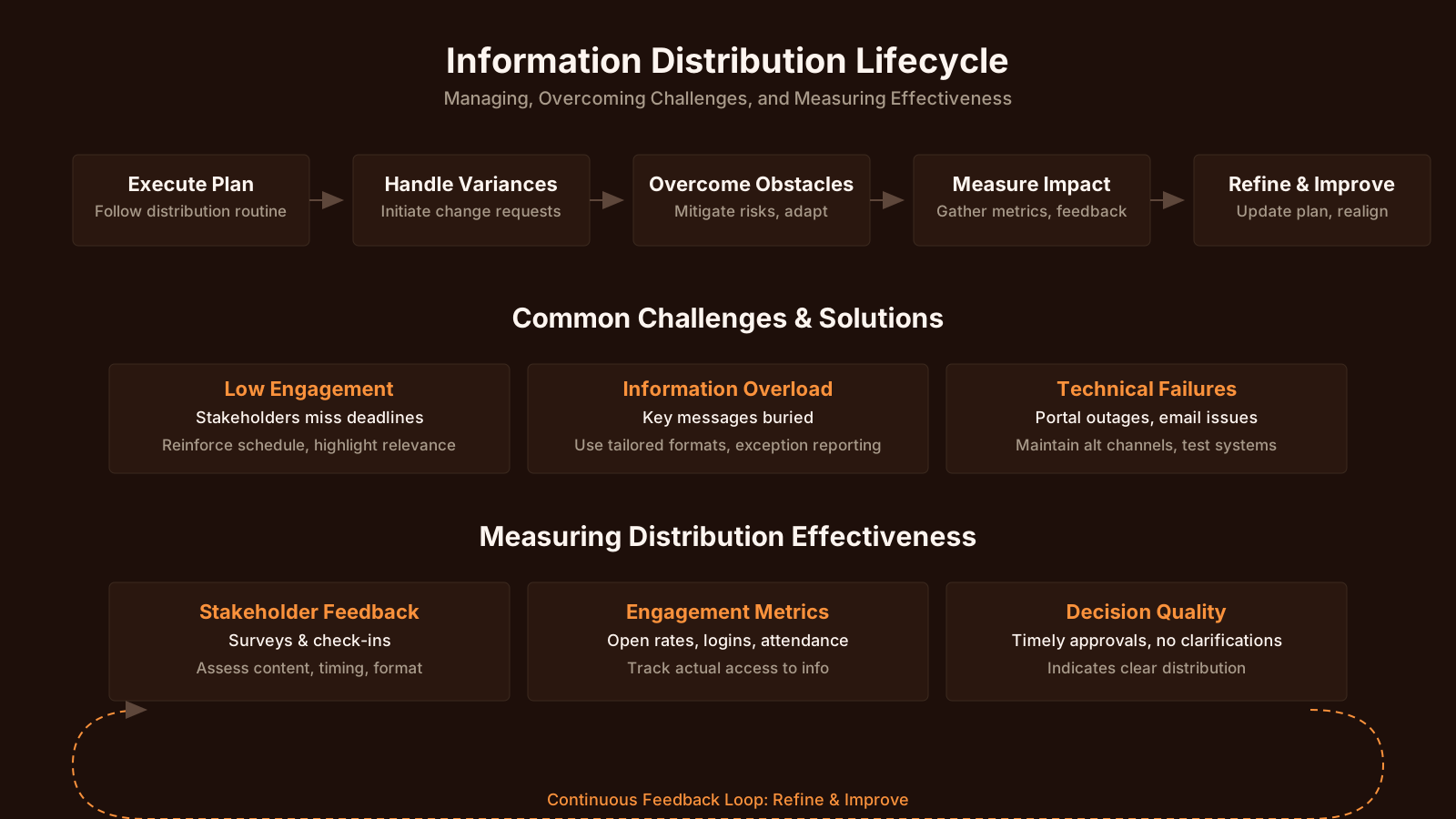
Key Steps to Distribute Project Information as Planned
| Key Concept | Summary |
|---|---|
| Plan Activation | The distribution process converts the communications management plan from a static document into a dynamic workflow, delivering targeted data to stakeholders to enable informed decisions and organizational alignment. |
| Practical Challenges | Beneath the surface simplicity of inputs and outputs lies a complex network of judgment calls and feedback loops that determine whether distribution creates clarity or information overload. |
| Stakeholder Reach | Executing this process ensures that each stakeholder, from team members to regulators, receives precisely the data needed for their role, ensuring engagement and compliance. |
| Delivery Mechanics | Effective distribution goes beyond transmission; it requires orchestrating timing, format, granularity, and security protocols to protect sensitive information while maximizing utility. |
| Distribution Rhythm | Establishing a predictable distribution cadence enables stakeholders to anticipate and retrieve updates efficiently, minimizing disruptive ad-hoc requests and preserving project manager bandwidth. |
| Receiver Context | Astute project managers tailor distribution packages to the receiver's context, embedding explanatory notes, glossaries, or highlighted summaries to proactively bridge comprehension gaps. |
| Primary Inputs | The three primary inputs create a cohesive logic: the project management plan defines the distribution blueprint, performance reports furnish the factual content, and organizational process assets supply tested templates and governance standards. |
| OPA Library | The OPA library provides curated distribution lists from prior projects, insights into effective formats, and corporate communication protocols to ensure consistent, compliant external messaging. |
What It Really Means to Distribute Project Information as Planned
At first glance, the phrase distribute information sounds like a clerical task, a simple forwarding of documents or presentation of slides. The reality is far richer. When a project manager executes this process, they are activating a premeditated system that connects team members, sponsors, functional managers, customers, and regulators to the specific data they require. The process of distribute project information as planned involves not just the mechanics of sending but also the timing, the format, the level of detail, and the security constraints that safeguard sensitive material. A status report handed to a steering committee two days after a critical decision was made is technically distributed, but it has failed its purpose entirely. The planned element matters as much as the distribution itself.
In many organizations, the project management plan includes a Communications Management Plan that spells out exactly which stakeholder receives which artifact, through which channel, and at what frequency. Think of it as a delivery schedule: the blueprint that transforms raw project data into packaged intelligence. When you distribute information as planned, you are respecting that schedule. You might be emailing a weekly highlight report every Monday morning, posting a dashboard to a shared portal every Friday at noon, or presenting a financial summary to the portfolio review board on the first Tuesday of each month. The process is not a one-time event but a recurring rhythm that builds trust over time.
Distributing information as planned also means adhering to the chosen medium. Some stakeholders insist on a face-to-face briefing; others require a formal written report that can be archived for compliance. The process encompasses electronic distribution, hard-copy delivery, verbal presentations, and even visual management tools like information radiators in Agile environments. The plan might specify that technical specifications go through a document management system with version control, while team morale updates might simply be conveyed in a daily stand-up. Every distribution channel carries its own risks and confirmation requirements, and the process must account for them without turning into a bureaucratic nightmare.
Why Timing and Cadence Make or Break the Distribution
If you have ever received a weekly report on a Thursday that still references data from the previous Friday, you know the frustration of stale information. The Distribute Information process is tethered to the performance reporting cycle. Performance reports generate the snapshot, and distribution follows immediately, within a window that keeps the data relevant. A planned distribution that lags by days erodes confidence almost as much as no distribution at all. Stakeholders begin to seek back-channel updates, sidelining the formal communications structure and creating rumor-driven decision-making.
One of the subtle aspects of this process is that it can be triggered by time-based events or by exception conditions. The plan might call for a standard monthly distribution, but it could also mandate that a risk threshold report be distributed within hours of a trigger being breached. The project manager’s discipline in executing these distributions according to plan, especially under pressure, distinguishes a well-communicated project from one where communication is reactive and chaotic. A planned distribution rhythm also helps stakeholders manage their own attention, knowing exactly when to expect updates and where to look for them, reducing the need for ad-hoc inquiries that drain the project manager’s time.
Where Distribution Differs from Other Communication Processes
Newcomers often confuse Distribute Information with Manage Communications or even with Report Performance. The three are tightly linked but serve distinct roles. Manage Communications encompasses the entire lifecycle: planning, creating, distributing, storing, and monitoring. Distribute Information is the execution sub-process, the act of putting the prepared communication into the stakeholders’ hands. Report Performance, on the other hand, is about compiling performance data into reports; those reports then become inputs to distribution. Understanding this demarcation prevents the project manager from treating distribution as an afterthought appended to reporting, rather than as a deliberate, planned activity with its own success criteria.
There is also a nuanced connection to the Monitor Communications process, which checks whether the distributed information was received and understood as intended. Distribution alone does not guarantee comprehension. A technical report distributed to a non-technical stakeholder without a summary layer may tick the box on the distribution checklist but fail the ultimate test of enabling informed decision-making. The Distribute Information process focuses on the delivery side of the equation, but smart project managers design their distribution packages with the receiver’s context in mind, embedding explainers, glossaries, or call-out boxes that bridge the gap without waiting for the formal monitoring step to reveal failure.
Distribution as Deliberate Information Delivery
- Premeditated stakeholder connection system
- Distributing information puts into motion a carefully designed system that ensures team members, sponsors, managers, customers, and regulators each receive the precise data required for their roles.
- Timing, format, and security
- Effective distribution transcends simple document delivery, embedding precise timing, tailored formats, appropriate detail levels, and strict security controls to protect sensitive information.
- Communications Management Plan blueprint
- A Communications Management Plan specifies exactly which stakeholder receives which artifact, via which channel, and at what cadence, effectively serving as a delivery schedule for curated intelligence.
- Multiple delivery channels and methods
- Distribution spans diverse methods, including email reports, shared portal dashboards, financial presentations, hard-copy delivery, verbal updates, and visual tools such as information radiators commonly used in Agile settings.
- Receiver context in package design
- Experienced project managers design distribution packages with the receiver's context in mind, incorporating explainers, glossaries, or call-out boxes to proactively eliminate understanding gaps.
Inputs You Need to Distribute Project Information as Planned
Every process in project management is only as strong as its inputs, and Distribute Information is no exception. The three primary inputs to distribute project information as planned form a logical chain: the project management plan tells you what to send and to whom, the performance reports provide the raw content, and the organizational process assets supply the templates, guidelines, and historical wisdom that make the distribution efficient and compliant. Missing or poor-quality inputs will produce a distribution that is either late, incomplete, or irrelevant, regardless of how meticulously the project manager presses the send button.
It is tempting to view the inputs in isolation, but the real power lies in their interaction. The project management plan might define a weekly report format; the performance report fills in the numbers; and the organizational process assets might offer a pre-existing dashboard template that accelerates the entire workflow. When all three inputs are mature and well-maintained, distributing project information as planned becomes a smooth, almost automatic cadence. When any one of them is weak, the project manager spends extra hours cobbling together emails, hunting for accurate data, or reinventing formats that have already been perfected by previous projects.
The Project Management Plan: Your Blueprint to Distribute Project Information as Planned
Most of the distribution logic lives inside the Communications Management Plan, which is a subsidiary of the overall project management plan. This document identifies every stakeholder, their information requirements, the preferred delivery method, and the frequency of distribution. It also defines any confidentiality constraints, such as documents that must be password-protected or transmitted only over secure networks. When a project manager consults the project management plan as an input to distribution, they are not reading a dusty shelf document; they are following a routing chart that eliminates guesswork and ensures no stakeholder is accidentally left in the dark.
However, the project management plan does more than list recipients and schedules. It also outlines escalation paths for urgent communications, standards for formatting (font sizes, branding, date conventions), and the language to be used for multinational teams. In some regulated industries, the plan specifies record retention requirements that affect how the distribution itself is documented. For instance, pharmaceutical projects might need to log every instance of a clinical report being distributed to external regulators, including timestamps and confirmation receipts. The project management plan anticipates these constraints so that the distribution process flows within a compliant framework rather than forcing retroactive fixes.
There is a common pitfall here: project managers sometimes assume that the Communications Management Plan, once approved, remains static. In reality, stakeholder rosters shift, new reporting requirements emerge, and team members change roles. A distribution that faithfully follows a stale plan can do more harm than good, sending outdated contacts information that confuses procurement or alerting a former sponsor about risks they no longer oversee. The Distribute Information process, while relying on the plan as an input, also acts as a reality check. If the plan no longer matches the current stakeholder landscape, the savvy project manager flags an update before the next distribution cycle.
How Performance Reports Fuel the Distribution Engine
Performance reports are the content payload. Performance reports are what you actually distribute when you distribute project information as planned. They come in many flavors: status reports, progress updates, earned value analyses, risk dashboards, milestone trend charts, and even qualitative narratives assembled by the team. Without accurate, timely performance reports, the distribution process becomes hollow, a ritual of sending out documents filled with placeholder data or, worse, with information that misleads recipients about the project’s true health.
The quality of performance reports directly influences the credibility of the distribution. A well-constructed report that clearly shows variances, forecasts, and corrective actions makes the distribution a value-adding event. Stakeholders read it, understand the trajectory, and can provide meaningful feedback. Conversely, a sloppy report filled with unexplained metrics will trigger confusion and a flood of clarification requests, essentially doubling the communication workload. The Distribute Information process does not evaluate the report’s quality; it simply moves it to the target. That is why the upstream reporting processes must be robust, and the project manager should, as a practical habit, perform a quick sanity check on the content before distribution, even if it is not a formal step in the PMBOK flow.
One underappreciated dimension is the aggregation of performance reports from multiple workstreams or subprojects. In large programs, a single distribution might consolidate a dozen team-level reports into a coherent program dashboard. The project management plan, in such cases, defines the roll-up logic and the format for the consolidated view. The Distribute Information process then disseminates that synthesized picture, not the raw fragments. This shift from component-level to enterprise-level distribution is where many projects stumble, because the consolidation effort often falls between the cracks of reporting and distribution responsibilities. Clarifying that consolidation is complete before distribution is triggered eliminates embarrassing corrections.
Organizational Process Assets: The Hidden Accelerator to Distribute Project Information as Planned
Organizational process assets, or OPAs, might sound like administrative overhead, but in the context of distributing information they are a treasure trove of efficiency. Organizational process assets provide the templates, communication policies, and historical records that shape how you distribute project information as planned. When a project manager opens the OPA library, they find not just a folder of old reports, but approved distribution lists from similar past projects, feedback on which formats resonated with particular executive groups, and corporate communication standards that must be followed for external stakeholders.
Templates are the most tangible OPA for distribution. A weekly status report template that already includes the correct header, branding, and key metric sections saves hours of recreation. Distribution policies within OPAs might dictate that all formal communications to the governance board must be sent through a specific project management office coordinator, or that certain financial figures require a legal review before dissemination. Using these assets as an input ensures that the distribution not only happens as planned but also conforms to the organization’s norms, which reduces friction with audit, legal, and senior leadership.
There is a trap, though, in blindly following historical distributions without questioning their relevance. An OPA from a five-year-old project might contain a distribution list that includes departments that no longer exist. A template that was perfect for a waterfall construction project might be indigestible for an Agile software initiative. The Distribute Information process benefits from OPAs as a starting point, but the project manager must apply critical thinking, filtering out what no longer fits and augmenting with lessons learned that have been formally captured. This critical adaptation is itself a subtle form of OPA input, because the updated version becomes part of the asset base after distribution, closing the learning loop.
What Changes After You Distribute Project Information as Planned
The immediate output of the Distribute Information process is not a new document or a status change; it is an update to the organizational process assets themselves. That may seem anti-climactic given the effort that went into the distribution, but it reflects a forward-looking principle: every distribution event leaves behind artifacts and insights that should improve future communications. The output is categorized as organizational process assets updates, and it encompasses the project records that are created or modified as a result of distribution, as well as any lessons learned that surface from the experience.
Project records include the actual communications that were sent, the distribution logs, stakeholder feedback, and any acknowledgments received. For compliance-heavy projects, these records form the audit trail that proves information was disseminated according to plan. If a dispute later arises about whether a steering committee received a risk alert, the distribution log within the updated OPAs becomes an objective piece of evidence. The update process is not a separate, heavy ceremony; it often happens naturally as the project manager files the sent email in the project repository, logs the presentation date in a stakeholder register, or saves the meeting minutes that confirm receipt.
Updating Organizational Process Assets After You Distribute Project Information as Planned
Once the distribution is complete, the project manager or the communications coordinator should record what was sent, to whom, when, and through which channel. Updating organizational process assets after you distribute project information as planned is the formal closure of the distribution loop. Some might argue that this update is purely administrative, but in reality it serves multiple purposes. It ensures that an accurate record exists for future reference, it feeds the lessons learned repository if something went notably wrong or right, and it gives the organization a feedback mechanism to refine its communication standards for subsequent projects.
Imagine a scenario where a critical risk report was distributed via email to five executives, but one of them was out of office and their email auto-reply indicated unavailability. The distribution log in the updated OPAs would capture this anomaly, and the project manager can decide whether to follow up with a phone call. If the project later suffers because that executive missed the warning, the audit trail shows that the email was sent, but the auto-reply gap might prompt a change in corporate policy: urgent communications should use a distribution channel that confirms receipt, not just delivery. That lesson learned becomes part of the organizational process assets, available for the next project to incorporate into its Communications Management Plan.
How the Updated Assets Feed the Next Cycle
Each iteration of the distribution process enriches the organizational memory. When a project manager begins planning communications for a new initiative, they consult the OPAs that were updated by previous distributions, seeing exactly which formats worked, which distribution lists generated the most valuable feedback, and which times of day yielded the quickest stakeholder responses. This creates a virtuous cycle where the institution gradually becomes smarter about information flow. The output of one project’s Distribute Information becomes a quality improvement input for the next. Even the simple act of saving a final version of a report with annotations about stakeholder reactions turns a one-off distribution into a reusable asset.
There is also a less visible benefit: the update to OPAs provides a natural checkpoint for the project manager to reflect on the distribution’s effectiveness. By formally documenting that the distribution occurred, they are prompted to ask: Did the right people receive it? Was the information understood? Were there any immediate follow-up queries that suggest the message was unclear? This reflection may not be mandated by the PMBOK process, but astute project managers weave it into the OPA update step, capturing not just the fact of distribution but its outcome quality. This practice aligns with the broader philosophy of continuous improvement that runs through modern project management frameworks, including BVOPM, where brief, widely readable planning documents encourage rapid feedback and adaptation.
Core Insights on Distribution Aftermath
- Distribution creates organizational assets
- Each distribution generates tangible records such as meeting summaries, decision logs, and feedback reports, which are systematically archived as organizational process assets to guide future work.
- Project records form audit trails
- Structured evidence including transmission logs, confirmation receipts, and stakeholder responses creates a verifiable audit trail that demonstrates compliance with the communication plan, a necessity for regulated projects.
- Updates happen naturally
- Distribution details are seamlessly captured when project managers catalog email correspondence, log meeting outcomes, and store presentation summaries, integrating recordkeeping into routine workflows without added administrative burdens.
- Lessons learned feed improvements
- Each distribution cycle contributes practical observations to the lessons learned repository, giving the organization a structured way to sharpen communication tactics and boost stakeholder responsiveness on future initiatives.
- Future planning uses past data
- New projects tap into accumulated OPAs to pinpoint which formats, audience segments, and sending schedules historically produced the most meaningful stakeholder engagement, driving smarter distribution decisions.
Common Failures That Derail Information Distribution
Even when all three inputs seem solid, distribution can still go sideways. One of the most pervasive failures is confusing distribution with communication completion. Sending a report is not the same as ensuring it is read, understood, and acted upon. Project managers who treat the distribution list like a checkbox exercise risk building a false sense of security while stakeholders remain uninformed. Another classic blunder is over-distribution: broadcasting every granular detail to every stakeholder under the assumption that more information equals better decisions. In practice, this floods recipients with noise, causing them to ignore future communications or to miss the critical signals buried in the volume.
A subtler pitfall lies in channel mismatch. The plan may specify that certain updates go through a collaboration platform like a wiki or a Slack channel, but if the stakeholder group is accustomed to email, they may never check the platform. The distribution happens from the sender’s perspective, but the receiver remains in a communication black hole. This is where the Monitor Communications process should catch the gap, but the damage is already done for that cycle. Aligning the planned channel with actual stakeholder habits, confirmed during stakeholder analysis, is a preventative measure that falls before distribution but heavily influences its success.
Technology also introduces its own failure modes. Automated distribution systems can fail silently, leaving the project manager unaware that a report never reached its recipients. Over-reliance on push notifications can desensitize stakeholders, while poor version control can lead to multiple conflicting reports circulating simultaneously. A practical safeguard is to build a lightweight feedback mechanism into the plan itself, such as asking key stakeholders to reply with a brief acknowledgment, or using read receipts where appropriate. This turns the one-way distribution into a handshake that flags delivery issues almost in real time.
Tuning Distribution for Agile and Hybrid Environments
The principles of distributing project information as planned scale across methodologies, even if the mechanics differ. In a pure Agile setup, there is no monthly steering committee report; instead, the team radiates information through daily stand-ups, sprint reviews, and visible task boards. The plan for distribution here is embedded in the Scrum framework: the Product Owner communicates progress to stakeholders, the Sprint Review demonstrates working software, and the burndown chart is updated daily and visible to all. The project management plan equivalent is the team’s working agreement or the program’s Definition of Done, which signals when information should be shared.
Agile projects still need performance reports, though they are often more informal: velocity charts, cumulative flow diagrams, sprint goal completion status. These reports are inputs to distribution, just as in a waterfall context. The organizational process assets might include retrospective findings about communication breakdowns, formatted as improvement experiments for the next sprint. So the PMBOK skeleton remains intact, but the flesh is leaner and more frequent. The biggest shift is that distribution becomes a continuous, low-ceremony activity rather than a periodic checkpoint, reducing the risk of stale data but increasing the risk of noise if the team does not curate what is shared.
Hybrid projects, which blend predictive and adaptive elements, require a careful segmentation of information. The predictive stakeholders (such as a governance board) may demand formal monthly reports, while the Agile delivery squads rely on daily stand-ups and sprint walls. Distributing project information as planned in this context means operating dual distribution streams without letting one contaminate the other. The project management plan must clearly demarcate which groups receive which artifacts, and the project manager acts as an interpreter, translating Agile metrics into the language that traditional stakeholders understand before distributing them. This extra step adds complexity but is essential to prevent the communication plan from fracturing along methodological lines.
Key Insights on Agile Distribution
- Continuous low-ceremony information sharing
- Agile teams rely on daily stand-ups, sprint reviews, and visible task boards to replace traditional steering committee reports, ensuring information flows continuously and transparently.
- Working agreement guides distribution timing
- The team's working agreement or Definition of Done functions as the Agile equivalent of a project management plan, establishing clear triggers for when to share information with stakeholders.
- Informal metrics monitor Agile progress
- Instead of formal monthly performance reports, Agile projects track progress through velocity charts, cumulative flow diagrams, and sprint goal completion, providing real-time visibility into delivery trends.
- Project manager bridges methodology gaps
- In hybrid settings, the project manager bridges methodology gaps by translating Agile metrics into board-ready formats, ensuring the communication plan remains cohesive across both Agile and traditional governance layers.
Practical Steps to Strengthen Your Distribution Discipline
Moving from theory to practice, there are a handful of habits that dramatically improve distribution outcomes. First, always do a stakeholder map refresh before a major distribution cycle. People change roles, new hires join, and priorities shift. A two-minute review of the recipient list prevents the embarrassment of sending sensitive information to a departed executive or omitting a newly critical decision-maker. Second, pre-check your distribution materials for accessibility. If the report includes complex charts, include a plain-language summary so that non-technical stakeholders can grasp the message without decoding the data.
Third, assign a backup communicator. Projects that rely on a single project manager for all distributions create a fragile single point of failure. When that person is ill or traveling, planned distributions stall. Designate a team member who understands the plan and can step in, ensuring that the rhythm never breaks. This is a simple resilience measure that costs almost nothing but saves the project from the perception of chaotic communication. Finally, review distribution logs monthly as a team, not for blame but for learning. Did a distribution to a vendor fail because of a firewall issue? Was a particular format repeatedly requested to be changed? These patterns are the raw material for updating OPAs meaningfully.
Beyond mechanics, the cultural tone of the communication matters. Distributing information as planned is not a robotic data dump. The way a project manager frames the accompanying message (the cover note, the presentation introduction) sets expectations. A distribution that arrives with a brief, honest note, “We are tracking slightly behind on Milestone 4 but recovery actions are underway,” is received very differently than a sterile attachment with no context. Thoughtful framing leverages the distribution moment to reinforce transparency and trust, which in turn encourages stakeholders to engage with the content rather than dismiss it.
Linking Distribution to Organizational Learning
The output of organizational process assets updates is not a storage closet; it is a learning engine. When organizations treat distribution records as living documents rather than archives, they create a feedback loop that elevates future projects. For instance, if a program repeatedly sees that risk reports distributed on Friday afternoons go unread until Monday, the corporate OPA can be updated with a guideline: avoid Friday afternoon distribution for urgent items. This kind of institutional wisdom accumulates slowly, but it only accumulates if the OPA update step is performed consistently and reviewed periodically by a center of excellence or a PMO.
In the BVOPM mindset, every planning document, including communication plans, should be concise and accessible to new team members. When a distribution log reveals that certain reports are consistently ignored, the lesson is not just to change the timing but to question whether the report itself is too long, too filled with jargon, or misaligned with what that stakeholder truly needs. The OPA update becomes a space to record not just what was sent but what was actually used, creating a usage pattern that informs the next communication plan. This shifts the distribution process from a mechanical push to a value-driven pull, where stakeholders’ demonstrated needs shape the future flow of information.
Retention policies also play a role. In some sectors, regulations require that certain communications be kept for years. The updated OPAs must include the storage location, the retention period, and the destruction date. Failure to properly update OPAs with this metadata can lead to serious compliance risks later. A project manager who treats the output step lightly might find that, two years after project closure, the organization cannot prove it notified a regulatory body about a safety finding because the distribution record was never captured. That is a high-stakes consequence for what appears to be a minor administrative task.
Core Takeaways on Distribution as Learning
- OPA updates fuel learning
- When distribution records are treated as living documents within OPA, they generate feedback loops that steadily improve future project outcomes.
- Usage patterns reshape communication
- By monitoring which reports are genuinely consumed, teams can recalibrate timing, depth, and language to align future communications with real stakeholder behavior.
- Neglect creates compliance exposure
- Neglecting to capture distribution metadata in OPA updates creates lasting compliance vulnerabilities, including the inability to prove years later that a regulatory agency was properly notified of critical safety findings.
Sustaining the Rhythm Over the Project Lifecycle
Projects have a natural energy curve, and communication tends to follow it. At the start, distributions are frequent and optimistic; during the messy middle, they may become defensive or inconsistent; at closure, they often dwindle. The challenge is to distribute project information as planned even when the project hits turbulence. When a crisis erupts, the temptation is to abandon the scheduled distribution to fight fires. Paradoxically, that is exactly when stakeholders most need the planned communication to maintain confidence. The process must be robust enough to operate in crisis mode, perhaps by triggering exception distributions that supplement, not replace, the normal cadence.
A practical technique is to build a comms calendar that is shared with the entire core team, showing all planned distribution dates for the next three months. This creates peer accountability and prevents the project manager from unilaterally deciding to skip a week because things are busy. The team can help prepare the performance report input, and the distribution becomes a team obligation rather than a solo burden. When the whole team owns the communication rhythm, the bus factor drops and the quality of distributed information improves, because more eyes shape the content.
As the project nears closure, the focus of distribution shifts from progress tracking to handover and lessons learned. Final reports, transition checklists, and post-project review documents become the payload. Distributing these as planned ensures that the operational teams receive what they need to take over the deliverables, and that the organization captures the knowledge that will refine future OPAs. This final distribution is not a bureaucratic wrap-up but the legacy of the project’s communication effort. A well-executed final distribution can leave stakeholders with a lasting impression of professionalism, while a haphazard one can tarnish the entire project’s reputation.
There is also a human element that often gets overlooked. Stakeholders who have received consistent, reliable information throughout the project are more likely to champion the project manager for future initiatives, provide positive references, and support the transition. The Distribute Information process, executed with discipline and empathy, builds a network of advocates who feel respected and included. That network becomes an intangible organizational asset in itself, a testament to the power of planned communication over ad-hoc firefighting.
The mechanics of the process will always be with us: inputs of plan, reports, and assets; outputs of updated assets. But the art lies in recognizing that every distribution is a touchpoint that either strengthens or erodes the relationship between the project and its ecosystem. The question “How do I distribute project information as planned?” is not answered by a procedure alone. It is answered daily, in the choices a project manager makes about what to emphasize, how quickly to react, and how much care to pour into the seemingly simple act of getting the right information to the right people, exactly when they need it.