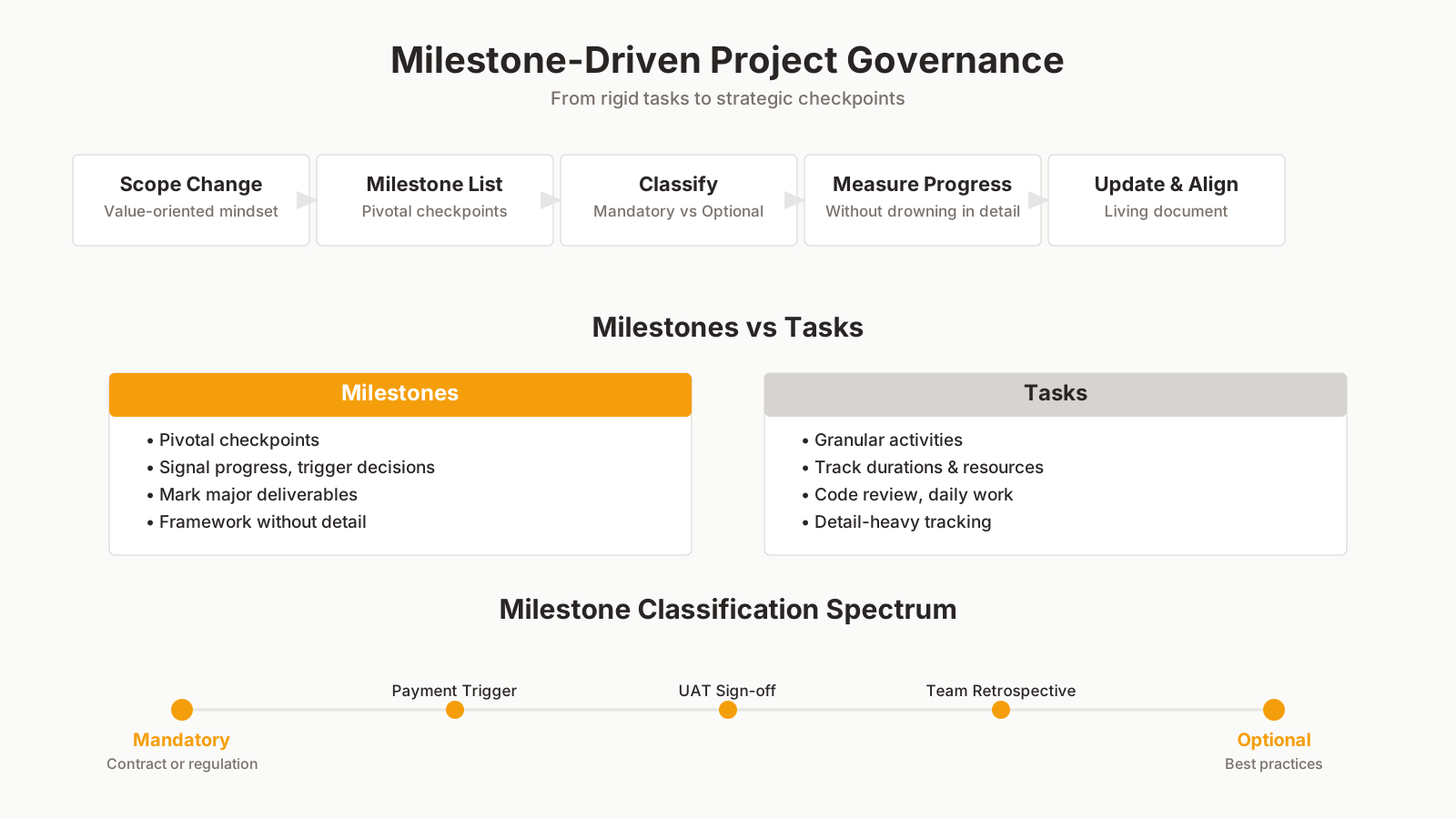
Few planning artifacts carry as much weight in a project schedule as a well-constructed milestone list. You might hear the term tossed around in kickoff meetings and status reviews, but what exactly goes into creating a milestone list that genuinely guides execution? A milestone list identifies all significant points or events in the project and indicates whether each milestone is mandatory, such as those required by contract, or optional, like those based upon historical information. It is not simply a to-do list with fancy labels. Instead, it marks the pivotal checkpoints that tell you whether the project is drifting or staying on course. When you first set out to create a milestone list for your project, you enter a structured process that bridges the gap between high-level project objectives and the detailed schedule that follows.
Summary: Key Steps to Create a Milestone List
| Key Concept | Summary |
|---|---|
| Milestone Inventory | A milestone inventory catalogs every pivotal project juncture, clearly marking each as a contractual requirement or an advisory reference point. |
| Obligatory vs. Discretionary | Obligatory milestones are imposed by contracts or regulatory mandates; discretionary milestones are informed by historical benchmarks and proven project patterns. |
| Strategic Signaling | Milestones act as strategic communication instruments and early warning triggers, not mere calendar deadlines. |
| Unified Project Narrative | Structuring the schedule around roughly twenty core milestones, rather than thousands of line items, forges a shared mental model of the project journey for all stakeholders. |
| Milestone Qualification | A date earns milestone status only if missing it invokes a contractual penalty, blocks a formal phase gate, or releases a scarce resource. |
| Genuine Milestone Test | Curating the list requires relentless scrutiny: each candidate must prove it represents a true project landmark, not a routine task dressed in a deadline. |
| Organic Milestone Emergence | As the work breakdown evolves, natural milestones surface such as major deliverable completions, system integration points, and prototype acceptance events. |
| Schedule Skeleton | A template preloaded with proven milestones provides a stable backbone that prevents the schedule from morphing into an unmanageable sprawl. |
Understanding the Strategic Role of Milestones in Projects
Milestones serve as the heartbeat of a project schedule. They represent moments where decisions must be made, deliverables are handed over, or external constraints force a pause. Many project managers think of milestones as deadlines, but that narrow view misses their power as communication tools and risk indicators. A contractor might have a milestone for "foundation inspection complete," while a software team could mark "user acceptance testing sign-off." Both are moments of truth that trigger subsequent work or release withheld payments. Strategic milestone planning turns abstract deadlines into tangible progress markers that stakeholders can grasp immediately. If you cannot describe a milestone to a sponsor in one sentence, it probably needs more clarity.
In portfolio-level reviews, a curated set of milestones replaces the noise of hundreds of individual tasks. Executives do not need to see that task 4.2.7 involves formatting the appendix. They need to know when the regulatory submission is scheduled and whether it is slipping. This filtering function makes the milestone list an indispensable governance tool. It also allows the project manager to maintain a degree of schedule compression without overwhelming the team. By anchoring the plan around twenty key milestones rather than two thousand line items, you give everyone a shared mental model of the journey ahead.
Not every significant date qualifies as a milestone, though. The distinction lies in the event's impact on project constraints. If missing a date causes a contractual penalty, a phase gate cannot be passed, or a critical resource is released, then that date merits milestone status. Regular task completion rarely qualifies. When you begin constructing your list, you will find yourself constantly asking whether a particular point is truly a milestone or just an ordinary task dressed up with a deadline. This discipline weeds out clutter and keeps the list focused.
Core Insights on Milestone Strategy
- Milestones as decision points
- Milestones are critical junctures where decisions must be made, deliverables change hands, or external constraints force a pause, elevating them far above routine calendar deadlines.
- Communication and risk tools
- Milestones serve as powerful communication tools and risk indicators, transforming abstract deadlines into tangible progress markers that stakeholders can immediately grasp and align around.
- Curated selection criteria
- Effective milestone planning centers on a carefully curated set of about twenty key milestones rather than thousands of individual tasks, and a date merits milestone status only when missing it would trigger contractual penalties, block a phase gate, or release a critical resource.
The Define Activities Process and How It Generates the Milestone List
The milestone list does not appear from a brainstorming session alone. It is an output of the Define Activities process, which is part of the Planning Process Group within the Schedule Management knowledge area. During this process, the project team takes the work packages from the work breakdown structure and decomposes them into the activities required to complete each one. As that decomposition occurs, certain points naturally emerge as milestones—the completion of a major deliverable, the integration point between two sub-systems, or the acceptance of a prototype. Creating a milestone list through Define Activities means you are not guessing; you are deriving these markers from the work itself.
This origin matters because it tethers the milestones to actual deliverables rather than wishful thinking. A common temptation is to set a milestone for "design approval" before anyone has defined what activities produce the design documentation. By starting with activity definition, you ensure that every milestone has a sequence of concrete tasks leading up to it. You also uncover dependencies you might otherwise miss. For instance, the activity of "draft technical specification" reveals that the milestone "design freeze" cannot occur until that draft is reviewed and baselined. The process doesn't just give you a list; it gives you the logic behind the list.
Many teams struggle because they rush through Define Activities, eager to build the schedule. They end up with a list of milestones that float without connection to work packages. This disconnect becomes painfully obvious when a stakeholder asks, "What has to happen before we reach this milestone?" and nobody can answer precisely. The remedy is to treat activity definition as a collaborative effort that involves the people who will execute the work. Their insight into work package decomposition is what populates the milestone list with realistic and defensible points.
The Output That Feeds Everything Else
The milestone list, once created, becomes a critical input to the Sequence Activities process. That process arranges activities in the order they must be performed and draws the network logic. The milestone list, at that stage, often has provisional dates that may shift once the full sequencing and resource allocation occur. The list itself remains a living document that evolves as the schedule matures. Yet its core content—the milestones and their mandatory or optional nature—remains relatively stable, providing a backbone that prevents the schedule from morphing into something unrecognizable.
Classifying Each Milestone as Mandatory or Optional
Every milestone on your list must carry a clear designation: is it mandatory or optional? Mandatory milestones are those imposed by contract, regulation, or external obligation. Think of a construction project where the contract stipulates that the final inspection must occur by a certain date, with liquidated damages applying if it does not. Or a pharmaceutical project where a regulatory submission milestone is governed by filing deadlines that, if missed, reset the entire approval clock. Marking mandatory milestones is not an administrative formality; it is your early warning system for non-negotiable commitments that can make or break the project’s viability.
Optional milestones, by contrast, arise from historical experience, best practices, or internal management preferences. A project manager might insert a milestone for "internal design review complete" because past projects that skipped such a review suffered costly rework. There is no contract clause enforcing it, but its absence correlates with poor outcomes. Distinguishing optional milestones helps you prioritize when things get tight. You can delay or eliminate some optional events without breaching any agreement, though you should always weigh the risk. A mandatory milestone missed is a compliance failure; an optional milestone missed might just be a lesson learned.
The act of classification also forces a conversation with stakeholders about what truly binds the project. In one scenario, a client might assume that a prototype demonstration is mandatory because "that's how we've always done it." Upon examination of the contract, you find no such requirement—it is pure preference. Highlighting that distinction can open up schedule flexibility that wasn’t apparent. Conversely, a team may treat a regulatory clearance milestone as optional in their heads because the regulator seems lenient. Exposing the mandatory nature on the list makes the stakes transparent and reduces the chance of accidental noncompliance.
When you later add scheduled dates to the list, the mandatory-optional split helps you configure the critical path. A mandatory milestone with a fixed date becomes a hard constraint in the scheduling software. An optional milestone can be a target you aim for but one that doesn't dictate the entire project's logic. Many project failures trace back to a milestone list that treated everything as equally binding, leaving the team unable to triage when resources dwindled.
Key Takeaways on Milestone Classification
- Every milestone requires classification
- Every milestone on a project register must be explicitly tagged as mandatory or optional because this distinction underpins effective planning, scheduling, and risk prioritization.
- Mandatory milestones are externally imposed
- Mandatory milestones are enforced by contracts, regulations, or external obligations; failure to meet them can trigger liquidated damages, breach penalties, or a complete restart of regulatory review timelines.
- Optional milestones draw on experience
- Optional milestones are based on historical performance, industry best practices, or internal management standards, and while they can be deferred or eliminated without formal repercussions, the trade-offs demand thoughtful risk evaluation.
- Classification guides the critical path
- Distinguishing mandatory from optional milestones defines the true critical path and enables precise resource triage when constraints tighten; treating all milestones as equally obligatory is a frequent driver of project failure.
Decomposing Work Packages to Reveal Meaningful Milestones
Work package decomposition is the engine that produces the raw material for your milestone list. Each work package represents the lowest level of the WBS—a discrete chunk of work that can be assigned and tracked. As you break that work package into activities, you naturally identify the point at which the package is completed, validated, or handed off. That completion point often becomes a milestone. Decomposing work packages for milestones forces you to think in terms of deliverables rather than vague progress markers, which significantly improves the accuracy of your initial schedule estimates.
Imagine a work package labeled "training material development." Decomposing it might yield activities such as "outline course modules," "draft facilitator guide," "record video demonstrations," and "perform quality review." At what moment does the work package achieve completion? When the final version is approved and uploaded to the learning management system. That is your milestone: "training materials released." Had you not decomposed the package, you might have set a milestone for "training materials 50% complete," which is notoriously subjective and invites status inflation. The decomposition method grounds milestones in objective, verifiable events.
This approach also uncovers hidden milestones at integration points. Suppose two work packages "backend API development" and "mobile frontend development" must converge. Decomposing both reveals that the integration testing activity cannot start until both packages have completed their respective build activities. You can then define a milestone like "API and frontend ready for integration testing." Such milestones emerge from the structure of the work, not from arbitrary calendar placement.
Predecessor and successor relationships naturally crystallize around these delivery-based milestones. When you move to the Sequence Activities process later, the milestone list is already primed with the logical ties because each one sits at the boundary of a completed work package and the start of dependent work. This alignment between the WBS, the activity list, and the milestone list is a hallmark of mature schedule development.
Applying Templates to Accelerate Milestone Identification
Not every project needs to start from scratch. Organizationally standardized templates that contain typical schedule milestones can dramatically speed up the creation process. These templates are usually derived from historical projects of similar type and complexity. A commercial construction template might pre-populate milestones such as "site mobilization complete," "structural frame topped out," "MEP rough-in complete," and "substantial completion achieved." Project milestone list templates bring institutional memory to the planning table and reduce the risk of forgetting an industry-standard checkpoint.
Templates serve a dual purpose: they prompt the planning team to consider milestones they might overlook, and they provide a consistency baseline for cross-project comparison. If every software development project in a portfolio uses a template that includes "code freeze" and "production deployment," then portfolio managers can rapidly assess schedule health across initiatives. The template is not a straitjacket, however. You must tailor it to the specific project context. A template milestone for "environmental impact study approved" might be irrelevant for an internal IT system upgrade, so you simply drop it.
The real value of a template emerges during the Define Activities process when the team can compare their work package decomposition results against the template. Gaps often surface. The team might identify all their technical milestones but forget a critical business milestone like "service level agreement signed with operations group." The template catches that omission. It also encourages the team to document why a specific template milestone is not applicable, which is itself a useful record for later audits or lessons learned.
Maintaining the template library itself requires periodic refresh. Milestones that were critical in one era of technology or contracting may become obsolete. A template that includes "physical server procurement complete" may need replacing with "cloud environment provisioned" as the organization shifts infrastructure models. Assigning template stewardship to a project management office ensures that the library stays current without burdening individual project managers.
Customizing Templates Without Losing Consistency
Customization can go too far if teams start adding every possible event as a milestone. The template should enforce the discipline of keeping the list lean. A well-designed template differentiates between core milestones that every project of that type must have and optional ones that can be selected from a pool. For instance, a capital project template might list "commissioning complete" as mandatory and "community ribbon-cutting event" as optional. This guided selection prevents milestone inflation while maintaining consistency. Over time, the ratio of mandatory to optional milestones in the template becomes a signal of governance maturity in the organization.
Key Insights on Milestone Templates
- Templates from historical projects
- Standardized templates drawn from comparable historical projects give planning teams an immediate, reliable framework that eliminates the need to start from scratch and ensures no critical checkpoint is overlooked.
- Dual purpose of templates
- These templates serve a dual purpose by systematically surfacing oversight-prone checkpoints and establishing a consistent baseline that enables meaningful schedule comparisons and portfolio-level governance.
- Flexible adaptation of milestones
- Teams adapt the template by discarding irrelevant items like environmental impact studies when not required, and updating legacy entries, such as substituting cloud provisioning for physical server procurement, so the milestone list reflects current project realities.
- Value in Define Activities
- The template delivers its greatest value during the Define Activities process, where the team cross-references its work breakdown structure with the template to identify gaps, often revealing missing business-critical milestones like a signed service-level agreement that might otherwise be overlooked.
Attaching Dates and Sequencing Milestones in the Schedule
Although the initial milestone list from Define Activities may not contain hard dates, the Sequence Activities process transforms it into a temporal roadmap. During sequencing, dependencies between activities—and therefore between milestones—are plotted, and scheduling tools use that network to calculate early and late dates for each milestone. Scheduling milestones in sequence activities turns the list from a static register into a dynamic forecast that reveals where bottlenecks will likely form.
The scheduled dates on a milestone are often the first numbers a stakeholder will ask about. It is vital to communicate that these dates are initially provisional and based on preliminary network logic. If you present them as promises during charter development, you set an unrealistic expectation. Instead, the milestone list with dates should emerge iteratively as resource assignments, calendars, and risk buffers are incorporated. Many project managers incrementally mature the milestone dates: first a rough order-of-magnitude for feasibility, then a definitive estimate when the baseline is set.
Once the schedule is baselined, the milestone dates become part of the performance measurement baseline. Earned value techniques often use milestone completion to drive progress metrics. A simple rule like "50% of planned value earned when the design review milestone passes" relies on dates being realistic and milestones being appropriately weighted. This interlock between the milestone list and the project’s measurement system elevates the list from a communication aid to a contractual or performance-reporting tool.
Later scope changes or risk events will cause re-sequencing and date shifts. The milestone list helps you isolate the impact. If an optional internal review milestone slips by two weeks but the subsequent mandatory customer acceptance milestone remains on track, the schedule integrity stays intact. But if a mandatory milestone date violates a contractual constraint, you have an escalation trigger. This filtering capacity is what makes the milestone list an active management instrument rather than a passive set of dates scrawled on a whiteboard.
Common Mistakes That Undermine Milestone Lists
Even seasoned project managers can fall into traps when building a milestone list. The most pervasive error is confusing milestones with activities. A milestone is a point in time with zero duration, while an activity consumes resources and has duration. Listing "prepare monthly report" as a milestone muddies the schedule logic because the software treats it as an instant event that can't have a predecessor relationship indicating the effort required. Avoiding milestone list mistakes begins with enforcing this zero-duration rule. If you find yourself wanting to attach work to a milestone, convert it into a summary task and place the milestone at its end.
Another classic mistake is choosing milestones that are too vague to verify. A milestone like "project on track" is utterly useless because nobody can objectively say when it occurs. The milestone must describe a deliverable, a decision, or an event that a third party could walk into the room and confirm without interpretation. "Server migration complete and validated by operations" qualifies; "migration phase going well" does not. Vagueness is often a symptom of the team wanting to show continuous progress rather than intermittent, objective checkpoints, but it only creates a false sense of control.
Over-population is equally destructive. When every activity completion is elevated to milestone status, the list loses its power of focus. Stakeholders drown in a sea of insignificant markers and stop paying attention to the ones that truly matter. Aim for a milestone count that a busy executive can review in under two minutes. For a medium-complexity project, fifteen to thirty milestones often provide adequate granularity without overwhelming. If the list grows beyond forty, consider whether many of those items are better tracked as activity completions within the detailed schedule.
Project teams also frequently neglect to flag mandatory milestones sourced from external stakeholders who are not at the planning table. A procurement department might have a contractual delivery date for a long-lead item that, if missed, incurs huge penalties. If the project manager never interviews the procurement lead during milestone creation, that external obligation can remain invisible until it is too late. The Define Activities process must involve all relevant functions, not just the immediate project team. A cross-functional review of the list before baselining can close this gap.
Key Takeaways on Milestone Mistakes
- Milestones versus activities confusion
- The most common mistake is treating milestones as activities: milestones are zero-duration events marking a moment in time, whereas activities consume resources and extend over a period.
- Enforce the zero-duration rule
- When work must be associated with a milestone, preserve the zero-duration rule by converting the work into a summary task and placing the milestone at its completion point.
- Require objectively verifiable milestones
- An effective milestone describes a deliverable, decision, or event that a third party can confirm without any interpretation, such as "Server migration completed and validated by the operations team."
- Avoid vague progress indicators
- Vague milestones usually stem from a desire to show continuous progress, yet they create a false sense of control and overwhelm stakeholders with trivial markers that lack real insight.
Connecting the Milestone List to Other Project Processes
The milestone list does not live in isolation. It connects deeply with risk management, communication, and quality. Every milestone presents an opportunity to reassess project risk. When you reach the "prototype completed" milestone, you confirm assumptions about technical feasibility; when you pass the "regulatory submission" milestone, external compliance risk shifts. Milestone integration with project risks enables you to plan risk reviews and contingency activations directly in the schedule, aligning risk response with real-world trigger events.
From a communication standpoint, the milestone list often forms the backbone of status reports and steering committee presentations. A typical executive dashboard shows milestone status as green, yellow, or red. Designing the list with that reporting need in mind ensures that every milestone can be meaningfully color-coded. If a milestone is too granular, its status flickers rapidly and causes noise. If it is too high-level, executives feel uninformed. The art is to select milestones that represent decision-relevant progress increments for your specific audience.
Quality assurance processes also rely on milestones as checkpoints for verification and validation activities. A milestone like "customer requirements document signed off" is the natural place to schedule a peer review or an audit of the requirements baseline. By tying quality gates to the milestone list, you embed verification into the normal flow of the schedule rather than treating it as a separate, bolt-on activity. This integration reduces the chance that quality steps are skipped when schedule pressure mounts, because the milestone cannot be claimed complete without the associated quality activity having occurred.
Procurement and contract management similarly depend on the milestone list. Payment schedules in fixed-price contracts often map directly to milestone achievement. If the milestone list is poorly defined, disputes over what constitutes completion can arise. Alignment between the contractual milestones in the statement of work and the internal project milestone list prevents discrepancies that lead to delayed payments and damaged supplier relationships.
Applying Milestone Lists in Agile and Hybrid Environments
Agile projects may not use the Define Activities process in the traditional PMBOK sense, but they still need milestones. Fixed-date releases, hardening sprints, and regulatory compliance checkpoints serve the same function. Instead of deriving milestones from a WBS, Agile teams often identify them from the product roadmap and the release plan. Agile milestone planning frequently focuses on "potentially shippable product increment" milestones aligned with sprint boundaries. The zero-duration concept remains essential: a milestone marks the moment the increment is accepted, not the series of development tasks that produced it.
Hybrid projects that blend predictive and adaptive lifecycles face a particular challenge. The physical construction portion of a project might have traditional work packages, while the software component evolves iteratively. The milestone list must bridge these two worlds. A milestone like "facility ready for IT equipment installation" is predictive, while "user story set accepted by product owner for build three" is adaptive. The project manager must maintain a unified milestone list that respects the planning cadence of each component but provides a single source of truth for integrated progress. This composite list often becomes the primary instrument for managing dependencies between the waterfall and Agile workstreams.
Cadence-based milestones, such as program increments in a SAFe implementation, can also populate the list. While these are less about a single deliverable and more about a timeboxed evaluation, they still function as forced synchronization points. Documenting them as milestones, with the same mandatory-optional classification, ensures that Agile delivery teams and traditional governance bodies agree on when integration testing or demo events will occur. The clarity prevents the "we're Agile, we don't do dates" disconnect that sometimes frustrates external partners who operate on fixed schedules.
Core Takeaways on Agile Milestone Planning
- Agile still requires milestones
- Even without traditional activity definition, Agile projects preserve critical milestones via fixed-date releases, hardening sprints, and regulatory compliance checkpoints that maintain governance and strategic alignment.
- Roadmap-driven milestone identification
- Rather than decomposing a work breakdown structure, Agile teams derive milestones directly from the product roadmap and release plan, linking each milestone to strategic delivery commitments and stakeholder expectations.
- Sprint-aligned increment milestones
- Milestone planning revolves around potentially shippable product increments, deliberately synchronized with sprint cadence and formal acceptance events to validate value delivery at regular, predictable intervals.
- Zero-duration acceptance markers
- A milestone is a zero-duration marker that signals the instant an increment is formally accepted, entirely separate from the sequence of development tasks that produced it.
- Unified hybrid milestone list
- Project managers maintain a single consolidated milestone list that respects each component’s planning cadence and applies a mandatory-optional classification, ensuring Agile teams and traditional governance are aligned on key integration testing windows and demo schedules.
Business Value-Oriented Perspective on Milestone Planning
A business value-oriented view introduces a subtle shift. Instead of marking only completion of work, milestones can be tied to realized business outcomes or to threshold checks that confirm the project still warrants continued investment. In this context, a milestone such as "first pilot customer generates positive net promoter score" becomes a gate that validates value assumptions. Business value milestones encourage the project team to look beyond the plan and toward the actual benefit delivery, making the list a tool for adaptive governance rather than a static compliance record.
Relational effort planning, as seen in some modern methodologies, warns against deriving milestones solely from work package decomposition without testing their alignment to scope certainty. A milestone built on a package with highly uncertain scope may be a mirage. Declaring a milestone for "module X complete" when the scope of that module is only vaguely defined sets the project up for later disputes about what "complete" means. A practical safeguard is to classify scope certainty for the work package underlying each milestone and flag any milestone whose root work package falls into a low-certainty category. This extra step makes the milestone list a more honest representation of the project's confidence level.
Scope change, when it occurs, is sometimes treated as a failure of planning, but a value-oriented mindset accepts that some scope adjustment is normal user feedback. The milestone list can accommodate that by treating certain optional milestones as modifiable without full re-baselining. Only mandatory milestones, particularly those tied to investment decisions or contractual payments, remain immutable. This distinction reduces the administrative burden of change control while preserving the governance that stakeholders need, a nuance often overlooked in rigid milestone management approaches.