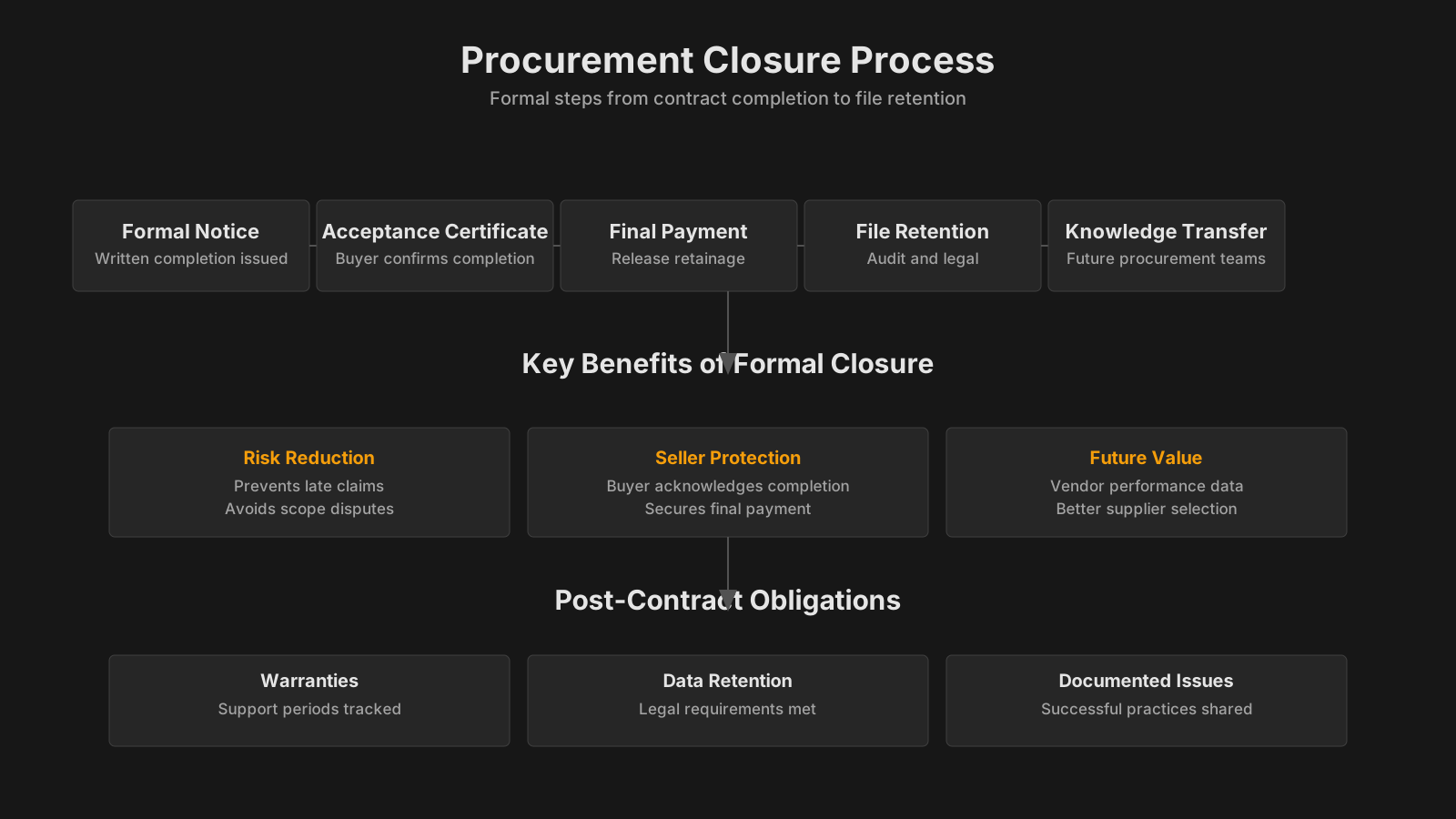
Formal procurement closure often gets treated as a final checkbox, but the last few steps carry significant legal and operational weight. The final steps to formally close a procurement determine whether the buyer has clear evidence that contractual obligations were completed, whether organizational records are ready for audit, and whether future procurement teams can learn from what actually happened. These steps produce two essential outputs: closed procurements and organizational process assets updates. The buyer, normally through an authorized procurement administrator, provides the seller with formal written notice that the contract has been completed. That notice is not just a courtesy; it is the formal trigger for final acceptance, release of remaining payments, and the start of post-contract obligations.
The requirements for these final actions are usually embedded in the contract terms and conditions and in the procurement management plan. Project managers who wait until the very end of the project to think about procurement closure often discover that the contract requires specific notices, documentation formats, or acceptance procedures that cannot be reconstructed easily. That is why the closing process deserves the same discipline as negotiation and contract award. The buyer's authorized procurement administrator owns this process in most organizations, but project managers, contract managers, and receiving teams all contribute to the evidence trail. Without a clean closure file, a completed project can still generate disputes long after the deliverable has been handed over.
Summary of Key Steps for Formally Closing a Procurement
| Key Concept | Summary |
|---|---|
| Purpose | Formal procurement closure confirms that all contractual obligations have been met, records are ready for audit, and lessons learned are systematically captured for future procurement teams. |
| Timing Risks | Deferring closure until the final phase of a project frequently prevents accurate reconstruction of required notices, original documentation formats, and formal acceptance procedures, increasing compliance risk. |
| Ownership | The authorized procurement administrator retains ownership of the closure process, while project managers, contract managers, and receiving teams provide the evidence needed to demonstrate contract compliance. |
| Outcome | Proper closure creates a definitive, documented record of the date on which the buyer formally confirms that the seller has satisfied all contractual requirements. |
| Seller Protection | Formal closure protects the seller with written acknowledgment of completion, which is particularly important for releasing retainage and authorizing final payment. |
| Coordination | Project managers should coordinate continuously with the procurement administrator during closing, particularly when outstanding quality issues, disputed change orders, or incomplete acceptance records still require resolution. |
| Distinction | Procurement closure is distinct from overall project completion. Treating the two as identical can delay a seller's final payment because of open work unrelated to the contract being closed. |
| Notice | The primary output is a formal set of closed procurements, evidenced by written notice issued by the buyer to the seller in accordance with the contract and the procurement management plan. |
Why the Final Steps to Formally Close a Procurement Matter
The practical value of formal procurement closure becomes obvious when someone asks for proof that a contract actually ended. Buyers need that proof for finance teams, auditors, senior management, and sometimes regulators. Sellers need it to close their own revenue recognition and release internal resources. A properly executed closure process establishes a single, documented point in time when the buyer confirms that the seller has satisfied the contract. This reduces the risk of late claims, scope disputes, and confusion about whether outstanding work remains. Formal closure also protects the seller by confirming that the buyer acknowledges completion, which is especially important when retainage or final payment depends on that acknowledgment.
The Role of the Procurement Administrator in Formal Closure
The buyer's authorized procurement administrator is usually the person who signs and sends the formal written closure notice. In many organizations this is a contract manager or procurement officer rather than the project manager. The distinction matters because the procurement administrator has the delegated authority to bind the organization in contractual matters. For that reason, the final closure step is not simply an administrative task that can be delegated to a project coordinator. It requires someone who understands the contract terms, has verified that all obligations were met, and can represent the buyer in the formal communication. Project managers should coordinate closely with this role throughout the closing process, especially when there are unresolved quality issues or pending change orders.
Contract Closure Versus Project Closure
Contract closure and project closure are often confused. A single project may have multiple contracts, each with its own procurement closure point. Each contract is formally closed when its terms have been met, and that may happen well before the overall project is finished. Project closure, on the other hand, occurs when the entire project or phase has been completed and administrative closure is performed. Treating the two as identical can cause a project manager to delay a seller's final payment because other unrelated project work remains open. That distinction trips up even experienced project managers. It is not only administratively incorrect but can also damage the buyer's relationship with the seller and trigger unnecessary late payment disputes. Each contract should close on its own schedule based on its own acceptance criteria.
Defining the Final Steps to Formally Close a Procurement in the Contract
Requirements for formal procurement closure are usually defined in the terms and conditions of the contract and included in the procurement management plan. This means the exact method, timing, and format of the closure notice should not be improvised at the end of the project. A well-structured procurement management plan will identify who has authority to close contracts, what documentation must be attached, how acceptance is recorded, and how lessons learned will be captured. Contracts may also specify whether closure requires a joint inspection, a final audit, or a seller sign-off. Because these requirements are often negotiated before the work begins, project managers should pull them out during planning and build them into the schedule. Waiting until the last week to discover a contractual closure condition is one of the most avoidable sources of delay.
Key Insights on Procurement Closure
- Proof that contract truly ended
- Formal closure creates the auditable documentation that finance teams, auditors, management, and regulators require to confirm contract completion, while also allowing sellers to finalize revenue recognition and reallocate internal resources.
- Single documented completion point
- A disciplined closure process locks in the exact date of contract satisfaction, shielding both parties from late claims, scope disagreements, and uncertainty about remaining work, and it protects the seller when final payment or retainage depends on the buyer's acknowledgment.
- Admin signs the closure notice
- The buyer's authorized procurement administrator is responsible for issuing the formal written closure, and although project managers should coordinate with this administrator, combining the two roles can incorrectly delay a seller's final payment over unrelated outstanding work.
Issuing the Formal Notice of Closed Procurement
One of the primary final outputs is the set of closed procurements, and the visible act that creates them is the formal written notice sent by the buyer to the seller. This notice confirms that the contract has been completed and that the buyer recognizes the seller's fulfillment of obligations. The buyer's authorized procurement administrator sends this notice, not the project sponsor or the technical lead, unless those roles have been explicitly delegated. In practical terms, this notice is the contractual counterpart to the seller's final invoice and delivery documentation. Without it, the seller may not be able to close out its own internal books, and the buyer may not be able to release any remaining payments cleanly.
Formal Written Notice Requirements
The written notice must be formal and unambiguous. It should reference the contract number, the effective date of closure, and a clear statement that the contract is complete. Many contracts also require the notice to be delivered through a specific channel, such as registered mail or a procurement system, and to be copied to particular parties. While the exact content varies by contract, the purpose is always the same: to create a record that both sides can rely on later. This record protects the buyer if the seller later claims additional compensation for work allegedly performed before closure. It also protects the seller if the buyer later refuses to pay the final invoice or disputes the completion status. Formal written notice removes ambiguity about when the contract ended.
Timing the Final Steps to Formally Close a Procurement
Timing matters more than many project managers expect. A closure notice should be issued only after all contract deliverables have been accepted or formally rejected and all unresolved issues have been addressed. If the buyer sends the notice too early, it may accidentally waive rights to demand corrective action for defects discovered after that date. If the buyer sends it too late, the seller may face unnecessary administrative burdens and may start charging for extended support or storage. The contract often includes a defined period after delivery during which the buyer must accept or reject deliverables. The closure step should align with that period. In practice, the procurement administrator confirms that all acceptance records are in place, checks for outstanding change orders, verifies that any required audits were completed, and only then issues the notice.
Protecting the Buyer Through Written Confirmation
Buyers sometimes assume that paying the final invoice or receiving the final deliverable is enough to close the procurement. It is not. The formal written notice is the step that legally and operationally finalizes the contractual relationship in the procurement file. It signals that the buyer has no further claims under the contract except for warranties or other surviving clauses. This is particularly important in contracts that include liquidated damages, performance incentives, or multi-phase delivery. Without a written confirmation, a seller may argue that the contract remained open because the buyer never formally acknowledged completion. A clean closure notice is one of the cheapest risk mitigation tools available to a buyer.
Updating Organizational Process Assets After Procurement Closure
Alongside the closed procurement notice, the buyer must complete organizational process assets updates to ensure that the project's records remain useful for future work. These updates include the procurement file, deliverable acceptance records, and lessons learned documentation. This is where many projects lose valuable information, not because the data is unavailable but because it is never organized, indexed, or stored in a way that future teams can access. Organizational process assets are supposed to support future projects by capturing decisions, contracts, and performance insights. A scattered procurement file undermines that purpose and makes audits unnecessarily painful. The final closure step is not finished until these assets are updated and placed into the final project files.
Preparing the Indexed Procurement File
The procurement file is a complete set of indexed contract documentation. It includes the closed contract itself, along with amendments, change orders, correspondence, inspection records, acceptance documents, and payment history. Indexing means organizing these documents so that someone can locate a specific item without reading the entire file. A good index groups documents by contract phase, document type, or date, and includes a clear reference to the contract number. In many organizations, this file must be stored with the final project files for a defined retention period. If the buyer later receives a warranty claim or an audit request, the indexed procurement file allows the team to answer quickly. A disorganized file, on the other hand, can turn a minor audit inquiry into a week of searching.
Documenting the Final Steps to Formally Close a Procurement Through Acceptance Records
Deliverable acceptance is itself a formal communication that must be captured in the organizational process assets. The buyer provides the seller with formal written notice that the deliverables have been accepted or rejected. This notice should include enough detail to identify the specific deliverables, the acceptance date, the acceptance criteria used, and any conditions attached. If a deliverable was rejected, the record should state the reasons and the remedy required. These acceptance records are not the same as the closure notice, although they are related. A closure notice confirms the contract is complete; an acceptance record confirms the status of individual deliverables. Both should exist in the procurement file because they answer different questions.
Nonconforming deliverables do not automatically prevent contract closure, but they must be formally addressed. The contract usually defines remedies for nonconforming work, such as repair, replacement, price reduction, or rejection with an opportunity to correct. The buyer should document the nonconformance, provide written notice to the seller within the contractual period, and agree on a corrective action plan if necessary. If the seller corrects the nonconformance and the buyer accepts the revised deliverable, the acceptance record should reflect the original rejection and the final acceptance. If the buyer rejects the deliverable outright, the contract may need to be closed through a different mechanism, such as a termination for default or a negotiated settlement. In either case, formal written notice is essential.
Connecting Acceptance to Final Payment
Final payment and deliverable acceptance are often contractually linked. Many buyers withhold a retainage or final payment until formal acceptance is documented. The trigger for releasing that payment is usually the written notice of acceptance, not the physical delivery of the product or service. The procurement administrator should therefore ensure that the acceptance record is complete before the finance team processes the final invoice. If acceptance is partial, the contract may specify partial payment terms. If acceptance is refused, the buyer may need to hold payment and escalate the issue through the contract's dispute resolution process. Misalignment between acceptance status and payment release is a classic source of conflict at the end of a procurement.
Core Takeaways on Asset Updates
- Organize assets for future teams
- Procurement closure remains incomplete until all records are organized, indexed, and stored in a structure that future teams can retrieve without unnecessary effort.
- Include all key procurement records
- A complete procurement file includes the executed contract, all amendments, change orders, correspondence, inspection records, formal acceptance documents, and a detailed payment history.
- Build a clear document index
- Organize records by contract phase, document type, or date, and consistently include the contract number so retrieval is immediate and reliable.
- Capture deliverable acceptance formally
- Formal acceptance of deliverables is a critical communication that must be captured in the organizational process assets before the procurement is considered fully closed.
- Prepare for audits and claims
- A well-indexed procurement file enables the team to respond promptly to warranty claims and audit requests without having to reconstruct information from scattered records.
Common Pitfalls in the Final Steps to Formally Close a Procurement
Even experienced teams fall into procurement closure pitfalls when the pressure to finish the project overtakes the discipline of closing the contract. The most common failure is treating closure as a single email rather than a documented sequence of formal notices and record updates. Oddly enough, this is where many projects quietly fall apart. That leads to missing evidence, unresolved acceptance disputes, and an OPA file that cannot be audited later. Another frequent pitfall is conflating contract closure with project closure, which can delay seller payments or force a contract to remain open far longer than necessary. Recognizing these risks in advance helps teams design closure checkpoints that match the contract's requirements instead of relying on memory or informal conversations.
Skipping the Formal Written Notice
Some buyers assume that if the final deliverable was received and the seller stopped sending invoices, the procurement is effectively closed. That assumption creates a dangerous gap in the record. Without formal written notice, there is no definitive proof of contract completion. Months later, a seller may claim that additional work was performed after the informal handover, or a finance auditor may ask for evidence that the contract was properly closed before the final payment was released. The simple act of sending a written notice eliminates that ambiguity. It takes only a few minutes to prepare when the contract requirements are already known, but it can prevent weeks of dispute resolution later.
Treating Lessons Learned as Optional Administration
Lessons learned are often the first thing cut when the team is exhausted and ready to move on. That is a costly mistake because procurement lessons rarely resurface unless someone captures them deliberately. A lessons learned entry that records a specific seller performance issue, a contract clause that caused delay, or a negotiation tactic that worked well can directly inform the next procurement. Without that documentation, the next team starts from zero. The process improvement recommendation is what makes the entry actionable. Instead of writing only that the seller was late, the team should note why the seller was late and what clause or checkpoint would have prevented the delay. That level of detail turns lessons learned into a real organizational asset.
Failing to Index the Procurement File Until Later
Postponing the indexing and filing of procurement documents is another common failure. The team may have all the documents scattered across email, shared drives, and individual laptops, but they never assemble them into a complete indexed file. When the project closes and team members leave, that knowledge disappears. The notes on final outputs state that the procurement file should be a complete set of indexed contract documentation prepared for inclusion with the final project files. This is not about creating extra work; it is about arranging what already exists so that someone else can find it. An indexed file also protects the buyer during audits, warranty claims, and any post-closure disputes. A few hours of filing at the end of a procurement can save significant cost later.
Procurement Closure Across Different Project Frameworks
The core sequence of procurement closure across frameworks remains consistent even when the surrounding method changes. Formal notice, deliverable acceptance, and lessons learned are not unique to any single project management standard. In PMBOK, these activities fall under the Closing Process Group and the Procurement Management knowledge area. PRINCE2 treats closure as a controlled handover activity within its managing a stage boundary and closing a project processes. Agile environments often handle procurement closure with shorter feedback loops and a stronger emphasis on iterative acceptance. Understanding these variations helps project managers apply the right emphasis without losing the essential rigor of formal closure.
PMBOK and the Closing Process Group
In PMBOK, the formal closure of procurements is part of the Closing Process Group, specifically connected to the Control Procurements process and the overall project or phase closure. The buyer confirms that all contract obligations were met, issues formal written notice, and updates organizational process assets. The PMBOK framework also distinguishes between closing a contract and closing the project, a distinction that many practitioners learn the hard way. A project may have several contracts, each requiring its own closure check. The Closing Process Group emphasizes verifying that all work is complete and documented before the project or phase is formally closed. Procurement closure therefore contributes directly to the final project file and the transition to ongoing operations.
PRINCE2 and Controlled Handover
PRINCE2 does not have a separate procurement knowledge area, but its controlled approach to closing a project includes confirming that all products have been delivered and accepted. In a PRINCE2 project, acceptance records are part of the project product description and the quality register. The closure stage also includes evaluating the project, capturing lessons, and preparing follow-on action recommendations. For projects with external suppliers, the project board and senior supplier may be involved in confirming that the supplier's obligations are complete. The same principle applies: acceptance must be recorded, the contract must be formally closed, and the lessons learned must be passed to the organization. PRINCE2's emphasis on product acceptance aligns well with the formal deliverable acceptance requirements found in procurement contracts.
Agile Manifestations of Procurement Closure
In Agile environments, procurement closure can feel less formal because the focus is on iterative delivery and continuous feedback. However, the need to formally close a contract does not disappear just because a team uses sprints. Many Agile projects still rely on external suppliers for software components, infrastructure, or specialized services. In those cases, the buyer should still issue a formal closure notice when the supplier's contract is complete. The difference is that deliverable acceptance may occur incrementally, with each sprint or release accepted through a product increment review. At the end of the contract, the procurement administrator consolidates these incremental acceptance records into a final acceptance notice. Lessons learned can also be captured during regular retrospectives rather than only at the end of the project.
Business Value Considerations in Final Procurement Steps
Business Value-Oriented Project Management extends the closure discussion beyond financial and administrative closure. When a procurement is formally closed, the organization captures not only contract performance but also non-financial benefits such as supplier relationship improvements, employee engagement in the procurement process, and future risk reduction from better supplier selection criteria. Program realization sets may allow different projects to choose their own methodology while still feeding results into a broader program-level view. This perspective reinforces the importance of lessons learned documentation. The final steps of procurement closure can therefore contribute to long-term business value rather than simply closing a file. Capturing how a procurement reduced future operational risk or improved internal procurement capability is just as valuable as recording schedule and cost performance.
Key Insights on Procurement Closure
- Consistent closure sequence
- Across all frameworks, the core closure sequence of formal notification, deliverable acceptance, and lessons learned remains consistent, enabling project managers to adjust emphasis without weakening the rigor of formal closure.
- PMBOK closing process group
- PMBOK positions procurement closure within the Closing Process Group and the Procurement Management knowledge area, requiring the buyer to verify that all contractual obligations have been met and to issue formal written notice to the seller.
- PRINCE2 controlled handover
- PRINCE2 integrates closure into its Managing a Stage Boundary and Closing a Project processes, confirming that all products have been delivered and accepted without requiring a separate procurement knowledge area.
- Agile iterative acceptance
- Agile environments adapt procurement closure by using shorter feedback loops and frequent iterative acceptance, yet they still uphold the core rigor required for formal closure.
- Non-financial benefit capture
- Beyond cost and schedule outcomes, formal procurement closure captures non-financial benefits such as stronger supplier relationships, higher employee engagement in the procurement process, and reduced future risk through sharper supplier selection criteria.
What Remains After the Procurement Is Formally Closed
Even after the buyer issues the formal closure notice and updates the organizational process assets, certain post-closure obligations survive the contract. Warranties, support periods, confidentiality clauses, and records retention requirements often continue for months or years after closure. The procurement file must remain accessible during that period so the buyer can respond to warranty claims or audit inquiries. The closure notice does not extinguish those surviving terms unless the contract explicitly says so. Project managers should therefore identify which obligations continue after closure and ensure that someone is responsible for managing them. Otherwise, a formally closed procurement can still generate surprises.
Warranty and Support Periods
Many contracts include a warranty period that starts when the buyer accepts the final deliverable. During that period, the seller may be obligated to repair defects, provide updates, or offer technical support. The formal acceptance record and closure notice determine the start date of that warranty. For that reason, inaccurate dating or ambiguous acceptance language can create confusion later. The procurement file should include the warranty terms and the acceptance date so the buyer knows when warranty coverage begins and ends. If a defect appears, the buyer can quickly reference the file and contact the seller without searching through old emails.
Records Retention and Audit Readiness
Organizational policies and contract terms usually require the buyer to retain procurement records for a defined period. The indexed procurement file is the foundation for that retention. It should be stored in a location that can survive team turnover and project closure. Audits, litigation, and regulatory reviews can occur years after the contract ends, and the buyer will need to reconstruct what happened. A complete indexed file with the closed contract, acceptance records, and lessons learned makes that reconstruction straightforward. It also demonstrates that the organization followed its own procurement policies and the contract's terms. Records retention is not a closing step itself, but it directly depends on the quality of the closure outputs.
Using Lessons Learned for Future Procurements
The final residual value of a closed procurement is the knowledge it leaves behind. Lessons learned documentation does not help if no one reads it before the next procurement. Organizations can make this practical by linking lessons learned to procurement templates, contract checklists, and risk registers. For example, a lesson about ambiguous acceptance criteria can be added to the procurement management plan checklist for future contracts. A lesson about a seller's poor communication can inform the next prequalification process. These small integrations turn the closing process into a continuous improvement loop. The formal closure of one procurement becomes the starting point for a better procurement next time.