Project managers often reach a point where internal capabilities simply cannot deliver everything the work requires. At that juncture, they need to conduct procurements and select a seller using a disciplined, transparent approach that balances cost, quality, and risk. The process is far more nuanced than sending out a request and signing a contract. It demands careful alignment with the procurement management plan, a clear-eyed evaluation of seller responses, and the political astuteness to navigate bidding conferences and negotiations while keeping stakeholder expectations in check. When done well, the conduct procurements process becomes a strategic enabler rather than just a transactional chore.
Procurement and Seller Selection: Key Topics at a Glance
| Procurement Conduct | Summary |
|---|---|
| Definition | Conducting procurements encompasses the full lifecycle: defining needs, soliciting and evaluating vendor responses, and awarding a contract that best meets strategic objectives. |
| Iterative Approach | An iterative process typically begins with high-level proposals to shortlist capable suppliers, then progressively requests more detailed submissions until a well-informed final selection is made. |
| Selection Criteria | Apply the source selection criteria defined during planning to systematically narrow the seller field, while issuing solicitations and holding bidder conferences to align expectations. |
| Stakeholder Views | Stakeholder priorities can diverge sharply: a financial controller may weight total cost of ownership, while a technical lead emphasizes architecture robustness and proven delivery performance. |
| Thresholds | Separating mandatory eligibility thresholds from value‑added features ensures a fundamentally deficient proposal cannot win by compensating with high marks on non‑essential extras. |
| Evaluation Methods | A multi‑stage review sharpens decision quality by applying compliance checks first, weighted criteria scoring second, and interactive sessions such as interviews or demonstrations third. |
| Document Types | Match the solicitation document to the procurement context: a Request for Information clarifies market capability, a Request for Proposal elicits solution‑oriented offers, and an Invitation for Bid suits well‑defined requirements where price dominates. |
| Bias Avoidance | Ad‑hoc proposal reviews often anchor on a single vivid factor like price; a structured, multi‑factor evaluation framework is indispensable for balanced, defensible decisions. |
How to Conduct Procurements and Select a Seller
The phrase “conduct procurements” refers to the set of activities that take a project from having identified a need for external products or services to actually obtaining signed proposals, evaluating them, and awarding a contract. It sits squarely in the Executing Process Group and falls under the Project Procurement Management Knowledge Area in PMBOK. Although the term sounds administrative, the reality involves a great deal of judgment, iterative refinement, and sometimes delicate negotiation. For large or complex acquisitions, the process does not happen in a single pass. Instead, you might receive initial high-level proposals, create a short list of promising sellers, and then ask those candidates to respond to a more detailed set of requirements before making the final call. Recognizing this iterative nature early on prevents the common mistake of treating the entire exercise as a one-shot paper chase.
What often trips up less experienced project managers is the assumption that the evaluation criteria are obvious. They rarely are. Different stakeholders value different attributes. A finance controller may worship the lowest life-cycle cost, while a technical lead cares about a seller’s architecture expertise and past performance reliability. That is why building a weighted evaluation system, discussed later, becomes one of the most powerful tools in your arsenal. The moment you try to structure a formal selection process, you force the team to articulate trade-offs before being confronted with glossy proposals that can tug emotions in unhelpful directions.
Think of the entire conduct procurements process as a funnel. At the top, you have a broad pool of potential sellers generated through advertising, internet searches, or pre-qualified lists. As you invite proposals, host bidder conferences, and receive responses, your job is to steadily narrow that pool using the source selection criteria defined earlier in the planning phase. At the bottom of the funnel, after rounds of clarifications, independent cost validation, and perhaps tense procurement negotiations, you end up with a selected seller and a mutually acceptable contract. Keeping that funnel analogy in mind helps you avoid falling in love with a particular seller too early, a bias that routinely undermines objectivity.
Defining Your Evaluation Framework to Conduct Procurements and Select a Seller
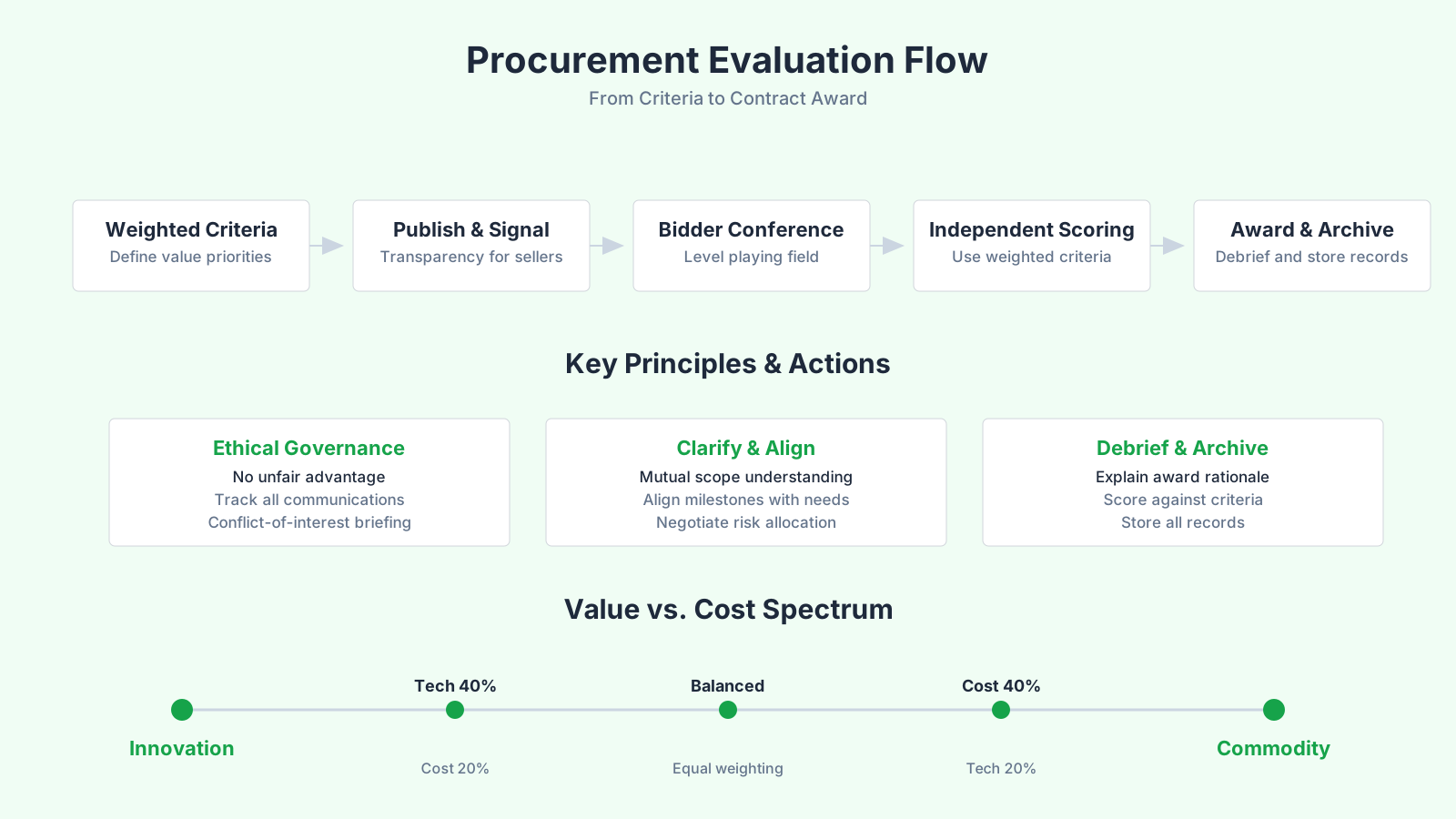
Every selection decision rests on a foundation of source selection criteria that should have been baked into the procurement management plan. These criteria can include capabilities, capacity, delivery dates, cost, life-cycle cost, technical expertise, and the proposed contract approach. The mistake many teams make is using a flat list of factors without weighting. When you simply eyeball proposals with all criteria floating in your head, the human brain latches onto one vivid dimension, often price or a charismatic presentation, and downplays equally important factors like long-term maintainability or the seller’s financial stability.
A weighted scoring model brings rigor. You assign a percentage weight to each criterion, reflecting its relative importance to the project’s objectives. For instance, in a software development procurement, technical expertise might carry thirty percent, past performance twenty-five percent, cost twenty percent, delivery timeline fifteen percent, and contract terms ten percent. Each proposal gets a score against every criterion, multiplied by the weight, and the totals point to the most balanced choice. This doesn’t automate the decision, but it makes the logic transparent and vastly easier to explain to a skeptical steering committee. It also forces you to have the uncomfortable conversations about priorities early, rather than after the bids are in and tempers are short.
Another nuance is distinguishing between must-have and nice-to-have criteria. A qualified seller list, built from pre-screened vendors with verified qualifications and experience, already filters out those who cannot meet baseline requirements. But even among qualified sellers, you will find stark differences in the finesse of their proposed solutions. Some will offer ingenious ways to reduce total ownership cost through innovative contract structures, while others meet the specification without any extra spark. Your evaluation framework must be capable of rewarding that spark without being dazzled into ignoring fundamental weaknesses. This is where separating minimum thresholds (must-haves) from value-adds (nice-to-haves) prevents a deeply flawed proposal from sneaking through because it scores highly on bells and whistles.
Applying Proposal Review Techniques to Conduct Procurements and Select a Seller
Once proposals land on your desk, the real analytical work begins. Proposal evaluation techniques vary widely. Some teams rely on simple screening, quickly discarding any bid that fails a mandatory requirement. Others use a multi-stage review where the first pass checks compliance, the second applies the weighted criteria, and a third involves interviews or demonstrations. For complex procurements, having a cross-functional evaluation committee is almost mandatory. If only the procurement specialist and one technical lead read the proposals, you guarantee blind spots no single person can anticipate.
Independent estimates serve as a reality check on seller pricing. Before you even open the proposals, your team should develop its own cost estimate for the work, based on internal data, market research, and parametric models. When a seller’s bid comes in thirty percent below that independent estimate, it is not a cause for celebration. It is a red flag demanding investigation. Perhaps the seller misunderstood the scope, or intends to make up the difference through change orders later. The independent estimate acts like a sanity gauge, keeping the evaluation tethered to reality rather than letting the lowest number dictate the conversation.
Bidder conferences, held before proposals are submitted, can dramatically improve the quality of responses. These sessions give potential sellers the chance to ask clarifying questions and for you to express the project’s intent more vividly than any dense document can. They also level the playing field: all attendees hear the same answers, reducing the information asymmetry that can plague negotiated procurements. A pitfall here is answering one seller’s question informally after the conference and forgetting to share that answer with everyone else. That kind of slip can trigger protests and legal challenges, even if the intent was innocent. Good practice is to log every question and post anonymized responses to all registered bidders promptly.
Negotiating and Awarding the Contract to Conduct Procurements and Select a Seller
Procurement negotiations are not simply about squeezing the price down. The scope, schedule, quality requirements, payment terms, intellectual property rights, and risk allocation are all on the table. A project manager who treats negotiation as a win-lose battle usually ends up with a seller who cut corners to protect margins or who will be uncooperative when unexpected changes arise. The objective is a contract that both sides can live with over the long haul. Skilled negotiators know their best alternative to a negotiated agreement and use objective criteria, such as market benchmarks or industry standard contract terms, to keep discussions grounded.
One output of this process is the resource calendar, which lists when the seller’s resources will be available. That piece of information feeds directly into the master project schedule and can surface constraints early. If the selected contractor cannot start for six weeks, your timeline may need to shift accordingly, and downstream activities that depend on those deliverables get adjusted before they become fire drills. Change requests may also emerge from the procurement process. For example, if the seller’s proposed delivery approach is faster but requires the project to provide certain interfaces earlier than planned, that triggers a change to the project management plan. Smart project managers treat these change requests not as disruptions but as validation that the procurement process uncovered reality rather than optimistic fiction.
Once the contract is signed, the chosen seller becomes a project team member in a virtual sense, and everything from communication plans to risk management must integrate their workflows. Updating project documents like the risk register is not optional; a new contracted relationship introduces its own set of risks, from vendor solvency to delivery dependency, and those need to be logged, analyzed, and assigned owners. The conduct procurements process therefore does not end at contract signature. It flows seamlessly into control procurements, where you monitor performance and manage the relationship until closeout.
Core Insights: Seller Selection Process
- Iterative procurement funnel
- Effective procurement unfolds as a deliberate funnel, moving from broad market scans and high-level proposals to a negotiated shortlist before finalizing detailed requirements and the contract award, which avoids the trap of treating selection as a single-pass paperwork exercise.
- Formal criteria force trade-offs
- A well-structured formal selection process compels stakeholders to weigh trade-offs against explicit, predefined source selection criteria, ensuring that visceral reactions to polished presentations do not override the careful balancing of cost, risk, and capability.
- Guard against selection bias
- Informal proposal reviews often lead evaluators to fixate on one vivid element, such as price or a charismatic presentation, while neglecting long-term factors like maintainability and vendor financial stability, making the structured funnel essential for preserving objective judgment.
Building the Procurement Management Foundation
Long before you open a proposal, the procurement management plan lays out the rules of engagement. This document, a component of the project management plan, describes how procurement activities will be managed from developing procurement documents through contract closure. It specifies the types of contracts to be used, the approval authorities, the constraints and assumptions, and how procurement risks will be handled. Without this plan, you risk ad-hoc decisions that contradict organizational policies or even legal requirements. The plan also defines the metrics by which seller performance will be measured, giving you a reference point when disagreements arise during contract execution.
Procurement documents themselves come in many flavors. Depending on the project’s nature, you might issue a request for information to gauge market capability, a request for proposal when the solution is not fully defined, or an invitation for bid when the requirements are crystal clear and the lowest price among technically acceptable offers will govern the choice. The crafting of these documents is an art. Sloppy or ambiguous requirements lead to proposals that cannot be compared fairly. Too much detail, on the other hand, can stifle seller creativity and lock you into a rigid solution when a smarter alternative might exist. The key is to focus on performance-based specifications whenever possible, describing the outcome you need rather than prescribing exactly how to achieve it.
The qualified seller list, often overlooked, is a tremendous time-saver. This is a roster of pre-screened sellers who have already demonstrated the necessary capabilities, capacity, and past performance. Using such a list reduces the risk of receiving bids from completely unsuitable parties that waste evaluation effort. However, don’t let the list become a comfortable rut. New entrants with fresh technologies may not be on it, and periodically refreshing the list through open advertising and internet searches prevents complacency. Balancing the efficiency of the qualified list with the innovation potential of an open market is a recurring tension in procurement management.
Teaming agreements also shape the selection landscape. Sometimes two firms will form a joint venture or a prime-subcontractor relationship specifically to pursue your project. These agreements can bring complementary strengths but also introduce coordination complexity. When you evaluate a proposal submitted by a team, you are implicitly assessing the viability of their internal working relationship, a dimension that is notoriously hard to gauge from paper. Checking references not just for individual firms but for the specific team combination is worth the extra effort. Organizational process assets, such as past procurement files, lessons learned, and standard contract templates, round out the foundation. Leaning on these assets avoids reinventing the wheel and helps enforce consistency with corporate procurement policies.
Make-or-buy decisions, finalized earlier in planning, feed directly into this foundation. If you’ve decided to buy rather than make, that decision triggers the entire procurement cycle. What many miss is that make-or-buy is not a one-time event. As seller proposals come in, you might discover that an in-house solution is actually more viable than initially thought, or that a hybrid approach combining internal work with an external component yields the best value. The conduct procurements process should have the flexibility to revisit those decisions if new information warrants, though doing so requires careful change control to avoid derailing the project.
Essential Tools and Techniques for Seller Evaluation
Bidder conferences rank among the most underutilized tools. When executed well, they transform the procurement from a purely transactional document exchange into a collaborative dialogue that clarifies expectations. Sellers get a feel for the project’s culture and your team’s technical maturity, both of which influence their pricing and risk premiums. You, in turn, can spot which sellers ask incisive questions versus those who seem confused about basic requirements. That subtle insight often foreshadows the quality of their eventual proposals and their ability to perform under pressure.
Proposal evaluation techniques need to match the complexity of the procurement. For straightforward off-the-shelf purchases, a simple screening against mandatory requirements followed by low-price selection might suffice. For highly complex, multi-year services contracts, a best-value evaluation employing weighted criteria, scenario-based interviews, and even paid proof-of-concept phases can separate genuinely capable sellers from those who are simply good at writing proposals. The danger lies in overengineering the evaluation for a small purchase and underengineering it for a strategically critical one. Striking that balance is a judgment call that improves with experience and post-procurement reviews.
Independent estimates serve as both a budgeting tool and a negotiating lever. When you develop an in-house cost model using parametric estimating, analogous data from past projects, or bottom-up buildup from the work breakdown structure, you anchor the entire price discussion in objectivity. If all received bids cluster twenty percent above your independent estimate, that signals either that your scope was too aggressive or that the market is hotter than you assumed. Adjusting expectations before entering negotiations prevents last-minute sticker shock that can stall the selection. Conversely, if all bids come in suspiciously low, alarm bells should ring about scope omissions or a deliberate low-ball strategy.
Expert judgment threads through every tool. It can come from within the organization, such as a subject matter expert who understands the technology deeply, or from external consultants and industry bodies. The key is to use expert judgment not as a substitute for analysis but as a lens through which to interpret evaluation results. For example, a procurement attorney’s perspective can highlight hidden indemnification clauses that render a seemingly cheap proposal extremely risky. Similarly, a cybersecurity specialist might flag vulnerabilities in a seller’s proposed data handling that the main evaluation team would miss. The more diverse the expert panel, the better the final decision.
Advertising and internet searches expand the field beyond the known qualified list. Government projects often have statutory advertising requirements, but even in the private sector, casting a wide net can uncover niche specialists who bring unique value. The internet also enables you to vet sellers informally before they even submit a proposal. Reading case studies, checking online reviews, and scanning for news about litigation or financial trouble adds a layer of due diligence that complements formal evaluation. Just be careful not to let informal impressions override the structured criteria.
Procurement negotiations deserve a deeper look. They occur after evaluation but before contract award, and the objective is to refine the terms to mutual benefit. Topics often include clarifying ambiguous scope descriptions, negotiating intellectual property rights, defining acceptance criteria, and agreeing on a governance structure for issue resolution. A common mistake is to allocate all negotiation time to price reduction while glossing over the service levels, warranties, and exit clauses that determine the long-term value of the deal. You can often secure better overall value by conceding a bit on price in exchange for extended warranty coverage or faster escalation paths for critical defects.
Key Takeaways on Seller Evaluation
- Collaborative dialogue reveals seller quality
- Well-run evaluations transform procurement from a transactional document exchange into a collaborative conversation, allowing buyers to identify sellers who pose incisive questions while sellers gauge the project culture and technical depth before setting pricing and risk premiums.
- Match evaluation depth to complexity
- Straightforward off-the-shelf purchases require only mandatory-requirement screening and a lowest-price selection, whereas complex multi-year service contracts demand a best-value evaluation that employs weighted criteria, scenario-based interviews, and paid proof-of-concept phases to distinguish suppliers with genuine capability from those armed only with polished proposals.
- Cost models anchor negotiation objectivity
- Constructing an independent in-house estimate via parametric analysis, comparable past projects, or bottom-up work breakdown analysis anchors price discussions in objective reality; when bids cluster twenty percent above that reference point, it reveals either an inflated scope or a seller's market, enabling expectations to be recalibrated before negotiations reach an impasse.
Navigating Common Pitfalls in Procurement Selection
Even with robust processes, several traps persistently snare project teams. The first is bidding fatigue. When a procurement drags on for months due to endless clarifications and revised proposals, both the evaluation team and the sellers lose energy. Decision quality crumbles as people rush to “just pick someone” to end the administrative pain. Setting clear timelines at the start and sticking to them with disciplined gate reviews keeps the momentum from stalling. If delays become unavoidable, transparently communicating the reasons to bidders helps maintain goodwill and avoids perceptions of unfair treatment.
Another pitfall is the halo effect, where a seller’s stellar reputation in one domain blinds evaluators to mediocrity in the specific area you need. A large consultancy known for digital transformation might submit a proposal that is light on the exact technical skills your niche project requires, yet the weight of their brand name sways the scoring. The antidote is to design the evaluation criteria so that relevance to this project counts more than overall industry standing. Weighted scoring helps, but it also requires that the scorers have enough domain knowledge to distinguish between generic competence and project-specific fit.
Gold plating during negotiations is a subtle but destructive force. Sellers may add features or services that were not requested, positioning them as free extras, but those additions can increase complexity and future maintenance burdens. When evaluating, strip the proposal back to what was actually asked for and compare sellers on like-for-like scope. If one seller’s extras genuinely reduce risk or add value, treat those as a separate line item so the baseline comparison remains clean.
Internal stakeholders who were not involved in developing the source selection criteria can derail a selection late in the game. Suddenly, a senior executive questions why you are not picking a particular seller they know personally, or a business unit head demands a capability that was deprioritized. This is why the procurement management plan must gain broad buy-in before the bids arrive. If the criteria were agreed upon and approved, any attempt to override them after proposals are in can be met with the simple response: we already defined what matters. That shield only works if the upfront agreement was genuine and well-documented.
Finally, treating the contract award as the finish line is a mental trap. The real test begins when the seller starts delivering. If the procurement process was adversarial or cut corners on relationship building, the project inherits a hostile dynamic. Procurement negotiations that leave the seller feeling exploited often lead to minimal compliance rather than proactive partnership. Maintaining a fair, professional tone throughout the process pays dividends in the execution phase, where the seller’s willingness to go the extra mile can make or break a tight deadline.
Aligning Procurement with Project Management Frameworks
The project procurement management process described here does not stand alone. It connects deeply with other knowledge areas. Risk management feeds in through the risk register and risk-related contract decisions, which influence contract types and the allocation of risks between buyer and seller. A fixed-price contract, for instance, transfers more risk to the seller, while a time-and-materials contract keeps risk with the buyer. Those decisions must be made deliberately, not by default, and they ripple through the evaluation criteria you set.
From a PRINCE2 perspective, procurements map to the commercial management aspects of the project, with an emphasis on business justification and continued focus on value for money. PRINCE2’s emphasis on management stages often aligns procurement decisions with stage boundaries, so that a decision to buy external services is only made when the relevant stage plan is approved. That staged approach can prevent premature commitment to large contracts before the project has proven its viability.
In Agile environments, procurement looks different but the core principles persist. Agile teams often prefer shorter-term contracts with service providers that allow for iterative delivery and flexibility in scope. Instead of a single massive procurement event early in the project, the team might use a master services agreement with task orders released incrementally. The selection of a seller in such contexts still relies on capability and capacity, but the emphasis shifts toward the seller’s ability to adapt to changing requirements and collaborate intimately with the team. Bidder conferences may be replaced by collaborative workshops where sellers demonstrate their understanding by co-creating a draft sprint backlog, but the evaluation still needs criteria, comparison, and a negotiated agreement.
It’s also worth noting that many organizations now blend traditional and Agile procurement through hybrid models. You might use a traditional RFP to select a vendor for a multi-year program but include Agile clauses that allow scope adjustment via change orders tied to value demonstrations. The conduct procurements process then becomes a mechanism to select not just a seller but a long-term partner who can evolve with the project’s shifting priorities. This shifts the evaluation focus toward factors like cultural compatibility, collaboration tooling, and the seller’s track record with continuous delivery, which are harder to quantify but often more predictive of success than a fixed price alone.
Finally, the outputs of conduct procurements feed into the project’s overall monitoring and controlling rhythm. The resource calendars from awarded contracts update the project schedule, and any change requests that arise modify baselines. Resource management plans get refreshed, and the stakeholder register may gain new entries from the seller’s organization. Seeing these connections prevents the procurement from becoming an isolated silo that surprises the rest of the project team later. The process is a pivot point where the project’s resource strategy converts from plans on paper into committed external capabilities, and the rigor with which you manage it reverberates through every subsequent phase.
Key Insights on Procurement Alignment
- Contract type determines risk
- Choosing a fixed-price contract shifts the burden of cost overruns and scope changes to the seller, whereas a time-and-materials agreement retains financial risk with the buyer, making contract selection a decisive instrument for allocating procurement exposure.
- PRINCE2 stage-gated buying
- PRINCE2 ties procurement authorization to approved management stage plans, ensuring that external spending proceeds only after the ongoing business justification, viability, and value for money are reaffirmed at each stage boundary.
- Agile contract flexibility
- Agile environments favor master services agreements with incremental task orders or short-term contracts, enabling iterative delivery and continuous scope refinement instead of a single, early procurement commitment.
- Adapted seller evaluation
- In Agile procurement, seller selection retains structured criteria and comparison but elevates adaptability and collaboration, using collaborative workshops in place of bidder conferences and weighting cultural fit alongside proven continuous delivery track records.