Schedule network templates are standardized schedule network diagram templates that project managers use to speed up the preparation of networks of project activities. The question of when should I use them comes up most often in environments where the same pattern of work repeats across deliverables, phases, or projects. A template can represent an entire project or only a portion of it. When it represents a portion, practitioners often call it a subnetwork or a fragment network. These reusable fragments are especially valuable in projects that include several identical or nearly identical deliverables.
In many project environments, planning the sequence of activities consumes as much effort as estimating durations or assigning resources. The schedule network diagram shows how tasks connect through logical dependencies. Constructing that diagram from scratch for every new deliverable adds little value when the deliverable is essentially the same as one already planned. A template stores the logical relationships so the team can insert them directly into the schedule model. That frees up time for the project manager to focus on the unique constraints and risks that actually differ from one deliverable to another.
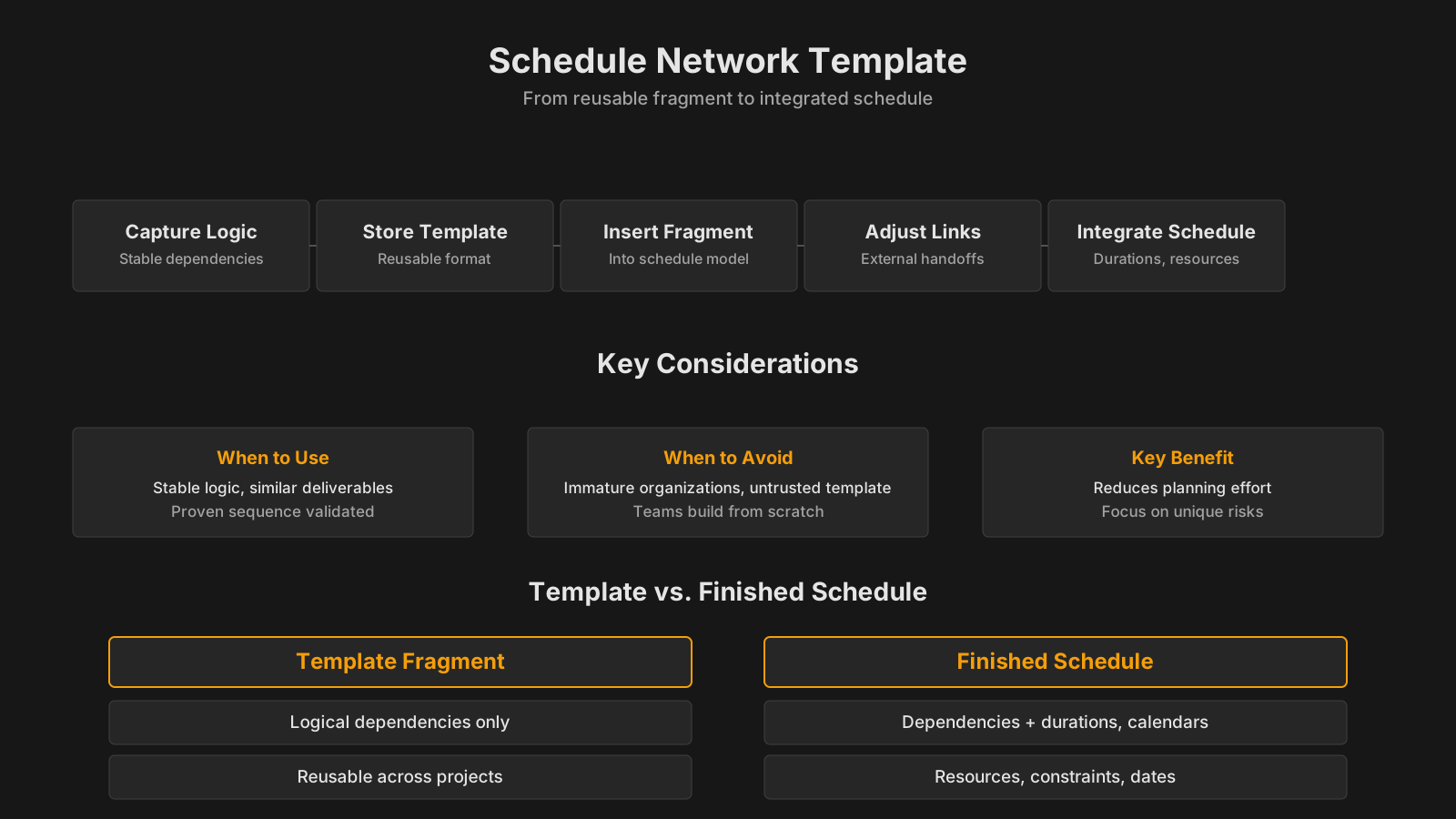
Summary of Schedule Network Template Essentials
| Key Concept | Summary |
|---|---|
| Template Value | Schedule network templates deliver the greatest value when a project contains repeated deliverables governed by nearly identical work sequences, enabling consistent planning and faster schedule development. |
| Fragment Network | A fragment network represents a smaller, self-contained subset of schedule logic that can be reused independently, often serving as a modular building block within a larger schedule. |
| Template Contents | Effective templates typically capture activity descriptions, dependency relationships, and occasionally role assignments, while deliberately excluding fixed dates and resource availability so they remain adaptable across projects. |
| Boundary Relationships | Inserting a template without defining boundary relationships often produces an internally clean sequence that nevertheless fails to reflect real external constraints, leaving the schedule disconnected from surrounding work. |
| Copying Mistake | A frequent error is copying a fragment between projects without validating that the inherited predecessor logic still applies to the new context, which can introduce misleading dependencies. |
| Repeated Sequences | Many development initiatives and clinical trials follow stable core sequences, such as progressing from site readiness to patient enrollment, even when individual activity durations vary significantly. |
| Linking Fragments | The overall project schedule can be structured as a series of fragments connected vertically by logistics dependencies such as hoist capacity, trade stacking, and inspection release, creating a coherent flow across levels. |
| Unique Elements | Projects also contain unique, non-repeating activities such as regulatory submissions, manufacturing scale-up, and market access planning that lie outside standard templates and require tailored schedule logic. |
What Are Schedule Network Templates?
At its core, a schedule network template is a reusable format for project activity dependencies that can be inserted into a larger schedule network diagram. The template defines which activities belong together and how they are logically connected. It typically includes activity descriptions, dependency types, and sometimes role assignments, but it does not include fixed dates or resource availability. The actual schedule emerges only after the project manager applies durations, calendars, resources, and constraints. Without that distinction, teams easily mistake the network logic for a finished schedule.
The Core Purpose of Standardized Schedule Network Templates
Standardized schedule network templates serve a straightforward purpose. They prevent a team from reconstructing the same activity logic every time a similar work package appears. When a project has forty floors or thirty clinical trial sites, the core sequence of work does not change fundamentally from floor to floor or site to site. What changes are the specific durations, resource availability, and external dependencies. A template captures the stable logic once and lets the team apply it repeatedly.
This does not mean the template should be applied blindly. Every insertion point in the larger network has predecessor and successor activities that the template must connect to correctly. If the template's first activity assumes a certain handoff from a previous phase, the project manager must verify that handoff exists in the current project. The internal logic of the template can be perfect and still fail at the boundaries. That is why experienced schedulers treat a network template as a starting point, not as an automatic solution.
Defining Subnetwork and Fragment Network Templates in Project Schedules
Portions of a project schedule network diagram are often referred to as a subnetwork or a fragment network. The two terms are interchangeable in most practical settings. A subnetwork is simply a defined set of activities and dependencies that form part of a larger network. A fragment network tends to describe the same concept, though some practitioners use it to emphasize a smaller or more self-contained piece of logic. In this article, both terms refer to a reusable portion of the network.
Consider a high-rise office building. The mechanical, electrical, and finishing work on each floor follows a predictable sequence. Framing or structural completion must precede wall construction, which must precede painting and final inspection. That sequence can be modeled as a fragment network and copied for each floor. The project schedule then becomes a series of these fragments linked vertically by logistics dependencies such as hoist capacity, trade stacking, or inspection release.
How Schedule Network Templates Fit Into the Larger Project Network
A schedule network template is not a standalone schedule. It becomes meaningful only when it is connected to the broader project network. The first activity in a fragment has at least one predecessor outside the fragment, and the last activity has at least one successor. Those external dependencies are often the source of schedule risk. If a template is inserted without defining the boundary relationships, the resulting schedule may show a clean internal sequence but fail to reflect real constraints.
Scheduling software typically allows project managers to store fragments in a library. When a fragment is inserted, the software copies the internal dependencies into the target file. The project manager then links the fragment's entry and exit points to the surrounding activities. This integration step is where schedule logic errors tend to appear. A common mistake is to copy a fragment from one project into another without checking whether the assumed predecessor type still makes sense. The result is a network that looks plausible but contains an incorrect dependency.
Template Logic Key Insights
- Reusable dependency logic
- Schedule network templates bundle activity descriptions, dependency types, and role assignments into a portable structure that can be inserted into larger schedule network diagrams, ensuring the same sequencing logic is reused consistently across projects.
- Not a finished schedule
- Because templates omit fixed dates and resource availability, the executable schedule takes shape only after the project manager applies durations, calendars, resource assignments, and constraints.
- Avoids repeated reconstruction
- Using templates eliminates the need to rebuild identical activity logic for repetitive work packages, such as multiple building floors or numerous clinical trial sites.
- Verify insertion point connections
- Before relying on a template, project managers should verify that its links to predecessor and successor activities are valid at the insertion point and that the assumed handoffs exist in the current project.
When Should I Use Schedule Network Templates?
Schedule network templates are most valuable when a project includes repeated deliverables that follow nearly identical work sequences. If every deliverable requires a completely different set of activities and dependencies, a template adds little benefit. But when the same logic applies to many work packages, the time saved by reusing that logic can be substantial. The key condition is repetition of the network structure, not necessarily repetition of the durations. Even if one floor takes six weeks and another takes eight, the logical sequence remains the same.
Repeated Deliverables That Make Schedule Network Templates Useful
A project that includes several identical or nearly identical deliverables is the clearest case for using subnetwork templates. A high-rise office building has multiple floors. A pharmaceutical research project may run multiple clinical trials with similar protocols. A software project may code many program modules that follow the same development and testing sequence. In each case, the project manager can define the network once and reuse it for each instance.
Repetition does not have to mean exact duplication. Nearly identical deliverables still justify a template because the variations are usually in parameters, not in dependency logic. One clinical trial site might have a longer patient recruitment period than another, but the fundamental sequence from site readiness to patient enrollment, treatment, data collection, and closeout remains stable. The template preserves that stable sequence while allowing the team to modify durations and resource assignments for each instance.
High-Rise Floors, Clinical Trials, and Software Modules as Schedule Network Template Examples
The high-rise office building example illustrates how subnetworks reduce planning time across vertical construction. The structural frame, envelope, interior partitions, mechanical rough-in, electrical work, and finishes follow a dependency chain that does not change from floor to floor. External constraints such as crane time or material availability may vary, but those are added at the integration points rather than rebuilt inside every fragment.
In pharmaceutical research, clinical trials often follow a regulated sequence. Site selection, investigator training, patient recruitment, treatment administration, data monitoring, and closeout are highly standardized. A subnetwork template can represent that clinical trial lifecycle and be instantiated for each trial in the research program. The project manager still adjusts durations and site-specific factors, but the sequence is not redrawn each time.
Software projects frequently involve coding program modules that share a common workflow. A module may move from requirements clarification to design, coding, unit testing, integration testing, and release. If the project includes thirty modules, defining that network once and reusing it for each module saves considerable planning effort. The template also supports consistency, because every module follows the same logical path unless a deliberate exception is made.
Startup Phases and Other Reusable Schedule Network Templates
Startup phases of development projects also benefit from schedule network templates. Many development initiatives begin with a similar set of activities: feasibility assessment, preliminary design, stakeholder review, environmental screening, and procurement readiness. This startup sequence often precedes very different project execution phases. By templating the startup fragment, the organization can ensure that all projects begin with the same essential checks without reinventing the network for each one.
This partial-project use is often more practical than full-project templates. Full-project templates can become too rigid because the unique portion of a project dominates the schedule. A fragment that covers the common startup phase, or a repeated deliverable pattern, is easier to maintain and adapt. The template remains small enough to understand, which increases the chance that project managers will actually use it correctly.
Signs That a Schedule Network Template Is the Wrong Fit
Templates are not useful when each deliverable has a genuinely unique sequence of activities. A project that combines research, construction, software, and organizational change may have little repetitive logic. Trying to force a template onto such work creates unnatural dependencies and obscures the real flow. The same is true for projects where the sequence is still emerging and the team is using rolling wave planning. In those cases, the network is not stable enough to standardize.
Another warning sign is when the template requires more modification than original creation. If every insertion demands substantial rework of the dependencies, the template is not saving time. Project managers should periodically review their fragment libraries and remove templates that no longer reflect current practice. A stale template can be worse than no template because it gives the illusion of consistency while encoding outdated or incorrect logic.
Choosing Between Full Project Templates and Subnetwork Templates
Schedule network templates can cover an entire project or only a portion of it, so the first real decision is whether to invest in a full project network template or a set of smaller subnetwork templates. Full project templates are appropriate when the entire project follows a nearly identical sequence each time it is executed. Partial templates, also called subnetworks or fragment networks, are usually the better choice when only certain deliverables or phases repeat.
When a Full Project Template Makes Sense
A full project template works when the entire project follows a stable sequence with limited variation. For instance, a routine compliance audit or a standard equipment installation might be repeated many times with only minor differences. In these cases, a complete project template can save significant planning effort. The project manager starts with the full logical sequence and then adjusts only the parameters that are unique to the current instance.
Full project templates also make sense for small, simple projects that are well understood. If the project has fifteen activities and the order rarely changes, standardizing the entire network is low risk. The team can insert the template and immediately focus on resource assignment and scheduling. There is no need to assemble multiple fragments when the whole is already small enough to manage.
Why Partial Subnetwork Templates Are Usually More Flexible
Most projects contain both repetitive and unique elements. A pharmaceutical research project may repeat the clinical trial lifecycle across multiple trials, but the overall program also includes unique regulatory submissions, manufacturing scale-up, and market access activities. A full project template would have to exclude or distort those unique elements. Subnetwork templates let the team standardize the repetitive part while leaving the rest of the network open to project-specific design.
There is also a maintenance argument. Full project templates are more difficult to keep current because they include many activities and dependencies. A change in one part of the project may require updating the entire template. Subnetwork templates are smaller and easier to revise. When a building code changes, only the floor fragment may need an update. The startup fragment and other subnetworks remain unaffected. This modularity mirrors the broader principle of breaking complex systems into manageable components.
Key Takeaways on Template Choice
- Template scope is first decision
- Choosing between a full project network template and a set of smaller subnetwork templates establishes how broadly you can standardize and reuse project planning content.
- Full templates fit stable sequences
- A full project template is most effective when the entire project follows a nearly identical sequence each time, significantly reducing planning effort and improving consistency.
- Subnetworks suit repeating phases
- Partial templates, also called subnetworks or fragment networks, are usually the stronger choice when only specific deliverables or phases repeat, allowing the repeatable work to be captured without over-constraining unique portions.
- Mixed approach for complex programs
- Complex programs often require a hybrid approach because some components repeat while others remain unique; for example, pharmaceutical research can standardize the clinical trial lifecycle while regulatory submissions, manufacturing scale-up, and market access activities remain project-specific.
Benefits and Limitations of Schedule Network Templates
The primary benefit of using schedule network templates is faster schedule development, specifically in the activity sequencing phase. Instead of defining predecessor and successor relationships for every repeated deliverable, the team copies a proven fragment and adjusts only the boundaries and parameters. This reduces the administrative burden and lets the scheduler focus on the portions of the network that genuinely require analysis. It also supports consistency across similar projects and work packages.
Why Standardized Network Fragments Speed Up Planning
Sequence definition is often one of the more time-consuming parts of schedule development. When a project has many similar deliverables, the project manager can spend hours connecting the same types of tasks over and over. A template eliminates that repetitive work. The first time the fragment is created requires careful thought, but each subsequent use is much faster.
Standardized fragments also reduce the chance of missing a dependency. Human error tends to increase with repetition. A scheduler who manually links floor after floor may inadvertently skip a relationship or create an incorrect one. A well-maintained template embeds the correct logical sequence, so the same dependency structure is reproduced every time. That consistency can improve the overall quality of the schedule network diagram.
Potential Pitfalls When Reusing Network Logic
Despite the benefits, templates have limitations. The most common pitfall is treating the template as if it were a complete schedule. A network template does not include resource leveling, calendars, risks, or durations. If a project manager inserts the fragment and assumes the schedule is ready, the resulting plan will be incomplete. The template must still be integrated into the full schedule model with realistic durations and resource assignments.
Another pitfall is over-standardization. When a template is applied too rigidly, project teams may fail to account for legitimate differences between deliverables. For example, the first few floors of a high-rise may require more complex structural work than upper floors. If the template does not allow for that variation, the schedule will be wrong. The project manager must assess each insertion point and determine whether the standard logic still applies or whether an exception is justified.
How Schedule Network Templates Relate to Project Management Frameworks
In formal project management frameworks, schedule network templates belong to the broader domain of schedule management processes. The schedule management plan may include guidance on which templates exist, when they should be used, and how they are maintained. The templates themselves support the sequencing activities process by providing ready-made fragments of the schedule network diagram. They are not a separate knowledge area but a tool within schedule development.
The PMBOK View of Network Templates and Scheduling
Within the PMBOK framework, schedule network diagrams are developed during the planning process group, specifically under the schedule management knowledge area. Network templates can be considered an organizational process asset. They are a form of standardized scheduling data that the organization has developed from previous projects. The PMBOK approach encourages the use of organizational process assets to improve planning efficiency, provided the project team tailors them to the current project context. Templates are not meant to replace expert judgment; they support it.
The sequence activities process involves identifying and documenting relationships among project activities. A template can accelerate that process by populating the network with predefined dependencies. The project manager still needs to validate those dependencies against the specific project. This aligns with the PMBOK principle that tools and techniques should be tailored to the project environment rather than applied mechanically.
PRINCE2 and Agile Perspectives on Reusable Network Logic
PRINCE2 does not place the same emphasis on schedule network diagrams as PMBOK, but the idea of reusable process fragments is compatible with its principle of learning from experience. A PRINCE2 project might maintain a quality register or lessons log that includes reusable planning patterns. In practice, the project manager can apply a network fragment as a reusable component within the plan, as long as it supports the project's controls and reporting requirements. The key is that the template must not conflict with the project's stage boundaries or management products.
In Agile environments, schedule network templates are less common because work is often planned iteratively and just in time. However, teams sometimes use standard definitions of done or standard workflow states that function as a loose equivalent. A Kanban board with columns such as analysis, development, testing, and deployment represents a repeatable sequence, though it is not a schedule network diagram. Agile teams may not build detailed activity networks, so full network templates are often unnecessary. Still, the concept of standardizing repetitive work patterns can translate into standard workflows or checklists.
Value-Oriented Planning and Schedule Network Templates
Business Value-Oriented Project Management (BVOPM) treats planning detail as a means to reduce waste, not as an end in itself. A schedule network template can support that principle by cutting repetition in planning. BVOPM also warns about work breakdown structure inaccuracy and treats scope change as user feedback rather than failure, which means a network fragment should remain easy to adjust. The template helps by providing a baseline logic, not by locking the team into an unchanging sequence.
At the same time, value-oriented planning cautions against treating the template as a precise prediction. Scope change is viewed as feedback rather than failure. A network fragment should therefore be easy to modify when the project learns that a different sequence would deliver value sooner. The template saves time on the stable portions of the logic, but the team still needs freedom to revise the network when new information emerges. This perspective aligns with broader tailoring guidance in PMBOK and PRINCE2.
Core Takeaways on Network Template Integration
- PMBOK scheduling asset usage
- Within the PMBOK framework, schedule network templates function as reusable organizational process assets that accelerate activity sequencing; however, they deliver value only when project teams adapt them to the specific dependencies, constraints, and risk profile of the current project instead of applying them unchanged.
- PRINCE2 reusable planning components
- PRINCE2 assigns less formal weight to schedule network diagrams than PMBOK does, but it still permits reusable network fragments when they strengthen project controls and reporting; this usage directly supports the method's principle of learning from experience by enabling teams to refine proven planning patterns.
- Agile and BVOPM flexibility requirements
- Kanban boards encode repeatable workflow sequences without functioning as formal schedule network diagrams, and BVOPM regards scope changes as valuable user feedback rather than planning failures; as a result, any network fragments used in these environments must remain lightweight and easy to revise as priorities shift.
Common Misconceptions About Schedule Network Templates
One widespread misunderstanding is that a schedule network template is the same as a project schedule. In reality, the template is only a logical dependency pattern that must be combined with durations, resources, calendars, and constraints to become a schedule. The template may show that activity B follows activity A, but it does not say how long either activity will take or who will do the work. Confusing the two leads to incomplete schedules and unrealistic expectations.
A Network Template Is Not a Project Schedule
This distinction is important because many teams use the terms interchangeably. A schedule includes time data. It tells you when work is expected to start and finish. A network template contains sequence logic. It tells you which tasks must precede or follow other tasks. You can have a complete network fragment with no dates at all. Until durations and resources are applied, the template cannot answer the question of when a deliverable will be ready.
Project managers sometimes import a template into a scheduling tool and see a list of tasks with zero durations or default durations. They may present this as a schedule because the Gantt chart displays bars. But the bars are based on assumptions that may not reflect actual resource availability. The network template becomes a schedule only after the planning team adds the remaining schedule data and integrates the fragment into the project calendar.
Network Templates and Work Breakdown Structure Templates Are Different
Another misconception is that a network template is the same as a work breakdown structure template. A WBS decomposes project scope into deliverables and work packages. A network template shows dependencies among activities. A WBS template might contain standard deliverable categories, such as design, procurement, installation, and testing. A network template might show that installation cannot begin until procurement and design are complete. They are related but serve different purposes.
An organization may have both a WBS template and a network template for the same type of project. The WBS template defines what will be delivered and how the work is broken down. The network template defines the logical order in which the activities associated with those work packages will occur. Using both together can improve consistency, but they should not be conflated. One is about scope structure; the other is about time logic.
Practical Steps for Creating and Using Schedule Network Templates
Building an effective set of schedule network templates starts with building a library of schedule network fragments that reflect proven sequences from past projects. The first step is to identify which portions of your project work are truly repetitive. Look for tasks that appear in a similar order across multiple projects or deliverables. Then extract that sequence into a reusable fragment. Store it in a location where project managers can access it, and document the assumptions behind the logic.
Identifying Reusable Logic in Your Project Portfolio
Start by reviewing completed project schedules to find patterns. If the same five activities appear in the same order across several projects, that sequence is a candidate for a template. The high-rise floor sequence, the clinical trial lifecycle, and the software module workflow are all examples of such patterns. The key is to separate the stable logic from the variable parameters. Durations, resource names, and external constraints vary. The sequence itself remains relatively fixed.
During this review, involve the people who actually perform the work. A planner may see a pattern that a field engineer would say is too simplified. Conversely, a field engineer may identify a reliable sequence that the planner has never explicitly documented. Collaborative identification improves the quality of the template and increases the likelihood that teams will use it.
Building and Maintaining a Library of Network Fragments
Once a fragment is identified, encode it in the scheduling software or a standard template format. Keep the fragment small enough to understand at a glance. If it contains fifty activities, it may be too large to reuse effectively. Smaller fragments can be combined in different ways. For example, a startup fragment and a floor delivery fragment can be used separately or linked together depending on the project.
Maintenance is just as important as creation. Review the library periodically to ensure the fragments still reflect current practice. If a new regulation changes the clinical trial sequence, update the template immediately. If a software team changes its testing workflow, the module template must follow suit. A template that drifts from reality becomes a source of error rather than a time saver.
Tailoring Templates to Fit Specific Project Constraints
Tailoring is the step where most of the project-specific thinking happens. When you insert a fragment, check each boundary relationship. Confirm that the predecessor activity outside the fragment actually exists and that the dependency type makes sense. Also review the internal logic for any assumptions that may no longer hold. For instance, a floor fragment may assume that structural work is complete before mechanical work starts. If the project uses a different construction method, that assumption may be invalid.
Tailoring also means adjusting durations and resources for the specific deliverable. The template may state that clinical trial site activation precedes patient recruitment. That logic is likely stable. But the duration of site activation may differ from one site to another. The project manager must enter the specific estimate for each instance. In this way, the template saves time on logic while still respecting the unique characteristics of each deliverable.
Building Reusable Network Template Libraries
- Identify repetitive task sequences
- Examine completed project schedules to detect recurring task sequences across multiple projects or deliverables, such as a high-rise floor cycle or a software module workflow.
- Separate stable logic from variables
- A reliable template isolates the proven, stable sequence of activities from variable parameters, such as durations, resources, or naming conventions, that shift between projects.
- Collaborate with field experts
- Engaging project managers and field engineers during identification strengthens template quality by grounding the logic in verified field practices rather than untested assumptions.
- Store and document assumptions
- After identifying a reusable fragment, encode it in your scheduling software or a standard template format, then store it in an accessible library with the underlying assumptions clearly documented for future reference.
Making Schedule Network Templates Work in Practice
The practical success of schedule network templates depends less on the template itself and more on how project managers integrate reusable network fragments. A well-designed fragment used poorly will create as many problems as it solves. The project manager must understand the logic, verify the boundaries, and adjust the parameters for each application. When that happens consistently, templates reduce planning time and improve schedule quality across the organization.
Organizations that benefit most from these templates are those that already have a culture of standardization. They keep their schedules clean, document dependencies clearly, and review past projects for lessons. In such environments, a network fragment is a natural extension of existing practices. In less mature organizations, the template may not be trusted, and teams may continue to build schedules from scratch even when a fragment exists. Changing that behavior requires demonstrating the time savings and consistency benefits in a low-risk pilot.
Ultimately, schedule network templates are a planning tool, not a substitute for project management judgment. They work best when the logic is stable, the deliverables are similar, and the team knows how to tailor the fragment to the current context. The examples of building floors, clinical trials, software modules, and startup phases all share that profile. If your project contains that kind of repeatable work, building a small library of network fragments is often a worthwhile investment. If not, the effort may be better spent elsewhere.
