Project professionals regularly encounter moments when the actual work no longer matches the plan, when a risk seems likely to materialize, or when a deliverable simply fails to meet its stated requirements. In each of these situations, the project team must decide whether to submit a change request and what type of change request best describes the problem. Understanding the distinctions among corrective actions, preventive actions, and defect repairs is essential for anyone responsible for maintaining alignment with the project management plan and protecting the integrity of project objectives.
Change requests often fall into specific categories, and these categories are more than administrative labels. A corrective action is a documented direction for executing the project work to bring expected future performance back in line with the project management plan. A preventive action is a documented direction to perform an activity that can reduce the probability of negative consequences associated with project risks. A defect repair is the formally documented identification of a defect in a project component with a recommendation to either repair the defect or completely replace the component.
What makes these definitions valuable is that each one points to a different root condition. Corrective actions respond to a deviation that has already occurred. Preventive actions anticipate a future problem. Defect repairs address a nonconformance or error in a specific deliverable, work product, or component. Many project managers have learned the hard way that using the wrong label can confuse the approval process, delay the response, or hide the real source of trouble.
Beyond corrective actions, preventive actions, and defect repairs, change requests can include updates, which are changes to formally controlled documentation, plans, and other records to reflect modified or additional ideas or content. Together, these categories provide a structured way to control change rather than allowing uncontrolled workarounds to slip into the project. The formal definitions appear in project management references and are subject to review and approval through an integrated change control process.
Key Topics: Corrective Actions, Preventive Actions, and Defect Repairs
| Key Concept | Summary |
|---|---|
| Change Request Types | Change requests encompass corrective actions, preventive actions, defect repairs, and documentation updates. They can originate from variance analysis, quality inspection results, risk reviews, and stakeholder feedback. |
| Corrective Action | A corrective action is a formally documented change request that realigns project performance with the approved plan. It is typically initiated when a variance becomes significant enough to threaten a milestone, deliverable, or contractual commitment. |
| Preventive Action | A preventive action is a targeted change request that authorizes proactive measures to reduce the probability or impact of a potential risk. It is often undervalued because it requires investment before the problem materializes. |
| Documentation Updates | Documentation updates are controlled modifications to formal documentation, management plans, and project records that incorporate revised or newly introduced content. |
| Approval Process | Implementing a change request typically requires documenting the anticipated impact and obtaining the necessary approvals, unless governance rules permit limited discretion within predefined thresholds. |
| Root Cause Analysis | Addressing deviations should begin with root cause analysis. Pressing the team to work harder rarely resolves structural issues such as inaccurate estimates, resource constraints, or ambiguous requirements. |
| Change Request Labeling | Incorrectly labeling a change request can confuse the approval routing, delay the response, and hide the root cause of project variation. |
The Nature of Change Requests in Project Management
To make sense of corrective actions, preventive actions, and defect repairs, it helps to see them as formal project change request categories that move through a controlled approval process. A change request is not a casual suggestion or an informal note in a meeting; it is a documented proposal to modify some aspect of the project. Without consistent categorization, project teams tend to react to problems in ad hoc ways, which often makes the situation worse. The categories create a common language that supports analysis, prioritization, and accountability.
Change requests can originate from many sources, including variance analysis, quality inspections, risk reviews, stakeholder feedback, and lessons learned during execution. Not every deviation automatically becomes a formal change request. Small variances within agreed tolerances may be handled by the team without invoking the full change control process. However, when a deviation threatens the project management plan, a documented change request is the mechanism through which the project manager seeks approval for a different course of action.
The distinction among corrective actions, preventive actions, defect repairs, and updates matters because each type triggers a different pattern of evaluation. A corrective action is closely tied to schedule, cost, or scope performance. A preventive action emerges from the risk management process. A defect repair flows from quality control findings. An update usually reflects new information or a change in documented decisions rather than a performance gap. Recognizing these origins helps the project manager gather the right supporting evidence before submitting the request.
Key Takeaways on Change Request Categorization
- Formal documented proposals
- Change requests are formal, controlled proposals for modifying any element of the project, distinct from casual suggestions or informal meeting notes and subject to a documented approval process.
- Category-driven common language
- Categorizing requests as corrective actions, preventive actions, defect repairs, or updates establishes a shared vocabulary that sharpens analysis, prioritization, and ownership while reducing reactive, uncoordinated responses.
- Multiple origin sources
- Change requests typically emerge from variance analysis, quality inspections, risk reviews, stakeholder feedback, and lessons learned; recognizing these sources helps project managers assemble the appropriate supporting evidence.
- Tolerance-based escalation threshold
- Minor variances within approved tolerances can often be managed by the project team without initiating full change control, whereas deviations that could affect the project management plan require a formal, documented request for approval.
Corrective Actions, Preventive Actions, and Defect Repairs: Core Definitions
The formal definitions of corrective actions, preventive actions, and defect repairs create a shared vocabulary that helps teams avoid misaligned responses. A corrective action is a documented direction for executing the project work to bring expected future performance of the project work in line with the project management plan. This means the team has already observed a deviation from the plan, and the corrective action is intended to realign future performance, not to punish past mistakes.
Corrective Action: Realigning Performance With the Project Management Plan
In practical terms, a corrective action is triggered when a variance becomes significant enough that the project team can no longer simply wait for the next reporting period. For example, if a procurement activity is running three weeks late and that delay will push a critical milestone beyond its committed date, the project manager may document a corrective action. The direction could involve resequencing downstream tasks, adding temporary capacity, or negotiating an alternative delivery method. The key point is that the action addresses the future performance path, not the past variance itself.
A corrective action must be evaluated against the project management plan to determine whether it will actually restore alignment. Sometimes the proposed action might create new side effects, such as higher cost or increased risk elsewhere. That is why corrective actions are subject to the same integrated change control review as other change requests. The project manager cannot simply decide to implement a corrective action without documenting the expected impact and obtaining the necessary approvals, unless the project governance allows limited discretion within defined thresholds.
Preventive Action: Reducing the Probability of Negative Consequences
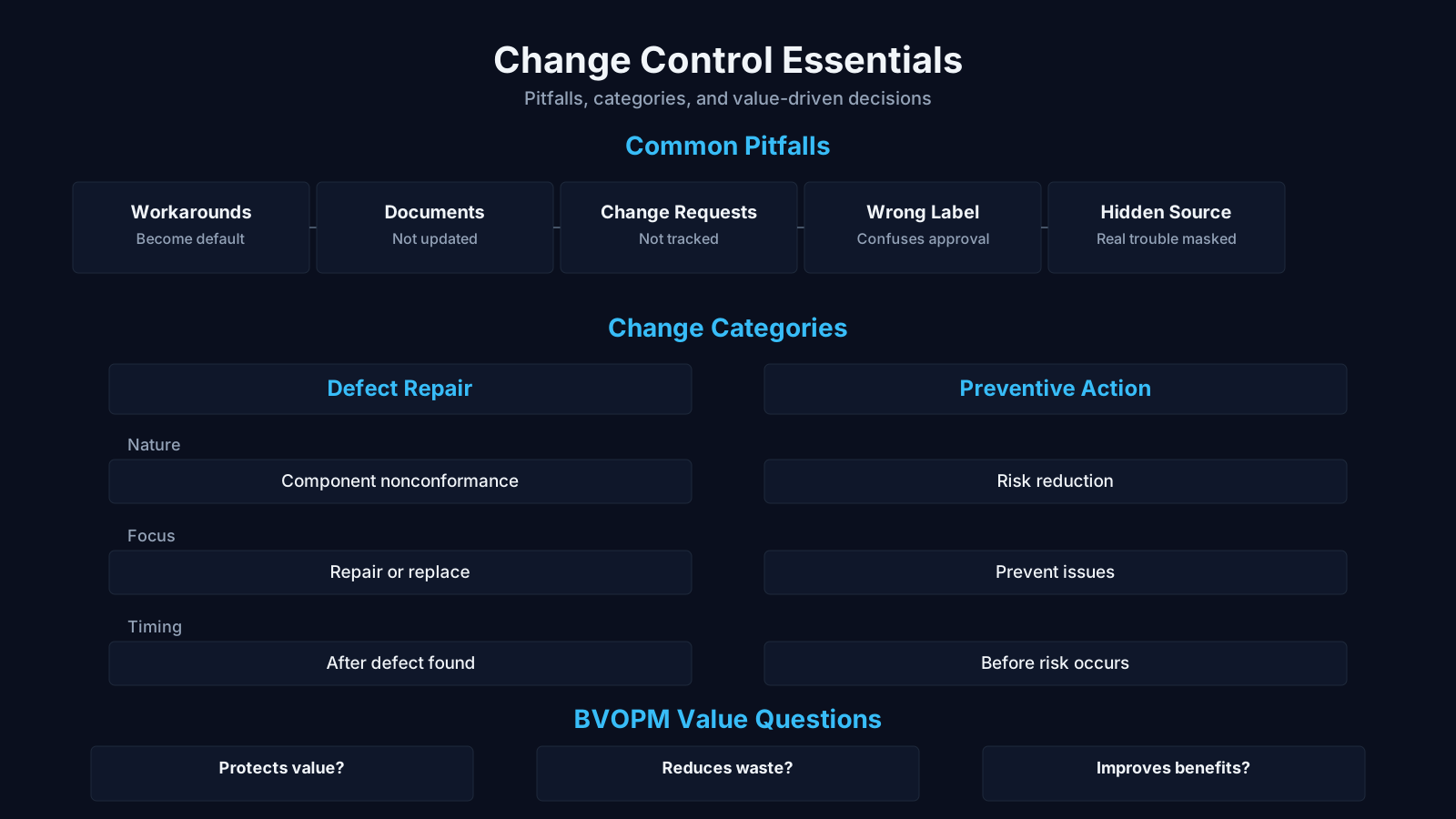
A preventive action is a documented direction to perform an activity that can reduce the probability of negative consequences associated with project risks. This is fundamentally a proactive measure. Instead of waiting for a problem to appear, the team identifies a risk and decides to act before the risk can materialize into an issue. Preventive actions often come from the risk register, where the team has already analyzed probability and impact and assigned risk responses.
Preventive actions can take many forms, such as additional training, prototype development, early supplier involvement, or increased inspections at a critical stage. What unites these examples is the intention to lower the chance of a negative outcome. While risk mitigation strategies also aim to reduce probability or impact, a preventive action is a specific, documented change request that authorizes the team to carry out the activity. In some organizations, preventive actions are still undervalued because they require spending time or money before a problem exists, which can be a difficult sell to stakeholders focused on short-term delivery.
Defect Repair: Recommending Repair or Replacement of a Component
A defect repair is the formally documented identification of a defect in a project component with a recommendation to either repair the defect or completely replace the component. This category is tightly linked to quality management. When an inspection, test, or review uncovers a nonconformance, the team must document the defect, recommend a course of action, and submit it through change control. The recommendation must be specific enough to allow an informed decision.
Defect repair is not the same as a corrective action, even though both respond to something that has already gone wrong. A corrective action addresses a performance deviation, such as a late schedule or an overspent budget. A defect repair addresses a flaw in a deliverable, component, or work product. For instance, if a software build repeatedly crashes under certain conditions, the fix for that defect would be a defect repair. If the testing phase is running behind because too many defects are being found, a corrective action may be needed to address the testing schedule.
How Corrective Actions Work in Project Execution
A corrective action in project execution is triggered when actual performance has moved far enough from the baseline that the expected future performance will not meet the project management plan. Most project managers first notice this through earned value metrics, milestone tracking, or variance reports. The formal process starts with analyzing the root cause of the deviation, because directing the team to simply work harder rarely solves a structural problem caused by poor estimates, resource bottlenecks, or unclear requirements.
Once the root cause is understood, the project manager prepares a corrective action recommendation. The recommendation should describe what will be done differently, who will do it, when it will be completed, and what impact it will have on scope, schedule, cost, quality, and risk. This is not a trivial documentation exercise. A well-written corrective action prevents a repeat of the same problem by changing the execution approach rather than masking the symptom.
Corrective actions often require updates to the project management plan and its subsidiary plans. If the corrective action changes the schedule or budget, those baselines may need to be adjusted through formal change control. Some organizations allow small corrective actions to be implemented immediately and then reported retroactively, but this can undermine the control process if not carefully governed. The best practice is to define approval thresholds in advance so that urgent corrective actions do not bypass the necessary review.
Corrective Actions: Essential Process Takeaways
- Triggered by baseline deviation
- Corrective action becomes necessary when actual performance deviates so far from the baseline that projected outcomes are expected to fall short of the project management plan.
- Root cause analysis first
- Project managers must first identify the root cause of the deviation, because structural issues such as inaccurate estimates, resource constraints, or ambiguous requirements cannot be resolved by additional effort alone.
- Structured recommendation content
- A strong corrective action recommendation clearly states what will change, who is responsible, when the change will be completed, and how it affects scope, schedule, cost, quality, and risk.
- Baseline changes need formal control
- When a corrective action changes the schedule or budget, those baselines should be revised through formal change control to maintain the integrity of the project.
- Define approval thresholds upfront
- Organizations should define approval thresholds in advance to ensure that urgent corrective actions receive proper oversight instead of circumventing controls through after-the-fact reporting.
The Proactive Logic of Preventive Actions
A preventive action in project risk management is a proactive, documented activity that reduces the probability of negative consequences associated with identified project risks. This definition places preventive actions squarely within the risk knowledge area, although they may also draw on quality, procurement, or schedule expertise. The team examines the risk register, selects risks with high probability or impact, and proposes actions that either lower the chance of occurrence or reduce the severity if the risk cannot be avoided.
Here is where things get tricky. Many teams confuse preventive actions with general risk responses, because both are proactive. The difference is that a preventive action is a formal change request that authorizes specific work to be performed, while a risk response may be a strategy such as avoidance, transfer, or mitigation that is already embedded in the risk management plan. When the chosen response requires additional activity outside the current plan, that activity should be documented as a preventive action.
For example, consider a project that relies on a custom component from a supplier with a history of late deliveries. A risk mitigation strategy might involve identifying an alternate supplier. A preventive action might be the documented direction to qualify that alternate supplier now, conduct a pilot order, or build a buffer into the schedule. The preventive action turns the risk strategy into an authorized work package. Without that authorization, the team may talk about the risk but never actually perform the preventive work.
Defect Repairs and Their Place in Quality Control
The defect repair process starts when a nonconformance or error is formally identified in a project component. This identification usually comes from quality control activities such as inspections, testing, peer reviews, or user acceptance sessions. The defect is documented in enough detail for the team and the change control authority to understand its nature, location, severity, and likely impact on the deliverable. The recommendation then specifies whether to repair the defect or replace the component entirely.
Defect repairs are often mistakenly seen as minor technical fixes that do not need formal change control. That assumption can be dangerous. Even a small defect can hide a systemic quality problem, and multiple small repairs can accumulate into significant rework if the underlying cause is not addressed. By requiring a formal defect repair request, the project team preserves an audit trail and creates a record that can be analyzed for patterns. This supports continuous improvement and helps prevent similar defects in future components or phases.
Once a defect repair is approved and implemented, the repaired or replaced component must be re-verified through the appropriate quality control process. Just fixing the defect is not enough; the team must confirm that the fix works and that it did not introduce new problems. In software projects, this often involves regression testing. In construction or manufacturing projects, it may involve re-inspection or additional testing. The re-verification step closes the loop and provides evidence that the deliverable now meets requirements.
Defect Repair Quality Insights
- Formal change control required
- Every defect, no matter how minor, should be captured in a formal repair request so that the team maintains an auditable history and can analyze recurring patterns for continuous improvement, rather than letting small fixes bypass the change control process.
- Documentation and repair recommendation
- Defect records should include sufficient detail on the nature, location, severity, and impact of the issue so that the team and change control authority can make an informed decision, and each record should conclude with an explicit recommendation to repair or replace the affected component.
- Re-verification closes the loop
- Once an approved repair or replacement has been implemented, the component should undergo formal re-verification through quality control activities to confirm that the corrective action resolved the issue and that the deliverable now conforms to its specified requirements.
Updates and Other Change Request Categories
The change request framework also includes updates to formally controlled documentation, which reflect modified or additional ideas or content. Updates are not necessarily performance corrections or defect responses. They might include changes to the project management plan, the scope statement, the schedule baseline, the cost baseline, the risk register, or other controlled documents. When new information emerges or stakeholders refine their requirements, the team may need to update these documents to keep them current.
Updates often accompany corrective actions, preventive actions, and defect repairs, because those actions frequently have secondary effects on the plan. For example, a corrective action that adds resources may require an update to the cost baseline. A defect repair that changes a component's design may require an update to the requirements documentation. However, updates can also be standalone change requests when a stakeholder formally changes an assumption or when a new regulatory requirement appears.
How Updates Differ From Corrective Actions and Defect Repairs
The main distinction is that updates are primarily about documentation, while corrective actions, preventive actions, and defect repairs target actual work performance or deliverable quality. An update might not change the physical work at all; it may simply record a decision that has already been made or reflect a change in the project context. That said, updates should still move through the same integrated change control process to ensure consistency and traceability. Uncontrolled document changes can create as much confusion as uncontrolled work changes.
Where These Change Request Types Appear in PMBOK Processes
Corrective actions, preventive actions, and defect repairs appear as Direct and Manage Project Execution outputs, as well as outputs of Monitor and Control Project Work. This placement indicates that these change request types can emerge both while the team is executing project work and while the project manager is monitoring overall performance. During execution, the team may identify the need for a change based on day-to-day realities. During monitoring and controlling, variance analysis and performance reporting may reveal trends that warrant a corrective action or preventive action.
The Direct and Manage Project Execution process belongs to the Integration Management knowledge area and involves leading and performing the work defined in the project management plan. As the work proceeds, the team may encounter obstacles, discover risks, or find defects that require formal change requests. Likewise, the Monitor and Control Project Work process tracks, reviews, and reports progress against the plan, and its outputs include change requests when the project manager determines that performance is not aligned. Both process outputs feed into the Perform Integrated Change Control process.
Notably, these change request types are not limited to a single process group. Corrective actions and defect repairs are more common during execution and controlling, but preventive actions can arise during planning when the team is analyzing risks and deciding how to respond. Updates can happen at any point when controlled documents need to reflect new or modified content. This cross-process nature reinforces the importance of having a single, integrated change control system rather than scattered, process-specific mechanisms.
Key Takeaways on Change Request Placement
- Two primary PMBOK processes
- Change requests emerge as formal outputs from both Direct and Manage Project Execution and Monitor and Control Project Work, covering corrective actions, preventive actions, and defect repairs.
- Execution triggers formal requests
- The practical realities of project execution routinely surface obstacles, emerging risks, and defects that must be translated into formal change requests.
- Monitoring detects performance deviations
- Variance analysis and performance reporting within Monitor and Control Project Work identify deviations from the plan and justify corrective or preventive actions before they escalate.
- Preventive actions span planning
- Planning processes also generate preventive actions when the team evaluates risk responses, and document updates can be issued at any point throughout the project life cycle.
Perform Integrated Change Control and the Approval Workflow
Every corrective action, preventive action, and defect repair must go through the integrated change control approval process before implementation. This process reviews all change requests, evaluates their impact on project objectives and constraints, and either approves, rejects, or defers them. The goal is to ensure that only beneficial changes are implemented, that all impacts are understood, and that the project management plan is updated to reflect approved changes.
The approval workflow typically includes a change control board, a project sponsor, or another designated authority, depending on the project's governance structure. The project manager usually prepares the change request with supporting analysis, then presents it to the authority for a decision. In some cases, a project manager may have authority to approve certain types of changes within predefined limits. For larger or more complex projects, the change control board may include representatives from finance, legal, operations, and other functions.
Once a change request is approved, the project manager updates the appropriate documents and communicates the decision to affected stakeholders. For defect repairs, the approval may also include the requirement for re-verification after the repair. For preventive actions, approval may authorize funds or resources for an activity that was not originally in the plan. For corrective actions, approval ensures that the realignment effort is coordinated across all affected areas. Rejected change requests are logged, and the reasons for rejection are documented to inform future decisions.
Common Misconceptions About Corrective Actions, Preventive Actions, and Defect Repairs
Many of the most damaging mistakes come from misunderstandings about corrective actions, preventive actions, and defect repairs. One common misconception is that a corrective action is a punishment for poor performance. In reality, it is a forward-looking direction designed to bring future work back in line with the plan. Blaming individuals or teams for a variance does not help, and it can discourage honest reporting. A well-managed project treats corrective actions as a normal part of execution and controlling, not as evidence of failure.
Why Corrective Actions, Preventive Actions, and Defect Repairs Are Often Confused
Another misconception is that preventive actions are only necessary for high-risk, large-scale projects. In fact, preventive actions are valuable in any project where uncertainty exists, which means nearly every project. Even a simple internal process improvement project can benefit from a preventive action that reduces the chance of a data migration error or a stakeholder communication breakdown. The challenge is that preventive actions often require spending time or money before a problem appears, and some sponsors resist that logic.
A third misconception is that defect repairs are always minor and can be handled informally. This thinking leads to unreported defects, repeated rework, and quality problems that surface late in the project. By treating defect repairs as formal change requests, the project team creates visibility into quality issues and enables root cause analysis. That visibility is essential for preventing recurrence and protecting the deliverable's fitness for use.
Key Insights on Misconceptions
- Corrective action is not punishment
- A corrective action is a forward-looking measure that realigns future work with the plan rather than serving as a penalty for past performance.
- Blaming discourages honest reporting
- Attributing variance to specific individuals or teams erodes trust and discourages people from openly reporting problems.
- Corrective actions are normal execution
- In well-managed projects, corrective actions are treated as a routine part of project control, not as evidence of failure.
- Preventive actions fit all projects
- Preventive actions strengthen even straightforward internal process improvements by reducing risks such as data migration errors and communication breakdowns.
- Formal defect repair requests
- Recording defect repairs as formal change requests increases visibility into quality issues and supports more effective root cause analysis.
Framework Context: PMBOK, PRINCE2, and Agile Perspectives
The PMBOK change request process supplies the structured definitions and approval routes that many predictive projects rely on. In PRINCE2, the concept of issues and change control serves a similar purpose, with work packages and stage boundaries providing the governance framework. PRINCE2 distinguishes between requests for change, off-specifications, and problems, each of which may map to corrective actions, defect repairs, or other responses. Practitioners working across frameworks often find that the core idea is the same: formal documented change, evaluated against a baseline, and approved before implementation.
In Agile environments, the formal change request categories may look different, but the underlying needs remain. A defect found during a sprint review is often logged as a work item in the product backlog rather than as a formal defect repair request. A corrective action in an Agile context might mean adjusting the sprint plan, re-prioritizing the backlog, or altering the team's approach to meet a short-term goal. Preventive actions might appear as experiments, spikes, or process improvements introduced during retrospectives.
What this means for project managers is that the definitions of corrective actions, preventive actions, and defect repairs are not limited to predictive methodologies. The key is to adapt the documentation and approval approach to the methodology's governance model. Even in a highly adaptive environment, some record of the decision and the resulting change is usually necessary for transparency, learning, and long-term accountability.
Interactions With Risk, Quality, and Scope Management
A project manager can use the connections to risk, quality, and scope management to decide which type of change request is most appropriate. Corrective actions are most closely aligned with schedule, cost, and scope variance analysis. When performance metrics show a trend away from the baseline, a corrective action addresses the root cause and realigns future work. Preventive actions draw directly from the risk register, where identified risks and planned responses provide the raw material for proactive activity. Defect repairs originate in quality control, where inspections and tests reveal nonconformances in specific components.
These connections also create dependencies across knowledge areas. A defect repair may reveal a quality problem that requires a preventive action to reduce the chance of similar defects in future components. A corrective action may introduce new risks that then require additional preventive actions. An update to the scope baseline may trigger a series of corrective actions elsewhere. The project manager must integrate these flows deliberately rather than treating each change request as an isolated event.
Understanding these interactions also helps with stakeholder communication. A sponsor may push back on a preventive action as unnecessary, but if the project manager can show that the risk is documented, the probability is high, and the impact would be severe, the preventive action becomes easier to justify. Similarly, a quality manager may be frustrated by repeated defects, but a formal defect repair process provides the data needed to identify the root cause and fix the systemic issue.
Key Insights on Change Requests
- Change request type selection
- Selecting the appropriate change request type depends on how the situation interacts with risk exposure, quality requirements, and scope constraints.
- Corrective actions and variance
- Corrective actions respond to schedule, cost, and scope variances by targeting the underlying causes that drive actual performance away from the approved baseline.
- Preventive actions from risk register
- Preventive actions originate from documented risks and their planned responses, gaining stronger justification when a risk shows both high probability and severe potential impact.
- Interconnected change dependencies
- Defect repairs often expose underlying quality issues that call for preventive actions, while corrective actions can create new risks that require further preventive measures.
Practical Application Across Project Lifecycles
The practical challenge of applying corrective actions, preventive actions, and defect repairs across the project lifecycle is that each phase presents different triggers and constraints. During initiation and planning, preventive actions are more common because the team is analyzing risks and developing the plan. During execution, corrective actions and defect repairs become more frequent as work is performed and inspected. During monitoring and controlling, all three types may appear as the project manager reviews performance data and forecasts future outcomes.
Timing Corrective Actions, Preventive Actions, and Defect Repairs by Phase
In the early phases, preventive actions might include additional market research, early prototyping, or supplier prequalification before the main work begins. During execution, corrective actions might include resequencing work, adjusting staffing levels, or changing procurement methods when progress falls behind. Defect repairs tend to cluster around quality control checkpoints, such as phase gate reviews or testing cycles, when the team examines deliverables against their requirements.
At project closure, formal corrective actions and defect repairs should be complete, though some findings from lessons learned may lead to preventive actions for future projects. It is worth noting that not all projects follow the same lifecycle. In an iterative or incremental project, the team may handle defect repairs and corrective actions within each iteration, while preventive actions emerge during retrospectives and feed into the next iteration's planning. The labels remain useful, but their timing and frequency shift with the delivery approach.
Building a Disciplined Change Request Practice
A disciplined approach to managing corrective actions, preventive actions, and defect repairs starts with clear thresholds and documented decision criteria. The project management plan should define who can submit change requests, what information is required, which changes can be approved at the project manager level, and which must go to a change control board. Without these thresholds, the team may overburden the approval process with trivial changes or, conversely, allow significant changes to slip through informally.
Documenting Corrective Actions, Preventive Actions, and Defect Repairs Consistently
Documentation is the backbone of this discipline. Each corrective action should include the variance that triggered it, the root cause analysis, the proposed realignment, and the expected impact. Each preventive action should reference the specific risk, its probability and impact, and how the action will reduce the probability. Each defect repair should identify the defect, its location and severity, and the recommended repair or replacement approach. This level of detail may seem heavy, but it protects the project from guesswork and enables better decisions.
Common pitfalls in building this practice include allowing workarounds to become the default, failing to update controlled documents after approval, and not tracking change requests through to completion. A change log is essential. It records each request, its status, decision date, and approved actions. Project managers who maintain a clean change log find it much easier to explain project history, justify variances, and demonstrate control during audits or phase reviews.
Core Insights on Change Control Discipline
- Define approval thresholds upfront
- Establishing approval thresholds in the project management plan clarifies who may submit change requests, what supporting information is required, and which changes need project manager approval rather than change control board review, preventing both process overload and informal workarounds.
- Corrective actions need full context
- Each corrective action should capture the variance that triggered it, the results of root cause analysis, the proposed realignment steps, and the anticipated impact so decision makers can act on evidence rather than assumption.
- Preventive actions target specific risks
- Each preventive action should identify the specific risk it addresses, state its probability and impact, and describe how the proposed action lowers the likelihood that the risk will materialize.
- Defect repairs require precise details
- Each defect repair should identify the defect, specify its location and severity, and outline the recommended repair or replacement method so approval decisions rest on precise and actionable information.
- Track changes to completion
- Maintain a disciplined change log through closure to avoid common pitfalls such as allowing workarounds to become the default, leaving controlled documents outdated after approval, and failing to track requests, because a complete record supports variance justification and demonstrates control during audits.
Business Value and Modern Project Management Perspectives
From a business value-oriented perspective, corrective actions, preventive actions, and defect repairs are assessed by their effect on business value and waste reduction. A corrective action that restores schedule performance may also prevent late delivery penalties or lost market opportunity. A preventive action that avoids a risk may protect future benefits. A defect repair that ensures the deliverable works correctly can be the difference between a satisfied customer and a failed product. In this sense, these change request categories are not merely administrative; they are levers for value protection.
Modern project management methods increasingly emphasize waste reduction and continuous feedback. Scope changes, for example, are sometimes treated as user feedback rather than as failures of planning. Similarly, defects are viewed as opportunities to learn about process weaknesses, not just as items to be fixed. Business Value-Oriented Project Management, or BVOPM, reflects this mindset by tracking business value points and treating persistent decline as a signal for possible project closure. In that environment, defect analysis often uses predefined root-cause categories, and waste is categorized as overwork, perfectionism, and rejected acceptable work.
These perspectives do not replace the formal definitions of corrective actions, preventive actions, and defect repairs; they add a layer of strategic evaluation. The project team should still document, review, and approve changes through integrated change control. But the conversation around each change request can also ask whether the proposed action protects value, reduces waste, or improves the likelihood of realizing benefits. That connection to value helps project managers secure support for proactive and corrective actions alike.