Every project, no matter how large or small, simple or complex, can be mapped to a generic life cycle structure made up of starting the project, organizing and preparing, carrying out the project work, and closing the project. Understanding the key characteristics of a project life cycle gives project managers a reliable way to anticipate resource needs, manage risk, and communicate progress to senior leaders. This high-level view is particularly useful when executives or other stakeholders need a common reference point for projects that are otherwise completely different in nature.
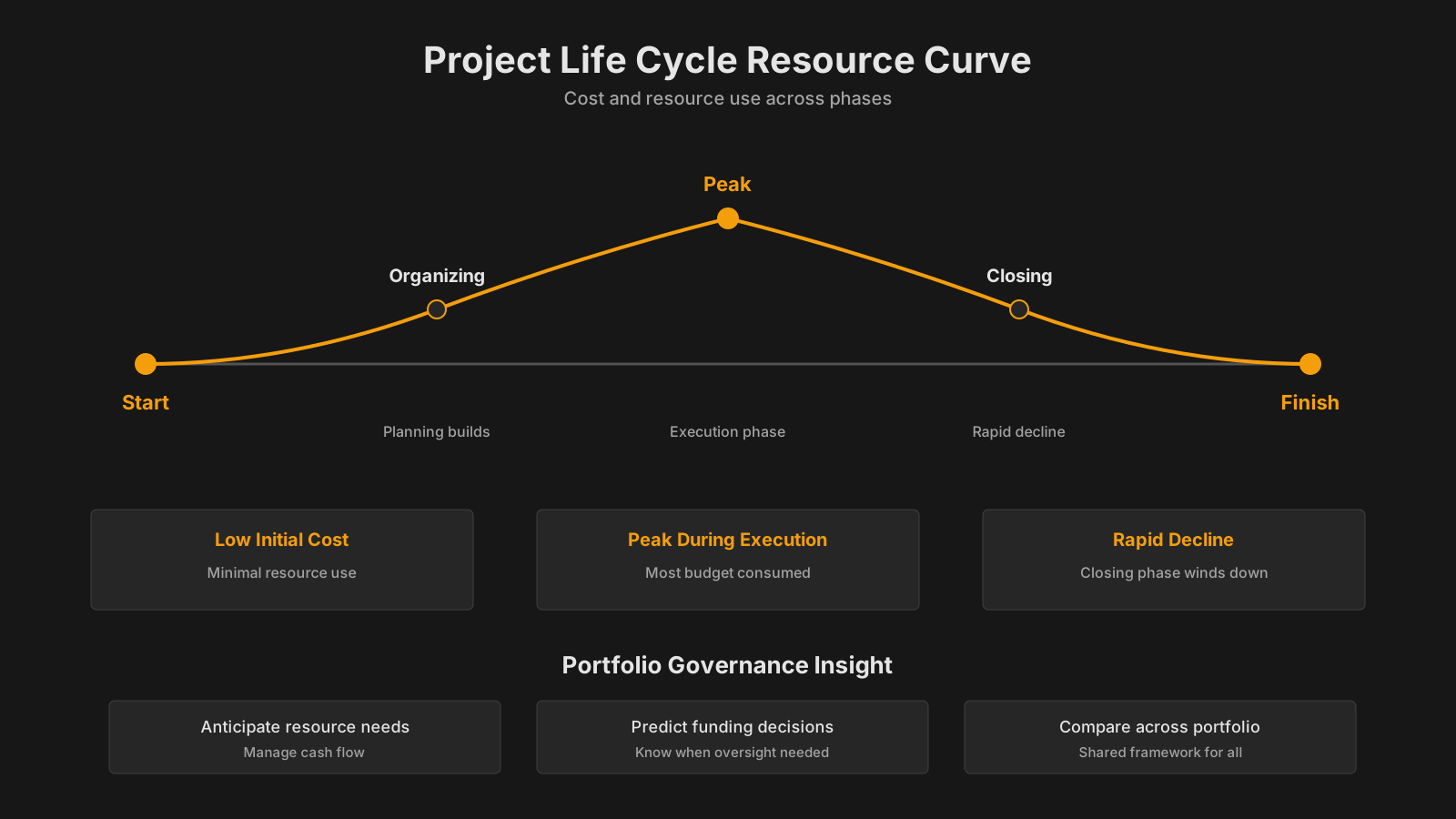
At first glance, the four phases may seem too broad to be useful. A small internal website refresh and a multi-year infrastructure program share very little in terms of daily tasks, technical skills, or deliverables. Yet both follow the same broad pattern: low initial cost and staffing, a peak of activity during execution, and a rapid drop as the work winds down. That pattern carries practical consequences for governance, budgeting, and decision rights, which is why the generic life cycle remains a cornerstone of project communication.
Project Life Cycle: Key Characteristics Summary
| Life Cycle | Key Insight |
|---|---|
| Standard Phase Structure | Every project follows a consistent four-phase sequence: initiation, organization and preparation, execution, and closure, regardless of scale or technical complexity. |
| Resource Loading Pattern | Resource demand follows a predictable curve, with minimal early staffing and cost, peak intensity during execution, and a steep decline as deliverables near completion. |
| Stakeholder Alignment Value | A shared life cycle framework gives executives and stakeholders a consistent reference model for evaluating projects that vary substantially in scope, technical requirements, and deliverables. |
| Portfolio-Level Oversight | Using a common life cycle vocabulary, senior leaders can compare schedule progress, resource burn rates, and risk exposure across a portfolio of concurrent projects. |
| Influence and Cost Tradeoff | The leverage to influence final outcomes with minimal cost impact is greatest during early phases and diminishes steadily as design and execution commitments accumulate. |
| Closure Resource Dynamics | As deliverables approach completion, team size contracts rapidly and cost outlays fall almost as quickly as they escalated during the execution peak. |
The Four Phases of the Generic Project Life Cycle
The generic project life cycle begins with starting the project. During this phase, the project is authorized, initial objectives are clarified, and key stakeholders are identified. The level of formal detail may be minimal, but the foundation for everything that follows is set here. The organizing and preparing phase then introduces more detailed planning, resource identification, and baseline development. Carrying out the project work consumes most of the budget and produces the actual deliverables. Closing the project involves final acceptance, handover, and administrative closure.
What makes this structure so valuable is that senior leaders can use it as a generic project life cycle structure to compare projects that have almost nothing in common operationally. For example, an executive committee can discuss a construction project and a marketing campaign using the same broad language of start, preparation, execution, and closure. Without that shared framework, the conversation quickly fragments into technical jargon and department-specific details.
This high-level view is not meant to replace detailed project schedules or work breakdown structures. It serves a different purpose: providing a common frame of reference for governance and portfolio-level decisions. When an organization runs dozens of projects simultaneously, senior management needs a way to compare progress, resource consumption, and risk exposure across the portfolio. The generic life cycle offers exactly that, simply because it focuses on the shape of the work rather than the content.
In many project management frameworks, this generic life cycle is closely related to process groups or stage gates, though the mapping is not always one-to-one. Practitioners often use the generic life cycle to explain where a project stands to people who do not need the granular detail. It also helps in aligning project reviews with natural decision points, such as the transition from planning to execution or from execution to closure.
Core Takeaways on Generic Phases
- Four standard life cycle phases
- A generic project life cycle progresses through initiation, organizing and preparing, execution, and closure, with each phase establishing the conditions needed for the next phase to deliver value.
- Shared language for executives
- This shared structure enables senior leaders to compare dissimilar initiatives, such as a construction project and a marketing campaign, using consistent categories of initiation, preparation, execution, and closure.
- Framework complements detailed plans
- Rather than replacing detailed schedules or work breakdown structures, the high-level life cycle provides a consistent frame of reference for governance and stage-gate decisions.
- Enables portfolio-level oversight
- Organizations managing multiple concurrent projects can use the generic life cycle to compare progress, resource consumption, and risk exposure consistently across the entire portfolio.
Key Characteristics of a Project Life Cycle
Three characteristics stand out in the generic life cycle pattern. First, cost and staffing levels are low at the start, peak as the work is carried out, and drop rapidly as the project draws to a close. Second, stakeholder influences, risk, and uncertainty are greatest at the start and decrease over the life of the project. Third, the ability to influence the final characteristics of the project's product without significantly impacting cost is highest at the start and decreases as the project progresses toward completion. These key characteristics of a project life cycle are not just observations; they directly shape how project managers should plan, staff, and govern their work.
Key Characteristics of a Project Life Cycle: Cost and Staffing Levels
Cost and staffing levels follow a predictable curve across the generic life cycle. At the start, only a few people are involved, often a project manager, a sponsor, and a small planning or scoping team. As the project moves into organizing and preparing, the team expands modestly to include planners, analysts, and subject matter experts. During carrying out the project work, staffing reaches its maximum, and expenditures rise accordingly. When the deliverables are largely complete and the project enters closing, the team shrinks quickly, and costs drop off almost as fast as they rose.
This pattern is often represented as a dashed line in project management illustrations, showing a low baseline at the beginning, a steep climb through execution, and a sharp decline at the end. The exact shape of the curve varies by industry and project type, but the overall progression holds in most cases. A software development project may ramp up with a small architecture team before adding developers and testers, while a construction project starts with designers and engineers before bringing in contractors and tradespeople. Both follow the same general cost and staffing profile.
The practical implication is that resource planning cannot be uniform across the life cycle. Project managers need to anticipate the ramp-up period and ensure that specialized skills are available when execution begins. Equally important is planning for ramp-down so that team members can be released to other projects without disrupting knowledge transfer or final acceptance. Overstaffing early in the project wastes money and can create coordination problems, while understaffing during execution delays deliverables.
One common mistake is assuming that the cost curve applies in a perfectly linear fashion from phase to phase. In reality, there may be spikes during planning when expensive consultants are engaged or during testing when large environments are provisioned. The general pattern remains, but the fine-grained shape requires project-specific judgment. Understanding the characteristic at a high level helps senior leaders avoid premature concern when early costs seem low, and similarly avoid surprise when the spending accelerates during execution.
Key Characteristics of a Project Life Cycle: Stakeholder Influence, Risk, and Uncertainty
Stakeholder influence, risk, and uncertainty are greatest at the start of the project and decrease over its life. Early on, the project may have ambiguous requirements, unproven technical approaches, or unclear regulatory constraints. Stakeholders may still be discovering what they actually need, and their opinions can shift rapidly. As the project progresses, decisions get made, requirements are elaborated, and the team gains a clearer picture of the path ahead. That growing clarity reduces uncertainty, but it also means stakeholders have fewer opportunities to change direction without causing disruption.
Risk does not simply vanish because the project moves forward. Instead, the nature of risk changes. Early risks tend to be strategic and structural: Will the business case hold? Is the technology feasible? Are the key stakeholders aligned? Later risks tend to be operational and delivery-related: Will integration tests pass? Can the team meet the remaining schedule? Are there supplier delays? The overall level of uncertainty decreases, but individual risks can still emerge and require active management.
From a practical standpoint, this characteristic argues for heavy stakeholder engagement and rigorous risk identification in the early phases. Facilitating workshops, conducting feasibility studies, and holding design reviews before execution begins are not bureaucratic overhead; they are the most cost-effective moments to shape the project. Once execution is underway, the window for cheap experimentation narrows considerably. Delaying risk identification until the project is already in full execution tends to force expensive corrective actions later.
A subtle pitfall is treating the decline in risk as automatic. If early planning was shallow or stakeholder input was ignored, uncertainty may simply hide until late in the project, when it reappears as rework or disputes. The characteristic holds when early phases are used properly. In projects that rush through initiation and planning, the supposed decline in uncertainty may be an illusion, and the cost and staffing curve may spike later than expected.
Key Characteristics of a Project Life Cycle: Ability to Influence the Final Product
The ability to influence the final characteristics of the product without significantly impacting cost is highest at the start and decreases as the project progresses. At the beginning, changing a requirement, selecting a different technology, or adjusting a design may cost very little because no physical work has been done. Once the team has started building, testing, or constructing, those same changes become increasingly expensive and disruptive. This inverse relationship between influence and cost is one of the most consequential insights in project management.
Design decisions made early tend to lock in future options. If an architecture choice is made without considering scalability, the team may later face a costly rework effort. If a foundation is poured before the building's layout is fully validated, changing the structure becomes prohibitively expensive. The same logic applies in software, where data model decisions made in the first iterations affect everything that follows. The earlier a stakeholder participates, the more leverage they have over the final outcome.
Progressive elaboration is the practical response to this characteristic. Instead of trying to nail down every detail at the start, the team can make high-level decisions early and refine them as understanding grows. This approach preserves flexibility while still respecting the reality that late changes are costly. In adaptive or agile environments, the team deliberately structures work in short iterations so that learning can be incorporated without the same level of rework that a fully predictive approach would impose.
Change control processes exist precisely because the ability to influence the product declines over time. A change request that arrives during planning may be accepted with minimal analysis. The same request during execution may require impact assessment, cost estimation, and formal approval. During closing, it may simply be rejected or deferred to a future phase. This progression is not bureaucratic resistance; it reflects the genuine economic shift in what change costs as the project moves forward.
Practical Implications for Governance, Decision Making, and Communication
The life cycle characteristics have direct consequences for how projects should be governed. Because risk and uncertainty are highest at the start, that is when senior leaders should spend the most time challenging assumptions, validating the business case, and ensuring that stakeholder needs are understood. This is also when governance checkpoints have the greatest potential to influence outcomes. A review at the end of initiation can still redirect the entire project with minimal sunk cost. A similar review during execution is usually limited to corrective actions within an already committed direction.
Cost and staffing curves also inform governance. Executives who understand that spending will peak during execution are less likely to misinterpret early under-spending as poor performance or late spending as uncontrolled scope creep. Instead, they can use the expected curve as a baseline for financial monitoring. Deviations from the curve may signal problems, but only when the normal shape is understood.
Communication with upper management benefits enormously from the generic life cycle. Rather than presenting a detailed Gantt chart to a steering committee, a project manager can describe the project in terms of where it sits in the life cycle and what that means for risk, influence, and cost. This shared language works across different types of projects and allows portfolio-level comparisons that would otherwise be impossible. A project in the organizing phase can be compared to another in the same phase, even if one is a software initiative and the other is a facilities upgrade.
Decision rights naturally shift as the project progresses. Early on, the project sponsor and key stakeholders hold significant influence because the cost of changes is low. As the project moves into execution, the project manager and technical leads take on more authority for day-to-day decisions, while changes that affect scope or cost often escalate to a change control board. Recognizing this shift prevents confusion about who can decide what at each stage.
Essential Insights on Project Governance
- Front-load governance at initiation
- Because uncertainty and risk are highest at the start, senior leaders should use early governance reviews to challenge the business case, expose hidden stakeholder constraints, and redirect the project before sunk costs accumulate.
- Compare spending to cost curve
- By comparing actual expenditure against the expected life cycle cost curve, executives can distinguish normal cost phasing from genuine deviations and avoid misreading low early spend as underperformance or high late spend as uncontrolled scope growth.
- Speak in life cycle terms
- Project managers should describe the project's life cycle position and its implications for risk, influence, and cost rather than relying solely on a Gantt chart, because this framing enables portfolio-level comparisons and clarifies when decision authority passes to execution teams and change control boards.
Common Misconceptions and Limitations of the Generic Life Cycle
A frequent misconception is that the generic life cycle represents a strictly linear sequence that every project must follow step by step. In practice, the phases may overlap, repeat, or be tailored. Iterative and incremental projects often cycle through planning, execution, and review multiple times within a single phase. The project life cycle is not strictly linear in many real-world environments, even though the high-level pattern remains useful for communication and governance.
Another misconception is that the cost and staffing curve applies with equal shape and intensity to every project. Research and development projects may have a longer, flatter early phase as ideas are tested, while event planning projects may ramp up steeply very close to the event date. The generic pattern is a useful default, but project managers must adapt it to the specific rhythm of their work.
Some practitioners also misunderstand the early influence characteristic as a mandate to freeze all requirements at the start. That interpretation misses the point. The insight is not that all decisions should be made early; it is that the cost of changing decisions rises over time. Adaptive methods respond to this by keeping work increments short and incorporating feedback frequently, which allows influence to remain higher later in the project without incurring the same cost of large-scale rework.
Finally, risk rarely reaches zero by the time a project closes. Residual risks may transfer to operations, and benefits realization may introduce new uncertainties. The life cycle characteristic describes the general decline in project-level uncertainty, not the elimination of all uncertainty. Organizations that treat project closure as the end of risk management may be surprised by operational failures or unrealized benefits.
Applying the Life Cycle Characteristics in Predictive and Adaptive Environments
Predictive or plan-driven projects tend to align closely with the generic life cycle phases. Initiation and planning receive significant emphasis early, execution follows a structured path, and closure is a distinct final stage. In adaptive or agile environments, the phases are compressed and repeated. Each iteration or sprint includes some form of starting, preparing, doing, and closing, even if the language differs. Yet the life cycle characteristics still apply across predictive and adaptive approaches because the fundamental economics of cost, risk, and influence do not disappear.
In an adaptive project, the cost and staffing curve may look less smooth. Team size often remains relatively stable after the initial ramp-up, but the intensity of spending can vary by release. Risk and uncertainty remain high early in each iteration, and the team continually rediscovers the product through feedback. The ability to influence the final product remains higher later in the project than in a fully predictive approach, but the cost of changing foundational architecture still rises over time.
Organizations that run hybrid portfolios, with some predictive projects and some adaptive projects, often find the generic life cycle useful as a translation layer. A steering committee may not care whether a team uses sprints or stage gates. They need to know how much risk remains, how much cost is yet to come, and how much room exists to adjust the outcome. The life cycle view answers those questions in a way that works across methods.
Project managers can therefore use the generic life cycle characteristics as a diagnostic tool. If a project in execution still exhibits very high uncertainty, that may indicate insufficient early planning or ineffective risk management. If staffing is still low late in the schedule, the team may be headed for a last-minute crunch. Rather than treating the characteristics as rigid rules, experienced practitioners use them as heuristics to spot anomalies and ask better questions.
Key Insights on Life Cycle Applicability
- Predictive projects align with generic phases
- Plan-driven projects proceed through a deliberate sequence of initiation, planning, structured execution, and a clearly defined closure, with control points placed at each transition.
- Adaptive projects compress life cycle phases
- Agile environments repeat the core activities of initiating, planning, executing, and closing within every iteration or sprint, even when teams use different terminology for those activities.
- Underlying economics apply to both approaches
- Cost, risk, and stakeholder influence follow the same fundamental patterns in predictive and adaptive settings, so the generic life cycle characteristics continue to serve as a reliable analytical lens.
- Risk persists at iteration starts
- Adaptive teams encounter elevated uncertainty and risk at the beginning of each iteration and rely on frequent feedback to reshape the product as the iteration unfolds.
- Hybrid portfolios benefit from generic life cycle
- Organizations that combine predictive and adaptive work can use the generic life cycle as a shared translation framework, applying its characteristics as diagnostic heuristics to spot anomalies and sharpen their inquiries.