When project managers ask what configuration management activities are part of integrated change control, they are usually trying to separate two related but distinct disciplines. Integrated change control is the process of reviewing all change requests, approving or rejecting them, and managing changes to deliverables, documents, and baselines. Configuration management sits inside that process as a set of activities that bring order to the components being changed. Without configuration management, change control becomes a series of disconnected approvals with no clear picture of what version of a product or document is actually being altered.
In the PMBOK Guide, Perform Integrated Change Control belongs to the Monitoring and Controlling Process Group and the Project Integration Management Knowledge Area. Configuration management is not a separate knowledge area in that framework, but it serves as a supporting discipline that makes integrated change control reliable. Practitioners often describe configuration management as the inventory system and change control as the approval system. That distinction matters because a project can have strong approval meetings and still lose track of which version of a design document was approved or whether an approved change was actually implemented.
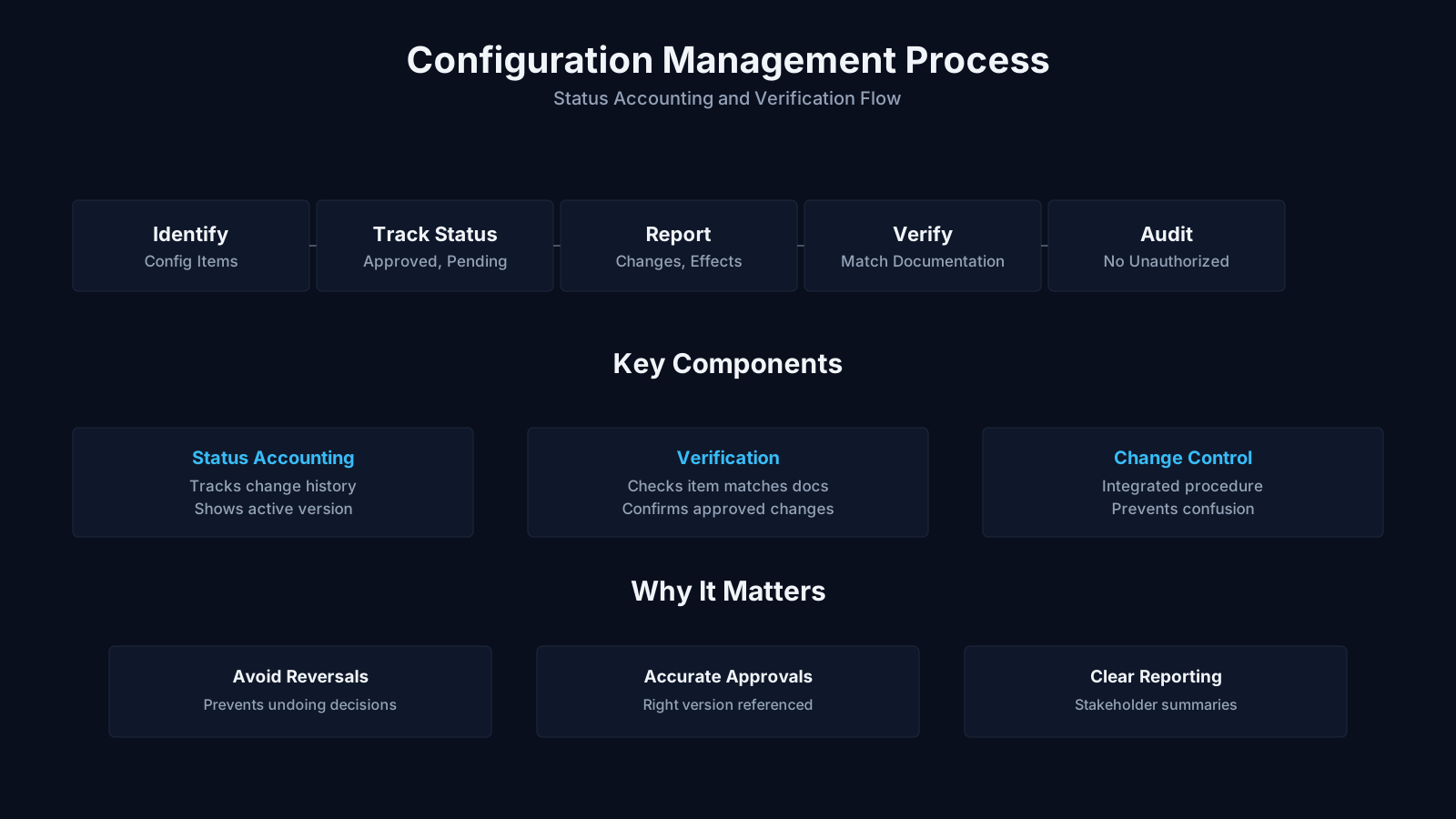
The configuration management activities included in integrated change control can be grouped into three main categories: configuration identification, configuration status accounting, and configuration verification and audit. Each activity has a distinct purpose, but they work together as a continuous loop. Identification labels the pieces, status accounting reports where each piece stands, and verification and audit confirm that the pieces match the documentation and that changes were done correctly.
Configuration Management in Integrated Change Control: Key Topics
| Key Concept | Summary |
|---|---|
| Integrated Change Control Process | Perform Integrated Change Control sits within the Monitoring and Controlling Process Group and the Project Integration Management Knowledge Area, operating as the central gate for evaluating and adjudicating all change requests. |
| Configuration Management Activities | Within integrated change control, configuration management formalizes the review process through identification, status accounting, and verification and audit, ensuring that only approved changes alter established baselines. |
| Configuration Management System | The configuration management system comprises the integrated tools, procedures, naming standards, and repositories that store configuration items and maintain their complete change history. |
| Configuration Items | Configuration items encompass project plans, design specifications, source code, test scripts, hardware components, and any other deliverable or document that requires formal version control and change discipline. |
| Baseline Reference | A baseline establishes a controlled reference point, enabling proposed changes to specify the precise version of the affected item and making scope, schedule, and cost variances measurable. |
| Configuration Status Accounting | Configuration status accounting provides reliable identification of the current component version, converting a high-level approval into actionable implementation details and supporting accurate reporting. |
| Configuration Verification and Audit | Configuration verification and audit validate that approved changes are physically implemented and that the documented configuration state fully matches the actual state, closing the loop on change control. |
| End-to-End Traceability | Configuration item identifiers flow through change requests, status reports, and audit records, establishing end-to-end traceability from initial request through final implementation and release. |
How Configuration Management Activities Are Part of Integrated Change Control
A configuration management system is the working mechanism that links the three configuration activities to the decisions made during integrated change control. This system includes the tools, procedures, naming conventions, and storage locations that hold configuration items and their historical records. When a change request arrives, the configuration management system tells the project team which configuration item is affected, what baseline applies, and what previous changes have already touched that item.
Integrated change control cannot function properly without this underlying system. A change control board may approve a request based on a clear impact analysis, but if the team cannot reliably locate the current version of the affected component, the approval remains abstract. The configuration management system turns the abstract approval into a concrete instruction by identifying the exact document, module, or specification to be changed. This is why configuration management activities are not optional add-ons; they are embedded in the review, approval, and implementation cycle.
Configuration Identification Activities Are Part of Integrated Change Control
Configuration identification begins with selecting and naming the configuration items that will be managed. A configuration item can be a project plan, a design specification, a piece of source code, a test script, a hardware component, or any other deliverable or document that needs formal control. The purpose of identification is not just to create a list. It is to establish a stable reference point for every item so that when someone proposes a change, the team knows exactly which item is being discussed and which version forms the current baseline.
This activity provides the basis for product configuration to be defined and verified. Without a clear identification scheme, two stakeholders might refer to the same document by different names, or worse, refer to different versions by the same name. That kind of confusion becomes expensive when a change request references a version that is already obsolete. Configuration identification removes ambiguity by assigning unique identifiers and labels to each configuration item. Those identifiers then appear in change requests, status reports, and audit records, creating a consistent thread from request to implementation.
Configuration identification also supports accountability. When a configuration item has an owner and a defined version history, the project team can trace who approved changes to it, when those changes were made, and why. This traceability is valuable during an audit, but it also helps during day to day change control. A change control board reviewing a request to modify a technical specification can see whether the specification is under formal control or whether it has been drifting without documented updates.
A common pitfall in this activity is treating configuration identification as a one-time task performed at the start of the project. In practice, new configuration items emerge as the project progresses. A risk register may become formally controlled only after the risk management plan is approved. A custom software module may not exist as a configuration item until its design is baselined. The identification activity must therefore continue throughout the project lifecycle, not stop after the initial planning phase. Each time a new deliverable or document reaches a point where uncontrolled changes would cause harm, it should be brought under configuration control.
Another practical consideration is the level of granularity. Not every file or meeting note needs to be a configuration item. Teams that over-identify create administrative burden and reduce the credibility of the configuration management system. Teams that under-identify leave critical components vulnerable to unauthorized change. The right level depends on the project's complexity, regulatory requirements, and the impact of a change to that item. A requirement baseline for a medical device may need configuration identification at the individual requirement level, while an internal marketing project may manage only major deliverables and plans.
Configuration Status Accounting Activities Are Part of Integrated Change Control
Configuration status accounting is the activity that records and reports information about configuration items. It answers questions such as which items are approved, which changes have been proposed, and which approved changes have actually been implemented. This is not merely a filing task. Status accounting creates the current picture of the project's configuration that decision makers rely on during integrated change control. If a change request asks to modify a component, the status accounting records show whether other changes to that same component are already in progress or pending.
The information maintained in status accounting includes a listing of approved configuration identification, the status of proposed changes, and the implementation status of approved changes. That list of approved configuration identification serves as the official inventory of what is under control. The status of proposed changes shows which requests are awaiting review, under assessment, or deferred. The implementation status shows which approved changes have been completed, which are in progress, and which have not yet started. Together these records provide a complete narrative of each configuration item's history and current state.
In integrated change control, status accounting prevents several recurring problems. It reduces duplicate change requests by showing that a similar request is already under review. It helps the change control board understand whether a component has too many open changes, which can signal instability. It also helps the project manager report accurately to stakeholders about whether an approved change has actually been delivered or is still waiting for resources. Without this activity, teams often rely on memory or scattered spreadsheets, which fail under the volume of changes in complex projects.
Status accounting is often confused with simple version control, but it is broader. Version control tracks the revision history of a single configuration item. Status accounting tracks the state of the entire configuration set, including pending and approved changes across multiple items. For example, version control can show that a design document is now at revision 1.4. Status accounting can show that revision 1.4 was created as a result of change request CR-42, which was approved on a specific date and has been implemented but not yet verified. That additional context is what makes status accounting indispensable to integrated change control.
A practical challenge is keeping status records current. Some teams update the status only when a change is approved, but ignore the period between approval and implementation. That gap creates false confidence because the approved change may not be reflected in the product yet. The discipline of updating status accounting at each transition, not just at major milestones, is what separates mature configuration management from superficial record keeping.
Configuration Verification and Audit Activities Are Part of Integrated Change Control
Configuration verification and audit activities close the loop. They ensure that the composition of a project's configuration items is correct and that corresponding changes have been registered, assessed, approved, tracked, and correctly implemented. This means checking not only that a change was made, but that it was made through the proper process and reflected in the appropriate documentation. Verification tends to focus on whether the configuration items match their specification or baseline. Audit tends to focus on whether the change management procedures were followed and whether records are complete.
One important outcome of these activities is confirming that the functional requirements defined in the configuration documentation have been met. A change request might be approved to add a new feature to a software component. Configuration verification checks that the component now behaves as the new requirement specifies. Configuration audit checks that the change request was properly documented, the impact analysis was completed, the change control board approval was recorded, and the new version was labeled correctly. Both layers are necessary because a product can meet its functional requirement while the surrounding administrative records remain inconsistent.
In integrated change control, verification and audit often occur after implementation, but they also provide input before approval. For example, an audit of past change records may reveal that a particular component has been changed several times without corresponding verification. That finding can influence the change control board's decision to impose stricter conditions on the next request. Verification and audit are therefore not just historical checks; they inform future decisions by exposing patterns of weak configuration discipline.
These activities also support the integrity of the project's baselines. A baseline is only meaningful if the team can trust that the actual work products match the documented baseline. Verification and audit test that trust. They identify unauthorized changes, incomplete updates, and discrepancies between the configuration records and the physical or digital state of the deliverables. When such discrepancies are found, they become issues that the project manager must address, sometimes through a new change request or corrective action.
Config verification and audit activities are often the first to be skipped when schedules tighten. That is a serious mistake. Skipping verification does not eliminate the need to confirm that approved changes were implemented; it only postpones the discovery of discrepancies until a later stage, when correction is more expensive. A project that verifies changes incrementally will catch mismatches early, while a project that waits until the end will face a large and difficult cleanup effort.
Core Insights on Configuration Management
- System foundations and records
- A configuration management system combines the tools, procedures, naming standards, and repositories that maintain both the current state of configuration items and their complete change history.
- Concrete direction from abstract approval
- Once a change control board grants approval, the configuration management system translates that decision into a precise target by identifying the specific document, module, or specification to update.
- Wide range of configuration items
- Configuration items encompass project plans, design specifications, source code, test scripts, hardware components, and every other deliverable subject to formal change control.
- Integrated in the change cycle
- Configuration management is embedded throughout the review, approval, and implementation cycle, giving reviewers clear visibility into whether each item remains under formal control or has drifted from its documented baseline.
Applying Configuration Management Activities Across the Project Lifecycle
Establishing and maintaining configuration baselines early in the project gives integrated change control a stable reference point for evaluating subsequent changes. A baseline is a formally approved version of a configuration item or set of items that can be changed only through the change control process. Configuration identification defines what the baseline contains; status accounting tracks its evolution; verification and audit confirm that the actual output continues to match the baseline unless a change has been formally approved.
During project initiation and planning, configuration identification is the dominant activity. The project team decides which deliverables and documents require formal control, defines naming conventions, and establishes initial baselines for the project management plan, scope statement, and schedule. This is also when the configuration management plan is prepared. In many projects, this plan is a subsidiary plan of the project management plan and describes how configuration identification, status accounting, and verification and audit will be performed, who is responsible, and what tools will be used.
During execution, configuration status accounting becomes more visible because change requests begin to arrive. The team updates the status of proposed changes and tracks the implementation of approved changes. The change control board uses this information to evaluate cumulative impact. For instance, if three change requests are pending against the same requirement, the board may want to consolidate them or assess whether the requirement itself needs to be re-baselined rather than modified piecemeal.
During monitoring and controlling, verification and audit activities become more frequent. Each time an approved change is implemented, someone should verify that the deliverable now matches the new specification and that the configuration records were updated. Periodic configuration audits may be scheduled at the end of each phase or before major deliverables are handed over. These audits check that the configuration items identified in the plan are present, correctly labeled, and consistent with the approved documentation.
At project closing, configuration verification and audit play a critical role in confirming that the final product, service, or result matches the final configuration documentation. This is often part of the formal acceptance process. The project manager needs to demonstrate that all approved changes were implemented and that no unauthorized changes remain. The configuration records become part of the project archives and may be transferred to operations or a maintenance team. If the project delivered software, the configuration audit helps the operations team understand exactly which version of the code, documents, and installation scripts are being handed over.
Common Pitfalls and Misconceptions in Configuration Management for Change Control
One recurring misunderstanding is that configuration control and change control are the same thing, when in fact configuration control is a subset of the broader change control process. Change control includes the full review, approval, and impact analysis of all changes. Configuration control specifically governs how changes to configuration items are proposed, evaluated, and recorded. Treating the two as synonymous can lead teams to ignore configuration status accounting or verification, assuming that an approval decision is enough to keep the project coherent.
Another misconception is that configuration management is only needed for software or highly regulated projects. It is true that software projects and regulated industries such as aerospace, medical devices, and finance often have formal configuration management requirements. But any project with multiple documents, deliverables, or people can benefit from basic configuration identification and status accounting. A construction project needs to control engineering drawings and specifications. A marketing campaign needs to control brand assets and campaign plans. The consequences of uncontrolled changes may be less severe, but the waste and rework are still real.
A frequent pitfall is under-resourcing the configuration management function. Many organizations treat it as an administrative chore to be handled by whoever has spare time. When configuration records are not maintained, the project manager loses the ability to answer simple questions like what version of the design is current or has that change been implemented. These questions look trivial until a defect or dispute forces the team to reconstruct the history from email threads and old file names.
Business Value-Oriented Project Management frames this kind of invisible coordination failure as process damage, where small misalignments accumulate into larger organizational harm that is not visible in a single change request. That harm might show up as rework, duplicated effort, or stakeholders making decisions based on outdated documents. In that light, configuration management activities are not just technical controls; they protect the project from silent erosion of value.
Another pitfall is designing the configuration management system without considering how changes will be reported to stakeholders. Status accounting generates data, but that data only has value if it reaches the people who need it. The project manager should define reporting formats, frequency, and distribution lists early. Some stakeholders need a high-level summary of pending changes and their impact. Others need detailed release notes or version histories. Tailoring the reports to different audiences makes the configuration management system more than a repository; it becomes a communication tool.
Key Takeaways on Configuration Pitfalls
- Configuration control versus change control
- Configuration control is a specific discipline within the broader change control framework, focusing on how changes to configuration items are formally proposed, evaluated, and recorded, while change control covers the full review, approval, and impact analysis of all project changes.
- Configuration management applies beyond software
- Limiting configuration management to software or highly regulated projects overlooks its practical value, since any project that produces multiple documents, deliverables, or involves several people can benefit from basic configuration identification and status accounting to reduce confusion and rework.
- Neglecting records undermines project clarity
- Without maintained configuration records, project managers cannot quickly confirm which version of a design is current or verify whether a change has actually been implemented, leaving the team to reconstruct project history from scattered emails and outdated file names when defects or disputes arise.
- Small misalignments create process damage
- Business Value-Oriented Project Management describes this hidden coordination failure as process damage, where minor misalignments accumulate into significant organizational harm that remains invisible within any single change request.
Connecting Configuration Management Activities to Other Project Controls
The integrated change control process also depends on configuration data when updating project baselines, risk registers, and work performance reports. A change to the scope baseline cannot be properly reflected unless the configuration management system identifies the scope statement version, records the approved change, and verifies that the updated baseline is the one used by the team. Without that linkage, the project's official documents drift from the actual work.
Configuration management is closely tied to scope management. Scope changes are processed through integrated change control, and the scope baseline is a configuration item. Configuration identification labels the scope statements and work breakdown structure. Status accounting records proposed changes to scope. Verification and audit confirm that the work being performed still aligns with the current scope baseline after approved changes. When these activities are weak, scope creep becomes harder to detect because the approved scope is not clearly defined and tracked.
Schedule and cost baselines also depend on configuration control. A schedule change should be processed as a change request, approved, and then recorded in the configuration management system. The new baseline version must be clearly identified so that performance measurements compare actual progress against the correct baseline. If an older version of the schedule is accidentally used, the project may appear to be ahead or behind schedule when it is not. Configuration status accounting prevents this by showing which baseline version is current and when it changed.
Quality management also intersects with configuration verification and audit. Quality control inspects whether the product meets specified requirements. Configuration verification checks whether the product matches the configuration documentation. These are complementary but not identical. A product can pass a functional test but still be built from an unapproved version of a component. Configuration audit catches that discrepancy. In regulated environments, this distinction is crucial because a product may be rejected solely on the basis of configuration nonconformity, even if it appears to work correctly.
Risk management benefits from configuration status accounting as well. When a risk is identified, the project team may need to know the current status of affected configuration items. If a component is already under multiple change requests, the risk of instability increases. Configuration records provide objective evidence for risk assessments. They also help the team track whether risk responses that involve changes to plans or documents have been implemented and verified.
Stakeholder communication can be improved with clear configuration reports. Rather than sending stakeholders long change logs with technical details, the project manager can summarize which baselines changed, what the impact was, and which changes are pending. Configuration status accounting supplies the raw material for these summaries. The audit records provide confidence that the reported state is accurate. This reduces the likelihood that stakeholders will act on outdated information, which is a common source of project conflict.