When project managers talk about building a high-performing team, they often refer to a predictable path known as the five stages of team development. Teams do not become effective simply because skilled people are placed in the same room. They move through a sequence of phases, each with its own emotional tone, communication patterns, and leadership demands. Understanding these stages helps project managers diagnose why a team feels stuck, why conflict has surfaced, or why productivity suddenly improves. This article explores each stage, the factors that influence how long a stage lasts, and what leaders can do to guide a team forward effectively.
Team Development Stages: Key Topics Overview
| Key Concept | Summary |
|---|---|
| Five Stages | The five-stage team development model provides a structured lens for understanding how teams evolve from initial formation through dissolution, enabling project managers to diagnose stagnation, conflict, and performance gaps with greater precision. |
| Forming | In the forming stage, team members tend to be reserved and reliant on direction, so leaders should establish explicit expectations, clarify roles and responsibilities, and provide a stable structure that reduces ambiguity. |
| Storming | The storming stage is characterized by disagreements, competing perspectives, and occasional open challenges. Although this phase can be uncomfortable, it represents a normal and necessary step in building a resilient team. |
| Stage Dynamics | Teams can become stalled within a stage, regress to an earlier stage following the departure of a key member or a significant shift in scope, or bypass certain stages altogether when members bring prior collaboration experience. |
| PMBOK Context | Within the PMBOK Guide, team development is addressed in the Project Resource Management knowledge area, specifically through the Develop Team and Manage Team processes, where it informs practices for improving competencies and team interaction. |
| Leadership Response | Accurately identifying whether a team is in the forming, storming, norming, performing, or adjourning stage enables leaders to apply targeted interventions that address the team's actual developmental needs instead of defaulting to generic team-building activities. |
| Regression Risk | Even high-performing teams can regress to the storming stage when a new member is introduced, the project scope shifts materially, or leadership changes abruptly, making ongoing attention to team dynamics essential. |
The Five Stages of Team Development Explained
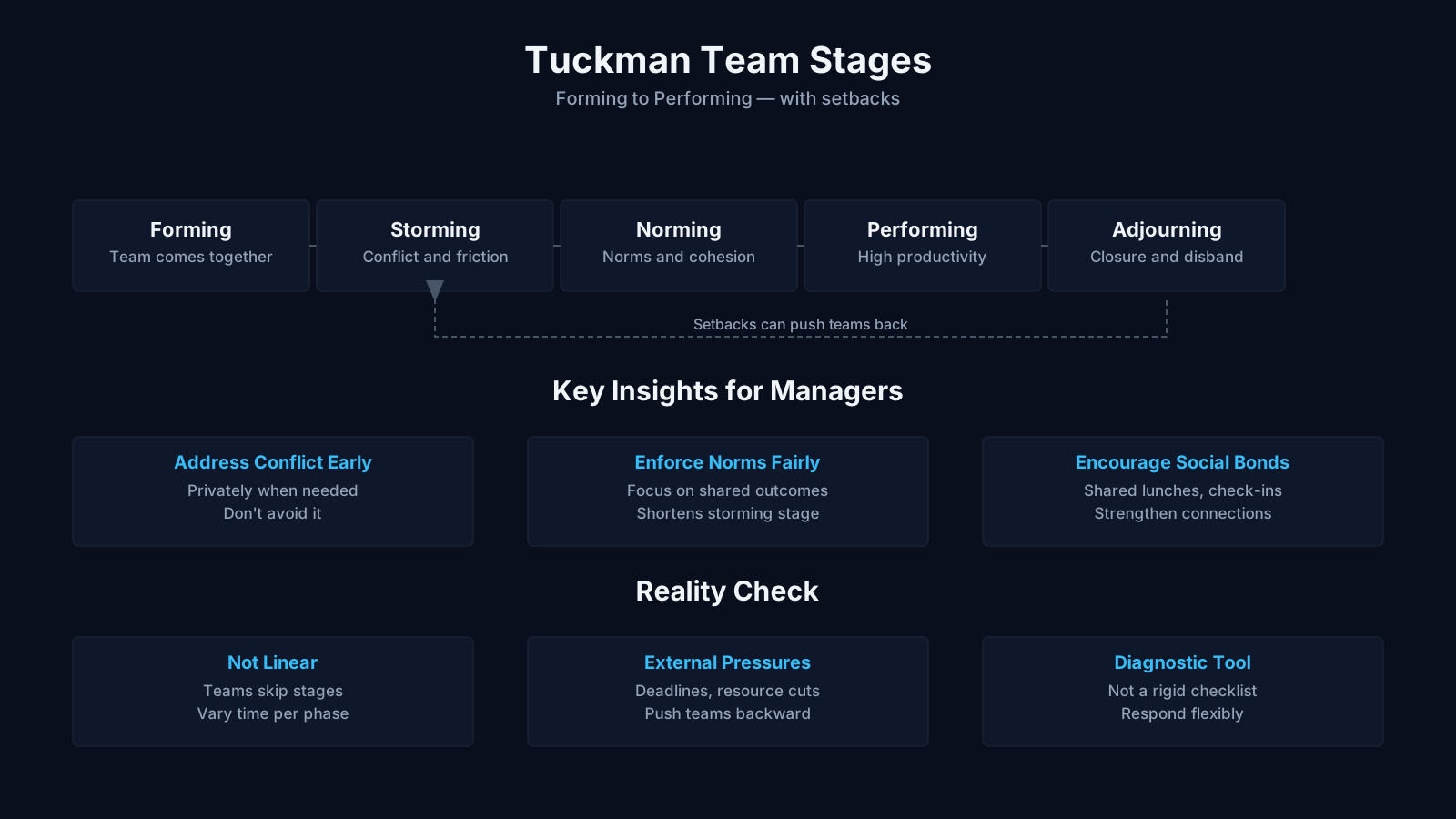
The five-stage team development model describes a common progression that many project teams experience from initial formation to final dissolution. The stages are forming, storming, norming, performing, and adjourning. Although the stages usually appear in this order, teams do not always move through them neatly. A team can get stuck in a particular stage, slip back to an earlier stage when a key member leaves or a major change occurs, or skip a stage entirely if members have worked together before.
In the PMBOK Guide, team development sits within the Project Resource Management knowledge area, particularly in the Develop Team and Manage Team processes. Those processes focus on improving competencies, team interaction, and the overall team environment. The five-stage model gives project managers a diagnostic lens. Knowing whether a team is in forming, storming, norming, performing, or adjourning helps a leader choose appropriate interventions rather than relying on generic team-building exercises.
One nuance that often surprises new project managers is that progress through the stages is not a permanent achievement. A team that reaches performing can slide back into storming if a new member joins, scope shifts significantly, or leadership changes abruptly. This is not a failure of the team. It is a normal response to disruption in the team system. The practical takeaway is that team development requires ongoing attention, not a one-time intervention.
Core Insights on Stage Progression
- Five sequential team stages
- Forming, storming, norming, performing, and adjourning map the typical team life cycle from initial assembly and role negotiation through peak collaboration to formal dissolution.
- Non-linear stage movement
- In practice, progression is rarely linear; teams may stall in conflict, regress when they lose a key member or face major change, or bypass stages when members already share a working history.
- Diagnostic leadership interventions
- The model serves as a diagnostic lens that helps project managers pinpoint the current stage and choose stage-appropriate interventions instead of defaulting to generic team-building exercises.
- Regression risk from changes
- The performing stage is not a stable endpoint, because the arrival of a new member, a significant scope shift, or an abrupt leadership change can push a team from performing back into the conflict and realignment of storming.
Forming in the Five Stages of Team Development
The forming stage of team development is the initial phase where team members first meet and learn about the project and their formal roles and responsibilities. During this stage, team members tend to be independent and not as open with one another. They often look to the project manager for direction and may avoid expressing strong opinions until they understand the group norms.
Forming as the First of the Five Stages of Team Development
In practice, forming often looks like a kickoff meeting where people are polite, curious, and somewhat guarded. A new software project team might gather for the first time, review the project charter, and nod along as the project manager explains the timeline and deliverables. People may ask clarifying questions about their own assignments, but they rarely challenge the approach or surface concerns about feasibility. That independence is not necessarily resistance. It is a natural early response when relationships are still being established.
Project managers who treat this polite quietness as full alignment can miss early warning signs. Team members may be unclear about the project objectives, uncertain about how their work connects to others, or privately worried about resource constraints. The most useful leadership behaviors during forming include setting clear expectations, defining roles, and creating a structured environment where people know what is expected of them. A simple responsibility matrix and a clear communication plan can reduce ambiguity without forcing premature openness.
It is also worth remembering that not every team begins at forming in the traditional sense. Projects with team members who have worked together in the past could skip a stage. A group of colleagues who have already delivered several initiatives together may quickly move into norming or even performing because trust and working rhythms already exist. The model describes typical patterns, not rigid requirements.
Storming in the Five Stages of Team Development
The storming stage of team development emerges when the team begins to address the project work, technical decisions, and the project management approach. This is where differing ideas and perspectives surface. If team members are not collaborative and open to those differences, the environment can become destructive rather than productive.
Storming as the Second of the Five Stages of Team Development
Storming can feel uncomfortable because it involves disagreement, friction, and sometimes open challenge to the project manager or to other team members. A technical team might argue about the best architecture for a new system. A marketing team might split over campaign messaging priorities. One person may prefer a detailed upfront plan, while another wants a more iterative delivery model. These disagreements are not inherently bad. In fact, when handled with respect, they often lead to stronger decisions.
The problem arises when team members personalize disagreement or when the project manager suppresses conflict to keep the peace. If a database specialist says the front-end developer is incompetent rather than questioning a specific technical choice, the conversation shifts from problem-solving to blame. That kind of destructive conflict can erode trust and stall the team for weeks. The project manager should establish ground rules for healthy debate, model curiosity, and intervene when comments become personal.
This is where many project managers trip up. They assume that conflict means the team is failing, so they smooth it over quickly. But avoidance often prolongs storming. Teams need to surface disagreements, explore options, and arrive at decisions they can support. An effective leader facilitates structured discussion, clarifies decision rights, and ensures that quieter voices are heard. Once the team has worked through substantive disagreements, it can move toward shared norms.
Key Insights on the Storming Stage
- Origin of storming phase
- Storming typically begins as the team engages with project execution, technical choices, and management methods, surfacing competing ideas and perspectives that had previously remained unspoken.
- Risk of destructive conflict
- When team members resist collaboration and dismiss differing viewpoints, the storming phase can degenerate into destructive friction instead of productive debate.
- Common technical disagreements
- Disagreements frequently center on technical direction, especially system architecture, where some members advocate a comprehensive upfront design and others prefer an incremental delivery approach.
- Danger of personal attacks
- Conflict becomes damaging when team members shift from critiquing ideas to questioning personal competence, such as calling a colleague incompetent rather than examining a specific technical choice.
- Leader's role in storming
- An effective project manager during storming establishes clear norms for constructive disagreement, demonstrates genuine curiosity, steps in when comments become personal, structures discussions to keep them focused, clarifies how decisions will be made, and actively invites quieter team members to contribute.
Norming in the Five Stages of Team Development
The norming stage of team development is the phase where team members begin to work together and adjust their work habits and behaviors to support the team. The team begins to trust each other. They develop a sense of cohesion and start coordinating more smoothly without constant intervention from the project manager.
Norming as the Third of the Five Stages of Team Development
In norming, people shift from defending their own positions toward finding workable patterns. A team might settle on a regular meeting cadence, agree on how decisions get documented, or establish a shared definition of done. Members start to understand each other's strengths and limitations. Help becomes more natural. One person might offer to review a colleague's code. Another might summarize a discussion to make sure everyone is aligned. These small behaviors signal that trust is forming.
Project managers should recognize that norming is still fragile. The team has built trust, but that trust has not yet been tested under significant pressure. A missed deadline, a scope change, or a personality clash can still push the group back into storming. Leaders can reinforce norming by acknowledging collaborative behavior, removing obstacles, and gently holding people accountable to the agreements the team has made. The goal is to let the team take ownership while providing enough support to prevent regression.
One common misconception is that norming means everyone agrees all the time. That is not the point. A team in norming can still disagree, but the disagreement feels different. It is aimed at solving a problem rather than proving who is right. The project manager might notice shorter meetings, fewer follow-up emails, and more direct but respectful communication. Those are signs that the group is moving toward genuine interdependence.
Performing in the Five Stages of Team Development
The performing stage of team development is reached when a team functions as a well-organized unit. Team members are interdependent and work through issues smoothly and effectively. They do not need close supervision. They anticipate problems, coordinate without being told, and hold each other accountable for results.
Characteristics of High Performing Teams
A performing team often feels almost self-managing. People know what they need to do, how it connects to the project goals, and when to escalate a genuine roadblock. Decisions happen quickly because trust is high and roles are clear. Conflict still occurs, but it is handled within the team without damaging relationships. The project manager can focus more on external stakeholders, resource planning, and strategic alignment rather than day-to-day task management.
Not every team reaches performing. Some projects end before the group fully matures. Short-duration efforts, high turnover, or persistent unresolved conflict can prevent a team from moving beyond storming or norming. This does not mean the project failed. It simply means the team did not have the conditions or time to reach that level of cohesion. From a Business Value-Oriented Project Management perspective, cross-functional teams are treated as a core success factor, which aligns closely with the interdependence seen in performing teams.
Leaders should resist the temptation to disrupt a performing team with unnecessary oversight. Micromanaging a group that already works well tends to undermine trust and slow things down. The better role is to clear external blockers, protect the team from shifting priorities where possible, and keep an eye on subtle signs of complacency. Even high-performing teams can drift into groupthink if they stop challenging assumptions.
Core Takeaways on Performing Stage
- Self-managing team dynamics
- Performing teams proactively identify issues, coordinate without explicit direction, and hold one another accountable for delivering results.
- Swift decisions through trust
- High trust and clearly defined roles enable performing teams to make decisions quickly and resolve conflict internally without damaging relationships.
- Manager shifts to strategy
- Once a team reaches the performing stage, the project manager shifts focus to external stakeholders, resource planning, and strategic alignment rather than day-to-day task management.
- Barriers to reaching performing
- Short project durations, high turnover, or persistent unresolved conflict can prevent a team from advancing beyond the storming or norming stages.
- Cross-functional teams as core
- In a Business Value-Oriented Project Management approach, cross-functional teams are a core success factor, and the manager's primary role is clearing external blockers, protecting priorities, and monitoring for complacency.
Adjourning in the Five Stages of Team Development
The adjourning stage of team development occurs when the team completes the work and moves on from the project. This phase is sometimes overlooked because the project deliverables are already finished, but it carries real emotional and organizational weight. Team members may feel pride, relief, sadness, or uncertainty about what comes next.
Managing the Transition at Project Completion
Adjourning is not just about closing out tasks. It is about recognizing contributions, capturing lessons learned, and supporting people as they transition to new assignments. A project manager should schedule a meaningful retrospective or lessons-learned session before the team disbands. This gives team members a chance to reflect on what worked, what did not, and how they might improve in future projects. It also reinforces the value of their work.
Some teams struggle with adjourning because they have built strong working relationships and do not want to let go. Others feel relieved that a difficult period is over. Both reactions are valid. The leader can help by clearly communicating the closeout plan, celebrating achievements, and ensuring that knowledge is not lost when people leave. Handover documentation, final project reports, and individual recognition all support a clean transition.
Without deliberate adjourning, teams can disband abruptly and carry unresolved feelings into their next project. That can affect morale and make future collaboration harder. A short closeout conversation or a simple thank-you note may seem small, but it reinforces that the work mattered. Teams that adjourn well are more likely to carry positive working relationships into later initiatives.
Team Dynamics and Leadership Across the Five Stages
The duration of a particular stage depends heavily on team dynamics in team development, along with team size and team leadership. A team with strong existing relationships may move through forming quickly. A larger team with many different communication styles may spend longer in storming. A skilled project manager can shorten destructive phases and help the team reach performing sooner.
Team dynamics include the interpersonal patterns, levels of trust, cultural backgrounds, and communication preferences that shape how people interact. Teams with high psychological safety tend to pass through storming faster because members feel comfortable raising concerns early. Teams where people fear blame may stay in forming longer, hiding their real opinions and avoiding hard conversations. The project manager can influence these dynamics by modeling vulnerability, inviting dissenting views, and responding calmly when problems surface.
Team size also matters. Small teams can coordinate more easily, but they may lack diverse perspectives. Large teams bring more ideas but require more structure to stay aligned. A team of fifteen may need clearer roles, more formal decision rules, and extra coordination mechanisms. A team of five can sometimes operate with less overhead, but a single unhealthy relationship can affect a larger proportion of the group. Project managers should adapt their communication and leadership style to the size and maturity of the team.
Leadership is not static across the stages. During forming, the team needs direction. During storming, the team needs coaches who can facilitate conflict without taking over. During norming, the team benefits from supportive leadership that reinforces collaboration. During performing, the team often needs delegation and trust. During adjourning, the team needs closure and recognition. A leader who applies the same style at every stage will likely slow progress. Understanding the current stage allows the project manager to choose the right balance of support and autonomy.
Core Takeaways on Team Stages
- Stage duration depends on dynamics
- The pace at which a team moves through each development stage is shaped by its interpersonal dynamics, team size, and the quality of leadership guiding the process.
- Strong relationships accelerate forming
- Teams with established working relationships tend to pass through forming faster because foundational trust and rapport already exist, reducing the need for early relationship-building.
- Larger teams extend storming phase
- Larger teams often remain in storming longer because more voices and communication styles must be aligned before disagreements can be resolved into shared working norms.
- Psychological safety speeds conflict resolution
- High psychological safety accelerates progress through storming by encouraging team members to surface concerns early, which prevents avoidance and allows disagreements to be resolved before they harden into conflict.
- Leadership shapes team development pace
- Skilled leadership shortens destructive phases by modeling vulnerability, inviting dissenting views, and responding calmly to setbacks, all of which move the team toward performing more quickly.
Common Pitfalls and Misconceptions in the Five Stages of Team Development
Several pitfalls in team development can undermine a project manager's ability to guide a team effectively. The most common is treating the five stages as a rigid checklist. Teams do not progress in a perfectly linear sequence. They can get stuck, slip backward, or skip stages depending on team history, project pressure, and leadership changes. A project manager who expects a team to move from storming to norming by a specific date may become frustrated and miss what is actually happening.
Another misconception is that conflict is always a sign of failure. Storming involves disagreement, but that disagreement can be a sign of engagement rather than dysfunction. The real risk is not the presence of conflict but the absence of respectful communication. Teams that never challenge each other may be stuck in a false harmony that masks unresolved technical or interpersonal problems. Project managers should watch for patterns of avoidance, not just loud arguments.
Some leaders also mistake an absence of complaints for performing. A quiet team is not necessarily a healthy team. It could be a team that has given up, disengaged, or decided that speaking up is not safe. Performing teams are active, interdependent, and willing to raise issues. They are not passive. Confusing compliance with performance is a classic error. It can keep a team trapped in low-level storming or even forming because real concerns never surface.
Adjourning is another area that gets neglected. Many project managers move quickly to the next assignment once deliverables are done. They skip the reflection, recognition, and transition support that the team needs. That neglect reduces the value of lessons learned and can damage relationships for future projects. A project manager who invests a little time in closeout activities builds a stronger foundation for the next team.
Finally, team development is not a set-and-forget activity. Changes in membership, scope, or leadership can reset progress. A new team member joining during performing can trigger a return to norming or even storming. Remote and hybrid teams may experience these stages differently because informal communication cues are reduced. Project managers should reassess team dynamics regularly, not just at the beginning of the project.
Practical Steps to Move a Team Through the Five Stages
Moving a team through the five stages requires deliberate, stage-appropriate action. The process of moving a team through the development stages starts with honest observation. Project managers should pay attention to how people communicate, how decisions are made, and how conflict is handled. Those patterns reveal the current stage more accurately than a calendar or a project phase.
During forming, clarify the project purpose, roles, and constraints. Use a kickoff session to align expectations and answer questions. During storming, establish ground rules for disagreement and facilitate structured discussions. Ensure that all perspectives are heard and that decisions are made transparently. During norming, reinforce collaborative behaviors and let the team take on more ownership while staying available to remove obstacles. During performing, delegate authority and protect the team from unnecessary external noise. During adjourning, plan for closure and recognize contributions.
Regular retrospectives can help teams see their own progression. An agile team might use sprint retrospectives to reflect on working relationships, not just technical output. A traditional project team can use phase-gate reviews or lessons-learned sessions for the same purpose. The key is to create recurring opportunities for the team to assess its own dynamics and adjust.
Above all, project managers should avoid forcing a team to behave as if it is in a later stage than it actually is. Trust cannot be mandated. It grows through repeated positive interactions and through leaders who respond consistently to problems. The five stages of team development are not a set of boxes to check. They are a map of human interaction under project pressure. Reading that map well is what separates average project managers from those who consistently build strong teams.
Key Takeaways on Guiding Team Development
- Observe patterns to identify stage
- Project managers should observe how team members communicate, make decisions, and handle conflict, because these recurring behaviors reveal the team's actual development stage more accurately than project timelines or phase labels.
- Match actions to each stage
- A kickoff session aligns expectations during forming, whereas the storming stage requires explicit ground rules and facilitated discussions to keep disagreements constructive and focused on project goals.
- Shift from direction to delegation
- During norming, leaders should reinforce collaborative norms and transfer ownership to the team, and during performing, they delegate decision-making authority while shielding the team from avoidable external interruptions.
- Use existing reflection rituals
- Sprint retrospectives in agile teams and phase gate reviews or lessons learned sessions in traditional projects provide natural opportunities to evaluate working relationships and team dynamics, not just technical deliverables.
