The idea that a manager functions much like a network router—directing information traffic, preventing overloads , and ensuring packets of data reach the right destinations—is not just a clever metaphor but a practical blueprint for building high‑bandwidth teams. When we examine how robust computer networks are engineered for speed and reliability, a whole set of design principles emerges that can be applied directly to human organizations. In networks, bandwidth determines how much data can flow through a channel in a given time period, latency measures how long it takes for a single message to travel from source to destination, and routing protocols decide the most efficient paths through a mesh of connections. For teams, exactly the same concepts apply, except the data includes project updates, strategic directives, technical specifications, and interpersonal feedback. A team with high bandwidth can process more information, coordinate more effectively, and make decisions faster without anyone feeling overwhelmed or out of the loop. High‑bandwidth team architecture is all about structuring human interactions so that communication flows smoothly, important signals are not lost in noise, and every team member maintains a clear, current picture of what needs to happen next.
Managers naturally sit at the nexus of many communication streams, and the mistake many make is in thinking their primary job is to hoard information or dole it out sparingly. When a manager acts as a gatekeeper, it creates a bottleneck—just like a router that queues up packets but fails to forward them quickly enough. The manager as an information router behaves differently, actively scanning inbound messages, applying filters and priorities , and redistributing content to the appropriate recipients without unnecessary delay. This small shift in mindset turns the manager from a choke point into a powerful distribution node that increases the total throughput of the team. And just as enterprise networks have redundant paths and load‑balancing strategies, the modern team can be designed with overlapping roles, shared knowledge, and multiple communication channels so that critical information never gets stranded on a single device. The goal is not to increase the sheer volume of messages flying around, but to increase the amount of meaningful, actionable information that reaches the right minds at exactly the right time.
In enterprise networking, you would never expect a single switch to carry all traffic between every node in a sprawling office; you would deploy a topology that matches the traffic patterns and scale requirements. Teams need the same careful consideration. Some kinds of work demand tight coordination where everyone talks to everyone else—a mesh topology that adds resilience but can become noisy and distracting . Other work thrives in a hub‑and‑spoke model where a central coordinator manages most information flows, making it easier to prioritize and control the quality of what circulates. The biggest gains come when managers treat information architecture as a design problem rather than as a random emergence of who happens to email whom. By measuring things like how long it takes for a decision to be made after a question is asked, or how often the same message is duplicated across channels, you can start to see the invisible shape of your team’s communication network. Often, the delays and frustrations that people attribute to “poor communication” are actually symptoms of an underlying network problem—too many hops, a single noisy channel, or a misconfigured filtering rule that drops important messages.
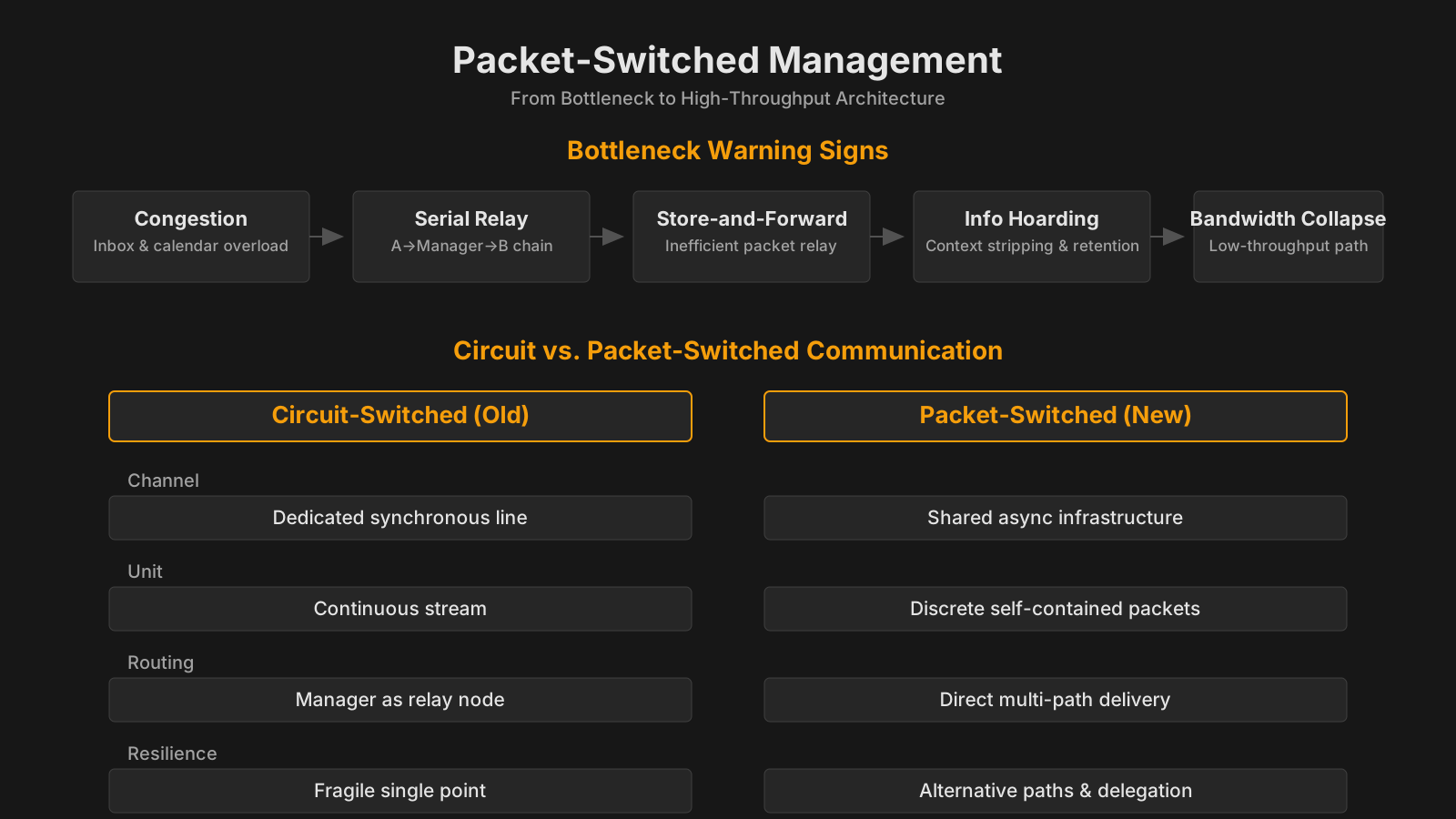
Key Topics: The Manager as an Information Router
| Key Concept | Summary |
|---|---|
| High Bandwidth Teams | A high bandwidth team rapidly absorbs and shares information through deliberate communication structures that prevent overload while enabling swift coordination and decision making. |
| Manager as Router | Rather than creating a bottleneck by hoarding information, an effective manager scans, prioritizes, and routes relevant data to the right people, amplifying the team's collective processing capacity. |
| Team Network Topology | Communication architecture should be intentionally designed around how work actually gets done, using mesh networks for collaborative tasks and hub and spoke models for coordinated execution to minimize noise and latency. |
| Information Flow Mapping | By auditing both formal reporting lines and informal communication patterns, managers can build a topology map that exposes hidden bottlenecks, overloaded individuals, and points where critical messages routinely drop. |
| Bottleneck Detection | Signs of communication congestion include sustained peak load on key individuals, unanswered or dropped requests, and the same message propagating through multiple redundant channels, each indicating strained throughput. |
| Communication Latency | Latency measures the elapsed time from question to complete, actionable answer; eliminating unnecessary intermediaries and handoffs compresses this window and directly speeds up team execution. |
| Channel Performance | Every communication tool has an optimal bandwidth and signal fidelity profile; deliberately matching message urgency and complexity to the right channel prevents jamming high volume, low context traffic through inefficient pathways. |
| Routing Rules | Clearly defined ownership and decision rights allow queries to reach the accountable person without detours, functioning like a routing table that directs each request to the correct destination in a single hop. |
| Redundancy and Load Balancing | Strategic overlap in roles, shared documentation, and parallel communication channels ensure that critical information never depends on a single point of failure and that cognitive load distributes evenly across the team. |
| Meaningful Throughput | The objective is not raw message volume but the rate at which relevant, decision ready information reaches each team member precisely when it is needed to move work forward. |
Information Flow Mapping: How the Manager as an Information Router Identifies Bottlenecks
Before you can redesign anything, you have to understand the current architecture, and mapping information flow inside a team is like creating a network topology map that includes every link, node, and traffic pattern. This exercise reveals the hidden wiring behind day‑to‑day collaboration—who sends what to whom, through which channels, and at what frequency. The manager as an information router begins by auditing all the major communication streams: not only formal reports and meetings, but also the informal Slack threads, hallway conversations, and email chains that often carry the most critical operational intelligence. Identifying communication bottlenecks usually starts with observing where messages pile up, where responses are chronically delayed, and where team members repeatedly complain they were not informed about something that directly affected their work.
One useful technique borrowed from network assessment is to look for peak‑load periods—times when the volume of messages spikes and the system starts to show strain. In a network, you’d monitor packet loss and increased latency during high‑traffic windows; in a team, you look for what happens right before major deadlines or during the morning rush after overnight messages have accumulated. You’ll often see that certain individuals become overwhelmed and start dropping requests, deferring replies, or making hasty decisions without full context. That’s equivalent to packet loss, and it’s just as damaging. Another sign of trouble is message concurrency, where a single piece of information travels through multiple channels simultaneously, creating confusion about which version is authoritative. Network engineers hate duplicate packets that waste bandwidth, and team leaders should hate them too.
Detecting Communication Latency and Its Hidden Costs
Latency is the time delay between when a question is asked and when a complete, usable answer is delivered. In high‑bandwidth teams, this latency directly impacts the speed of execution because every dependent task must wait for the information it requires. Measuring decision latency can be as simple as tracking the average time from the moment a request for a decision is made until all necessary parties have signed off and the action can proceed. Often the delay hides not in the decision‑maker but in the chain of relays that precede the final call—multiple approvals, endless clarifications, forwarded threads with “thoughts?” tacked on top. Mapping these relay chains is a bit like running a traceroute command, seeing each hop and the milliseconds added at every junction.
Peak‑load analysis combined with latency measurement provides a powerful diagnostic picture. You might discover that a particular senior engineer is copied on every design discussion even when their input is rarely needed, and the simple act of waiting for them to respond adds two days of latency to every minor change. That’s an easy routing rule to adjust. The idea is not to eliminate human judgment but to make the cost of each hop visible, so that you can design a topology that avoids unnecessary relays. Sometimes the simplest fix is to define ownership more clearly so that questions go directly to the person who can answer them, the way a well‑configured router sends packets straight to the destination subnet without bouncing through a dozen intermediate gateways.
Evaluating Channel Performance in the Manager as Information Router Framework
Evaluating channel performance means looking at which communication tools your team uses, and whether each is suited to the kind of traffic it carries. Email is excellent for formal, asynchronous, long‑form messages but terrible for quick back‑and‑forth discussions that would be resolved in seconds over chat. Yet many teams use email for everything, which forces all traffic through a low‑throughput, high‑overhead channel. Similarly, a video call that could have been a two‑paragraph document wastes not only time but also the opportunity to create a persistent, searchable record. The manager as router needs to establish clear protocols for which types of information travel on which channels, much like assigning different quality of service levels to voice traffic versus large file transfers.
Usage patterns often reveal that certain channels have become the default dumping ground for every kind of message regardless of urgency or relevance. A Slack general channel with three hundred members where everyone posts everything is a broadcast storm waiting to happen. It generates so much noise that people either tune it out entirely (dropping the connection) or spend inordinate cognitive energy filtering it manually. By mapping the flow, you can identify these congested channels and either split them into topic‑specific streams or introduce routing rules that limit who can post what. This reduces the total load on each individual and increases the probability that an important message will actually be seen and acted upon. The goal is to move from a chaotic, flat‑topology noise floor to a structured architecture with clear signal paths.
Key Insights for Information Routing
- Mapping communication streams
- Auditing formal reports together with informal channels such as Slack threads uncovers the hidden wiring of organisational communication and pinpoints exactly where messages stall or fall through the cracks.
- Peak load bottleneck detection
- Observing teams during surge periods, for instance in the run‑up to a deadline, reveals overloaded individuals who either drop requests or make rushed decisions, mirroring packet loss in a congested network.
- Measuring decision latency
- Tracking the time from a decision request to final sign‑off exposes the hidden delays inside multi‑step relay chains of approvals and clarifications, much like running a traceroute to identify slow network hops.
- Routing rule adjustments
- Inefficiency often stems from unnecessary routing hops, such as a senior engineer being copied on every discussion, and is resolved by defining clear ownership so that questions reach the right person directly without intermediaries.
- Channel performance evaluation
- Assigning the correct communication tool to each traffic type, using chat for rapid exchanges and email for formal records, prevents channel congestion and measurably reduces cognitive overload.
Team Topologies: Choosing Communication Structures for High‑Bandwidth Teams
Different team structures solve different communication problems, and no single topology fits every situation. The hub‑and‑spoke model, in which the manager sits at the center and all information flows through that central node, works well for small teams or early‑stage projects where a single mind needs to maintain a complete picture. It makes prioritization straightforward—the manager can filter, combine, and redistribute information according to a single coherent strategy. Choosing the right communication structure requires weighing the trade‑offs: a hub‑and‑spoke is efficient and clear, but it does not scale well because the central node eventually becomes the bottleneck. When a team grows past about six to eight people, the sheer volume of messages that must pass through one person starts to create latency that frustrates everyone.
A mesh topology, where every team member can communicate directly with every other without going through a central point, reduces the bottleneck risk but introduces its own challenges. Coordination overhead grows quadratically with the number of nodes—ten people create forty‑five potential direct links, each with its own state that needs to be maintained. In practice, pure mesh topologies only work when the work is highly interdependent and the team is physically colocated or has extremely disciplined communication habits. Most organizations end up with a hybrid, where a core group operates in a dense mesh while satellite members connect through a hub. This mirrors the spine‑and‑leaf architecture used in modern data centers, where a high‑capacity core provides low‑latency paths between edge nodes but not every node connects to every other.
Modular and Hybrid Topologies for the High‑Bandwidth Organization
Modular topologies divide the team into semi‑autonomous units that handle most communication internally and connect to the rest of the organization through designated liaisons. This is precisely the pattern used in large open‑source software projects, where sub‑communities maintain their own modules and communicate upstream or downstream through maintainers who act as connectors. For a business team, this might mean a product group has a clear boundary, and their interface to marketing and engineering is through a single product manager who serves as the API through which requests pass. This structure dramatically reduces the total number of cross‑team links and allows each module to optimize its own internal communication protocols without causing cascading disruptions elsewhere.
When you start thinking in terms of topologies, you also become aware of the scaling limits of your current design. A team of twenty that still tries to operate with everyone attending every stand‑up meeting is essentially running a fully connected mesh on a low‑bandwidth channel, and it will collapse under its own weight. The manager as router can instead design a hierarchical meeting structure where key decisions propagate from working groups up to a cross‑cutting coordination layer and then back down, much like a routing table update. This reduces the cognitive load on any single person while ensuring that the relevant information moves efficiently through the system. The topology becomes not a static org chart but a living map of how information actually travels, and it can be deliberately reshaped as the team grows or the nature of the work changes.
Applying Network Topology Logic to Distributed and Hybrid High‑Bandwidth Teams
Distributed and hybrid teams present additional challenges because the natural, serendipitous communication that happens in an office evaporates, leaving only the explicitly designed channels. Without careful attention, remote teams often default to a star topology where everyone communicates only with the manager, creating severe dependence and isolation. The high‑bandwidth team model counters this by deliberately creating peer‑to‑peer links: establishing norms that encourage direct communication between individual contributors, documented in public channels for visibility. It also demands more intentional redundancy—if a key link in a co‑located team can be reinforced by overheard conversations and informal check‑ins, that backup is absent remotely and must be created through structured practices like rotating information buddies or overlapping documentation responsibilities.
Network topologies also teach us that the shortest path is not always the best. Sometimes you want to route traffic through an intermediary that adds value—a technical lead who can translate marketing requirements into actionable tasks, for example. That extra hop might add a little latency but dramatically increases the quality and clarity of the information reaching the engineers. Designing a team topology is thus a balancing act between speed and quality, between directness and processing. The manager as router selects the topology that offers the best tradeoff for the specific type of work, then continuously monitors and tunes it as conditions change.
The Manager as Router: Routing Rules, Filters, and Prioritization
Sitting at the intersection of multiple information streams, a manager has the unique ability to see patterns that no individual contributor can perceive, and this vantage point makes them the natural routing intelligence for the team. When we speak of the manager as an information router, we mean someone who actively curates the flow: deciding which messages should be amplified, which should be condensed, which need immediate action, and which can safely be deferred or ignored. Routing rules and prioritization are not about exercising control but about applying a consistent logic that everyone on the team can understand and even participate in. Just as a network router uses forwarding tables and quality of service settings to manage traffic without having to inspect every packet’s full content each time, a manager can establish heuristics and standards that automate part of the routing burden.
One powerful routing protocol is the explicit escalation rule—a pre‑agreed pattern that specifies what kinds of issues should be raised to a particular level and in what timeframe. For example, a team might agree that any operational incident that affects a customer carries a mandatory notification to the manager within fifteen minutes, but a feature request from a small client can be batched into a weekly report. This rule functions like a priority queue, ensuring that critical packets jump ahead of the general traffic while bulk data transfer waits for off‑peak hours. The manager’s job is not to be the only person who can declare something a priority, but to train the team to recognize priority signals and route them accordingly, much like edge routers marking DiffServ code points so that downstream nodes know how to handle the traffic without re‑examining the payload.
Quality of Service Principles for the Manager as Information Router
In the language of networking, Quality of Service (QoS) refers to the mechanisms that give preferential treatment to certain types of traffic, and this maps beautifully onto how a team should handle different categories of information. A real‑time voice call needs low latency and jitter control; a bulk file transfer needs high throughput but can tolerate delays. Similarly, a team’s urgent decision about a security vulnerability demands immediate, low‑latency, high‑fidelity transmission with an acknowledgment receipt, while a quarterly strategic reflection can travel through a slower, more deliberative channel with time for asynchronous commentary. The manager as router classifies information into these categories and applies appropriate handling rules: for urgent matters, perhaps an instant message with a distinctive alert; for important but non‑urgent context, a well‑structured weekly digest that people read when their mental bandwidth is available.
Filters are another essential tool. A manager constantly receives far more information than they could possibly forward, and much of it is noise for any particular team member. A good routing filter removes duplicate information, consolidates multiple reports about the same event into a single coherent summary, and strips out unnecessary detail before forwarding. This is not censorship—it is protocol translation, converting a verbose, unstructured message into a compact, structured one that fits the recipient’s interface. When a manager sends a concise “here are the three things you need to know from this customer call,” they are functioning exactly like a router that compresses packet headers for efficiency. The team learns to trust that when information does reach them, it has already been processed for relevance and clarity, saving them the cognitive overhead of doing their own filtering on raw data streams.
Structured Communication Formats as Routing Protocols
To scale routing beyond what one person can handle manually, the manager needs to introduce structured communication formats that act like standardized packet headers. When a team adopts a consistent template for project status updates—perhaps sections for accomplishments, blockers, and upcoming milestones—every recipient instantly knows where to look for the information they need without parsing free‑form narratives. This reduces processing time and makes it easier to automate certain routing tasks, like aggregating all blocker items into a single management report. Over time, the team internalizes these formats and begins to structure their own messages accordingly, which further reduces the filtering load on the central router.
Priority queues can also be literal queues. Many high‑bandwidth teams adopt a practice of maintaining a visible, ordered list of the top priorities for the current sprint or quarter, and all incoming requests are evaluated against that list before being slotted in. This prevents the constant context‑switching that fragmentation causes and ensures that the team’s collective bandwidth is applied to the most important work first. The manager does not need to be the sole arbiter of every priority decision; instead, they maintain the queue and the criteria, and the team learns to apply those criteria autonomously when new requests arrive. That is the true sign of a mature information routing system—when the router’s logic has been so thoroughly distributed that many routing decisions are made at the edge, reducing the load on the core.
Manager Router Core Takeaways
- Routing Heuristics and Escalation Rules
- Managers rely on structured routing logic and pre-agreed escalation rules to automate information flow while coaching their teams to independently detect and act on critical signals.
- Quality of Service Information Classification
- Managers class information by urgency and importance, directing time-sensitive updates through immediate channels and consolidating non-urgent context into periodic digests, mirroring how network QoS prioritizes high-value traffic.
- Structured Formats as Routing Protocols
- Standardized update templates and visible priority queues function as communication protocols, lowering processing overhead and letting team members self-route their messages, which substantially lightens the manager’s filtering burden.
Bandwidth Optimization: Tools and Protocols for Faster Communication
Even with the perfect topology and routing rules, a team can still struggle if its underlying communication tools and habits create unnecessary friction. Bandwidth optimization is about tuning the physical and procedural layer so that information moves through the system as efficiently as possible. One of the most impactful shifts a team can make is to embrace asynchronous messaging as the default for non‑urgent communication. Synchronous meetings, like real‑time video streams, consume bandwidth in fixed time slots and force all participants to be available simultaneously, much like a circuit‑switched network that holds a line open even during silence. Optimizing communication bandwidth through asynchronous tools—shared documents, recorded video updates, threaded discussions—allows team members to consume information at their own pace, on their own schedule, dramatically increasing the total throughput of the system.
Structured templates are another high‑impact optimization. When a team consistently uses a simple, standardized format for requests—such as a brief description, a priority level, and a requested completion date—the recipients can parse and act on the request in seconds rather than minutes. This is akin to using fixed‑length packet headers that routers can process in hardware without deep packet inspection. A template also forces the sender to clarify their own thinking, which improves the signal‑to‑noise ratio of the message before it ever enters the network. In organizations where request chaos is the norm, simply introducing a consistent intake form can reduce communication latency by half without any other changes.
Single‑Source‑of‑Truth Systems and Bandwidth Management
When multiple people maintain separate copies of the same information—spreadsheet versions, document revisions, slide decks—the team wastes enormous bandwidth on synchronization overhead. Every time someone asks “which is the latest version?” or emails an attachment that already exists in three other inboxes, they consume network capacity for zero value. Establishing a single‑source‑of‑truth system—a canonical location for each type of information—eliminates this duplicate traffic. Whether it is a shared drive, a wiki, or a project management tool, the key is that everyone agrees where to look and where to put updates. This is the human equivalent of a content delivery network with a single origin server; you cache copies for speed but always know the authoritative source.
Tools should also support traffic shaping, which in networking means controlling the volume and rate of data sent into the network to avoid congestion. For teams, this translates into practices like designating “communication windows” where non‑urgent messages are batched and sent together rather than drip‑fed throughout the day. Some teams adopt a rule that any internal question that can wait four hours should be posted in a shared channel rather than sent as a direct message, allowing responders to answer when their own focus period permits. This reduces the barrage of interruptions that characterize many workplaces and dramatically increases the effective bandwidth available for deep work. The manager’s role is to model and enforce these protocols until they become team habits that no longer require policing.
Monitoring Throughput and Reducing Congestion in the High‑Bandwidth Team
You cannot improve what you do not measure, and bandwidth management starts with baselining the current state. Simple metrics like the average time to close a decision loop, the number of unread messages in team channels, or the frequency of “what’s the status on X?” queries can reveal congestion points. One of the most revealing exercises is to track how often the same item appears on multiple meeting agendas without resolution—a sign that information is stuck in a routing loop. Once you identify that a particular topic circulates between the same three groups for weeks, you can intervene with a dedicated decision protocol that breaks the cycle.
Congestion reduction often involves introducing queuing mechanisms that smooth out spikes. Instead of allowing every request to interrupt ongoing work, a team can maintain a visible backlog that stakeholders can add to, with the understanding that items will be processed in priority order during the next available window. This marshaling of incoming traffic prevents the thrashing that occurs when everything is urgent. It also gives the team a clear way to push back respectfully—not with a “no” but with a “yes, and here is when it will be addressed given current priorities.” The bandwidth‑aware manager actively protects this queue, shielding the team from pressure that would otherwise force context‑switching and degrade overall throughput.
Reducing Cognitive Load: Protecting Mental Bandwidth for High‑Bandwidth Teams
Every time a team member switches from one task to another, there is a cognitive cost—a few minutes of mental recalibration that adds no value but consumes available processing cycles. In network terms, this is like the overhead of tearing down and re‑establishing a connection, and when it happens dozens of times a day, it eats into the total bandwidth that could have been used for productive work. Protecting mental bandwidth means designing the communication environment so that individuals can maintain focus on a single stream of work for extended periods, only interrupted by truly important signals. The most immediately effective technique is to batch communication—consolidating non‑urgent messages into designated blocks of time, perhaps right after lunch or at the end of the day, rather than letting notifications trickle in continuously and yank attention away.
Defining focus periods is another powerful intervention. Some teams adopt a convention that certain hours of the day are “quiet time,” during which direct messages and meeting invites are discouraged except for emergencies. This is equivalent to reserving a dedicated bandwidth allocation for deep‑work traffic, much as a network administrator might carve out a guaranteed bit rate for a critical application. During those focus blocks, team members can shut down their notification clients, set status messages that explain their availability, and trust that the routing system—the shared channels, the manager as central router—will hold any incoming messages until the next processing window. This reduces the fragmentation that makes people feel busy but unproductive, and it often leads to a noticeable increase in the quality and speed of output.
Using Clear Message Headers to Reduce Cognitive Switching Costs
Just as a network packet needs a header that tells the receiving device what to do with it, human messages need clear subject lines and structured fields that let the recipient immediately classify the request without parsing the whole content. A message that begins with “[Decision Needed by Friday]” allows the reader to slot it into the appropriate mental queue without opening the full email, whereas a vague “Quick question” forces them to read the entire message, figure out the context, and then decide what to do. That extra cognitive step is not trivial; it adds up across hundreds of messages and can be the difference between staying on top of things and drowning.
The same principle applies to notification management. Each unnecessary alert is a tiny packet of overhead that interrupts cognitive processing and forces a context switch, even if the user decides not to act on it. Teams that ruthlessly prune their notification settings—disabling non‑essential alerts, consolidating channels, and using granular preferences—are essentially reducing the jitter in their communication network. Jitter, the variation in latency, is especially disruptive because it makes the system unpredictable; you never know when you will be interrupted, so you cannot plan deep work with any confidence. By creating predictable communication rhythms, the manager as router stabilizes the environment and allows team members to allocate their mental bandwidth more strategically.
Batching and Fragmentation Reduction for the Manager as Router
Batching goes beyond the timing of messages; it also applies to the way information is grouped and presented. Instead of sending five separate emails about different aspects of the same project, a manager can compile them into a single, well‑organized update that covers everything at once. This is the human equivalent of packet aggregation—combining small payloads into larger frames to reduce the per‑packet overhead. The team saves the cognitive effort of processing multiple fragmented messages, each requiring a separate mental context load, and can instead absorb the whole update in one focused session.
Another fragmentation pattern is the meeting that could have been an email, or the email that spawns a chain of clarifying replies that could have been avoided with a little more upfront thought. The manager who functions as a router trains the team to err on the side of greater initial clarity, even if it takes an extra minute to compose a message. That investment pays off in downstream efficiency because it prevents fragmentation loops where clarification messages beget more clarification messages, all of which compete for the same limited cognitive bandwidth. Over time, a culture of thoughtful, complete communication reduces the total message count and improves the team’s ability to stay in a flow state—the state where the highest‑throughput work actually happens.
Key Insights on Protecting Mental Bandwidth
- Task switching cognitive cost
- Shifting between tasks forces the brain through a recalibration lag, wasting cumulative minutes of focused energy that could drive high-value output.
- Batch communication strategy
- Consolidating non-urgent messages into planned daily blocks shields deep work from the disruptive pull of real-time notifications.
- Focus periods as quiet time
- Reserving hours free from messages and meetings, barring genuine emergencies, preserves uninterrupted cognitive capacity for complex, high-impact tasks.
- Clear message headers reduce switches
- Action-driven subject lines like “[Decision Needed by Friday]” let recipients triage requests instantly, bypassing the need to read the full content.
- Packet aggregation for updates
- Combining all project information into a single, well-organized message eliminates the mental strain of synthesizing fragmented communications.
Resilience and Redundancy: Avoiding Single‑Point Information Failures
Every seasoned network engineer knows that single points of failure are the enemy of reliability, and the same is true for team communication systems. When critical knowledge lives in only one person’s head, that person becomes a fragile node whose absence—whether through vacation, illness, or departure—can bring large parts of the operation to a halt. Building resilient information systems within a team involves deliberately creating redundancy: multiple people who understand the same processes, documentation that is current and accessible, and communication paths that can re‑route around a missing node just as a network re‑routes around a downed link. This is not about duplication for its own sake but about ensuring that the team can continue functioning at near‑normal capacity even when a key individual is unavailable.
Cross‑training is the most intuitive form of redundancy. When each critical area of knowledge has at least two people who can cover it, the team gains both resilience and flexibility. The secondary person does not need to be a full expert; they just need enough understanding to handle routine matters and to know where to find deeper documentation if something unusual arises. In network terms, this is a hot standby—a backup node that can take over within minutes. The investment upfront in pair‑working, shadowing, and knowledge transfer sessions pays off the first time an unexpected absence occurs and the team does not miss a beat. It also reduces the pressure on primary knowledge holders, who can take real vacations without a lurking sense of dread.
Documentation and Shared Knowledge Bases for High‑Bandwidth Team Resilience
Documentation that is scattered, outdated, or impossible to find is worse than no documentation because it consumes bandwidth without delivering value—people waste time searching, then eventually give up and ask someone, creating extra traffic for the human nodes. High‑bandwidth teams treat documentation as a first‑class component of their communication architecture, with clear conventions for where things live, how they are updated, and who is responsible for maintaining them. A shared knowledge base that is continuously refined functions much like a network’s routing table: it tells anyone in the team where to go for a particular answer without having to broadcast a query to everyone. This reduces the overall message load on the team and makes the system more resilient because the information does not vanish when the subject‑matter expert steps away.
Redundant communication paths also mean having multiple ways to reach people and multiple channels through which important information flows. If a team relies solely on one synchronous meeting for all status updates and that meeting gets canceled, the whole information system collapses for a week. A simple redundancy like a written daily stand‑up log that is posted in a persistent channel means that even if someone misses the call, they still receive the essential data. The manager as router ensures that no single channel becomes a critical dependency by cross‑posting key decisions in at least two formats—perhaps a verbal announcement followed by a brief summary in the team’s chat platform. This is the same principle that leads network architects to run multiple fiber lines along different physical paths; you might never need the duplicate, but when you do, it saves the day.
Testing Resilience Through Simulations in the Manager as Information Router Model
You do not wait for a real network outage to discover whether your failover systems work, and you should not wait for a key team member to leave to find out whether your information redundancy is adequate. High‑bandwidth teams proactively test their resilience by running short simulations or role swaps. For example, you might designate a “documentation clean‑up week” where someone who is not the usual expert attempts to perform a routine task using only the written materials, flagging any gaps or inaccuracies. Or you might have a team member act as a silent observer during a project handoff, noting where reliance on tacit knowledge creates risk. These exercises feel like overhead at first, but they are insurance, and they almost always reveal vulnerabilities that would have gone unnoticed until a crisis forced them to the surface.
Temporary role swaps are another effective method. When a developer spends a sprint handling triage of incoming bug reports, they gain direct insight into the information routing patterns that the support team uses every day, and they often identify opportunities to streamline handoffs or improve documentation. That dual perspective creates a kind of mesh resilience at the cognitive level—more people understand more parts of the system, which reduces the team’s overall dependence on any single individual’s specialized knowledge. The manager who intentionally rotates responsibilities is building a living network of overlapping competencies that can absorb shocks and keep information flowing no matter what.
Implementation Roadmap: Deploying a High‑Bandwidth Team Model
Moving from a traditional, ad‑hoc communication environment to a deliberately designed high‑bandwidth model is itself a change initiative that benefits from a clear, phased approach. The first step is always assessment: you need an honest picture of your current information flows, bottlenecks, and pain points before you can prescribe changes. This audit can be as simple as spending two weeks mapping every significant communication event—meetings, emails, chat messages, decision requests—and noting where delays, confusion, or overloads occur. High‑bandwidth team implementation roadmap starts with gathering this baseline data and translating it into a few clear metrics that everyone can understand: average decision latency, unread message counts, frequency of duplicate requests, and subjective satisfaction scores from team members about their communication load.
Once the current state is visible, the next phase is to define what “good” looks like. The team should agree on target metrics that are ambitious but realistic, like cutting decision latency in half or reducing the number of channels each person must monitor by onethird. These targets then guide the choice of topology. A small team with tight interdependencies might opt for a mesh pattern with strong asynchronous documentation practices; a larger, multi‑functional team might restructure into modular subgroups with clear liaisons. The manager as router works with the team to sketch out the desired communication structure, making it explicit rather than leaving it to chance.
The 90‑Day Plan with Checkpoints for Managers as Information Routers
A compressed 90‑day roadmap often works well for this kind of transformation because it is long enough to make meaningful changes but short enough to maintain momentum. Days one through thirty focus on the audit and topology selection, combined with immediate quick wins: clearing out noisy channels, establishing a few basic routing rules, and introducing a single structured template for the most common type of request. By day thirty, the team should be seeing early signs of relief—fewer interruptions, faster responses to critical items. Days thirty‑one through sixty shift to deeper optimization: implementing the new topology more fully, rolling out batching norms and focus periods, and beginning the work of building documentation and cross‑training for redundancy. Around day sixty, a formal check‑in using the original metrics will show whether the changes are having the intended effect, and adjustments can be made.
The final thirty days are about hardening the gains and building self‑sustaining habits. The manager gradually steps back from being the sole router and begins to coach team members to take on routing responsibilities themselves—deciding what information to share, applying prioritization rules, and maintaining the shared knowledge base. By day ninety, the team should be capable of operating the new information architecture without constant managerial intervention. This final phase also includes a retrospective that captures lessons learned and sets the stage for continuous improvement, because like any network, the communication system will evolve as the team’s work and composition change.
Applying the High‑Bandwidth Model Across Different Team Types
Not every team will implement the model in the same way, and a simple case‑study framework can help adapt the principles to different contexts. A small product trio consisting of a product manager, a designer, and a lead engineer might naturally gravitate toward a dense mesh with a heavy emphasis on asynchronous documentation, using shared templates for requirements and design specs to keep everyone aligned without constant meetings. A larger, cross‑functional team of twenty people might instead adopt a modular spine‑and‑leaf structure, where squad leads act as the spine, handling cross‑cutting decisions, while each squad operates as a semi‑autonomous leaf node with its own communication norms. A remote‑first support team might lean heavily on a single‑source‑of‑truth knowledge base and a priority‑queue system for incoming tickets, with the manager serving as the final escalation router for ambiguous cases.
In every scenario, the core idea remains the same: treat information flow as a design problem, not a random byproduct of people working together. Measure it, structure it, optimize it, and protect it with redundancy. The manager who learns to think like a network engineer—watching for congestion, configuring routing rules, and ensuring that every packet of information gets to where it needs to go without delays or data loss—transforms their team into something far more capable than a mere collection of talented individuals. That team becomes a true high‑bandwidth system, one that can handle massive information loads with low latency, high reliability, and a remarkable freedom from the communication chaos that drains energy and kills momentum in so many organizations.
Implementation Roadmap: Core Takeaways
- Phase one: audit current flows
- Begin by documenting every communication event over a two-week period and translating the data into baseline metrics such as decision latency, unread message volume, and team satisfaction scores.
- Define targets and choose topology
- The team sets ambitious yet achievable targets, for instance halving decision latency, then selects a communication topology that aligns with its scale and cross-functional dependencies.
- Compressed 90-day transformation plan
- During days 1-30, the focus is on auditing and capturing rapid improvements; days 31-60 deepen optimization through message batching and updated documentation; days 61-90 cement gains as the manager coaches the team to manage routing independently.
- Adapt model to team type
- A small product trio thrives on a dense mesh backed by asynchronous documentation, a large cross-functional group adopts a spine-and-leaf structure with squad leads, and a remote support team relies on a knowledge base and strict priority queues.
- Treat information flow as design problem
- The manager operates like a network engineer, systematically measuring, structuring, optimizing, and building redundancy into communication to transform the team into a high-bandwidth system with low latency and high reliability.