Supply chains today are a web of interdependencies so intricate that a single factory shutdown in Southeast Asia can idle assembly lines across three continents within a matter of days. Traditional planning approaches, built on historical patterns and point forecasts, routinely collapse under such shocks. Leaders who recognize this shift are turning to scenario planning for supply chain disruptions as a structured way to prepare for the unthinkable. It is not about predicting the future. It is about building a strategy that remains coherent no matter which of several plausible futures unfolds. This article explores the methods, frameworks, and real-world cases that bring that capability to life, from qualitative narrative workshops to quantitative simulation models, and how to embed the practice so it yields resilient operations.
Scenario Planning for Supply Chains: Key Topics at a Glance
| Key Concept | Summary |
|---|---|
| Supply Chain Interdependence | Today’s tightly woven supply networks mean a single factory shutdown in Southeast Asia can stop assembly lines on three continents within 72 hours. |
| Traditional Forecasting | Traditional forecasting extrapolates historical patterns and assumes stable cause and effect, causing it to fail precisely when market shocks demand agile decisions. |
| Scenario Planning | Rather than betting on one forecast, scenario planning constructs a set of divergent, data-grounded narratives that challenge assumptions and uncover hidden supply chain vulnerabilities. |
| Compound Disruption Scenarios | Scenario planning probes the system with compound shocks, for instance a port strike coinciding with a currency collapse while a critical supplier grapples with a labor walkout. |
| Response Readiness | Teams that have rehearsed a major port closure can detect early warning signs and shift to alternative routings days ahead of competitors who never modeled the event. |
| Systems Thinking | Exercising internally consistent multi-variable scenarios forces cross-functional teams to view the supply chain holistically and to design buffers that withstand simultaneous stress points. |
| Organizational Peripheral Vision | Simultaneously entertaining contrasting futures gives the organization a form of peripheral vision that single-scenario planners lack, enabling early recognition of weak signals from any direction. |
| Cascading Disruption Effects | A sourcing-region drought can cascade beyond commodity price hikes, triggering export bans, spiking energy costs, and sparking civil unrest that paralyzes distribution networks. |
Why Deterministic Forecasting Fails in Supply Chain Disruption
Supply chain planning has long been dominated by single-number forecasts. Demand plans, inventory targets, and transportation budgets all flow from a central assumption: next quarter will look roughly like last quarter, adjusted for known promotions and seasonal patterns. The fundamental problem is that traditional demand forecasting techniques extrapolate from past data and assume that cause–effect relationships will remain stable. A geopolitical flare-up, a sudden raw material shortage, or a cyberattack on a logistics provider shatters that assumption instantly. When the historical correlation between container spot rates and delivery lead times breaks down, the forecast becomes noise.
Linear regression models and exponential smoothing were never designed to handle regime changes. They can catch regular variability but not a structural break like a canal blockage or a pandemic-driven demand spike. Even machine learning models, for all their sophistication, rely on training data that may no longer represent the current reality. The illusion of precision masks the width of possible outcomes. Planners get a sense of control while walking blindfolded past cliffs. That false confidence is far more dangerous than admitting uncertainty.
Another flaw is the organisational reflex to fixate on the most probable scenario. When a sourcing team runs a Monte Carlo cost simulation, they often look at the median outcome and treat the tails as statistical curiosities. But in supply chain disruption, the tail events are where the damage lives. The 95th percentile lead time volatility or the 1-in-100-year weather event can wipe out an entire season’s margin. Ignoring those extremes because they seem unlikely is precisely how supply chains get caught off guard.
Interconnectedness compounds the problem. A small supplier in a distant tier may seem irrelevant until a quality issue at its plant triggers a recall that halts production globally. Deterministic models rarely capture these tier-two and tier-three dependencies with any accuracy. They treat the supply network as a linear chain rather than a dynamic web. When the network topology changes because a key node fails, the model’s underlying structure no longer holds. That is why the conversation must shift from prediction to preparedness.
Core Takeaways on Forecast Blind Spots
- Historical data assume stable relationships
- Forecasting models built on historical data assume stable cause-and-effect linkages, but a sudden geopolitical disruption, critical material shortage, or cyberattack can sever those relationships overnight and reduce forecasts to noise.
- Models fail on structural breaks
- Linear regression, exponential smoothing, and even advanced machine learning tools are designed to track recurring patterns, not to detect regime shifts; consequently, the apparent precision of their outputs conceals an alarmingly broad distribution of potential outcomes.
- Tail risks hold the real damage
- Planners often anchor on median forecasts and dismiss tail events as improbable outliers, yet a 95th-percentile jump in lead times or a once-in-a-century weather event can erase a full quarter's profit margin.
- Shift from prediction to preparedness
- Deterministic supply chain models view the network as a linear chain, overlooking tier-two and tier-three supplier interdependencies; when the network's structure changes, the priority must shift from trying to predict the future to investing in adaptability and contingency readiness.
The Philosophy of Scenario Planning: Multiple Futures, Not Predictions
Scenario planning flips the question from “what will happen” to “what could happen and how would we respond?” It is a discipline born out of military strategy and later refined by corporate strategists like those at Royal Dutch Shell. Instead of predicting a single future, scenario planning focuses on developing multiple plausible supply chain scenarios that stretch the imagination while remaining grounded in data. Each scenario is a coherent narrative about a different possible world, complete with triggering events, timeline, and logical consequences. The goal is not accuracy but breadth of perspective and adaptive capacity.
The Shell experience is informative. In the early 1970s, Shell’s scenario team explored futures that included a dramatic oil price shock, something most energy companies considered remote. When the 1973 oil crisis hit, Shell was mentally and strategically prepared while competitors scrambled. That did not mean Shell predicted the exact date or magnitude. They had simply lived through a plausible version of that crisis in their planning meetings, so the real event triggered pre-rehearsed plays. The same principle applies to supply chains: a team that has gamed out a major port closure will recognise the early signals and switch to contingency routing faster than one that has never considered it.
A critical distinction is between scenario planning and sensitivity analysis. Sensitivity analysis tweaks one variable at a time, holding everything else constant. It asks, for example, what happens to inventory levels if demand increases by ten percent. Scenario planning, in contrast, weaves together multiple simultaneous changes: a port strike coincides with a currency devaluation, just as a key supplier faces a labour shortage. These compound effects are what create truly punishing disruptions. Practising with coherent, multi-variable futures forces cross-functional teams to see the system as a whole and to design buffers that work across multiple stress points.
Another element that separates mature scenario planning from sporadic what-if exercises is the deliberate use of both plausible best-case and worst-case storylines, as well as more exotic “wild card” scenarios. A best-case scenario might involve unexpectedly smooth customs clearance after a trade deal. A worst-case could involve simultaneous drought in two major agricultural regions. The wild card could be a sudden technology shift that renders a key component obsolete. By holding these contrasting futures in mind at the same time, an organisation develops a kind of peripheral vision that single-point planners never acquire.
Qualitative Methods for Scenario Construction
Qualitative methods are often the starting point because they require less historical data and can incorporate expert judgment about forces that have no statistical footprint yet. Many supply chain teams begin with qualitative scenario planning methods to map out the geopolitical, environmental, and technological uncertainties that escape spreadsheets. These approaches rely on structured conversations, facilitated workshops, and narrative building. They are deceptively simple but incredibly powerful when done rigorously.
Intuitive Logics and the Shell Method
The intuitive logics approach, popularised by Shell, builds scenarios around a small set of critical uncertainties. A cross-functional team identifies the key driving forces shaping the supply chain environment: trade policy, energy prices, labour availability, climate regulation, digital disruption. They then rank these forces by their degree of impact on the business and their inherent uncertainty. Two high-impact, highly uncertain drivers are selected as the axes of a scenario matrix. If, for example, the axes are “degree of trade protectionism” and “pace of automation adoption,” the quadrants generate four distinct worlds: open markets with slow automation, open markets with fast automation, protectionist with slow automation, and protectionist with fast automation.
For each quadrant, a detailed narrative is written. A narrative for high protectionism and slow automation might describe a world of reshored production, fragmented logistics, and rising labour costs. The team then works backward from the narrative to identify early indicators that world is emerging. This is where the supply chain gains its early warning system. They might track political speeches, port throughput data, or capital investment patterns in automation technology. When several of those indicators start lighting up, the organisation can increase its readiness posture without waiting for the quarterly forecast to be revised.
Cross-Impact Analysis
Developed by Theodore Gordon and Olaf Helmer at RAND and later refined by Michel Godet in the French school of La Prospective, cross-impact analysis addresses interdependence between events. In a supply chain context, a drought in a sourcing region does not just increase raw material costs; it might also trigger export restrictions, spike energy prices, and cause social unrest that disrupts logistics. Cross-impact matrices formalise these linkages. Experts assign probabilities to a set of future events, then estimate how the occurrence of one event would change the probability of others. The result is a more internally consistent scenario set that accounts for cascading failures.
The process generates surprising insights. A team might initially view a cyberattack on a cloud logistics platform and a labour strike at a key port as independent risks. Through cross-impact analysis, they might discover that the port strike increases reliance on digital rerouting tools, which simultaneously elevates the damage a cyberattack could cause. That realisation might shift investment from purely physical redundancy to cybersecurity hardening of the rerouting algorithms. It is the kind of connection that emerges only when the team maps interactions explicitly.
War Gaming and Tabletop Exercises
War gaming takes the narrative and makes it interactive. A facilitator presents a disruption scenario and teams role-play their response in real time. For supply chain disruptions, a war game might involve a sudden closure of the Suez Canal combined with a simultaneous ransomware attack on a freight forwarder. The procurement team must find alternative lanes, the logistics team must assess inventory stranded in transit, and the commercial team must communicate with customers. Compressed time pressure reveals decision-making bottlenecks, missing information flows, and conflicting priorities.
After the exercise, a thorough after-action review captures what worked, what broke, and what capabilities need building. Organisations that run such tabletop exercises regularly begin to build muscle memory. Leaders who have “fought” through a simulated chip shortage are far less likely to freeze when a real one hits. They already know which alternate suppliers have been pre-qualified, which designs can be adapted, and what contractual force majeure clauses can be invoked. The qualitative methods, therefore, are not just analytical tools but also socialisation mechanisms that align the organisation’s reflexes across functions.
Core Takeaways: Qualitative Scenario Tools
- Intuitive logics scenario matrix
- Pioneered by Shell, the intuitive logics method ranks driving forces by their impact and uncertainty, selects the two most critical and uncertain forces as axes, and constructs four distinct scenario narratives, each with early warning signals to monitor.
- Cross-impact analysis maps event interdependencies
- Originating at RAND, cross-impact analysis leverages expert probability judgments to quantify how an event, such as a port strike, alters the likelihood of related events, thus exposing cascading failures and hidden interdependencies among seemingly independent risks.
- War gaming builds response muscle memory
- Interactive tabletop simulations subject cross-functional teams to compressed timelines, forcing them to role-play simultaneous disruptions; the subsequent after-action review then pinpoints operational bottlenecks and measurably strengthens the organisation's crisis readiness.
Quantitative Techniques and Simulation Models
Qualitative scenarios provide the narrative spine, but often leaders want to know the operational and financial implications in numbers. When precision is needed, quantitative supply chain simulation models such as Monte Carlo analysis can estimate the probability of stockouts under different disruption scenarios. These models embed the narrative assumptions into mathematical structures and run thousands of iterations to surface the distribution of outcomes. They do not eliminate uncertainty, but they quantify the risk-reward trade-offs that decisions entail.
Monte Carlo Simulation for Supply Chain Variables
Monte Carlo simulation is particularly useful for variables with known historical variability but uncertain future paths, such as lead time, demand spikes, or yield rates. Instead of using a single forecast number, the planner defines a probability distribution for each variable. The simulation randomly samples from these distributions, calculates the resulting service levels or costs, and repeats the process tens of thousands of times. The
Case Examples of Scenario Planning in Supply Chains
The gap between theory and practice can feel wide until concrete examples bring it to life. These case examples of supply chain scenario planning illustrate how organisations have turned abstract possibilities into concrete action plans. While the specific firms are not named to respect confidentiality, the situations are drawn from common patterns observed across industries.
Navigating Port Congestion in Consumer Goods
A mid-sized consumer goods company with heavy reliance on Asian manufacturing ran a scenario exercise focused on trade route interruptions. The team developed four scenarios anchored by two uncertainties: the severity of port labour disputes and the pace of nearshoring adoption in the industry. In the scenario where labour disputes escalated and nearshoring remained slow, the model showed a frightening four-week average delay in arrival at distribution centres during peak season. Historical data had never shown anything close to that duration.
Armed with that scenario, the supply chain team worked with logistics partners to pre-book alternative rail and truck routes from secondary ports, even though those routes were initially fifteen percent more expensive. They also renegotiated supplier contracts to include flexible incoterms that shifted the point of risk transfer earlier in the journey. When a real waterfront labour disruption hit eighteen months later, the company was able to redirect forty percent of its volume within five days. Competitors who had not gamed out such an event saw their inventory days of supply drop perilously low. The scenario planning exercise had essentially bought the firm a two-week head start.
Preparing for Semiconductor Shortages in Automotive
An automotive parts supplier, watching the growing concentration of chip fabrication in a handful of geographic zones, ran a “chip famine” scenario. The narrative assumed a combination of a natural disaster impacting a major fab, a sharp rise in consumer electronics demand pulling supply away, and export controls tightening. The scenario projected a nine-month period of severely constrained microcontroller availability. The initial internal reaction was that the scenario was too extreme, but the exercise forced a granular mapping of every electronic component across the product portfolio.
The mapping uncovered a surprising fact: several low-volume but critical modules used a legacy chip that had only one qualified foundry. The supplier had treated those modules as commodity parts. The scenario planning team pushed for qualification of a second foundry, a multi-quarter engineering effort that would have been hard to justify under a business-as-usual capital allocation process. The project got approved with the caveat that it was scenario-driven insurance. When the global semiconductor shortage hit in subsequent years, that second-source qualification kept production lines running while competitors idled. The scenario did not predict the exact trigger (the trigger turned out to be demand volatility rather than a natural disaster), but the diversification strategy proved robust across multiple possible causes.
Pharmaceutical API Supply Shocks
A generic pharmaceutical manufacturer conducted a scenario exercise centred on concentration risk in active pharmaceutical ingredients. They built a scenario around a geopolitical crisis in a region that supplied sixty percent of a key antibiotic intermediate. The scenario narrative detailed how export bans, airfreight cancellations, and quality testing backlogs would combine to create a three-month supply gap in finished dosage forms. The financial impact model showed a potential revenue loss of over eight percent of annual turnover, but more critically, a prolonged shortage could permanently damage relationships with hospital buying groups.
In response, the company started building a buffer stock of the intermediate, despite the carrying cost and shelf-life challenges. They also invested in developing a synthetic route using an alternative starting material sourced from a different continent. The regulatory revalidation process was time-consuming and expensive. When a real trade dispute later throttled API exports from the region, the company was the only one in its peer group able to maintain supply continuity. Pharmacy chains took notice and shifted volume toward the reliable supplier, turning a defensive move into a market share gain. This case underscores how scenario planning can identify not just downside protection but upside opportunity in a crisis.
Key Insights from Supply Chain Cases
- Pre-booked alternatives cushion port shocks
- The consumer goods company had pre-booked higher-cost rail and trucking services from secondary ports, which allowed it to divert forty percent of cargo volume within five days when a primary port was disrupted.
- Flexible incoterms shift risk earlier
- By renegotiating incoterms to transfer risk to an earlier stage of the journey, the company gained a two-week advantage over competitors still scrambling to secure alternative routes.
- Component mapping uncovers hidden vulnerabilities
- A rigorous scenario exercise forced the automotive supplier to map every electronic component at the bill-of-materials level, revealing low-volume modules dependent on a single qualified foundry and thus exposing critical single points of failure.
- Diversification beats exact predictions
- Although the semiconductor scenario did not predict the exact trigger of the crisis, the second-source qualification strategy demonstrated resilience across a wide range of possible disruption causes.
- Defensive moves can yield market gains
- The pharmaceutical manufacturer’s combination of buffer inventory and an alternative synthesis route transformed a defensive supply continuity measure into market share gains, as competitors were unable to sustain deliveries during the shortage.
Organizational Resistance and Cognitive Biases
Even the best-designed scenario method can fail if the human element is overlooked. Successfully implementing scenario planning requires overcoming bias in scenario planning exercises, such as anchoring on the most recent disruption or groupthink. After a major hurricane, for instance, every scenario suddenly revolves around weather. After a cyberattack, the conversation fixates on IT vulnerabilities. This recency bias narrows the scenario set and leaves blind spots.
Another common trap is the “official future” syndrome. Senior leaders often carry a deeply held mental model of how the industry works, and they unconsciously steer the scenario process toward that future. Facilitators must challenge these assumptions without triggering defensiveness. One technique is to bring in external perspectives: an academic, a regulator, or a practitioner from a different industry who can question the orthodoxies that insiders take for granted. Their role is not to provide answers but to crack open the thinking.
Over-optimism is also pervasive. Teams tend to assign excessively low probabilities to negative events because acknowledging them feels defeatist or requires admitting that previous risk assessments were insufficient. A skilled scenario planner uses anchoring techniques: instead of asking “how likely is this event,” ask “if this event were to happen, what would have to be true?” That mental pivot moves participants from defensive probability estimation to constructive system analysis. Once they start connecting the dots, the scenario often becomes more tangible and its likelihood less dismissed.
Groupthink can flatten the range of scenarios. When a dominant executive speaks first, the rest of the room often aligns. Scenario workshops benefit from silent brainstorming, anonymous voting on driving forces, and breaking into small, psychologically safe groups before reconvening. Separating idea generation from idea evaluation is a fundamental principle borrowed from design thinking. The process must protect the delicate, half-formed insights that often contain the seeds of the most disruptive scenarios.
Embedding Scenario Planning into the Supply Chain Operating Rhythm
One of the biggest mistakes is treating scenario planning as a one-off project rather than integrating scenario planning into S&OP processes on a quarterly basis. When scenario thinking is isolated to an annual strategy retreat, it quickly goes stale. The external environment shifts, new signals emerge, and the scenarios become historical artifacts. Making it part of the sales and operations planning cycle keeps the narratives alive and relevant.
A practical cadence looks like this: each quarter, the supply chain centre of excellence reviews the horizon-scanning inputs, adjusts the scenarios if needed, and presents a brief update at the pre-S&OP meeting. The discussion does not need to be lengthy. Even thirty minutes of focused “what has changed” dialogue can recalibrate the team’s mental model. If an early indicator is flashing, the group decides whether to shift contingency plans from a monitoring stance to an active preparation stance. That decision point is far cheaper than reacting after the disruption has landed.
Connecting scenarios to key performance indicators is essential for credibility. For each scenario, the team identifies the three to five metrics that would move first. For a port congestion scenario, those might be container dwell times at import gateways, spot freight rates on secondary lanes, and order-to-shipment lead time variance. When those metrics breach a predefined trigger, the organisation automatically launches a pre-agreed response package, no committee approval required. This trigger-based activation removes the delay caused by internal debate about whether a disruption is “real” and allows the scenario planning investment to translate into operational speed.
Budgets also need to reflect scenario readiness. Too often, contingency actions remain unfunded recommendations in a slide deck. Leading organisations allocate a small percentage of the supply chain budget to scenario response capabilities, much like an insurance premium. That might mean retaining a flexible capacity agreement with a third-party logistics provider, paying a modest fee to hold a backup production line in warm standby, or investing in cross-training so that workers can shift between product lines when a component shortage hits. These line items are easy to cut in a cost-down initiative, which is why the tie to scenario narratives must be explicit and periodically reaffirmed.
Key Takeaways on Scenario Integration
- Quarterly S&OP integration
- Scenario planning is embedded into the quarterly S&OP cycle, ensuring strategic narratives evolve with real-time market signals rather than remaining static after an annual exercise.
- Light-touch review cadence
- A concise thirty-minute change assessment in every pre-S&OP session enables rapid recalibration of scenarios and the seamless movement of contingency plans from monitoring to active preparation.
- KPI-linked early triggers
- Each scenario defines three to five leading KPIs with pre-set thresholds that, when breached, automatically launch pre-negotiated action playbooks, bypassing committee approval delays.
- Budgeted scenario readiness
- Top-performing organizations embed scenario readiness expenses such as flexible capacity agreements, warm standby production lines, and cross-training directly into the supply chain budget as operational insurance against disruption.
Digital Technologies that Amplify Scenario Planning
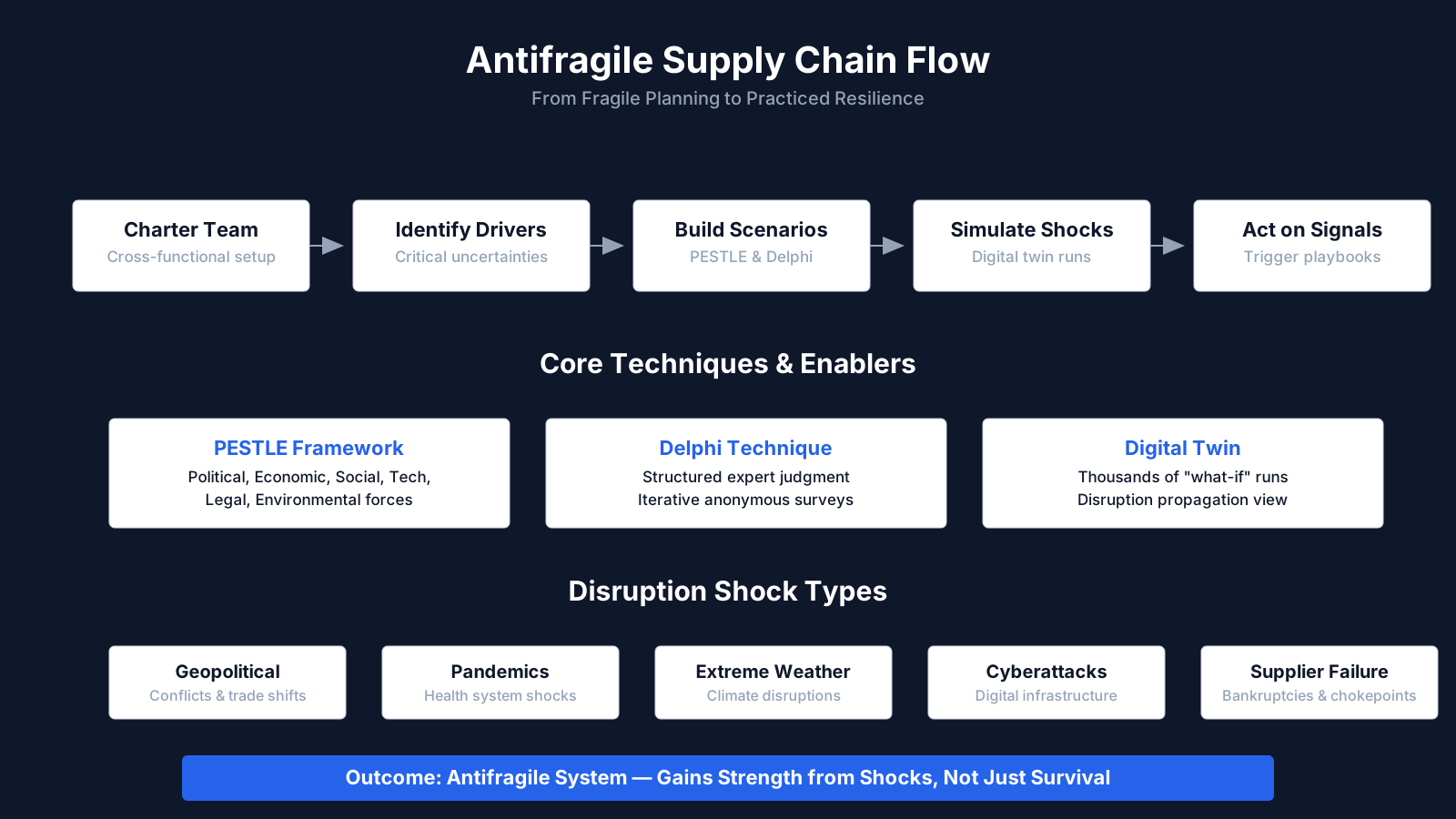
Technology is not the core of scenario planning, but it is a force multiplier. The rise of digital twin supply chain scenario analysis has transformed the speed and granularity with which organisations can test disruption hypotheses. A digital twin can ingest a scenario narrative and translate it into thousands of simulated supply chain configurations, each with a full cost and service outcome. The result is a hybrid approach where qualitative storytelling drives the scenario design and quantitative simulation measures the impact.
Control tower platforms with integrated risk feeds add another layer. They monitor news, weather, social media, and supplier financial health in near real time. When the control tower’s AI detects a pattern that matches a pre-defined scenario signature, it alerts the planning team and automatically pulls up the relevant contingency playbook. This tight coupling between signal detection and scenario activation moves the organisation closer to an autonomous supply chain, where human judgment remains central but decision latency shrinks dramatically.
Graph databases and network analytics enable a deeper understanding of tier-n interdependencies. Traditional supply chain mapping often stops at the first tier. With a graph-based model, a company can identify single points of failure deep in the network, such as a mine that supplies a crucial mineral to many downstream suppliers. Scenario narratives can then be built around the failure of those hidden nodes. The combination of network visibility and scenario discipline creates a far more resilient system than either could alone.
Evaluating Resilience and Measuring the Value of Scenario Planning
Any management practice eventually faces the question of return on investment. Without a clear way of measuring the value of supply chain scenario planning, investments in the discipline risk being cut when budgets tighten. Traditional ROI frameworks struggle because the benefit is primarily avoided loss, which is counterfactual. You cannot easily prove what did not happen. Still, there are proxies that build a compelling case.
One approach is to track decision speed and quality during real disruptions. If a company with mature scenario planning resolves a supplier failure in three days while the industry average is ten days, the avoided revenue loss and reduced expediting costs provide a tangible metric. Comparing pre- and post-implementation metrics on supplier lead time recovery, inventory write-offs, and premium freight spend often reveals a step-change improvement. These numbers do not separate the scenario planning effect from other resilience investments, but when combined with team debriefs, the attribution becomes reasonably clear.
Another method is to run a simulation-based stress test under two conditions: with and without the strategies informed by scenarios. Suppose the scenario process led to a dual-sourcing strategy for a particular category. The company can model a supply disruption and compare the financial outcome of single-source versus dual-source configurations. The difference in expected downside captures the insurance value. When that value exceeds the cost of the dual-sourcing arrangement and the scenario planning effort, the investment is justified. Sharing such analysis with the finance team in their language builds lasting support.
The more profound value often lies in the strategic optionality that scenario planning creates. A company may not activate a contingency today, but the mere existence of a pre-approved playbook and qualified alternate suppliers gives it the confidence to pursue more aggressive growth strategies. It can commit to a large customer contract with a tight delivery promise because it knows it has fallback routes. That upside is harder to quantify but frequently surfaces in win-loss analysis and customer retention rates.
Key Insights on Resilience ROI
- The counterfactual benefit challenge
- Because its core value lies in losses that never materialize, scenario planning resists traditional ROI quantification: the benefit is avoiding a disaster that, by definition, leaves no observable trace.
- Decision speed as a proxy
- Decision speed during crises provides a clear, quantifiable proxy for resilience; a firm that resolves a supplier disruption in three days, compared to the industry's ten-day average, converts readiness into demonstrable competitive advantage.
- Pre- and post-implementation metrics
- Tracking shifts in key operational indicators before and after scenario planning implementation, such as supplier lead time recovery, inventory write-offs, and premium freight expenditure, surfaces step-change improvements that build a compelling, data-driven business case.
- Simulation-based stress testing
- Simulating disruption scenarios with and without scenario-informed strategies, such as dual-sourcing, yields a measurable insurance value by contrasting the expected financial downside in each case.
- Strategic optionality upside
- Beyond risk mitigation, scenario planning generates strategic optionality: pre-vetted playbooks and qualified alternate suppliers empower firms to confidently pursue aggressive growth, capture new business, and secure large contracts that competitors may hesitate to bid on.
Sustaining a Scenario Thinking Culture
Processes and tools are necessary but not sufficient. Ultimately, the long-term payoff comes from building a scenario thinking culture in supply chain teams, where leaders routinely ask “what if” and challenge single-point forecasts. This cultural shift begins at the top. When executives consistently probe plans with scenario questions, the organisation learns that “I don’t know, but here is what we would do in several possible worlds” is an acceptable and indeed preferred answer.
Developing scenario thinking skills requires practice and psychological safety. Junior planners need space to voice unpopular contrarian scenarios without being labelled as negative. Some organisations hold monthly “red team” sessions where a small group is tasked with dismantling the prevailing supply chain plan. The exercise is not about winning an argument but about stress-testing assumptions. Over time, these rituals make scenario thinking a habit rather than a special event.
Recognition and storytelling reinforce the culture. When a scenario-based early warning system correctly flags a disruption that the team then navigates smoothly, the story should be told widely. Highlighting how the foresight saved costs or protected customers creates a shared narrative of competence. It also builds the emotional reward cycle that keeps people engaged in the unglamorous discipline of horizon scanning. Without that reinforcement, scenario planning can feel like an academic exercise disconnected from the adrenaline of daily operations.
Continuous learning loops are the final piece. After every real disruption, the team should conduct a retroactive scenario analysis. They examine what signals were missed, which scenarios proved most relevant, and how the response could be improved. This after-action learning is fed back into the scenario development process, making the next set of scenarios sharper and more realistic. The result is a self-improving system that does not just cope with supply chain disruptions but gradually becomes more antifragile, gaining strength from the shocks that would break a deterministic planning regime.
Advance Your Career with Professional Certification
Project leaders who want to advance their careers often turn to a PM certification online because it provides flexible access to rigorous training in scheduling, risk management, and resource allocation. Earning this credential demonstrates to employers that you can deliver results in volatile environments where supply chains may shift unexpectedly. Many programs now incorporate real-world simulations that sharpen decision-making under pressure.
Agile teams benefit when the individual responsible for maximizing value holds a product owner certification that confirms practical knowledge of product strategy and iterative delivery. This credential goes beyond theory, testing your ability to prioritize features based on customer needs and market feedback. With a certified mindset, product owners reduce wasteful development and align every sprint with organizational goals.
Organizations facing rapid workforce changes rely on a certified HR manager to design policies that balance legal compliance with employee engagement. This certification validates a professional’s command of talent acquisition, performance systems, and change management. Investing in this qualification signals to leadership that you can navigate restructuring or scaling efforts without disrupting company culture. The structured curriculum also deepens analytical skills for data-driven workforce decisions.