In an era where technology dictates market pace and reshapes entire industries, the CIO Strategy & Innovation Certification has emerged as a critical pathway for senior technology leaders determined to future-proof their careers and elevate their strategic contribution. This credential, often pursued by seasoned chief information officers, IT directors, and aspiring digital executives, goes far beyond the operational management of servers, networks, and software rollouts—the kind of expertise validated by ITIL 4 Foundation —and reshapes the professional’s identity from a reactive service provider into a proactive architect of business value, innovation, and organizational agility. For anyone navigating the complex intersection of technology leadership and corporate strategy, understanding what this certification entails, how it is structured, and why it has become a career differentiator is no longer optional but essential. A grounding in agile principles, such as those provided by Agile Essentials: A Manager's Guide to Core Concepts , further strengthens this foundation.
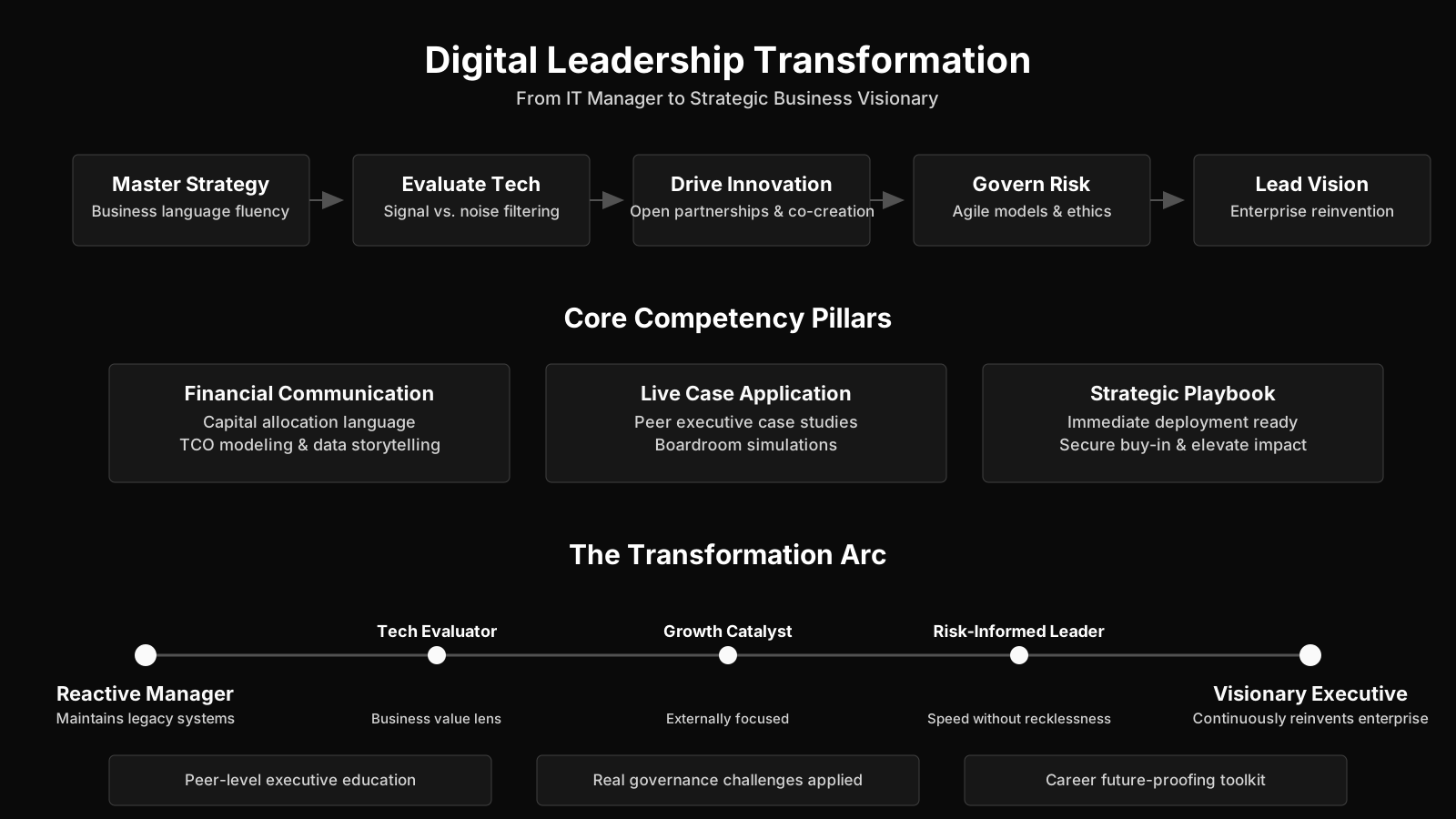
Summary: Future-Proof Your Leadership with CIO Certification
| Key Concept | Summary |
|---|---|
| Certification Purpose | This credential equips senior technology leaders to shift from reactive IT service delivery to proactively architecting enterprise business value and innovation pipelines. |
| Leadership Gap | Many CIOs ascend without formal grounding in corporate strategy, design thinking, or organizational change management, leaving a competency void that this certification directly addresses. |
| Market Signal | The credential serves as a clear market signal to recruiters, boards, and CEOs that the holder can define a digital vision and systematically align IT investments with measurable strategic outcomes. |
| Strategic Decision Making | Training shifts decision making from reactive troubleshooting to proactive strategic framing, ensuring every technology choice is deliberately connected to a defined business outcome. |
| Innovation Catalyst | Graduates learn to construct innovation portfolios, design rigorous experiments, and discontinue underperforming initiatives based on evidence rather than emotional attachment. |
| Meta Skills Focus | The curriculum cultivates meta skills such as evaluating emerging technologies through a strategic investment lens and guiding organizations through persistent, adaptive change. |
| Strategic Narrative | Accredited leaders reframe IT spending as a portfolio of value hypotheses rather than a ledger of technical costs, reshaping boardroom conversations. |
| Role Evolution | The certification dismantles legacy success metrics like uptime and ticket volume, repositioning the technology function as a primary engine of revenue growth. |
| Innovation Culture | Leaders gain the ability to foster psychologically safe climates and apply lean product development discipline to rapidly convert concepts into market ready innovations. |
| Future Proofing | This credential future proofs leadership careers by fusing deep technical acumen with strategic foresight, financial literacy, and structured innovation governance. |
Why the CIO Strategy & Innovation Certification Defines the Next Generation of IT Leadership
The modern enterprise operates in a state of permanent volatility, where market shifts can render a business model obsolete in months. In this environment, the CIO cannot afford to be merely the steward of back-office systems. The demand is for a leader who speaks the language of the boardroom, co-creates revenue-generating digital products, and harnesses emerging technologies to invent new sources of competitive advantage. Applying lean product development methods, such as the Build, Measure, Learn: The MVP Blueprint for Success , enables CIOs to turn concepts into market-ready innovations rapidly. The CIO Strategy & Innovation Certification was designed precisely to bridge the gap between legacy IT management and the strategic, innovation-centric leadership that firms desperately need.
Too many technology executives still find themselves trapped in a cycle of cost-cutting and technical firefighting. They are assessed on uptime, help desk ticket resolution, and infrastructure refresh cycles. While those metrics remain important, they no longer define impact at the executive table. The certification challenges this outdated framing by equipping leaders with the mental models, frameworks, and peer networks required to position technology as a primary growth engine—an endeavor that benefits greatly from adaptable leadership styles such as Mastering Situational Leadership . It forces a re-examination of what the CIO role means and how it must evolve to stay relevant. This closely parallels the 5 Crucial Differences Between a Manager and a Leader that every aspiring strategic CIO must internalize.
The credential also acts as a signal to the broader market. Recruiters, boards, and CEOs increasingly look for evidence that a technology leader can craft a digital vision, drive innovation culture, and align IT investments with strategic outcomes. Building that innovation culture often starts with creating psychologically safe environments, as detailed in Cultivating Courageous Teams: A Leader’s Roadmap to Psychological Safety . A well-regarded CIO Strategy & Innovation Certification provides that signal in a credible, structured form, supplementing years of practical experience with a formalized, peer-validated mastery of strategic management disciplines.
The Shifting Landscape that Demanded the CIO Strategy & Innovation Certification
Just two decades ago, the chief information officer role was predominantly technical. The mandate was clear: keep the email running, maintain the ERP system, and ensure data security. Strategic conversations happened elsewhere, often driven by the CFO or COO. The separation made sense when technology was a support function, not a core business driver. Fast forward to today, and that separation has collapsed. Every customer interaction, every supply chain node, and every employee experience is mediated by software and data. The CIO now sits at the center of business model innovation, whether they are ready or not.
This shift exposed a glaring competence gap. Many technology leaders had risen through infrastructure or application management roles without formal training in corporate strategy, design thinking, portfolio management, or organizational change. Promoting a brilliant engineer to a strategic leadership role without bridging that gap was a recipe for misalignment, wasted investment, and cultural friction. The CIO Strategy & Innovation Certification was born from the recognition that technical acumen alone cannot drive digital transformation. It must be fused with strategic foresight, financial literacy, and innovation governance.
Moreover, the acceleration of artificial intelligence, cloud-native platforms, and platform business models means that the half-life of traditional IT skills is shrinking. A certification program that focuses purely on current technologies would become obsolete quickly. The programs that truly future-proof leadership are those that teach meta-skills: how to evaluate emerging technology through a strategic lens, how to build adaptable innovation portfolios, and how to lead organizations through continuous change. This is precisely the terrain the CIO Strategy & Innovation Certification covers.
How the CIO Strategy & Innovation Certification Enhances Strategic Decision-Making
Strategic decision-making in a technology context is fundamentally different from operational problem-solving. It requires the ability to operate with incomplete information, to balance long-term vision with short-term constraints, and to translate abstract market signals into concrete capability roadmaps. The certification curriculum typically immerses participants in scenario planning, competitive analysis, and technology trend radar exercises that sharpen this cognitive muscle. Leaders learn to move from a reactive posture to one where they actively shape the organization’s strategic options.
One of the most powerful shifts is mastering the art of the strategic narrative. Instead of presenting IT budgets as a list of software licenses and hardware refreshes, certified leaders learn to frame every investment as a hypothesis about future value. A cloud migration is no longer a technical refresh; it becomes a platform for rapid experimentation that reduces time-to-market for new digital services. A data governance overhaul is reframed as the foundation for AI-driven personalization that could unlock a new revenue stream. This ability to connect technology choices to business outcomes is what separates a transactional IT manager from a true strategic partner.
The certification also emphasizes evidence-based decision-making. Leaders are trained to design experiments, interpret data from pilots, and kill initiatives that do not meet pre-defined success criteria without emotional attachment. This discipline is rare in traditional IT environments, where sunk-cost fallacy and political inertia often keep failing projects alive. By embedding a portfolio approach to innovation, the CIO Strategy & Innovation Certification helps leaders allocate scarce talent and capital to the initiatives most likely to generate strategic returns.
The CIO Strategy & Innovation Certification as a Catalyst for Enterprise Innovation
Innovation is frequently misunderstood as a random flash of creativity or a hackathon gimmick. In large, complex organizations, sustainable innovation is a managed capability that requires systems, metrics, and cultural reinforcement. The certification treats innovation as a disciplined process that can be taught, measured, and scaled. Leaders explore various innovation typologies, from incremental process improvement to adjacent market expansion and radical business model reinvention, learning when to apply each and how to resource them appropriately.
A central theme is the concept of ambidextrous leadership: the ability to simultaneously optimize the existing core business while exploring new, potentially disruptive opportunities. Most CIOs are hardwired for optimization because their performance is judged on reliability and efficiency. The certification introduces frameworks like the Three Horizons model, lean startup methodologies, and innovation accounting that allow leaders to create a separate, protected space for exploration without cannibalizing the core. This prevents innovation from becoming a side project that always gets deprioritized during budget season.
Furthermore, the certification underscores the role of the CIO as an ecosystem orchestrator. Innovation rarely happens in isolation. It requires partnerships with startups, academic institutions, consortia, and even competitors through co-opetition. Leaders learn how to scan the external environment for emerging technologies, evaluate partnership models, and negotiate collaboration agreements that accelerate capability development without bloating internal R&D budgets. This outward-facing orientation is a hallmark of the modern strategic CIO and a direct outcome of the CIO Strategy & Innovation Certification experience.
Key Competencies Developed in a CIO Strategy & Innovation Certification Program
While program designs vary by institution, the core competencies cultivated in a rigorous CIO Strategy & Innovation Certification generally align around a handful of transformative skill clusters. The first is strategic alignment, which encompasses the ability to translate corporate objectives into technology roadmaps and, conversely, to surface new strategic possibilities enabled by technology. This bi-directional translation skill is rare and highly valued. It requires fluency in both business unit economics and the technological art of the possible.
The second competency cluster is innovation governance. This includes designing stage-gate processes for innovation projects, managing an innovation portfolio, and defining metrics that balance learning and financial return. Leaders learn to avoid the common trap of applying standard capital budgeting techniques to high-uncertainty ventures, which often kills promising ideas prematurely. Instead, they adopt discovery-driven planning and real options thinking that match the risk profile of innovation.
Third, digital business model acumen has become indispensable. The certification dives deep into platform economics, subscription models, data monetization, and ecosystem strategies. CIOs who understand how software reshapes industry boundaries can proactively propose new revenue models instead of waiting for the marketing or strategy team to hand down requirements. This proactive posture transforms the IT organization from an order-taker into an innovation incubator.
Fourth, organizational change leadership and culture transformation are woven throughout the curriculum. The most brilliant strategy fails without the organizational willingness to adopt new ways of working. Participants explore change management theories, including Kotter’s eight-step framework and Prosci’s ADKAR model, and apply them to real-world digital transformation scenarios. They learn to diagnose organizational readiness, build guiding coalitions, and communicate a compelling vision that overcomes resistance.
Fifth, financial fluency and value realization round out the competency set. The certification ensures that leaders can build business cases, forecast benefits, and track value delivery against promised outcomes. Beyond the simple ROI calculation, they explore modern approaches like value stream mapping and economic value added that connect technology investment directly to shareholder value. This competency is critical for building credibility with the CFO and the board.
Evaluating the ROI of a CIO Strategy & Innovation Certification
Investing in an executive certification involves significant time and financial resources, so it is fair to scrutinize the return on investment. Tangible career returns often manifest as expanded role scope, promotion to a more strategic CIO or chief digital officer position, or selection for high-visibility transformation initiatives. The credential can also strengthen a leader’s position during mergers and acquisitions, when the acquiring entity evaluates the leadership team’s ability to integrate and innovate.
From an organizational perspective, the ROI is measured in the quality of strategic decisions, the speed of innovation delivery, and the reduction in failed technology projects. Certified leaders bring structured thinking that de-risks large-scale transformations. They are more likely to introduce innovation management systems that turn scattered ideas into a reliable pipeline of new services. Over time, this capability can translate into measurable market share gains, improved customer experience scores, and even entirely new lines of business.
However, it is essential to acknowledge limitations. No certification guarantees a specific salary bump or a seat on the board. Context matters immensely. If the organizational culture fundamentally resists strategic IT involvement, even the most certified CIO will struggle. The credential amplifies existing leadership qualities and provides new tools, but it cannot compensate for poor interpersonal skills, lack of industry knowledge, or a toxic work environment. Therefore, the real ROI of the CIO Strategy & Innovation Certification is best viewed as a multiplier of the leader’s baseline capability and the organization’s readiness to embrace strategic technology leadership.
Selecting the Right CIO Strategy & Innovation Certification for Your Career Stage
The market for executive technology leadership credentials has expanded significantly, and not all programs carry the same weight or focus. When evaluating a CIO Strategy & Innovation Certification, it is crucial to look beyond the brand name and examine the curriculum depth, the faculty’s mix of academic rigor and practitioner experience, and the quality of the peer cohort. A program taught exclusively by academics may lack the gritty, real-world application that senior leaders need, while one taught solely by consultants may downplay the organizational change complexities.
A well-designed certification will include a capstone project or applied learning component that forces participants to tackle a live strategic challenge within their own organization. This not only cements learning but also generates immediate business value, making the investment easier to justify to a sponsor or employer. Additionally, look for programs that provide ongoing access to alumni networks, research updates, and continuous learning opportunities after the formal coursework ends. The velocity of technology and business change means that certification should be the beginning of a lifelong learning relationship, not a one-time transaction.
Leaders should also consider their personal growth edge. If the primary gap is innovation process management, a certification that heavily features design thinking, lean startup, and innovation metrics may be ideal. If the gap is strategic communication and board influence, a program that includes intensive executive presence coaching and board simulation exercises will provide more immediate impact. The best CIO Strategy & Innovation Certification programs offer enough flexibility or specialization tracks to meet these varied needs without diluting the core leadership message.
How the CIO Strategy & Innovation Certification Integrates with Real-World Frameworks
Any credible business education must translate theory into practice, and the CIO Strategy & Innovation Certification grounds its teaching in frameworks that are immediately applicable. Participants often apply the strategic alignment model to map their own organization’s IT investments against business priorities, revealing misalignments that have persisted for years. This exercise alone frequently leads to immediate budget reallocations that generate quick wins and build stakeholder confidence.
Similarly, innovation portfolio management frameworks enable leaders to audit their current project pipeline. Many discover that their portfolio is lopsided, heavily weighted toward low-risk, low-return incremental improvements with almost no exploration of breakthrough opportunities. The certification teaches how to rebalance the portfolio using clear criteria, and participants leave with a concrete action plan to discuss with the executive committee. This is not abstract theory; it is a restructuring of how innovation capital is deployed.
The application of agile and lean principles at the strategic level is another practical takeaway. While most IT organizations have adopted agile at the team level, scaling it to align with enterprise strategy remains a persistent challenge. The certification explores frameworks like the Scaled Agile Framework (SAFe) and lean portfolio management, but does so through the lens of business outcomes rather than methodology compliance. Leaders learn to create flow from strategic intent to customer delivery without getting lost in process dogma.
Core Insights on Next-Gen CIO Leadership
- Bridging the strategic gap
- The certification elevates the CIO role from a back-office custodian to a boardroom leader who co-creates revenue-generating digital products and drives sustainable competitive advantage.
- Moving beyond cost-cutting metrics
- It shifts focus from legacy operational metrics like uptime and ticket resolution, providing frameworks that reposition technology as a core engine of enterprise growth.
- A market signal for strategic value
- Recruiters and boards interpret this credential as clear validation that a technology leader can formulate a forward-looking digital vision and align IT investment with concrete strategic outcomes.
- Future-proofing through meta-skills
- The program builds the capacity to strategically assess emerging technologies and construct adaptive innovation portfolios, replacing fixation on fleeting technical skills with enduring leadership capability.
Debunking Common Myths Around CIO Certifications
A persistent myth suggests that seasoned executives do not need certifications because their experience speaks for itself. While experience is invaluable, it can also be limiting. Years spent in one industry or one organizational culture can create blind spots that a well-structured certification program exposes. Peer discussions with CIOs from different sectors often reveal alternative approaches to common problems, sparking insights that would not emerge from the isolation of a single company. The CIO Strategy & Innovation Certification serves as a structured forcing function to break out of experience-based echo chambers.
Another myth claims that innovation cannot be taught and that certification programs are therefore a waste of time. This confusion conflates individual creativity with organizational innovation capability. While it is true that no program can make someone a genius inventor, the ability to design processes, governance, and cultures that systematically produce innovation is absolutely teachable. The certification focuses on the latter. It does not promise to turn every leader into Steve Jobs; it promises to give them the tools to build an organization that can identify, test, and scale good ideas faster than the competition.
There is also a misconception that such certifications are a shortcut to bypass deep technical knowledge. The opposite is true. The most effective participants already possess a strong technical foundation. The certification adds a strategic layer that allows them to leverage that technical depth for business impact. A leader without understanding of cloud, data, or cybersecurity could complete the program but would struggle to apply the concepts credibly. The CIO Strategy & Innovation Certification is an amplifier of existing expertise, not a replacement for it.
Change Management and Cultural Transformation Through the Certification Lens
Digital transformation is at its core a human endeavor. Technology is the enabler, but people and culture determine success or failure. The CIO Strategy & Innovation Certification dedicates substantial attention to the human side of change, recognizing that resistance to new digital tools rarely stems from technical concerns. It stems from fear of job loss, loss of status, or disruption to comfortable routines. Leaders learn to diagnose the root causes of resistance and design interventions that address emotional and psychological barriers.
One powerful framework explored is the concept of psychological safety and its role in innovation. High-performing teams that experiment and learn from failure require an environment where speaking up is safe. The certification shows how CIOs can deliberately cultivate this climate through leadership behaviors, reward systems, and storytelling. Case studies of failed transformations often highlight a culture of fear that prevented early warning signals from reaching leadership. Certified leaders are equipped to detect and dismantle such cultural barriers before they derail major initiatives.
The program also teaches how to build a coalition of champions across the business. A common mistake is the CIO attempting to drive change alone from the IT function. The certification stresses the importance of co-ownership, where business unit leaders jointly sponsor digital initiatives and are held accountable for adoption outcomes. This transforms the political dynamic from “IT is doing something to us” to “we are transforming together,” dramatically increasing the likelihood of sustained success.
The Organizational Payoff of a Company with Certified Strategic CIOs
When a company has a CIO equipped with the Strategy & Innovation Certification, the effects ripple far beyond the IT department. Strategic alignment improves because technology roadmaps are continuously validated against market shifts and corporate strategy, not built in an annual planning vacuum. This reduces the number of orphaned platforms and redundant systems that accumulate over time. The result is a leaner, more modern technology estate that can flex with business needs.
Innovation velocity increases as well. A certified leader introduces lightweight governance that accelerates decision-making for small experiments while maintaining appropriate controls for large bets. The organization stops getting bogged down in endless business case cycles for ideas that cost little to test. Employees feel empowered to propose experiments because there is a clear, transparent process for funding and evaluating them. This grassroots innovation dynamic feeds the top-down strategic vision, creating a virtuous loop.
Talent attraction and retention also benefit. High-caliber technologists and digital-savvy business professionals gravitate toward organizations where they see a compelling digital vision and a leadership team that understands both technology and strategy. The CIO Strategy & Innovation Certification serves as a beacon to the external talent market, signaling that this is a place where an IT career can evolve into a broader business leadership trajectory. Retention improves when high-potential employees see that innovation and strategic thinking are valued, not just uptime and cost control.
Moreover, the organization’s risk posture improves, not because the certified CIO avoids risk, but because they manage it intelligently. They can differentiate between risks worth taking to gain competitive advantage and risks that threaten compliance or security without commensurate benefit. This nuanced risk conversation builds trust with the board and regulators, positioning the company as a responsible innovator rather than a reckless or stagnant one.
The Capstone Project: Bridging Certification Learning to Immediate Impact
One of the most distinguishing features of a high-quality CIO Strategy & Innovation Certification is the capstone project. This is not an academic paper filled with generic recommendations. It is a real strategic initiative that the participant designs, pressures-tests with faculty and peers, and often begins to implement during the program. The topic might be a new digital business model, a major cloud transformation with a value capture plan, or an organizational redesign that places innovation at the center of the IT operating model.
The capstone process forces synthesis. Instead of treating strategic alignment, innovation governance, and change management as separate modules, the leader must weave them together into a coherent execution plan. They must defend their assumptions, respond to the kind of skeptical questioning they will face from their own CFO or board, and iterate based on feedback. This experience builds the confidence to lead high-stakes strategic conversations long after the certification is complete.
Many participants report that the capstone project became the foundation for a promotion case or a board presentation that significantly elevated their internal profile. The immediate business value created often offsets the program’s cost within the same fiscal year, which makes the investment a no-brainer for forward-thinking organizations that sponsor their leaders. The capstone is the ultimate proof that the CIO Strategy & Innovation Certification is not a passive learning exercise but a driver of real-world transformation.
The Intersection of Technology Leadership and Continuous Learning
Future-proofing a leadership career is not a one-time event. The CIO Strategy & Innovation Certification is best understood as a pivotal milestone in a longer arc of development. The rate of change in artificial intelligence, quantum computing, Web3, and other emerging fields means that even the most comprehensive certification curriculum will eventually need refreshing. What the certification provides, however, is a durable learning framework and a professional network that makes continuous education far more efficient.
Leaders who have completed the program tend to stay connected through alumni events, online communities, and executive briefings. They share war stories about what is working and what is not in their respective industries. This informal knowledge exchange is often as valuable as the structured curriculum because it offers real-time, context-rich insights. The certification acts as an entry ticket to a lifelong community of practice dedicated to elevating the strategic impact of technology leadership.
Furthermore, the mindset shift that occurs during the program, moving from a fixed asset steward to a perpetual learner and experimenter, becomes self-reinforcing. Certified CIOs are more likely to allocate personal time for reading strategy journals, attending innovation workshops, and mentoring the next generation of leaders. This ripple effect strengthens the entire leadership pipeline, ensuring that the organization builds a bench of strategically minded technology executives who can step into bigger roles when needed.
Selecting the Right CIO Strategy & Innovation Certification Program for Long-Term Impact
Given the investment at stake, careful due diligence is essential. Accreditation can be a useful signal, but for executive-level programs, the reputation of the issuing institution and the track record of its alumni often matter more. Look for programs that have produced CIOs or chief digital officers in companies you admire. Reach out to alumni for candid conversations about how the certification actually changed their day-to-day work and career trajectory. Beware of programs that promise exaggerated outcomes or quick fixes.
Examine the curriculum’s balance between contemporary case studies and timeless strategic frameworks. A program that leans too heavily on the technology flavor of the month may feel relevant for a year and then date badly. The best CIO Strategy & Innovation Certification programs use current technology trends as a context for teaching enduring principles of strategy, innovation economics, and organizational behavior. This balance ensures the credential remains valuable even as the technological landscape shifts.
Consider the learning format. Executive leaders rarely have the luxury of full-time study, so blended or modular formats that combine intensive residential sessions with virtual collaboration are common. The quality of the digital learning platform and the peer interaction design can make or break the experience. High-touch cohort models that foster deep, trust-based relationships provide support networks that last beyond the classroom. These human connections often become the most durable asset of the entire certification journey.
Core Organizational Benefits Summary
- Strategic alignment and a leaner technology estate
- Technology roadmaps are continuously validated against shifting market conditions and corporate strategy, which systematically eliminates orphaned platforms and redundant systems, yielding a leaner and more responsive technology estate.
- Accelerated innovation velocity
- Lightweight governance accelerates decision-making for exploratory initiatives while preserving rigorous controls for strategic investments, enabling any employee to pitch ideas through a clear, transparent funding mechanism.
- Enhanced talent attraction and retention
- Top-tier professionals are attracted by a compelling digital vision, and retention strengthens when the organization visibly rewards innovation and strategic thinking rather than focusing narrowly on cost containment.
- Heightened intelligent risk posture
- A certified CIO distinguishes clearly between competitive risks and compliance threats, building trust with the board and regulators by consistently positioning the organization as a responsible innovator that balances growth and control.
Preparing for the Future of the CIO Role with Confidence
The CIO role will continue to morph. In many organizations, it is already splitting into more specialized leadership positions such as chief digital officer, chief data officer, and chief technology officer. The CIO Strategy & Innovation Certification equips leaders not just for one narrow track but for the broader enterprise leadership responsibilities that increasingly fall to technology executives. Whether the title on the door says CIO, CDO, or something else, the strategic muscle and innovation discipline developed through the certification remain highly transferable.
The certification also provides a common language and mental model that aligns technology leadership with the board’s agenda. Boards are increasingly focused on digital risk, innovation capacity, and technology-driven growth. A certified CIO can articulate how technology investments connect to enterprise resilience, how innovation metrics demonstrate progress, and how the organization is preparing for disruptive threats. This boardroom fluency is not developed through technical training alone; it requires the kind of integrated strategic education that the certification delivers.
As artificial intelligence and automation continue to reshape the workforce, the CIO’s role in human capital strategy will grow. Certified leaders understand that technology adoption must be accompanied by thoughtful workforce transition plans, upskilling initiatives, and ethical governance. They can lead conversations about the future of work that go beyond headcount reduction and encompass new value-creation roles that technology enables. This holistic perspective is what separates a cost-focused IT leader from a future-proof enterprise strategist.
Sustaining the Momentum After the CIO Strategy & Innovation Certification
Completion of the program is an achievement, but it is the start of a new chapter, not the end. Leaders who maintain momentum schedule regular reflection sessions to assess whether they are applying the frameworks learned or slipping back into old reactive patterns. They identify one or two innovation governance changes they can implement within the first ninety days to create visible traction. Early wins, such as streamlining the idea evaluation process or launching a small cross-functional innovation sprint, generate the credibility needed for larger transformations.
Sharing knowledge formally with the team is another powerful way to embed the learning. A certified CIO might run a mini-strategy workshop for their leadership team using the alignment models from the program, adapting the language to the company’s context. This not only reinforces their own understanding but also develops strategic thinking capacity across the IT organization. It sends a clear signal that strategic leadership is now expected at all levels, not just in the corner office.
Finally, paying it forward by mentoring others who are considering the CIO Strategy & Innovation Certification creates a virtuous cycle. Explaining concepts to others deepens mastery. Mentoring also expands the leader’s network of strategically minded professionals and reinforces their reputation as a thought leader. In a business world where networks and knowledge compounds, these activities build an invisible career asset that pays dividends for decades.
The decision to pursue a CIO Strategy & Innovation Certification is fundamentally a decision to take ownership of your leadership trajectory. It acknowledges that the half-life of purely technical skills is shrinking and that the only sustainable competitive advantage for a senior technology executive is the ability to think strategically, drive innovation culture, and lead through change. In a landscape where yesterday’s differentiators quickly become table stakes, this certification offers not a guarantee of success but a structured, time-tested approach to building the capabilities that the market consistently rewards. For those ready to move beyond managing technology to shaping the business with it, the path forward is clear and the investment in a CIO Strategy & Innovation Certification is one of the most deliberate steps you can take to future-proof your leadership.
Advance Your Career with Professional Certification
Professional project management certification is a powerful way to demonstrate your ability to lead complex initiatives and deliver strategic value, making you a more competitive candidate for senior roles. Pursuing a PM certification online enables you to gain these critical skills with flexibility while balancing work and personal commitments. Organizations increasingly rely on certified project managers to reduce risks, optimize resources, and drive innovation, which directly contributes to business growth. Ultimately, this credential not only future-proofs your career but also strengthens your organization’s capacity to achieve its long-term goals.
In today's competitive landscape, a product management certification equips professionals with the strategic frameworks needed to align customer needs with business objectives, directly boosting career advancement and earning potential. Employers increasingly trust a recognized product owner certification to validate an individual's ability to lead agile teams and prioritize backlogs effectively, reducing costly missteps. This upskilling not only future-proofs your leadership profile but also drives tangible organizational success by streamlining product delivery and enhancing stakeholder satisfaction.
Earning a professional HR management certification is a strategic investment that validates your expertise in workforce planning, compliance, and strategic partnership, making you a more competitive candidate for senior roles. As organizations increasingly rely on data-driven people strategies, a certified HR manager brings proven knowledge of modern practices that directly improve employee retention and organizational agility. This credential not only accelerates your career trajectory but also equips you to design inclusive cultures and navigate complex labor laws, ensuring your company remains resilient in a changing market.
