Pursuing a PRINCE2 Foundation Certification Training & Exam Preparation Course is a strategic step for anyone looking to build credibility in project management . The Foundation certification, issued by AXELOS, verifies that you understand the PRINCE2 method enough to contribute to a project team operating within that framework. The PRINCE2 methodology is deceptively simple on the surface, but its real power lies in how principles, themes, and processes interlock to control project variables. This article will guide you through the entire journey, from selecting a training course to passing the exam and applying the knowledge in the real world. A well-designed PRINCE2 Foundation Certification Training & Exam Preparation Course can compress months of self-study into a focused, efficient learning path.
PRINCE2 Foundation: Key Topics at a Glance
| Key Concept | Summary |
|---|---|
| Certification | PRINCE2 Foundation, an entry-level qualification from AXELOS, confirms a candidate’s command of the methodology and holds lifetime validity with no renewal requirement. |
| Training Course | A dedicated training course delivers a structured curriculum and realistic practice exams, markedly increasing the probability of passing on the first attempt. |
| Career Benefits | Earning this certification strengthens your profile for roles in government, consulting, and other sectors that list PRINCE2 as a fundamental prerequisite. |
| Global Reach | Recognized in more than 150 countries, PRINCE2 is widely embedded across IT, construction, international development, and other project-intensive industries. |
| Framework | The framework integrates seven principles, seven themes, and seven processes into a cohesive structure that systematically governs project variables from initiation to closure. |
| Principles | The seven universal principles, including continued business justification, learning from experience, defined roles and responsibilities, and management by stages or exception, ensure every project remains aligned with strategic objectives. |
| Themes | The seven themes provide continuous oversight of critical dimensions: business case, organization, quality, planning, risk, change, and progress, ensuring nothing is neglected throughout the project lifecycle. |
| Processes | The seven processes map the project journey from start-up to closure, assigning clear responsibilities and timelines to maintain structured, controlled progress. |
| Exam Preparation | An effective course decodes the official manual, exposes common exam pitfalls, and supplies realistic mock tests that evaluate applied understanding rather than rote recall. |
| Methodology | As a governance framework, PRINCE2 complements agile delivery by adding essential structure and control, proving especially valuable in complex or fast-changing environments where clarity and accountability are paramount. |
What is PRINCE2 Foundation Certification?
PRINCE2, which stands for PRojects IN Controlled Environments, is a process-based methodology for effective project management. The Foundation level is the entry-point qualification that confirms a candidate’s understanding of the PRINCE2 terminology, structure, and basic application. Obtaining the PRINCE2 Foundation certification demonstrates a solid grasp of the method’s principles, themes, and processes. Unlike certifications that demand years of experience, the Foundation exam is open to anyone and does not require proof of practical project management hours. This makes it an ideal starting point for newcomers to the field or for experienced professionals seeking a structured approach. The certification is valid for life, unlike the Practitioner level which requires re-registration, so once you earn it, you keep it.
The Role of the PRINCE2 Foundation Certification
Many organizations adopt PRINCE2 as their standard project management framework, especially in government, construction, IT, and international development. Holding a Foundation certificate signals to employers that you can speak the same language as the project team and understand the fundamental controls and documentation. It is not a guarantee of project success, of course, but it reduces the learning curve when joining a PRINCE2-aligned environment. In practice, the Foundation certification often serves as a prerequisite for more advanced roles or for the Practitioner exam. Recruiters frequently list it as a desired qualification, and it sometimes acts as a tiebreaker between candidates with similar experience.
How the PRINCE2 Methodology Differs
PRINCE2 is unique
Core Takeaways on PRINCE2 Foundation Certification
Why Pursue a PRINCE2 Foundation Certification Training & Exam Preparation Course?
A structured course is not mandatory to sit for the exam, but it dramatically increases your chances of passing on the first attempt. Enrolling in a dedicated PRINCE2 Foundation certification training course provides a clear roadmap through the syllabus and hands-on practice with sample questions. The exam tests not just rote recall but also the application of concepts like tailoring, management stages, and roles. Without guidance, it is easy to misinterpret the official manual, which is dense and written in a very precise language. A good course decodes that language, highlights common exam traps, and offers a safe environment to test your understanding through mock exams.
Career Benefits of the Foundation Certification
Adding PRINCE2 Foundation to your resume can open doors in sectors where the method is a baseline requirement. Governments in the UK, Australia, and several European countries embed PRINCE2 in their procurement processes. As a result, consulting firms and contractors must demonstrate PRINCE2 competence. Even if your current employer does not use PRINCE2, the certification proves that you have a systematic approach to managing projects, which is transferable. Some salary surveys indicate that project professionals with PRINCE2 credentials earn slightly more than their non-certified peers, though this varies by region and industry. The real value often comes in the confidence it gives you to structure chaotic projects.
Industry Recognition and Global Reach
PRINCE2 is among the most widely adopted project management certifications alongside PMP and CAPM from PMI. While PMP focuses heavily on predictive lifecycle and knowledge areas, PRINCE2 offers a governance layer that complements many other methodologies. Many organizations blend PRINCE2 with agile delivery methods, using PRINCE2 for project governance and agile for product delivery. The Foundation certification is recognized in over 150 countries. The official AXELOS syllabus is regularly updated, and the current version is PRINCE2 6th Edition, though updates may occur. When you choose a training provider, make sure the course aligns with the latest syllabus.
Understanding the PRINCE2 Framework
The PRINCE2 framework is built on seven foundational principles that must be satisfied for a project to be considered PRINCE2-compliant. These principles are universal, self-validating, and empowering. They include continued business justification, learning from experience, defined roles and responsibilities, managing by stages, managing by exception, focusing on products, and tailoring to suit the project environment. The framework then provides seven themes that address aspects of project management that need to be handled continuously: business case, organization, quality, plans, risk, change, and progress. Finally, seven processes describe the chronological steps a project goes through from start-up to closure, defining who does what and when. Understanding how these three elements interact is the core of the Foundation exam.
The Seven Principles
Continued business justification means that a PRINCE2 project must have a valid business case and that justification must be re-evaluated throughout the project. If it disappears, the project should be stopped. The learn from experience principle requires the project team to actively seek, record, and apply lessons from previous projects. Defined roles and responsibilities ensure that everyone involved understands what is expected of them, with clear accountability. Manage by stages breaks the project into management stages, providing control points at which the project board can decide whether to continue. Manage by exception sets tolerances for each project objective, allowing the project manager to handle day-to-day issues without escalating unless thresholds are breached. Focus on products means that planning and work are driven by the deliverables and their quality criteria, not by activities. Tailor to suit the project environment means that PRINCE2 must be adapted to the project’s scale, complexity, and risk, not applied blindly.
The Seven Themes
Themes answer the “what” questions of project management. The business case theme establishes the mechanism to judge whether the project remains worthwhile. Organization defines the project management team structure, roles of project board, project manager, team manager, and other stakeholders. Quality covers how the project will ensure that its products meet the required standards and fitness for purpose. Plans describes the different levels of planning (project plan, stage plan, team plan) and the product-based planning technique. Risk deals with uncertainty and the management of both threats and opportunities. Change is about issue management, handling requests for change, off-specifications, and problems. Progress monitors actual achievements against plans and forecasts, enabling decisions on escalation and stage boundaries. Each theme gets attention throughout the project, not just in one phase.
The Seven Processes
The processes provide the project lifecycle. Starting up a Project is pre-project work to assess viability and appoint the project manager. Directing a Project runs from start-up to closure and covers the project board’s decision-making. Initiating a Project establishes solid foundations through detailed planning, risk analysis, and setting up controls. Controlling a Stage is the day-to-day work of the project manager, assigning work, reviewing progress, and dealing with issues. Managing Product Delivery focuses on the team manager’s role in accepting and delivering work packages. Managing a Stage Boundary occurs at the end of each stage to review progress, update plans, and prepare the next stage plan. Closing a Project ensures formal handover, evaluation, and recommendations for future projects. The Foundation exam expects you to know the purpose and objectives of each process and how they relate to one another.
Key Insights into the PRINCE2 Framework
- Seven universal principles
- PRINCE2 rests on seven non‑negotiable principles, including continued business justification and learning from experience, each of which must be upheld for a project to be considered compliant.
- Seven continuous themes
- These themes represent the continuous management disciplines of business case, organization, quality, plans, risk, change, and progress, defining what aspects require sustained attention throughout the project lifecycle.
- Seven chronological processes
- The processes chart the project’s temporal flow from initiation to closure, detailing the roles, responsibilities, and timing for directing, initiating, controlling stages, and managing product delivery.
- Interaction of principles, themes, processes
- Mastering the interplay among principles, themes, and processes constitutes the central assessment criterion of the PRINCE2 Foundation exam.
- Tailoring as a core principle
- PRINCE2 mandates deliberate adaptation to each project’s unique scale, complexity, and risk profile, reinforcing that effective application relies on thoughtful tailoring rather than rigid adherence.
Training Options for the PRINCE2 Foundation Exam
Professionals can choose from several training formats, including classroom, virtual instructor-led, and self-paced online PRINCE2 Foundation certification training. Each has trade-offs in terms of cost, flexibility, and interaction. The right choice depends on your learning style, schedule, and budget. Classroom training provides immersive, distraction-free learning over consecutive days, often culminating in the exam on the final day. Virtual instructor-led courses replicate the classroom experience via video conferencing, offering interaction with a live trainer and peers without travel. Self-paced online courses allow you to study at your own rhythm, often with video lectures, quizzes, and forums, but demand high self-discipline. Many accredited providers offer these formats, and some blend them. Some employers fund these courses, so it is worth checking with your organization.
Classroom-based Training
Classroom training remains popular because it forces focus. For three or five days, you are away from the office, fully immersed in the material. Trainers can adapt to the group’s pace and clarify difficult concepts on the spot. The main downside is cost and the need to travel, which can be a barrier. However, many find the intensive format highly effective for passing the exam. Courses typically include the official manual, sample exams, and the exam fee. Accreditation by AXELOS is essential, so always verify that the provider is an Accredited Training Organization (ATO). The exam is often taken on the last day of the class, while knowledge is fresh.
Virtual Instructor-Led Training
This format gained traction during the pandemic and has remained a staple. You join scheduled live sessions from anywhere, using tools like Zoom or Teams. The advantage is real-time interaction: you can ask questions, participate in breakout discussions, and get immediate feedback. Providers usually supply digital materials and exam vouchers for online proctored exams. The main challenge is maintaining engagement over long virtual sessions; breaks and interactive exercises are key. The quality of instruction varies, so checking trainer credentials and reviews is important. Some people find virtual training less distracting than a physical classroom because they can control their environment.
Self-paced Online Courses
These are the most flexible and often the most affordable option. You access a learning platform with recorded video lessons, reading materials, quizzes, and full-length mock exams. You can study whenever suits you, over a few weeks or months. The onus is on you to stay on track. Many platforms include a pass guarantee or a free resit if you fail the exam. However, without a live instructor, you might struggle with ambiguous concepts. Supplementing self-paced study with a study group or forum can help. Ensure the course is up-to-date with the current PRINCE2 version and includes official sample papers.
Selecting a Quality PRINCE2 Foundation Certification Training & Exam Preparation Course
Not all courses are created equal. When you invest time and money, you want a program that covers the entire syllabus, provides ample practice, and prepares you for the exam’s peculiar style. A reliable PRINCE2 Foundation certification training course should be fully accredited by AXELOS and include official materials. Accreditation means the training organization and its courseware have been reviewed and meet the required standards. Check if the course includes the official manual, “Managing Successful Projects with PRINCE2,” or a digital equivalent. Also, look for inclusions like exam vouchers, resit options, and access to a question bank. Some providers also offer a post-course support period where you can ask questions via email or forum. It is worth reading recent reviews to gauge the actual student experience.
Why a Dedicated PRINCE2 Foundation Certification Training & Exam Preparation Course Adds Value
A dedicated course bundles the learning and exam preparation into one coherent package, reducing the guesswork. Instead of piecing together free resources that may be outdated, you get a curriculum designed to meet the exam specification. The best courses also teach you how to read the questions carefully, as the exam often uses subtle wording to test understanding. For example, distinguishing between “project mandate” and “project brief” or knowing the exact objective of the “Initiating a Project” process. Without such focused training, you might miss these nuances and lose marks.
Key Components of a PRINCE2 Foundation Certification Training & Exam Preparation Course
A high-quality course should contain at least these elements: a syllabus walkthrough, module summaries, real-world examples to illustrate concepts, interactive quizzes after each topic, and several full-length mock exams with detailed answer explanations. It should also cover the tailoring aspects, as many candidates underestimate how PRINCE2 adapts to different situations. Some courses now incorporate a mobile app for on-the-go revision. The sequence of learning matters too; effective courses build from principles to themes to processes, then integrate them. Look for a course that ends with a solid revision phase rather than cramming all content at once.
Balancing Theory and Practice in a PRINCE2 Foundation Certification Training & Exam Preparation Course
Pure theory can be dry and hard to retain. An engaging course weaves in practical scenarios, case studies, or exercises that force you to apply the method. For instance, a trainer might present a mini-case of a construction project and ask you to identify missing management products or determine when a stage boundary should occur. These exercises cement understanding far better than passive reading. When evaluating a course, ask if it uses scenario-based learning. Even if the course is self-paced, good platforms include simulations. The Foundation exam does not require you to create artefacts, but it does test your ability to choose the correct artifact or role in a given scenario.
Core Takeaways on Course Selection
- Accreditation and official materials
- Prioritize a course that is fully accredited by AXELOS and provides the official PRINCE2 manual, ensuring the syllabus aligns with the latest standards and offering a reliable reference for self-paced review.
- Comprehensive exam preparation bundle
- An effective preparation bundle combines structured syllabus walkthroughs with extensive mock exams, detailed question banks, and a dedicated revision phase, enabling you to master the exam's subtle wording and make informed choices without guesswork.
- Practical scenario-based learning
- Quality training incorporates authentic real-world cases and application-focused exercises that reinforce PRINCE2 concepts through active practice, strengthening long-term retention and sharpening your ability to interpret scenario-driven exam questions.
Creating an Effective Study Plan for the PRINCE2 Foundation Exam
A haphazard study approach leads to unnecessary stress and gaps in knowledge. An effective study schedule for the PRINCE2 Foundation exam allocates time for reading, practice tests, and revision. Most successful candidates spend between 20 and 40 hours preparing, depending on prior project management experience. If you have been managing projects for years but without a formal method, you might need less time than a complete novice, but the exam’s terminology can still trip you up. The key is to start with a diagnostic quiz to identify weak areas, then create a timetable that cycles between learning new material and reinforcing earlier topics. Procrastination is the enemy, so set a firm exam date and book it to create a deadline.
Assessing Your Current Knowledge
Before diving into the manual, take a short sample test available from AXELOS or a reputable provider. This reveals what you already know and highlights which themes or processes need deeper study. Do not be discouraged by a low score; the purpose is calibration. Note any topics where you consistently confuse terms like “risk” versus “issue” or “project product description” versus “product breakdown structure.” These confusions are common and fixable. Also, reflect on your own learning style: do you retain information better through reading, listening, or doing? Use that insight to choose the most efficient study method.
Time Allocation and Milestones
Divide your study plan into phases. First, a foundation phase where you cover the principles and themes to understand the big picture. Next, a process phase where you map out the lifecycle and how documents flow. Then, an integration phase where you review the relationships between principles, themes, and processes through scenario questions. Finally, an exam simulation phase where you take at least two timed mock exams and analyze mistakes. You can schedule 2-3 hours per study session, a few times per week. Leave the last few days before the exam for light revision and mental rest, not cramming.
Practice Exams and Review Cycles
Mock exams are the most critical part of preparation. Aim to complete at least three full practice tests under timed conditions. After each one, thoroughly review every incorrect answer, not only to understand the right choice but also to grasp why the other options were wrong. Many exam answers hinge on exact phrasing; for instance, “the project board is responsible for…” versus “the project manager is accountable for…”. A pattern of mistakes will emerge, revealing your weak areas. Focus your remaining study on those, using the official manual or course materials to reinforce the correct logic. Real exam questions are drawn from a large pool, so practice tests help manage time pressure and build stamina.
Mastering Key Concepts for the PRINCE2 Foundation Exam
The Foundation exam is not a test of memory alone; it evaluates whether you can correctly apply concepts in different scenarios. Mastering key PRINCE2 concepts like management stages, product-based planning, and roles is essential for passing the exam. The exam will ask you to identify the correct document associated with a process, the responsibility of a specific role, or the content of a management product. Understanding the purpose and composition of key documents such as the business case, project brief, project initiation documentation, and end stage report is critical. Many questions are structured as a short scenario followed by a stem like “which role is responsible for…” or “which management product should be updated…”. The more you practice mapping real-world situations to the PRINCE2 model, the easier the exam becomes.
Business Case and Continued Justification
The business case is the backbone of a PRINCE2 project. It provides the justification for the project and must be revisited at each stage boundary. The project board owns the business case, and the project manager is not responsible for validating its continued desirability. The exam may ask what a project should do if the business case becomes invalid. The correct answer is often to recommend premature closure, not to replan or replan the project. This principle surprises many candidates, but it is a core PRINCE2 tenet. Make sure you understand the difference between the business case and the project brief: the brief is a pre-project document that contains an outline business case, not the detailed one.
Management Stages and Stage Boundaries
PRINCE2 projects are divided into management stages, which are partitions of the project with decision points for the project board. A stage provides a control point. The managing a stage boundary process is where the project manager prepares for the project board’s review. This involves updating the project plan, preparing an end stage report, and creating the next stage plan. Confusion often arises between a stage boundary and a project closure; closure happens only once, at the end, and involves handover and evaluation. The exam might present a scenario where a project is halfway through a stage and ask what should be done next. Understanding the flow is key.
Product-based Planning
PRINCE2 emphasizes product-based planning rather than activity-based planning. The technique involves writing a project product description, then constructing a product breakdown structure (PBS) that hierarchically decomposes the final product into its component products. From there, you derive a product flow diagram that shows the sequence of creation and dependencies. The exam might ask you to identify what document is used to describe the final product’s quality criteria and acceptance methods; that is the project product description. Many candidates confuse the PBS with a work breakdown structure, but PBS is product-focused, not activity-focused. Knowing this distinction will save marks.
Roles and Responsibilities in PRINCE2
PRINCE2 defines specific roles: the project board (comprising executive, senior user, senior supplier), project manager, team manager, project assurance, change authority, and project support. The executive is the single point of accountability for the project’s success and is the key decision maker. The project manager runs the project on a day-to-day basis within tolerances. The team manager is responsible for delivering the products assigned in work packages. The exam frequently asks about the interests of the senior user (representing those who will use the products) versus the senior supplier (those providing the resources). Misunderstanding these roles is a common pitfall, so drill them until they are second nature.
Core Takeaways on PRINCE2 Exam Essentials
- Business case as the justification backbone
- The business case serves as the project’s ongoing rationale and is formally re-evaluated at each stage boundary; if it becomes demonstrably invalid, the correct PRINCE2 response is to recommend premature closure instead of replanning.
- Management stages as control points
- Each management stage culminates in a project board decision point, with the Managing a Stage Boundary process updating the project plan, producing an end stage report that assesses performance, and preparing the next stage plan to enable informed authorization of continuity.
- Product-based planning technique
- Product-based planning decomposes the final output into a product breakdown structure and sequences the deliverables through a product flow diagram, while the project product description defines the definitive quality criteria, acceptance methods, and customer quality expectations that govern all work.
- Distinct roles and responsibilities
- PRINCE2’s governance framework clearly separates accountability: the executive owns the business case and project viability, the senior user represents stakeholder needs and expected benefits, the senior supplier commits specialist resources, and the project manager executes day-to-day activities within delegated tolerances.
Common Mistakes in PRINCE2 Foundation Exam Preparation
Even diligent learners can fall into traps that cost them a passing score. One of the most frequent mistakes during PRINCE2 Foundation exam preparation is relying solely on memorization without understanding the underlying logic. The exam is designed to test application, not recall of definitions. If you can recite the definition of a risk but cannot distinguish between a risk and an issue in a scenario, you will struggle. Another error is ignoring the official glossary; the exam uses precise terminology and every word carries weight. Additionally, candidates often skip the Prince2 principles, thinking they are too abstract, but they underpin every theme and process, and questions often test them indirectly. Time management during mock exams is also crucial; some candidates spend too long on a few questions and guess wildly at the end.
Memorizing Without Understanding
Repeatedly reading the manual and making flashcards of definitions is not enough. The Foundation exam presents situations where two answers might seem plausible. Only by grasping how PRINCE2 handles the governance flow can you pick the correct one. For example, a question might ask, “Who should approve the stage plan?” If you memorized that the project board approves the project plan, you might incorrectly apply that to the stage plan. In reality, the project manager creates the stage plan, but the project board approves it as part of the stage boundary review. So understanding the decision hierarchy matters. Use practice questions to test your real comprehension, not just your memory.
Neglecting the Official Glossary
The glossary at the back of the official manual is a goldmine. It defines every term exactly as the exam uses it. Candidates who do not study the glossary can misinterpret questions. For instance, "project assurance" is the project board’s responsibility to monitor all aspects of the project’s performance and products, independent of the project manager. If you are unfamiliar with the precise definition, you might think it is the project manager’s job. Reviewing the glossary during the final revision phase helps solidify the exact wording. Even subtle words like “verify” versus “assure” can be tested.
Overlooking Tailoring and Principles Integration
Tailoring is a principle that often gets short shrift. The exam may ask how you would tailor a theme for a small project. For instance, on a small project, you might combine stage plans into one or have the project manager assume some project assurance tasks. Understanding tailoring prevents you from applying PRINCE2 rigidly. Also, many questions integrate multiple themes: a scenario about a risk might also touch on the business case and change theme. If your study is siloed, you will miss these connections. Practice with scenario-based questions that require cross-topic analysis.
Resources and Study Materials for the PRINCE2 Foundation Exam
Having the right study materials can make or break your preparation. Essential resources for the PRINCE2 Foundation exam include the official manual, sample exam papers, and accredited study guides. The official manual is “Managing Successful Projects with PRINCE2,” published by AXELOS. It is a dense read, so many candidates supplement it with a study guide that translates the official text into plainer language and provides exam tips. AXELOS offers sample papers on their website; these closely mirror the real exam and are invaluable for practice. Some third-party publishers like TSO or APMG produce revision guides, although ensure they are up-to-date with the current syllabus. Avoid relying on outdated resources, as the exam content can shift subtly with each refresh.
Official AXELOS Publications
The core text is the definitive source. It contains all the principles, themes, processes, and management products described in full. Reading it from cover to cover is a grind, but it ensures you do not miss any nuance. The manual also includes appendices with roles, management products, and tailoring examples. Pay special attention to the tables and diagrams; they summarize relationships and often form the basis of exam questions. The downside is that it is not written as a tutorial; it assumes a certain level of project management maturity. So using it together with a structured course is a common approach.
Third-party Study Guides and Books
Study guides are written to make the content more digestible. They often include memory aids, chapter summaries, and practice questions. Be cautious: some guides contain errors or are based on previous versions of PRINCE2. Check the publication date and look for alignment with the 6th Edition (or later). Popular study guides include “PRINCE2 Study Guide” by David Hinde or “Passing the PRINCE2 Foundation Exam” by various authors. These guides are not official but can be helpful when used alongside the manual. Online marketplaces also have flashcard sets and quick-reference cards that can serve as revision tools.
Online Forums and Study Groups
Connecting with others preparing for the exam can provide motivation and clarification. Platforms like Reddit’s r/PRINCE2 or LinkedIn groups host discussions where people share experiences, warn about tricky questions, and recommend resources. However, verify any advice against the official syllabus. Sometimes well-meaning candidates give incorrect interpretations. Study groups can also arrange mock exam sessions and discuss answers collectively, which surfaces misunderstandings. Some training providers have their own student communities. These are generally more reliable because they are moderated by instructors.
Key Study Materials Insights
- Official Manual and Sample Exam Papers
- The AXELOS manual provides the authoritative foundation, and practicing with official sample papers from their website is essential to familiarize yourself with the exam format and question style.
- Supplementary Study Guides
- Supplementary guides, such as David Hinde's text, simplify complex concepts, but you must verify they fully reflect the 6th Edition syllabus to avoid studying outdated material.
- Online Communities and Discussion Forums
- Peer discussion platforms provide collaborative learning and practical exam tips, yet all shared advice should be cross-referenced with the official syllabus to ensure accuracy.
What to Expect on the PRINCE2 Foundation Exam Day
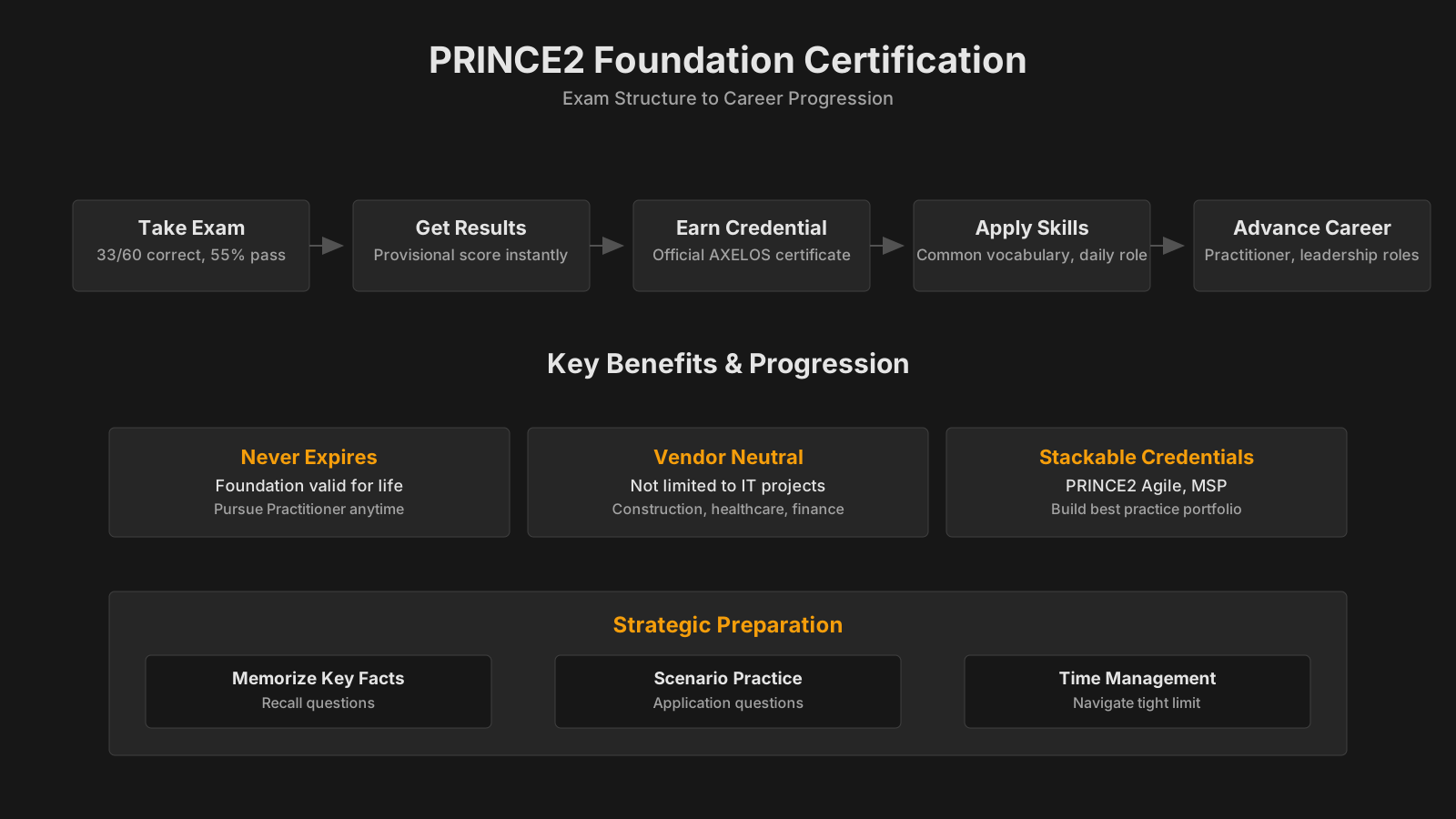
The exam experience is straightforward but requires preparation for the logistics. Understanding the exam format, time constraints, and environment is crucial for performing well on the PRINCE2 Foundation certification exam. The Foundation exam is 60 minutes long, contains 60 multiple-choice questions, and you need 33 correct answers (55%) to pass. There is no negative marking. The questions are based on the official syllabus and can cover any topic. The exam can be taken either at a Pearson VUE test centre or via online proctoring, depending on your training provider and location. On the day, you will need valid identification and, if online, a quiet room with a reliable internet connection, a webcam, and no materials other than those permitted. The exam is closed book; you cannot refer to any notes or the manual.
Online Proctoring vs. Testing Centre
Online proctoring allows you to take the exam from home, with a proctor monitoring you via webcam and screen sharing. You must ensure your workspace is clear, and no one enters the room. Technical issues can be stressful, so test your system beforehand with the proctoring software. Testing centres provide a controlled environment with fewer distractions, but you need to travel. Both options are equally valid, and the exam is the same. Choose whichever makes you more comfortable. If you are anxious about technology, a testing centre might reduce stress.
Question Types and Time Management
All questions are multiple choice, with one correct answer from four options. Some are scenario-based, some are factual. You have exactly one minute per question, which is usually enough if you are well prepared. Mark questions you are unsure about and return to them later. Do not spend more than two minutes on a single question; flag and move on. The exam interface usually allows you to review all questions at the end. The last five minutes should be used to check flagged questions and ensure you have answered everything. Remember, unanswered questions score zero, so never leave a blank.
Post-Exam Results and Certification
In most testing centres, you receive a provisional result immediately after completing the exam. Online proctoring also provides an instant indicator. The official result and certificate are usually processed within a few days. If you pass, you will receive a digital certificate and can use the “PRINCE2 Foundation” designation. You might also get a badge to share on LinkedIn. If you fail, most training providers offer a free resit or a discounted retake. Analyse your score report to identify weak areas before attempting again. The retake policy allows a second attempt soon after, but rules vary by exam board.
After Certification: Next Steps and Career Growth
Earning the Foundation certification is just the beginning. After obtaining the PRINCE2 Foundation certification, many professionals progress to Practitioner or integrate PRINCE2 with agile methods like PRINCE2 Agile. The Foundation credential does not expire, so you can take your time before deciding on further certifications. However, to truly lead a PRINCE2 project, the Practitioner level is often expected. The Practitioner exam tests your ability to apply and tailor PRINCE2 to a given project scenario, and it requires a pass in Foundation as a prerequisite. Some roles, especially project management office (PMO) or project support, value Foundation holders, but for project manager positions, Practitioner is more competitive. Beyond PRINCE2, you might combine it with certifications like AgilePM, MSP (Managing Successful Programmes), or even PMP to broaden your toolkit.
Building on the Foundation with Practitioner Certification
The PRINCE2 Practitioner exam is a step up in difficulty. It is a 150-minute, scenario-based, open-book exam (you can use the official manual). The scenario describes a project, and questions ask you to apply your knowledge to specific situations. Many training providers offer a combined Foundation and Practitioner course, which some candidates prefer because the material is fresh. Others choose to get some practical experience before attempting Practitioner. There is no fixed rule. Practitioner certification requires re-registration every three years to remain current, which involves either retaking the exam or earning CPD points through AXELOS membership. This ensures practitioners stay up to date.
Applying PRINCE2 in the Workplace
Passing the exam is one thing; implementing PRINCE2 in a live project is another. Organizations rarely adopt the method wholesale; they tailor it. As a Foundation holder, you can contribute effectively by understanding the documentation and governance processes. You can support the project manager in maintaining logs, preparing reports, and attending stage boundaries. Over time, you can suggest improvements based on the method’s principles. Avoid the trap of becoming a “PRINCE2 police” who enforces every template rigidly. Instead, focus on the value: better decision-making, clearer accountability, and controlled project outcomes.
Maintaining Your Skills and Knowledge
Project management trends evolve. AXELOS updates PRINCE2 guidance periodically, and new complementary certifications emerge. Staying connected with the PRINCE2 community through webinars, LinkedIn groups, and conferences helps keep your skills fresh. Many training providers offer advanced modules on risk, planning, or leadership. Even without pursuing Practitioner immediately, you can deepen your expertise by reading case studies and reflecting on how PRINCE2 principles apply to your daily projects. The investment in a PRINCE2 Foundation Certification Training & Exam Preparation Course pays off over a career, not just in passing the exam.
Key Career Growth and Application Insights
- Progression from Foundation to Practitioner
- Earning the Foundation certification opens a direct route to the Practitioner level, a credential widely sought for project management roles and one that must be renewed every three years to maintain its professional standing.
- Practitioner Exam Structure
- The Practitioner exam is a 150‑minute, open‑book assessment built around a realistic project scenario, designed to evaluate your ability to apply PRINCE2 principles in a practical, context‑sensitive manner.
- Applying PRINCE2 in Practice
- Foundation‑certified professionals gain the most impact when they actively shape governance structures and tailor the method to deliver genuine value, rather than merely enforcing prescriptive templates.
- Continuous Skill Maintenance
- Long‑term expertise deepens through active community involvement, pursuit of advanced modules, and regular reflection on real‑world case studies to challenge and expand your practical judgment.
Advance Your Career with Professional Certification
Pursuing a project management certification strengthens your ability to align deliverables with business goals while controlling scope, schedule, and budget. This credential moves you beyond theory into applied, process-driven execution that employers immediately recognize. Candidates who earn it often report sharper decision-making and increased stakeholder confidence on complex initiatives.
Mastering backlog refinement and sprint planning becomes measurable when you hold a product owner certification that validates your skill in turning market needs into actionable user stories. The program teaches you to balance technical feasibility with customer outcomes, making you a reliable bridge between development teams and business sponsors. Organizations increasingly seek this proven ability to steer product direction without losing sight of delivery cadence.
An accredited human resources certification equips you to navigate evolving employment regulations and design performance systems that actually retain talent. It formalizes your capacity to handle investigations, workforce analytics, and strategic workforce planning with a consistent legal and ethical framework. HR leaders with this designation tend to influence executive decisions more effectively because they ground people strategy in verifiable practice.