The landscape of business analysis has evolved dramatically over the past decade, transitioning from a role primarily focused on requirements documentation to a strategic discipline that requires effective strategic change leadership to drive organizational change, innovation, and value delivery, often guided by a MVP blueprint for success . For experienced practitioners seeking to validate and elevate their expertise, the Certified Business Analysis Professional (CBAP) credential stands as the gold standard, and achieving it demands more than casual preparation. This article explores the journey of CBAP Mastery: Advanced Business Analysis Certification Training in depth, offering a roadmap that blends rigorous BABOK framework knowledge with real world application, accelerate your career , and the mindset shifts necessary to become a truly advanced business analyst. Whether you are considering the certification for the first time or have already begun your study, understanding the nuance behind the certification process will help you not just pass the exam, but embody the professional capabilities the credential represents. Understanding the crucial differences between a manager and a leader can further guide your journey.
CBAP Mastery: Key Topics Summary
| Key Concept | Summary |
|---|---|
| CBAP Certification | Requiring over 7,500 hours of hands-on business analysis experience and a comprehensive competency-based exam, the CBAP from IIBA validates senior-level proficiency and strategic leadership in the discipline. |
| Market Value | CBAP holders command a salary premium exceeding 20 percent and consistently gain access to more strategic assignments, trusted advisor roles, and a global professional network that accelerates long-term career growth. |
| BABOK Guide | The BABOK Guide structures activities across six knowledge areas; genuine exam readiness comes from understanding how tasks interconnect and flow through the lifecycle, not from memorizing isolated descriptions. |
| BACCM Framework | The six core concepts of change, need, solution, stakeholder, value, and context form the Business Analysis Core Concept Model, offering a unified mental framework to decode scenario-based questions and tie all knowledge areas together. |
| Optimal Study Sequence | Experienced instructors recommend progressing through knowledge areas in the natural order of an initiative, starting with Strategy Analysis, to reinforce how analysis unfolds in practice and to build intuitive recall during the exam. |
| Artifact Traceability | Tracing how key outputs, such as the business case and requirements package, move across knowledge areas creates a layered, interconnected mental model that mirrors the end-to-end flow of real business change efforts. |
| Systems Thinking | Grasping how a single amendment to one artifact cascades through related tasks separates candidates who recall content from those who can apply analysis in ambiguous, complex environments. |
| High-Yield Techniques | Concentrating on the 15 to 20 most heavily tested techniques and mastering each one's purpose, inputs, outputs, and BABOK task connections yields far better results than attempting to superficially memorize all fifty techniques. |
| Exam Preparation Strategy | Effective preparation integrates structured BABOK study, repeated full-length practice exams under timed conditions, and scenario-based drilling to build the speed, stamina, and diagnostic skill the rigorous four-hour exam demands. |
| Career Transformation | CBAP certification elevates the analyst from a requirements recorder into a strategic partner who drives enterprise-wide change, aligns solutions with business value, and cultivates a culture of innovation. |
Understanding the Strategic Value of the CBAP Credential
The CBAP certification, administered by the International Institute of Business Analysis (IIBA), is not an entry level designation. It is designed for professionals with significant hands on experience who can demonstrate the ability to lead business analysis activities across complex initiatives. Organizations increasingly view the CBAP as a differentiator because it signals a practitioner who can navigate ambiguity, align business needs with strategic goals, and mentor others in best practices. The credential requires documented hours of business analysis experience, adherence to a code of conduct, and passing a comprehensive exam based on the Business Analysis Body of Knowledge (BABOK Guide). This foundation ensures that credential holders possess both the theoretical knowledge and the practical wisdom to handle high stakes environments.
The economic rationale for pursuing a CBAP is compelling. Multiple industry surveys indicate that CBAP certified professionals earn a premium over their non certified peers, often exceeding a twenty percent salary differential in markets where the designation is recognized. However, the true value extends beyond compensation. Certified analysts frequently report gaining access to more strategic assignments, Senior Management Certificate Program , and a global professional network. The certification process itself, which requires you to ace your remote exam , forces a thorough review of the entire business analysis discipline, filling in gaps that even seasoned professionals may have in areas like strategy analysis or solution evaluation. This comprehensive understanding makes the analyst a more versatile and trusted advisor.
A common misunderstanding is that the CBAP is solely about memorizing the BABOK Guide. While the guide is the primary reference, the exam tests the ability to apply concepts in contextual scenarios. This is where advanced business analysis certification training becomes critical. Training programs that focus exclusively on rote memorization leave candidates unprepared for the situational judgment required on the exam. True CBAP mastery involves synthesizing knowledge across knowledge areas, understanding how tasks interrelate, and making decisions based on the underlying principles of business analysis rather than isolated facts. This article will unpack how to approach that mastery systematically.
Core Ideas
- CBAP as strategic differentiator
- The CBAP certification validates a professional’s capacity to lead complex, high-impact initiatives, manage ambiguity with confidence, and bridge business needs with strategic objectives, serving as a powerful differentiator for both the individual and the organization.
- Economic and career benefits
- Earning the CBAP translates directly into a measurable salary premium over non-certified peers and unlocks access to more influential assignments, a worldwide professional network, and a command of business analysis disciplines that deepens long-term career resilience.
- Application over memorization
- Rather than testing recall, the CBAP exam assesses applied thinking through realistic business scenarios, requiring candidates to integrate concepts across knowledge areas and develop the nuanced situational judgment essential for strategic decision-making.
The Foundation: Deconstructing the BABOK Guide for CBAP Preparation
The BABOK Guide version three serves as the core study text for the current CBAP exam. It is structured around six knowledge areas: Business Analysis Planning and Monitoring, Elicitation and Collaboration, Requirements Life Cycle Management, Strategy Analysis, Requirements Analysis and Design Definition, and Solution Evaluation. Each knowledge area contains a set of tasks that describe the work business analysts perform, along with inputs, outputs, guidelines, and techniques. The guide also defines underlying competencies, perspectives such as agile and business intelligence, and a conceptual model called the Business Analysis Core Concept Model. Understanding this architecture is the first step in any serious study plan.
Far too many candidates approach the BABOK Guide as a linear textbook to be read from cover to cover. A more effective method is to begin with the Business Analysis Core Concept Model, which identifies six core concepts: change, need, solution, stakeholder, value, and context. Every task in every knowledge area can be traced back to these concepts, and the relationships between them form a mental framework for answering exam questions. For example, when a scenario describes a stakeholder conflict, the analyst must consider the context of the change and the value each stakeholder seeks. This conceptual backbone prevents the candidate from getting lost in the sheer volume of task level details and techniques.
In advanced CBAP training, instructors often guide learners through the knowledge areas not in their sequential order in the book, but in the order they typically occur on an initiative. Starting with Strategy Analysis makes intuitive sense, as it sets the stage for understanding the business need and defining the future state. From there, Planning and Monitoring establishes how the work will be done, followed by Elicitation, Requirements Analysis, Life Cycle Management, and finally Solution Evaluation. However, the exam will require the ability to jump between knowledge areas, as a question about stakeholder engagement during elicitation also touches on planning outputs and lifecycle management decisions. The integration of knowledge is the hallmark of an advanced analyst.
Mastering the Outputs and Their Flow Across Knowledge Areas
One of the most challenging aspects of the CBAP exam is tracing how outputs from one task become inputs to another, often across different knowledge areas. The BABOK Guide provides an input output diagram for each task, but memorizing these diagrams in isolation is insufficient. A deeper technique is to map the major outputs, such as the business case, the requirements management plan, and the solution scope, as they evolve throughout the initiative lifecycle. For instance, the business case, an output of Strategy Analysis, informs planning activities, serves as a reference for requirements prioritization, and is revisited during solution evaluation to assess whether the expected value was delivered. Seeing these connections builds an interconnected mental model that mirrors how real projects function.
During certification training, consider creating a visual map or a cross reference matrix that shows how a change in one artifact ripples through other tasks. This exercise reveals that business analysis is not a series of isolated activities but a cohesive system. For example, if a stakeholder requests a change late in the project, the analyst must consider the impact on requirements, the traceability matrix, the test cases, and the solution evaluation criteria. The exam will present such scenarios, and the correct answer often involves understanding which output would be most directly affected or which task would be the first to perform. This systems thinking approach separates those who merely know the content from those who can apply it.
Furthermore, the business analysis information architecture, which includes various states of requirements such as stated, analyzed, and confirmed, is a recurring theme. Understanding the distinction between requirements and designs, as defined in the Requirements Analysis and Design Definition knowledge area, is particularly important. The CBAP exam frequently tests the ability to discern whether a described deliverable is a requirement representing a need or a design representing a solution option. Training that emphasizes these nuanced definitions and the iterative nature of refining business analysis information will equip candidates to handle tricky questions with confidence.
CBAP Mastery: Advanced Business Analysis Certification Training Approaches
Not all training programs are created equal, and the path to CBAP Mastery: Advanced Business Analysis Certification Training requires careful selection of resources and study methods. The most effective programs blend multiple modalities: self paced reading, instructor led workshops, peer discussion groups, and extensive simulation. A common mistake is to rely exclusively on one provider’s question bank. While practice exams are essential, the real exam is written to avoid questions that can be answered by recognition alone. Therefore, the training must teach the underlying logic of the BABOK Guide and the IIBA’s perspective on business analysis.
Instructor led workshops offer the advantage of real time clarification and the opportunity to learn from the experiences of other seasoned analysts. A skilled instructor will not just lecture on the BABOK content but will facilitate case study discussions, role plays, and deconstruction of ambiguous exam style questions. When evaluating a training provider, look for those who employ CBAP certified instructors with extensive industry experience, not just academic knowledge. Ask about the curriculum’s balance between theory and application. A program that dedicates significant time to techniques, such as process modeling, data modeling, and risk analysis, is more valuable than one that only covers task descriptions, because the exam includes questions that require selecting the most appropriate technique for a given situation.
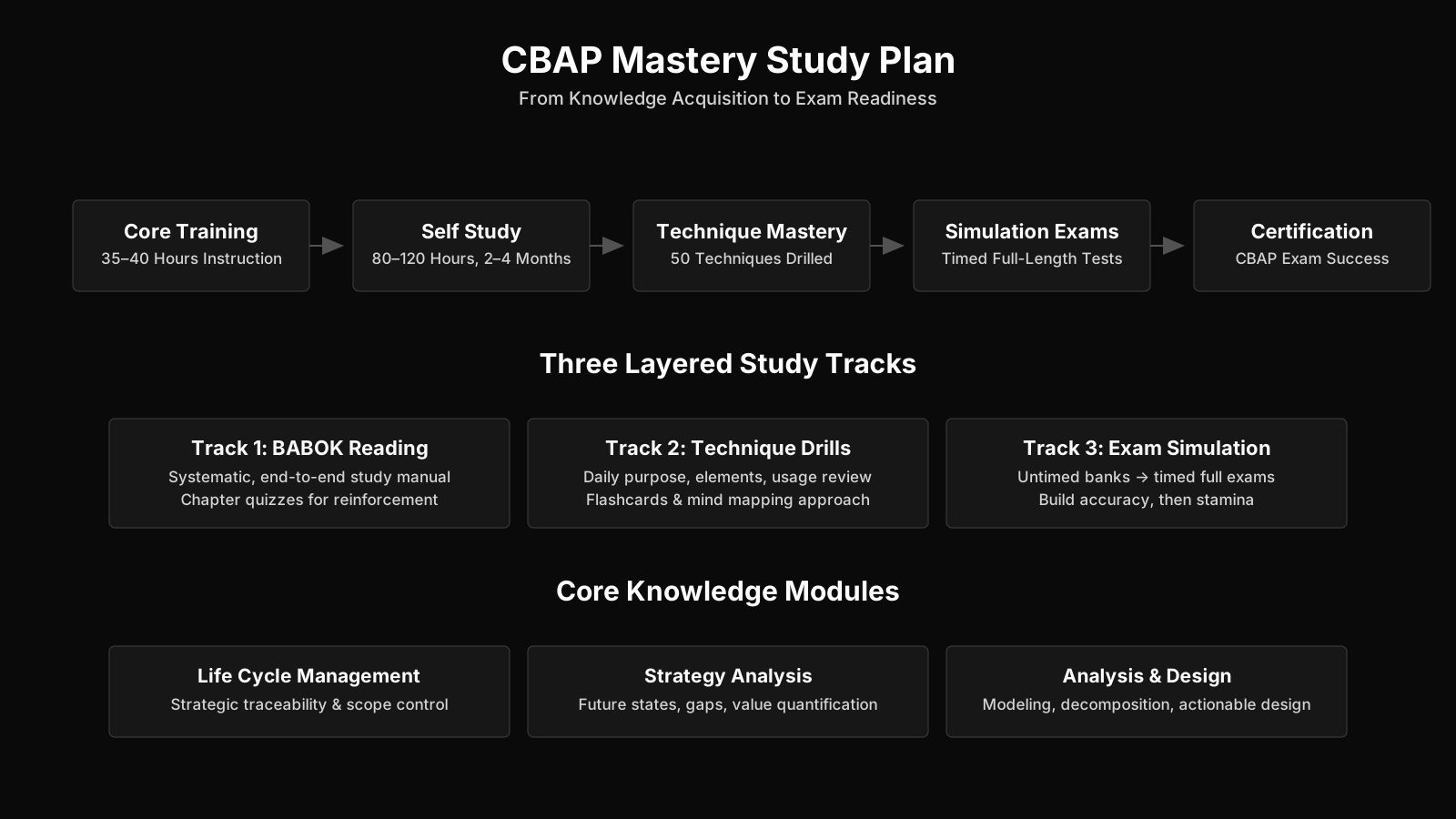
Self study remains a cornerstone of CBAP preparation, but it must be structured. The sheer volume of the BABOK Guide can be overwhelming, so a disciplined schedule is necessary. Many successful candidates break their study into phases: an initial overview phase to grasp the big picture, a deep dive phase focusing on each knowledge area and its techniques, an integration phase where cross knowledge area scenarios are analyzed, and a final review phase dominated by timed practice exams. In advanced business analysis certification training, learners are often given supplemental materials such as flashcards, mind maps, and white papers that explore the underlying competencies like analytical thinking and relationship management in more depth.
Leveraging Practice Exams to Build Exam Readiness
Practice exams are a non negotiable component of CBAP preparation, but they must be used diagnostically rather than as a simple score indicator. The initial practice tests should be taken with the BABOK Guide available, allowing the candidate to research why a particular answer is correct and, more importantly, why the other options are wrong. This process of elimination training is critical because the actual exam often presents multiple answers that seem plausible at first glance. As the study progresses, full length timed simulations under conditions that mimic the actual testing environment become essential for building the mental stamina required to focus for three and a half hours.
High quality question banks will include scenario based questions that combine elements from multiple knowledge areas. For example, a question might describe a project that is struggling with scope creep and ask what the business analyst should have done during planning to prevent this situation. The answer may involve establishing a change control process in the Requirements Life Cycle Management knowledge area, but it also relates to properly setting up the governance approach in Planning and Monitoring. Analyzing these cross functional questions hones the ability to think holistically. Advanced business analysis certification training programs often include hundreds of such questions, each with detailed explanations that reinforce the concepts.
One of the most overlooked aspects of exam preparation is learning the language of the exam itself. The IIBA has a specific way of phrasing business analysis concepts, and the exam uses keywords that signal the correct answer. For instance, words like “next,” “last,” “best,” and “most likely” dictate how the candidate should approach the question. Understanding that the exam is testing the application of the BABOK Guide, not the candidate’s personal experience or company specific practices, is a fundamental mindset shift. Training that emphasizes this perspective and teaches techniques for deconstructing question stems will increase both accuracy and speed.
Integrating Advanced Business Analysis Certification Training with Work Experience
For the experienced business analyst, one of the most rewarding aspects of CBAP preparation is the way it illuminates and reframes past project experiences. As you study each BABOK task, you will inevitably recall situations where applying a particular technique earlier or engaging a stakeholder differently could have altered the outcome. This reflective process is not just academic; it deepens your professional competence. Effective training programs deliberately create space for this reflection, asking participants to map their own project histories onto the BABOK framework. This makes the material sticky and immediately applicable.
However, a word of caution is necessary. The CBAP exam expects answers based on the IIBA standard, not on what your organization typically does. Many experienced analysts face a challenge here because they have developed successful shortcuts or adaptations that, while effective in their context, deviate from the BABOK ideal. Advanced business analysis certification training must explicitly address these gaps, contrasting real world practices with the standard and explaining the rationale for the standard approach. This comparative analysis prevents the candidate from selecting an answer based on habitual thinking rather than the prescribed body of knowledge.
Additionally, the experience hours required for CBAP eligibility are not just a hurdle to clear; they are a foundational layer of context. Training is most effective when it treats those thousands of hours as a canvas for illustration. Case studies used in class should resonate with the complexity that experienced analysts handle, such as enterprise transformations, regulatory compliance projects, or product portfolio decisions. Simple scenarios about gathering requirements for a minor system enhancement are insufficient to prepare for the level of complexity the exam targets. The exam assumes a level of situational maturity, and the training should match that assumption.
Key Insight Snapshot
- Multimodal Training Approach Required
- Effective CBAP preparation integrates self-paced reading, instructor-led workshops, peer exchange, and thorough simulation, avoiding over-reliance on any single provider's question bank.
- Value of Instructor-Led Workshops
- Workshops delivered by CBAP-certified instructors with deep industry experience provide on-the-spot clarification, case study discussions, and technique-oriented learning that goes far beyond rote task descriptions.
- Structured Self-Study Phases
- Successful candidates organize their preparation into four deliberate phases: an overview, a deep-dive into each knowledge area, an integration stage, and a final review phase dominated by timed practice exams.
- Diagnostic Use of Practice Exams
- Practice exams serve as diagnostic instruments, requiring you to research the rationale behind correct answers and systematically eliminate incorrect options, while full-length timed simulations build the mental stamina essential for the 3.5-hour exam.
- Exam Language and Mindset Shift
- Mastering the IIBA's precise language and decoding keywords such as "next" or "best" is critical, because the exam assesses application of BABOK Guide concepts rather than reliance on personal experience or customary company practices.
Advanced Business Analysis Techniques and Competencies
Beyond the six knowledge areas, the BABOK Guide lists fifty techniques that business analysts employ, ranging from brainstorming and document analysis to complex modeling approaches like decision analysis and financial analysis. The CBAP exam does not require that you memorize every step of each technique, but you must know when each technique is most applicable, its strengths and limitations, and how it relates to the tasks in the knowledge areas. For instance, you may be asked which technique would best support prioritizing requirements based on value, risk, and dependency. The answer is not simply “prioritization” but a specific technique such as backlog management, MoSCoW, or weighted ranking, depending on the context provided in the question.
Advanced business analysis certification training should dedicate significant effort to the analysis and design techniques, as these are often where candidates with a generalist background feel less confident. Data flow diagrams, use case modeling, process modeling, and prototyping are not just tools for technical specifications; they are methods for structuring thinking and facilitating shared understanding among stakeholders. Understanding the difference between a context diagram and a data flow diagram, or knowing when to use a state model versus a sequence diagram, demonstrates the depth of analytical capability that the CBAP represents. Hands on exercises in these techniques, even in a virtual classroom, help build this competency.
Underlying competencies, as defined in the BABOK Guide, cover analytical thinking and problem solving, behavioral characteristics, business knowledge, communication skills, interaction skills, and tools and technology. The exam includes questions that test these soft skills, often embedded in scenarios about stakeholder conflict, ethical dilemmas, or gaining agreement. For example, a question might describe a situation where a key stakeholder is resistant to a proposed solution, and you must choose the best approach: escalating to a sponsor, conducting a follow up meeting to address concerns, or re evaluating the stakeholder’s actual needs. The correct answer draws on negotiation skills and the principle of understanding stakeholder goals, highlighting the fact that business analysis is as much about relationships as it is about artifacts.
Applying CBAP Mastery to Digital Transformation Initiatives
Digital transformation is one of the most common contexts in which CBAP certified analysts operate today. These initiatives involve not just technology implementation but fundamental changes to business models, customer experiences, and operational processes. Advanced business analysis certification training that incorporates transformation case studies prepares the analyst to handle the ambiguity and scale of such efforts. The Strategy Analysis knowledge area becomes particularly vital here, as defining the future state and assessing risks depend on deep industry knowledge and the ability to synthesize diverse inputs from across the enterprise.
In a transformation context, the business analyst often plays a role that overlaps with enterprise architecture and product management. Knowing how to facilitate a collaborative modeling session that brings together executives, process owners, and technical architects is a skill that goes beyond basic facilitation. It requires familiarity with business capability maps, value stream mapping, and the ability to translate strategic objectives into measurable KPIs. The CBAP curriculum, when taught with a focus on advanced applications, covers how these strategic tools align with the BABOK tasks, such as conducting enterprise analysis and defining solution scope.
Moreover, the agile perspective within the BABOK Guide is not a separate certification but a lens through which to view the knowledge areas. Advanced training will contrast traditional and agile contexts for each task, discussing how the role of the business analyst adapts. In an agile team, requirements might be expressed as user stories and acceptance criteria, and the rhythm of elicitation shifts to continuous collaboration. The exam expects a nuanced understanding of when a particular technique or task is more suited to a predictive versus adaptive environment. Candidates who have only worked in one methodology will need to broaden their perspective through targeted training and reading.
Strategic Career Planning with the CBAP Credential
Obtaining the CBAP is not the end of a learning journey but a milestone that opens doors to more strategic roles. Post certification, many professionals move into positions such as Senior Business Analyst, Business Analysis Center of Excellence Lead, Enterprise Architect, or Product Manager. The credential signals that you can be trusted with high visibility initiatives and can coach less experienced analysts. To capitalize on this, you need a deliberate career strategy that leverages the CBAP brand while continuing to build new skills in areas like product ownership, data analytics, and change management.
One effective approach is to use the CBAP as a foundation for thought leadership within your organization. Write white papers, present at internal conferences, or lead community of practice sessions on business analysis topics. This not only reinforces your own knowledge but also increases your visibility and value. Many organizations are building business analysis practices, and a CBAP holder is ideally positioned to define those practices, assess maturity, and propose improvements. Advanced business analysis certification training that includes consulting skills can help you make this transition from practitioner to internal advisor.
The continuing education requirements for maintaining the CBAP certification, known as Continuing Development Units, also guide career growth. By attending webinars, taking additional certifications, or presenting at IIBA chapter events, you naturally stay current with trends and expand your network. The IIBA offers specialized certifications in areas like cybersecurity analysis and agile analysis that can complement the CBAP. An advanced understanding of these adjacent disciplines makes you a more versatile professional who can speak to risk, security, and agile delivery with authority.
Key Insight Snapshot
- CBAP as a career milestone
- The CBAP credential qualifies professionals for strategic roles such as Senior Business Analyst, Enterprise Architect, or Product Manager by validating their capacity to lead complex, high-visibility initiatives with confidence.
- Deliberate career strategy needed
- Capitalizing on the CBAP requires a deliberate career strategy that not only leverages the credential but also intentionally builds complementary skills in product ownership, data analytics, and change management to drive broader business impact.
- Thought leadership through CBAP
- Building thought leadership on your CBAP foundation, through activities like writing white papers or facilitating community of practice sessions, elevates your visibility and establishes you as a trusted internal advisor on business analysis best practices.
- Continuing education guides growth
- The Continuing Development Units (CDUs) required for CBAP recertification keep your knowledge current with industry trends and organically expand your professional network via webinars, advanced certifications, and active participation in IIBA events.
- Complementary certifications add value
- Earning specialized IIBA certifications in cybersecurity analysis or agile analysis deepens your versatility, enabling you to speak authoritatively on risk, security, and agile delivery and to demonstrate cross-functional expertise.
The Path to Exam Day and Beyond
As exam day approaches, the emphasis should shift from learning new material to consolidating knowledge and managing mental readiness. Many candidates find it helpful to create a one page summary of each knowledge area, including the purpose, key tasks, and the most critical techniques. Reviewing these summaries in the final days, rather than re reading entire chapters, reinforces the high level structure without causing burnout. Adequate sleep, a good meal, and a calm mindset are as important as the last minute review of a process model. The exam is demanding, but a well prepared candidate can approach it with confidence.
During the exam, time management is critical. The CBAP consists of 120 multiple choice questions to be completed in 210 minutes, with some questions being case based and requiring reading of a longer scenario. A common strategy is to answer the straightforward questions first, marking the more complex scenario based items for review, ensuring that easy points are secured early. Because the exam is not adaptive, you can move back and forth, so flagging and returning is a valid tactic. Training should include mock exams that simulate this process, so you develop a personal pacing rhythm.
After passing the exam, the real work of applying the advanced business analysis mindset begins. The credential changes how you approach problems. You will find yourself unconsciously framing every initiative in terms of the core concepts of change and value, and your stakeholder interactions will become more structured and impactful. The network of CBAPs is a collaborative community that shares lessons learned, job opportunities, and continues to push the profession forward. Mastery is not a static achievement but an ongoing commitment to learning and contributing to the discipline of business analysis, and the certification is a catalyst for that lifelong pursuit.
Advance Your Career with Professional Certification
Earning a professional project management certification validates your expertise in standardized methodologies, making you a more competitive candidate and often leading to higher earning potential. Beyond personal career growth, certified professionals drive organizational success by improving project efficiency, reducing risks, and ensuring deliverables align with strategic goals. Investing in structured project management training equips you with practical frameworks and leadership skills that directly translate to higher project success rates. Ultimately, such credentials signal a commitment to excellence that employers and clients consistently value in today’s fast-paced business environment.
In today’s competitive landscape, a recognized credential can distinguish you as a strategic thinker who bridges market needs with tangible solutions. A formal product management certification not only deepens your knowledge of end-to-end product lifecycles but also signals to employers that you possess the discipline to drive vision, roadmapping, and cross-functional alignment. This validation of your skills can accelerate career advancement, boost earning potential, and empower you to deliver products that truly resonate with customers, ultimately fueling sustainable organizational growth.
In today's competitive business landscape, earning a professional HR management certification demonstrates mastery of modern people strategies and legal compliance, making you a strategic asset to any organization. Becoming a certified HR manager validates your ability to handle complex employee relations, drive talent development, and align workforce planning with company goals. This credential not only accelerates your career advancement and earning potential but also equips you with frameworks to foster a positive workplace culture that reduces turnover and boosts productivity. Organizations increasingly rely on certified professionals to navigate regulatory changes and build resilient teams, giving certified HR managers a distinct edge in the job market.