In boardrooms and Zoom calls around the world, professionals frequently ask whether they need a manager or a leader to guide their team through turbulent times . The debate often simplifies a profoundly nuanced relationship that shapes everything from daily operations to decade-long strategy. Understanding the 5 crucial differences between a manager and a leader is not just an academic exercise; it is a practical necessity for anyone who allocates resources, nurtures talent, or sets a vision. While the two roles overlap, they spring from fundamentally distinct mindsets, behaviors, and sources of authority. Organizations that fail to discern these contrasts often promote brilliant individual contributors into management positions only to watch them struggle with the human elements of leadership, or they hire charismatic visionaries who neglect the systems that keep a business solvent. This article explores each of the five differences in depth, providing real-world context, evidence-based frameworks, and actionable insights for professionals at every stage of their career. By the end, you will possess a clear mental model for diagnosing your own tendencies and deliberately expanding your capacity to both manage complexity and lead change.
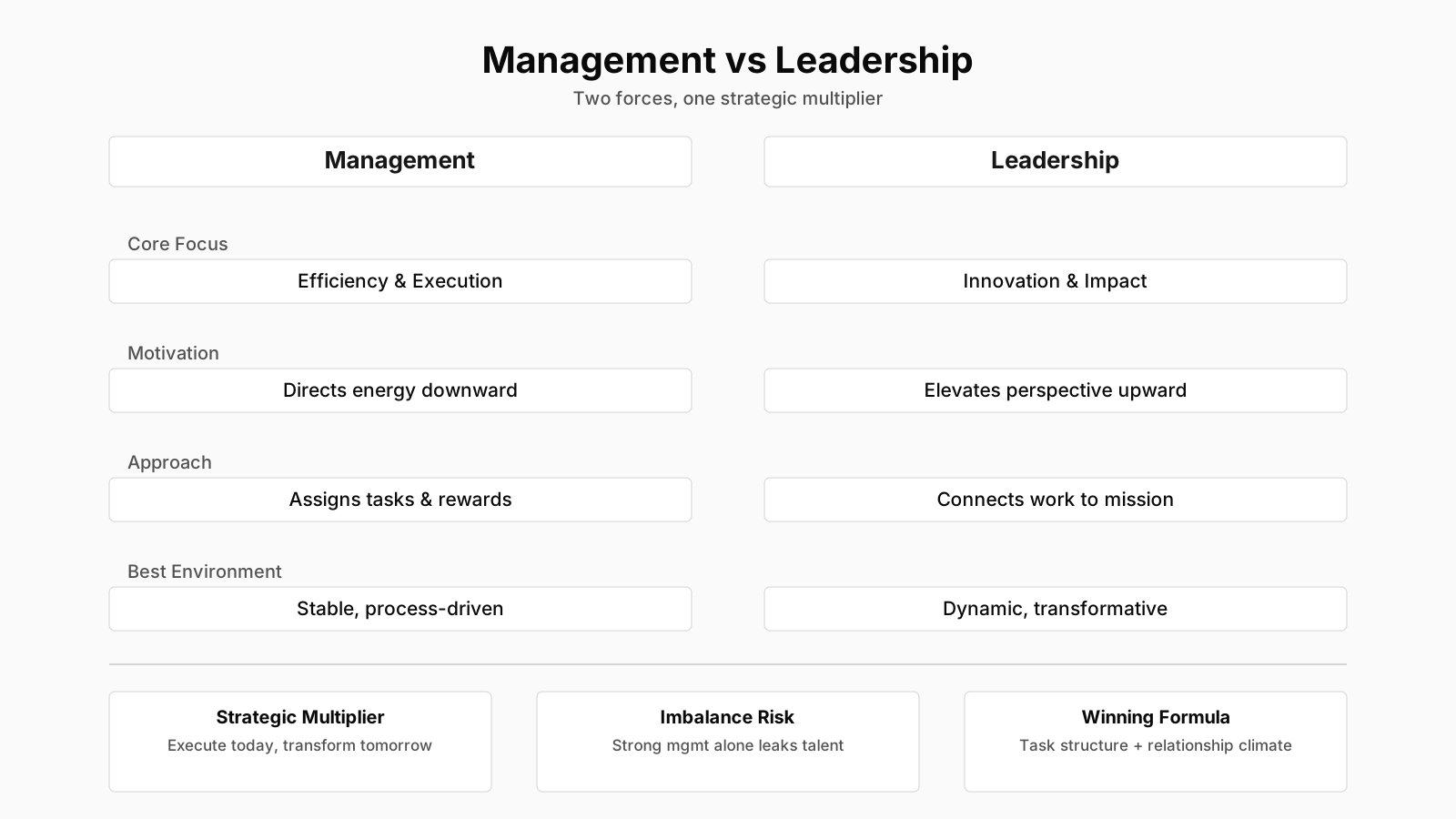
Manager vs. Leader: Key Distinctions Summarized
| Key Concept | Summary |
|---|---|
| Fundamental Distinction | Management establishes order and consistency to handle complexity; leadership provides direction and motivation to navigate change. |
| Shareholder Impact | Organizations that cultivate leadership capabilities across every tier generate up to 13% higher total shareholder return compared to peers fixated on managerial efficiency alone. |
| Professional Growth | Mastering both disciplines allows professionals to maintain operational credibility while cultivating the visibility and leadership acumen that accelerate promotion. |
| Talent Strategy | Embedding this distinction into talent frameworks deepens bench strength and prevents expensive misalignments between individuals and roles. |
| Systems vs. Culture | Managers administer systems to deliver predictable results; leaders challenge underlying assumptions and reshape culture by modeling new behaviors. |
| Operational vs. Strategic Focus | Managers optimize the current operating model for reliability; leaders question whether the model itself requires fundamental redesign. |
| Strategic Imperative | Distinguishing between management and leadership is essential for anyone who allocates resources, develops talent, or charts a strategic direction. |
| Shared Attributes, Divergent Roots | Although these responsibilities often intersect, they originate from fundamentally different mindsets, behavioral patterns, and bases of influence. |
| Contemporary Imperative | Amid relentless digital disruption and dispersed teams, sustained resilience demands that organizations fuse robust management with adaptive leadership. |
| Leadership Succession | These distinctions equip selection committees to discern candidates who will merely sustain operations from those capable of reimagining and transforming the business unit. |
The Foundation: Why Distinguishing Management from Leadership Matters in Modern Organizations
Before dissecting the five differences, it is essential to clarify why the distinction has become so urgent. Modern management theory, shaped by thinkers from Peter Drucker to John Kotter, has long acknowledged that management and leadership are complementary systems of action rather than interchangeable labels. Management, broadly defined, deals with coping with complexity. It brings order, consistency, and predictability to organizations through planning, budgeting, staffing, and controlling. Leadership, in contrast, copes with change. It sets a direction, aligns people , and motivates them to move toward a shared aspiration. When the business environment was relatively stable, companies could survive with strong management and minimal leadership. In the current era of digital disruption, hybrid work , and shifting employee expectations, the balance has shifted decisively. Organizations now require a blend of both functions to remain resilient.
The consequences of conflating the two roles are far from theoretical. A study published in the Harvard Business Review revealed that companies that develop leadership capacity at all levels outperform those that focus solely on managerial efficiency by up to thirteen percent in total shareholder return. Similarly, Gallup’s global workplace research consistently shows that employees who rate their supervisor highly on leadership behaviors such as inspiration and development are far more engaged and less likely to quit. Yet many organizations still promote people based on technical proficiency or years of tenure, expecting them to suddenly exhibit leadership behaviors without training, coaching, or a supportive culture. Recognizing the 5 crucial differences between a manager and a leader equips individuals and HR leaders to design roles, learning paths, and performance evaluations that honor the unique contributions of each.
Why the 5 crucial differences between a manager and a leader matter for career advancement
For ambitious professionals, the ability to articulate and demonstrate both managerial and leadership competencies can dramatically accelerate career progression. Management skills keep you credible and operationally relevant, while leadership skills make you visible, influential, and promotable. When you understand where you naturally excel, you can intentionally seek projects or mentorship that fill your gaps. For instance, an early-career project coordinator might be a meticulous planner who loves Gantt charts and risk logs. That person may be an excellent manager but might need to practice articulating an inspiring product vision to cross-functional partners. Without awareness of the five differences, that coordinator could plateau at a senior individual contributor level, perceived as lacking executive presence. Conversely, a magnetic team lead who rallies people around a mission but neglects budgets and performance reviews may eventually lose credibility when stakeholders ask for metrics and accountability. The differences serve as a career GPS.
How this understanding transforms talent development and succession planning
Organizations that embed the management-leadership distinction into their talent frameworks build stronger bench strength. They stop writing job descriptions that simply say “manage a team” and instead specify the blend of system-building and inspiration required. They design separate development tracks for high-potential individual contributors who wish to remain deep experts, for people managers who thrive on process optimization, and for emerging leaders who can shape culture and strategy. This alignment reduces costly mismatches, such as the star engineer promoted to engineering manager who becomes miserable and disengaged because the role demands ninety percent leadership and only ten percent technical work. It also helps succession planning committees differentiate between a candidate who can keep the lights on and one who can reimagine the business unit. In short, the 5 crucial differences between a manager and a leader provide a diagnostic lens that elevates talent decisions from intuition to evidence-based practice.
Core Takeaways on the Management-Leadership Distinction
- Complementary but distinct roles
- Management sustains organizational stability by designing efficient processes and monitoring outcomes, while leadership mobilizes people through a shared purpose and encourages adaptive innovation.
- Modern environment demands both
- As digital disruption and hybrid work dismantle traditional structures, organizations that integrate rigorous management with adaptive leadership build the resilience needed to pivot, innovate, and sustain engagement across dispersed teams.
- Conflation has real costs
- Organizations that cultivate leadership capabilities across all roles achieve up to a 13 percent higher total shareholder return compared to those fixated on efficiency alone, while employees led by inspiring managers report significantly higher engagement and retention.
- Framework for talent decisions
- Grasping these five distinctions equips professionals to pinpoint skill gaps and fast-track their career progression, while enabling organizations to architect roles, development tracks, and succession plans that deliberately balance operational discipline with visionary direction.
Difference One: Managers Administrate Systems, Leaders Innovate and Shape Culture
The first distinction emerges in the fundamental orientation toward structure and stability versus evolution and adaptation. A manager’s default mode is to create and maintain systems that ensure reliable outcomes. These systems include workflow automation, standard operating procedures, quality control checkpoints, and resource allocation algorithms. When a manager sees a recurring problem, the instinct is to design a process that prevents it from happening again. This administrative mindset is invaluable in industries where safety, compliance, and cost efficiency are paramount. Consider a hospital unit manager who ensures that nurses follow hand hygiene protocols and that medication carts are stocked precisely. That person is managing a complex system to deliver patient safety. The focus is on consistency, measurement, and incremental improvement within existing boundaries.
A leader, on the other hand, looks at the same hospital and asks a different set of questions. What if we could radically reduce patient stays through preventive community programs? What if the culture of the nursing staff shifted from task-completion to patient advocacy and empathy? Leaders innovate by challenging the very premises that the current systems are built upon. They shape culture by modeling new behaviors, telling stories that shift beliefs, and celebrating acts that embody aspirational values. While the manager fine-tunes the engine, the leader wonders whether a different engine type is needed altogether. This difference does not make managers inferior; it simply defines their primary contribution. A well-run factory without any innovation will eventually become obsolete, but constant innovation without the discipline of management produces chaos, burnout, and quality failures.
Operational excellence versus cultural transformation and the 5 crucial differences between a manager and a leader
The tension between operational excellence and cultural transformation surfaces daily in technology companies. A product manager who focuses exclusively on refining the backlog, tracking velocity, and hitting release dates is operating from a managerial stance. That person ensures the team delivers value predictably. A product leader, in contrast, may spend significant time interviewing customers to uncover unmet needs, then rally engineers around a bold product vision that requires deprioritizing the current roadmap. The manager worries about the missed sprint commitments, while the leader worries about market relevance in two years. Both concerns are legitimate, and the most effective product executives oscillate between the two modes deliberately. When you hear someone say “we need more leadership around here,” they are often expressing frustration that the organization is trapped in a cycle of optimizing the present without anyone designing the future.
In the context of hybrid and remote work, this first difference has become even more pronounced. Managing remote employees requires clear expectations, digital tracking tools, and structured check-ins. These are managerial interventions that reduce ambiguity. Leading a distributed team, however, demands intentional culture-building rituals that transcend email and Slack. It involves creating virtual spaces where vulnerability is welcomed, celebrating wins loudly across time zones, and crafting a shared narrative that connects individual tasks to a larger purpose. Without the leader’s cultural touch, remote workers can devolve into isolated cogs executing tasks without emotional connection. That disconnection inevitably undermines engagement and retention, no matter how well the managerial systems are designed.
Practical strategies to develop system-building and innovation mindsets simultaneously
Professionals who want to embody both the administrator and the innovator can adopt several deliberate practices. Start by auditing your calendar for a typical month. Identify what percentage of time you spend on maintaining existing processes versus exploring new ideas or having unscheduled strategic conversations. If the maintenance percentage exceeds eighty, you are likely over-indexing on management. Block two hours per week for what leadership author Stephen Covey called Quadrant II activities: important but not urgent work such as reading industry research, sketching a future org structure, or having coffee with a potential cross-industry collaborator. Additionally, practice reframing problems. When a team member reports a process breakdown, resist the immediate urge to design a new checklist. First ask, “What assumption are we making about how this work should be done, and is that assumption still valid?” That simple question shifts you from a purely managerial reaction to a leadership-oriented inquiry. Over time, you will notice patterns and opportunities that were invisible when you were buried in spreadsheets.
Difference Two: Managers Direct Work, Leaders Develop and Empower People
The second major divergence concerns the relationship with the people on the team. A manager typically directs work by assigning tasks, monitoring progress, providing feedback on performance issues, and ensuring accountability. This direction is necessary for clarity and throughput. Employees need to know what is expected of them, by when, and at what quality standard. Great managers excel at clarifying roles and removing obstacles so that their direct reports can execute efficiently. They conduct performance reviews, hold difficult conversations when someone is underperforming, and link rewards to outcomes. In many ways, the manager acts as a performance coach within the boundaries of the team’s defined objectives.
Leadership, by contrast, focuses on developing and empowering people beyond the immediate task list. A leader sees a junior analyst not just as a deliverer of weekly reports but as a future department head who needs stretch assignments, exposure to executives, and mentorship on strategic thinking. Leaders ask questions that expand self-awareness: “What part of this project gave you the most energy, and what drained you?” They delegate authority, not just tasks, allowing team members to make decisions and learn from the consequences. Empowerment does not mean abandonment; it means deliberately increasing the decision-making scope of others while providing a safety net of support. This developmental approach creates a multiplier effect. A manager may maximize the output of ten people through efficient coordination, but a leader grows ten more leaders, each of whom can then multiply impact further.
Task delegation versus developmental delegation within the 5 crucial differences between a manager and a leader
Task delegation is the manager’s classic tool: “Please complete the competitive analysis by Friday using the template in the shared drive.” It is clear, measurable, and efficient. Developmental delegation is a leadership practice: “I’d like you to present our market positioning to the leadership team next month. The goal is for you to learn how to communicate with senior stakeholders, not just to deliver information. I’ll help you prepare and give you feedback after.” In developmental delegation, the primary objective is the growth of the individual, with the business deliverable serving as the vehicle for that growth. This distinction echoes the 5 crucial differences between a manager and a leader because it reveals how the two roles view people: managers often see human resources as inputs to a process, while leaders see each person as an appreciating asset that can compound in value if invested in wisely.
Research on employee engagement underscores the importance of developmental delegation. When employees feel that their manager is also their coach and sponsor, they are significantly more likely to report high well-being and intent to stay. However, many first-time leaders fail precisely because they continue to delegate tasks without any development lens. Their teams become execution machines that run smoothly in the short term but lose their most ambitious members who crave learning and growth. The erosion happens silently until a key employee resigns, and the exit interview reveals a yearning for development that was never addressed. Smart organizations train new managers in coaching skills, not just performance management, explicitly teaching them to identify career aspirations and connect daily work to those aspirations.
Building a coaching habit without abandoning accountability
One common objection to the leadership approach is that focusing on development may dilute accountability and slow down execution. This is a false dichotomy. High-quality leadership development integrates accountability by setting high expectations and then providing the support needed to meet them. The key is to adopt a coaching habit that uses inquiry to build ownership. Instead of telling a direct report how to fix a client issue, ask, “What options have you considered, and what might be the second-order consequences of each?” If the person proposes a flawed approach, you can still intervene, but you first let them wrestle with the problem. This builds critical thinking capacity while still maintaining quality standards. Additionally, incorporate development goals into the performance management process. A balanced key performance indicator set for a team leader might include a metric on team engagement score and another on internal promotion rates. When managers are evaluated partly on how much their people grow, they naturally shift toward leadership behaviors without sacrificing operational rigor.
Core Insights on Developing vs Directing
- Manager as task director
- This approach focuses work by setting clear expectations, tracking progress, and enforcing accountability to deliver consistent, predictable output.
- Leader as people developer
- Leaders expand individual capacity beyond immediate demands through stretch assignments and targeted mentorship, cultivating long-term capability.
- Task versus developmental delegation
- Task delegation drives efficiency by handing off defined, measurable work; developmental delegation uses real business projects to strengthen skills and judgment for future responsibilities.
- People as appreciating assets
- Leaders treat every person as a compounding asset whose value grows through deliberate investment, while managers sometimes view human resources simply as inputs to a process.
- Coaching habit with accountability
- A coaching habit that uses inquiry to build ownership weaves development into daily accountability, preserving operational rigor while accelerating individual growth.
Difference Three: Managers Control Risks, Leaders Embrace Uncertainty and Foster Resilience
Risk posture represents a profound psychological and behavioral distinction between management and leadership. Managers are trained, often explicitly, to identify, assess, mitigate, and control risk. Project management methodologies like PRINCE2 or the Project Management Institute’s framework devote entire knowledge areas to risk management. A professional manager builds a risk register, calculates probability and impact, and designs contingency plans. The goal is to protect the project’s scope, schedule, and budget from negative surprises. This protective function is absolutely critical, especially in regulated industries, construction, or finance, where a single uncontrolled risk can lead to catastrophic loss. Managers are the guardians of downside protection, and their cautious posture preserves institutional capital.
Leaders, while not reckless, cultivate a fundamentally different relationship with uncertainty. They recognize that breakthrough innovation, market disruption, and personal growth all require stepping into the unknown. Where a manager might see a threat to the baseline, a leader sees a probability distribution of outcomes where the right tail contains enormous potential. Leaders build resilience in their organizations not by eliminating risk but by developing the adaptive capacity to respond quickly when surprises occur. They normalize experimentation, frame failure as learning, and celebrate intelligent mistakes that advance collective knowledge. This psychological safety enables teams to operate at the edge of their competence without paralyzing fear. In today’s volatile economy, resilience and adaptability often become the ultimate competitive advantage, far outweighing the protection offered by rigid risk avoidance.
How risk management and innovation tension shapes the 5 crucial differences between a manager and a leader
Consider a pharmaceutical company deciding whether to invest in a novel drug research platform. The managerial perspective emphasizes the capital at risk, the probability of regulatory failure, and the opportunity cost of not investing in incremental improvements to existing drugs. That analysis might lead to a “no go” decision that preserves the quarterly earnings. The leadership perspective balances those factors against the long-term portfolio risk of stagnation, the talent attraction power of moonshot projects, and the possibility of a revolutionary therapy that redefines the company’s legacy. Neither view is wholly right; the organization needs a dialectic where managers and leaders pressure-test each other’s assumptions. This tension is one of the 5 crucial differences between a manager and a leader because it reveals their distinct internal compasses: one calibrated to loss avoidance, the other to possibility realization.
In software development, the Scaled Agile Framework explicitly addresses this tension through the concept of “Lean budget guardrails.” Managerial controls set boundaries within which teams are free to innovate without seeking approval for every small decision. Leaders articulate the vision and empower teams to make local risk decisions, but the manager-monitored guardrails prevent systemic financial or security exposure. This hybrid approach demonstrates that the best organizational systems do not choose between management and leadership but weave them together. For individual professionals, self-awareness about your risk orientation can inform career choices. If you are naturally risk-averse and find deep satisfaction in predictability, a managerial path in operations, compliance, or program management might be deeply fulfilling. If you thrive on ambiguity and see uncertainty as energizing, lean into leadership roles in innovation, business development, or change management. Neither profile is superior; both are necessary.
Cultivating calibrated risk-taking as a development practice
If you identify as a strong manager but want to stretch your leadership muscle, start with small, bounded experiments. Define a project where the cost of failure is low but the learning potential is high. For example, pilot a new meeting format for one month and publicly share the results, including what did not work. Frame the initiative as a learning experiment from the outset to manage stakeholder expectations. Gradually increase the scope of your experiments as your tolerance for ambiguity grows. Simultaneously, build resilience by practicing scenario planning. Instead of a single risk register, sketch three future scenarios for your team: an optimistic, pessimistic, and surprise scenario. Identify the early warning signals that would indicate which scenario is unfolding. This exercise blends the manager’s analytical rigor with the leader’s forward-looking flexibility. Over time, you will notice that you no longer see unexpected changes as disruptions to your plan but as data points that inform a dynamic strategy.
Difference Four: Managers Rely on Positional Authority, Leaders Cultivate Referent and Moral Authority
The source of a person’s power within an organization marks the fourth critical demarcation between a manager and a leader. Managers typically derive authority from their formal position in the hierarchy. They can assign work, approve expenses, grant time off, and initiate performance improvement plans because the organization has delegated those powers to the role. This positional authority is legitimate, codified in the org chart, and often necessary for maintaining order. When a crisis hits, people look to the designated authority to make the call. Positional power works well in contexts of compliance, safety, and clear chain of command, where swift, unambiguous decisions save lives and money.
Leaders, however, often rely on influence that transcends their place on the org chart. They cultivate referent authority, which is the influence that arises from others’ respect, admiration, and desire to emulate them. They build moral authority through consistency between their words and actions, demonstrating integrity even when it is costly. A software architect with no direct reports might lead a technical transformation across multiple teams because engineers trust her judgment and believe in her vision. A frontline nurse might lead a patient safety initiative that the hospital adopts enterprise-wide because colleagues see her deep commitment and practical wisdom. This kind of leadership does not wait for a title; it emerges from credibility, emotional intelligence, and a track record of putting the collective interest above self-interest. In flat or networked organizations, referent authority often outperforms positional authority in creating sustainable change.
The erosion of positional authority and the rise of servant leadership ideals
In knowledge-driven economies, the limitations of positional authority have become increasingly apparent. Talented professionals, especially in tech and creative fields, often resent being told what to do simply because of someone’s rank. They expect to be persuaded by logic, data, and a compelling why. Gallup’s research on employee engagement highlights that the manager’s ability to build trust and connection is a far stronger predictor of team performance than their formal title. This reality has propelled concepts like servant leadership to the forefront of modern management discourse. Servant leaders invert the traditional power pyramid: their primary goal is to serve the team’s growth, well-being, and autonomy, trusting that performance will follow. This approach builds massive referent authority over time, because team members feel genuinely supported rather than controlled.
The distinction between positional and referent authority speaks directly to the 5 crucial differences between a manager and a leader because it clarifies why some people in high-ranking roles fail to inspire followership while others with modest titles galvanize movements. Consider a newly promoted director who immediately starts issuing directives and enforcing policies without building relationships. Her positional authority may generate short-term compliance, but she will not unlock discretionary effort. Now imagine a team lead who spends her first month understanding each team member’s strengths, frustrations, and career goals, co-creating team norms, and shielding the team from unreasonable stakeholder pressure. That lead builds enormous social capital. When she later makes a tough strategic decision, the team follows not because they have to but because they trust her. Organizations that understand this difference invest heavily in leadership development programs that teach influence without authority, emotional intelligence, and storytelling rather than just policy enforcement and reporting structures.
Developing referent authority: a practical roadmap for the ambitious professional
If you currently rely primarily on your title to get things done, you can deliberately expand your influence by focusing on three pillars: expertise, empathy, and integrity. Build a recognized expertise that makes you the go-to person for a particular domain. Share that knowledge generously through internal presentations, mentorship, and publishing internal guides. Generosity, paradoxically, increases your referent power because it signals confidence and a desire to elevate others. Second, practice active empathy. Learn to diagnose the emotional undercurrents in meetings, and address them directly and compassionately. When a team member is frustrated, name it: “I sense there is some concern about the timeline. Let’s take a moment to unpack that.” This emotional translation work signals that you see people as whole humans, not just role occupants. Third, protect your integrity fiercely. If you make a commitment, follow through. If you cannot follow through, communicate early and honestly. Never throw a team member under the bus to protect your own reputation. Over two to three years, these behaviors compound into a reputation that makes you essentially un-ignorable, regardless of where you sit on the org chart.
Core Insights on Authority Types
- Positional authority defined
- Positional authority flows from an individual’s formal rank, granting the legitimate power to allocate resources, direct work, and enforce rules in order to maintain organizational structure and compliance.
- Referent authority explained
- Referent authority emerges from earned respect, admiration, and trust, enabling a person to inspire commitment and drive change through personal credibility rather than hierarchical status.
- Moral authority through integrity
- Moral authority is cultivated when leaders consistently align their conduct with their stated principles, upholding integrity even at personal cost to earn voluntary, lasting followership.
- Erosion of positional power
- In knowledge-driven environments, talented professionals frequently disregard rank-based commands, requiring persuasion grounded in logic and trust, which makes referent authority a stronger source of engagement.
- Developing referent authority
- Professionals strengthen their referent authority by building deep, recognized expertise, practicing genuine empathy through attentive listening, and protecting their integrity with transparent, reliable commitments.
Difference Five: Managers Focus on Short-Term Goals and Metrics, Leaders Envision Long-Term Sustainable Impact
The time horizon that governs decision-making forms the fifth and often most consequential distinction. Managers are typically measured and rewarded based on short-term key performance indicators: quarterly revenue, sprint velocity, customer satisfaction scores this month, defect rates this week. Organizations design management dashboards and bonus structures around these metrics because they are tangible, trackable, and linked to near-term survival. The manager’s world revolves around closing the gap between current performance and the quarterly target. This short-term orientation drives efficiency, accountability, and operational discipline. It ensures that the bills get paid and that the organization meets its commitments to shareholders, customers, and regulators.
Leaders, while respecting the necessity of short-term viability, orient their vision toward a longer arc of sustainable impact. They ask where the organization needs to be in five or ten years and what capabilities, partnerships, and cultural shifts must start today to make that future possible. This long-term view often demands making investments that depress short-term profitability, such as retraining a workforce for a digital future, entering an embryonic market, or overhauling a legacy technology platform. Leaders accept the risk of being misunderstood by analysts and shareholders in the present because they are building an asset that will outlast quarterly cycles. The conflict between the short and long term is one of the most difficult tensions in modern business, and resolving it requires both management discipline and leadership courage working in tandem.
Sprint goals versus strategic horizons and how they illuminate the 5 crucial differences between a manager and a leader
In agile software development, this tension is visible in the contrast between sprint goals and product strategy horizons. A scrum master or engineering manager focuses heavily on the current sprint: have we committed to the right stories, is the burn-down chart on track, are blockers being resolved quickly? That manager protects the team’s short-term flow and predictability. A product leader, however, spends significant time six to twelve sprints out, conducting discovery, validating market hypotheses, and aligning stakeholders on the product’s evolution. If the leader gets absorbed entirely into sprint-level management, the team may produce a stream of flawless increments that solve yesterday’s problem. This misalignment is at the heart of why some technically excellent teams deliver products that fail in the market. The 5 crucial differences between a manager and a leader become painfully visible when an organization has plenty of the former and a deficit of the latter; the present is well-managed but the future is neglected.
Strategic planning processes often institutionalize the short-term bias unless leadership intervenes. Budget cycles demand annual justifications, and many companies evaluate investments based on payback periods of two years or less. This systematically starves long-term initiatives. Leaders with a long-term orientation fight for ring-fenced innovation budgets, develop strategic narratives that make the future feel concrete and urgent, and publicly celebrate long-term wins, even when they benefit a previous generation’s leadership. They also mentor high-potential managers to extend their time horizons, introducing them to systems thinking tools like causal loop diagrams that reveal how short-term fixes can create long-term problems. For example, cutting research and development spending boosts this year’s margin but hollows out the product pipeline three years later. Learning to spot and articulate these delayed feedback loops is a hallmark of leadership maturity.
Integrating short-term execution and long-term vision in personal and organizational planning
On a personal level, you can integrate both time horizons by adopting a dual planning cadence. Use a robust weekly and monthly review to manage your managerial commitments: inbox, meetings, project milestones, and direct report requests. That keeps you reliable. Simultaneously, conduct a quarterly personal retreat, even if only for a half-day, where you reflect on your career trajectory, core values, and legacy ambitions. Write a personal vision statement and identify one long-term capability you want to build, such as public speaking, strategic finance, or cross-cultural leadership. Then translate that into a monthly learning goal that your weekly system will protect. This practice ensures that you do not become so consumed by the urgent that the important never arrives. Organizations can scale this thinking through OKR frameworks where Objectives represent visionary leadership aspirations and Key Results provide the managerial measurement mechanism. When cascaded thoughtfully, OKRs force the dialogue between short-term delivery and long-term direction, holding both in creative tension rather than allowing one to dominate.
Synthesizing the Five Differences: Becoming an Ambidextrous Professional
After exploring these five dimensions of systems versus culture, direction versus development, risk control versus uncertainty embrace, positional versus referent authority, and short versus long term, a clear picture emerges. The 5 crucial differences between a manager and a leader are not a checklist to decide which camp you belong to permanently. Instead, they represent a spectrum along which effective professionals must learn to move with agility. The most respected executives are ambidextrous: they can dive into a detailed budget review at nine in the morning, demonstrate empathy and coaching in a one-on-one at ten, and then deliver a compelling vision speech at an all-hands at eleven. This fluidity is not innate; it is practiced, reflected upon, and refined over years.
The path to ambidexterity starts with honest self-assessment. For each of the five differences, rate your natural comfort zone on a scale of one to ten. If you score below five on the leadership side of any dimension, seek a project or volunteer role that will stretch you in that specific area. For example, if risk control is your strength and you avoid uncertainty, volunteer to lead a small innovation sprint where the deliverable is a validated learning rather than a finished product. If you lean heavily on positional authority, practice leading a cross-functional initiative where none of the participants report to you, forcing you to rely on persuasion and coalition-building. Combine this experiential learning with deliberate study: read widely, find a mentor who embodies the qualities you lack, and perhaps hire a coach to accelerate your blind spot discovery.
How organizations embed the 5 crucial differences between a manager and a leader into their DNA
Forward-thinking companies embed this synthesis into their human capital infrastructure. They design a dual career ladder that equally rewards deep domain experts, people managers, and enterprise leaders. They train interviewers to assess both managerial competencies like operational planning and leadership competencies like vision-setting and coaching. They rotate high-potentials through roles that demand different blends of the five dimensions: putting a naturally cautious risk manager into a business development role for two years, for instance, to build her comfort with ambiguity. They also celebrate management excellence as loudly as leadership charisma. Internal awards for “best process improvement” or “most reliable project delivery” signal that the organization values the guardian mindset alongside the pioneer spirit. Over time, this cultural reinforcement reduces the stigma that can attach to “just managing” and honors the profound, often invisible, work of keeping a complex organism healthy and stable.
Ultimately, the goal is not to turn every manager into a charismatic visionary or to burden every leader with spreadsheets. It is to create a society of professionals who understand the full spectrum of value creation and who can flex across it as context demands. The 5 crucial differences between a manager and a leader, when properly understood, dissolve the artificial either-or thinking that plagues so many organizational debates. They reveal that management without leadership becomes brittle and soul-crushing, while leadership without management becomes naive and unsustainable. The professionals who master this interplay will not only advance their own careers; they will build the resilient, innovative, and humane organizations that the future demands. As you return to your workplace, carry these distinctions as a diagnostic framework, not a judgment tool. Notice when your team needs tighter process and when it needs a new story. Notice when you are leaning on your title and when you are earning followership. The awareness itself, acted upon with courage, is the essence of growth.
Core Takeaways on Ambidextrous Leadership
- Spectrum of Manager and Leader
- The five distinctions between managing and leading form a spectrum of capabilities, not a fixed identity; skilled professionals flexibly draw upon each as the context demands.
- Path to Ambidexterity
- Achieving ambidexterity starts with a candid self-diagnosis across the five dimensions, then deliberately using stretch assignments and mentorship to strengthen one’s less practiced orientation.
- Organizational Embedding
- Forward-thinking companies embed this dual capability through dual career ladders, rotational roles, and a culture that equally celebrates management rigor and visionary leadership.
Where the Five Differences Show Up in Daily Behavior
One of the fastest ways to spot whether someone is operating from a managerial or leadership mindset is to listen to the questions they ask. Managers tend to ask questions that close variance: Are we on schedule? Who owns this? What did the data show last week? Leaders ask questions that open possibilities: Why does this still matter? What would make our current approach obsolete? Neither set is wrong, but if you only hear the first set, the team gets efficient at preserving the status quo. If you only hear the second, the team can generate excitement without ever converting it into reliable output.
In practice, the most useful move is to calibrate your own default. I often have clients keep a one-week log of every meeting they attend and code each interaction as either "manage" or "lead" based on the five differences. The pattern usually surprises them. A senior director might discover she spends eighty percent of her time on planning, budgeting, and control, even though her title and compensation point toward vision and alignment. That gap is not a character flaw; it is a signal that the organization has quietly asked her to fill both roles without telling her which one deserves more attention at this stage of growth. Once you see the imbalance, you can start renegotiating which meetings you facilitate and which ones you simply monitor.
The interesting part is that leadership capacity is not just a personality trait. It can be treated like a practice with deliberate reps. For example, when a decision is ambiguous and the path forward is unclear, managers often reach for more data to reduce uncertainty. Leaders sometimes need to help the team make sense of incomplete information long enough to act. That shift requires a different kind of cognitive work, one that moves from controlling variables to interpreting weak signals. In these moments, I point people toward sensemaking for managers as a structured way to lead when the data will not give you a clean answer. It is a practical method for building the interpretive muscle that separates leadership from pure administration.
Another practical application is to separate your one-on-ones into two distinct conversations. The first is operational: status updates, blockers, resourcing, and performance feedback. That is management. The second is strategic: career direction, values, stakeholder relationships, and what should change about how the team operates. That is leadership. Mixing them into a single weekly meeting usually means the operational agenda wins and the leadership agenda gets postponed indefinitely. By scheduling both explicitly, you give yourself permission to practice the five differences instead of just reading about them. Over time, the goal is not to choose between being a manager and a leader. It is to develop enough fluency to shift between the two depending on what the situation demands.
Advance Your Career with Professional Certification
Earning a professional project management certification validates your expertise, directly boosting your career growth by opening doors to senior roles and higher salaries. Organizations also benefit from certified professionals who apply standardized best practices, leading to more successful project outcomes and reduced risks. Investing in quality project management training equips you with the frameworks needed to align projects with business strategy. Ultimately, this certification distinguishes you in a competitive job market and drives consistent organizational success.
Earning a professional product management certification validates your expertise in strategic thinking, customer-centric development, and cross-functional leadership, setting you apart in a competitive job market. It demonstrates a commitment to mastering the frameworks that drive successful product lifecycles, directly boosting a company’s ability to innovate and deliver value. To build this critical skillset, many professionals pursue structured product management training that bridges theoretical knowledge with real-world application. Such certification not only accelerates your career trajectory but also empowers you to lead teams more effectively and make data-driven decisions that align with organizational goals.
For HR professionals aiming to advance their careers, earning a respected credential validates expertise and signals a commitment to strategic people management. A human resources certification bridges the gap between administrative tasks and high-level organizational impact, equipping practitioners with modern frameworks for talent development, compliance, and change leadership. Organizations benefit from certified HR leaders who can align workforce strategies with business goals, reducing turnover and fostering a culture of continuous improvement. Ultimately, such certification not only accelerates personal career growth but also elevates the HR function from a support role to a critical driver of success.
