For many project professionals in Sydney, the Project Management Professional certification represents a turning point in their career, not just another line on a CV but a tangible signal of competence that resonates across industries from financial services in Barangaroo to infrastructure delivery in Western Sydney. Deciding to pursue a PMP certification training course in Sydney , is as much about local networking and understanding regional business culture as it is about mastering the exam content, because Sydney’s market has its own rhythm, dominated by large-scale construction, technology transformation, and government programmes that value formalised project governance. The training ecosystem here is surprisingly rich, with options ranging from intensive bootcamp-style classes in the CBD to virtual instructor-led courses that let you join from a home office in Parramatta or the Northern Beaches. As you start exploring, you will notice that the best training providers do not simply coach you to pass a test; they embed the PMP mindset into how you already manage projects, making the study period a genuinely useful professional development experience rather than a cramming exercise.
PMP Certification in Sydney: Key Topics Summary
| Key Concept | Summary |
|---|---|
| PMP Certification Overview | An advanced, globally recognized credential that requires verified project leadership experience, the PMP validates strategic competence and is highly regarded across Sydney's finance, infrastructure, and technology sectors. |
| Exam Structure & Domains | The current examination assesses three performance domains: People (42%), Process (50%), and Business Environment (8%). Its scenario-driven questions replicate complex, real-world decision-making typical of Sydney's corporate and government projects. |
| Employer Demand & Career Impact | A PMP frequently serves as a screening criterion in Sydney's competitive hiring market, with certified contractors commanding higher daily rates and being perceived as more immediately capable of delivering project outcomes. |
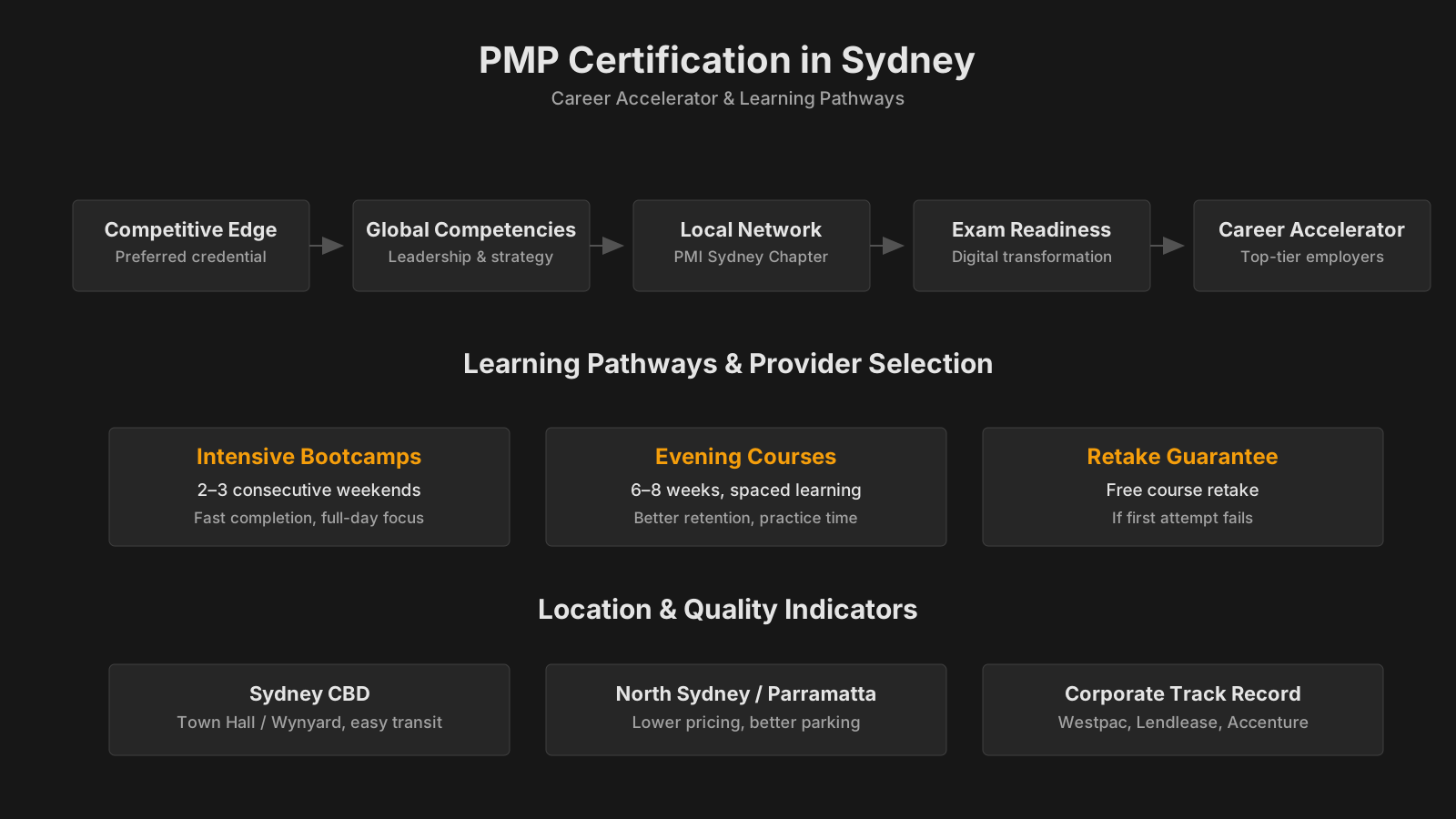
| Training Delivery Formats | Sydney offers intensive bootcamps, extended part-time programmes, and fully digital live courses, each designed to accommodate different professional schedules and learning preferences. |
| Classroom-Based Training | Face-to-face sessions in Sydney's CBD foster deep engagement through direct peer interaction, accelerated focus, and valuable industry networking, ideal for professionals who benefit from a dedicated learning environment free from workplace interruptions. |
| Virtual Instructor-Led Training | Real-time online sessions deliver live instructor guidance with the flexibility to attend from any location, though success depends on strong personal discipline to manage home or office distractions. |
| Hybrid Learning Models | Integrating self-directed online materials with scheduled live workshops, blended formats balance flexibility with rigorous exam practice and collaborative scenario exercises that mirror the PMP testing approach. |
| Selecting a Quality Provider | Leading providers cultivate a practitioner's mindset rather than short-term exam cramming, offering high-fidelity question banks, real-world case discussions, and sustained coaching until certification is earned. |
| Eligibility Requirements | Many Sydney professionals holding titles such as Delivery Lead, Programme Coordinator, or Senior Project Analyst have already accumulated the necessary months of project leadership experience without realising they qualify for PMP candidacy. |
| Relevance to Sydney's Industries | PMP's emphasis on predictive planning, formal risk management, and lifecycle governance aligns closely with Sydney's enterprise and public-sector preference for structured project controls, making it directly applicable to local practice. |
Understanding the PMP Credential and Its Relevance in Sydney
The Project Management Professional certification, administered by the Project Management Institute, is not a beginner-level qualification. It assumes you have spent years leading projects in some capacity, and the application process itself requires documented experience hours that filter out those who have only dabbled. In Sydney, where project management roles often go by titles like delivery lead, programme coordinator, or even business transformation manager, many professionals are surprised to find they already satisfy the prerequisite when they add up their time running sub-projects or managing discrete workstreams. The credential cuts through title ambiguity, giving recruiters and hiring managers a standardised benchmark that works across banking, construction, healthcare, IT, and government. What makes the PMP particularly valuable in the Sydney context is its alignment with the local preference for formalised methodologies; while agile is gaining ground, a large portion of enterprise and public-sector work still expects familiarity with predictive planning, governance gates, and structured risk management , all of which the PMP covers in depth.
What the PMP Certification Actually Covers
The current exam content outline, which took effect in 2021, divides project management into three domains: people, process, and business environment. People accounts for 42% of the exam, emphasising team leadership , conflict resolution , and stakeholder engagement in a way that previous versions did not. Process, at 50%, still addresses the technical aspects like scope, schedule, budget, quality, and risk, but with a strong hybrid flavour that blends predictive and adaptive approaches. The business environment domain, at 8%, links projects to organisational strategy and compliance, which resonates strongly with Sydney professionals who often have to justify project alignment to programme business cases and regulatory frameworks. Training courses designed around this outline do not just teach you to memorise inputs and outputs of forty-nine processes; instead, they help you think through scenarios where a sponsor demands a sudden scope change or a virtual team member in a different time zone starts missing deadlines. That kind of scenario-based learning is exactly what makes a good PMP certification training course in Sydney, Australia so practical, because it mirrors the complex, often messy project realities of the local market.
The Sydney Job Market and Demand for PMPs
Walk into any project management meetup in the CBD or browse through LinkedIn job listings for Sydney-based roles, and you will see that PMP appears as a preferred or mandatory qualification in a striking number of advertisements. This is not just a filtering tactic by HR; it reflects the reality that many large Australian enterprises, including banks, insurance companies, and infrastructure operators, have aligned their internal project delivery frameworks with PMI standards. Contracting agencies that place project managers into government departments also report that PMP holders often command higher daily rates, not because the certificate itself magically makes someone better, but because it reduces the perceived risk for the client. There is also a subtle cultural factor in Sydney: the professional community here values credentials that demonstrate a commitment to continuous learning, and adding PMP to your title after your name is a recognised shorthand for that commitment. While it would be misleading to promise that a PMP alone will land you a senior role, it undoubtedly opens doors that might otherwise remain firmly shut, especially when competing against candidates with similar years of experience but no external validation of their skills.
Key Takeaways on PMP and Sydney Relevance
- PMP requires documented project experience
- The PMP certification targets seasoned practitioners, and professionals in Sydney often realize they already satisfy the experience requirements by leading discrete workstreams or sub-projects within larger initiatives.
- Aligns with Sydney’s demand for formal methodologies
- Even with agile adoption accelerating, many enterprise and government roles in Sydney continue to demand predictive planning, staged governance, and formal risk management, core competencies of the PMP framework.
- Exam focuses on people, process, and business context
- Today's exam prioritizes team leadership, conflict resolution, and stakeholder engagement alongside process rigour, using scenario-based questions that reflect the complexities faced by Sydney project managers in regulated and hybrid environments.
- PMP boosts career prospects and rates in Sydney
- Holding the PMP often serves as a differentiator in Sydney's competitive market, lowering perceived delivery risk for clients and enabling professionals to negotiate premium daily rates while demonstrating a tangible commitment to professional development.
Navigating PMP Certification Training Courses in Sydney
The training landscape in Sydney can feel overwhelming at first glance, because every provider claims to have the ultimate methodology or the highest pass rates. The reality is more nuanced. What works for a seasoned IT project manager preparing for the exam while juggling a full-time role and young children is very different from what suits a construction project engineer who can take a week off for an immersive classroom experience. When you look for a PMP certification training course in Sydney, Australia, you will encounter everything from five-day intensive bootcamps run in physical training rooms near Wynyard Station to evening live online sessions scheduled over two months. Some providers are global organisations with extensive content libraries; others are local boutiques that supplement the PMI curriculum with Australian case law examples relevant to procurement and contract management. It pays to look beyond marketing gloss and examine the instructional design, the quality of the practice exam bank, and the support available after the course formally ends.
Types of Training Delivery: In-Person vs Live Online in Sydney
Before the pandemic, the default option for many Sydney professionals was an in-person classroom course, often held in a hotel conference room or a dedicated training centre in the city. The appeal was straightforward: you could step away from your daily responsibilities, engage face-to-face with an instructor, and build a small study group with classmates over coffee. That format still exists and works particularly well for people who learn best through direct interaction and who value the discipline of physically showing up. However, the dramatic improvement in live online platforms has made virtual instructor-led training a serious contender. In today’s Sydney market, you can join a morning session from a café in Manly, follow along with a digital workbook, and participate in breakout rooms with professionals from Melbourne, Brisbane, or even Singapore. The convenience factor is enormous, but it demands more self-discipline; if you are the type to check emails during a webinar, you might find in-person training more effective. A third model that has been gaining traction is the blended approach, where you complete self-paced foundational content before attending a condensed live workshop focused on scenario practice and exam technique. Each format has its trade-offs, and the right choice depends less on the provider’s slick website and more on your learning style and current life situation.
Key Features of a High-Quality PMP Training Course
When you strip away the branding, a quality training course is defined by a few specific characteristics. First, the curriculum should be explicitly mapped to the most recent Exam Content Outline and should not simply rehash the PMBOK Guide as if it were a textbook to be memorised. The PMBOK Guide is a reference, not an exam blueprint, and a good instructor will tell you that on the first day. Second, the course must include a substantial practice exam component with questions that mimic the situational, often ambiguous style of the real test. Passing PMP practice tests from the 2016 era will not prepare you for the current emphasis on servant leadership, agile ceremonies, and hybrid life cycles. Third, look for an instructor who is not just a certified PMP themselves but someone who has actually managed projects in industries relevant to your own. A trainer who has delivered construction projects in Western Sydney will bring different insights than one whose background is purely software, and those insights often translate into more vivid, memorable examples during class. Fourth, check whether the provider offers post-class support, such as access to a question bank until you sit the exam, or weekly check-in calls. Many candidates need that continued momentum after the course ends, because life inevitably interrupts the best-laid study plans.
The PMP Exam: Structure, Content, and Recent Changes
The current PMP exam is a four-hour computer-based test that comprises 180 questions, a mix of multiple-choice, multiple-response, matching, hotspot, and limited fill-in-the-blank formats. It is administered at Pearson VUE testing centres in and around Sydney, with locations in the CBD and in Parramatta providing convenient access for most candidates, though an online proctored option is also available. The shift from the previous 200-question format reduced the overall testing time but increased the depth of scenario analysis required per question. One common misunderstanding about the exam is that it tests your ability to recall knowledge areas and process groups in a linear fashion. In reality, a significant portion of the exam presents you with a complex project scenario and asks you to decide the best course of action, often with two answers that look almost equally correct. This is where a training course that teaches critical thinking and elimination strategies becomes invaluable, because memorising the ITTOs alone will leave you second-guessing yourself through half the test.
Domains, Tasks, and Enablers in the New Exam Content Outline
Breaking down the domains further, the people section is particularly challenging for technical project managers who are more comfortable with Gantt charts than with emotional intelligence. Questions here might involve a team member who is consistently underperforming, a sponsor who is micromanaging, or a cross-functional team that is resisting the transition to a new agile framework. The correct answer is rarely the most authoritarian option; it usually involves some combination of coaching, stakeholder analysis, and adaptive leadership. The process domain, while still heavy on traditional planning tools, now includes substantial content on agile and hybrid approaches, meaning you might be asked to determine the appropriate iteration length for a value stream or to interpret a cumulative flow diagram. The business environment domain feels compact at only 8% but can be disproportionately influential on your score if you ignore it, because questions about regulatory compliance, benefits realisation, and organisational change often require a broader strategic perspective that project managers in Sydney’s larger enterprises are expected to have. A well-structured training course will weave these three domains together into realistic scenarios rather than teaching them in silos.
How the PMP Exam is Scored and What to Expect
The scoring mechanism remains something of a black box, as PMI does not publish the exact passing score. Instead, your performance is evaluated against a psychometrically determined standard that can shift slightly between exam forms. This ambiguity causes anxiety, which is why training courses often advise candidates to aim for a consistent 75% or higher on reputable practice exams. During the actual test, you receive an immediate preliminary pass or fail notification at the centre, followed by a more detailed score report that breaks down your performance into the three domains using a four-level scale: above target, target, below target, and needs improvement. The goal is to achieve at least target in all domains, though many candidates pass with a mix. The adaptive nature of the exam, introduced in 2021, means that the difficulty of questions can vary based on your previous answers, making some sections feel more challenging than others. The experience can be mentally draining, so building stamina through full-length practice exams is a standard part of any serious preparation, and Sydney’s training providers often schedule a timed simulation on the final day to replicate that pressure.
Key Insights on PMP Exam Structure and Content
- Exam format and question types
- The current PMP exam consists of 180 questions delivered over a four-hour computer-based session and incorporates multiple-choice, hotspot, and fill-in-the-blank formats that emphasize applied judgment over simple recall.
- Three domains tested
- The exam covers three integrated domains: People, which tests emotional intelligence and adaptive leadership; Process, spanning agile, hybrid, and predictive practices; and Business Environment, assessing strategic compliance and benefits realization, making cross-domain integration a critical training focus.
- Scoring and performance targets
- A psychometrically determined, confidential passing standard is used; candidates are well served by consistently scoring at least 75% on full-length practice tests and can expect a preliminary pass/fail result plus a detailed domain proficiency breakdown on a four-level scale.
- Adaptive and stamina demands
- Since 2021, the exam dynamically adjusts question difficulty based on earlier performance, elevating the importance of sustained focus, a skill best developed through repeated full-length simulation exams under timed conditions.
- Common misconception about memorisation
- Passing does not rely on linear recall of knowledge areas; it demands nuanced judgment to select the best answer among plausible alternatives in realistic project situations.
Designing a Study Plan with a Sydney-Based PMP Training Course
Enrolling in a course is only the beginning. A common mistake is to treat the training as the entirety of exam preparation, only to realise two weeks before the test that you have barely scratched the surface of the material. The most successful candidates in Sydney integrate the course into a longer study plan that typically spans eight to twelve weeks. If you take an intensive bootcamp class, you should plan a follow-on period of at least four weeks to consolidate the concepts and complete enough practice questions to spot your weak areas. If you choose an evening or weekend course that stretches over several weeks, the schedule naturally spaces out your learning, but you need to protect that time aggressively against work demands. Sydney’s professional culture is notoriously fast-paced, and it is very easy for project deadlines to eat into your study hours unless you explicitly block them out in your calendar and communicate the commitment to your family and colleagues. One approach that works well is to book your exam a few weeks after the course concludes, creating a concrete deadline that combats the tendency to let preparation drift.
Integrating Coursework with Self-Study Resources
Your training provider will likely give you a set of materials: a slide deck, a workbook, perhaps an online portal with video recordings and quizzes. These are your core resources, but they should be supplemented with the official PMI publications, including the PMBOK Guide Sixth and Seventh Editions, the Agile Practice Guide, and perhaps a reputable third-party study guide that explains concepts in plain language. The seventh edition of the PMBOK Guide, with its focus on principles and performance domains rather than processes and knowledge areas, is particularly important for understanding the mindset behind the current exam, though the sixth edition remains useful for its detailed process descriptions. Many Sydney candidates also form informal study groups through their training cohort or through the PMI Sydney Chapter, meeting on weekends at a library or a quiet café to quiz each other and discuss the more confusing topics. These peer discussions often clarify concepts that remained fuzzy after class, because explaining something to someone else forces you to articulate it clearly. Just be careful not to let study groups turn into complaint sessions about difficult practice questions; the goal is to reinforce understanding, not to collectively panic.
Common Pitfalls and How to Avoid Them
One of the biggest pitfalls is spending too much time on topics you already know well and avoiding the ones that make you uncomfortable. Project managers from a waterfall background often struggle with agile concepts like servant leadership and self-organising teams, and the natural instinct is to double down on what feels familiar. A disciplined study plan forces you to confront those weak areas early, using practice question performance as an objective measure rather than relying on how confident you feel. Another trap is underestimating the application process itself. Before you can even sit the exam, you must submit a detailed application describing your project management experience, and if you are audited, you need to provide supporting documentation. A training course that includes guidance on how to write experience summaries in the language PMI expects, focusing on deliverables rather than generic descriptions, can save you weeks of back-and-forth. Finally, many candidates in Sydney underestimate the cost of delaying. Every month you postpone the exam, your knowledge atrophies slightly, and the likelihood of needing to restudy increases, so treat the exam date with the same seriousness you would treat a major project milestone.
The Costs of PMP Certification Training in Sydney
The financial investment for a PMP certification training course in Sydney, Australia, ranges widely depending on the format and provider. An in-person five-day bootcamp might cost anywhere from two thousand to four thousand Australian dollars, often including the course materials but not the exam fee itself, which is around 555 US dollars for PMI members and 770 for non-members. PMI membership, at about 129 US dollars annually, is almost always worth it for the exam fee discount alone, plus the free digital copy of the PMBOK Guide and access to local chapter events. Live online courses are sometimes priced slightly lower, reflecting reduced venue and catering costs, though premium providers charge similar rates regardless of delivery mode because the instruction quality remains the same. Self-paced on-demand courses can be found for significantly less, sometimes under a thousand dollars, but they lack the interactive elements that many learners need to stay motivated. Some employers in Sydney, particularly larger consultancies and government agencies, will cover the full cost of training and certification as part of professional development budgets, so it is worth checking your organisation’s policy before paying out of pocket. Even if you are self-funding, consider the cost against the potential increase in contracting rates or salary uplift, which in the Sydney market can often recoup the investment within the first few months of a new role or renegotiation.
Hidden Costs and Value Comparisons
Beyond the obvious expenses, there are costs that catch people off guard. If you fail the exam, the retake fee is notable, and you will likely need to purchase additional practice tests or tutoring to shore up your weaknesses. Travel to a city-based training venue, parking, and meals during a multi-day course also add up if you are coming from outer suburbs or regional areas. Some training providers bundle in a retake guarantee, but read the fine print carefully because these guarantees often require you to complete a specific number of practice exams at a certain score threshold. When comparing course prices, do not just look at the dollar figure; evaluate what it includes. Does the provider supply a full-length exam simulator with thousands of questions, or just a handful of end-of-chapter quizzes? Are the materials updated for the most recent exam content outline, or are you getting slightly tweaked content from 2018? In the end, the most expensive course is the one that does not prepare you adequately, causing you to sit the exam again or, worse, to miss out on a career opportunity because you were underprepared. Value in PMP training comes from instructional quality and ongoing support, not from glossy brochures or a fancy lunch spread.
Core Insights on PMP Costs in Sydney
- Training cost and exam fees
- In-person bootcamp training in Sydney ranges from two to four thousand Australian dollars, while the separate PMP exam fee is roughly US$555 for PMI members, making PMI membership a smart financial choice because the exam discount alone typically offsets the membership cost.
- Hidden and additional expenses
- Retake fees, travel to city venues, parking, and meals are easily underestimated yet can substantially increase your total investment; some providers mitigate this by offering retake guarantees tied to meeting specific practice exam requirements.
- Value over upfront price
- The most cost-effective course is one that delivers high-quality instruction, current exam-aligned content, and rigorous simulation tools, as a substandard program frequently leads to expensive retakes and lost career momentum.
Beyond the Exam: Maintaining Your PMP and Advancing Your Career in Sydney
Passing the exam feels like the end of a long journey, but it is actually the start of a maintenance cycle that requires earning 60 professional development units every three years. This is not a burdensome chore; it is an opportunity to stay connected to the evolving practice of project management and to build your professional network in Sydney. The PMI Sydney Chapter runs regular events, from breakfast seminars to full-day conferences, where you can pick up PDUs while hearing from industry leaders on topics like digital transformation, sustainable project management, and mental health in the workplace. Volunteering with the chapter, either by mentoring newcomers or helping organise events, also earns PDUs and deepens your ties to the local community. Over time, these connections often lead to job referrals or collaborative opportunities that are hard to access through standard recruitment channels. Many senior project managers in Sydney will tell you that the real value of PMP certification is not just the credential itself, but the ecosystem of continuous learning and professional relationships that it unlocks.
Earning PDUs in the Sydney Professional Community
The PMI Talent Triangle, which structures the PDU categories, requires a balance of technical, leadership, and strategic and business management education. Sydney offers a rich landscape for all three. Technical PDUs can be earned through workshops on emerging tools like Jira advanced reporting or Monte Carlo simulation for risk; leadership PDUs through courses on emotional intelligence or managing virtual teams; and strategic PDUs by attending panels where executives discuss how their organisations align project portfolios with long-term strategy. Many training providers also offer short courses specifically designed to help PMP holders maintain their certification, often delivered as evening seminars or half-day workshops. Recording PDUs is straightforward through the PMI online portal, but you need to keep evidence for at least eighteen months after the cycle ends in case of an audit. It is a small administrative overhead compared to the benefit of staying current in a field that is constantly evolving, and the habit of deliberate professional development often separates the project managers who plateau from those who continue to advance into programme management, portfolio management, or C-suite roles.
Final Thoughts on Choosing a PMP Training Course in Sydney
Deciding on a specific PMP certification training course in Sydney, Australia, is an intensely personal decision that blends career goals, learning preferences, budget, and timing. There is no single best provider, just as there is no single best approach to managing projects. What matters most is that the course you choose forces you to engage actively with the material, challenges your assumptions, and gives you honest feedback on where you stand relative to the exam standard. It is often observed that candidates who approach the training as a genuine learning experience rather than a box to tick report not only higher pass rates but also a greater sense of professional growth that stays with them long after the certificate arrives in the mail. The Sydney market, with its diverse industries and its appetite for formally certified professionals, rewards those who invest the time to prepare thoroughly. When you walk into that testing centre, whether it is in the city or in Parramatta, and you sit down in front of the screen, you want to feel ready not just to answer questions but to apply the underlying principles to your very next project. That readiness comes from a combination of solid training, disciplined self-study, and a clear-eyed understanding of how the PMP framework connects to the real work you do every day. So take your time evaluating options, talk to colleagues who have gone through the process recently, and trust that the effort you put in now will compound in ways that are not always immediately visible but are absolutely genuine.
Core Takeaways for PMP Course Selection
- Your personal selection criteria
- Selecting the ideal PMP course requires aligning your career ambitions, learning style, financial constraints, and availability.
- Active engagement over box-ticking
- An effective course compels active participation, pushes you to question your understanding, and delivers candid assessments of your exam preparedness.
- Genuine learning versus certification
- Treating PMP training as a deep learning journey, rather than a checkbox, correlates with significantly higher exam success and sustained career development.
- Sydney market rewards preparation
- Given Sydney’s competitive landscape spanning finance, construction, and technology, rigorous PMP preparation translates directly into accelerated career progression and broader job opportunities.
- Readiness through integrated study
- True exam readiness emerges from blending structured coursework, consistent self-study, and the practical application of PMP concepts in your everyday project environment.
Advance Your Career with Professional Certification
Earning a recognized project management certification gives professionals a structured framework for managing scope, budgets, and timelines, directly reducing project failure rates. It also signals to employers a verified competence that goes beyond on-the-job experience, often becoming a differentiator in hiring and promotion decisions. For organizations, teams led by certified managers consistently complete initiatives on time and within budget because they apply consistent methodologies and risk mitigation techniques. Many choose to pursue formal project management training as the most reliable path to passing rigorous certification exams and developing the practical skills that drive measurable business results.
Product management certification provides a structured mastery of lifecycle frameworks, market analysis, and prioritization techniques that directly improve a team’s ability to deliver value. Hiring managers recognize that rigorous product management training validates a candidate’s competence beyond on-the-job anecdotes, reducing onboarding risk and building confidence in strategic decision-making. For individual professionals, the credential accelerates career growth by offering tangible proof of expertise in competitive job markets and often leads to expanded leadership responsibilities. On an organizational level, certified product managers consistently apply repeatable processes that raise alignment across engineering, design, and business units, cutting wasted effort and increasing the frequency of successful launches.
Earning a professional HR management certification validates advanced competencies in workforce planning, compliance, and strategic human capital management, directly setting practitioners apart in a competitive job market. A certified HR manager brings tested knowledge of employment law, total rewards design, and performance systems that reduce legal exposure and improve talent retention. This credential signals to employers a commitment to evidence-based practice and continuous development, accelerating eligibility for senior leadership roles. At the organizational level, certified professionals consistently drive measurable gains in employee engagement and operational efficiency by aligning people strategy with business objectives.