Most business problems are not solved by simply jumping to a solution. The design thinking process gives teams a structured way to explore a problem, generate ideas, and test solutions before committing large amounts of money or time. In this article, we will walk through the five stages in business, with examples that show how empathize, define, ideate, prototype, and test can be applied outside the traditional design studio. The goal is not to replace your current project management approach, but to layer a human-centered lens over decisions that are often made too quickly.
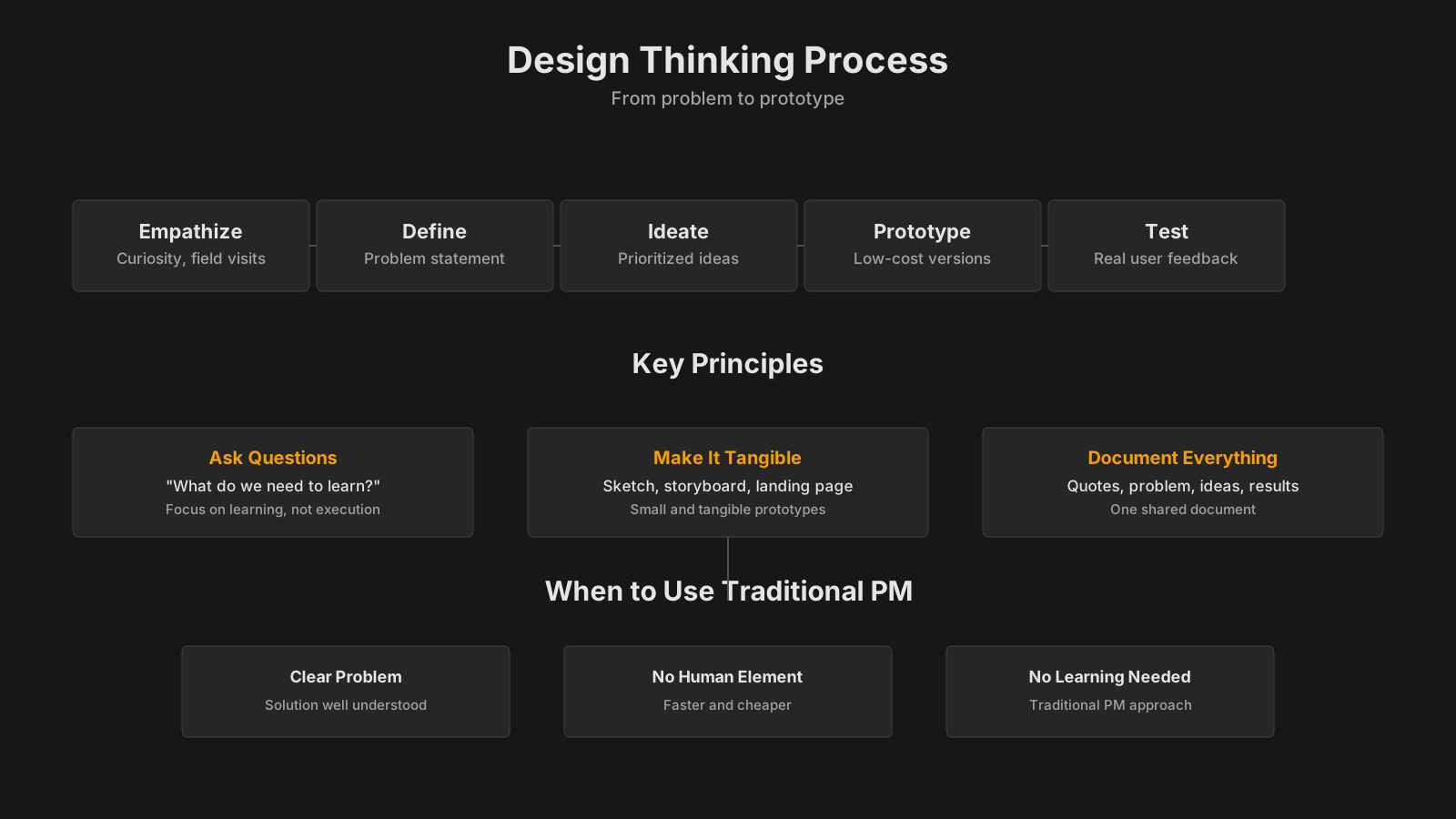
Design Thinking Five Stages: Summary of Key Topics
| Key Concept | Summary |
|---|---|
| Design Thinking | Design thinking equips teams with a structured approach to investigate problems, generate ideas, and validate solutions before allocating major resources. |
| Purpose | Its purpose is to apply a human-centered perspective to decisions that are often made too quickly, strengthening current project management practices rather than replacing them. |
| Applications | Retail banks, healthcare providers, logistics firms, government agencies, and HR teams have used design thinking to enhance customer services and streamline internal operations. |
| Business Focus | Business teams apply the same stages to billing workflows, employee onboarding journeys, and maintenance processes, adapting the method beyond physical product design. |
| Complex Problems | Design thinking is most valuable for ambiguous challenges where the solution path is unclear and human behavior strongly influences outcomes. |
| Value Added | The process offers the greatest value when the problem landscape is uncertain, stakeholders disagree, or earlier solution attempts have failed. |
| Empathize Stage | The empathize stage requires teams to set aside assumptions and gather direct evidence of genuine customer needs. |
| Research Methods | Typical methods include journey mapping an outpatient check-in, running diary studies on driver fatigue, and conducting focused interviews on loan renewal frustrations. |
What Is the Design Thinking Process in Business?
At its core, design thinking is a human-centered approach to innovation. It prioritizes understanding the people who experience a problem before deciding what solution to build. The five stages of design thinking provide a repeatable sequence that teams can follow, but not a rigid one. Empathize, define, ideate, prototype, and test are often drawn as a loop rather than a straight line. Teams may move back to a previous stage when testing reveals a flaw in the original problem definition.
The model was popularized by Stanford University's d.school and the design consultancy IDEO. But the underlying ideas are older, drawing on practices from engineering, architecture, and the social sciences. What makes the design thinking process distinct is its emphasis on direct interaction with users and its willingness to embrace ambiguity during the early stages. In a business setting, that can feel uncomfortable because it asks managers to slow down before making a decision.
Organizations often treat problem solving as a linear path from issue to fix. Design thinking disrupts that by insisting that the first step is not to define the solution but to understand the person affected. That shift can reveal that the original problem was a symptom of something deeper. For example, a company that wants to reduce customer complaints may discover that the complaints stem from confusing billing language, not from a missing feature.
Design Thinking Is Not Just for Designers
There is a persistent myth that design thinking belongs only to product designers or marketing teams. That is not the case. Banks, healthcare systems, logistics companies, government agencies, and human resources departments have all used the process to improve services and internal operations. The difference is that business teams often apply the same stages to a billing workflow, an onboarding journey, or a maintenance process instead of a physical product.
What changes is the object being designed, not the underlying logic. A finance team trying to reduce invoice disputes is designing an experience. An HR team trying to shorten time-to-hire is designing a process. Viewing these as design problems opens up new types of solutions that purely technical or policy-driven approaches miss.
The Five Stages Are a Loop, Not a Checklist
One of the most common misunderstandings is treating the five stages as a rigid sequence. In practice, the stages overlap. A team may begin prototyping and realize it does not understand the customer well enough. That should send the team back to empathy work. Likewise, a test may produce feedback that forces a redefinition of the original problem statement.
The iterative nature is what separates design thinking from a traditional stage-gate process. Stage gates often assume that once a phase is complete, the team moves forward. Design thinking assumes that learning can invalidate earlier assumptions at any point. This is not a weakness. It prevents teams from scaling an idea that is built on a misunderstanding.
Why Businesses Use Design Thinking for Complex Problems
Design thinking is most useful for ambiguous problems where the solution is not obvious and human behavior plays a major role. For example, if a company wants to reduce customer churn, the reasons may be hidden in service interactions, unclear pricing, or emotional responses to a product. The five stages help teams uncover those reasons before choosing an intervention.
For well-defined technical problems, such as fixing a known software bug or replacing a machine part, design thinking may be unnecessary overhead. The process adds the most value when the problem space is uncertain, multiple stakeholders disagree, or previous attempts to solve the issue have failed. Teams should assess that context before launching a full design thinking initiative.
Key Insights on Design Thinking Process
- Empathy precedes solution building
- Design thinking begins with a deep investigation of the people affected by a problem, ensuring that solutions address real needs rather than assumed ones.
- Stages form an iterative loop
- Because the empathize, define, ideate, prototype, and test stages form a continuous cycle, teams regularly revisit earlier steps when testing exposes gaps or flawed assumptions in how the problem was framed.
- Popularized by d.school and IDEO
- Stanford's d.school and the design firm IDEO brought the model into mainstream practice, yet its intellectual foundations extend across engineering, architecture, and the social sciences.
- Applied to business workflows
- When business teams adapt these stages to billing workflows, onboarding journeys, and maintenance processes, the deliberate focus on user feedback and open-ended exploration often challenges managers who are accustomed to rapid, definitive decisions.
Stage One: Empathize to Understand Real Customer Needs
Many teams assume they already know what customers want, but the empathy stage in design thinking forces them to set aside assumptions and gather direct evidence. This stage is not about asking people what solution they want. It is about understanding their context, constraints, emotions, and unspoken needs. Without this grounding, the rest of the process becomes an exercise in building features or services that no one actually values.
The goal of empathy work is to move beyond secondhand reports. A manager reading a customer satisfaction survey is not empathizing. Empathy requires spending time with the people who experience the problem. That might mean interviewing a customer, observing an employee at work, or walking through the same process that a user completes.
The interesting part is that users often describe their problems in ways that hide the real issue. They might say "the website is slow" when the actual frustration is uncertainty about whether their action was saved. Empathy work helps separate the stated complaint from the underlying need. This distinction becomes critical when the team moves into the define stage.
Field Research Methods That Reveal Unspoken Needs
Interviews are the most common method, but they are often done poorly. A good empathy interview uses open-ended questions and follows the participant's story instead of checking off a script. Observations are equally valuable. Watching a warehouse worker pack orders can reveal workarounds that no one would mention in a survey because they have become invisible habits.
Journey mapping is another practical tool. It captures the steps a person takes, the questions they have, and the emotions they feel at each point. For example, a regional hospital trying to improve its outpatient check-in process might map the journey from receiving an appointment reminder to leaving the clinic after a visit. The map may show that the pain is not the wait time itself, but the uncertainty about what to do next.
Diary studies and shadowing can add depth when a process happens over time or across locations. These methods are more resource intensive, so they are best reserved for high-stakes projects where a wrong assumption would be expensive. A logistics company studying driver fatigue might use diary studies over several weeks, while a bank exploring loan renewal frustration might rely on shorter targeted interviews.
Avoiding Bias During the Empathize Phase
Confirmation bias is a major risk. If a leader enters the empathy stage wanting to prove that a new app is needed, the team will likely hear only the comments that support that conclusion. To counter this, teams should include a mix of users, including extreme users or those who have abandoned the service. The point is to hear inconvenient feedback early.
Questions should avoid leading language. Asking "Don't you think this app would help you?" is not empathy. Asking "Can you walk me through what happened the last time you tried to complete this task?" is much more useful. The first question seeks agreement; the second seeks understanding. This difference seems small, but it changes the quality of the data.
Turning Observations Into Insight
Raw observations are not yet insights. A note like "customer waited 20 minutes" is a fact. An insight might be "the customer did not know whether the system was working, and that uncertainty made the wait feel longer than it was." The insight reframes the problem and sets the team up for a stronger define stage.
Teams often gather far more data than they can use. A useful practice is to cluster observations into themes and then ask what underlying need or motivation connects them. This synthesis work takes time, but skipping it produces a shallow problem statement. A team that goes straight from interviews to solutions will likely just repackage an existing idea with better language.
Stage Two: Define the Right Problem Before Solving It
After gathering customer and employee feedback, teams often rush into solution mode. The define stage in design thinking is the moment to pause and articulate what is actually going on. A well-crafted problem statement does not describe a preferred solution. It describes the user, the unmet need, and the insight that explains why the need matters. That distinction sounds small, but it changes everything downstream.
Consider a logistics company that notices late deliveries. A solution-first definition might be "we need a new routing app." A design thinking definition might be "drivers need to know dock availability before arrival so they can plan breaks and update customers accurately." The second statement opens up possibilities beyond software, including process changes, communication protocols, and signage.
The define stage is also where team disagreements become visible. Different departments often have different assumptions about the problem. Finance may believe the issue is cost control, while operations believes it is staffing. A clear problem statement forces those assumptions to be tested against evidence instead of settled by hierarchy.
Writing a Strong Problem Statement
A common format for a problem statement is: [User] needs a way to [need] because [insight]. For example, a small business owner needs a way to see the status of a loan application because prolonged uncertainty leads them to assume the application has been lost. This sentence does not mention a dashboard or a notification system. It leaves room for multiple solutions.
The quality of the problem statement depends on the quality of the empathy work. If the team skipped interviews, the statement will be based on internal assumptions and will likely reflect what the company wants to build rather than what the user actually needs. A weak problem statement often includes the solution, such as "we need to build a mobile app to reduce calls." That is not a problem; it is an implementation preference.
The How Might We Question
One practical bridge from define to ideate is the "How might we" question. A strong problem statement can be turned into a prompt such as "How might we reduce uncertainty during the loan application process?" The words "how might we" invite exploration without premature judgment. They signal that there are many acceptable answers.
Teams should avoid writing "How might we get customers to use our app" because that presumes the app is the answer. A better version is "How might we help customers feel confident about their application status." The difference may feel subtle, but the second version does not embed the solution. This style of framing unlocks creativity in the next stage.
Connecting the Define Stage to Business Objectives
Design thinking can drift into academic exercises if the problem statement is not connected to a business goal. That does not mean user needs should be ignored. It means the team should explicitly link the problem to metrics such as retention, cycle time, error rate, or employee turnover. For example, a bank may define the problem around loan application uncertainty because that uncertainty correlates with abandonment and support calls.
The define stage is also where constraints belong. Budget, regulatory requirements, and technical feasibility should be acknowledged, even if they are not used to eliminate ideas yet. Clear constraints give the ideation stage productive boundaries. Without boundaries, teams can waste time generating ideas that cannot be implemented.
Core Takeaways on Defining Problems
- Pause before rushing to solutions
- The define stage creates a deliberate pause that requires teams to articulate the underlying situation before committing to a fix, so feedback is translated into understanding rather than premature execution.
- Well-crafted statements expand possibilities
- A precise problem statement such as "drivers need to know dock availability before arrival" expands the range of viable responses beyond software, opening the door to process changes, communication protocols, and physical signage.
- Evidence over hierarchy
- A clear problem statement typically framed as [User] needs a way to [need] because [insight] forces departmental assumptions to be tested against evidence, whereas skipping user interviews produces statements grounded in internal assumptions rather than user evidence.
Stage Three: Ideate Without Constraints
Once the problem is framed clearly, teams can move into generating options. Common ideation techniques for business include structured brainstorming, brainwriting, and reverse ideation, but the real value is in separating idea generation from idea evaluation. When the two are mixed, the loudest voice in the room often wins and potentially valuable ideas get discarded before they have a chance to be examined.
Ideation is not a free-for-all. It works best when participants
Another method is to run multiple short rounds with different prompts. For example, a team working on patient check-in might first generate ideas for reducing uncertainty, then generate ideas for reducing physical movement, then generate ideas for improving staff communication. Each round produces distinct options. The variety prevents the group from fixating on one type of solution.
Using Prompts and Constraints to Spur Creativity
Counterintuitively, constraints can improve idea generation. Asking a team to design a solution that costs nothing or that could be tested in one week forces creative thinking. It prevents the tendency to propose a large software project as the default answer. Reverse ideation, where participants ask "How could we make this problem worse?", can also reveal hidden assumptions and lead to unexpected solutions.
External analogies help as well. A team working on hospital patient flow might study how airports manage passenger queues or how restaurants handle reservations. The transfer of a principle, not the copying of a tool, is what sparks innovation. That said, analogies work best when the team understands the source context well enough to adapt it thoughtfully.
Prioritizing Ideas Without Killing Momentum
After generating a large number of ideas, teams need to converge. Dot voting is a simple method, but it has limitations because people tend to vote for familiar ideas. A better approach is to combine voting with an impact and effort discussion. Ideas that score high on impact and low on effort are often good candidates for prototyping.
It is sometimes observed that the most promising idea is not the most polished one. Teams should keep a few wild cards alive rather than narrowing to one solution too quickly. The prototype stage is cheap enough to test more than one concept in parallel. Preserving this optionality is one of the practical advantages of the design thinking approach.
Stage Four: Prototype to Make Ideas Tangible
A prototype is not a finished product. In business settings, prototyping in design thinking means creating a cheap, low-risk representation of an idea to learn what works before building the real thing. The representation might be a paper sketch, a role play, a clickable wireframe, a physical model, or a service walkthrough. The key is that it is concrete enough to generate a reaction.
The prototype stage is where many ideas meet reality. A concept that seemed brilliant in a meeting can fall apart when employees try to act it out or when a customer tries to complete a task. That failure is valuable because it happens before significant resources have been committed.
A useful rule of thumb is to prototype at the lowest level of detail that can still answer the learning question. If the team wants to know whether users understand a new process, a written scenario and a role play may be enough. If it wants to test whether a dashboard layout communicates urgency, a digital wireframe with sample data is more appropriate.
Choosing the Right Fidelity for Each Prototype
Low-fidelity prototypes are usually best early on. A paper form, a storyboard, or a cardboard model allows a team to test the core logic without worrying about visual polish. High-fidelity prototypes are useful later when the question shifts from "does this concept make sense" to "does this specific interaction feel usable."
The fidelity should match the learning goal. If a team wants to know whether users understand a new process, a written scenario and a role play may be enough. If it wants to test whether a dashboard layout communicates urgency, a digital wireframe with sample data is more appropriate. Matching fidelity to the question prevents teams from spending weeks polishing something that only needs a rough sketch.
Prototyping for Services and Processes, Not Just Products
Business teams sometimes believe prototyping only applies to physical products or software. That is a mistake. A new employee onboarding program can be prototyped by running a pilot with one new hire and using a mocked-up checklist. A new claims review process can be prototyped on paper by asking a claims specialist to walk through a hypothetical case.
Service prototypes can include scripts, signage, physical props, and role assignments. For example, a retail bank testing a new account opening process might set up a desk in a meeting room, have one staff member act as the customer, and run through the exact steps. The prototype reveals confusion, redundancy, and emotional friction that a process diagram would miss.
Using Prototypes to Surface Hidden Costs and Risks
Prototyping also helps identify operational constraints. A team may discover that a proposed idea requires data that is not accessible in real time, or that it depends on a role that does not exist in the current structure. These discoveries are much cheaper to make during a prototype than during a full implementation.
It is useful to bring operational staff into prototyping sessions, not just designers or managers. Frontline employees often know which parts of a process will break first. Their skepticism is an asset if it is channeled into improving the prototype rather than blocking the session. In many cases, their input prevents the team from pursuing an elegant but operationally unrealistic solution.
Prototyping for Low-Risk Learning
- Cheap, low-risk idea testing
- Prototyping turns an idea into a low-cost, tangible form, such as a sketch, role play, or wireframe, allowing teams to surface potential flaws and failure points before investing heavily in the final solution.
- Match detail to learning question
- Teams should build each prototype at the minimum level of detail needed to answer their specific learning question, using a written scenario and role play to clarify process understanding or a digital wireframe with sample data to test interface layout and communication.
- Fidelity scales with question type
- Low-fidelity prototypes such as paper forms, storyboards, and cardboard models validate core logic without visual polish, while high-fidelity prototypes are more appropriate when the question shifts from whether a concept is viable to whether a specific interaction feels genuinely usable.
Stage Five: Test and Learn From Real Feedback
The testing phase in design thinking is not a final approval gate. It is an opportunity to observe how real users interact with a prototype and to gather feedback that can send the team back to redefine the problem. Testing often reveals that the solution works in part but misses an emotional or contextual detail that only appears during actual use.
A well-run test focuses on behavior, not opinions. Asking "Did you like it?" tends to produce polite answers. Watching a user struggle to find a button or misread an instruction is far more informative. The goal is to identify what needs to change, not to defend the prototype.
Testing in a business context often happens with internal employees as users. That is acceptable if the employees are representative of the target group. For example, a new expense reporting process might be tested with a small group of employees from different departments. Their attempts to submit a report will reveal where the process is confusing or unnecessarily slow.
Designing a Useful User Test
A useful test starts with a clear learning objective. Are you testing whether the concept is understandable, whether the process reduces time, or whether the user feels supported? The tasks given to participants should reflect that objective. If the team is testing a claims review process, the participant might be asked to process a simple claim while thinking aloud.
Recruiting the right participants matters. Testing with colleagues is tempting, but they often share the team's assumptions. Real users or employees from another department will provide more honest and useful feedback. Even five participants can surface many usability issues if the test is designed well.
Iterating Based on Feedback
After the test, the team should identify patterns. One participant struggling may be an anomaly. Three participants struggling with the same step indicates a problem. The team then decides whether to iterate on the prototype, revisit the problem definition, or abandon the idea. That decision should be based on evidence, not attachment.
The loop back to earlier stages is a feature, not a failure. If a test reveals that users do not care about the problem the team chose, the right response is to return to empathy and find a more meaningful need. Killing an idea early saves the cost of building something that would have failed later. This is often the most valuable outcome of the testing phase.
Testing in Low-Risk Business Environments
For business applications, testing can happen in a single branch, one department, or a limited market before a broader rollout. A company testing a new scheduling process for field technicians might run it with one team for two weeks. The limited test generates real operational feedback without disrupting the entire workforce.
Pilot programs are a common form of testing in business. They are more structured than a user test and often include measurement of specific metrics such as time saved, error rate, or customer satisfaction. A pilot should still leave room for qualitative feedback, because the metrics alone may not explain why a change is working or failing.
How to Apply the Five Stages in a Business Setting
Applying design thinking in business requires more than training employees on the five stages. It means changing how decisions are made, how projects are scoped, and how different functions collaborate. The process works best when a small, cross-functional team has permission to explore a problem before committing to a solution. Without that permission, the stages become a rhetorical overlay on a predetermined plan.
One practical approach is to run a design thinking sprint over a week or two, with dedicated time for field research, synthesis, ideation, prototyping, and testing. A compressed timeline forces prioritization and prevents the process from becoming endless. It also gives senior leaders a concrete deliverable to review rather than a vague set of recommendations.
The process does not require a complete overhaul of existing project management methods. It can be integrated into a phase before development starts, or into a discovery track within a larger initiative. The important thing is that the team is not asked to skip the problem framing step when deadlines tighten. That is where the real value is created or lost.
Using the Design Thinking Process in Product Management
Product managers often use design thinking to complement agile delivery. Agile teams are good at building and iterating quickly, but they can skip the deep problem exploration if the backlog is already full of features. The design thinking process helps product managers validate which features matter before they enter the development cycle. Empathy work with users shapes the problem statement, and prototypes test assumptions cheaply before expensive sprints begin.
For example, a software product team might assume that users need more analytics dashboards. Empathy interviews reveal that users need help interpreting the data they already have. The team then prototypes a weekly plain-language summary instead of building another chart. The result is less development work and a stronger user outcome.
Applying the Design Thinking Process in Human Resources
HR teams can use the same five stages to improve employee experience. Consider onboarding. Instead of assuming new hires need more training videos, the HR team could empathize by interviewing employees who joined in the last six months. The define stage might reveal that new hires feel overwhelmed by unsorted information during the first week. Ideation could generate options such as a buddy system, a simplified checklist, or a staged release of information. Prototypes might include a mock onboarding plan, and testing could run with one cohort.
This application works because the stages do not depend on the output being a physical product. The object being designed is the employee journey. The same logic applies to performance reviews, leave policies, and career development conversations. HR leaders who adopt the process often find that employees are more willing to share feedback when they see it used to make tangible changes.
Adapting the Design Thinking Process for Operations and Service Delivery
Operations teams face broken processes, handoffs, and service failures. The design thinking process helps them see the process from the perspective of the person living it, not the org chart. For instance, a hospital might map the discharge journey and discover that patients leave without understanding their medication instructions. That insight leads to a problem statement focused on comprehension, not on discharge speed.
Prototyping a new discharge instruction format as a one-page visual guide and testing it with a few patients is much faster than rolling out a system-wide training program. If the guide works, it can be refined and scaled. If it fails, the team learns why without having spent heavily. That ability to fail small is one of the most practical benefits of design thinking in operations.
Key Insights for Business Application
- Cross-functional team exploration
- When senior leaders empower a small cross-functional team to explore a problem deeply before committing to a solution, the approach reshapes decision-making and strengthens collaboration across functions.
- Focused design thinking sprint
- A dedicated one to two week sprint that allocates time for field research, synthesis, ideation, prototyping, and testing produces a concrete deliverable for senior leaders to evaluate instead of broad, speculative recommendations.
- Integrate with existing methods
- This approach can be embedded into existing project management practices without a full overhaul, serving as a pre-development phase or a discovery track within a broader initiative.
- Validate features before building
- By using user empathy to shape problem statements and low-cost prototypes to test assumptions, design thinking enables Agile and product teams to validate which features truly matter before development begins, for example, HR interviewing recent hires rather than assuming training videos are needed.
Tools and Methods for Each Stage
The five stages can be supported by a practical set of design thinking tools and methods that help teams move from abstract conversation to concrete decisions. These tools are not proprietary, and most do not require software. The goal is to make thinking visible and to create artifacts that a team can react to together.
Selecting the right tool depends on the stage and the context. A tool that works well for a product team may need adaptation for a financial process or a field service operation. The method should serve the learning goal, not become an end in itself. Too many teams fall in love with sticky notes and forget why they are using them.
Tools for Empathize and Define
During the empathy stage, interviews, observation guides, and journey maps are foundational. A simple empathy map with sections for what the user says, thinks, does, and feels can help a team synthesize individual conversations. For the define stage, a problem statement template and "How might we" prompts convert insights into an actionable direction.
These artifacts do not need to be polished. Handwritten sticky notes or a shared whiteboard are often more effective than a pristine slide deck because they invite correction and spontaneous grouping. The value lies in the conversation they provoke. A polished document can actually reduce discussion because people assume it is already final.
Tools for Ideate and Prototype
During ideation, brainwriting, reverse brainstorming, and analogical thinking work well. A simple matrix that plots ideas by impact and effort helps a team choose what to prototype. During prototyping, storyboards, paper models, wireframes, and service role plays are all practical options.
Teams should keep prototypes rough enough to be changed quickly. The moment a prototype becomes too polished, people may hesitate to give critical feedback because they assume the work is already final. That psychological effect is real and can undermine the testing stage. A good facilitator will explicitly remind people that the prototype is meant to be broken.
Tools for Test and Iteration
Usability testing scripts, observation checklists, and feedback capture templates keep the testing phase structured. A simple format that records what the participant did, what they struggled with, and what they said is sufficient for many business tests. The team can then cluster the findings and decide what to change.
Many teams skip formal tools and simply watch a user try the prototype. That is acceptable as long as someone records the session and the team reviews the evidence together. The tool matters less than the discipline of acting on what was observed. Without that discipline, a testing session becomes a meeting about opinions rather than a basis for iteration.
Common Pitfalls and How to Avoid Them
The most common design thinking pitfalls come from treating the process as a box-ticking exercise rather than a way to change decision behavior. A team can conduct interviews, write a problem statement, run a brainstorm, and still produce a solution that was decided in the first meeting. The process only works when the participants are willing to let evidence change their minds.
Another pitfall is excluding the people who will implement the solution. Design thinking projects often involve a core team that may not include frontline workers, IT staff, or compliance officers. When those groups are brought in only at the end, they find practical problems that could have been caught earlier. Involving them from the beginning slows the process slightly but dramatically improves implementation success.
Skipping or Underfunding the Empathy Stage
Teams under deadline pressure often shorten the empathy phase to a few internal conversations. That defeats the purpose. Internal conversations reflect internal assumptions. The empathy stage does not have to take months, but it does require direct contact with real users. A short field visit or a handful of well-structured interviews can be enough for a focused project.
Underfunding empathy can also mean not allowing time for synthesis. Raw observations that are not analyzed become trivia. The team needs space to connect the dots between what people said and what that means for the problem. A common mistake is to collect a lot of data and then move straight to ideation without writing a clear problem statement. That often leads to a solution that sounds good but solves the wrong issue.
Treating Prototypes as Finished Products
Prototypes are meant to be changed or discarded. When a leader sees a polished prototype and says "looks good, ship it," the team may skip testing. The right response to a prototype is a question: "What do we need to learn from this?" That question keeps the focus on learning rather than premature execution.
This pitfall is especially common in organizations with a strong engineering culture. The desire to build a real system can overshadow the need to test a rough concept first. Setting an explicit expectation that prototypes are low-cost learning tools can reduce this pressure. It also helps to keep the prototype visually rough, which signals that it is not yet ready for production.
No Feedback Loop or Decision Rule
Some teams run through the five stages but have no mechanism for acting on test results. They present findings to a steering committee, the committee asks for more analysis, and the project stalls. To avoid this, define in advance who decides what happens after testing and what evidence will trigger a pivot, an iteration, or a stop.
Without a decision rule, the process can become a lengthy research exercise that never reaches implementation. Design thinking is not just about discovering problems; it is about making a concrete choice based on what was learned. That choice may be to stop, but it should still be a deliberate decision rather than a slow fade.
Key Insights on Design Pitfalls
- Evidence must change decisions
- Design thinking fails when teams perform the process as a checklist and disregard evidence that contradicts the solution they intended to pursue from the start.
- Involve stakeholders from the start
- Keeping frontline workers, IT staff, and compliance officers out of the process until the final stage creates operational obstacles that their early participation would have surfaced and resolved.
- Don't underfund the empathy stage
- When deadlines compress the empathy phase, teams lose the opportunity to translate direct user observations into a precise understanding of the problem they are trying to solve.
- Define problems before brainstorming
- Gathering research without first articulating a clear problem statement pushes teams into premature ideation and causes them to bypass the testing that validates the design direction.
Measuring Success and Building a Design Thinking Culture
Measuring the impact of design thinking can be difficult because the outcomes are often indirect. However, measuring design thinking outcomes is possible if the team connects the process to business metrics from the start. The right measures depend on the problem being addressed. A service improvement project might track cycle time and customer satisfaction. A product concept might track concept test results and implementation rate.
The temptation is to measure activity, such as the number of interviews conducted or the number of ideas generated. Those are useful process indicators, but they do not prove that the business benefited. The more meaningful question is whether the team avoided a bad investment, made a better decision, or improved a specific outcome.
Leading and Lagging Indicators
Leading indicators show whether the process is being adopted. Examples include the percentage of projects that start with a problem statement, the number of stakeholders involved in empathy work, or the time spent testing before implementation. Lagging indicators show the downstream effect, such as reduced onboarding time, fewer support calls, or higher employee satisfaction.
A balanced approach works best. Leading indicators help leaders see whether the process is being used, while lagging indicators show whether it is producing results. Neither set of measures should be used in isolation. If only lagging indicators are tracked, it may take too long to see a signal and leaders may lose patience. If only leading indicators are tracked, the team may mistake activity for impact.
Building Capability Through Coaching and Pilot Projects
Training alone rarely changes behavior. Teams need to apply the design thinking process to a real problem with a coach or facilitator who can model the mindsets. A small pilot project with visible results can create more internal support than any number of workshops. Leaders should identify a problem that is important enough to matter but contained enough to show a result within a few weeks or months.
After the pilot, the team should share both the process and the outcome. That transparency helps others see that design thinking is not a mysterious creative exercise. It is a structured way to make better decisions. Over time, the language of problem statements, prototypes, and user testing can become part of the normal planning conversation.
When Not to Use Design Thinking
Design thinking is not the right tool for every challenge. If the problem is perfectly clear, the solution is well understood, and there is no meaningful human element, a traditional project management approach may be faster and cheaper. Using design thinking in those cases can frustrate teams and create unnecessary bureaucracy.
The process also requires a tolerance for ambiguity and the ability to stop a project before it reaches implementation. Organizations that cannot accept early failure or that punish teams for changing direction will struggle. In those cultures, leadership support and clear expectations are essential before adopting the process. Without that support, design thinking becomes another management fad that people perform but do not use to make real decisions.
The five stages are simple to describe and harder to practice. They require a shift from advocating for a solution to investigating a problem. When applied within a business setting, the design thinking process gives teams a common language and a disciplined way to test assumptions. The examples across product management, HR, and operations show that the method does not belong to any one function. It belongs wherever decisions are made about how people experience a product, service, or process.
Advance Your Career with Professional Certification
Earning a project management certification gives you a structured approach to handling scope, budgets, and stakeholder expectations without relying on guesswork. Most programs cover risk registers, critical path analysis, and resource leveling so you can spot schedule conflicts before they derail delivery. Hiring managers often treat this credential as evidence you can run a project from kickoff to closeout with minimal oversight. It is especially useful if you are moving from a technical role into a coordination-heavy position where soft skills and tracking tools matter. The certification process typically includes scenario-based exams that test judgment, not just terminology.
Pursuing a certified product manager credential helps you shift from building features to validating customer problems first. You learn to write testable hypotheses, run discovery interviews, and align engineering work with measurable business outcomes. Many courses also cover roadmapping, pricing experiments, and lifecycle management so you can prioritize based on evidence instead of internal opinions. This certification is valuable for founders, business analysts, and engineers who want to own the product strategy rather than just execute a backlog. Employers frequently use it as a filter when recruiting for roles where cross-functional influence matters more than direct authority.
Investing in HR training and certification prepares you for compliance demands, employee relations cases, and workforce planning in a way that informal experience rarely covers. A structured program walks you through labor law updates, compensation benchmarking, and performance management frameworks that hold up under audit. It also builds confidence when you need to handle disciplinary meetings, leave requests, or restructuring announcements with consistent documentation. Many HR professionals use certification to move from administrative support into advisory roles where they shape hiring policy and retention strategy. The credential signals that you understand both the legal boundaries and the human side of managing people.