Many professionals first hear about Lean Six Sigma Green Belt certification when a manager asks them to lead a small process improvement effort or when a job description lists the credential as a preferred qualification. The path to Lean Six Sigma Green Belt Certification: Training and Exam Preparation can seem unclear because there is no single global curriculum, and providers vary widely in rigor, price, and format. The certification generally signals that you can apply the DMAIC framework, collect and interpret basic process data, and support improvement projects without needing the depth of a Black Belt. This article walks through what the credential actually covers, how training works, how to prepare for the exam efficiently, and how to use the certification after you earn it.
There is a practical reason the credential has become common in operations, healthcare, financial services, and technology roles. Employers use it as a screening signal for people who can speak the language of process improvement and who have some structured problem-solving ability. But the credential alone does not guarantee better project outcomes, and some training programs leave gaps that candidates only discover during the exam or on the job.
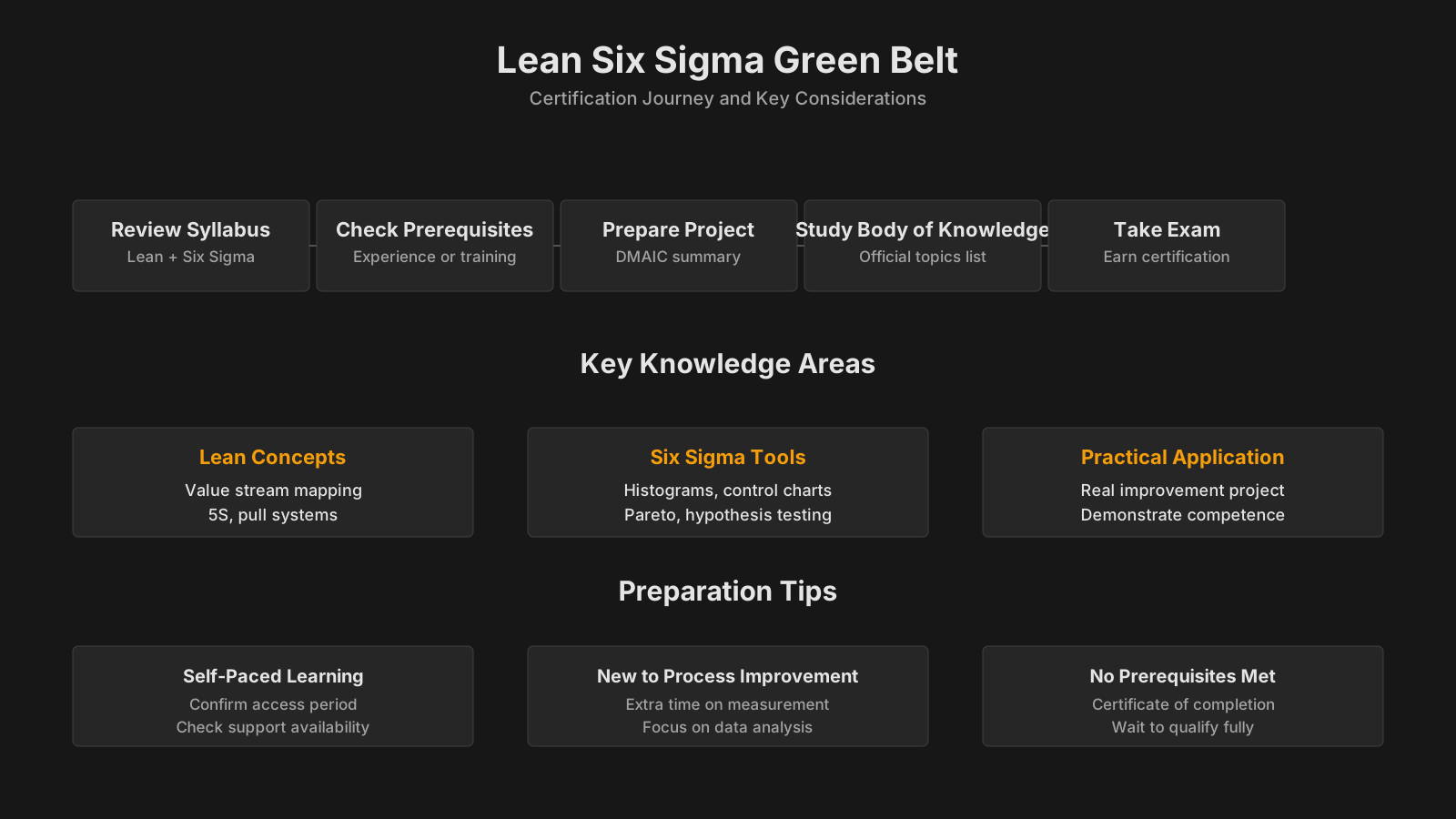
Lean Six Sigma Green Belt Certification: Key Topics at a Glance
| Key Concept | Summary |
|---|---|
| Typical Entry Points | Professionals often first encounter Green Belt certification when a manager assigns them a process improvement task or when a role description lists the credential as a preferred qualification. |
| Certification Path Variability | Without a unified global curriculum, certification standards vary considerably across providers in syllabus depth, assessment rigor, cost, and delivery format, making credential selection difficult. |
| Credential Value | A credible Green Belt credential signals applied competence in the DMAIC framework, basic data interpretation, and project support, positioning holders as effective contributors without requiring the statistical depth of a Black Belt. |
| Core Body of Knowledge | Reputable curricula consistently cover the define, measure, analyze, improve, and control phases along with foundational Lean tools, yet specific tools, project requirements, and assessment depth vary by provider. |
| Lean Waste Categories | Lean thinking targets eight forms of waste: waiting, overproduction, defects, unnecessary motion, excess inventory, overprocessing, underutilized talent, and transportation. |
| Role Responsibilities | Typical Green Belt responsibilities include process mapping, bottleneck identification, baseline data collection, root cause analysis, solution piloting, and post-implementation performance monitoring. |
| Analytical Toolkit | Green Belts apply accessible analytics such as Pareto charts for defect prioritization and control charts for process stability monitoring, while complex experimental design remains a Black Belt responsibility. |
| Course and Project Selection | Mandatory project work adds practical credibility but can exclude professionals between roles. Effective course selection requires comparing examination syllabi and prioritizing applied tool coverage over programs that overemphasize terminology. |
What Lean Six Sigma Green Belt Certification Actually Means
Lean Six Sigma Green Belt certification is widely understood as a mid-level process improvement credential, sitting between the awareness-level Yellow Belt and the more advanced Black Belt. The certification generally indicates that an individual has been trained in the DMAIC improvement cycle, basic statistical process control, waste elimination, and team facilitation. Green Belt body of knowledge requirements differ by provider, but most reputable programs include the define, measure, analyze, improve, and control phases along with a set of foundational Lean tools. Some providers issue the certificate after an exam alone, while others require documented project work or relevant experience.
The term Lean Six Sigma itself combines two related but distinct improvement traditions. Lean focuses on eliminating waste in the form of waiting, overproduction, defects, unnecessary movement, excess inventory, overprocessing, underutilized talent, and transportation. Six Sigma emphasizes reducing variation and defects through statistical analysis and disciplined problem solving. A Green Belt is expected to understand the intersection of these two approaches well enough to lead smaller projects or support larger initiatives under a Black Belt.
Green Belt vs Yellow Belt and Black Belt
A Yellow Belt typically learns the basic vocabulary of Lean Six Sigma and may participate on improvement teams without leading them. A Green Belt takes that further by learning how to run a small project, collect data, perform basic statistical tests, and facilitate team meetings. A Black Belt generally carries more advanced statistical skills, manages larger or cross-functional projects, and often mentors Green Belts. The boundaries between these levels are not always consistent across organizations, but the general progression is clear.
In many companies, a Green Belt is not a full-time improvement role. The person usually has a regular operational job and spends a portion of time on improvement work. That changes the nature of the training because Green Belts need practical tools they can apply without a heavy statistical software infrastructure. It also means the credential is often valued as an additional skill set rather than a standalone career path.
Typical Responsibilities of a Lean Six Sigma Green Belt
A Green Belt may be asked to map a process, identify bottlenecks, collect baseline data, run a root cause analysis, pilot a solution, and monitor results after implementation. Much of this work follows the DMAIC sequence, but the actual depth of statistical analysis can be modest. For example, a Green Belt might use a Pareto chart to prioritize defect categories or a control chart to check whether a process is stable, without needing to design complex experiments.
The most successful Green Belts are not necessarily the most statistically advanced people. They tend to be strong communicators who can translate data into operational language and keep a team focused. That often matters more than knowing every formula, especially in service or administrative environments where processes involve handoffs, approvals, and unclear ownership.
Does Lean Six Sigma Green Belt Certification Require a Project?
This is one of the most common questions, and the answer depends on the certifying body. Some providers, including ASQ, have experience or project requirements in addition to the exam. Other well-known providers offer exam-only certification, which means you can earn the credential by passing the test after completing training. Project requirements add practical weight to the certification, but they also create a barrier for people who are between jobs or working in roles where a full improvement project is not immediately available.
The difference matters for how employers interpret the credential. A certification with a project component may carry more credibility in some industries because it implies hands-on application. However, many hiring managers do not distinguish between project-based and exam-only certifications. What they care about is whether you can describe a real improvement effort and explain the tools you used.
Green Belt Certification Core Points
- Mid-level process improvement credential
- Green Belt certification occupies the middle tier between the awareness-focused Yellow Belt and the advanced Black Belt, equipping professionals with applied skills in the DMAIC cycle, foundational statistical process control, waste elimination, and cross-functional team facilitation.
- Provider requirements vary widely
- Although the body of knowledge varies by provider, reputable programs generally cover the define, measure, analyze, improve, and control phases along with foundational Lean tools; however, certification requirements range from passing an exam alone to completing a documented project with measured results.
- Hands-on small project leadership
- A Green Belt translates training into practice by leading well-scoped improvement projects, mapping current-state processes, quantifying bottlenecks, collecting baseline performance data, conducting structured root cause analysis, and applying tools such as Pareto charts and control charts to sustain measurable gains.
Core Lean Six Sigma Green Belt Certification Training Content
Before selecting a course, compare the provider’s Green Belt certification exam syllabus against the main sections of the body of knowledge. A solid training program should cover more than just vocabulary. It should walk through the entire DMAIC lifecycle with examples, data sets, and opportunities to apply the tools in realistic scenarios. Some courses cut corners by focusing heavily on definitions and leaving statistical application for later, which becomes a problem when you sit for the exam.
The training content usually mirrors the exam blueprint. Most reputable programs organize their material around the five DMAIC phases, then layer in Lean principles and team dynamics. The balance between statistical content and conceptual content differs by provider, so it helps to review the syllabus before paying for a course.
DMAIC Phases and Tollgate Reviews
DMAIC stands for define, measure, analyze, improve, and control. Each phase has a distinct purpose and a set of associated tools. In the define phase, you clarify the problem, scope the project, and identify the customer or stakeholder requirements. The measure phase establishes baseline performance and validates the measurement system. Analyze focuses on identifying root causes, improve develops and pilots solutions, and control sustains the gains over time.
Tollgate reviews are checkpoints between phases where a project leader presents progress to a sponsor or a Black Belt. These reviews force discipline and prevent teams from jumping to solutions before understanding the problem. Green Belt training should include examples of tollgate documents or presentation templates, because many organizations use tollgates to decide whether a project continues.
Lean Tools Every Green Belt Should Know
Green Belts are expected to understand value stream mapping, 5S, standard work, visual management, and the concept of pull versus push production. These Lean tools are often easier to apply than statistical methods, but they still require careful observation and facilitation. For example, a value stream map of an invoice approval process can reveal delays that a traditional flowchart might hide.
Waste identification is another foundational skill. The classic Lean framework breaks waste into categories such as waiting, defects, overproduction, excess motion, and unnecessary processing. In service environments, waiting and rework often dominate. Being able to identify these wastes in everyday workflows is a practical skill that exam questions often test through short scenario descriptions.
Basic Statistics and Data Analysis for Green Belts
The statistical portion of Green Belt training usually includes descriptive statistics, probability distributions, measurement system analysis, control charts, and hypothesis testing. The level of depth is not as intense as Black Belt training, but it goes beyond simple averages. You need to understand variation, common versus special cause variation, and how to choose the right control chart for different types of data.
In practice it often happens that Green Belt candidates struggle with normality assumptions and the difference between discrete and continuous data. A good training course will give you structured exercises that force you to classify data types and select appropriate tools. This is not just
Creating a Lean Six Sigma Green Belt Exam Preparation Schedule
Divide your preparation into three broad phases. The first phase is content review, where you work through the training material and take notes on key concepts. The second phase is active practice, where you attempt full practice exams and analyze every wrong answer. The third phase is targeted review, where you revisit only the topics that caused errors and close those gaps.
For most working professionals, a study schedule of six to eight weeks is realistic. That allows enough time to absorb the statistical concepts without cramming. If you only have two weeks after training, focus on practice questions and the body of knowledge outline rather than trying to reread every module. The goal is not to cover everything equally, but to identify your weakest areas and improve them enough to pass comfortably.
Using Practice Tests for Lean Six Sigma Green Belt Certification Success
Practice tests are useful only if you treat them as diagnostic tools rather than memory exercises. Take the first practice test early to establish a baseline, even if you expect a low score. That gives you a clear picture of which topics need the most attention. After each test, sort your incorrect answers into categories such as define phase tools, measurement concepts, statistical analysis, and control planning.
Some people avoid practice tests because they fear seeing a low score. That avoidance is counterproductive. The exam is the wrong place to discover that you did not understand process capability or measurement system analysis. Practice tests reduce uncertainty and make the actual exam feel more familiar.
Memorization Techniques for Statistical Formulas
Not every Green Belt exam requires you to calculate from memory, but many do include formula-based questions. Flashcards work well for formulas because they force active recall. Group formulas by their purpose rather than trying to memorize them in isolation. For example, process capability indices like Cp and Cpk both relate to specification limits, but they answer different questions. Understanding that relationship helps you remember when to use each one.
It also helps to work through small numerical examples by hand. The act of calculating a control limit or a basic hypothesis test cements the formula better than reading it multiple times. Even if the exam is mostly conceptual, the process of working calculations deepens your overall understanding of variation and process performance.
Common Lean Six Sigma Green Belt Certification Mistakes
Many candidates focus on memorizing definitions and then struggle with scenario-based questions that determine whether they can actually apply the concepts, which is the real test for passing the Lean Six Sigma Green Belt exam. This mismatch between study approach and exam design is one of the most common reasons people fail on the first attempt. The exam is not trying to trick you, but it does expect you to think through problems rather than simply recall terms.
Another frequent mistake is waiting until the last week before the exam to start studying. That leaves no time for repetition, and the statistical concepts never get a chance to settle into long-term memory. Cramming can work for vocabulary-heavy tests, but Green Belt exams usually require understanding relationships between tools and phases, which develops through practice over time.
Underestimating the Statistical Reasoning Component
The statistical section is not the majority of the exam, but it is often the part that separates passing from failing. Concepts like standard deviation, process capability, and control chart interpretation require more than surface familiarity. If you cannot explain why a control chart shows signs of special cause variation, you may miss several related questions.
Spend extra time on the distinction between common cause and special cause variation. That distinction appears in exam scenarios and in real project work. It is also foundational for choosing appropriate improvement actions. If you try to fix a common cause problem as if it were special cause, you will likely make the process worse.
Cramming Without Applying Tools to Scenarios
Scenario-based questions often present a short business context and ask for the next logical step or the most appropriate tool. For example, a question might describe a process where data is collected but the measurement system has not been checked, and ask what should happen before further analysis. The correct answer often involves validating the measurement system first. That kind of thinking comes from working through examples, not from reading bullet points.
When you study, ask yourself how each tool would be used in a real process. If you learn a Pareto chart, think about what kind of data it displays and when it would be useful. That habit builds the mental connections you need for scenario questions. It also makes the material more useful after the exam.
Ignoring the Project or Portfolio Requirement
Some certification bodies require a completed project or a project portfolio before they issue the official certificate. Candidates sometimes pass the exam and then realize they still need to document a project. That can delay the credential by months, especially if you have not been planning a suitable project in advance.
If your chosen certification includes a project requirement, start identifying a potential project early in your training. Look for processes that have clear problems, available data, and a manager who supports improvement work. A narrowly scoped project with measurable results is often easier to document than a broad initiative with vague outcomes.
Key Takeaways on Green Belt Mistakes
- Memorization fails on scenario questions
- Rote memorization of definitions rarely transfers to exam performance because scenario-based questions require candidates to diagnose a process problem and apply the Lean Six Sigma concept that matches the operational context.
- Last-minute cramming is ineffective
- Cramming in the final week leaves no opportunity for spaced repetition, so technical concepts such as standard deviation and control chart interpretation fail to move into long-term memory and are easily forgotten under exam pressure.
- Exam requires connecting tools to contexts
- Strong performance depends on linking tools to the DMAIC phase and business context. Many scenario questions present a realistic process issue and ask for the next logical step or the most appropriate tool, such as recognizing when a measurement system analysis should be completed before further analysis.
Applying Lean Six Sigma Green Belt Skills After Certification
The credential becomes meaningful when you use it to lead a DMAIC improvement project that reduces defects, cycle time, or cost in a real process. Certification without application tends to fade quickly because the tools are not reinforced through practice. The best time to start a small project is shortly after you pass the exam, while the concepts are still fresh.
Many newly certified Green Belts make the mistake of waiting for a big, formal project to be assigned. In reality, small opportunities are everywhere. An approval process with too many handoffs, a report that requires excessive manual rework, or a recurring customer complaint can all become Green Belt projects. Starting small lets you practice without high stakes.
Leading a Small DMAIC Project
A Green Belt project does not need to produce millions in savings. A project that removes a few hours of rework per week or reduces a recurring error rate can be significant in a team environment. The point is to follow the DMAIC structure rather than jumping directly to a solution. Define the problem, measure the current state, analyze the root causes, implement a pilot, and control the result.
Documentation matters. Write down the problem statement, the baseline metrics, the root cause analysis, the selected solution, and the control plan. That documentation becomes your evidence of competence when you talk about the certification in interviews or performance reviews. It also gives you a template for future projects.
Facilitating Kaizen Events and Rapid Improvements
Kaizen events are short, focused improvement sessions that typically last a few days. Green Belts often facilitate or support these events because they bring together frontline employees and managers to solve a specific problem quickly. The format is less formal than a full DMAIC project, but it uses many of the same tools, such as process mapping, waste identification, and root cause analysis.
Facilitation skills matter more than statistical depth in these sessions. You need to keep the group focused, capture ideas without judgment, and translate rough observations into actionable changes. Green Belt training helps with the structure, but actual facilitation improves only through practice.
Communicating Results to Leadership
A major part of Lean Six Sigma work is convincing sponsors and stakeholders that a change is worth making. Green Belts need to present data clearly, explain tradeoffs, and connect project outcomes to business goals. A simple control chart or before-and-after Pareto chart can be more persuasive than a long narrative.
When presenting results, focus on the operational impact rather than the statistical technique. Leaders usually care about cycle time, cost, quality, and customer satisfaction. Mention the tools you used only enough to establish credibility. The rest of the conversation should be about what changed, why it matters, and what is needed to sustain the improvement.
Maintaining Lean Six Sigma Green Belt Certification and Advancing Your Career
Before you enroll, check the provider’s recertification requirements because they can affect the long-term value of the credential. Some certifications are valid for life, while others require renewal through continuing education or project activity. Knowing this upfront helps you plan whether the certification is a one-time effort or an ongoing commitment.
Even if your certification does not require renewal, the knowledge itself can become stale if you do not use it. The best recertification strategy is ongoing practice. That might mean leading a small project each year, coaching a colleague through a problem, or taking an advanced course in a specific area like design of experiments or change management.
Recertification and Continuing Education
Some professional associations require recertification units that you earn through continuing education, conference participation, publishing, or project work. The rules are usually not especially burdensome, but they require planning. Keep a simple log of your improvement activities, training hours, and any presentations you deliver. That record makes renewal much easier.
If your provider does not require recertification, you can still benefit from periodic refreshers. Revisiting the body of knowledge every couple of years helps you retain the statistical concepts. It also helps identify new tools or updated software that could improve your project work.
When to Pursue Black Belt Certification
Green Belt is often a stepping stone to Black Belt, but not every Green Belt needs to move up. Black Belt certification involves deeper statistics, larger project expectations, and more organizational responsibility. It makes sense if you want to lead improvement full time or if your employer supports that career path.
Before pursuing Black Belt, spend time applying Green Belt skills on real projects. That experience gives you context for the advanced material. Jumping straight from Green Belt training to Black Belt training without practical application can create a knowledge gap that becomes obvious during complex projects.
Using Green Belt Credentials in Job Applications
List the certification clearly on your resume, including the certifying body and the year earned. If you completed a project as part of the certification, include that in your experience section or a project summary. A credential alone tells an employer you passed a test, but a project description shows you can apply the methods.
During interviews, be prepared to explain the DMAIC framework in plain language and describe a specific problem you solved. Avoid the trap of reciting definitions without context. The interviewer is often less interested in whether you remember every tool and more interested in how you think through a process problem.
Lean Six Sigma Green Belt certification is a useful credential, but its value depends heavily on how you prepare and what you do after earning it. The most successful candidates treat training and exam preparation as the beginning of a practice, not the end of a checklist. That distinction shows up clearly in project work, interviews, and long-term career growth.
Essential Points on Certification Renewal
- Check recertification requirements early
- Confirm the certifying body's renewal policy before enrolling so you know whether the credential remains valid indefinitely or requires periodic continuing education.
- Earn recertification units actively
- Meeting renewal requirements typically means earning units through continuing education, conference attendance, published work, or leadership roles on process improvement projects.
- Keep a simple activity log
- Maintain a concise log of training hours, project work, and presentations so your recertification application is easy to complete and audit-ready.
- Review the body of knowledge
- Refreshing your knowledge of statistical methods and emerging quality tools every few years sharpens your analytical skills and leads to stronger project results.
- List credentials accurately on resumes
- List the full certification name, the issuing organization, and the year it was earned so hiring managers can quickly confirm your Lean Six Sigma Green Belt credential.
Advance Your Career with Professional Certification
Project management certification offers a structured way to validate scheduling, budgeting, and communication skills under real constraints. Teams often look for a certified project manager when assigning ownership of cross-functional initiatives. The exam process forces candidates to map deliverables to measurable outcomes rather than relying on intuition. This credential also helps standardize terminology across vendors and internal departments.
Product management certification builds skill in user research, roadmap sequencing, and go-to-market alignment. Enrolling in structured product management training gives you repeatable methods for prioritizing features against limited engineering capacity. Unlike general business courses, this training focuses on feedback loops, pricing sensitivity, and lifecycle metrics. Candidates should evaluate programs that include portfolio projects reviewed by practitioners.
HR certification helps practitioners stay current with employment law, compensation bands, and performance management systems. A human resources certification signals familiarity with audits, onboarding compliance, and dispute resolution. It also provides frameworks for designing equitable promotion ladders and retention surveys. Many programs require case simulations that mirror workplace investigations.