For ambitious project professionals seeking a structured way to demonstrate their expertise, the IPMA Certification Levels A–D represent a globally respected pathway that goes far beyond a simple test of knowledge. Whether you are launching your career in project coordination or already steering multimillion-euro programs at the executive level , the International Project Management Association offers a certification framework that validates what you can actually do, not just what you know. The four progressive designations, from Level D to Level A, map directly to real-world roles and escalating levels of responsibility, making the IPMA certification pathway one of the most practical and career-aligned systems in existence today. This comprehensive guide will walk you through every level, the competence-based philosophy that underpins it, how to prepare, and how to leverage certification for long-term success in an increasingly competitive global market.
Unlike certifications that rely solely on multiple-choice examinations, the IPMA approach integrates a holistic assessment of your knowledge, practical experience, and personal behavior. The organization, which operates through more than 70 national member associations, has refined its methodology over several decades to reflect the complex realities of managing projects in environments where technical skill must merge with leadership , strategy, and cultural awareness. Understanding the IPMA certification levels requires first grasping the competence baseline that anchors them, then mapping each level to specific career stages and organizational needs. This article will serve as your complete companion, from exploring the fundamentals of the Competence Baseline to navigating the rigorous assessment center for the most senior designations.
The demand for project management certification continues to grow as organizations recognize that on-time, on-budget delivery is only the foundation, and that sustainable success hinges on people who can align projects with strategic goals, inspire teams , and manage stakeholder complexity . In that context, the IPMA levels provide a language of competence that is recognized across industries and borders. A professional holding an IPMA Level C certificate in Brazil speaks the same competence language as a peer in Germany or China, which facilitates mobility and trust. This article will explore not only what each level entails but also how to select the right one for your current career phase, how to prepare effectively, and how the IPMA pathway compares with other prominent certifications such as PMP and PRINCE2.
IPMA Levels A–D: Quick Summary Table
| Key Concept | Summary |
|---|---|
| IPMA Levels | The IPMA certification levels, from A to D, offer a globally respected, competence-based pathway that validates practical expertise and progressively greater responsibility, reflecting the full spectrum of professional maturity. |
| Competence Baseline | The ICB4 framework structures 29 competence elements across the Perspective, People, and Practice domains, providing a robust model for assessing integrated knowledge, experiential application, and behavioral fluency. |
| Holistic Assessment | IPMA goes beyond exam-only certifications by evaluating real-world application through behavioral evidence, comprehensive written reports, and, at senior levels, rigorous panel defenses that test genuine capability under scrutiny. |
| Global Recognition | With a presence through more than 70 national member associations, IPMA balances local cultural adaptation with unwavering international standards, ensuring trusted cross-border portability of credentials. |
| Flexible Entry | The reverse scale design, where Level A represents the most senior credential, allows professionals to enter directly at the level matching their experience; a seasoned program director can pursue Level A without completing lower tiers. |
| Methodology Agnostic | The framework deliberately avoids prescribing any single lifecycle or methodology, instead assessing a professional's capacity to intelligently select, tailor, and blend approaches to suit the unique demands of each project context. |
| Career Alignment | Each certification level corresponds to authentic organizational roles and responsibilities, from entry-level project coordination to executive portfolio steering, making the progression deeply practical and career-anchored. |
| Strategic Value | Certified professionals demonstrate the ability to connect project outcomes to organizational strategy, inspire high-performing teams, and navigate complex stakeholder landscapes, capabilities that directly address the rising demand for sustainable, strategically aligned project delivery. |
| Contemporary Relevance | ICB4 undergoes regular updates to maintain alignment with contemporary challenges, including agile and hybrid delivery models, digital transformation, sustainability imperatives, and cross-cultural leadership dynamics. |
| Preparation Guidance | The article offers guidance on selecting the appropriate certification level for one's career stage, adopting an evidence-rich preparation approach, and strategically positioning the credential to accelerate long-term career growth in a competitive global market. |
Understanding the IPMA Certification Framework and Its Global Relevance
The International Project Management Association originated in 1965 and has since been a pioneer in developing competence-based certification for project management. Unlike some newer credentialing bodies that focus primarily on a specific methodology or a single exam, IPMA built its reputation on evaluating the whole professional. The framework currently in use is anchored by the Individual Competence Baseline version 4, commonly referred to as ICB4, which organizes the competencies required for effective project management into three distinct domains: Perspective, People, and Practice. Each certification level, from D to A, draws upon these competence areas with increasing depth and breadth, so that the assessment not only tests what you know but also examines how you apply that knowledge in complex, often ambiguous situations.
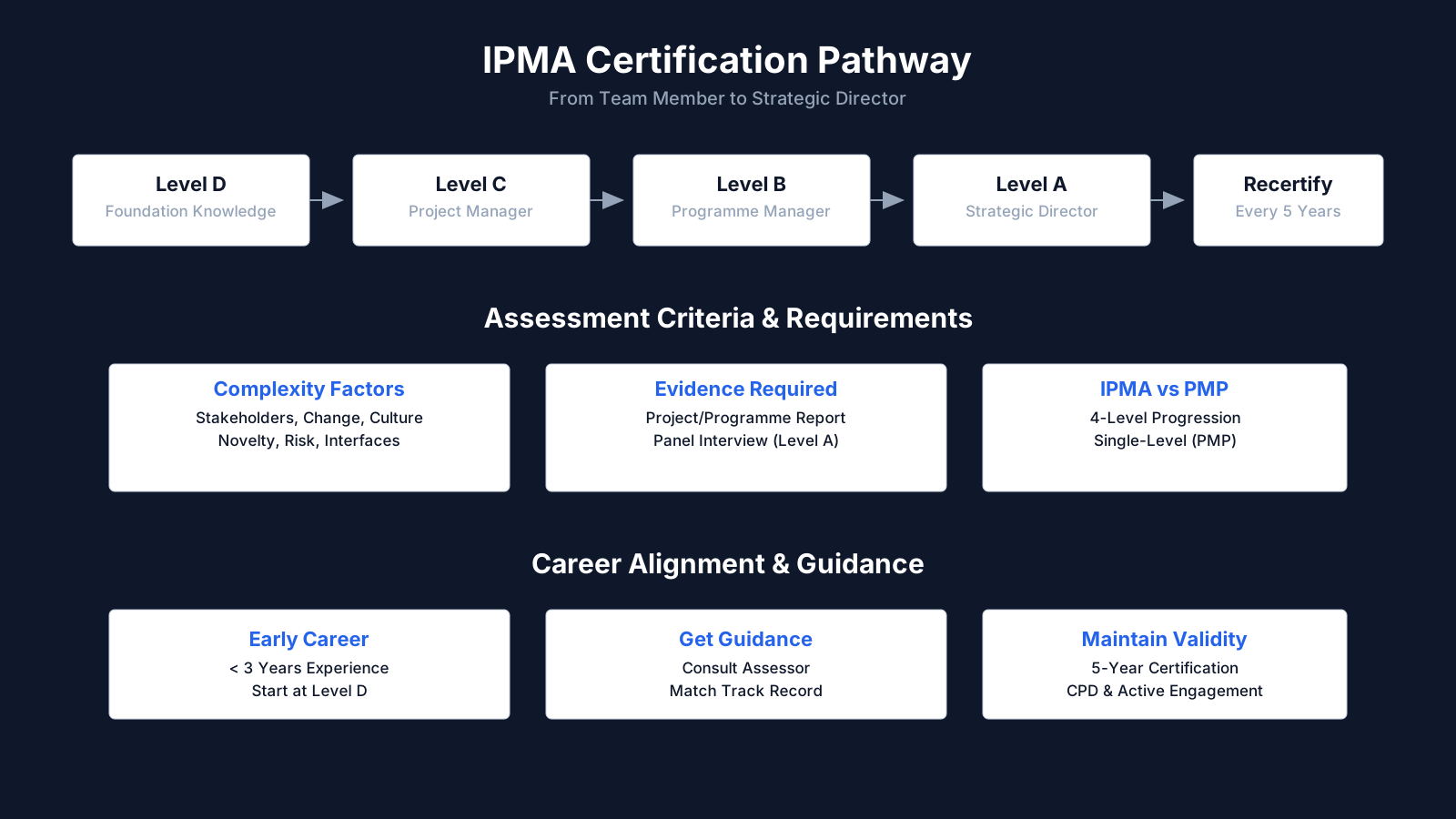
The IPMA certification levels operate on a reverse scale compared to some other frameworks, with Level D being the entry point and Level A being the most advanced. This structure allows professionals to enter at the level that matches their actual experience and responsibility rather than forcing a linear progression. A seasoned program director with 15 years of experience does not need to go through Level D or C first; he or she can apply directly for Level A certification after demonstrating the requisite competence. This flexibility makes the pathway efficient for mid-career and senior professionals seeking validation without redundant steps, while still offering a clear ladder for those just starting out. The framework is also completely methodology-agnostic, meaning it does not prescribe a specific project management lifecycle, tool set, or agile versus predictive approach. Instead, it evaluates whether you can select and adapt methods intelligently to suit the project context.
IPMA certifications are delivered by Member Associations in each country, ensuring that the assessment process is culturally adapted while still adhering to strict international standards. This local presence is a significant advantage, as it means you interact with assessors who understand your business environment, can conduct assessments in your native language, and provide local networking and continuous professional development opportunities. The global consistency, however, is guaranteed by the IPMA regulations and the regular audits conducted by the international body, so that an employer in Singapore can trust the rigor behind a certification earned in Sweden. For project professionals seeking a credential that travels well across borders and industries, the IPMA pathway offers a compelling balance of local relevance and international prestige.
How the IPMA Competence Baseline Shapes Every Certification Level
The IPMA Certification Levels A–D are impossible to understand fully without a solid grasp of the Competence Baseline that underpins them. ICB4 defines 29 competence elements distributed across three areas. The Perspective area covers competencies related to the context of a project, program, or portfolio, such as strategy, governance, structures, and compliance. The People area includes the personal and social competencies that determine how effectively you lead and interact, including self-reflection, personal communication, leadership, teamwork, and conflict resolution. The Practice area contains the technical aspects of managing a project, from design and requirements to time, cost, quality, procurement, and change control. At Level D, the candidate must demonstrate knowledge of these competence elements, while at Level C and above, the assessment shifts rapidly into the application of that knowledge, requiring evidence of real experience and the ability to perform under pressure.
What sets the IPMA system apart from purely exam-based certifications is the requirement for behavioral evidence. For Level B and Level A, candidates must submit detailed reports on complex projects or programs they have managed, and then defend their decisions in front of a panel of senior assessors. This defense is not a friendly chat; it is a thorough exploration of why you chose a particular path, how you handled stakeholder resistance, what you learned when things went wrong, and how you would replicate success. The competence elements are cross-referenced throughout the assessment, so you might be asked how your leadership style, grounded in the People domain, influenced your risk management approach, which sits in the Practice domain. This interconnected evaluation ensures that a certified professional can demonstrate not just knowledge silos but integrated, applied competence.
Because the ICB4 is periodically updated with input from practitioners around the world, it remains relevant to contemporary challenges such as agile and hybrid delivery models, digital transformation, sustainability, and cross-cultural leadership. Studying the IPMA Competence Baseline is therefore not just exam preparation; it is a career-long reference that can guide your development from a junior project coordinator to a confident portfolio director. As we move through each of the IPMA certification levels in the following sections, keep in mind that the same 29 competence elements form the backbone, but the bar for evidence and the complexity of the context in which they must be demonstrated rises sharply with each step up the ladder.
Core Insights on IPMA Certification Framework
- Competence-Based Evaluation Approach
- IPMA evaluates the complete professional by integrating knowledge assessment with practical application across the three competence areas of Perspective, People, and Practice.
- Flexible Certification Levels
- The four-level certification structure, from Level D to Level A, enables professionals to enter at the tier that matches their actual experience, allowing seasoned practitioners to pursue advanced credentials directly.
- Methodology-Agnostic Framework
- Rather than mandating a specific lifecycle or tool set, IPMA evaluates a candidate’s ability to intelligently select and adapt methods to suit the unique demands of each project context.
- Local Delivery with Global Standards
- Certifications are administered by national Member Associations, which localize the process to reflect cultural nuances and offer native-language assessments, while regular international audits uphold uniform global rigor.
IPMA Level D: Your Entry Point into Project Management Certification
The IPMA Level D certification, known formally as the Certified Project Management Associate, is designed for individuals who are entering the field of project management or who work in a supporting role within a project team. This level confirms that you possess a broad understanding of the fundamental concepts, methods, and terminology of project management as described in the ICB4. There is no requirement for prior professional experience in a project management role, although familiarity with project environments is certainly helpful. The assessment focuses entirely on knowledge, making it an ideal starting point for recent graduates, specialists transitioning into project coordination, or team members who want to formalize their understanding of how projects work.
To obtain the IPMA Level D certification, you normally must pass a written examination that covers all 29 competence elements but only at a knowledge level. The format may vary slightly depending on your national member association, but it typically includes multiple-choice questions, short-answer prompts, and questions that ask you to explain concepts in your own words. The key distinction is that you are not required to prove how you have applied this knowledge in a real project. That means you can prepare through self-study, university programs, or accredited training courses, and then sit for the exam without having to document years of experience. This makes Level D accessible to a wide audience and a popular choice for people who want to establish a solid foundation before taking on greater responsibility.
While Level D does not certify you as a project manager in the full sense, it offers significant value in the job market. Many organizations recognize it as evidence that the holder understands the standard language of project management and can contribute meaningfully to project teams, support planning activities, and assist with documentation and communication. For individuals, the preparation process itself builds a mental framework that makes on-the-job learning faster and more structured. Instead of picking up techniques haphazardly, you begin work with a clear map of all the competence areas, which allows you to recognize good practice and spot gaps in your team’s approach. Level D also serves as a motivational milestone that can encourage you to pursue the higher, experience-based certifications once you have accumulated sufficient practice.
Who Should Pursue IPMA Level D Certification First
Recent university graduates with degrees in engineering, business, or information technology often find that an IPMA Level D certificate helps them stand out in a crowded entry-level job market. Even though they may lack extensive project experience, the certification signals that they understand the discipline’s fundamentals and are ready to integrate quickly into a project environment. Professionals in roles such as project assistant, project controller, or junior business analyst also benefit because the credential validates the knowledge they already apply daily and can accelerate their progression to more autonomous roles. Additionally, specialists who frequently participate in projects, such as software developers, construction engineers, or marketing coordinators, can use Level D to formalize their understanding of the project context, thereby increasing their value to cross-functional teams.
Another group that finds Level D particularly relevant is career changers who are moving into project management from entirely different backgrounds. The structured nature of the ICB4 provides a comprehensive overview of what the profession entails, reducing the anxiety of transitioning to a new field. By earning the certification, they demonstrate to potential employers that they have invested seriously in acquiring the necessary vocabulary and conceptual foundation. It is important to remember, however, that Level D certification does not qualify you to lead complex projects independently. The certification deliberately reflects an associate level of competence, and you should pair it with practical experience, mentorship, and further study as you aim for positions with greater accountability.
Preparing for the IPMA Level D Knowledge Examination
Preparation for the Level D exam typically begins with acquiring the official ICB4 documentation and any supplementary study guides published by your national member association. Since the exam covers all 29 competence elements, you should plan a systematic review that ensures no area is neglected. A common approach is to break the study plan across the three domains of Perspective, People, and Practice, dedicating sufficient time to the People domain because many candidates with a technical background find the behavioral competencies less familiar. Formal training courses can accelerate this process significantly, especially when they are delivered by accredited providers who align their materials with the exam blueprint and include plenty of practice questions.
While rote memorization of definitions will help with some parts of the test, you should aim to understand the relationships between competence elements. The exam may ask you to explain how risk management interacts with stakeholder engagement, for example, or how leadership style influences the choice of project lifecycle. Creating mind maps or summary sheets that connect the elements will reinforce this integrated understanding. Practice exams offered by training providers or your member association are invaluable for getting used to the question format and time pressure. Because the Level D exam does not ask for experiential evidence, you can focus entirely on comprehending concepts, models, and the purpose behind each competence element, setting you up not just to pass the test but to apply the knowledge later in real projects.
IPMA Level C: Becoming a Certified Project Manager
The IPMA Level C certification, or Certified Project Manager, marks the transition from knowing about project management to actually doing it. This level confirms that you can manage a project of limited complexity from start to finish, taking responsibility for planning, execution, monitoring, and closure while leading a team and interacting with stakeholders. Unlike Level D, significant professional experience is required. Typically, you need several years of project management experience, with a portion of that time spent in a role where you had full accountability for the project’s success, not just delivering a work package. The exact prerequisites regarding years and complexity are defined by your national member association, but the international regulation sets minimum thresholds that ensure consistency across the globe.
The assessment for IPMA Level C moves far beyond a written knowledge test. In most countries, you will be asked to compile a report describing a project you have managed, demonstrating how you applied specific competence elements from the ICB4. You select a project that shows your range, and then you write a structured narrative linking your decisions and actions to the competence areas. The report is followed by an interview, typically conducted by two assessors, who will probe your descriptions, ask for clarifications, and explore alternative courses of action you could have taken. This interview may also include a short written exercise or case study analysis to test your ability to think on your feet. The goal is to verify that your claimed experience is genuine and that your competence is sustainable and transferable, not just a one-time success.
Earning the IPMA Level C certification communicates to employers, clients, and colleagues that you are a capable project manager who can handle moderate complexity independently. It is often the level at which organizations begin to see a clear return on investment, because certified project managers tend to apply structured methods, manage risks proactively, and communicate more effectively with stakeholders. For the individual, the preparation process itself often becomes a profound learning experience. Writing the project report forces you to reflect on your own practice, identify patterns in your decision-making, and recognize areas where you can improve. Many certified professionals describe the assessment interview as a high-value developmental dialogue, not just a pass or fail test. This dual function of assessment and professional growth is central to the IPMA philosophy.
Meeting the Experience Requirements for IPMA Level C Certification
To qualify for Level C, you generally need a minimum of three years of project management experience, though this can vary slightly depending on your educational background and the national regulations. More importantly, you must have been the person primarily responsible for the project’s delivery, not merely a team member executing tasks defined by others. Your role should have included activities like defining scope, negotiating with stakeholders, managing the budget, leading the team, and reporting progress to sponsors. The complexity of the project you reference does not need to rival a billion-euro initiative; it should involve multiple stakeholders, some degree of uncertainty, and a reasonable level of coordination. The assessors will evaluate whether the complexity was sufficient to demonstrate competence across the relevant ICB4 elements.
When selecting a project to document for your assessment, choose one where you can clearly recall specific challenges and how you addressed them. A project that went smoothly is less effective for demonstrating competence than one that required you to adapt, resolve conflicts, or recover from setbacks. The assessors want to see evidence of your problem-solving process, not just a story of effortless success. Ensure that you can back up your account with artifacts such as project plans, risk registers, meeting minutes, and correspondence, although you are not normally required to submit all of them. The richness of your narrative and your ability to discuss the project in depth during the interview are what matter most. If you have managed multiple projects over the required period, pick the one that provides the best canvas to illustrate a wide range of competence elements.
Navigating the Level C Assessment Report and Interview
The assessment report for Level C typically follows a prescribed structure that guides you through the key competence areas. You will describe the project context, your objectives, the approach you took, and then systematically address how you applied competencies in the Practice, People, and Perspective domains. This is not a simple project report in the traditional business sense; it is a reflective document that explicitly connects your actions to the terminology and models of the ICB4. For example, you will not just state that you created a project plan but explain how you used risk management to inform the plan’s contingencies, how you aligned the plan with the organization’s strategy, and how you communicated the plan to your team using leadership skills. The report must be clear, honest, and self-critical where appropriate, demonstrating that you can evaluate your own performance.
The interview that follows is a structured conversation lasting anywhere from one to two hours. Assessors receive your report weeks in advance and prepare deep questions. They may challenge your decisions, ask what you would do differently with hindsight, or present a scenario based on your project and ask how you would handle a new risk. The atmosphere is professional and respectful, but the questioning is rigorous. To prepare, review your report carefully, anticipate weak points, and practice discussing your project with a mentor or peer who can ask tough questions. Remember that the assessors are not looking for a perfect project; they are looking for a competent project manager who thinks clearly, learns from experience, and can hold a professional dialogue about the discipline. After the interview, the assessors deliberate and, in most national systems, provide you with a detailed feedback report, regardless of the outcome, which is an extremely valuable development tool.
Core Insights on IPMA Level C Certification
- Practical Experience Requirement
- Candidates must demonstrate at least three years of project management experience with full accountability for project delivery, not merely participation as a team member.
- Assessment Beyond Knowledge Tests
- The certification requires a detailed project report and a rigorous interview, enabling assessors to evaluate genuine, transferable competence rather than just factual recall.
- Selecting the Right Project
- Select a project that forced adaptation and creative problem-solving; assessors value concrete evidence of overcoming challenges far more than stories of effortless success.
- Reflective Learning and Professional Growth
- Preparing the report and engaging in the interview fosters deep reflection on one's decision-making, transforming the certification into a developmental dialogue that extends well beyond a conventional test.
IPMA Level B: Achieving Senior Project Manager Status
When you are ready to manage highly complex projects that involve multiple organizations, significant uncertainty, and strategic implications for the business, the IPMA Level B certification, called Certified Senior Project Manager, validates that capability. This level addresses the reality that as projects grow in size and intricacy, the project manager’s role evolves from executing a defined plan to creating the conditions for success in a fluid environment. A Level B manager must demonstrate competence in structuring a project that may have ambiguous initial requirements, building coalitions among stakeholders with conflicting interests, and making high-stakes decisions without complete information. The assessment for Level B is even more demanding than for Level C, requiring a more extensive report and often a longer, more strategic interview.
Experience requirements for Level B are naturally higher, with most national associations requiring at least five years of project management experience, including a significant portion leading complex projects. Complexity is assessed using criteria such as number of stakeholders, geographical spread, integration of novel technology, strict regulatory constraints, and alignment with organizational strategy. The candidate must be able to demonstrate not only that the project was complex but that his or her leadership was a decisive factor in navigating that complexity. The IPMA Level B certification is frequently sought by professionals who are already established project managers but who want independent confirmation that they operate at a senior level, as well as by consultants and project directors who need a portable, internationally recognized credential that reflects their advanced skills.
Holding IPMA Level B signals to executive leadership that you can be trusted with mission-critical initiatives. It often correlates with expanded job opportunities and the authority to manage larger budgets and cross-functional teams. Because the assessment focuses heavily on the integration of Perspective and People competencies, Level B certification also demonstrates that you understand the organizational and political dimensions of a project, not just the technical execution. This is precisely the capability that distinguishes a senior project manager from a competent practitioner. In the assessment, you will likely be asked to explain how you aligned your project with corporate strategy, how you navigated governance challenges, and how you developed the project management culture within your team. These are not topics that appear in entry-level exams, and mastering them requires deep reflective practice.
Defining and Demonstrating Complex Project Leadership for Level B
Complexity at the Level B level is not simply about large budgets or long schedules; it is about the degree of novelty, the number of interrelated components, and the pace of change. A project to build a new bridge may be large but relatively straightforward if it uses well-established engineering practices. On the other hand, a project to implement a digital transformation across a multinational organization may have a smaller financial footprint but present far more complexity due to the cultural, technological, and human factors involved. When preparing your application and project report, you must articulate the specific dimensions of complexity that challenged you and explain how your competence allowed you to manage them. The assessors will evaluate whether the complexity you describe genuinely demanded senior-level skills, so choosing an appropriate reference project is crucial.
Your report for Level B will typically be longer and more detailed than for Level C, diving into strategic alignment, governance structures, long-term capability development, and the way you managed stakeholder expectations over an extended period. You will need to show how you tailored the project management approach, perhaps blending agile and traditional methods to match the nature of the work, and how you built resilience into the project to cope with external shocks. The interview will push you to defend your strategic decisions and might include questions about organizational change management, political navigation, and ethical dilemmas. The assessors want to see that your leadership extends beyond the project boundaries to influence the parent organization and the wider project management community. This is a hallmark of a true senior professional.
The Level B Assessment: Evidence of Mastery in Action
The assessment process for IPMA Level B typically involves a comprehensive written report, sometimes supplemented by a self-assessment against the ICB4 competence elements, and an in-depth interview that can last several hours. In some national systems, the assessment center may include a group exercise or a case study discussion where you interact with other candidates while assessors observe. This format evaluates your ability to collaborate, communicate, and lead under real-time pressure, reflecting the People domain competencies in a live setting. Preparation for such an event requires more than studying theory; it requires you to practice articulating your leadership philosophy, receiving feedback openly, and engaging constructively in group problem-solving. If your member association uses an assessment center approach, participating in preparatory workshops is highly advisable.
Given the rigor of the Level B assessment, many candidates engage a coach or mentor who is already IPMA certified at Level A or B. Such a mentor can help you select the right project, structure your report to highlight the most relevant competencies, and simulate the interview experience. The investment of time and effort is considerable, but it returns lasting dividends in self-awareness and professional confidence. Even if the outcome is not immediately positive, the detailed feedback you receive will pinpoint the exact areas where your competence needs further development, allowing you to work on them and reapply with a stronger case. The IPMA process is explicitly designed to support continuous improvement, not just to award a certificate.
IPMA Level A: The Pinnacle for Program and Portfolio Directors
At the summit of the IPMA certification pathway lies Level A, the Certified Projects Director certification, which recognizes individuals who manage complex project portfolios or programs with strategic organizational impact. This is not an advanced project manager certification; it is a credential for those who govern multiple projects and programs simultaneously, aligning them with long-term business objectives, managing interdependencies, and ensuring that the aggregate investment delivers the intended benefits. A Level A certified professional typically operates at a director, vice president, or C-suite level, and is accountable not for a single project outcome but for the overall health of the project portfolio and the development of project management capabilities within the organization.
The Level A assessment focuses on perspective and strategic integration more than any other level. You must demonstrate that you can design and operate governance frameworks, manage resource allocation across competing initiatives, and engage with the board and external stakeholders at the highest level. The behavioral and contextual competencies remain important, but the strategic lens dominates. Experience requirements are the most significant, commonly requiring several years of portfolio or program management at a senior level, and the reference evidence you submit should demonstrate transformative leadership that improved the organization’s project management maturity or delivered a substantial portfolio of change. Because so few people reach this level, earning IPMA Level A places you in an elite group of global project leaders whose competence has been independently verified at the most demanding standard.
For organizations, having an IPMA Level A certified professional at the helm of the project portfolio provides assurance that investment decisions are made with discipline, that risks are balanced across the portfolio, and that projects are terminated when they no longer serve strategy. This certification level is increasingly sought after in industries undergoing rapid transformation, such as energy, infrastructure, and digital services, where the ability to manage a dynamic portfolio is a clear competitive advantage. For the individual, the journey to Level A often involves a profound transformation of professional identity, from a manager of projects to a leader of the organizational systems that deliver change. The assessment process itself, including the requirement to write a strategic reflection and be examined by a panel of senior assessors, serves as a powerful developmental milestone.
Strategic Competence and Portfolio Governance at IPMA Level A
The heart of the Level A assessment is the demonstration of strategic competence, which goes well beyond aligning a single project with annual objectives. You must show how you contribute to, or even shape, the organization’s strategy through the lens of project delivery. This might involve developing a portfolio roadmap that translates a five-year business plan into a set of prioritized programs, establishing stage-gate review processes that ensure continued strategic alignment, and making tough calls to halt projects that no longer deliver sufficient value. Your evidence must illustrate your role in governing others, not just executing yourself. The assessors will be looking for concrete examples of portfolio decisions you made, the criteria you used, and the outcomes you achieved in terms of benefits realization and organizational capability growth.
In your written submission, you are likely to describe a specific program or portfolio that you led, but you can also draw evidence from a longer career track showing a progression of increasing responsibility. The report should address how you handled conflicts between project managers, how you balanced the demands of different business units, and how you fostered a culture of accountability and learning across the project community. During the interview, expect questions that probe the depth of your strategic thinking. You might be asked, for instance, how you would restructure a portfolio if the organization’s core market were suddenly disrupted. The ability to think on your feet about systemic, long-term issues is what distinguishes Level A from the project-focused certifications below it.
The Rigorous Path to Earning the IPMA Level A Credential
The assessment process for Level A is the most extensive in the IPMA spectrum. Candidates typically submit a detailed portfolio of evidence, which may include a summary of their career, a reflective analysis of a major program or portfolio they directed, and a self-assessment against all 29 competence elements at the highest level of proficiency. This documentation is reviewed by a panel of at least two, and often three, senior assessors who have been trained specifically for high-level evaluations. The interview that follows is not just a validation of the written evidence; it is a wide-ranging strategic conversation that can explore geopolitical impacts on the organization’s projects, ethical leadership in cross-cultural contexts, and the candidate’s personal contribution to the evolution of the project management profession.
Because the bar is so high, the failure rate at Level A can be significant, and the feedback is exceptionally detailed. Candidates are encouraged to view the assessment as part of their ongoing leadership development. Some national member associations offer peer forums or mastermind groups for senior professionals aiming for Level A, where they can test their arguments and sharpen their strategic narratives. The payoff, once certified, includes a credential that is instantly credible to boards and government bodies, invitations to contribute to national and international standard-setting activities, and a deep personal satisfaction in having reached the recognized pinnacle of project leadership competence. For those who aspire to shape not just projects but the entire ecosystem in which projects are delivered, Level A is the definitive goal.
Core Insights on IPMA Level A Certification
- Strategic Portfolio Leadership Role
- IPMA Level A certifies directors and C-suite professionals who orchestrate project and program portfolios, aligning them with long-term strategic goals while governing portfolio-wide risks and maximizing benefits.
- Dominance of Strategic Competence
- The assessment emphasizes strategic integration, requiring candidates to design governance frameworks, allocate resources across competing initiatives, and engage senior stakeholders to translate corporate strategy into measurable outcomes.
- Rigorous Evidence and Assessment
- Candidates compile a comprehensive portfolio of evidence that includes a strategic reflection and a self-assessment against 29 competence elements, all subject to rigorous review by a panel of experienced assessors.
- Organizational and Individual Impact
- Organizations secure disciplined investment decisions through certified leaders, while the individual transitions from project manager to transformational leader of change delivery systems.
Choosing the Right IPMA Level for Your Career Stage and Ambitions
One of the most common questions asked by professionals considering the IPMA pathway is how to determine which level they should target. The answer depends on a combination of your existing experience, your current job responsibilities, and your career trajectory. The IPMA certification levels are not designed as a rigid ladder that everyone must climb from the bottom rung. Instead, they are discrete descriptors of competence levels that map to real-world roles. If you are a project coordinator with two years of experience, Level D or C might be appropriate, but if you have been leading complex programs for a decade, applying directly for Level A or B is both possible and expected. Your national member association can provide specific guidance, often through a preliminary self-assessment tool that helps you gauge the level at which you could realistically meet the evidence requirements.
For someone just entering the profession, Level D offers an accessible first step that builds confidence and a common language. Once you have managed a few projects of modest complexity, you will naturally gravitate toward Level C, which will stretch you to reflect deeply on your practice. If you are already comfortable managing complex projects and are seeking formal recognition of your seniority, Level B is the logical target, and you should not waste time and money on lower levels that do not reflect your actual capability. For those at the strategic helm, Level A is the only certification that fully captures the scope of your role. Some professionals choose to certify initially at one level and later upgrade as their responsibilities grow, using the feedback from each assessment to inform their development plan.
Mapping Organizational Roles to IPMA Certification Levels A through D
To make the choice more concrete, consider how typical job titles align with the certification levels. Project assistants, graduate trainees, and junior analysts often find Level D aligns with their day-to-day knowledge needs. Project managers, project leaders, and Scrum Masters who have independent responsibility for project outcomes fit the Level C profile. Senior project managers, program managers, and project management office directors who handle complex, multi-stakeholder initiatives are best served by Level B. Portfolio managers, heads of project management, transformation directors, and chief project officers fall naturally into the Level A category. This mapping is not rigid, but it provides a useful heuristic. When in doubt, look at the description of complexity and strategic involvement in the official ICB4 documentation and compare it against your current role and recent achievements.
Another consideration is the signal you wish to send to the market. If you are actively seeking a new position, the certification level that matches your desired role will maximize your credibility. An experienced program director who only holds a Level C certification may raise eyebrows, just as a junior professional claiming Level B without the required experience will be quickly exposed during the assessment. The IPMA pathway is built on authenticity; the assessment process is designed to detect inflated claims. Therefore, aligning your certification goal with your genuine competence not only increases your chance of success but also ensures that the credential carries its full weight when you present it to employers, clients, and stakeholders.
Preparing Effectively for Your IPMA Certification Journey
Successful preparation for any of the IPMA certification levels requires a blend of structured study, practical application, and honest self-assessment. While the specifics differ by level, there are common success factors that apply across the entire pathway. First and foremost, you must internalize the ICB4 structure and terminology. This does not mean rote memorization for its own sake, but rather developing the ability to describe your project management practice using the competence language that assessors will use to evaluate you. The sooner you start framing your daily work in terms of the 29 competence elements, the more natural it will be to write about them in a report and discuss them in an interview. Keep a journal or a simple log where you note which competencies you exercised each week and what the outcomes were.
Second, engage with the IPMA community. Your national member association likely offers networking events, workshops, special interest groups, and even mentoring programs. Exposure to professionals who have already achieved certification provides you with realistic insights into the assessment process and helps you avoid common mistakes. Many associations also maintain a register of accredited training providers who offer targeted preparation courses. For Levels C, B, and A, participating in a workshop that includes mock interviews and report writing guidance is invaluable. The feedback you receive from instructors and peers in a safe environment reduces anxiety and sharpens your reflective thinking. Finally, allocate sufficient time; rushing the process leads to superficial evidence and a weaker performance at the interview. A sustained, reflective preparation over several months is far more effective than a last-minute cram.
Leveraging Study Resources and Formal Training for IPMA Exam Success
For the knowledge-based Level D exam, a combination of the official ICB4, approved study guides, and online question banks provides a solid foundation. Many candidates prefer a blended approach where they attend an intensive two or three-day training course and then consolidate their learning with self-study. The training course helps you prioritize the most heavily weighted competence areas and clarifies any concepts that are hard to grasp from a book alone. For higher levels, training courses typically shift to a workshop format where you bring your own project experiences and work through how to present them effectively. These workshops often include peer review, where you read and critique each other’s draft reports, which dramatically improves the clarity and relevance of your final submission.
Beyond formal courses, reading widely about project management leadership, organizational change, and strategic management will deepen your understanding of the Perspective and People domains. Books, podcasts, and articles by respected practitioners can provide you with fresh frameworks and real-world case studies that you can cite or draw upon during your assessment. Many successful candidates also form study groups with colleagues who are preparing for the same level. Meeting regularly to discuss a competence element, share report excerpts, or conduct mock interviews creates a supportive learning community that holds you accountable and enriches your preparation. The combination of formal training, self-study, and peer support is a powerful recipe for not just passing the assessment but genuinely growing as a professional.
Core Preparation Strategies for IPMA Success
- Internalize the ICB4 Competence Language
- Systematically align your daily project activities with the 29 ICB4 competence elements and keep a reflective journal to track how each competence is demonstrated week by week.
- Engage with the IPMA Community
- Immerse yourself in networking events, workshops, and mentoring opportunities offered by your national member association to absorb authentic assessor expectations and avoid recurring mistakes.
- Allocate Sustained Preparation Time
- Dedicate several months to deliberate, reflective practice rather than last-minute cramming, as hurried preparation yields shallow evidence and compromises your interview performance.
- Combine Formal Training with Peer Support
- Integrate intensive courses, peer study groups, and mock interviews to deepen conceptual clarity, refine written submissions, and build an accountability network that drives consistent progress.
The Lasting Benefits of Completing the IPMA Certification Pathway
The value of obtaining an IPMA certification extends far beyond the initials after your name. Research and survey data from IPMA member associations consistently show that certified professionals experience accelerated career progression, stronger earning potential, and greater job mobility across industries and countries. Because the certification is competence-based and internationally standardized, it serves as a portable passport that reduces the friction when moving between organizations or even relocating to a different country. Employers benefit as well, because hiring a certified project manager reduces the risk of costly project failures and provides assurance that the individual has been independently assessed against a rigorous, holistic standard.
On a personal level, the journey through the IPMA levels transforms how you think about your work. The reflective practice required for certification becomes a habit, meaning that you continue to learn and improve long after the certificate is issued. You become better at diagnosing project problems, communicating with stakeholders, and developing the people around you. Many certified professionals also report a boost in professional confidence that enables them to take on bigger challenges and advocate more effectively for good project management practices within their organizations. The IPMA community provides a lifelong network of like-minded peers, mentoring opportunities, and continuous professional development pathways that keep your skills current and your perspective fresh.
How IPMA Certification Levels A–D Boost Your Global Career Mobility
In an era of global supply chains, distributed teams, and cross-border projects, having a credential that is recognized in more than 70 countries is a significant strategic asset. The IPMA certification levels A–D are often explicitly mentioned in government procurement requirements for infrastructure projects, in the hiring criteria of multinational corporations, and in the competency frameworks of professional bodies. When you hold an IPMA certificate, you are not limited to a single methodology or a narrow industry focus; you carry a signature of broad competence that adapts to different contexts. This global portability is especially valuable for consultants, contractors, and managers who follow projects wherever they arise, from the Middle East to Southeast Asia to Northern Europe. The local member association model further supports mobility by allowing you to transfer your certification seamlessly when you move to a new country.
Additionally, the IPMA system is increasingly aligned with other international standards, such as ISO 21500 and the various national standards for project management competence. This alignment means that your IPMA certification can often be recognized for credit or advanced standing in postgraduate degree programs, professional licensing schemes, and corporate internal certification tracks. The visibility of the IPMA brand continues to grow as the association and its member bodies actively promote the value of competence-based certification to governments, industry associations, and educational institutions. For the ambitious project professional, building a career around the IPMA certification levels is not a short-term tactic; it is a long-term strategy for international career resilience and leadership.
Comparing IPMA Certification with PMP, PRINCE2, and Other Credentials
Project management professionals often wonder how the IPMA certification levels compare to the more widely advertised PMP certification from the Project Management Institute or the PRINCE2 practitioner qualifications. While all these credentials have their merits, they serve different purposes and are built on fundamentally different philosophies. The PMP is primarily a knowledge-based certification, although it does require experience documentation, and its exam tests understanding of the PMBOK Guide. It is highly recognized in North America and the Middle East. PRINCE2 focuses on a specific process-based methodology and is especially popular in the United Kingdom and parts of Europe. IPMA, by contrast, is a competence-based, methodology-neutral system that assesses the whole person across knowledge, practice, and behavior at multiple levels of seniority.
For a project coordinator or junior manager starting out, the choice between PMP and IPMA Level D or C might be influenced by geography and employer preference. However, for experienced professionals and those aiming for senior leadership roles, the IPMA pathway offers a more nuanced and comprehensive evaluation that goes deeper than any multiple-choice exam can. The IPMA assessment at Levels B and A, with its emphasis on strategic alignment, leadership, and the ability to defend one’s actions in front of a panel, provides a richer demonstration of capability. Many professionals find that holding both an IPMA certification for its breadth and a methodology-specific credential like PRINCE2 or an agile certification provides the most complete professional profile. The key is to understand that they are complementary, not mutually exclusive, and that the IPMA framework excels in certifying your overall competence to manage and lead, rather than just your knowledge of a particular guide or method.
When IPMA Certification Outshines Other Project Management Credentials
The IPMA certification pathway truly shines in environments where project success depends heavily on context, stakeholder relationships, and adaptive leadership rather than on rigid adherence to a prescribed process. Sectors like public infrastructure, international development, complex engineering, and organizational transformation involve a vast array of stakeholders, from community groups to government regulators, and a project manager must be able to navigate these relationships with empathy and strategic intent. The ICB4’s emphasis on the Perspective domain, which includes competencies like culture and values, governance, and strategy, directly addresses these demands. A purely process-based certification provides little guidance on how to build trust across cultures or how to realign a struggling program with a shifting political mandate, whereas IPMA certification explicitly requires evidence of such competence at the appropriate level.
For employers with mature project management offices and a desire to build a sustainable project management culture, the IPMA model offers a common competence language that can be used for recruitment, development, and succession planning. Because the levels clearly differentiate between a junior project manager and a senior program director, organizations can map their entire project management workforce onto a coherent career framework. This granularity is missing in certifications that have only one or two levels. When HR departments and senior leaders understand this, they often become strong advocates for the IPMA approach, integrating it into their competency models and linking it to performance reviews and promotion criteria. For the professional, being certified within such an ecosystem reinforces the credential’s value and creates internal demand for your skills.
Core Takeaways on Certification Comparisons
- Philosophical differences between credentials
- PMP validates applied knowledge and process management, PRINCE2 defines a structured methodology, and IPMA assesses a person’s behavioral, technical, and contextual competencies in a methodology-agnostic framework.
- Geographic and career stage influences
- Early-career choices between PMP and IPMA are largely shaped by regional market expectations and employer preferences, whereas at senior levels IPMA’s holistic competency assessment carries greater weight in career advancement decisions.
- Complementary nature of certifications
- Pairing an IPMA certification for broad competence depth with a methodology-specific credential like PRINCE2 builds the strongest professional profile, as the two frameworks are complementary rather than redundant.
- IPMA's advantage in complex environments
- IPMA certification excels in public infrastructure and international development, where success hinges on contextual intelligence, stakeholder alignment, and adaptive leadership rather than rigid adherence to prescribed processes.
- Organizational workforce framework benefits
- The IPMA model offers a unified competence language with clear progression levels that organizations can embed into recruitment profiles, targeted development plans, succession management, and performance appraisal linkages.
Maintaining and Advancing Your IPMA Certification Over Time
IPMA certifications are not awarded for life without any further obligation. To maintain the validity of your certificate and ensure that your competence remains current, you must participate in a continuous professional development program, often called the IPMA CPD or re-certification process. The exact requirements are set by your national member association but typically involve accumulating a certain number of hours of professional development activities over a period of three to five years. These activities can include attending conferences, publishing articles, delivering training, participating in IPMA events, or taking on new and challenging project assignments. You record your CPD hours and submit a log along with a brief reflective statement, which is reviewed to confirm that your development aligns with the competence framework.
The re-certification process is not a heavy administrative burden; rather, it is a structured way to keep your learning intentional. Instead of accumulating random training courses, you become more strategic about your development, identifying gaps in your competence profile and seeking opportunities to fill them. This ongoing commitment to growth is one of the reasons IPMA certified professionals tend to stay at the forefront of the profession. Additionally, as you gain experience and stretch into more complex roles, you may decide to re-certify at a higher level. The feedback from your previous assessment becomes a roadmap, and the new assessment validates your progress. This continuous cycle of reflection, development, and external validation is what transforms project management from a job into a recognized, respected profession.
Using Your IPMA Certification to Mentor Others and Shape the Profession
Once you have achieved certification, particularly at Levels A or B, you are in a strong position to give back to the project management community. Many IPMA member associations actively seek certified professionals to serve as assessors, workshop facilitators, mentors, or contributors to national competence development projects. Serving as an assessor, for example, not only helps the profession by ensuring a high standard of certification but also sharpens your own competence. You learn how other project managers think, you see patterns of strength and weakness across candidates, and you reflect more deeply on your own practice. This role is often recognized as a high-value CPD activity in its own right.
Mentoring candidates who are preparing for their IPMA levels is another rewarding way to leverage your certification. By guiding someone through the selection of a reference project, the structuring of a report, or the mental preparation for an interview, you solidify your own grasp of the ICB4 and develop coaching skills that are directly transferable to your professional role. Moreover, as organizations increasingly emphasize knowledge sharing and capability building, your ability to develop others becomes a visible leadership trait that strengthens your case for promotion. The IPMA certification pathway, when fully embraced, becomes not just a personal achievement but a platform from which you contribute to the maturation of the entire discipline, ensuring that future generations of project professionals are even better prepared for the challenges of an uncertain world.
The IPMA Certification Levels A–D offer a profound and practical pathway that meets project professionals where they are and challenges them to grow in evidence-based, meaningful ways. From the foundational knowledge of Level D to the strategic mastery of Level A, each stage aligns with real career demands and recognizes the full complexity of managing projects, programs, and portfolios in the 21st century. As you plan your own journey, remember that the certification is not merely a badge but a catalyst for deeper reflection, stronger leadership, and sustained career resilience. Whether you take your first step with the associate exam or reach for the director level, the IPMA framework provides a lifelong structure for development and a global community that will support you every step of the way.
Advance Your Career with Professional Certification
Earning a professional project management certification validates your expertise and demonstrates a clear commitment to continuous improvement, setting you apart in a competitive job market. Structured frameworks like the IPMA’s four-level system offer a clear progression from technical proficiency to strategic leadership, guiding your development step by step. Through targeted project management training , you gain practical tools to mitigate risks and drive complex initiatives forward with confidence. Organizations increasingly rely on certified professionals to ensure projects are delivered efficiently, which directly boosts team morale and bottom-line results. In the long run, this credential not only increases your earning potential but also builds the resilience needed to navigate evolving industry demands.
Earning a professional product management certification validates your strategic skills and deepens your understanding of the entire product lifecycle, making you a more effective decision-maker. It signals to employers that you possess a standardized, contemporary skill set, which can accelerate career advancement and open doors to senior roles. Investing in structured product management training not only sharpens your ability to align cross-functional teams but also equips you with frameworks to drive innovation and measurable business outcomes. For organizations, certified product managers consistently deliver higher-value products, reduce costly missteps, and foster a culture of customer-centric growth, creating a clear competitive edge.
Earning a professional HR management credential demonstrates your commitment to mastering strategic workforce planning and ethical practices, giving you a competitive edge in today's talent-driven market. A recognized human resources certification validates your expertise in areas like compliance, performance management, and employee development, which employers increasingly prioritize when filling leadership roles. This formal validation not only accelerates your career progression but also equips you to drive measurable organizational success through improved retention and a stronger culture. Ultimately, certified HR professionals are better positioned to influence key business decisions, making them vital partners in achieving long-term growth.