For seasoned directors, vice presidents, and senior functional leaders, the ambition to advance to the C-suite is not simply about earning a more prestigious title. It demands a deliberate transformation in mindset (informed by the 5 crucial differences between a manager and a leader), a broader strategic aperture, and demonstrable competence across disciplines that extend far beyond a single function. A senior management certificate program designed specifically for this career inflection point offers a structured, evidence-based, and time-efficient way to acquire those cross-cutting capabilities and signal readiness for enterprise leadership. Unlike traditional graduate degrees that often require years of interruption, the modern executive certificate in senior management distills critical executive competencies into an immersive, practical experience that aligns directly with the challenges of the corner office.
The modern C-suite is more demanding than ever before. Stakeholders expect leaders who can navigate geopolitical volatility, harness digital disruption, shape organizational culture (a priority illuminated by The Dual Lens: Measuring Culture with Numbers and Narratives), and drive sustainable growth, all while maintaining fiduciary rigor. Gaining these competencies organically through on-the-job learning alone can take a decade or longer. An executive certificate in senior management acts as a catalyst, compressing that timeline through deliberate practice, exposure to the latest management science, and facilitated peer exchange. The following analysis explores the full landscape of these programs, from their curriculum architecture and strategic value to the ways in which they help professionals move from functional excellence to enterprise stewardship.
The following topics are examined in detail:
| Key Concept | Summary |
|---|---|
| Mindset Shift | Advancing to the C-suite demands a deliberate transformation from functional mastery to enterprise stewardship, far beyond a mere title change. |
| Program Purpose | A senior management certificate provides a structured, time-efficient path to acquire cross-functional leadership capabilities and signal executive readiness. |
| Target Audience | These programs are designed for directors, vice presidents, and senior managers with 10 to 15 years of experience who are actively being groomed for enterprise leadership succession. |
| Curriculum Focus | The curriculum elevates thinking to strategic, systemic, and governance levels with a boardroom lens, sharpening stakeholder management and fiduciary acumen. |
| Program Format | Formats span weeks to months, blending intensive in-person residencies, live virtual engagement, and applied capstone projects that yield immediate organizational impact. |
| Competency Gap | Certificates close the gap between deep functional expertise and C-suite breadth by requiring leaders to master unfamiliar domains such as financial strategy, brand architecture, and risk governance. |
| Behavioral Growth | Embedded coaching and psychometric assessments cultivate emotional regulation, political savviness, and heightened self-awareness essential for high-stakes executive leadership. |
| Strategic Thinking | Executive education refines the capacity to detect faint strategic signals, navigate sustained ambiguity, and commit to bold decisions with incomplete information. |
| Network Value | Cohort-based learning forges a trusted peer network of senior leaders that provides enduring counsel and cross-industry perspective long after the program concludes. |
| Career Catalyst | By compressing experiential learning curves and signaling boardroom readiness, the certificate accelerates the trajectory toward C-suite appointment. |
Understanding the Senior Management Certificate Program
What Defines a Senior Management Certification
A senior management certificate program is a short-form credential typically offered by leading business schools, professional institutes, and corporate universities that targets leaders with at least ten to fifteen years of management experience. The participants are usually directors, senior directors, vice presidents, and occasionally high-potential senior managers who have been identified as succession candidates. The curriculum is not remedial; rather, it assumes a baseline of operational excellence and aims to elevate thinking to the systemic, strategic, and governance levels. Accreditation bodies and program designers focus on the integration of strategy, finance, leadership, and innovation within complex organizational systems. A certificate in this category differentiates itself from mid-career management programs by emphasizing board-level perspective, stakeholder management (where Craft a Communication Strategy That Unites Your Organization is pivotal), and the ability to lead through ambiguity and transformation, a focus that resonates with the principles of Navigating Turmoil: The Art of Crisis Communication.
These programs typically range from a few weeks of in-person instruction to several months of part-time blended learning, culminating in a capstone project or applied strategy simulation. The certificate is often linked to continuing education units or professional development credits that maintain relevance within a leader’s broader credentialing ecosystem. What makes a senior management certification distinct from a generic leadership short course is its intentional design around the competencies delineated in executive competency models, such as strategic orientation, financial stewardship, talent architecture (best leveraged with tools like the Unlock Star Potential: The Skill Will Matrix Guide), and external market sensing. Many are now aligned with frameworks like the SHRM Executive Competency Model or the McKinsey & Company research on CEO excellence, ensuring that the curriculum is not just academically sound but utterly pragmatic.
The Evolution of Executive Education
Executive education has undergone a radical shift from a series of lecture-based retreats to immersive, cohort-based experiences characterized by action learning and immediate applicability. Early models of senior management training were often exclusive, high-cost events held on university campuses with little follow-through. Today, the most impactful executive certificate programs leverage a blend of synchronous virtual engagement, asynchronous case study work, and in-person intensives that allow for deep relationship building without crippling the participant’s operational schedule. The pandemic accelerated the acceptance of high-quality remote delivery, and leading institutions now offer certificates that are indistinguishable in rigor from their on-campus counterparts, incorporating live executive coaching, boardroom simulations, and digital collaboration tools that mirror modern distributed work.
Another critical evolution is the shift from purely Western-centric business cases to a globally diverse curriculum that reflects the realities of emerging market dynamics, cross-cultural leadership, and supply chain geopolitics. The best senior management certificate programs embed real-time case studies from companies navigating disruption, and they frequently include global immersion modules, whether virtual or physical, that expose participants to different regulatory and cultural landscapes. This evolution means that the credential is no longer a mere résumé line but a genuine transformation process where participants test new leadership behaviors in a psychologically safe yet challenging environment.
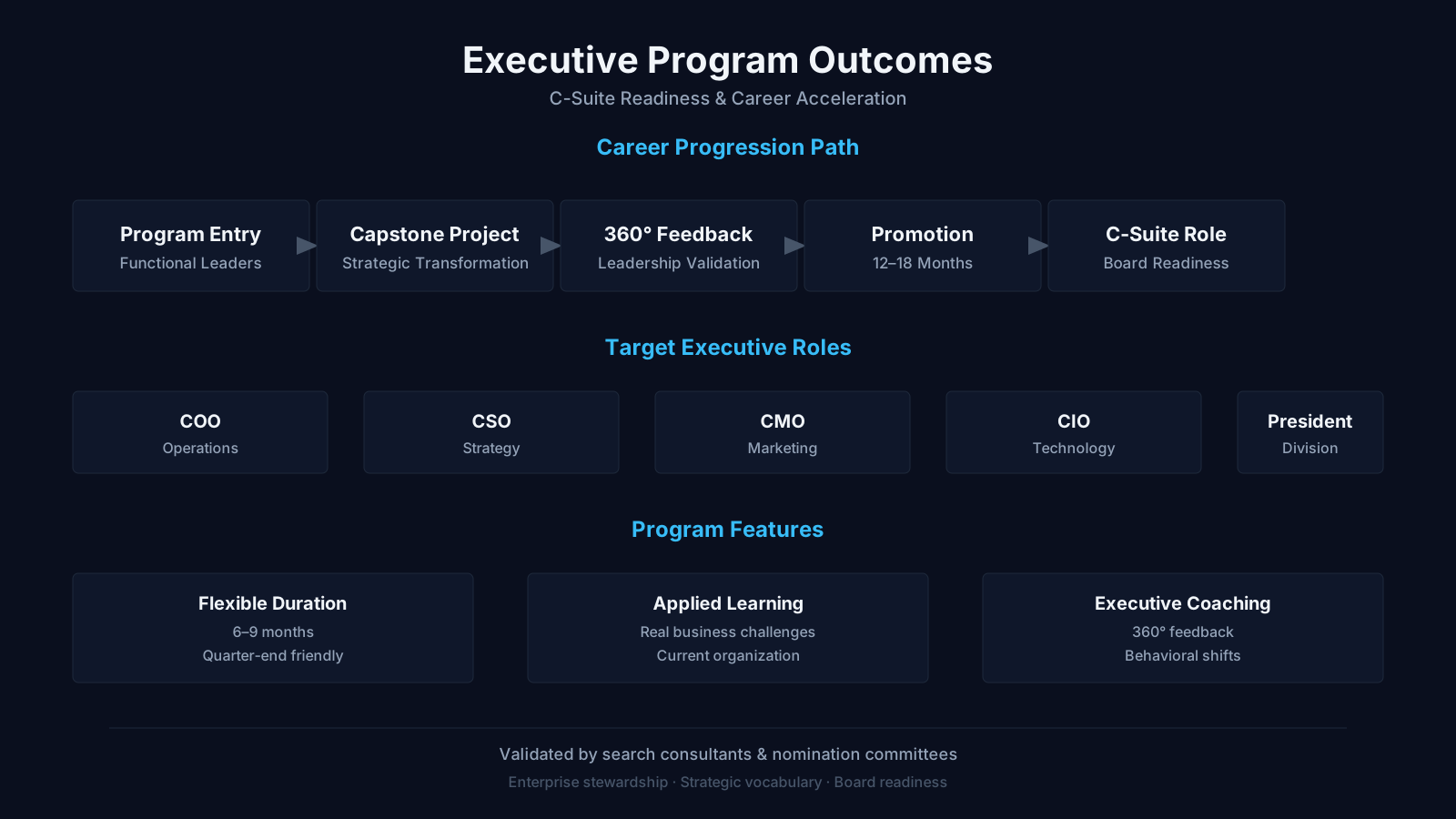
Key Observations
- Target Audience and Prerequisites
- These programs serve seasoned executives, typically directors or vice presidents with ten to fifteen years of leadership experience, and build upon a foundation of operational mastery to address elevated strategic priorities rather than provide remedial management training.
- Curriculum and Distinctive Focus
- The curriculum develops systems-level, strategic, and governance-oriented thinking, spanning boardroom dynamics and complex stakeholder management, distinguishing it from mid-career offerings by equipping leaders to navigate ambiguity and lead transformative change.
- Evolution of Program Delivery
- Today’s executive programs have shifted from lecture-heavy retreats to immersive, cohort-based journeys that blend digital and in-person learning, emphasize global diversity, and prioritize immediate real-world application, turning the credential into a catalyst for personal and professional reinvention instead of a mere résumé entry.
The Strategic Value of a Senior Management Certificate for C-Suite Aspirants
Closing the Leadership Competency Gap
Research consistently highlights a gap between the skills that propel leaders into senior roles and the skills required to thrive in the C-suite. High-performing functional leaders often ascend due to deep domain expertise and operational execution capability, yet these strengths can become liabilities at the enterprise level if they are not balanced with strategic abstraction and delegation. A senior management certificate program addresses this gap by forcing participants out of their functional echo chambers. A chief financial officer in the program, for example, might spend significant time on brand architecture and customer experience design, while a chief marketing officer might dive deep into balance sheet optimization and capital allocation. This forced diversification builds the intellectual dexterity that boards seek when appointing CEOs, COOs, and other top executives.
The competency gap is not solely about hard skills. Emotional regulation, political navigation, and the capacity to hold multiple competing truths simultaneously are often underdeveloped in executives who have not been intentionally trained in those domains. Certificate programs that embed executive coaching modules, psychometric assessments, and 360-degree feedback processes create a mirror that confronts leaders with their behavioral patterns, helping them understand how they show up in high-stakes situations. This self-awareness, combined with frameworks for power dynamics and organizational politics, equips participants to lead with influence rather than mere authority.
Enhancing Strategic Thinking and Decision-Making
Strategic thinking at the C-suite level is not about crafting a five-year plan in a vacuum; it is about sensing weak signals, making sense of ambiguity, and making rapid, high-consequence decisions with incomplete information. A properly designed senior management certificate program uses war games, scenario planning, and dynamic business simulations that replicate the pressure of real boardroom choices. Participants are asked to manage a multi-business enterprise through a simulated economic cycle, making trade-offs between short-term profitability and long-term innovation. These exercises sharpen the decision-making apparatus and help leaders build decision frameworks that they can immediately deploy in their organizations.
Beyond simulation, the pedagogical method often involves diving into the cognitive biases that distort executive judgment. Anchoring, overconfidence, and the sunk cost fallacy are dissected not as academic concepts but as traps that have led to multibillion-dollar blunders. By internalizing these heuristics and debiasing techniques, graduates of a senior management certification program bring a more disciplined and analytical approach to boardroom debates. They learn to structure problems using issue trees, prioritize strategic options through scenario-weighted scoring models, and articulate decision rationale in a way that secures alignment across diverse stakeholder groups.
Building a Peer Network of Senior Leaders
The network effect of a top-tier senior management certificate program is arguably as valuable as the curriculum itself. When a cohort consists of vice presidents from different industries, geographies, and functional backgrounds, the cross-pollination of ideas generates insights that cannot be gleaned from books or consulting reports. A VP of operations from a manufacturing firm learning alongside a VP of technology from a fintech startup will confront entirely different assumptions about process standardisation and speed, leading to a richer understanding of how context shapes management practice. These relationships, forged through late-night case study debates and shared vulnerability during leadership labs, often persist for decades and become a personal advisory board for navigating career transitions.
Structured alumni networks further amplify this value, providing access to exclusive events, board opportunity postings, and thought leadership forums. Many executive certificate programs have dedicated career management services for senior-level participants, including introductions to executive search firms that specialize in C-suite placements. These career services understand that the participants are not seeking entry-level roles; they are looking for that final push toward a chief title, and they tailor their support accordingly, offering personal branding sessions, board CV reviews, and media training designed for public company executives.
Core Curriculum of an Executive Certificate in Senior Management
Advanced Strategic Management
A central pillar of any credible senior management certificate program is the strategy module, which goes far beyond SWOT analysis and Porter’s Five Forces. The curriculum delves into blue ocean strategy, platform business models, ecosystem orchestration, and strategic foresight methodologies such as the Three Horizons framework. Participants learn to identify when their current core business is approaching a maturity inflection and how to sequence innovation investments to stay ahead of industry disruption. Case studies from companies like Adobe and Microsoft, which successfully navigated platform shifts, are analysed to understand the role of top leadership in driving transformation.
The strategy component often includes a deep dive into M&A activity and strategic partnerships, which are critical levers in the C-suite toolkit. Leaders are taught how to evaluate acquisition targets not just on financial multiples but on cultural compatibility, capability synergy, and post-merger integration complexity. They dissect both successful and failed deals, extracting principles that can be applied in their own organizations. The result is a more sophisticated view of corporate strategy that blends the rational analytics of portfolio management with the human dynamics of organizational behaviour.
Organizational Transformation and Change Leadership
Change management is one of the most cited skills in senior management certification frameworks, and for good reason. A significant portion of C-suite tenures fail not because of poor strategy but because of inability to mobilize the organization toward a new direction. An executive certificate program in senior management addresses this through a rigorous study of transformation models, from Kotter’s eight steps to more contemporary agile change approaches that treat the organization as a living system rather than a machine to be reprogrammed. Participants learn to diagnose cultural barriers, map informal influence networks, and craft a change narrative that resonates emotionally with employees at all levels.
Practical application includes conducting an organizational health diagnostic on their own company and presenting a transformation roadmap to a panel of experienced board members and CEOs. This forces participants to confront the messy realities of change resistance, middle management bottlenecks, and the frequent misalignment between stated values and actual incentives. The capstone work in this domain often becomes a real initiative that participants launch upon returning to work, giving the program immediate ROI and credibility with their supervising boards.
Financial Acumen for Senior Executives
Even if a leader does not aspire to be CFO, C-suite roles demand a level of financial sophistication that goes beyond budget management. A well-structured senior management certificate program includes modules on enterprise risk management, corporate finance principles, and shareholder value creation metrics. Participants are trained to interpret financial statements from an investor’s perspective, understanding the story that the numbers tell about operational efficiency, capital structure, and future growth potential. They engage with concepts like economic profit, return on invested capital, and the balanced scorecard in a way that enables them to challenge financial assumptions and contribute meaningfully to earnings calls and board meetings.
Special attention is now paid to ESG and sustainable finance frameworks, reflecting the shift in what constitutes fiduciary duty. Leaders are taught about integrated reporting, carbon pricing scenarios, and how social impact metrics are increasingly factoring into institutional investor decisions. This financial module ensures that graduates of the senior management certification program can not only defend their budgets but can also articulate the organization’s value creation story to analysts, rating agencies, and activist investors with clarity and conviction.
Talent Management and Succession Planning
A chief executive who neglects the talent architecture of the firm is effectively abdicating one of the most critical levers of long-term success. Executive certificate programs therefore place significant emphasis on strategic human capital management, including the design of a robust succession pipeline. Participants examine the difference between replacement planning, which is reactive, and genuine succession development, which grooms multiple candidates for key roles years ahead of time. They learn methodologies like the leadership bench index and talent review calibration processes that minimize bias and promote diversity of thought at the top.
Compensation philosophy, incentive design, and executive retention strategies are also covered in depth. Leaders dissect how poorly aligned bonus structures can inadvertently encourage short-termism or excessive risk-taking, and they practice designing balanced reward systems that drive both performance and ethical behaviour. The curriculum often includes guest sessions with chief human resources officers and board compensation committee chairs who share practical war stories, grounding theory in the labour market realities of hiring and retaining top-tier executive talent.
Digital Transformation and Innovation Governance
No modern senior management certificate program would be complete without a thorough exploration of digital leadership. However, rather than focusing on coding or data science, the curriculum addresses how C-suite leaders govern technology investments and foster a culture of innovation without betting the company on unproven hypes. Participants learn frameworks for assessing digital maturity, distinguishing between digitization as operational efficiency and digital transformation as business model reinvention. They study how organizations like DBS Bank and Domino’s Pizza transformed themselves not by merely adopting new tools but by rewiring their customer value propositions and operating models.
Innovation governance is treated as a systemic capability rather than a series of hackathons. Leaders are trained in venture capital-style investment committees, stage-gate processes appropriate for radical innovation, and ambidextrous organizational structures that separate core optimization from exploratory units. The certificate program often concludes this module with a challenge where participants must present a digital investment proposal to a simulated board that includes sceptical independent directors, sharp financial analysts, and a CEO managing the tension between short-term earnings and long-term relevance.
Key Observations
- Advanced strategy beyond conventional models
- The curriculum equips leaders with blue ocean strategy, platform business models, ecosystem orchestration, and strategic foresight frameworks to proactively navigate industry disruptions and capitalize on maturity inflection points.
- Change leadership as a core competency
- Participants master transformation models including Kotter's eight steps and agile change methods, learning to diagnose cultural barriers and construct compelling, emotionally resonant change narratives that mobilize the organization.
- Financial acumen for C-suite leadership
- The program builds advanced capabilities in enterprise risk management, corporate finance, and ESG frameworks, enabling participants to decode financial statements through an investor lens and persuasively articulate long-term value creation to diverse stakeholders.
How a Senior Management Certificate Program Propels You Toward the C-Suite
Credibility and Signaling in the Executive Labor Market
Executive search consultants and nomination committees look for signals of intentional development and breadth. A senior management certification from a reputable institution serves as a credible third-party endorsement that the candidate has invested in the enterprise-wide perspective necessary for a C-suite role. It differentiates the résumé not because the credential itself magically confers capability, but because it indicates a willingness to step outside one’s comfort zone and be assessed against rigorous standards. When two otherwise comparable finalists are under consideration for a COO or chief strategy officer role, the presence of a well-recognized executive certificate often tips the balance by demonstrating a commitment to ongoing professional growth.
This signaling effect is particularly potent for leaders who have spent their careers in a single industry or function. The certificate broadens their narrative, allowing them to speak credibly about strategic finance, digital business models, and organizational culture even if their direct experience is primarily in operations or sales. This narrative reshaping is not about embellishment but about equipping the candidate with the language and frameworks to engage in board-level conversations naturally and confidently.
Practical Application Through Capstone Projects
The heart of any serious senior management certificate program is the capstone project, which serves as a bridge between learning and real-world impact. Participants typically identify a strategic challenge within their own organization, apply the frameworks and diagnostic tools from the program, and develop a comprehensive solution that they present to senior stakeholders, sometimes including a member of the executive team or board. This is not a theoretical paper; it is a vetted, actionable plan that often becomes the seed for a major initiative. For example, a vice president of supply chain might use the capstone to redesign the global sourcing strategy in light of geopolitical risk, building a resilience framework that she later executes as COO.
This applied nature means that the senior management certification pays for itself long before the participant has been promoted. Companies that sponsor these programs often see an immediate return in the form of strategic projects that improve efficiency, identify new revenue streams, or mitigate existential risks. The capstone also provides a safe environment to test leadership approaches, receive critical feedback from faculty and peers, and build a body of evidence that can be referenced in executive job interviews. It is essentially a portfolio piece that demonstrates the ability to operate at the next level.
Mentorship and Executive Coaching Opportunities
Many senior management certificate programs embed one-on-one executive coaching as a core component, with professionally certified coaches who have experience working with C-suite clients. This coaching helps participants translate classroom insights into behavioural changes that are visible within their organizations. A leader might discover during a feedback session that her direct communication style, which served her well as a functional head, is perceived as dismissive in cross-functional executive meetings. The coach will work with her to develop a more inquiring, diplomatic approach that builds coalitions rather than shutting down debate.
In addition to coaching, the best programs facilitate structured mentoring relationships with experienced board members or retired CEOs who serve as guest faculty or advisors. These mentors provide candid, off-the-record advice about navigating the politics of the top floor, handling board dynamics, and managing the personal toll of C-suite pressure. Such relationships often extend well beyond the program duration and can be instrumental in helping a participant make the leap from senior vice president to president or chief executive officer.
Choosing the Right Senior Management Certification for Your Career Goals
University-Affiliated vs. Professional Body Certificates
The landscape of senior management certification is diverse, spanning elite business schools like INSEAD, Wharton, and London Business School, as well as professional bodies such as the Institute of Directors, the Chartered Management Institute, and the Project Management Institute’s executive leadership tracks. University-affiliated programs often carry strong brand recognition and provide access to extensive alumni networks, faculty research, and residential immersion experiences that are hard to replicate. These programs can be particularly advantageous for leaders targeting global multinational C-suites where brand signaling matters.
Professional body certificates, on the other hand, tend to be more tightly aligned with specific competency standards and codes of conduct that are recognized by regulatory bodies and industry associations. A senior management certificate from the Institute of Directors, for example, is heavily focused on governance, boardroom etiquette, and director duties, making it ideal for leaders aspiring to board roles in parallel with executive positions. The choice between these pathways should be guided by the leader’s specific career trajectory, the recognition these credentials hold within their target industry, and the extent to which the curriculum maps onto the strategic skills they need to strengthen.
Modality: Online, In-Person, and Hybrid Delivery
The delivery format of a senior management certificate program is not a trivial consideration; it directly impacts the learning experience and the ability to balance professional commitments. In-person executive programs, often conducted over two to four intensive residential weeks, promote deep, uninterrupted focus and the kind of spontaneous bonding that leads to lifelong networks. However, they require significant time away from work and family, which may not be feasible for every senior leader. Fully online programs offer maximum flexibility and are increasingly sophisticated, with live virtual boardroom simulations and asynchronous coaching, but they demand high self-discipline.
Hybrid models have emerged as the compelling middle ground, combining short residential modules with virtual learning sprints. This approach respects the reality of a senior executive’s schedule while preserving the immersive intensity that drives genuine transformation. When evaluating programs, prospective participants should examine the cohort composition, the faculty’s experience with digital facilitation, and the technological platform’s ability to support high-fidelity interaction, because the value of networking and live case discussion can be severely diminished by a poorly executed online environment.
Evaluating ROI and Employer Recognition
A comprehensive cost-benefit analysis is essential before committing to a senior management certificate program. The direct costs can range from fifteen thousand to over eighty thousand dollars depending on the institution, with top-tier university programs commanding a premium. Indirect costs, including time away from revenue-generating activities, must also be factored. However, ROI should not be calculated purely on immediate salary bumps. A senior management certification should be evaluated on its ability to accelerate a career trajectory by two to five years, open doors to board appointments, and mitigate the risk of career stagnation or obsolescence.
Employer sponsorship is a strong signal that the organization sees the participant as part of the succession pipeline. Many companies have dedicated executive development budgets and will fully fund a certificate that aligns with the company’s strategic priorities. Even if self-funding is required, the credential can be a prudent investment in one’s own human capital, much like an entrepreneur invests in a new venture. The key is to have an honest career conversation with one’s manager or HR business partner to gauge how much weight such a certificate carries within the organization’s promotion and talent review processes.
Real-World Impact: Case Studies and Success Stories
Consider the journey of a regional vice president at a global pharmaceutical company who had spent eighteen years rising through the commercial ranks. Her CEO candidly told her that while her sales leadership was exceptional, she lacked the broad enterprise perspective needed for the chief commercial officer role. She enrolled in a senior management certificate program that emphasized strategy, finance, and digital health innovation. During the program, she conducted a capstone project on integrating real-world evidence into the drug launch process, something that spanned R&D, market access, and digital analytics. Six months after completing the certificate, she was promoted to global vice president of commercial strategy, a role specifically created to bridge the gaps she had demonstrated through her project.
Another example involves a divisional chief information officer at a large industrial conglomerate. He was technically brilliant but was not seen as a serious contender for the executive committee because he communicated in IT jargon and struggled to connect technology investments to shareholder value. Through a senior management certification program with a heavy emphasis on business acumen and board-level communication, he learned to reframe digital initiatives in the language of cycle time reduction, customer retention, and capital efficiency. He presented his capstone on predictive maintenance as a new service line directly to the board. A year later, he was named chief digital officer, a newly created C-suite position reporting to the CEO.
These cases illustrate a consistent pattern. The senior management certificate does not hand out promotions. Instead, it equips high-performing functional leaders with the mindset, vocabulary, and evidence of enterprise-level thinking that enable key decision-makers to visualize them operating at the next level. The confidence gained through rigorous peer feedback and high-pressure presentations cannot be overstated in the transformation of a perceived “number two” into a credible candidate for the top seat.
Overcoming Common Myths About Senior Management Certificates
Myth 1: Only an MBA Can Get You to the C-Suite
A persistent myth in executive circles is that an MBA is the definitive entry ticket to the C-suite. While a top-tier MBA certainly carries cachet, it is fundamentally a generalist degree designed for individuals with about five to eight years of experience, not for seasoned executives with fifteen to twenty years of leadership under their belts. The content of an MBA can feel elementary and redundant to someone who has already managed large P&Ls, led complex transformations, and reported to boards. The executive certificate in senior management, by contrast, is purpose-built for this later career stage, focusing on synthesis, strategy, and governance rather than the functional basics of accounting, marketing, and operations.
Furthermore, boards of directors today increasingly value diverse educational backgrounds that signal ongoing learning rather than a diploma collected decades ago. The senior management certificate program signals that the executive is contemporary, adaptable, and serious about remaining at the cutting edge of management practice. For many Fortune 500 CEO roles, a short-form executive credential from a renowned institution, combined with a track record of impact, outweighs an MBA obtained twenty years earlier whose curriculum has since become outdated.
Myth 2: Certificates Are Theoretical and Lack Practical Relevance
Some sceptics dismiss executive certificates as high-priced networking clubs with little practical substance. While low-quality programs certainly exist and deserve that criticism, the gold-standard senior management certificate programs are heavily grounded in action learning. Faculty members in these programs are often a mix of academics and seasoned C-suite practitioners who bring boardroom cases they personally navigated. Assignments are not theoretical essays but strategic analyses of the participant’s own company, and the capstone demands actionable recommendations that stand up to scrutiny from actual investors or board members.
The practical relevance is further ensured by the peer group itself. When a cohort of senior leaders from unrelated industries dissects a participant’s challenge, the collective intelligence yields solutions that no single consultant or academic framework could produce. This real-time problem-solving, augmented by coaching and rigorous debriefs, creates immediate applicability. Many graduates describe the program as the most practical learning experience of their careers, precisely because it is not a one-size-fits-all curriculum but a highly contextualized journey.
Myth 3: A Certificate Guarantees Immediate Promotion
No ethical institution will promise that a senior management certificate automatically results in a C-suite title. Career advancement is a function of performance, relationships, opportunity, and timing, and a certificate is but one enabler among many. What the credential does is significantly improve the probability of being considered when an opportunity arises. It removes the “lack of breadth” objection that is the single most common reason cited for passing over an otherwise exceptional internal candidate for the top role.
Leaders who treat the certificate as a silver bullet and then stop investing in their development often find themselves disappointed. Conversely, those who view it as a catalyst to initiate deeper behavioural changes, to seek out P&L assignments outside their comfort zone, and to cultivate genuine mentoring relationships with board members, experience a compounding effect that dramatically alters their career trajectory over a multi-year period. The distinction is not in the certificate alone but in how the learning is leveraged.
Key Observations
- MBA not required for C-suite
- An MBA provides a broad foundation for early career professionals, while senior management certificates are designed for seasoned executives with 15 to 20 years of leadership experience, equipping them with advanced insights that directly inform C-suite decision making.
- Certificates signal ongoing learning
- Boards increasingly seek evidence of contemporary strategic thinking and adaptability. A senior management certificate from a renowned institution often outweighs an MBA earned decades earlier by demonstrating a commitment to relevant, current expertise.
- Programs grounded in action learning
- The most respected certificate programs blend academic faculty with sitting C-suite practitioners, requiring participants to tackle real company strategic analyses and capstone projects that are held to the rigorous standards of investors or board members.
- Peer group enhances practical relevance
- When senior leaders from diverse industries collaborate on a peer's strategic challenge, the resulting cross-sector insight generates solutions that no individual consultant or static academic framework could produce.
- Certificate does not guarantee promotion
- Promotion ultimately depends on performance, stakeholder relationships, and timing, but a credible certificate removes the common objection of limited strategic breadth and often catalyzes lasting behavioral shifts that alter a leader's career trajectory over time.
Integrating the Certificate into a Long-Term Executive Development Plan
Combining Certification with Experience and Mentorship
The most effective executive development plans treat a senior management certificate program as a component within a broader ecosystem of growth. After completing the program, a leader might seek a two-year assignment in a different geography or a cross-functional rotation that puts the newly acquired enterprise perspective to the test. The frameworks learned in the strategy module become living tools when applied to a turn-around situation in a newly acquired subsidiary. The talent management insights become visceral when one inherits a demoralized department that needs cultural resuscitation.
Formal mentorship should also be part of this post-certificate integration. Graduates can ask a board director or a senior C-suite leader from another organization to serve as a sounding board, reviewing major decisions through the lens of the certificate’s teachings. This ongoing calibration ensures that the insights from the program are not left on a shelf but are woven into daily leadership practice. The combination of the credential, stretch assignments, and external mentorship creates a powerful narrative of continuous development that resonates strongly with executive evaluators.
Leveraging the Certificate for Board Readiness
Many senior executives pursuing a senior management certification have an eye not just on the next promotion but on the long game of board service. The certificate can be instrumental in preparing for non-executive director roles, which require a different temperament and skill set than operational management. Programs that include governance, audit committee simulation, and director liability discussions help participants understand the fiduciary landscape and the subtle dynamics of the boardroom. Some certificate programs have articulation agreements with director credentialing bodies, allowing credits to be applied toward chartered director status.
When listing a senior management certificate on a board CV, the credential communicates to nomination committees that the candidate understands modern governance principles and has been exposed to the strategic oversight perspective. This can be particularly helpful for first-time board aspirants who lack public company board experience. Combined with operational track record and industry knowledge, the certificate makes the transition from executive to director a more navigable step, effectively rounding out a career portfolio.
Continuing Education and Lifelong Learning
The completion of a senior management certificate program should not be seen as the end of a learning journey but as a gateway to a lifelong commitment to intellectual refreshment. Many executive education providers offer modular stackable credentials or alumni access to new electives at reduced fees. Graduates can return periodically for shorter programs on specific disruptive topics such as artificial intelligence governance, climate strategy, or geopolitical risk analysis, keeping their knowledge frontiers current.
This commitment to continuous learning is exactly what boards and selection committees look for in a dynamic C-suite leader. It signals intellectual curiosity, humility, and a refusal to become complacent with yesterday’s solutions. A leader who can point to a progression of learning experiences, from a mid-career functional certification through a senior management certificate and onward to specialized board training, tells a coherent story of someone who is always preparing for the next level of complexity.
Conclusion: Is a Senior Management Certificate Program Worth the Investment?
The evidence strongly suggests that for the right candidate at the right inflection point, a senior management certificate program is one of the most high-leverage investments in career capital available. It systematically addresses the competency gaps that prevent functional vice presidents and directors from being perceived as enterprise leaders, it provides a safe yet rigorous space to practice board-level communication and strategic decision-making, and it surrounds the participant with a cohort of equally ambitious peers who become a long-term support network. The credential, when backed by substantive learning and applied in the months and years that follow, consistently facilitates smoother transitions into chief officer roles.
However, the program is not a shortcut around the fundamentals of performance, integrity, and stakeholder trust. A senior management certification amplifies existing capability rather than substituting for it. Leaders who will benefit most are those who already have a track record of delivering results and who see the certificate as a means to accelerate their readiness, not to manufacture it from scratch. By choosing a program that aligns with their industry, career stage, and learning style, and by integrating it into a broader plan of experiential development and mentorship, these leaders position themselves distinctly in the competitive arena of C-suite advancement.
Key Insight Snapshot
- High-Leverage Career Investment
- A senior management certificate program systematically closes critical competency gaps and provides a protected environment for practicing board-level communication and rigorous strategic decision-making.
- Amplifies Existing Capabilities
- The program accelerates readiness for leaders with a proven record of achievement, though it cannot replace the essentials of sustained performance, unwavering integrity, and stakeholder trust.
- Strategic Integration Is Essential
- Leaders who choose a program aligned with their industry, career stage, and learning style, and who supplement it with hands-on development and mentorship, position themselves distinctly for C-suite advancement.
The Social Fabric of the C-Suite
Functional expertise alone won’t get you a seat at the table. What truly separates C-suite leaders is their ability to shape the social and emotional architecture of the organization. In a senior management certificate program, this means moving beyond case studies on market disruption and into live simulations where participants must navigate conflicting priorities among peers who mirror the diversity of a real executive committee. You learn to read the room not as a functional advocate but as an enterprise steward, sensing when a finance-driven argument needs to yield to a talent imperative or when a growth push must be tempered by operational reality. It is painstaking, iterative work that you cannot outsource to a playbook.
Many programs now devote substantial time to the interpersonal dynamics that make or break strategic execution. Topics like trust-building, vulnerability, and healthy conflict are no longer relegated to a soft-skills sidebar; they are woven into modules on mergers, digital transformation, and crisis recovery. For instance, drawing on the principles of Cultivating Courageous Teams, participants practice framing challenges in ways that invite candor rather than defensiveness. This is not about becoming a therapist; it is about understanding that bold strategies fail when teams are afraid to surface bad news or challenge hidden assumptions. The certificate creates a safe container to experiment with these conversations, often using real organizational dilemmas as the raw material.
The payoff is tangible. Graduates return to their companies with a heightened ability to facilitate crucial conversations that had been stalled for months—whether about resource allocation, succession gaps, or cultural friction. They find themselves less reactive to pressure and more capable of convening the right people around messy, cross-functional issues without defaulting to positional authority. In a world where top talent leaves cultures it does not trust, this relational competence is not a nice-to-have. It is the quiet engine of strategic resilience, and the certificate program is one of the few places where an experienced leader can deliberately build it.
Advance Your Career with Professional Certification
Earning a professional project management certification signals your mastery of essential methodologies and leadership competencies that directly drive project success and strategic alignment. With a recognized project management certification, professionals not only expand their career opportunities but also equip their organizations with standardized processes that reduce risks and improve ROI. This credential builds the credibility needed to influence senior stakeholders and accelerates the path toward executive roles by demonstrating your commitment to continuous improvement and operational excellence.
Earning a professional product management certification provides a structured pathway to mastering strategic vision, stakeholder alignment, and agile execution, directly accelerating your journey toward senior leadership roles. Unlike experience alone, a recognized credential such as a product owner certification validates your ability to translate market insights into revenue-driving roadmaps, making you a compelling candidate for C-suite positions. It also signals to employers your commitment to continuous learning and modern frameworks, reducing hiring risk and often leading to faster promotions. For organizations, certified product leaders bring higher product success rates by applying proven prioritization techniques and data-informed decision-making, turning the certification into a smart investment for both the professional and the business.
For HR professionals aiming to reach executive leadership, a professional certification validates your strategic mastery of workforce planning, compliance, and culture-building. Pursuing HR training and certification deepens your expertise in data-driven talent management and organizational design, which directly impacts business performance. As boards increasingly seek HR leaders who can link people strategy to shareholder value, this credential signals readiness for C-suite responsibilities and helps you lead transformative change. Ultimately, investing in senior-level HR certification accelerates your career trajectory while strengthening your organization’s ability to compete.