When revenue targets shift overnight or a new product line demands skills that the organization does not yet possess, the Chief Operating Officer sits at the intersection of strategy and execution, facing a question that can define a tenure: does the workforce have the capacity to deliver? Strategic workforce capacity planning is not a back-office HR function to delegate and forget. It is a core operating discipline that determines whether the company’s ambitions are grounded in reality or floating on wishful thinking. A COO Strategic Workforce Capacity Planning Certification equips senior operations leaders with the analytical frameworks, forecasting rigor, and systems thinking necessary to translate multiyear business plans into a workforce able to execute them, without burning out key talent or missing critical market windows. This certification is designed for COOs who want to move beyond reactive headcount approvals and build a proactive, data-driven capacity architecture that can adapt to disruption while preserving margin integrity.
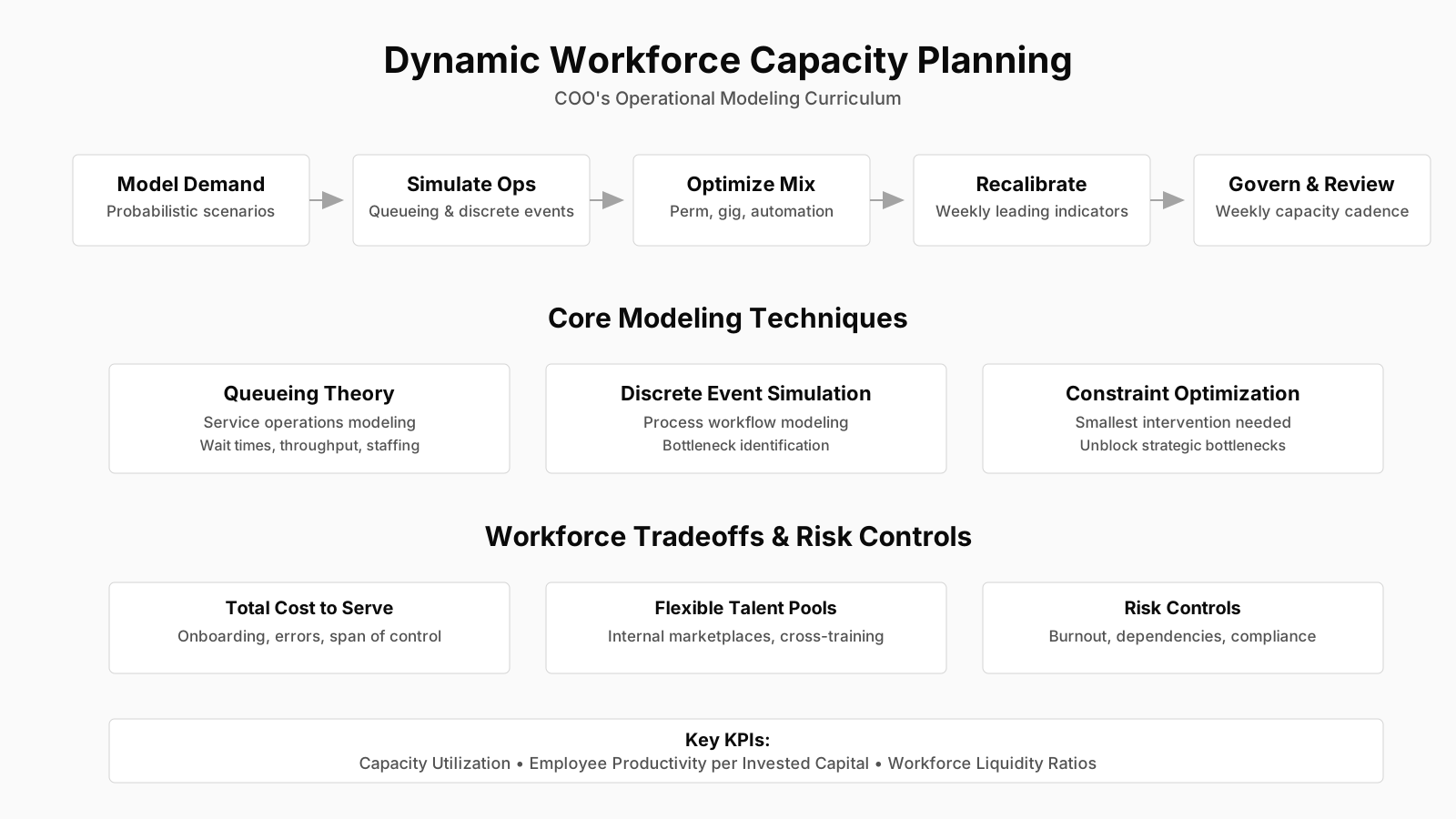
COO Workforce Capacity Planning Certification: Key Topics
| Key Concept | Summary |
|---|---|
| COO Mandate | The COO must treat workforce capacity as a core strategic capability, orchestrating real-time data from revenue forecasts, product roadmaps, and labor market trends to build an adaptive organizational model that scales with shifting demands. |
| Capacity Architect | A strategic COO evolves from static headcount monitoring to proactive skill forecasting, constructing internal talent pipelines and mobility pathways that cut dependence on costly, time-consuming external recruitment. |
| Capacity Failures | Capacity breakdowns trigger cascading failures: delayed milestones, burned-out leadership, and quality erosion that undermines market standing more rapidly than product deficiencies ever could. |
| Certification Scope | The certification equips leaders with demand forecasting, supply-side diagnostics, gap closure planning, and governance rhythms to build a resilient, stress-tested workforce capacity strategy. |
| Core Competencies | Core competencies span driver-based demand modeling, advanced supply analytics, build-buy-borrow-automate decision frameworks, and live governance dashboards that enable real-time monitoring and course correction. |
| Target Audience | This certification is designed for COOs, divisional presidents, and senior operations leaders in high-complexity sectors such as life sciences and technology, where specialized talent scarcity demands precision capacity planning. |
| Frameworks | The strategic workforce planning framework elevates leaders from reactive headcount tracking to predictive optimization, enabling a continuous planning cycle that aligns talent supply with evolving business strategy. |
| Driver-Based Modeling | Driver-based modeling links workforce requirements directly to operational drivers (units produced, customers served), exposing inflated productivity assumptions and grounding capacity plans in empirical business logic. |
| Scenario Planning | Scenario planning constructs a range of capacity scenarios with defined trigger points and pre-agreed actions, preventing reactive, panic-driven decisions and embedding strategic agility. |
| Governance Cadence | A disciplined governance cadence, supported by dashboards and regular review forums, transforms the capacity plan from a static document into a living system that continuously aligns with strategic priorities and market shifts. |
Understanding the COO Mandate in Workforce Capacity
For decades, workforce planning was treated as an annual budgeting exercise where department heads submitted spreadsheets and finance trimmed the totals. That model collapses when cycle times compress and skill requirements evolve mid-quarter. Today’s COO must own workforce capacity as a strategic capability , weaving together data from sales pipelines, product roadmaps, operational throughput, and external labor markets. This shift transforms the COO from a controller of existing resources into a designer of organizational capacity that can stretch, flex, and reconfigure without structural damage.
From Headcount Administrator to Capacity Architect
The traditional COO might have asked, “How many people did we hire last month?” The strategically oriented COO asks, “What skills will we need eighteen months from now to deliver our top three strategic initiatives, and what is the internal supply versus external market availability?” That distinction is fundamental. Capacity architecture involves mapping current competency inventories against future demand scenarios, identifying pivot roles where scarcity creates outsized risk, and building internal mobility pipelines that reduce dependence on external hiring during tight labor markets. It requires the COO to collaborate deeply with HR, finance, and strategy leaders, but to hold the integrative vision that no other executive can duplicate.
Why Capacity Planning Sits at the Executive Table
When workforce capacity fails, the symptoms are unmistakable: missed delivery deadlines, overloaded middle managers, surging contractor costs, and quality defects that trace back to undertrained employees rushed into complex roles. These failures erode competitive position faster than most product shortcomings because they compound silently. A COO who masters strategic workforce capacity planning can prevent these cascading breakdowns by instituting early-warning metrics that trigger capacity interventions well before the pain appears in customer satisfaction scores or margin reports. That capability elevates the COO from operational steward to strategic partner at the executive table, directly shaping what the organization can promise to the board and to the market.
Core Insights on Capacity Architecture
- From Controller to Capacity Architect
- To evolve from reactive headcount tracking into proactive capacity architecture, the COO maps existing talent capabilities against strategic demand forecasts and builds fluid internal mobility pathways that align workforce supply with future business scenarios.
- Strategic Collaboration Across Functions
- By synthesizing live data streams from sales, product, operations, and HR, the COO constructs a panoramic view of workforce capacity that no separate function can duplicate, turning cross-silo intelligence into competitive agility.
- Preventing Silent Competitive Erosion
- Mastery of capacity planning equips the COO to deploy leading risk indicators that preempt cascading failures such as missed deadlines and quality drift, repositioning the role from operational steward to essential strategic partner.
What a COO Strategic Workforce Capacity Planning Certification Covers
A COO Strategic Workforce Capacity Planning Certification is not a theoretical overview of HR models. It is an operationally grounded program that tests a leader’s ability to integrate financial planning, talent intelligence, and scenario modeling into a coherent capacity strategy. The certification typically addresses the full lifecycle of workforce planning: from demand forecasting and supply analysis through gap closure planning and governance cadence. Accrediting bodies and executive education providers design these credentials to validate that a COO can build a capacity plan that withstands stress tests and aligns with shareholder value creation.
Core Competencies of the COO Strategic Workforce Capacity Planning Certification
Candidates pursuing this certification should expect to be assessed on several interconnected domains. First, strategic demand forecasting, which includes the ability to translate business unit targets into detailed role and skill requirements using driver-based models rather than linear extrapolations. Second, supply analytics, covering internal talent assessments, attrition modeling, and external labor market analysis that accounts for regional and sector dynamics. Third, gap analysis and action planning, requiring the design of build-buy-borrow- automate strategies that close capacity deficits while respecting cost constraints and cultural fit. Fourth, governance and monitoring, establishing the dashboards, review rhythms, and accountability structures that keep the plan alive rather than letting it gather dust in a SharePoint folder.
Who Should Earn This Certification
While the title references the Chief Operating Officer, the certification is also relevant for divisional presidents, senior vice presidents of operations, chief transformation officers, and managing directors in private equity portfolio operations groups. Any leader who carries P&L responsibility for operational delivery and must integrate workforce decisions with capital allocation and growth commitments stands to benefit. It is particularly valuable for COOs in industries with high talent specialization, such as life sciences, technology, advanced manufacturing, and professional services, where a miscalculation in capacity can delay product launches by quarters or cause client attrition that takes years to reverse.
Frameworks That Anchor Strategic Workforce Capacity Planning
Effective capacity planning stands on a foundation of structured thinking. Several established frameworks help COOs break a complex problem into manageable components without oversimplifying. The Strategic Workforce Planning maturity model, adapted from practices at the Society for Human Resource Management and the broader organizational design literature, guides leaders from basic headcount tracking through to predictive optimization. At the higher maturity levels, the COO orchestrates a continuous planning cycle that links external market signals to internal talent flows in near real time.
Driver-Based Demand Modeling
Rather than asking managers for wish lists, driver-based modeling ties future headcount requirements to business drivers such as units produced, customers served, code deployed, or geographic territories covered. The COO’s team identifies the causal relationships between business volumes and the number of people in each job family, then stress-tests those relationships against historical data. This approach reveals productivity assumptions that may be unrealistic and pinpoints where automation or process redesign could alter the volume-to-headcount ratio before capacity becomes a crisis.
Scenario Planning and Capacity Buffering
Static plans break the moment reality deviates from assumptions. A COO Strategic Workforce Capacity Planning Certification teaches leaders to build multiple capacity scenarios tied to different business trajectories: a base case, an aggressive growth case, and a downside case. Each scenario includes trigger points and pre-determined action sequences, so that when a certain revenue threshold is crossed, the organization can accelerate hiring or defer it without panicked decision-making. Capacity buffering, analogous to financial reserves, involves maintaining flexible pools of contingent workers, cross-trained employees, and internal project-based talent that can absorb sudden demand shifts without permanent cost increases.
Core Insights on Capacity Planning Frameworks
- Driver-Based Modeling
- By tying headcount requirements directly to operational drivers such as units produced or customers served, this model surfaces underlying productivity assumptions and pinpoints where automation can relieve constraints before they evolve into critical capacity shortages.
- Maturity Model Progression
- The Strategic Workforce Planning maturity model guides leadership teams from transactional headcount tracking to a predictive optimization engine, forging a continuous planning cycle that aligns real-time market signals with talent pipeline adjustments.
- Scenario Planning with Buffers
- Constructing multiple capacity scenarios anchored to varying business trajectories with defined trigger points and pre-approved response actions enables organizations to navigate revenue swings with composure, while a flexible workforce buffer absorbs demand volatility without permanent cost escalation.
Implementing Strategic Workforce Capacity Planning: The COO’s Playbook
Translation from framework to practice is where many workforce planning efforts stall. The COO must build the organizational muscle for capacity planning gradually, starting with a focused pilot that demonstrates value before expanding the scope. This implementation journey respects the reality that line managers are already stretched and will resist processes that feel like additional bureaucracy rather than decision support.
Building the Data Foundation
Before sophisticated modeling can begin, the organization needs a reliable picture of its current workforce. This means cleaning and integrating data from HR information systems, finance systems, time-tracking tools, and project management platforms. The COO does not need to become a data architect, but must champion the investment in a single source of truth for headcount, skills taxonomy, labor costs, and attrition. Many organizations find that a well-structured pilot in one business unit or function generates enough insight to justify the data cleanup investment, which can then be scaled across the enterprise.
Engaging Stakeholders Without Overwhelming Them
A common pitfall is presenting workforce capacity as an HR initiative, when in fact it is an operational strategy tool. The COO should frame early conversations around business outcomes: faster time-to-market, reduced overtime costs, improved retention of critical talent. By involving finance early to validate cost assumptions and operations leaders to affirm demand drivers, the COO creates a coalition that sustains the planning discipline even when attention drifts toward quarterly pressures. Regular rhythms, such as a quarterly capacity review aligned with business planning cycles, embed the practice without requiring constant executive intervention.
Linking Capacity to OKRs and Strategic Priorities
To ensure that workforce plans do not float away from business strategy, the COO must thread capacity commitments directly into the objectives and key results framework. For example, if a company sets an OKR to enter three new international markets, the capacity plan must define the specific roles, language capabilities, and local regulatory expertise needed, along with the timeline and investment required. This linkage creates accountability: a missed hiring target for a key role directly threatens the organization’s stated priority, making the capacity conversation concrete and non-negotiable.
The Economic Logic Behind Workforce Capacity Planning
Beyond operational smoothness, strategic workforce capacity planning protects the economics of the business. Poor capacity decisions manifest as excessive overtime during peaks, idle resources during troughs, contingent labor premiums that erode margins, and severance costs from reactive layoffs. The certification curriculum often includes financial modeling modules that teach COOs to quantify these trade-offs and present them in terms that board members and investors understand.
Modeling the Cost of Capacity Gaps
When an understaffed team misses a product launch window, the lost revenue can dwarf the salary savings that triggered the underinvestment. A COO certified in strategic workforce capacity planning can build business cases that illustrate the full cost of capacity gaps, including customer churn, reputational damage, and the downstream strain on other functions that must compensate. These models shift the conversation from “How many people can we afford?” to “What is the optimal capacity level to maximize margin over the planning horizon?”
Capacity Optimization Through Internal Mobility
External hiring is expensive and slow. Yet many organizations default to external recruitment even when the required skills exist internally, simply because they lack visibility into their own talent inventory. A COO Strategic Workforce Capacity Planning Certification trains leaders to build internal talent marketplaces, project-based assignments, and rotational programs that unlock capacity without adding headcount. The financial benefit is twofold: lower direct hiring costs and faster time-to-productivity, since internal employees already understand the culture, systems, and stakeholder networks.
Core Economic Insights on Capacity Planning
- Protecting business economics
- Strategic workforce capacity planning safeguards margins by systematically avoiding the cost volatility that arises from excessive overtime, idle bench, inflated contingent labor premiums, and severance payouts tied to reactive staffing swings.
- Quantifying capacity gap costs
- Certified COOs construct financial models that capture the full economic impact of understaffing, including lost revenue from delayed product launches, customer churn driven by service failures, and reputational harm, thereby reframing the investment case from short-term affordability to revenue-optimal capacity.
- Internal mobility as cost saver
- Internal talent marketplaces and cross-functional rotational programs unlock latent capacity by redeploying existing employees, eliminating the steep costs and long lead times of external recruitment while leveraging deep institutional knowledge, cultural alignment, and established stakeholder networks.
- Dual financial benefits
- Internal mobility solutions deliver a dual financial advantage: lower direct acquisition costs and significantly faster time-to-full-productivity, because internal candidates already possess embedded understanding of the organization’s culture, systems, and relationship ecosystems.
Metrics and Analytics That Drive Capacity Decisions
Intuition and experience remain valuable, but they must be paired with a disciplined measurement system that tracks capacity health. The COO’s dashboard should include leading indicators that predict capacity trouble, not just lagging indicators that confirm it after the damage is done. This requires a blend of operational metrics, talent metrics, and financial metrics, viewed through the lens of strategic priorities.
Leading Indicators of Capacity Strain
Before attrition spikes or deadlines slip, there are early signals. Utilization rates that consistently exceed sustainable thresholds, increasing overtime hours, rising time-to-fill for critical roles, declining internal application rates for key positions, and manager self-assessments of team capacity are all predictive of future breakdowns. When the COO monitors these indicators monthly and ties them to a decision framework, temporary capacity crunches can be resolved with targeted interventions rather than broad, wasteful hiring freezes or hiring surges.
The Role of Workforce Analytics Platforms
Technology enables what human analysis alone cannot handle at scale. Platforms that ingest data from applicant tracking systems, learning management systems, and performance management tools can surface patterns such as flight risks in critical job families or emerging skill shortages before they become acute. The COO does not need to operate these platforms, but must demand that the analytics output is translated into actionable recommendations that feed the regular capacity review cycle. Certification programs often include case-based work with simulated analytics findings, forcing participants to interpret data and make resource allocation calls under time pressure.
Navigating the Human Side of Capacity Planning
Workforce capacity planning is not a purely mathematical exercise. It involves people with ambitions, anxieties, and finite cognitive and emotional resources. The most technically brilliant capacity model will fail if it ignores the human factors that shape engagement, burnout, and discretionary effort. The COO must blend quantitative rigor with emotional intelligence, recognizing that capacity is not just about bodies in seats but about the collective energy and focus available to do complex work.
Managing Manager Resistance and Reporting Burdens
Frontline and middle managers often view capacity planning requests as time-consuming exercises that produce no tangible benefit for their teams. The COO can shift this perception by reducing the reporting burden and giving managers tools that make capacity insights visible in the flow of their daily work. For instance, integrating capacity indicators into team dashboards so that a manager sees not only project status but also the workload balance across individuals. When managers experience capacity planning as a support to their own resource allocation decisions, resistance fades and data quality improves.
Workforce Capacity and Psychological Safety
Teams that feel psychologically unsafe will hide capacity problems, overworking rather than admitting they cannot meet a deadline. A COO who understands the interplay between culture and capacity fosters an environment where team leaders can raise concerns early without fear of being seen as incompetent. This cultural element is often addressed in certification programs through case studies of organizational failures where silence about capacity gaps led to burnout, attrition cascades, and project collapses that could have been prevented with honest, timely data.
Core Insights on Human Capacity Factors
- Quantitative rigor meets emotional intelligence
- Blending rigorous data analysis with a nuanced understanding of personal motivations, stress triggers, and cognitive bandwidth creates capacity plans that safeguard well-being while sustaining peak performance.
- Reducing manager resistance through tools
- Embedding capacity indicators directly into daily operational dashboards reframes resource allocation as an instant, data-supported decision aid rather than a separate reporting burden, easing frontline skepticism.
- Psychological safety enables honest data
- A culture that actively invites early warnings about workload constraints prevents the hidden overwork and silent capacity strain that otherwise lead to burnout and derailed projects.
- Real cost of silence about capacity gaps
- Unvoiced workload limits often trigger cascading attrition and project failures, outcomes that transparent, timely capacity reporting could have averted before damage compounds.
- Capacity as collective energy and focus
- Workforce capacity is not just a headcount metric but the shared cognitive focus and emotional resilience available for complex work, demanding that COOs track team energy and morale trends alongside quantitative indicators.
Common Misconceptions About Strategic Workforce Capacity Planning
Several persistent myths hinder COOs from fully embracing workforce capacity planning as a strategic lever. Dispelling these misconceptions is essential before meaningful progress can be made, because they justify inaction under the guise of pragmatism.
The Myth That Capacity Planning Is Only for Large Enterprises
Middle-market and growth-stage companies often argue that workforce planning is a luxury they cannot afford while they are scaling rapidly. In reality, the margin for error in a smaller organization is thinner. One misplaced key hire or an unexpected departure can stall a product launch indefinitely. Scaled-down capacity planning, appropriate to the size and complexity of the business, is arguably more critical when resources are scarce and each role carries disproportionate impact.
The Fallacy That Perfect Data Is Required to Begin
Waiting for a flawless workforce database is a recipe for stasis. An experienced COO knows that planning begins with the data available today, supplemented by manager judgment and external benchmarks, and then iteratively refines as data quality improves. The certification reinforces this pragmatism, teaching leaders to make decisions under uncertainty and to build feedback loops that tighten forecasts over time rather than seeking impossible precision upfront.
Another persistent myth is that capacity planning kills agility. Opponents argue that locking in headcount plans inhibits the organization's ability to pivot. This reflects a misunderstanding of modern planning, which builds in flexibility buffers and scenario triggers rather than rigid headcount ceilings. Properly designed capacity plans increase agility by ensuring that when a pivot happens, the talent needed is already identified and accessible rather than being sourced from scratch in a crisis.
Preparing for a COO Strategic Workforce Capacity Planning Certification
Aspiring candidates often wonder about the prerequisites, study commitment, and evaluation methods. While specifics vary by certifying body, several common threads run through credible programs. Most expect candidates to hold a significant operational leadership role or to have demonstrated the equivalent through consulting or general management experience. The certification is not entry level; it assumes familiarity with P&L management, organizational design, and basic analytics.
Study Pathways and Learning Resources
The certification curriculum often draws from a blend of academic research in strategic human capital management and practitioner methodologies from operations management. Candidates might engage with case studies from the public domain, participate in simulations that replicate multiyear workforce planning under volatile market conditions, and prepare written artifacts such as a workforce capacity strategy for a hypothetical or anonymized business unit. Recommended preparation includes reviewing seminal texts on strategic workforce planning, operations strategy, and data-driven management, but the emphasis remains on applied problem-solving rather than memorization of frameworks.
Assessment Methods and Practical Requirements
A rigorous certification will assess not only knowledge but judgment. Expect scenario-based questions where you must choose among capacity expansion options under cost and time constraints, justify your choices with financial and strategic reasoning, and identify the second-order consequences of each alternative. Some programs include a capstone project or a portfolio submission that demonstrates the candidate’s ability to design and defend a workforce capacity plan for a real organizational challenge. This practical component ensures that the credential signals genuine capability rather than mere completion of coursework.
Core Insights for Certification Preparation
- Prerequisite Leadership Experience
- Candidates must hold a significant operational leadership role or demonstrate equivalent experience in consulting or general management, as the certification assumes working knowledge of P&L management, organizational design, and core analytics.
- Applied Problem-Solving Focus
- The curriculum prioritizes applied problem-solving over rote framework memorization by integrating real-world case studies, multiyear workforce planning simulations under volatile market conditions, and formal written deliverables.
- Scenario-Based Assessment Methods
- Rigorous certifications assess strategic judgment through scenario-based questions that require selecting capacity expansion options under cost and time constraints, providing financial and strategic justifications, and identifying second-order consequences.
- Practical Capstone Requirement
- Many programs culminate in a capstone project or portfolio submission where candidates design and defend a workforce capacity plan for a real organizational challenge, ensuring the credential signals genuine capability.
How Certification Transforms the COO’s Career Trajectory
Possessing a COO Strategic Workforce Capacity Planning Certification does more than add a line to a resume. It signals to boards, CEOs, and private equity sponsors that the executive can connect the dots between capital allocation, talent strategy, and operational execution in a way that few leaders can. In a market where companies increasingly compete on the strength of their workforce, this capability becomes a differentiator for candidates seeking enterprise-wide COO roles or advisory board positions.
Elevating the COO’s Role in Strategy Formulation
When the COO can present a credible workforce capacity model alongside the strategic plan, the dynamic of strategy discussions changes. Instead of the CEO and CFO setting growth targets and the COO being tasked to “make it happen,” the COO becomes a shaper of the strategy itself, articulating which targets are feasible given capacity constraints and what investments would be required to stretch to more ambitious goals. This strategic voice increases the COO’s influence and accelerates the path to potential CEO succession, because workforce capacity is increasingly seen as a board-level concern.
Differentiating in the Executive Talent Market
Search committees and executive recruiters report growing demand for operations leaders who can demonstrate structured thinking around workforce scalability. A certification that verifies this competency can separate a candidate in a competitive shortlist, particularly for roles in private equity portfolio companies where operational due diligence routinely exposes talent-related risks. It also positions the COO to contribute to broader human capital governance, potentially leading to board committee appointments where workforce oversight is a growing priority.
Sustaining the Gains: Making Capacity Planning a Core Capability
A certification is a beginning, not an end. The true measure of impact is whether the COO can embed strategic workforce capacity planning into the organization’s operating rhythm so deeply that it persists through leadership transitions and market cycles. This requires treating capacity planning as a management process that gets the same discipline as financial planning, with regular cadences, clear ownership, and continuous improvement cycles.
Building a Capacity Planning Center of Excellence
Over time, the COO can delegate elements of the planning process to a dedicated team or a cross-functional center of excellence that reports up through operations or strategy. This team maintains the forecasting models, runs scenario analyses, and prepares the decision materials for quarterly capacity reviews. The COO’s role transitions from doing the analysis to challenging assumptions, making trade-off calls, and communicating the capacity narrative to the board and external stakeholders. The certification provides the foundational credibility to architect this function and to mentor the next generation of operations leaders who will sustain it.
Embedding Workforce Capacity in Risk Management Frameworks
Progressive organizations are now treating workforce capacity risk alongside financial risk, cyber risk, and supply chain risk in their enterprise risk management frameworks. The COO, armed with the concepts from a Strategic Workforce Capacity Planning Certification, can lead this integration by defining risk appetite for talent shortages, quantifying potential impacts, and designing mitigation strategies such as strategic partnerships, cross-training initiatives, and geographic diversification of talent hubs. This proactive stance appeals to audit committees and regulators who recognize that human capital risks can materialize as material weaknesses when left unmanaged.
Core Insights on Embedding Capacity Planning
- Certification as a starting point
- True success is achieved when strategic workforce capacity planning becomes part of the organization's operational cadence, surviving leadership transitions and market volatility to drive long-term strategic agility.
- Treating planning like financial discipline
- Rigorous capacity planning mirrors financial planning by adhering to a disciplined cadence, assigning explicit ownership, and embedding continuous feedback loops that sharpen accuracy over time.
- Delegating to a Center of Excellence
- The COO shifts from conducting analysis to stress-testing assumptions by entrusting forecasting and scenario modeling to a specialized center of excellence, thereby elevating strategic oversight and reducing cognitive bias.
- Integrating capacity into risk management
- Organizations must elevate workforce capacity risk to the same level of scrutiny as financial, cyber, and supply chain risks, integrating it seamlessly into enterprise risk management to safeguard against unseen people-related disruptions.
- Defining risk appetite and mitigation
- The COO leads the integration by defining the organization's risk appetite for talent shortages, translating those gaps into financial and operational impacts, and crafting mitigation strategies such as cross-training initiatives and geographic diversification.
The Future of Work and the Next Frontier in Capacity Planning
The context in which COOs plan for workforce capacity is shifting faster than the planning cycles themselves. The rise of AI-augmented roles, the blend of internal and external talent ecosystems, and the demand for sustainability-linked workforce metrics are all changing what capacity means. A certification that teaches principles rather than rigid templates prepares the COO to adapt as these forces reshape the workforce landscape.
AI and the Redefinition of Capacity
As artificial intelligence handles a growing share of cognitive tasks, capacity planning must evolve from counting roles to counting outcomes. A legal team augmented by AI may handle three times the contract volume with the same number of people; the capacity question shifts to whether the team’s time is being redeployed to higher-value work. The COO must model these productivity leaps and manage the transition so that capacity gains are realized without creating hidden vulnerabilities when AI systems fail or require human override. Certification programs are increasingly incorporating AI impact scenarios to help leaders navigate this uncertainty.
The Expanding Talent Ecosystem
Full-time employees no longer represent the entirety of workforce capacity. A modern capacity plan accounts for contractors, freelancers, gig workers, automation proxies, and strategic outsourcing partners as an integrated talent supply chain. The COO must design a governance model that ensures quality and cultural alignment across this fragmented workforce while capturing the flexibility benefits. This ecosystem view requires new contracting models, performance measurement systems, and knowledge retention practices that a certified COO is equipped to design and implement.
Strategic workforce capacity planning will only grow in complexity and strategic importance. A COO Strategic Workforce Capacity Planning Certification is not merely a professional development accolade; it is an investment in the core competence that separates companies that execute from those that merely aspire. By mastering the frameworks, metrics, and human dynamics described, a Chief Operating Officer can transform the organization’s relationship with its own talent, turning workforce capacity from a chronic liability into a durable competitive advantage.
Advance Your Career with Professional Certification
For senior operations leaders, earning a project management certification directly supports strategic workforce capacity planning by embedding standardised risk assessment, resource allocation, and milestone tracking into daily decision-making. It signals a level of disciplined execution that hiring panels and board members immediately recognise, accelerating career progression into executive roles. Moreover, certified professionals consistently reduce project overrun rates and improve cross-functional coordination, which translates into measurable gains in organisational throughput and cost efficiency. Pursuing a PM certification online allows experienced managers to strengthen these competencies without pausing their operational responsibilities, further demonstrating the ability to balance tactical delivery with long-term strategic development.
Earning a product management certification equips professionals with a structured framework to prioritize initiatives, allocate resources, and measure outcomes—skills that directly translate to more predictable revenue growth. Organizations increasingly rely on a certified product manager to bridge the gap between strategic vision and execution, reducing costly misalignment between development teams and market demands. This credential signals to employers a verified ability to manage product lifecycles, lead cross-functional teams, and apply data-driven decision-making, making you a stronger candidate for senior roles. When product leaders hold formal certification, companies report shorter time-to-market and higher rates of feature adoption, demonstrating that the investment in professional development yields measurable operational advantages.
Earning a professional HR management certification validates mastery of workforce planning, compliance, and strategic people operations that directly impact organizational agility. Credentialed HR leaders consistently demonstrate deeper expertise in aligning talent systems with business goals, leading to stronger board-level influence and higher promotion rates to executive roles. Formal HR training and certification programs equip practitioners with advanced frameworks for capacity modeling, risk mitigation, and data-driven decision-making, which elevates the entire department's credibility. Companies that invest in certified HR leadership report measurable improvements in retention, cost efficiency, and culture strength, turning human resources from a support function into a competitive lever.