Something is wrong with the way we work, but it is not about long hours or demanding bosses in the old familiar sense. The real erosion happens inside the mind, in the quiet background of a leader's attention that is slowly consumed by too many small things. When we talk about the cognitive load trap, what we are actually describing is a pattern that reduces leadership capacity not through dramatic failures, but through a thousand micro-withdrawals of mental energy. The more we load our brains with operational noise, the less we have left for the kind of thinking that leadership actually requires. This is the quiet crisis that sits behind the burnout statistics and the endless conversations about executive overwhelm.
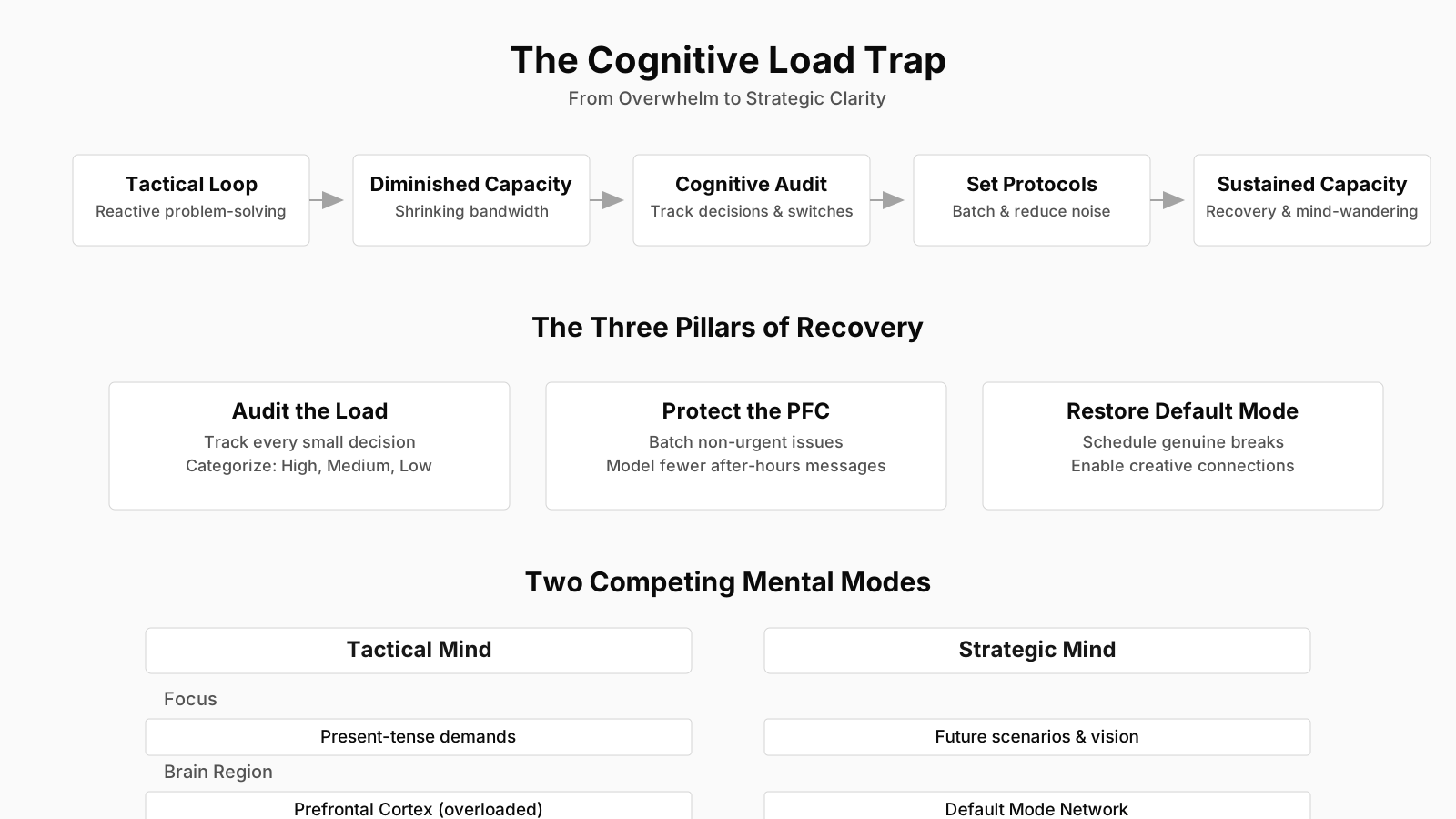
Key Takeaways: Cognitive Load's Impact on Leadership
| Key Concept | Summary |
|---|---|
| Cognitive Load Entrapment | Leadership capacity erodes not through dramatic failures, but through countless micro-depletions of mental energy triggered by operational noise. |
| Hidden Cognitive Load | Disproportionate mental energy is consumed by managing the human response to technological change, redirecting cognitive resources from strategic leadership. |
| Psychological Safety | AI adoption correlates with eroded psychological safety and rising depression, compressing the team’s finite cognitive bandwidth. |
| Ethical Leadership | While ethical leadership shields teams from AI-driven declines in psychological safety, it simultaneously intensifies the burden on already strained leaders. |
| Daily Decision Accumulation | Scores of minor operational decisions accumulate hourly, each extracting just enough cognitive effort to inhibit deep strategic reflection. |
| Strategic Deficit | The relentless pressure for near-term outcomes structurally erodes the mental space essential for forward-looking strategy. |
| Cognitive Fragmentation | A typical leadership day fragments into a cascade of micro-decisions that block integrative thinking, narrowing vision until the strategic horizon vanishes. |
| Human Cost | Leaders absorb organizational anxiety to function as stabilizing anchors, a form of emotional labor that drains working memory and hollows out core leadership capacity. |
| Structural Issue | Framing cognitive overload as a personal resilience deficit overlooks its structural origins and the impossibility of reversing systemic erosion through individual coping tactics. |
| Breaking Free | Sustained recovery and strategic thought require organizations to systematically safeguard cognitive space by imposing deliberate boundaries on constant responsiveness. |
Why Leadership Feels Harder Than Ever: The Hidden Cost of Mental Overload
There is a subtlety here that most organizations miss entirely. The introduction of artificial intelligence into daily workflows was meant to free up cognitive space, yet it often does the opposite by generating new forms of uncertainty and interpersonal threat . The hidden cognitive load trap emerges when leaders spend more mental energy managing the emotional and psychological fallout of technological change than they do on strategic direction . A study published by Palgrave Macmillan, authored by Byung-Jik Kim, Min-Jik Kim, and Julak Lee, uncovered a troubling relationship: as organizations adopt AI, employees experience a reduction in psychological safety , which is that shared belief that you can speak up, make mistakes, or challenge ideas without facing negative consequences [3] . When psychological safety drops, depression levels rise, and the entire team's cognitive bandwidth shrinks. The interesting part is that ethical leadership can buffer against this effect. But here is the trap: leaders who are already stretched thin by the same technological pressures are the very people expected to provide that ethical buffer, which means they must carry an even heavier psychological load just to keep their teams functional. This is not a simple case of more work; it is a recursive loop where the solution demands more from the same depleted resource.
What makes this dynamic so corrosive is that it operates beneath the surface of everyday awareness. A leader might notice they feel more drained by the end of the day, that decisions seem harder to make, that they are more irritable in meetings, but they seldom connect these symptoms to the erosion of psychological safety around them. The cognitive cost of AI adoption is not about learning new software; it is about the ambient anxiety that comes when people suspect their roles might change, their expertise might become obsolete, or that an algorithm might be silently evaluating their performance. That ambient anxiety gets processed by the leader's nervous system whether they want it or not. The Kim et al. research makes clear that this is not a soft skills issue but a measurable mechanism linking organizational change to mental health. The implication is stark: the modern workplace generates a constant low-level threat to the very cognitive faculties leaders need most.
Organizations tend to treat mental overload as an individual resilience problem, offering mindfulness apps or time management tips. But when the source of the drain is structural, no amount of personal coping can reverse it. The trap deepens because leaders who attempt to provide ethical guidance, who try to be the stabilizing force, end up absorbing the collective anxiety like a sponge. They feel they must be the ones who remain calm, who translate the uncertainty into manageable narratives, who shield their teams from the worst of the organizational noise. All of that emotional labor consumes working memory, reduces the ability to think systemically, and gradually hollows out the capacity for leadership itself. It is a trap precisely because the very behaviors that define good leadership in difficult times are the ones that accelerate cognitive depletion when sustained too long without recovery.
Core Insights on Leadership Overload
- AI erodes psychological safety
- Research reveals that AI adoption undermines employees’ psychological safety, fueling depression and narrowing cognitive bandwidth across teams, compounding the invisible mental burden that leaders already carry.
- Recursive ethical leadership trap
- Leaders already depleted by relentless technological demands become the designated ethical safeguard meant to counteract these effects, creating a self-perpetuating cycle where the remedy draws from the very reservoir that is running dry.
- Unnoticed ambient anxiety
- Leaders often experience exhaustion and irritability unknowingly driven by depleted psychological safety, a consequence of pervasive anxiety over shifting roles, fears of obsolescence, and the quiet scrutiny of algorithmic assessment.
- Structural drain misdiagnosed
- Organizations commonly mislabel mental overload as a failure of individual resilience, responding with wellness apps, while the true driver is structural and resists resolution through personal coping alone.
- Emotional labor consumes capacity
- Leaders who absorb collective anxiety by projecting calm and reframing uncertainty steadily deplete their working memory and capacity for systemic thinking, gradually hollowing out their leadership capability over time.
The Daily Decisions That Drain Your Leadership Reserves
Most people imagine that strategic thinking happens in quiet moments with a whiteboard and a cup of coffee. In reality, strategic thinking is supposed to emerge from the cracks between urgent demands, but those cracks keep getting smaller. The daily decisions that drain leadership reserves are not the big, consequential choices; they are the dozens of small, operational calls that pile up hour by hour, each one demanding just enough attention to prevent any deeper processing from taking hold. Jacob Jacobus Serfontein, in research conducted at Stellenbosch University, examined how strategic leadership connects to operational strategy and business performance in South African organizations [1] . What emerges from his work is a clear picture of leaders caught in a relentless churn of immediate demands, where the pressure to deliver results now systematically undermines the capacity to think about tomorrow. The irony is sharp: the more urgent the operational environment becomes, the more strategic leadership is needed, yet the less mental space exists to practice it.
When you unpack a typical leader's day, you find a pattern of cognitive fragmentation that is almost designed to prevent synthesis. A budget approval here, a personnel issue there, a quick review of a dashboard, an impromptu meeting about a delayed shipment, a dozen email decisions, and then another one. Each of these micro-decisions draws on the same pool of executive function, and by the time an hour of uninterrupted thinking might be possible, the tank is empty. Serfontein's work highlights that traditional leadership frameworks, built for more stable times, simply cannot cope with the pace and complexity of knowledge-driven environments. In these contexts, systemic innovation is not a luxury but a survival requirement, and systemic innovation demands cognitive space that the daily operational grind does not permit. So leaders end up stuck in a reactive loop, forever managing the present and never shaping the future.
There is a particular kind of exhaustion that sets in when you spend an entire day making decisions that all feel urgent but none feel important. This is not physical tiredness; it is a depletion of the mental machinery that allows for nuanced judgment, pattern recognition, and ethical reasoning. The pace and urgency of daily decisions create a cognitive tunnel vision where the leader can only see what is directly in front of them. The horizon disappears. And without the horizon, there is no strategy, only a series of tactical moves that may or may not add up to anything coherent. The Serfontein research underscores that operational strategy suffers when strategic leadership is crowded out, which means that even the immediate performance goals that everyone is so frantic about eventually degrade because nobody is steering the ship.
It is sometimes observed in organizations that the most dedicated leaders are the ones most vulnerable to this trap. They feel responsible for everything, they pride themselves on being accessible and responsive, and they mistake being busy with being effective. The cognitive cost of constant availability, of never allowing the mind to settle into a reflective mode, is that leadership capacity gradually diminishes without any obvious single cause. It happens across months and years, and by the time the effects are visible in missed opportunities or strategic drift, the habit of reactive management is so deeply ingrained that changing it feels impossible. The daily decisions that drain leadership reserves are, in this sense, not just a productivity problem; they are a developmental trap that keeps leaders from ever reaching the next level of capability.
When Your Brain Runs on Empty: Cognitive Load and Poor Judgment
There is a certain cruelty in how cognitive load distorts judgment. The very mental faculties that a leader needs to make fair, reflective, and innovative decisions are the first to degrade under pressure. Cognitive load impairs leadership judgment by hijacking the brain's capacity for deliberate reasoning and pushing it toward shortcuts and biases that feel efficient but produce systematically worse outcomes. Research published by Wiley, authored by G. James Lemoine and his colleagues, offers a fascinating window into this dynamic through the lens of servant leadership [2] . Their work shows that servant leadership operates through specific cognitive mechanisms, including enhancing followers' other-orientation and cognitive reflection, and these effects are moderated by moral identity internalization. In other words, the leadership style that is most likely to produce ethical, stakeholder-oriented behavior depends heavily on the leader's ability to model and encourage reflective thinking. But reflective thinking requires mental bandwidth, and mental bandwidth is precisely what gets stripped away when leaders are running on empty.
The implication is uncomfortable. When a leader's cognitive load is high, they are less capable of the very servant leadership behaviors that research says produce the best outcomes for the organization and its stakeholders. They default to faster, more self-interested processing. Their decisions become narrower, less inclusive, and less likely to consider long-term consequences. This is not a moral failing; it is a neurocognitive reality. The prefrontal cortex, which handles complex reasoning and impulse control, is an energy-hungry system that gets deprioritized when the brain is in survival mode. A leader who is drowning in operational demands is literally less capable of ethical reflection than the same leader would be after a period of mental rest and recovery. The moral minds research makes it clear that leadership effectiveness is not just about having the right values; it is about creating the conditions under which those values can be consistently enacted.
This deterioration in judgment also shows up in how leaders handle the diversity of perspectives around them. A study published in the Journal of Management Studies by Somendra Narayan, Jatinder S. Sidhu, and Henk Volberda, through Wiley, examined the influence of cognitive and ideological diversity in top management teams on business model innovation [5] . They found that cognitive diversity, meaning different ways of thinking about problems, expands attention to business model innovation, which is good. But excessive ideological diversity, differences in fundamental beliefs and values, negatively affects the intensity of innovation efforts. The reason is that processing genuinely divergent perspectives imposes its own cognitive load. A leader whose mental energy is already depleted does not have the spare capacity to integrate conflicting viewpoints productively. So instead of harnessing diversity for innovation, they either suppress it to reduce complexity or make superficial compromises that satisfy no one. The door to strategic innovation closes, not because the ideas are not there, but because the leader cannot afford the cognitive price of synthesizing them.
The drift toward bias under cognitive load is particularly damaging when it shapes developmental decisions. Jenny M. Hoobler, Grace Lemmon, and Sandy J. Wayne, in research published by SAGE Publishing, found that managers often hold biased perceptions that women are less career motivated than men [4] . This perception leads to women receiving fewer challenging assignments, less training, and less career encouragement, which in turn lowers their managerial aspirations over time. The tragedy here is that these biased judgments are more likely to surface when cognitive resources are drained. A manager who is making decisions under pressure and time constraint is less likely to override the automatic stereotypes that society has implanted and more likely to rely on gut feelings that reflect deep-seated bias rather than actual evidence. The developmental pipeline gets choked not by overt discrimination but by the quiet operation of a tired brain reaching for the easiest available schema. Thus the cognitive load trap does not just harm the individual leader; it systematically distorts who gets to lead in the future.
Core Insights on Cognitive Load and Judgment
- Impaired reflective reasoning under pressure
- Under cognitive load, the prefrontal cortex's capacity for elaborate reasoning diminishes, compelling leaders to default to automatic, biased heuristics that produce inferior outcomes.
- Servant leadership requires mental bandwidth
- High cognitive load depletes the mental bandwidth needed for the reflective, other-focused deliberation that servant leadership demands, regardless of a leader's personal values.
- Diversity integration taxed by depletion
- When mental energy is low, leaders' ability to synthesize divergent viewpoints falters, leading them to suppress diversity or settle for shallow compromises rather than sparking innovation.
- Biased career decisions intensify with load
- Cognitive depletion increases reliance on automatic stereotypes, such as the assumption that women lack career ambition, which narrows the talent pipeline and reinforces biased career decisions.
- Ethical judgment as a neurocognitive reality
- The deterioration of fair decision-making under pressure stems from a biological limitation, not a moral failing, underscoring the need for deliberate rest and recovery.
The Empathy Gap: How Overwork Erodes Emotional Connection
Emotional connection in teams does not happen by accident; it is built through small, consistent acts of attention that signal to people they are seen and valued. Overwork attacks these signals at their source. Overwork widens the empathy gap by consuming the very cognitive and emotional resources that inclusive leadership requires. Azadeh Shafaei, Mehran Nejati, Maryam Omari, and Fleur Sharafizad, in research published by SAGE Publishing, found that inclusive leadership significantly reduces workplace bullying, and this effect operates through a chain of psychological safety and self-esteem [6] . When a leader behaves inclusively, employees feel psychologically safe, which boosts their self-esteem, and bullying becomes far less likely. But inclusive leadership is not a personality trait that you either have or do not have; it is a set of behaviors that take effort, awareness, and emotional regulation. A leader who is drained by overwork has less capacity to be consistently inclusive. They miss the subtle cues that someone is feeling marginalized. They skip the check-in because they are behind on email. They respond to a concern with terseness rather than curiosity, and in doing so, they chip away at the psychological safety that protects the team from toxic dynamics.
The empathy gap manifests in ways that are easy to miss but accumulate over time. A leader might still hold one-on-one meetings, but they are transactional and rushed. They might still say the right words about inclusion, but the warmth and genuine interest behind the words have evaporated. Employees pick up on this. They feel the shift from being a person to being a task, and they respond by withholding their own engagement and discretionary effort. The Shafaei et al. research reveals a particularly sobering finding about the role of embeddedness. Employees who are highly embedded in their organization, those with strong ties and sunk costs that make leaving difficult, actually show a weaker negative relationship between inclusive leadership and bullying. This means that deeply committed employees tolerate lower quality leadership longer. They stay in environments where their psychological safety is eroding, and their self-esteem is taking a hit, because they cannot easily leave. The empathy gap gets hidden by loyalty, and overworked leaders may never realize the slow damage they are doing until the exit interviews pile up or the engagement scores plummet.
When leaders are running on fumes, their emotional radar becomes less sensitive to the needs of others. This is not a character defect; it is a biological reality. Empathy requires cognitive resources to read facial expressions, to remember personal details, to imagine another person's perspective, and to regulate one's own emotional reactions. All of this gets attenuated by mental fatigue. A leader who is sleep-deprived, decision-fatigued, and constantly multitasking will default to the emotional minimum. The irony is that in many organizations, the leaders who are most celebrated for their dedication are the ones most at risk of losing their capacity for the human connection that makes leadership work. They push harder, stay later, carry more, and in doing so, they become less of what their teams actually need from them. The empathy gap is not a soft concern; it is a hard performance issue that shows up in turnover, absenteeism, and a thousand small acts of withdrawal that no single metric captures but that collectively drag the organization down.
Losing the Big Picture: How Busywork Kills Strategic Thinking
Strategic thinking is often described as a capability you either have or you develop through training. Less discussed is the reality that strategic thinking is a cognitive state that certain kinds of work actively extinguish. Busywork kills strategic thinking by occupying the mind with tasks that are too low-complexity to stimulate the integrative, reflective processing that big-picture leadership requires. When a leader spends their day on administrative approvals, status updates, formatting slide decks, or troubleshooting routine operational hiccups, their brain shifts into a reactive, procedural mode that is the opposite of what is needed for strategy. Strategic thinking demands cognitive reflection, the ability to pause, question assumptions, connect disparate pieces of information, and envision futures that do not yet exist. That cognitive reflection is a finite resource that gets drained by the thousand small tasks that feel productive but generate no meaningful insight.
The servant leadership research discussed earlier highlights that cognitive reflection is not just a trait but a mechanism that can be fostered or stifled. When leaders model reflective thinking, followers adopt it, leading to better decisions that benefit multiple stakeholders. But the leader must first have the capacity for that reflection themselves. Busywork does not just steal time; it changes how the brain operates over the long term. The neural pathways that support deep, sustained attention weaken when they are not used, and the pathways for rapid task-switching and shallow processing strengthen. A leader who has spent years in a busywork culture may find that they literally cannot sit with a complex problem for an hour without feeling an intense urge to check something or do something tangible. Their strategic muscle has atrophied, not because they lack intelligence, but because their daily work never demanded it.
There is also a developmental dimension to this trap that affects who gets to lead in the first place. The assignment of challenging, cognitively demanding work is a primary driver of leadership growth. When managers, often unconsciously, funnel the most interesting and complex projects to people they perceive as high-potential, while relegating others to routine busywork, they are not just managing workload; they are determining who develops the strategic capacity to advance. The Hoobler et al. findings on managerial bias show that women frequently receive fewer challenging assignments, less training, and less career encouragement, which directly reduces their managerial aspirations. Over time, this creates a pipeline where certain groups are systematically denied the cognitive stimulation that builds the capacity for big-picture thinking. The organization loses not only diverse talent but the strategic perspectives that those individuals would have brought. The busywork trap, in this sense, is also an equity trap that compounds across careers and generations of leadership.
Organizations often believe they can fix this by adding strategic planning offsites or innovation workshops. But a two-day retreat cannot compensate for fifty weeks of work that rewards reactive busyness and punishes reflection. Leaders who want to reclaim strategic thinking must redesign how daily work is structured to protect cognitive complexity. This means deliberately removing low-value tasks, delegating operational decisions that others are capable of making, and creating genuine space for synthesis. It sounds simple, but the cultural forces that glorify busyness are powerful. Many leaders derive a sense of worth from being constantly needed and instantly responsive. Letting go of that identity is as much a psychological shift as a workflow redesign. Without it, though, the big picture remains forever out of focus, and the leader becomes merely a high-functioning operator rather than a true strategic guide.
Core Insights on the Busywork Strategy Trap
- Reactive mode overrides reflection
- When busywork takes over, the brain defaults to execution-only mode, starving the reflective capacity that connects disparate signals into coherent long-term strategy.
- Cognitive reflection is a finite resource
- Low-complexity tasks consume the same cognitive reserves needed for deep analysis, and over time the neural pathways that support sustained strategic attention weaken while rapid task-switching reflexes grow stronger.
- Challenging assignments build leaders
- Reserving complex projects for a perceived elite while defaulting others to routine busywork creates a self-fulfilling leadership gap, systematically denying whole cohorts the cognitive demands that forge strategic judgment.
- Retreats cannot fix daily work
- A two-day strategic offsite cannot counteract a year-round culture that rewards immediate responsiveness and treats quiet, reflective thinking as a sign of low productivity.
- Redesign work to protect complexity
- Reclaiming strategic capacity requires deliberately stripping away low-value tasks, delegating genuine decision rights, and shifting the leader’s self-image away from indispensability and constant availability.
The Ripple Effect: How a Tired Leader Hurts Team Performance
Leadership is never a solo activity. The state of the leader's mind ripples out through the team in ways that are often invisible to the leader but painfully obvious to everyone else. A tired leader hurts team performance not because they stop working hard, but because their depleted state undermines the psychological conditions that enable others to do their best work. When a leader is cognitively drained, the first things to go are the inclusive behaviors that signal to team members that they belong, that their voice matters, and that it is safe to take risks. Without those signals, the team environment becomes more guarded. People hold back ideas. They spend energy managing impressions rather than solving problems. Collaboration becomes transactional. The collective intelligence of the group drops even if every individual member is still talented.
The mechanisms behind this ripple effect are tied to psychological safety and self-esteem. When inclusive leadership is present, team members feel safe enough to speak up about concerns, admit mistakes, and propose unconventional solutions. That safety, in turn, protects against workplace bullying, which is both a symptom of a toxic culture and a cause of further disengagement. But inclusive leadership requires consistent, mindful attention from the leader. A tired leader, distracted by their own cognitive overload, sends mixed signals. One day they are supportive; the next day they are impatient and dismissive. That unpredictability destroys the psychological safety faster than a consistently negative leader would, because uncertainty is more stressful than a known bad situation. Team members start to self-censor, and the rich flow of information that a healthy team depends on slows to a trickle.
There is a compounding effect here that makes recovery difficult. As team performance starts to suffer because of the leader's depleted state, new problems arise that demand even more of the leader's attention. Conflicts that would have been resolved informally now require formal intervention. Quality issues that would have been caught early now escalate. The leader, already exhausted, must now deal with a crisis that their own tiredness helped create. This increases the cognitive load further, and the loop tightens. The team, sensing the leader's growing frustration and diminishing capacity, becomes even more disengaged, and performance dips again. It is a classic downward spiral that can transform a once high-functioning unit into a dysfunctional group in a surprisingly short time, all without a single major precipitating event.
The research on inclusive leadership and bullying also points to the importance of self-esteem as a mediator. When team members feel included and psychologically safe, their self-esteem is reinforced, which makes them more resilient and proactive. A tired leader inadvertently starves this mechanism. Employees whose self-esteem takes a hit become more vulnerable to bullying from peers, and they also become less willing to take on the challenging tasks that drive performance and develop their own leadership potential. So the ripple effect extends in time as well as space. The leader's current cognitive state shapes not just this quarter's results but the developmental trajectory of the people who might be the leaders of tomorrow. To underestimate this is to treat leadership as a mechanical function rather than the deeply human, contingent, and fragile process that it actually is.
What High-Performing Leaders Do Differently to Protect Their Focus
High-performing leaders are not immune to the cognitive load trap. They are simply more deliberate about managing the conditions that either amplify or reduce mental load. High-performing leaders protect their focus by treating cognitive capacity as a strategic asset that must be budgeted and defended as carefully as financial capital. Research on inclusive leadership published by Wiley, authored by Azadeh Shafaei and Mehran Nejati, shows that when leaders create environments where employees learn from errors and feel psychologically safe, work becomes more meaningful [7] . This is not just a nice outcome; it is a feedback loop that conserves the leader's own cognitive resources. When employees are engaged in meaningful work and can learn from mistakes without fear, they need less hand-holding, less correction, and less monitoring. The leader can then redirect attention from oversight to higher-level thinking. It is a proactive investment that pays dividends in freed cognitive bandwidth.
The deliberate cultivation of psychological safety emerges as a common thread in how high-performing leaders maintain their edge. Instead of spending energy on vigilance, constantly scanning for problems that might blow up, they invest upfront in building a team culture where problems surface early and get solved before they become crises. This reduces the ambient anxiety that consumes so much cognitive capacity. Leaders who get this right report a kind of calm that seems paradoxical in high-stakes environments. They are not ignoring the pressure; they have structured the environment so that the pressure does not have to be carried by them alone. The Shafaei and Nejati findings underscore that meaningful work is not a fuzzy concept but a measurable outcome of inclusive leadership practices that benefit both the employee and the leader's own ability to focus on strategic matters.
There is also a discipline of boundary-setting that high-performing leaders practice, often invisibly to others. They understand that not every email needs a response, not every meeting requires their attendance, and not every decision must be theirs to make. They ruthlessly eliminate low-value cognitive drains so that when complex, ambiguous problems demand their full attention, they have the mental reserves to engage deeply. This boundary-setting is not about working less; it is about working on the right things with an undivided mind. In many organizations, this kind of disciplined focus is misperceived as aloofness or lack of engagement, which is why lesser leaders feel compelled to respond to every signal of demand as proof of their dedication. High-performing leaders have the organizational courage to accept that short-term perceptions of busyness are less important than the long-term quality of their thinking and judgment.
What also distinguishes these leaders is their recognition that protecting focus is not a solo act. They actively shape the systems and norms around them to reduce unnecessary cognitive load for everyone. They streamline reporting processes, kill unnecessary meetings, clarify decision rights, and model the behavior of focusing on what truly matters. By doing this, they create an organizational microclimate where the entire team can operate with less mental clutter. The result is a collective cognitive dividend. When multiple people in a team or department are freed from low-value busywork, the group's capacity for innovation, problem-solving, and adaptive response multiplies. The leader who protects their own focus indirectly protects the focus of everyone else, and in that protection lies the seed of sustained high performance in a turbulent world.
Key Focus-Protecting Tactics for Leaders
- Treat cognitive capacity as a budget
- High-performing leaders guard their cognitive capacity like a finite financial resource, directing it only toward strategic, high-impact work and never wasting it on routine oversight.
- Invest in psychological safety early
- By building psychological safety from the outset, leaders enable teams to surface and solve problems without fear, eliminating the leader’s need for constant vigilance and freeing mental bandwidth for breakthrough thinking.
- Ruthlessly eliminate low-value drains
- Leaders impose hard boundaries on emails, unnecessary meetings, and low-stakes decisions so that their undivided attention stays available for the complex, ambiguous challenges that demand it most.
- Shape systems to lighten everyone's load
- They redesign workflows, clarify decision rights, and model focused behavior, creating a collective cognitive surplus that elevates team innovation and adaptive capacity across the organization.
The Long-Term Toll: From Cognitive Overload to Leadership Burnout
Burnout is often discussed as a endpoint, a sudden collapse, but in leadership it is more accurately a slow erosion that happens so gradually the person experiencing it is often the last to know. Leadership burnout from cognitive overload follows a predictable path that begins with a loss of inclusive capacity and ends with a hollowed-out leader who can no longer summon the emotional or intellectual energy that the role demands. The early signs are subtle: a declining interest in developmental conversations, a shorter fuse in meetings, a reliance on precedent rather than fresh thinking, and a growing sense that people are problems to be managed rather than partners to be developed. These are not moral failures; they are the behavioral fingerprints of a brain that has been running a cognitive deficit for too long.
The trajectory from overload to burnout is often masked by surface-level functioning. Leaders learn to simulate engagement, to say the right things in the right tones, even as their internal experience is one of numbness and disconnection. The research on inclusive leadership and workplace bullying demonstrates that the protective effects of inclusive behavior depend on consistent enactment. Once the leader begins to slip, the psychological safety of the team erodes, self-esteem wanes, and bullying incidents increase. The very problems that a healthy leader would prevent now become additional stressors that the burned-out leader must handle, accelerating the decline. The dark side of embeddedness becomes relevant again here: team members who are deeply attached to the organization may stay and suffer, enabling the leader's decline to continue unchallenged because the visible signs of distress are muted.
What makes leadership burnout particularly insidious is that it is self-reinforcing and contagious. A burned-out leader spreads stress throughout the team, which creates more demands, which deepens the burnout. The organization may respond by offering wellness programs or suggesting time off, but these surface-level fixes do nothing to address the structural cognitive load that started the whole process. Unless the fundamental pattern of work is redesigned, the leader returns from a break to the same relentless demands and quickly slides back into depletion. The long-term toll is not just on the individual leader's health and career but on the organization's leadership pipeline. Talented people who might have been excellent leaders burn out and leave, not because they could not handle the pressure, but because the system never gave them the conditions under which leadership can be sustained over a career.
Prevention requires a radical honesty about what leadership work actually demands and what kind of cognitive support it needs. It requires organizations to stop celebrating the exhausted leader as a hero and start measuring leadership effectiveness by the quality of thinking and the health of teams rather than the volume of activity. Leaders themselves must become fierce guardians of their own cognitive capacity, understanding that saying no to low-value demands is not weakness but stewardship. The cognitive load trap is not inevitable. It is a design flaw in how work is structured, and design flaws can be fixed. But fixing it requires seeing the problem clearly and having the courage to change patterns that are deeply ingrained in organizational culture. The first step is simply recognizing that the mind is not an infinite resource and that treating it as one is the surest path to losing the leadership capacity that every organization desperately needs.