Mastering situational leadership requires the discernment to know precisely when to direct, coach, support, or delegate, adapting your approach to the dynamic needs of each team member and task. This flexible framework, rooted in decades of organizational research, rejects the myth of a single best leadership style and instead champions a diagnostic mindset that aligns managerial behavior with an employee’s development level. In today’s volatile business environment, where hybrid teams, as discussed in Navigating the New Office: Performance Without Sacrificing Freedom, and agile workflows, guided by Agile Essentials: A Manager's Guide to Core Concepts, and rapid digital transformation are the norm, situational leadership has moved from a theoretical concept to an operational necessity for managers who must build resilience, accelerate learning curves, and sustain high performance without burning out their people. Throughout this article, we will explore the origins of the model, dissect the four primary leadership styles, provide a robust method for assessing development levels, and examine how these principles play out in real-world contexts, from product management to human resources, while also acknowledging the model’s limitations and the practical challenges of implementation.
Situational Leadership Styles: A Quick Summary
| Key Concept | Summary |
|---|---|
| Core Philosophy | Situational leadership recognizes no universal best style; effectiveness depends on aligning leader behavior with an individual’s task-specific development level. |
| Development Dimensions | Readiness is evaluated through two dimensions: competence, covering skills and knowledge, and commitment, capturing motivation and confidence. |
| Leadership Continuum | Leaders adjust their approach along two behavioral continua: task behavior, providing structure and direction, and relationship behavior, offering support and collaboration. |
| Directing Style | The directing style (S1) applies high direction with minimal support, issuing clear instructions and close oversight to employees who lack task competence. |
| Coaching Style | The coaching style (S2) combines high direction and high support, explaining the rationale behind tasks and actively developing capability while retaining necessary structure. |
| Supporting Style | The supporting style (S3) uses low direction and high support, drawing out capable but hesitant employees through collaborative dialogue and shared problem-solving. |
| Delegating Style | The delegating style (S4) provides minimal direction and support, empowering highly competent and committed team members with full autonomy and decision ownership. |
| Modern Relevance | In hybrid and remote environments, situational leadership becomes essential, as managers must deliberately diagnose development levels without the benefit of casual, in-person observation. |
| Common Pitfalls | A frequent failure is defaulting to a comfortable style, causing mismatches such as micromanaging experienced experts or abandoning novices without adequate support. |
| Practical Application | Effective practitioners use structured one-on-ones and outcome-based metrics to gauge competence and commitment, then flex their style to build trust and drive performance. |
The Foundational Logic of the Situational Leadership Model
The situational leadership model emerged in the late 1960s, articulated by Paul Hersey and Ken Blanchard in their seminal work on organizational behavior, and it quickly gained traction because it addressed a persistent frustration among practicing managers. The frustration stemmed from the fact that prescriptive management theories often prescribed a uniform style, ignoring the obvious truth that a new hire needs a different kind of leadership than a seasoned expert. Hersey and Blanchard proposed that effective leadership is not about inherent personality traits but about a deliberate choice of style that corresponds to the follower’s readiness or maturity level. This assumption was radical for its time because it placed the developmental context of the employee at the center of the leadership equation, rather than the personal comfort zone or default habits of the manager. Today, the model has been refined and is often described through two primary dimensions of follower development: competence, which is the skill, experience, and knowledge an individual brings to a specific task, and commitment, which encompasses motivation, confidence, and the sense of ownership that drives effort. The interplay between these two dimensions creates four distinct development levels, a concept closely related to the Skill Will Matrix Guide, and each development level requires a different blend of directive and supportive behavior from the leader.
Understanding the model’s core philosophy demands that we discard the binary thinking of autocratic versus democratic leadership. Instead, situational leadership introduces a continuum where leaders can be high or low on task behavior and high or low on relationship behavior. Task behavior refers to the degree of specific instructions, monitoring, and structure a leader provides, while relationship behavior involves the amount of emotional support, collaboration, and communicative openness the leader offers. When managers fail to diagnose the development level accurately, they often default to their own ingrained preferences, which can lead to mismatches such as micromanaging an expert or abandoning a struggling novice. The model’s enduring relevance lies in its push for leadership agility, making it a foundational tool for organizations that want to cultivate a coaching culture, reduce unnecessary turnover, and accelerate the time it takes for new employees to become productive contributors.
Why Situational Leadership Remains Critical for Contemporary Managers
The modern workplace has magnified the mental load placed on managers, who must now navigate distributed teams, asynchronous communication, and rapidly evolving technical requirements while maintaining interpersonal connection and clarity of purpose. In this context, a rigid leadership style becomes a significant liability, creating friction where adaptability is required. Situational leadership offers a diagnostic lens that helps managers avoid the twin pitfalls of over-supervision and under-supervision, both of which erode trust and productivity. When a team member is struggling with a new software platform during a digital transformation initiative, a directing style that breaks tasks into clear, manageable steps can reduce anxiety and prevent project delays. Conversely, applying that same directing style to a senior architect who has successfully designed similar systems for years would signal a lack of trust and likely provoke resentment or disengagement. The model’s emphasis on context-specific action aligns beautifully with evidence-based management practices, which show that the most effective leaders are those who possess a broad behavioral repertoire and the situational awareness to deploy it judiciously.
Furthermore, the rise of remote and hybrid work has made situational leadership even more indispensable because managers can no longer rely on casual, in-person observations to gauge an employee’s confidence or frustration. They must become intentional about collecting signals through structured one-on-ones, pulse surveys, and outcome tracking to assess whether someone needs clear directives, collaborative brainstorming, or simply the autonomy to run with an assignment. This shift demands that managers develop a conscious, deliberate approach to diagnosing development level, rather than relying on gut feel or proximity bias. As organizations flatten hierarchies and push decision-making closer to the front lines, leaders who master the timing of direction, coaching, support, and delegation create pockets of excellence that radiate throughout the enterprise, improving not only performance metrics but also the underlying psychological safety and learning orientation of the team.
Core Insights on Leadership Adaptability
- Follower readiness drives style choice
- Leadership effectiveness hinges on calibrating direction and support to the follower's specific combination of ability and willingness, rather than defaulting to a fixed personal style or personality.
- Task and relationship behavior continuum
- Effective leaders navigate a fluid spectrum of task-oriented direction and relational support, refusing to choose between authoritarian command and purely participative styles.
- Agility prevents mismanagement pitfalls
- Precise assessment of an employee's developmental stage enables managers to sidestep the dual dangers of smothering high performers and leaving inexperienced staff unsupported, both of which undermine engagement and output.
Dissecting the Four Leadership Styles: Directing, Coaching, Supporting, and Delegating
The situational leadership taxonomy distills leadership behavior into four discrete but overlapping styles, each defined by a unique combination of directive and supportive behaviors. The directing style, often denoted as S1, is characterized by high directive and low supportive behavior, with the leader providing specific instructions, close supervision, and clear performance milestones. The coaching style, or S2, combines high directive and high supportive behavior, where the leader not only clarifies goals and methods but also explains the rationale, solicits input, and heavily invests in the employee’s development. The supporting style, known as S3, shifts to low directive and high supportive behavior, emphasizing collaboration, encouragement, and shared problem-solving while granting the employee greater control over task execution. Finally, the delegating style, or S4, involves low directive and low supportive behavior, as the leader entrusts the employee with full responsibility for decisions and implementation, intervening only when boundaries are crossed. Mastery of situational leadership comes from recognizing that no single style is superior; the art lies in the seamless transition between them as the employee’s development level evolves.
Many well-intentioned leaders conflate coaching with supporting or apply delegation prematurely, leading to confusion, missed deadlines, and damaged morale. A systematic understanding of when and how to deploy each style is essential for anyone who oversees knowledge work, creative problem-solving, or high-stakes operational tasks. The following subsections explore each style in depth, providing operational definitions, behavioral indicators, and practical scenarios that illustrate their application, while also highlighting the common traps that managers fall into when they fail to calibrate their approach.
Understanding When to Direct for Clarity and Control
The directing style is the most interventionist approach, requiring the leader to define the what, how, and when of the task with precision and to monitor progress closely through frequent check-ins. Far from being a relic of command-and-control management, directing is the optimal response when an employee is at Development Level 1, characterized by low competence but often high commitment, such as a motivated new hire who simply lacks the skills and knowledge to perform the task without structured guidance. In such situations, leaving room for employee autonomy too early induces stress, error, and discouragement, because the individual has no mental model to reference for effective action. The leader’s responsibility during this phase is to reduce ambiguity, decompose complex objectives into actionable steps, and provide immediate, corrective feedback that builds the foundational muscle memory of the role. For example, during the onboarding of a junior business analyst who has never worked with a particular data visualization tool, a directing style would include step-by-step walkthroughs, annotated templates, and daily 15-minute stand-ups to check on progress and unblock obstacles.
A pervasive myth about directing is that it stifles creativity and demotivates employees, but when applied appropriately to novice performers, it actually reduces cognitive overload and accelerates the learning curve. Employees at D1 are often enthusiastic and eager to contribute, and they thrive on the certainty that comes from clear expectations and a structured path toward proficiency. The risk for managers lies in failing to transition away from directing as the employee begins to demonstrate competence, because sustained micromanagement leads to learned helplessness and the atrophy of independent problem-solving skills. Recognizing the exit criteria for directing is just as important as the initial diagnosis, and it requires the manager to actively track when the employee starts asking more conceptual questions, proposes minor optimizations, or begins to anticipate the next step without being prompted. At that inflection point, the leader must be ready to shift into a coaching stance, increasing the supportive dimension while gradually loosening directive control.
Mastering the Coaching Approach for Developing Competence and Ownership
Coaching occupies the critical middle ground where the leader balances high direction with high support, making it the style of choice for employees at Development Level 2, who have gained some competence but may be experiencing a dip in commitment or confidence. This development level often emerges after the initial honeymoon phase of a new role, when the individual has acquired basic skills but begins to confront the complexity and ambiguity of real-world problems, leading to self-doubt or frustration. The coaching style addresses this by maintaining a structured framework for task execution while simultaneously engaging the employee in dialog to explore challenges, surface barriers, and co-create solutions. A leader practicing coaching does not simply hand over a solution but instead uses Socratic questioning, progressive delegation of subtasks, and regular debriefing sessions to build critical thinking and resilience. For instance, a product manager coaching an associate product manager through the roadmap prioritization process might provide the analytical framework and decision criteria, then ask probing questions about trade-offs, stakeholder needs, and market data, gradually transferring the cognitive load as the associate demonstrates greater insight.
The coaching phase is where many otherwise competent managers stumble, because it demands a significant time investment and emotional intelligence at exactly the moment when business pressures push for speed and efficiency. It is tempting to abandon the coaching approach when deadlines loom and revert to directing, but doing so deprives the employee of the learning opportunity and signals that the manager prioritizes short-term output over long-term capability building. Sustaining a coaching posture requires the leader to tolerate some controlled failure, to celebrate learning from mistakes, and to articulate the vision of the employee’s future competence in a way that fuels motivation. When done well, coaching reduces the leader’s long-term burden by creating a self-correcting, increasingly autonomous team member who not only performs tasks but also understands the underlying principles. The transition out of coaching typically begins when the employee’s commitment stabilizes and their competence reaches a level where they can work effectively with less structure, at which point the leader can dial down directives and move into a supporting style.
Opting to Support for Empowerment and Collaborative Growth
Supporting is the leadership style that combines low directive behavior with high supportive behavior, and it is calibrated for employees at Development Level 3, who possess high competence but may have fluctuating commitment or confidence. These individuals know how to do the job effectively and often outperform their peers in terms of technical skill, yet they may hesitate to take full ownership, seek excessive validation, or hold back from suggesting bold innovations because they fear the consequences of a error. Leaders in the supporting mode act as a sounding board, a champion, and a facilitator, readily available for consultation but deliberately refraining from telling the individual how to approach the work. The objective is to reinforce the employee’s autonomy and amplify their intrinsic motivation through active listening, recognition of contributions, and the removal of organizational obstacles that dampen their initiative. For example, a senior engineer who is fully capable of leading a complex feature rollout may still seek frequent reassurance after a previous project setback, and the supportive leader will engage in reflective conversations that rebuild confidence without taking back the reins of task management.
A common misapplication occurs when leaders misinterpret the low direction requirement as a license to become distant or disengaged, which inadvertently widens the support gap that the employee is experiencing. In a supporting style, the leader is highly present and relationally engaged, creating a psychologically safe space where the team member can test ideas, express doubts, and strategize through challenges without fear of judgment or unilateral intervention. The leader’s role is to validate the employee’s capability, reinforce their decision-making framework, and gently nudge them toward greater self-sufficiency. This style is particularly crucial during organizational change, when even highly competent employees may feel destabilized by shifts in priorities, reporting structures, or resource allocations. By deploying a supporting style, leaders protect the team’s momentum while cultivating a deeper reservoir of discretionary effort and loyalty. The final stage of development, where the employee demonstrates both high competence and unwavering commitment, signals the readiness for delegation.
Knowing When Delegating Unlocks Full Autonomy and Accountability
Delegating is the least interventionist style because it involves low directive and low supportive behavior, and it is reserved for employees at Development Level 4, who operate at a high level of autonomy, mastery, and self-motivation. These team members do not need oversight, emotional cheering, or structured problem-solving from their manager; they require clear strategic intent, boundary conditions, and the authority to make decisions within their domain. Leaders who delegate effectively treat these high-performing individuals as true partners, aligning on goals and key results and then stepping out of the way, only intervening if the employee signals a need or if outliers emerge in performance data. Consider a marketing director who has consistently delivered exceptional campaign outcomes over multiple quarters and demonstrates deep strategic alignment, the delegating leader will empower them to set their own budget allocations, choose their methodologies, and report on exceptions rather than routine activities. The trust is earned through demonstrated reliability, but it must also be explicitly communicated, so the employee feels empowered to take calculated risks without fear of retroactive criticism.
Delegation is frequently misunderstood as abdication, which is a dangerous leadership failure. Delegation requires upfront investment in ensuring the employee has the resources, context, and organizational clarity to operate independently, and it demands a disciplined follow-up mechanism focused on outcomes rather than activities. Managers who delegate without verifying that the individual has truly reached D4 risk catastrophic errors and public embarrassment for the employee, which can shatter confidence and regress development. Moreover, delegation does not mean the leader withdraws relationship entirely; periodic strategic check-ins maintain alignment without sliding back into micro-supervision. The most effective delegating leaders are those who communicate their availability while demonstrating genuine confidence in the team member’s judgment, creating a mutually reinforcing dynamic where the employee feels trusted and the leader can reallocate cognitive bandwidth to higher-order strategic work. The challenge, as with all transitions, is the accurate and ongoing reassessment of development level to prevent performance plateaus or disengagement.
Matching Leadership Style to Development Level in Practice
The practical utility of the situational leadership model hinges on a manager’s ability to accurately assess an employee’s development level for a given task or goal, recognizing that development level is neither a fixed personality trait nor a permanent label. An experienced financial analyst might be at D4 for compiling quarterly earnings reports but only at D1 for building a new machine learning model for fraud detection, this duality means that the same individual requires different leadership styles concurrently, depending on the task domain. Failing to appreciate this granularity leads to the common error of applying a single style based on an overall impression of the employee, rather than performing a task-specific diagnosis. The process of matching style to development level involves two continuous acts: first, sizing up the current combination of competence and commitment through behavioral observation and dialog, and second, flexing your leadership behavior to provide the right mix of direction and support. This diagnostic discipline is the practical heart of mastering situational leadership and the area where the model provides its greatest return on managerial attention.
Diagnosing Competence and Commitment Accurately
A rigorous assessment of competence requires evidence beyond the employee’s self-report or tenure in the role, because overconfidence or imposter syndrome can distort self-perception. Competent performance on a task means that the individual can complete it to the expected quality standard with minimal guidance, not just that they have theoretical knowledge or have observed someone else performing it. Managers can gather reliable data by reviewing past outputs, observing work in progress, assigning low-stakes practice tasks, and soliciting input from peers who collaborate with the individual on similar assignments. Commitment is trickier to diagnose because it combines motivational factors like intrinsic interest, value alignment, and confidence with circumstantial variables such as personal stressors, team dynamics, and perceived organizational support. A drop in commitment is not always a reflection of the task itself but could signal a development plateau, a lack of growth opportunities, or a breakdown in trust with leadership. Therefore, diagnosing commitment demands empathic listening and the willingness to explore root causes without making presumptive judgments.
The intersection of these two dimensions forms the four development levels: D1 represents low competence with high commitment, typical of an enthusiastic beginner; D2 describes low to some competence with low commitment, appearing when the reality of skill acquisition sets in; D3 stands for moderate to high competence with variable commitment, the domain of the capable but cautious performer; and D4 encompasses high competence and high commitment, the self-reliant expert. A leadership misdiagnosis at this stage sabotages the entire matching process, if a manager mistakes a D2 employee for a D1 because they only see the low competence and miss the commitment dip, they may apply pure directing when coaching is needed, thereby deepening the employee’s frustration. Conversely, treating a D3 as a D4 leads to premature delegation, which can result in the employee feeling abandoned and the leader being blindsided by avoidable errors. Investing time in shared terminology and open conversations about development level with employees can demystify the process and turn the model into a joint framework for growth rather than a behind-the-scenes management technique.
Navigating the Ongoing Transition Through Development Levels
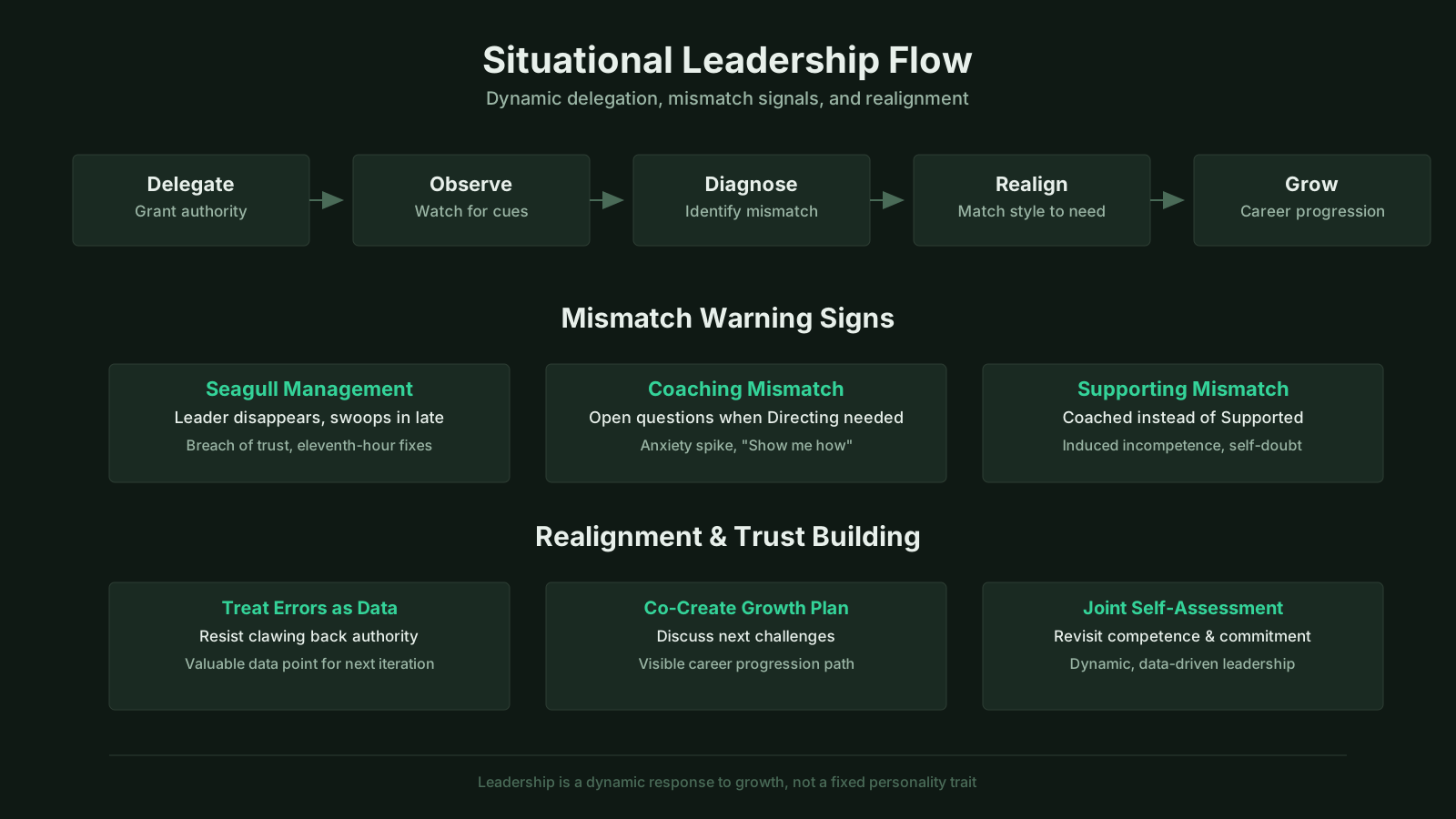
Employee development is rarely a smooth linear climb from D1 to D4; it is often characterized by plateaus, regressions, and sudden leaps triggered by new challenges or changes in context. An employee who operates at D4 on a core job function can plummet to D2 when confronted with a novel technology stack or a high-stakes cross-functional negotiation, requiring the leader to pivot back to a coaching or even directing stance temporarily. The regression is not a failure of character but a normal human response to skill disruption, and the leader’s response should be framed as a supportive recalibration rather than a punitive demotion. Leaders who resist revisiting earlier styles because they feel it signals mistrust or inefficiency end up creating an environment where employees hide their struggles until performance has already deteriorated, a pattern that undermines both individual and team resilience.
Masterful situational leaders use the rhythm of weekly one-on-ones and project retrospectives to explicitly evaluate development level shifts, asking questions such as, “On a scale from needing full instruction to full autonomy, where would you place yourself for this upcoming sprint?” or “What part of this project feels most confidence-shaky right now?” These conversations normalize the idea that leadership style should ebb and flow, transforming the model from a theoretical construct into a living management practice. The leader must also manage their own internal triggers, such as the anxiety that arises when a previously autonomous team member needs more oversight, by reframing the temporary intensification of direction as a strategic investment in re-establishing a solid performance trajectory. Ultimately, the goal is not to push everyone to D4 and keep them there indefinitely but to develop a team where members move fluidly across levels based on task demands, trusting that their leader will meet them precisely where they are.
Core Insights on Matching Leadership Styles
- Task-Specific Diagnosis Is Essential
- Effective leadership requires evaluating each employee’s development level per task, as an individual may be self-reliant on familiar assignments yet require close supervision when tackling unfamiliar ones; this dynamic demands the flexible application of different styles simultaneously.
- Accurate Assessment of Competence and Commitment
- Assessing competence demands observing concrete behaviors and outcomes rather than relying solely on self-assessments, while uncovering true commitment levels requires empathetic inquiry into underlying factors such as personal challenges, shifting priorities, or broken trust.
- Navigating Non-Linear Development Transitions
- Development is rarely linear; employees often plateau or temporarily regress when faced with new demands, requiring leaders to step back into more directive or supportive modes as circumstances dictate. Regular, explicit check-ins help detect these shifts early and realign the leadership style accordingly.
Applying Situational Leadership in Modern Management Contexts
The versatility of situational leadership becomes evident when it is mapped onto the demands of contemporary management domains, from agile project management and product development to human resources and remote team leadership. Each of these contexts amplifies certain challenges and opportunities related to the model, and a nuanced application requires integrating situational leadership with the rhythmic ceremonies, role clarity, and feedback loops native to those environments. The traditional critique that situational leadership is too simplistic for complex organizational settings often stem from attempts to apply it as a standalone framework without weaving it into the fabric of existing management practices. When deliberately overlaid onto agile backlogs, product lifecycle stages, or employee development plans, situational leadership provides a behavioral compass that guides daily interactions toward the most productive blend of direction and support.
Integrating Situational Leadership with Agile and Lean Project Management
Agile methodologies such as Scrum and Kanban already emphasize servant leadership, iterative development, and self-organizing teams, but these aspirations can falter when the team’s actual development levels are ignored in favor of a one-size-fits-all facilitation style. A Scrum Master or product owner who practices situational leadership will modulate their approach during sprint planning, daily scrums, and retrospectives based on the team’s collective and individual maturity on the specific domains of story writing, estimation, and cross-functional collaboration. For a newly formed agile team unfamiliar with test-driven development, the Scrum Master might adopt a directing style during the first few sprints, walking through the red-green-refactor cycle step-by-step and providing templates, then gradually shift to coaching as the team internalizes the discipline but still struggles with consistency, and finally move to supporting and delegating once the practice becomes ingrained. This calibrated involvement prevents the anti-pattern of “agile in name only,” where teams flounder because they receive insufficient structure under the guise of empowerment.
Lean management’s emphasis on continuous improvement and respect for people also aligns well with situational leadership because it encourages leaders to go to the gemba, observe the work, and provide just-in-time guidance that corresponds to the worker’s immediate learning needs. A value stream manager deploying situational leadership will not treat a new hire on the production line the same way as a veteran process engineer, even though lean principles advocate cross-training and standard work. The new hire will receive much more detailed standard operating procedures and closer monitoring (directing), while the engineer might be engaged in kaizen events where the leader plays a supporting role, asking catalytic questions rather than dictating solutions. This pragmatic adaptation helps organizations reap the benefits of lean systems without dehumanizing the workforce or ignoring individual skill differentials, thus strengthening the socio-technical fabric of the organization.
Adapting Your Style for Remote and Hybrid Team Dynamics
Remote and hybrid work arrangements strip away the serendipitous hallway conversations and visual cues that once allowed managers to intuitively sense when an employee was struggling or disengaging. In these distributed settings, mastering situational leadership demands the intentional design of communication channels and check-in cadences that surface development level signals before they manifest as missed deadlines or communication breakdowns. A leader supporting a remote team must develop the discipline of virtual observation, analyzing not just the completion of tasks but also the tone and content of Slack messages, the frequency of help-seeking requests, and the initiative demonstrated during video calls to gauge whether someone needs more direction or more space to thrive. When a newly onboarded remote employee hesitates in team meetings, fails to clarify ambiguous requirements, or submits work that barely meets the baseline, a swift pivot to a directing style with structured daily video huddles, shared task boards, and explicit performance rubrics can avert a downward spiral.
Conversely, a high-performing remote contributor who has demonstrated months of reliable output and proactive communication may be signaling for more delegation, but the leader must resist the anxiety-driven urge to request excessive status updates that disrupt deep work flow. The distance inherent in remote work can provoke unfounded micromanagement from leaders who equate visibility with productivity, and situational leadership serves as a counterweight by forcing a fact-based assessment of development level rather than a reaction to physical absence. Structuring one-on-ones with a brief, shared note on which leadership style both parties feel is currently optimal creates transparency and encourages the employee to co-own their development journey. When hybridity introduces an equity challenge where in-office employees receive more ad-hoc coaching, the manager must consciously calibrate their availability and style distribution across the entire team, using data and intent to close the proximity bias gap.
Situational Leadership in Product Management and HR Functions
Product management is an intrinsically cross-functional discipline where product managers must lead without formal authority, influencing engineering, design, and business stakeholders who occupy varying development levels on any given initiative. A veteran engineering lead may require a delegating style for technical feasibility discussions but suddenly need a coaching style when asked to co-present in a customer-facing roadmap session for the first time, necessitating that the product manager adapts moment by moment. The rhythm of the product lifecycle itself creates natural inflection points for style shifts, early-stage discovery work often benefits from a directing style on customer interview techniques for junior researchers, while mature scaling decisions might demand full delegation to an experienced engineering manager with deep system knowledge. Product leaders who internalize situational leadership can build stronger alignment by treating each interaction as an opportunity to calibrate their influence style, rather than relying on the blunt instruments of escalation or persuasion.
Human resources professionals likewise encounter the model in both talent development programming and in their advisory capacity to line managers. When designing leadership development curricula, HR business partners can anchor training modules on the core diagnostic skill of assessing development level and the behavioral flexibility to switch styles, rather than chasing the latest competency model trends. In coaching senior leaders, HR can use the language of situational leadership to depersonalize feedback, helping a VP understand that the team’s missed targets stem not from a “failure to manage” but from a mismatch between the prevailing leadership style and the team’s actual development needs on the new strategic initiative. This is particularly powerful during organizational restructuring or digital transformation, when the instability can regress even seasoned teams to a D2 state, requiring a temporary return to coaching and directing behaviors that might initially feel uncomfortable but are precisely what stability demands.
Overcoming Implementation Barriers and Leader Blind Spots
Translating the situational leadership model from training room enthusiasm into embedded managerial practice is fraught with obstacles that stem from organizational culture, individual psychological patterns, and the sheer cognitive load of managing complex teams. Many leaders who intellectually grasp the model still default to their dominant style under stress, reverting to the comfort of directing if they are naturally task-oriented or over-supporting if they derive their identity from being liked. Additionally, organizations sometimes punish the very flexibility the model demands by rewarding consistency over adaptability, creating a perceived risk for leaders who visibly change their style across different reports. Overcoming these barriers requires not only personal behavior change but also systemic reinforcement through performance management systems, peer accountability structures, and a leadership vernacular that normalizes style adaptation as a hallmark of managerial competence rather than inconsistency.
Addressing Concerns About Consistency and Equity
One of the most persistent objections to situational leadership is that treating team members differently creates perceptions of favoritism or inequity, potentially triggering resentment and eroding the sense of procedural justice. This concern is valid but stems from a misunderstanding of what consistency means in a leadership context: consistency should relate to the fairness of the diagnostic process and the transparency of the developmental rationale, not to mechanically identical behavior. Leaders can mitigate this risk by openly discussing the model with their teams, explaining that everyone will receive the leadership style that matches their current mastery of specific tasks, and that the goal is to help each person progress toward greater autonomy. When a high performer receives delegation while a newer colleague receives more direction, framing both situations as tailored support rather than a reward for some and punishment for others diffuses the emotional charge. Moreover, periodically inviting team members to share their own perceptions of their development level and what support they need cultivates a culture of mutual accountability and reduces the likelihood that employees will misinterpret differentiated treatment as bias.
Another dimension of this challenge emerges when leaders must adopt a directing style with an employee who previously enjoyed more autonomy, perhaps because of a role change, a shift in business strategy, or a performance regression. In such cases, the leader should have a direct, private conversation that describes the observed development gap, frames the increased oversight as a temporary scaffold to rebuild competence, and sets clear criteria for returning to a less directive style. Avoiding this conversation out of fear of discomfort only undermines the employee’s opportunity to improve and damages the relational trust that situational leadership aims to preserve. Ultimately, equity is achieved not by uniformity of leadership behavior but by the uniform application of a rigorous, empathetic development-oriented process that gives every individual the input they need to succeed.
Developing Personal Flexibility Across the Four Leadership Styles
Personal mastery of situational leadership requires a level of emotional regulation that can be cultivated through deliberate practice, self-reflection, and feedback solicitation. The first step is an honest inventory of one’s natural style proclivities, often uncovered through 360-degree assessments, leadership profiling tools, and the candid observations of trusted peers. A leader who gravitates powerfully toward supporting and delegating may find the directive behaviors required for D1 employees uncomfortable, interpreting clear instruction as abruptness, while someone anchored in directing may struggle to relinquish control and build the deep listening capacity required for effective coaching. Closing these gaps involves behavioral rehearsal, such as scripting and practicing directive feedback sessions with a coach or peer before live deployment, and setting micro-commitments in team meetings to experiment with a different style on a low-risk topic.
Beyond individual skill building, leaders need to design their own operating rhythm to facilitate style shifting. This can include brief pre-meeting reflection on the intended style for each agenda item or interaction, a quick post-interaction audit to assess whether the style matched the employee’s development level, and a weekly review of notes to spot patterns of mismatch. Technology can aid this process, with some managers maintaining a simple private log in their productivity tool that maps team members to tasks and their current development level, serving as a visual reminder to adjust their approach before a one-on-one or project review. The cumulative effect of these small habits, sustained over months, is a neurological rewiring where situational diagnosis becomes an automatic precursor to leadership behavior rather than an intellectual exercise left in the classroom. Leaders who commit to this journey often report not only better team outcomes but a profound reduction in their own leadership stress, because they stop trying to force a single style onto every situation and instead flow with the developmental currents present in their team.
Core Insights on Overcoming Leadership Barriers
- Managing perceptions of inequity
- Leaders can defuse suspicions of favoritism by clearly communicating that differences in guidance are rooted in each team member’s specific developmental stage on a given task, rather than personal bias.
- Building personal style flexibility
- Expanding behavioral range through honest self-reflection, structured peer feedback, and targeted practice enables leaders to fluidly shift among all four leadership styles as circumstances demand.
- Systemic reinforcement for adaptation
- Organizations that embed adaptive leadership into performance metrics and peer accountability systems create sustained incentives, counteracting the instinctive drift toward a single default style under stress.
The Evidence Base and Real-World Limitations of Situational Leadership
While situational leadership has enjoyed widespread popularity in corporate training programs and management education, the academic literature presents a nuanced picture regarding its empirical validation and practical limitations. Early research by Hersey and Blanchard provided conceptual appeal but faced criticism for methodological weaknesses and the difficulty of measuring development level reliably across diverse settings. More recent meta-analyses suggest that the model’s core insight, that leadership effectiveness depends on the interaction between style and follower readiness, does find support in broader contingency leadership research, even if the specific four-quadrant formulation has not been conclusively validated in every context. The wise manager approaches situational leadership as a robust heuristic rather than a scientifically inviolable law, leveraging its diagnostic power while remaining alert to contextual factors that may call for a more nuanced or hybrid approach.
What Research Tells Us About Situational Leadership Effectiveness
Studies in organizational psychology have consistently demonstrated that leaders who adapt their behavior to follower needs achieve higher levels of employee satisfaction, engagement, and performance than those who exhibit style rigidity. The mechanism is believed to be related to cognitive resource theory and self-determination theory: when leaders provide the right amount of structure and support, they optimize the employee’s cognitive load, reduce role ambiguity, and satisfy the basic psychological needs for competence and autonomy. However, the operationalization of development level often remains a sticking point, because competence and commitment are not static constructs but dynamic states influenced by factors outside the leader’s immediate view, such as workload, team conflict, and personal life events. Research also cautions that a leader’s accurate perception of an employee’s development level is easily distorted by similarity biases, halo effects from past performance, and the employee’s own self-presentation strategies, meaning that diagnosis is an inherently imperfect exercise that requires continuous recalibration.
Another important finding is that the ultility of situational leadership is significantly enhanced when the broader organizational culture supports learning, feedback, and psychological safety. In cultures that punish failure or stigmatize skill gaps, employees have strong incentives to mask their true development level, making it nearly impossible for leaders to apply the correct style. The most successful implementations of situational leadership are therefore coupled with culture change initiatives that reframe development dialogues as moments of support rather than evaluation, and that train employees as well as managers in the model’s principles so that they can self-advocate for the style they need. When both parties speak the same developmental language, the model becomes not a top-down management tool but a shared framework for accelerating growth and navigating the inherent messiness of organizational life.
Navigating the Limits of Situational Leadership Without Abandoning It
No leadership model can cover every contingency, and situational leadership has its boundaries. It does not directly address systemic issues like dysfunctional incentive structures, toxic workplace politics, or the deep-seated psychological barriers that some employees bring to the workplace, these factors can overwhelm the impact of even the most well-calibrated style matching. Furthermore, the model presupposes that the leader has the time, emotional bandwidth, and observational access to diagnose development levels across multiple task domains for each direct report, an assumption that collapses under extreme span-of-control conditions or exceptionally fast-paced environments. Leaders in start-up scaling phases or crisis management situations may find that they must rely on rule-of-thumb defaults and explicit delegation of coaching to senior team members to avoid decision paralysis. Recognizing these limitations does not invalidate situational leadership but rather defines the conditions under which it should be supplemented with systemic interventions, such as onboarding buddy programs that offload some directing responsibilities, or structured peer coaching cohorts that absorb the supportive function for D3 employees.
Critics also point out that the model’s reliance on a leader-centric perspective can inadvertently disempower followers if applied without genuine mutuality. The most evolved application of situational leadership transforms it into a shared leadership framework, where team members initiate conversations about their own development level and the style they would benefit from, turning what could be a paternalistic model into a partnership for professional growth. This evolution is particularly relevant for managing experienced professionals and cross-functional contributors who may have deep expertise that surpasses the leader’s own knowledge, requiring a fluid dance where the leader concedes the direction role on technical matters while maintaining it on process and strategy. In such collaborative ecosystems, the language of situational leadership provides a protocol for renegotiating influence rather than a rigid script, proving that the model’s enduring value lies in its capacity to adapt, much like the leaders it seeks to develop.
Ultimately, mastering situational leadership is a career-long pursuit that rewards those who approach it with curiosity, humility, and a genuine commitment to the growth of others. The practices of diagnosing development level, switching seamlessly between directing, coaching, supporting, and delegating, and reflecting honestly on the outcomes build a leadership muscle memory that transcends any single framework. In an age where the half-life of technical skills continues to shrink and the human elements of motivation, trust, and judgment become ever more critical, the leader who can meet each person where they are, while holding a clear vision of where they can go, will generate not just results but lasting organizational capability. The invitation is not to achieve perfection in style matching but to embark on a disciplined, reflective practice of seeing your team members clearly and adjusting your approach to serve their highest potential, one interaction at a time.
Misdiagnosis Is the Quiet Killer of Situational Leadership
Most managers accept the idea that different people need different leadership, but they still misread the person in front of them. Tenure gets confused with competence, and quiet compliance gets mistaken for commitment. A developer who has been on the team for eight years may have deep expertise in legacy systems but be completely lost in a new cloud migration. If you delegate based on seniority alone, that person might flounder for weeks without telling you. The model only works if you assess development level for the specific task or challenge, not for the employee as a whole. I have watched otherwise thoughtful leaders assign broad labels like "high performer" or "needs support" and then apply a single style across every project. That habit creates exactly the friction situational leadership is supposed to remove.
The interesting part is that commitment and competence do not always move together. A junior analyst might have enormous motivation but almost no skill, which calls for directing rather than delegating even if the person is eager and bright. A senior specialist might have plenty of competence but low commitment after years of repetitive work, and that combination often needs coaching or support rather than a simple assignment and a deadline. If you treat low commitment as low competence, you will over-supervise someone who does not need instructions and probably deepen their disengagement. I have found that pairing direct observation with a structured 360-degree feedback process surfaces patterns that a manager's one-on-one view often misses, especially around how a person actually behaves when you are not in the room.
One practical discipline is to narrate the shift when you change styles. If you started a project with close direction and then move toward delegation, say why. A short sentence like "you have handled the last three sprints without corrective input, so I am stepping back and letting you run the next one" protects trust. Without that explanation, your team may read the change as inconsistency or indifference. Another common trap is overusing the coaching style because it feels collaborative. For someone with low competence and high commitment, coaching can create too much back-and-forth ambiguity. That person usually needs clearer boundaries and fewer choices until the skill base catches up with the motivation.
Advance Your Career with Professional Certification
Earning a professional project management certification validates your ability to deliver results and opens doors to higher-level roles. Organizations often rely on a certified project manager to navigate complex initiatives with proven methodologies, which directly reduces risk and boosts team efficiency. This credential signals a commitment to continuous improvement, giving you a competitive edge and aligning your career with industry standards that drive long-term organizational success.
Professional product management certification signals a deep, practical understanding of market-driven decision-making and strategic lifecycle management, setting you apart in a competitive job market and unlocking senior-level opportunities. A credential such as a product owner certification refines your ability to prioritize customer value and align cross-functional teams, directly boosting delivery speed and product quality. For organizations, certified professionals reduce failed initiatives by institutionalizing consistent frameworks, which turns strategy into measurable revenue growth and strengthens sustained competitive advantage.
Earning a professional HR management certification validates your expertise in modern people strategies and signals to employers that you can navigate complex workplace dynamics with confidence and ethical rigor. For HR professionals aspiring to leadership roles, a recognized human resources certification often becomes a decisive factor in hiring and promotion decisions, setting you apart in a competitive field. Beyond personal advancement, certified HR practitioners bring structured, evidence-based approaches to talent development, conflict resolution, and compliance, which directly strengthens organizational culture and reduces risk. Ultimately, this credential deepens your ability to adapt management styles—whether directing, coaching, or delegating—to drive employee performance and long-term business success.