Defining the Modern CIO’s Mandate for AI Governance
The rapid infusion of artificial intelligence into every layer of enterprise operations has rewritten the chief information officer’s job description. Where once the CIO focused primarily on infrastructure reliability, application delivery, and cost optimization, today the role demands fluency in algorithmic accountability, data ethics, and the strategic orchestration of intelligent systems . The CIO AI Governance and Enterprise Technology Strategy Certification has emerged as a targeted credential for leaders who need to prove they can bridge the gap between technical feasibility and responsible value creation. It signals that a senior technology executive understands not only how to deploy machine learning models at scale but also how to construct the scaffolding of policies, controls, and cultural norms that keep those models aligned with corporate strategy, regulatory requirements, and societal expectations.
The certification addresses a critical gap in executive education . Traditional CIO development paths emphasized IT service management , project portfolio governance , and vendor management. Those disciplines remain essential, yet they do not fully prepare a leader to oversee an algorithm that determines creditworthiness, to validate a generative AI system producing customer-facing content, or to design a federated data architecture that respects privacy across jurisdictions. The credential therefore serves as a structured curriculum that marries established IT governance principles with the specific demands of AI risk , explainability, and lifecycle oversight. As boardrooms increasingly demand evidence of AI readiness, a certification of this nature becomes both a personal career differentiator and a governance instrument for the organization itself.
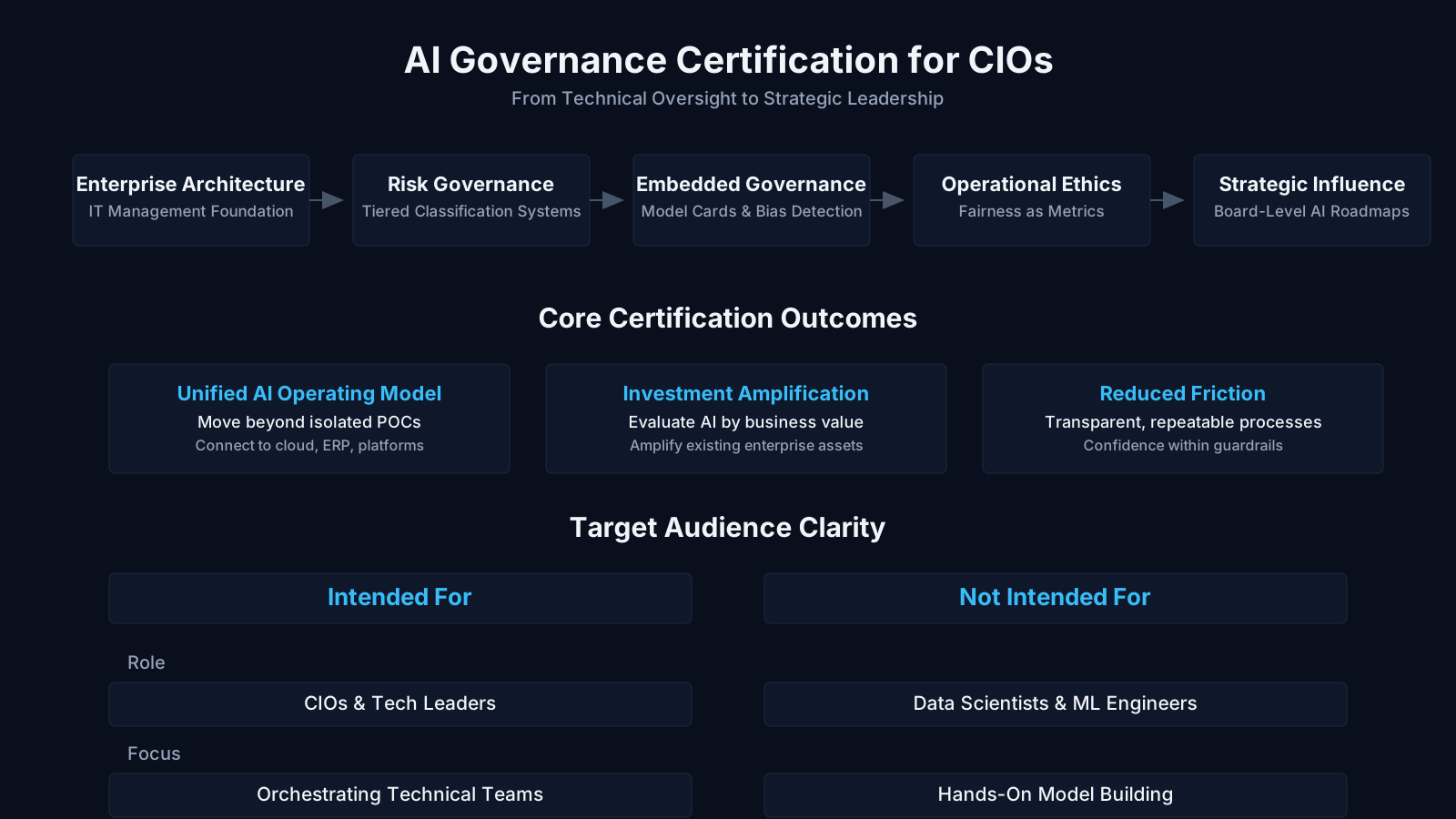
Key Topics: AI Governance and Enterprise Technology Strategy
| Key Concept | Summary |
|---|---|
| CIO Mandate | The modern CIO mandate has evolved from ensuring infrastructure reliability and cost optimization to prioritizing algorithmic accountability, data ethics, and the strategic orchestration of enterprise AI systems. |
| Certification Purpose | The certification bridges the divide between technical capability and responsible value realization by integrating established IT governance frameworks with AI-specific risk management and full lifecycle oversight. |
| Strategic Context | Accelerated AI deployment without structured governance has accumulated significant technical debt from undocumented models and biased training data, making this credential a critical response to mounting regulatory and market demands for traceability. |
| Regulatory Compliance | Evolving global regulations such as the EU AI Act compel CIOs to align governance controls with varied jurisdictional regimes, maintain comprehensive audit trails, and ensure automated decisions remain contestable and correctable. |
| Board Engagement | This certification empowers CIOs to articulate AI-related risks and strategic alignment to boards in the language of risk appetite and materiality, elevating their role from operational executors to strategic business partners. |
| Market Signal | A recognized AI governance credential sends a clear signal to investors and stakeholders that the enterprise possesses the leadership competencies to responsibly steward complex algorithmic ecosystems. |
| Risk Management | Core competencies encompass AI risk management aligned with frameworks such as NIST AI RMF, emphasizing data integrity, model drift, adversarial robustness, and the design of human-in-the-loop validation architectures. |
| Regulatory Literacy | The certification ensures CIOs can interpret AI-specific regulations and data protection laws, translating legal mandates into implementable technical controls through close collaboration with legal and compliance teams. |
| Enterprise Architecture | Advanced topics address the design of AI platforms that enable full reproducibility and lineage tracking, incorporating feature stores, model registries, and MLOps pipelines to enforce governance policies at scale. |
| Cultural Governance | Sustainable AI governance demands cultivating a risk-aware culture supported by algorithmic review boards and continuous automated monitoring, moving beyond static compliance checklists to embed governance as an organizational capability. |
The Strategic Context Driving AI Governance Certification
The pressure to adopt AI has not been matched historically by an equal pressure to govern it with rigour. Many enterprises accelerated their AI investments during the last five years under banners of digital transformation and competitive urgency, often bypassing traditional IT governance structures because data science teams operated outside the conventional software development lifecycle. As a result, organizations accumulated technical debt in the form of undocumented models, biased datasets, and opaque decision logic. The CIO AI Governance and Enterprise Technology Strategy Certification is a response to the inevitable correction: regulators, auditors, and customers are now demanding traceability and accountability for algorithmic systems, and the CIO is the executive most likely to be held responsible for systemic failures.
Regulatory momentum around the world has turned AI governance from a theoretical discipline into a compliance necessity. Frameworks such as the European Union’s AI Act classify applications by risk tier and impose obligations for transparency, human oversight, and accuracy. Similar initiatives in North America, Asia, and other regions focus on algorithmic discrimination, impact assessments, and mandatory reporting. For a multinational enterprise, the patchwork of obligations creates a compliance landscape that cannot be managed through ad hoc measures. The CIO must understand how to map governance controls to different regulatory regimes, how to maintain audit trails for model training data, and how to demonstrate that automated decisions can be challenged and corrected. Certification programs that focus on AI governance and enterprise technology strategy embed these regulatory trends into their body of knowledge, ensuring that credential holders can lead compliance efforts proactively rather than reactively.
The Board-Level Imperative for the CIO AI Governance and Enterprise Technology Strategy Certification
Board directors, historically uncomfortable with deep technology topics, are now compelled to engage with AI risk due to fiduciary duties around oversight. The CIO who can speak to the board in the language of risk appetite, materiality, and strategic alignment is far more effective than one who presents technical metric dashboards. The certification equips a CIO with frameworks to articulate how AI models are inventoried, what residual risks exist, and how the technology strategy supports revenue growth while safeguarding reputation. This capability transforms the CIO from an operational executor into a strategic partner at the highest level. It also helps the board fulfill its governance responsibilities under codes such as the UK Corporate Governance Code or the principles outlined by the National Association of Corporate Directors, which increasingly emphasize technology and cyber risk oversight.
Beyond formal board duties, institutional investors and proxy advisors are scrutinizing AI governance as a component of environmental, social, and governance criteria. A CIO who holds a recognized certification in AI governance provides a tangible signal to the market that the enterprise has invested in the leadership competencies required to manage complex algorithmic ecosystems. This can influence investor confidence, access to capital, and the organization’s reputation as a responsible innovator. The credential, therefore, is not merely a personal achievement but a corporate asset that can be referenced in sustainability reports, annual filings, and stakeholder communications.
Why AI Governance Certification Matters Now
- Regulatory compliance necessity
- Global frameworks such as the EU AI Act, along with emerging rules in North America and Asia, create a complex regulatory patchwork that demands consistent, structured governance rather than reactive, fragmented responses.
- Board-level strategic partnership
- Certification equips CIOs to articulate AI risks in terms of risk appetite and strategic alignment, elevating their role from technology overseers to trusted strategic advisors at the board table.
- Investor and market signal
- A recognized AI governance credential sends a clear signal to institutional investors and proxy advisors that the enterprise possesses the leadership capabilities to responsibly manage its algorithmic portfolios and associated risks.
- Corporate asset for reporting
- The certification acts as a tangible asset for sustainability reports, annual filings, and stakeholder communications, demonstrating mature AI oversight and reinforcing investor confidence and corporate reputation.
Core Competencies Embedded in the Certification
A comprehensive CIO AI Governance and Enterprise Technology Strategy Certification typically structures its curriculum around several interdependent competency domains. These domains reflect the reality that AI governance cannot be isolated from data governance, cybersecurity, enterprise architecture, and strategic planning. One foundational domain is AI risk management, which draws heavily on emerging standards like the NIST AI Risk Management Framework and ISO/IEC 23894. Candidates learn to identify and categorize risks associated with data quality, model drift, adversarial attacks, and unintended bias. They also study risk mitigation techniques such as human-in-the-loop architectures, continuous monitoring, and the establishment of algorithmic review boards. The emphasis is on building a risk-aware culture rather than merely constructing compliance checklists.
A second domain is regulatory and legal literacy for intelligent systems. The certification does not aim to turn CIOs into lawyers, but it ensures they can interpret the obligations imposed by major AI regulations, data protection laws, and sector-specific rules. This includes understanding the concepts of lawful basis for processing personal data in AI training, conducting data protection impact assessments that specifically address automated decision-making, and managing cross-border data flows that underpin global AI operations. The credential holder is expected to collaborate effectively with legal and compliance teams, translating regulatory requirements into technical controls and process changes.
Enterprise Architecture and the CIO AI Governance and Enterprise Technology Strategy Certification
Enterprise architecture provides the structural basis for embedding governance into the technology landscape. The certification curriculum therefore includes advanced topics on designing AI platforms that support reproducibility, lineage tracking, and policy enforcement. Concepts such as feature stores, model registries, and MLOps pipelines are examined not just as engineering artifacts but as governance enablers. The CIO learns to ensure that the architecture naturally captures metadata needed for audits, that access controls align with data sensitivity classifications, and that the technology stack supports the regional localization of data and models. This competency bridges the often damaging gap between data engineers who build models and compliance officers who demand evidence of control.
Interoperability with legacy systems and cloud environments adds another layer of complexity. Many enterprises run hybrid architectures where some AI workloads operate on-premises and others in public cloud platforms, each with its own set of governance tools. The certification addresses the design of a unified governance fabric that spans these environments, typically through the application of policy-as-code, federated data catalogs, and standardized APIs for model serving. A CIO with this knowledge can avoid the trap of fragmented, inconsistent governance that results when different business units adopt cloud-native AI services without central coordination.
Ethical AI and Organizational Culture
No governance framework succeeds without cultural embedding. The certification therefore dedicates significant attention to the organizational and ethical dimensions of AI leadership. This includes defining and operationalizing ethical principles such as fairness, transparency, and accountability in ways that are measurable and auditable. Candidates explore how to establish multidisciplinary AI ethics committees, how to design training programs that raise literacy across the executive team, and how to create incentive structures that reward responsible innovation rather than speed to deployment alone. The material acknowledges that ethical dilemmas in AI rarely have binary answers; the CIO’s role is to foster a process where trade-offs are surfaced, debated, and documented with integrity.
Cultural transformation also involves addressing workforce anxieties. When AI automates tasks previously performed by knowledge workers, the CIO must lead the social and organizational change, not merely the technology rollout. Certification programs grounded in enterprise technology strategy therefore include change management frameworks adapted from models like Prosci’s ADKAR or Kotter’s eight-step process, tailored to the specific dynamics of AI adoption. This ensures that governance extends to the human impact of algorithms, including retraining programs, job redesign, and transparent communication about the boundaries of automated decision-making.
Building an AI Governance Operating Model
An effective AI governance operating model defines the structures, roles, decision rights, and processes that guide AI activities from ideation to decommissioning. The CIO AI Governance and Enterprise Technology Strategy Certification teaches candidates how to design such a model to fit their organization’s size, industry, and risk profile. A common pattern is the three-lines-of-defense model adapted for AI, where data science and product teams constitute the first line responsible for building and operating models according to policy; a dedicated AI risk and compliance function forms the second line, providing oversight, challenge, and monitoring; and internal audit serves as the third line, offering independent assurance. The certification explores variations of this model, including hub-and-spoke structures where a central AI governance office sets standards while business unit teams execute within guardrails.
Within the operating model, the role of the AI governance council or steering committee is critical. The certification prepares the CIO to chair or influence such a body, ensuring it has the right cross-functional representation from legal, compliance, privacy, business, and technology domains. It covers best practices for meeting cadence, escalation thresholds, and the criteria for reviewing high-risk AI use cases. The CIO learns to balance the need for thorough review with the business imperative for speed, avoiding the governance bottleneck that drives teams to rogue, unmanaged deployments.
Structuring AI Governance for Action
- Three lines of defense model
- This model distributes AI risk management across three distinct tiers: development teams embed controls at the source, a specialized oversight function provides independent challenge, and internal audit delivers objective assurance over the entire framework.
- Hub-and-spoke governance structure
- A central AI governance office defines enterprise-wide policies and standards, while business units operationalize AI initiatives within those boundaries, enabling both consistent risk management and adaptive local execution.
- Critical AI governance council role
- To deliver balanced oversight, the council must integrate cross-functional perspectives from legal, compliance, privacy, business, and technology leaders, ensuring decisions reflect regulatory obligations and strategic goals alike.
- Balancing review with business speed
- Agile governance avoids bottlenecks by setting clear escalation thresholds and predictable meeting cadences, preventing unmanaged AI deployments without eroding the operational momentum that drives innovation.
- High-risk use case review criteria
- The council applies structured, risk-based criteria when evaluating high-risk AI use cases, ensuring rigorous scrutiny while preserving the speed essential for responsible competitive advantage.
Enterprise Technology Strategy as the Guiding North Star
AI governance does not exist in a vacuum; it must align with the broader enterprise technology strategy. The certification emphasizes the CIO’s role as the architect of a technology roadmap where AI initiatives are prioritized based on business value, feasibility, and risk appetite. This involves mastering strategic planning tools such as capability models, value stream mapping, and portfolio management techniques adapted for AI. The CIO learns to categorize AI investments along dimensions like differentiation versus utility, and to allocate resources accordingly. A generative AI chatbot that provides internal IT support may carry lower strategic risk and investment than a predictive model that determines supply chain logistics in real time, and the governance intensity should correspond to that classification.
The certified CIO also becomes adept at communicating the technology strategy to diverse stakeholders. This includes translating complex AI concepts into business narratives that highlight revenue opportunities, cost reduction, and risk mitigation. The technology strategy must be documented and socialized in a way that gains buy-in from the executive committee and the board. The certification curriculum often includes communication frameworks and scenario planning exercises that simulate boardroom conversations, equipping the CIO to field challenging questions about algorithm bias, vendor lock-in, and the environmental impact of large-scale AI compute.
Vendor Management and Ecosystem Strategy
Enterprise AI rarely exists solely within internally developed models. The landscape is populated by third-party platforms, APIs, and pre-trained models that introduce their own governance challenges. The certification addresses the due diligence required when procuring AI services, including evaluation of the vendor’s data handling practices, model documentation, testing for bias and security vulnerabilities, and contractual terms governing intellectual property and liability. The CIO must establish a supplier risk framework specifically tuned to AI, as traditional third-party risk management questionnaires may not surface model-specific risks such as indirect prompt injection or training data contamination.
Moreover, the technology strategy must consider the build-versus-buy-versus- partner calculus in the context of long-term architectural flexibility. Certifications in this field teach decision frameworks that weigh the total cost of ownership, the strategic importance of the capability, and the speed of market evolution. A CIO who rushes to standardize on a single cloud AI platform without understanding the exit implications may lock the enterprise into a trajectory that is difficult to alter. The curriculum therefore includes lessons on multi-cloud strategy, abstraction layers, and the use of open standards such as the Open Neural Network Exchange (ONNX) to maintain portability.
Data Governance as the Bedrock of AI Governance
AI models are fundamentally products of the data they consume, which makes data governance inseparable from any credible AI governance program. The CIO AI Governance and Enterprise Technology Strategy Certification devotes substantial attention to the data lifecycle, from acquisition and labelling to storage and deletion. Candidates explore data quality dimensions as they pertain to machine learning, such as completeness, representativeness, and timeliness, and they learn how to implement data lineage tools that provide a transparent record of data origins and transformations. This is essential for debugging model behaviour, replicating experiments, and demonstrating compliance with regulations that mandate data provenance tracking.
The certification also addresses the governance of synthetic data and data augmentation techniques, which are increasingly used to overcome privacy constraints or class imbalance. While synthetic data can reduce the risk of exposing personally identifiable information, it introduces new questions about fidelity, potential memorization pathologies, and the recreation of real-world biases. A certified CIO understands these nuances and can establish policies that permit synthetic data usage under conditions that are reviewed and monitored, rather than treating it as a blanket solution.
Data Quality Drives AI Integrity
- Data lifecycle governance
- The certification program governs data from acquisition through deletion, establishing lifecycle management as a foundational pillar of AI governance.
- Machine learning data quality
- Core dimensions like completeness, representativeness, and timeliness directly underpin model reliability and help prevent performance degradation over time.
- Data lineage for compliance
- Data lineage tools create fully traceable records of data provenance and transformation steps, streamlining root cause analysis and simplifying regulatory audits.
- Synthetic data governance
- Effective synthetic data governance demands rigorous policies to mitigate fidelity gaps, bias amplification, and unintended memorization, rather than treating it as a universal remedy.
Risk Management and Continuous Improvement
AI risk is dynamic by nature. Models degrade over time as real-world conditions shift, a phenomenon known as model drift. New types of adversarial attacks emerge. Regulatory interpretations evolve. The certification therefore instils a continuous improvement mindset rather than a one-time compliance exercise. Candidates study the implementation of real-time monitoring dashboards that track model performance metrics, data distribution statistics, and fairness indicators. They learn how to set thresholds that trigger automated alerts and, where appropriate, model rollback or human intervention. This operational discipline requires tight integration between AI operations teams and the governance function, a partnership the CIO is uniquely positioned to foster.
The governance framework must also include a robust incident response process for AI failures. Unlike traditional IT incidents, an AI failure may involve discriminatory outcomes, reputational harm, or physical safety risks that require forensic analysis of model logs, training data, and human decision flows. The certification covers the design of an AI incident response plan, including roles and responsibilities, communication protocols for regulators and affected individuals, and post-incident review cycles that feed lessons back into the governance model. This closes the loop between risk identification, mitigation, and organizational learning.
Preparing for the Certification Journey
Candidates pursuing the CIO AI Governance and Enterprise Technology Strategy Certification typically come from diverse backgrounds: some are seasoned CIOs seeking formal validation of their AI knowledge, while others are IT directors or chief data officers aspiring to the top technology leadership role. The certification bodies generally recommend a combination of experience and structured study. While specific prerequisites vary, a strong foundation in general IT governance frameworks such as COBIT 2019 or ITIL 4 is highly advantageous, as these provide the vocabulary and conceptual models that underpin many AI governance approaches. Formal training courses, either online or in-person, often span several days and conclude with an examination that tests both conceptual understanding and practical application through scenario-based questions.
Beyond the exam, the certification typically requires ongoing continuing education to maintain the credential. This is especially relevant in a field as fast-moving as AI, where new regulations, techniques, and societal expectations surface regularly. Credential holders may need to earn continuing professional education credits through conferences, publications, or additional coursework. This requirement ensures that the certified community stays current and that the credential retains its market relevance. For the individual CIO, it creates a structured incentive to remain at the frontier of AI governance practice rather than relying on knowledge that may become obsolete within a few years.
Study Domains and Assessment Methods within the CIO AI Governance and Enterprise Technology Strategy Certification
The examination blueprints for such certifications are usually divided into weighted domains. A typical distribution might allocate around twenty-five percent to AI governance principles and frameworks, another twenty percent to risk management and regulatory compliance, twenty percent to enterprise technology strategy and architecture, fifteen percent to data governance and management, and the remainder to ethics, culture, and leadership. Exam questions often present candidates with a complex scenario describing an organization at a certain level of AI maturity, with competing business pressures and limited resources, and ask them to select the most appropriate governance intervention or strategic recommendation. This format tests the ability to apply principles in realistic contexts rather than merely recalling definitions.
Preparation therefore demands more than reading whitepapers. Candidates benefit from engaging with case studies that require them to weigh trade-offs, such as balancing model accuracy against explainability, or deciding between centralized and federated governance structures. Study groups and executive workshops can be particularly effective, as they allow leaders to test their reasoning against peers from different industries and backgrounds. The certification itself thus becomes a catalyst for building a professional network of AI governance practitioners, which continues to provide value long after the examination day.
Mapping Your Certification Path
- Diverse Candidate Backgrounds
- Professionals ranging from seasoned CIOs to emerging IT directors leverage established governance frameworks like COBIT 2019 or ITIL 4, which provide a shared vocabulary and systematic approach that accelerates their mastery of AI certification content.
- Ongoing Professional Development
- Earning this credential demands continuous learning through active participation in industry conferences and advanced coursework, ensuring holders remain at the forefront of accelerating AI regulatory and technical shifts.
- Scenario-Based Assessment Focus
- The assessments immerse candidates in intricate, real-world governance dilemmas that demand nuanced trade-offs, such as balancing algorithmic accuracy against the imperative of explainability in sensitive deployments.
The Impact on Career Trajectory and Organizational Influence
A CIO who holds a recognized AI governance and enterprise technology strategy certification positions themselves for expanded influence beyond the traditional IT domain. This credential can be a decisive factor in board succession planning, where non-executive director roles increasingly seek technology governance expertise. It also strengthens the CIO’s hand in executive committee debates about digital strategy, as it provides an authoritative foundation for advocating governance investments that may otherwise be dismissed as overhead. In recruitment contexts, the certification serves as a signal to search firms and hiring committees that the candidate brings a rigorous, structured approach to the most pressing technology leadership challenge of the decade.
The career benefits extend to compensation and role security. As enterprises face mounting pressure to demonstrate responsible AI practices, the pool of leaders who can credibly design and communicate a governance program is relatively small. Certified individuals can command a premium in the executive labour market. More importantly, they reduce their professional risk; a CIO without a demonstrated understanding of AI governance may be held accountable for failures that could have been prevented with better oversight frameworks. The certification therefore functions both as a career accelerator and as a professional safeguard.
Common Misconceptions and Pitfalls to Avoid
There is a temptation to treat AI governance as a purely technical discipline, solvable with software tools that scan models for bias or generate compliance reports. The certification curriculum actively counters this misconception, emphasizing that tools are enablers, not substitutes, for human judgment and organizational process. Another frequent error is to delegate AI governance entirely to a newly appointed head of AI ethics while the CIO remains focused on traditional infrastructure. That approach creates a fragmentation where the ethics officer lacks the authority to enforce architectural standards, and the CIO disclaims responsibility for algorithmic outcomes. The certification teaches that ultimate accountability for AI risk rests with senior leadership, and that the CIO’s role is to integrate governance into the technology fabric, not to offload it.
Some leaders mistakenly assume that documenting an AI policy is sufficient. A policy document without accompanying operating procedures, training, monitoring, and enforcement mechanisms is a paper tiger. The certification spends considerable time on implementation science, demonstrating how to embed governance controls into CI/CD pipelines, procurement processes, and performance scorecards. It also warns against the utopian pursuit of perfect fairness or zero bias, as real-world AI systems operate in contexts where trade-offs are inevitable. The goal is to manage bias within acceptable boundaries and with transparent documentation, not to eliminate it entirely, which is often mathematically or practically impossible.
Avoiding Common Governance Mistakes
- Tools are not a substitute
- Even the most advanced monitoring software cannot replicate the contextual judgment and layered accountability that human oversight and mature organizational processes deliver.
- Leadership owns the risk
- Confining AI ethics to a single role without embedding it in the executive risk appetite fragments responsibility and treats governance as a side function rather than a core operational discipline.
- Policy alone is insufficient
- A policy statement becomes hollow unless it is activated by repeatable procedures, role-specific training, continuous monitoring, and enforcement mechanisms that translate intent into daily practice.
- Perfect fairness is impossible
- Governance aims not at the mathematically unreachable endpoint of zero bias but at transparently bounding and documenting bias within defined tolerances while steadily improving equity over time.
The Future of the CIO AI Governance and Enterprise Technology Strategy Certification
As AI evolves toward more autonomous and agentic systems, the governance demands will intensify. Agent-based AI that can take actions on behalf of the enterprise, such as negotiating contracts or executing trades, introduces entirely new categories of risk that current frameworks barely address. The certification bodies are responding by updating their curricula to include concepts like operational design domains for AI agents, bounded autonomy, and human-on-the-loop oversight protocols. The CIO of the near future will need to govern systems whose behaviour is emergent and not fully predictable, requiring a shift from deterministic control to probabilistic governance. The certification will continue to evolve to equip leaders with the mental models and practical methods for this new world.
Another trend is the convergence of AI governance with environmental sustainability. The computational resources required to train and serve large-scale models are substantial, and the CIO is responsible for the technology carbon footprint. Future iterations of the certification may incorporate sustainability metrics into the governance scorecard, pushing leaders to consider the trade-off between model performance and energy consumption. This aligns with the broader enterprise technology strategy where efficiency, cost, and environmental responsibility intersect. A certified CIO will be able to frame AI investments not only in terms of risk and revenue but also in terms of planetary impact, a consideration that is rising rapidly on the stakeholder agenda.
Integrating the Certification into Organizational Governance
While the certification is held by an individual, its true value is realized when the credential holder applies its principles to strengthen the organization’s collective capability. This means the CIO should actively mentor other leaders, sponsor AI governance training across functions, and champion the establishment of permanent governance structures that outlast any single executive’s tenure. The certification’s body of knowledge becomes a shared language that accelerates decision-making and reduces the friction that arises when legal, technology, and business teams speak past each other. By institutionalizing the frameworks learned through the certification process, the CIO creates a legacy of responsible innovation that endures.
Organizations that systematically incorporate certification-based competencies into their talent development programs often see faster maturation of their AI governance postures. They can point to certified leaders when engaging with regulators, auditors, or partners, demonstrating a tangible commitment to competence. This can translate into faster regulatory approvals, smoother due diligence in mergers and acquisitions, and stronger negotiating positions with insurers who offer cyber and technology errors-and-omissions coverage. The CIO AI Governance and Enterprise Technology Strategy Certification thus becomes not just an educational milestone but a strategic enabler for the entire enterprise.
Making Certification a Strategic Asset
- Mentoring and training across functions
- The CIO can embed certification principles across the organization by directly mentoring senior leaders and championing targeted AI governance training programs.
- Creating a shared decision-making language
- The body of knowledge from certification acts as a shared operational language that streamlines decisions and dissolves silos among legal, technology, and business units.
- Building permanent governance structures
- When the CIO institutionalizes certification frameworks, they forge governance systems that survive executive transitions and establish a lasting culture of responsible innovation.
- Demonstrating competence to external stakeholders
- Certified leadership gives organizations verifiable expertise in regulatory, audit, and partner discussions, which accelerates approvals and strengthens their negotiating leverage.
Choosing the Right Certification Pathway
The market for executive AI certifications is still maturing, and not all credentials are created equal. When evaluating a CIO AI Governance and Enterprise Technology Strategy Certification, candidates should examine the accrediting body’s reputation, the rigor of the examination process, and the ongoing professional education requirements. They should also consider the curriculum’s balance between technical depth and strategic breadth. A certification that focuses excessively on algorithm auditing at the expense of boardroom communication skills may not serve the CIO’s holistic role. Conversely, a program that remains at a high level without practical governance implementation guidance will leave leaders ill-equipped to effect real change.
Prospective candidates often benefit from speaking with alumni of the program, reviewing sample exam questions, and attending introductory webinars or information sessions. The investment of time and money is significant, often comparable to executive education programs at top business schools, so due diligence is warranted. Many reputable certifications offer lower-level foundation credentials that can serve as stepping stones, allowing a technology leader to build credibility incrementally before pursuing the full CIO-level designation. This modular approach reduces the barrier to entry and provides immediate value at each stage of the learning journey.
Conclusion
The CIO AI Governance and Enterprise Technology Strategy Certification represents more than a line on a resume. It embodies the recognition that governing AI at the enterprise level demands a unique synthesis of risk management, regulatory knowledge, ethical reasoning, strategic planning, and technology architecture. For the individual CIO, it is a career-defining investment that sharpens leadership capabilities and opens doors to the highest levels of organizational influence. For the enterprise, the presence of a certified CIO signals a mature commitment to harnessing AI’s potential while protecting the interests of customers, shareholders, and society. As artificial intelligence continues to permeate every industry, the integration of governance into the technology strategy will become the defining characteristic of effective digital leadership, and this certification will remain a cornerstone of that professional identity.
Certification as Leadership Imperative
- Career-defining leadership investment
- Earning this credential strengthens a CIO’s ability to drive enterprise-wide strategy and gain influence at the board level.
- Enterprise maturity signal
- A certified CIO signals that the organization has embedded responsible AI practices into its operations, balancing innovation with risk mitigation and societal accountability.
- Cornerstone of digital leadership
- In an era of pervasive AI, leaders who embed governance frameworks into core technology roadmaps set the standard for sustainable and ethical digital transformation.
Advance Your Career with Professional Certification
Acquiring a formal project management credential distinguishes professionals by validating their ability to lead complex initiatives, directly advancing career trajectories into senior roles. Earning a project management certification confirms a practitioner’s command of standardized processes, risk controls, and stakeholder communication—qualities that build immediate trust with clients and executives. This credibility translates into tangible organizational performance gains, as certified managers consistently narrow schedule and budget variances while keeping deliverables aligned with strategic objectives. For enterprises pursuing technology transformations, that reliability directly protects return on investment and accelerates time-to-value.
Professional product management certification validates expertise in lifecycle management, stakeholder alignment, and value-driven delivery, providing a concrete differentiator for career advancement. The process of earning a product owner certification sharpens decision-making capabilities and embeds repeatable frameworks that reduce time-to-market while improving cross-functional collaboration. This credibility not only unlocks leadership roles but also directly strengthens organizational performance by ensuring product initiatives stay tightly coupled to strategic business goals and real user needs.
Earning a respected HR management certification validates a professional’s grasp of evolving employment law, compensation architecture, and data-driven workforce planning, directly lowering compliance exposure and enhancing leadership credibility. That verified expertise often shortens the route to senior roles, as hiring managers consistently prioritize candidates who can demonstrate rigorous, standardized knowledge over self-taught experience alone. At the organizational level, certified HR practitioners translate strategic goals into practical talent systems—such as structured onboarding and performance calibration—that lift retention and cultural cohesion measurably. The certification also signals a commitment to continuous development, which encourages trust from executive teams and boards when navigating complex restructuring or expansion decisions.
