For ambitious professionals across the capital, London PMP certification has become far more than a line on a CV; it is a strategic accelerator that transforms how you lead , communicate, and deliver value in one of the world’s most demanding commercial environments. The Project Management Professional credential, issued by the Project Management Institute, represents a global standard of competence that instantly signals to recruiters, clients, and peers that you operate at the highest level of project leadership. In a city where every sector from financial services to creative technology competes on speed and execution, securing that certification while working in London places you in a distinct category of elite practitioners. Understanding how to navigate the local training landscape, leverage the certification for maximum career momentum, and integrate its frameworks into the daily rhythms of London’s unique corporate culture is what turns a qualification into a genuine turning point.
Key Takeaways: London PMP Certification
| Key Concept | Summary |
|---|---|
| Strategic Accelerator | Obtaining the PMP in London fundamentally reshapes leadership, stakeholder communication, and value delivery within high-pressure commercial projects. |
| Global Standard | The PMP credential serves as a globally recognized benchmark, demonstrating advanced project leadership capability to London's discerning recruiters, clients, and industry peers. |
| Market Necessity | Absence of the PMP increasingly filters out otherwise qualified candidates during senior-level screenings, effectively making it a prerequisite in London's talent market. |
| Economic Resilience | It reflects a structured approach to governance, risk mitigation, and value capture, qualities that London employers prioritize amid economic uncertainty. |
| Regulatory Alignment | The PMP provides a framework for navigating complex, post-Brexit regulatory landscapes, enabling effective project delivery across fragmented jurisdictions. |
| Financial Services | Within London's financial services, PMP holders consistently secure salary premiums of 15 to 25 percent over their non-certified counterparts, reflecting the credential's tangible market value. |
| Technology Hubs | Across London's technology clusters, the PMP instills a hybrid intelligence to seamlessly integrate agile delivery with enterprise-grade governance. |
| Career Momentum | The credential unlocks opportunities in top-tier consulting, Big Four advisory practices, and strategic execution units within leading corporations. |
| Interview Advantage | PMP-certified professionals articulate PMI methodologies with confidence during behavioral and scenario-based interviews, distinguishing themselves as structured thinkers. |
| Corporate Culture | When PMP frameworks are thoughtfully adapted to London's distinctive corporate environment, the qualification becomes a catalyst for accelerated career transformation. |
Why London PMP Certification Matters in Today’s Economy
London’s economy does not stand still. It is a dense, high-pressure ecosystem where large-scale transformation programmes, regulatory upheaval, and relentless innovation cycles create an insatiable demand for disciplined project delivery. Against this backdrop, holding a London PMP certification functions as a trusted shorthand. Organisations know that a certified professional has demonstrated not only the required 36 to 60 months of project leadership experience depending on educational background, but also a deep understanding of the PMBOK Guide’s processes, tailoring considerations, and the agile, hybrid, and predictive mindsets that modern initiatives demand. This credibility travels across borders, yet it carries particular weight in the London market because so many headquarters, global banks, and consulting firms anchor their talent strategies around standardised competence models .
The value proposition intensifies when you consider the sheer density of certified peers. In London, PMP holders are not rare, which means that not having the credential can increasingly become a disadvantage when screening algorithms and hiring managers shortlist candidates for senior programme manager or portfolio director roles . Recruiters frequently describe the London PMP certification as a filtering mechanism that allows them to quickly narrow a field of hundreds of applicants to those who have proven they can speak the common language of integrated change control, earned value management, and servant leadership. Beyond recruitment, the economic volatility of recent years has taught businesses that projects cannot afford the risk of amateur execution. The certification signals a mindset that embraces governance, risk assessment , and benefits realisation, traits that are immensely attractive when margins are thin and stakeholder scrutiny is high.
Furthermore, London’s post-Brexit repositioning and its continued status as a hub for sustainable finance and green infrastructure mean that projects now routinely span multiple regulatory jurisdictions. A London PMP certification equips you with the vocabulary and frameworks to align diverse teams, manage regulatory compliance as a project constraint, and communicate effectively with sponsors who may sit in New York, Singapore, or Frankfurt. The PMI Talent Triangle, which emphasises technical project management, leadership, and strategic and business management, maps perfectly onto what London employers demand: professionals who can both build the Gantt chart and present the business case to the board.
How London PMP Certification Opens Doors in Financial Services
London’s financial services sector, from investment banking in Canary Wharf to insurance syndicates in the City, runs on complex initiatives that must meet immutable regulatory deadlines. Whether it is a LIBOR transition programme, a core banking platform replacement, or the implementation of a new anti-money laundering directive, these projects demand leaders who can navigate ambiguity without losing control of scope, schedule, and budget. A London PMP certification tells programme directors that you understand not just the mechanics of a work breakdown structure, but the strategic alignment of compliance projects with business objectives. In practice, this often means the difference between being considered for a project coordinator position and being invited to interview for a vice president-level programme management role.
Banks and asset managers in London frequently embed PMP language into their job descriptions. They ask for experience with “planning, executing, and closing projects” according to PMI standards. When you hold the certification, you can speak authentically to how you would manage a project through the five process groups, tailoring the approach to a front-office trading system rollout versus a back-office settlement system migration. Interviewers often pose scenario-based questions drawn directly from the PMP exam’s situational judgment style, and certified candidates can reference tools such as a responsibility assignment matrix or a risk probability and impact assessment with genuine fluency. This is not about reciting theory; it is about demonstrating a structured cognitive framework that reduces the anxiety of senior stakeholders who are betting their careers on the outcome.
Compensation data further illustrates the financial services advantage. While salary surveys vary, multiple industry reports indicate that London-based PMP-certified project managers in financial services command premiums of fifteen to twenty-five percent over their non-certified peers. This is particularly pronounced in contract and day-rate roles, where a PMP can unlock rates that reflect the perceived lower risk of bringing on a proven professional. The certification also opens doors to consulting arms of the Big Four, boutique change management firms, and internal strategy execution teams where the ability to client-face with rigorous project discipline is non-negotiable.
The Role of London PMP Certification in Technology and Innovation Hubs
London’s so-called Silicon Roundabout and the wider tech corridor stretching from Shoreditch to Kings Cross conjure images of hoodie-wearing developers and scrappy startups. Yet even here, the London PMP certification has found a firm footing. As tech companies mature, pursue initial public offerings, or become acquired by larger enterprises, the need for predictable delivery scales exponentially. A startup that once thrived on informal Kanban boards suddenly requires real governance when a client like a major retailer demands contractual service level agreements. A certified project manager who understands how to blend Scrum practices with the PMBOK’s process framework brings a hybrid intelligence that is desperately needed in high-growth tech environments.
Moreover, London’s technology landscape is not confined to pure software. It includes healthtech firms navigating NHS procurement, fintech companies liaising with the Financial Conduct Authority, and edtech platforms scaling across multiple languages and curricula. Each of these contexts involves rigorous project management challenges such as stakeholder mapping, procurement management, and iterative benefit delivery. The London PMP certification ensures that you approach these challenges with a comprehensive methodology that respects both the creativity of agile development and the accountability of formal closure and handover. Leaders who can speak both languages are the ones who eventually move from delivery manager to chief operating officer.
For technology consultants and agency account directors, the certification serves as a differentiator when responding to requests for proposals. Many public sector and enterprise tenders in London explicitly require that the project lead hold a PMP or equivalent. Without it, the door simply does not open. Having a London PMP certification prominently featured in a proposal signals that the delivery methodology will be rigorous, that risk will be proactively managed, and that the client’s procurement team can tick an essential box. This translates directly into win rates and account growth.
Public Sector and Infrastructure: The Impact of London PMP Certification
The London public sector landscape, including Transport for London, the Metropolitan Police, local borough councils, and NHS trusts, consistently acknowledges the PMP as a gold standard. Large-scale infrastructure projects like Crossrail and the Thames Tideway Tunnel may make headlines, but thousands of smaller yet critical initiatives within these organisations rely on systematic project management to deliver on time and within the ever-tightening constraints of public money. A London PMP certification is often a mandatory or highly desirable criterion in job descriptions for project delivery roles across the public sector, partly because it aligns with the government’s own emphasis on professional project delivery standards through the Infrastructure and Projects Authority.
Within the NHS, the complexity of clinical service reconfigurations, digital health record deployments, and public health campaigns demands project managers who can balance clinical risk with administrative precision. A PMP-certified professional brings a structured approach to stakeholder communication, ensuring that clinicians, administrators, patients, and regulators remain engaged and informed. The certification’s emphasis on quality management and continuous improvement resonates strongly in a healthcare environment where outcomes are literally matters of life and death. London’s unique health ecosystem, with its world-leading teaching hospitals and diverse population, offers a fertile ground for certified project managers to build impactful careers while enjoying strong job security.
Infrastructure and construction in London have long been domains where project management certifications carry weight, but the PMP is increasingly seen as complementary to discipline-specific credentials such as PRINCE2 or engineering charterships. The PMP’s strength lies in its broad applicability across the lifecycle, from business case development through operations handover. For a city that is perpetually rebuilding, expanding its transport network, and upgrading its utilities, having a pool of PMP-certified talent is a strategic necessity. Professionals who combine on-site experience with the strategic oversight frameworks of the PMP find themselves moving into programme and portfolio roles that shape the city’s physical future.
Core Takeaways on London PMP Value
- Trusted Credential in a Dense Market
- In London’s high-pressure business environment, where transformation programmes and regulatory shifts are relentless, the PMP certification functions as a trusted signal of rigorous project delivery capability.
- Disadvantage of Not Being Certified
- In a market saturated with certified professionals, omitting the PMP from your profile often triggers automatic screening filters, immediately reducing your chances for senior roles where recruiters face exceptionally high application volumes.
- Alignment with Post-Brexit Demands
- The PMP credential verifies your ability to coordinate projects spanning diverse regulatory frameworks, an essential competency for London’s growing leadership in sustainable finance and green infrastructure initiatives.
- Key to Financial Services Roles
- Within London’s banking and insurance sectors, a PMP certification demonstrates your mastery of time-sensitive, high-stakes projects such as regulatory compliance programmes, frequently catalysing advancement to vice president-level roles.
- Significant Salary Premium
- Professionals holding the PMP credential in London’s financial services routinely secure a 15 to 25 percent pay uplift compared to uncertified counterparts, with the premium being most pronounced in contract and day-rate engagements.
The Path to Earning Your London PMP Certification
Pursuing the certification while based in London offers distinct practical advantages, including access to a dense network of accredited training providers, active study groups, and testing centres with ample availability. The journey begins with a candid assessment of your existing project leadership experience. PMI requires that candidates with a four-year degree document at least thirty-six months of non-overlapping project management experience, while those with a secondary degree or equivalent need sixty months. This experience must span the five process groups, and you need to be prepared to describe it in PMI’s preferred language when applying. For many London professionals, gathering this evidence is a valuable reflective exercise in itself, surfacing accomplishments that might otherwise remain buried in day-to-day busyness.
Once eligibility is confirmed, the next step is the thirty-five contact hours of project management education. London is saturated with options for fulfilling this requirement. Bootcamp providers run intensive four-day or five-day sessions that immerse you in the exam content and often include a guarantee of support until you pass. These are popular among City professionals who can secure a block of study leave or use a bank of holiday days to accelerate the process. For those who prefer a slower, more contemplative pace, part-time evening and weekend courses run by universities and specialist training companies allow learning to integrate more gently alongside a demanding job. The hybrid working patterns that have become normalised in London also mean that many professionals now opt for live virtual classrooms, combining the interactivity of an instructor-led experience with the convenience of not commuting to a training centre.
London PMP Certification Training Providers: What to Look For
Selecting the right training provider in a city as rich with options as London requires more than just comparing prices. You need to scrutinise the provider’s track record of student success, the quality of their mock exams, and the depth of their post-course support. Reputable providers are often Authorised Training Partners of PMI, meaning their curriculum and instructors have been vetted through a rigorous quality assurance process. These partners are listed on the PMI website, providing a trustworthy starting point for your search. However, even among authorised providers, the teaching style can vary dramatically. Some excel at fast-paced drilling of the forty-nine processes and their inputs, tools, techniques, and outputs, while others focus on conceptual understanding and the agile practice guide, which now accounts for a significant portion of the examination content.
Many London professionals benefit from providers that incorporate local case studies into their material. A session on stakeholder engagement that references the complexities of a Crossrail-type megaproject or a digital transformation at a major retailer like John Lewis feels immediately relevant. Such contextualisation helps embed the abstract concepts of the PMBOK Guide into mental models that are easier to recall under exam pressure. It is also wise to inquire about the format of mock examinations. The best providers offer a question bank containing hundreds of practice items that mimic the difficulty, length, and scenario-based nature of the real exam. Full-length simulated exams that replicate the four-hour time constraint are invaluable for building the mental endurance required on the day.
Beyond the classroom, some London providers have built thriving alumni networks that continue to meet for professional development, mock interviews, and even job sharing. When evaluating a provider, ask whether they facilitate these connections and whether they offer ongoing access to materials until you successfully clear the exam. The investment in a London PMP certification training course is significant, often ranging from one thousand to three thousand pounds, so ensuring that the provider is genuinely committed to your long-term success rather than just the upfront fee is a crucial part of the due diligence.
Navigating the London PMP Certification Exam Application
The application process itself can feel like a project, and it benefits from being treated with the same rigour you would apply to any workstream. PMI’s online application portal requires you to detail your project management experience, mapping each entry to the process groups and including dates, deliverables, and your role. London professionals who have managed complex, long-duration projects need to learn how to extract the most relevant narratives without misrepresenting their contributions. Many find it helpful to draft the application in a separate document, have a mentor or study group peer review it for clarity and PMI terminology alignment, and then submit. PMI may randomly select applications for audit, so keeping supervisors informed and having documented evidence ready is a prudent practice. The audit process is straightforward if you have been truthful; it simply requires signatures from those who can verify your experience.
Once the application is approved and the fee paid, you can schedule your exam at a Pearson VUE testing centre. London has several centres, including locations in Holborn, Croydon, and Uxbridge, offering considerable flexibility. You can also choose to take the exam online, a format that became widely available during the pandemic and has remained a permanent option. For those who value a controlled environment free from home distractions, the in-centre experience provides a dedicated workstation, proctor oversight, and the psychological separation from daily life that can sharpen focus. Slots often fill quickly, especially around popular dates, so planning your timeline and booking early is advisable.
Mastering the Content: Study Strategies for Busy London Professionals
Preparing for the PMP exam while maintaining a London professional’s schedule requires deliberate strategy. Most successful candidates commit to a study plan lasting between eight and sixteen weeks, depending on their existing knowledge and the number of hours they can reliably dedicate each week. A common framework is to treat the preparation as a phased project: a phase of foundational reading and contact hour classes, followed by a phase of focused practice testing and weak area remediation, and finally a phase of full simulation and mental conditioning. Executives with families and travel commitments often find that early morning study sessions, before the demands of the trading floor or the client inbox begin, provide the most consistent and interruption-free windows.
The PMP exam content outline, updated periodically by PMI, should be your strategic guide. Roughly half of the examination assesses process knowledge, while the other half tests your ability to apply that knowledge in scenarios that blend predictive and agile approaches. Understanding the PMI-isms, the particular way the institute expects you to think about servant leadership, conflict resolution, and change control, is as critical as memorising formulas for earned value. Many London study groups, which convene in cafes around Liverpool Street or in the quiet corners of the British Library, spend hours debating practice questions and collectively unpicking why the PMBOK answer differs from what might happen in their specific company culture. This peer dialogue accelerates the mental shift from practitioner to PMI thinker.
Memory aids and visual frameworks help enormously. Drawing process group and knowledge area matrices from memory, creating mind maps that link risk management to stakeholder engagement, and writing out the earned value equations until they become automatic are all techniques that London candidates have used to great effect. Mobile apps that provide micro-practice sessions during tube commutes or while waiting for a meeting to start transform dead time into productive study intervals. The key is consistency and honest self-assessment. Regularly taking full-length mock exams under timed conditions and then dissecting every incorrect answer to identify patterns will do more for your readiness than any number of passive readings of the PMBOK Guide.
Unlocking Career Growth with London PMP Certification
Once the congratulations email arrives and you can add those three letters after your name, the real work of career acceleration begins. The London PMP certification is not a finishing line; it is a launchpad. The immediate impact often manifests in your current role. You start seeing meetings through a new lens, identifying stakeholders who were inadvertently missed in the communications management plan, or noticing that a risk that everyone is afraid to mention should be on the register and assigned to an owner. This increased visibility and value-add behaviour catches the attention of sponsors and senior leaders, opening conversations about expanded responsibilities, higher-profile assignments, and eventually promotions.
Externally, the certification updates your professional brand. Recruiters searching LinkedIn for project managers in London frequently filter by the PMP credential. When your profile appears in those filtered results, you are competing in a much smaller and more prestigious pool. This can lead to unsolicited approaches for roles that genuinely match your ambition, from senior project manager positions in fintech to programme director roles in the public sector. Even if you are not actively looking, understanding the market rate for certified professionals in London provides leverage during annual performance reviews and salary negotiations. The data consistently shows that the investment in certification pays for itself within the first year of increased earnings alone.
Networking opportunities amplify the career benefits. PMI’s UK Chapter, one of the largest in Europe, organises regular events across London, from evening seminars with industry leaders to informal meetups in pubs and coffee shops. These gatherings are filled with senior practitioners who are often in a position to hire or recommend talent. The shared experience of having undergone the PMP journey creates an immediate bond and a professional shorthand. Many London PMP holders have found their next role, or their next key team member, through such exchanges. The certification also makes you a credible contributor to communities of practice within your own organisation, positioning you to lead internal learning sessions and thereby expanding your influence far beyond your immediate project.
Moving From Delivery to Leadership
The PMP is fundamentally a leadership credential dressed in process clothing. The exam’s significant emphasis on the people domain, covering team development, conflict management, and emotional intelligence, reflects a reality that London organisations know well: brilliant technical plans fail when people issues are ignored. With the certification, you can more confidently step into roles that require leading without formal authority, a common challenge in matrixed environments like those of major media conglomerates or multinational pharmaceutical firms headquartered in the city. You learn to differentiate between managing a team and leading a team, between tracking tasks and inspiring a shared vision. This leadership dimension is what transforms a project manager into a director of delivery or a chief transformation officer.
For those who aspire to the C-suite, the strategic and business management domain of the PMP provides essential scaffolding. You become conversant in the language of return on investment, benefits realisation, and organisational change, which are the currencies of the boardroom. A London PMP certification, when combined with an MBA or other advanced business education, creates a profile that is exceptionally attractive for roles that sit at the nexus of strategy and execution. In a city where many leaders rise through finance or marketing, the project manager who can demonstrate rigorous strategic alignment and risk-informed decision-making brings a differentiated and highly valued perspective.
Navigating the London Contract Market with PMP
London’s contract and interim project management market is one of the most liquid in the world, with day rates that can range from four hundred to over a thousand pounds depending on specialisation and seniority. The London PMP certification functions as a powerful entry ticket to this market. Agencies that specialise in placing interim project managers, programme managers, and PMO leads routinely use the PMP as a baseline filter, confident that a certified professional can be placed into a complex environment and deliver from the first week. For the contractor, this translates into shorter periods on the bench between assignments and the ability to charge a premium day rate that reflects the reduced risk for the client.
Successful London contractors often use their PMP not just as a badge but as an active toolkit. They arrive at a new engagement with templates, checklists, and a systematic methodology that allows them rapidly to assess the health of the existing project, identify gaps, and establish governance rigour without appearing to impose a rigid bureaucracy. This consulting-oriented application of the certification is highly prized. It requires the soft skills to tailor the approach while maintaining the core disciplines. The network effects within the London contracting community are strong; a reputation for PMP-level professionalism quickly generates repeat business and referrals, making the certification an asset that appreciates over time rather than depreciating.
Career Growth Insights from PMP Certification
- Immediate role impact
- The certification strengthens your skill in spotting overlooked stakeholders and latent project risks during discussions, thereby heightening your visibility and strategic worth to senior leadership.
- Enhanced professional brand
- Recruiters in London consistently apply PMP as a screening filter on LinkedIn, positioning certified professionals within a niche, high-demand segment that attracts frequent unsolicited job offers.
- Networking and community access
- PMI UK Chapter events in London introduce you to seasoned practitioners who are in a position to hire or refer, and the shared credential often accelerates introductions that translate into new roles or team placements.
- Leadership credential development
- The PMP’s emphasis on interpersonal competencies such as conflict resolution and emotional intelligence equips you to exercise leadership without direct authority, a crucial advantage in the matrixed environments common across London enterprises.
- Contract market advantages
- Staffing agencies treat the PMP as a standard qualifying filter for interim assignments, which shortens unpaid bench periods and empowers certified contractors to secure top-tier day rates within London’s fluid contract market.
Choosing the Right Investment: In-Person Versus Online London PMP Certification Training
The decision between attending a classroom course in the City or logging into a virtual class from your home office in Islington is not trivial. In-person training offers immersive focus, freedom from the distractions of family and domestic chores, and the serendipitous networking that happens over coffee breaks and lunch. Many London training centres are located in iconic buildings that inspire a sense of occasion, and the daily commute to a learning environment can help create the psychological separation necessary to absorb dense material. Furthermore, the ability to ask questions in real-time and read the body language of both the instructor and fellow participants can enrich the learning experience in ways that are difficult to replicate online.
Online live training, conversely, provides flexibility that better suits some London lifestyles. If you have caring responsibilities, a health condition that makes travel difficult, or a schedule that requires you to be available for critical calls even during a course week, the virtual classroom can be a lifeline. The technology platforms used by top-tier providers now include breakout rooms, interactive whiteboards, and polling tools that simulate the engagement of a physical classroom. Recordings of each session allow you to revisit complex topics such as earned value calculations or the risk breakdown structure on demand. The key is to be honest about your learning style and your capacity for self-discipline. A poorly engaged online student will get far less value than one who treats the virtual classroom with the same respect as a physical one.
A blended model has also emerged, where some foundational content is delivered through self-paced e-learning modules, and the intense, application-focused work is reserved for live sessions. This can be particularly effective for London professionals who want to control the pace of their initial exposure to PMBOK terminology while still benefiting from an instructor’s guidance on the most challenging topics. When evaluating these options, check that the provider’s virtual course still delivers the PMI-required thirty-five contact hours and that the structure explicitly builds towards exam readiness rather than just fulfilling the bare minimum requirement.
Overcoming Common Barriers to London PMP Certification
Time poverty is the most frequently cited obstacle among London candidates. The city’s work culture, while evolving, remains intense, and carving out a hundred or more hours of study over a few months can feel impossible. The solution is not to wait for a quiet period that may never arrive, but to integrate the preparation into existing routines with radical intentionality. This means blocking out study time in the calendar as non-negotiable appointments, negotiating with a partner or housemates for protected hours, and using techniques like the Pomodoro method to make the most of fifty-minute study sprints. Companies that genuinely value professional development may also offer study leave or financial support, and the business case for this is straightforward: a more skilled project manager reduces risk and increases throughput.
Financial cost is another genuine barrier. In addition to the training course, there is the PMI membership fee if you choose to join, the exam fee itself, and the cost of supplementary study materials and simulators. Altogether, a London PMP certification journey can cost between two thousand and three thousand five hundred pounds. Many employers are willing to sponsor this as part of a professional development budget, particularly if you can articulate how the certification will directly benefit an upcoming programme. For those self-funding, it is worth considering the return on investment as a relatively short payback period. The increased earning potential and the accelerated career trajectory typically recoup the cost within a year, making it one of the more efficient investments a professional can make in themselves.
Imposter syndrome often surfaces, particularly among those who did not follow a traditional project management career path. You might question whether your experience in creative agencies or event management truly qualifies as project leadership. The truth is that the PMP application values leadership of projects in any domain, as long as you directed the work and were accountable for the outcomes. The diversity of London’s economy means that there is no single typical candidate. A film production coordinator managing budgets, timelines, and cross-functional creative teams is using the same process groups as a construction project manager. The key is to map your experience honestly and to seek guidance from existing PMP holders who can help you see your career through the PMI lens.
Core Insights on Certification Hurdles
- Time poverty and study integration
- Secure consistent progress by carving out non-negotiable calendar blocks and applying focused techniques like the Pomodoro method, rather than postponing study until an uninterrupted stretch of time appears.
- Managing financial costs
- The total cost of London PMP certification typically ranges from £2,000 to £3,500, but employer sponsorship or the swift salary uplift that follows certification can quickly recover this investment.
- Overcoming imposter syndrome
- Candidates from non-traditional backgrounds, such as creative agencies or event management, should recognize that the PMP values project leadership wherever you directed work and were fully accountable for outcomes.
- Seeking guidance for application
- Map your project experience truthfully and consult current PMP holders to translate your career into PMI's terminology, since London's varied economy yields many well-qualified candidate profiles.
Maintaining Momentum After Certification
Securing your London PMP certification is a significant achievement, but the value of the credential is sustained only through continuing education. PMI requires sixty professional development units every three years, a structure that nudges you towards lifelong learning. London is arguably the best city in Europe to earn these PDUs, given the density of conferences, workshops, and corporate learning events. Organisations such as the PMI UK Chapter run an annual conference that draws international speakers, and many employers host lunch-and-learn sessions that qualify. Additionally, activities like volunteering as a PMI mentor, writing articles on project management topics, or even teaching a course yourself can all count towards your renewal.
Beyond the formal requirement, the real value lies in staying current. The project management discipline is not static. The PMP exam itself evolves, and the tools and techniques that dominate the London market shift as new technologies such as generative artificial intelligence enter the workflow. Certified professionals who treat their PDUs as a tick-box exercise risk seeing their knowledge fossilise. Those who use the requirement as a spur to explore neuroscience-based leadership techniques, data analytics for project control, or the latest thinking on sustainable project management will find that their certification remains as relevant on day one thousand as it was on day one.
Mentoring the next generation of London PMP candidates is another way to reinforce your own learning while giving back to the community that supported you. The act of explaining the difference between a risk response and a contingency plan, or clarifying why the project charter is not the same as a PID, deepens your own mastery. It also expands your professional network and positions you as a generous leader, traits that are noticed and rewarded in London’s relationship-driven business culture. Many senior leaders trace some of their most enduring professional friendships back to the shared crucible of PMP preparation.
Realistic Expectations: What London PMP Certification Will and Will Not Do
It is important to maintain a clear-eyed view of what the certification delivers. A London PMP certification will not instantly transform you into a charismatic leader, nor will it guarantee a promotion or a job offer. What it will do is equip you with a rigorous mental model, a shared language, and a recognised credential that removes many of the initial barriers to opportunity. The rest depends on your emotional intelligence, your industry knowledge, your reputation, and the quality of your actual delivery on live projects. There is no substitute for the trust you build when you successfully lead a brutal go-live weekend at a London hospital or guide a fintech through a regulatory milestone.
There is also no single “right” way to use the certification. Some professionals leverage it to pivot from a purely technical role, such as software engineering or architecture, into technical project management and then broader leadership. Others use it to lateral from a functional management position into the world of strategic initiatives, where the action and visibility are. Still others apply it to strengthen their consulting practice, using the PMP framework to develop a distinct methodology that they can market to clients. The certification is a tool of extraordinary versatility, and London’s commercial ecosystem is large enough to accommodate all these permutations and more.
A common myth is that the PMP is only relevant for those who plan to remain in pure project management roles indefinitely. In reality, the frameworks of benefits management, stakeholder communication, and risk analysis are foundational skills for any executive. Many London PMP holders eventually move into general management, product leadership, or entrepreneurship, taking with them a discipline of execution that sets them apart. The certification becomes not a ceiling but a floor, a solid base upon which broader business acumen is built. In this sense, the London PMP certification accelerates your career not by locking you into a single track, but by making you a more formidable professional regardless of the direction you ultimately choose.
Core Takeaways on PMP Realities
- Certification is not a guarantee
- The PMP credential alone cannot guarantee a promotion or job offer; success still hinges on your interpersonal skills, industry expertise, and demonstrable track record of delivering outcomes.
- Removes initial barriers
- The certification equips you with a rigorous decision-making framework, a common professional vocabulary, and a globally recognized credential that removes entry barriers, such as automated resume filters and initial credibility gaps.
- Versatile career applications
- Professionals leverage the PMP to pivot from specialized technical roles into formal project management, transition laterally from functional management to strategic initiatives, or strengthen their consulting practice with a disciplined, standardized methodology.
- Relevant beyond pure project management
- Far from being limited to traditional project management, the PMP’s guidance on benefits realization, stakeholder engagement, and risk analysis cultivates essential competencies for roles in general management, product leadership, and entrepreneurship.
- Creates a foundation for growth
- The certification functions as a robust foundation rather than a ceiling, fostering broader business fluency and propelling your career in multiple directions rather than confining you to a predefined path.
Integrating PMP with Other London Career Credentials
London professionals rarely build their careers around a single qualification. The PMP sits elegantly alongside other credentials commonly pursued in the city, such as PRINCE2, AgilePM, MSP for programme management, and sector-specific qualifications like the CFA for finance professionals or CEng for engineers. Rather than viewing these as competing standards, it is more productive to see them as complementary layers of a complete professional toolkit. PRINCE2 provides a robust process and governance framework that aligns well with UK public sector expectations, while the PMP adds the depth of knowledge areas and the strategic mindset that connects projects to business purpose. Many London organisations use a hybrid of both, and a professional who is accredited in multiple methodologies can navigate these environments with exceptional fluency.
The agile space is another domain where the PMP now integrates seamlessly. The current exam includes substantial content from the Agile Practice Guide, and PMI offers the PMI-ACP certification for those who wish to deepen their agile expertise further. For London professionals working in digital product development, user experience, or marketing technology, pairing the PMP with a Scrum Master or SAFe certification creates a profile that can lead delivery at the highest level. The combination is particularly potent in the London consulting market, where client engagements require practitioners who can tailor the delivery approach rather than rigidly applying a single methodology.
An MBA from one of London’s renowned business schools and the PMP together form a powerful executive combination. The MBA provides the broad strategic, financial, and organisational behaviour knowledge, while the PMP grounds that knowledge in the practical discipline of making things happen. Many MBA programmes incorporate project management content into their curriculum, but the certification signals a depth of commitment and a verifiable standard that distinguishes you from classmates who have only a surface-level appreciation of delivery risk. The two credentials, when presented together, tell a story of someone who can not only design a strategy but also mobilise the resources, manage the stakeholders, and overcome the obstacles required to execute it.
The Future of Project Management Careers in London
London’s project management labour market is evolving rapidly. Automation and artificial intelligence are beginning to take over many of the administrative tasks that once consumed junior project managers, such as updating plans and chasing action items. This means that the human skills assessed by the PMP, particularly in leadership, stakeholder negotiation, and ethical decision-making, are becoming the real differentiators. The certified professional who can use AI-generated insights to have more impactful conversations with sponsors, rather than being replaced by the technology, will be in immense demand. The London PMP certification is likely to retain and even increase its value as the baseline of technical knowledge that frees up the practitioner to focus on higher-order leadership.
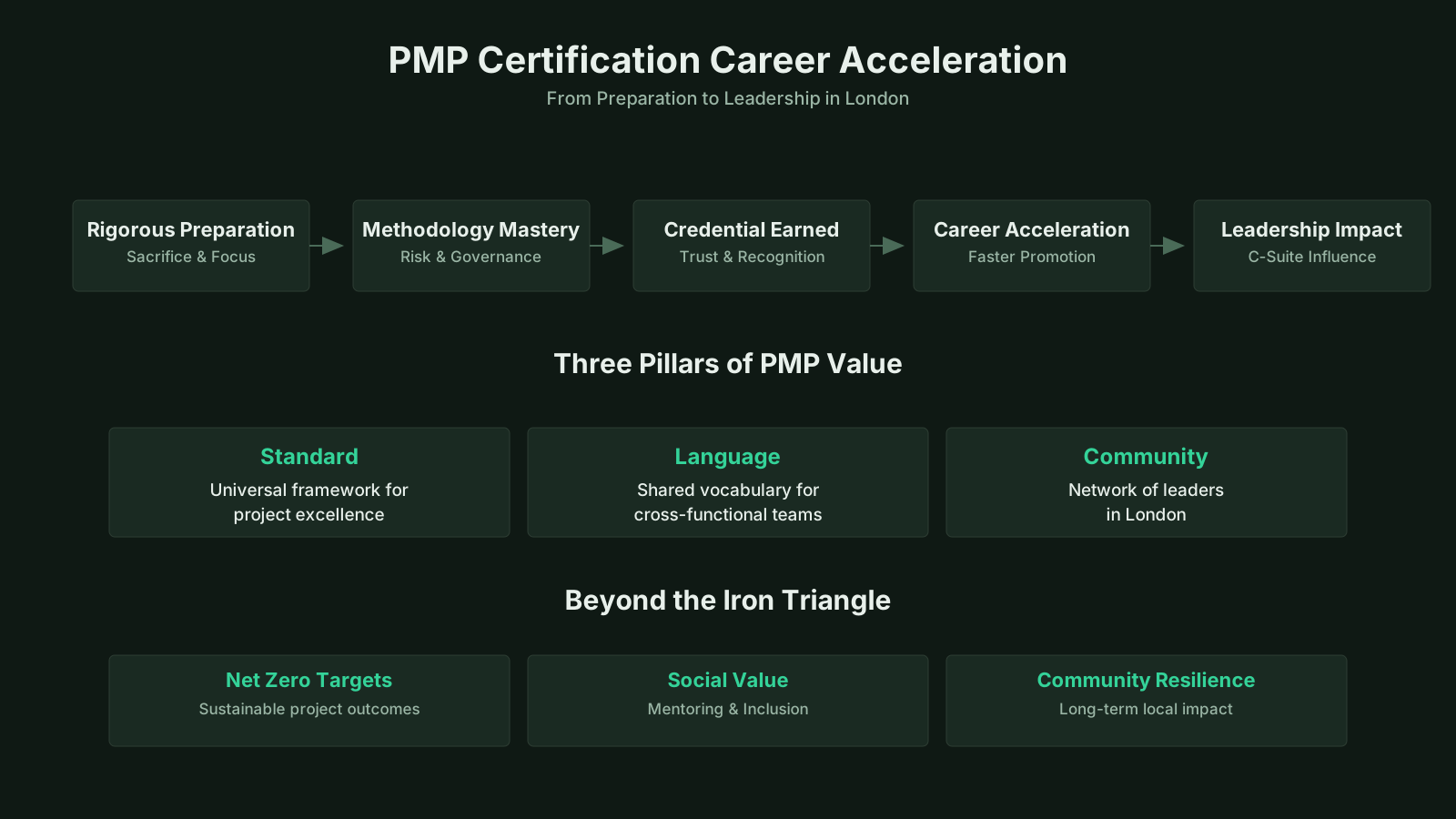
The emphasis on sustainability and environmental, social, and governance criteria is another trend that will shape London’s project management careers. Projects are increasingly evaluated not just on the traditional iron triangle of time, cost, and scope, but on their contribution to net zero targets, social value, and long-term community resilience. The PMP’s focus on benefits realisation and business case alignment positions certified professionals to lead in this new paradigm. Those who can speak credibly about how a project’s deliverables will generate sustainable outcomes, and who can build the stakeholder coalitions necessary to make that happen, will be at the forefront of the profession.
Diversity, equity, and inclusion within the project management field itself are also receiving long-overdue attention. London, as a proudly multicultural city, has a responsibility and an opportunity to build a project delivery workforce that reflects the communities it serves. A London PMP certification can be a leveller, providing a common qualification that recognises competence without regard to background. Initiatives to sponsor certification for underrepresented groups, to provide mentoring, and to create accessible pathways into the profession are growing, and they represent a chance for the London project management community to lead by example. The city’s future as a global project delivery hub depends on its ability to attract and develop the widest possible talent pool.
In the final analysis, London PMP certification accelerates your career by giving you what no amount of casual experience can: a standard, a language, and a community. It rebrands your CV, reshapes your thinking, and repositions you within the ecosystem of one of the world’s great commercial cities. The journey demands sacrifice, focus, and a willingness to challenge your own assumptions, but the outcome is a durable asset that pays dividends across decades. London will continue to run on projects, and the professionals who lead them will continue to be the ones who invest in the best preparation available. That preparation, for this moment and for the foreseeable future, is the Project Management Professional credential earned right here in the heart of a city that never stops building.
Core Insights on London PM Careers
- AI Elevates Human Leadership Skills
- As AI takes over routine administrative tasks, demand intensifies for PMP-certified leaders who can harness these tools to drive strategic stakeholder conversations and decision-making.
- Sustainability Drives Project Evaluation
- Project approval now rests on environmental and social performance, and PMP certification provides leaders with the governance tools to ensure every deliverable advances net-zero and community resilience objectives.
- Diversity Strengthens Talent Pipeline
- London’s multicultural workforce benefits from PMP certification as a shared professional standard, and a rising number of sponsorship initiatives are opening up career pathways for underrepresented groups by removing systemic barriers.
Advance Your Career with Professional Certification
Earning a professional project management certification validates your expertise in standardized methodologies and significantly boosts your credibility with employers, often leading to higher salaries and faster career advancement. Many professionals choose to pursue a PM certification online to gain flexible, self-paced training while balancing work commitments. For organizations, certified project managers consistently deliver projects on time and within budget by applying risk management and resource optimization skills, driving overall business success and stakeholder satisfaction.
Earning a recognized product management certification validates your expertise in modern frameworks and strategic thinking, setting you apart in a competitive job market. This credential not only deepens your ability to lead cross-functional teams and drive customer-centric innovation but also signals to employers that you can deliver measurable business outcomes. For organizations, certified product managers reduce costly missteps and accelerate time-to-market, making certification a win for both individual career advancement and company growth.
Earning a professional HR management certification validates your expertise in modern people strategies and significantly boosts your career trajectory by demonstrating a commitment to continuous learning and industry best practices. Through rigorous HR training and certification , professionals gain the advanced skills needed to navigate complex compliance landscapes, foster inclusive workplace cultures, and align talent management with business goals. For organizations, certified HR leaders drive higher employee engagement and retention, directly impacting bottom-line performance and building a resilient, future-ready workforce. Ultimately, this credential distinguishes you in a competitive job market and equips you to lead strategic transformation with confidence.