Every chief operating officer embarks on a distinct professional path, yet all share a common imperative: to master the art and science of running a business that delivers consistent, scalable value. The COO Leadership Journey: Mastering Operations Excellence is not a single promotion or a finite training program. It is a continuous evolution of mindset, capability, and influence that transforms a functional expert into an enterprise-wide orchestrator of performance, resilience, and growth. In today’s volatile markets, where supply chains fracture overnight and customer expectations shift by the week, the COO must blend operational discipline with strategic agility, data fluency with emotional intelligence, and technological curiosity with deep people wisdom. This article explores the full spectrum of that journey, from the foundational shifts in the COO mandate to the nuanced leadership behaviors that define world-class operations excellence.
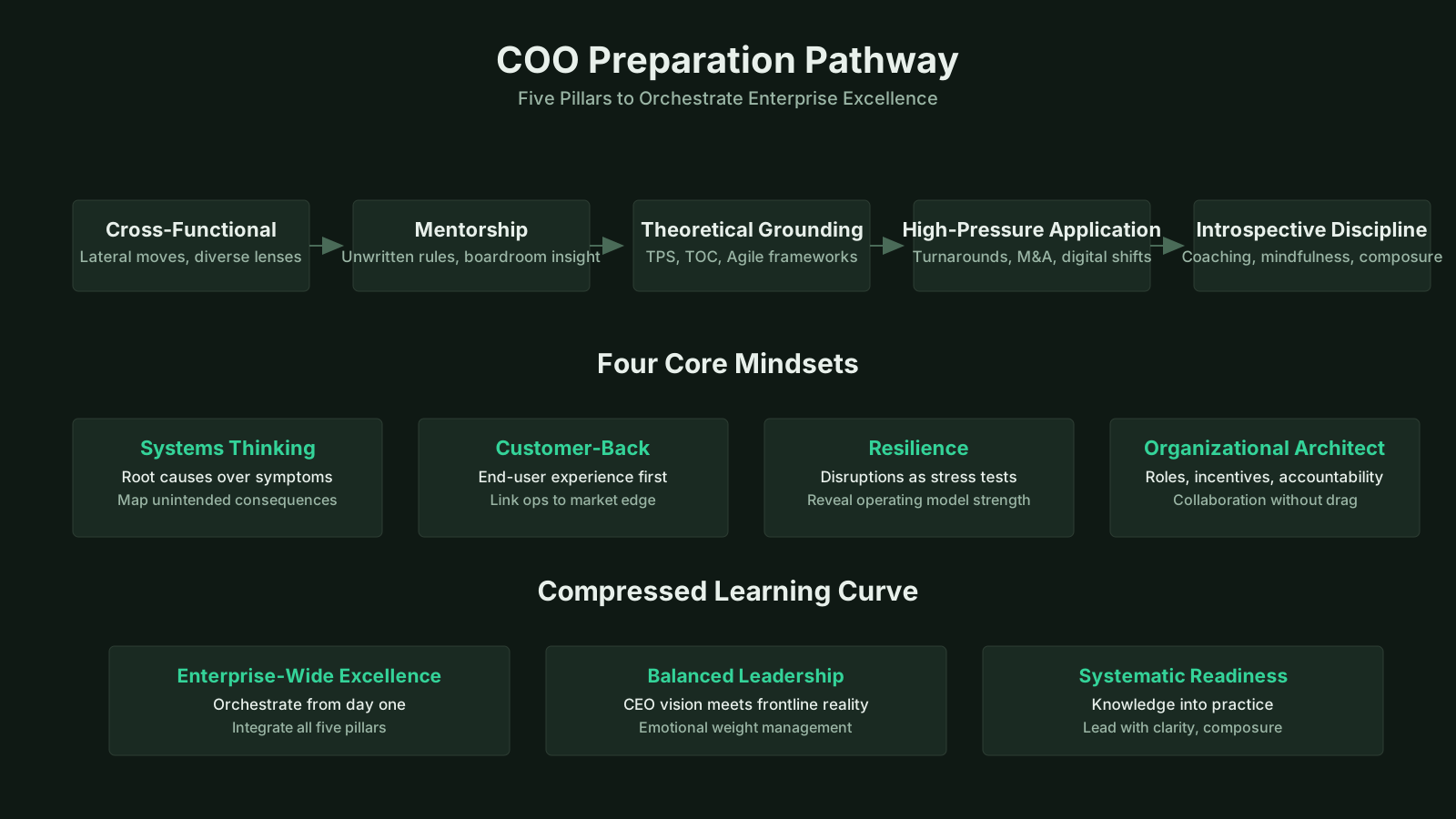
COO Leadership Journey: Key Topics Overview
| Key Concept | Summary |
|---|---|
| Evolving Mandate | The COO role has progressed from a conventional efficiency steward to a strategic integrator who fuses technology, operating process, and cultural initiative to catalyze enterprise performance. |
| Ecosystem Pressures | Digital disruption, geopolitical volatility, and hybrid work realities have recast the COO as a proactive change agent and primary architect of organizational resilience and adaptive capacity. |
| Structural Clarity | An explicitly scoped and autonomously empowered COO, possessing full accountability for the integrated value chain and operating cadence, directly correlates with superior benchmark performance. |
| Leadership Trajectory | The COO career arc ascends from governing discrete functional domains to orchestrating complex enterprise systems, deliberately pivoting from vertical technical depth to broad, cross-functional influence. |
| Strategic Bilingualism | Master COOs operate with a dual lens, converting granular operational metrics into compelling shareholder narratives for the board while maintaining front line visibility to identify and eliminate friction. |
| Digital Transformation | COOs secure genuine digital returns by anchoring transformation agendas in operational pain points, enforcing pragmatic adoption, and measuring success through realized productivity gains. |
| Operational Synthesis | Achieving excellence requires synthesizing Lean’s systemic waste elimination with Agile’s iterative feedback loops to engineer a responsive engine that balances maximum efficiency with rapid adaptation. |
| Continuous Improvement | Ingraining a pervasive improvement reflex, where process interrogation becomes a universal employee instinct, ultimately outperforms deploying Lean toolkits solely as a tactical cost reduction lever. |
| Servant Leadership | High-performing COOs must dismantle command-and-control reflexes, adopting servant leadership to cultivate autonomous, cross-functional teams that compress cycle time and accelerate value delivery. |
| Product-Centric Model | Embracing a product-led operating framework allows the COO to align technology, operations, and customer experience around persistent value streams, shifting success metrics from project completion to enduring business outcomes. |
The Evolving Mandate of the Chief Operating Officer
The role of the chief operating officer has undergone a dramatic reinvention over the past two decades. Traditionally, the COO was the steward of efficiency, the executive who ensured that factories hummed, logistics networks delivered on time, and back-office processes stayed within budget. While that executional backbone remains essential, the modern COO operates at the intersection of strategy, technology, and culture. No longer a mere number-two who handles day-to-day distractions so the CEO can focus on vision, today’s most effective COOs are co-creators of strategy and the architects of the operating model that brings that strategy to life.
Several forces have reshaped the COO role. The rise of digital business models has collapsed the boundary between product and operations, meaning the COO must understand platform economics, customer experience data , and iterative development cycles . Geopolitical uncertainty and climate-related disruptions have elevated supply chain resilience from a tactical concern to a board-level priority. Meanwhile, the post-pandemic normalization of hybrid work has placed unprecedented demands on the COO to redesign physical and digital workplaces , maintain cultural cohesion , and safeguard employee wellbeing without sacrificing productivity. In this environment, the COO is no longer just a custodian of the status quo but a proactive change agent who orchestrates enterprise agility .
Research on organizational leadership consistently shows that companies with a COO outperform those without one on operational metrics, but only when the role is clearly defined and empowered. Ambiguity around the COO’s remit can create friction with other C-suite peers, particularly the CFO, CHRO, and chief strategy officer. The journey to operations excellence therefore begins with a precise delineation of what the COO owns: typically, the end-to-end value chain, the operating rhythm of the business, and the translation of long-term goals into quarterly execution. How a COO navigates these structural tensions, builds trust with the CEO, and aligns the executive team around operational priorities sets the tone for everything that follows.
Core Takeaways on the COO's New Role
- From execution to strategic co-creator
- Today's COO transcends traditional efficiency oversight, actively shaping corporate strategy and architecting the operating model that brings it to life.
- Digital and operational boundary collapse
- As digital business models fuse product and operations, the COO must master platform economics, customer experience analytics, and agile development rhythms.
- Supply chain resilience as a board priority
- Mounting geopolitical tensions and climate volatility have turned supply chain resilience into a board-level strategic imperative that demands direct COO stewardship.
- Hybrid work demands cultural stewardship
- In the post-pandemic era, the COO must redesign the work environment, sustain cultural unity, and protect employee wellbeing, all while driving productivity gains.
- Clear role definition drives performance
- Organizations with a well-defined and empowered COO consistently outperform on key operational metrics, whereas role ambiguity fosters friction and strategic drift among the C-suite.
Defining the COO Leadership Journey in Modern Business
The COO leadership journey is rarely linear. Many COOs rise through finance, engineering, supply chain, or consulting, and each path brings a distinct lens through which operations excellence is envisioned. The common thread is a progression from managing resources to leading systems. Early in their careers, future COOs master discrete functions like production planning, quality control, or logistics optimization. The pivotal transition occurs when they start connecting these dots, understanding how a decision in procurement reverberates through inventory, fulfillment, customer satisfaction, and cash flow. This systems thinking is the cognitive foundation of the COO leadership journey.
A critical inflection point comes when the COO candidate moves from a functional P&L role to a cross-functional enterprise role. At this stage, technical expertise becomes less important than the ability to shape culture, facilitate trade-offs, and communicate a compelling narrative of operational excellence to diverse audiences. The COO must learn to speak the language of the boardroom, translating operational metrics into shareholder value drivers, while simultaneously staying grounded enough to walk a factory floor or a distribution center and spot waste that data dashboards miss. This dual fluency, strategic and granular, is what allows a COO to influence without formal authority over every function.
The modern COO leadership journey also demands a deep engagement with digital transformation. Many COOs have witnessed the failure of large-scale technology implementations that were driven solely by the IT function without operational grounding. The COO who champions digital initiatives from a place of operational pain, rather than technological fascination, dramatically increases the odds of adoption and return on investment. This means learning enough about cloud architectures, APIs, and machine learning to ask the right questions, hold vendors accountable, and translate technical roadmaps into operational capability roadmaps that the frontline can embrace.
Mastering Operations Excellence Through a Lean-Agile Mindset
Operations excellence in the twenty-first century owes much to the Lean philosophy that originated in manufacturing, but its modern expression has been profoundly influenced by Agile and DevOps principles from the software world. The COO who can synthesize these approaches creates an operating system that is both efficient and adaptive. Lean thinking provides the relentless focus on eliminating waste, standardizing work, and visualizing flow, while Agile brings the cadence of short feedback loops, empowered teams, and continuous reprioritization. The COO leadership journey involves discerning which elements of each philosophy fit the organization’s context and cultural maturity.
A common pitfall is to apply Lean tools as a cost-cutting exercise without addressing the underlying mindset. Mastering operations excellence requires building a culture where every employee, from the loading dock to the executive suite, habitually asks how a process can be improved. This is far more difficult than implementing a 5S program or a Kanban board. The COO must model the behaviors of curiosity, humility, and respect for frontline expertise. When a warehouse team suggests a layout change that reduces walking time, the COO’s visible support for that idea, and the removal of any bureaucratic barriers to its implementation, sends a stronger signal than any corporate communication campaign.
Agile principles become particularly relevant in business functions that have historically been project-driven, such as product development, marketing, and HR operations. The COO can spearhead the creation of cross-functional value streams that break down silos and accelerate delivery of customer value. For instance, instead of a sequential handoff from product design to procurement to manufacturing, a collocated team with representatives from each discipline can iterate on a new product introduction, cutting months from the launch cycle. The COO leadership journey entails unlearning the command-and-control reflexes that often accompany years of operational management and replacing them with servant leadership and the facilitation of autonomous teams.
The COO Leadership Journey and the Shift to Product-Led Operations
Many traditional companies are transitioning from a project-centric to a product-centric operating model, a transformation that places the COO at the very center. In a product-led organization, persistent, cross-functional teams own the full lifecycle of a product or a customer journey, rather than temporary project teams that disband after go-live. This structural shift requires the COO to rethink funding mechanisms, governance, talent management, and technology architecture. Operations excellence in this context means ensuring that these stable teams have the platforms, data, and standards they need to move fast without creating chaos.
The product-operating model demands a different approach to resource allocation and performance measurement. Instead of annual budgeting cycles that lock in plans twelve months ahead, the COO can champion a rolling, outcome-based funding process where teams are resourced based on the value they deliver for customers and the business. This shift is uncomfortable for many finance and operations leaders accustomed to predictability, yet it is essential for mastering operations excellence in a digital economy. The COO’s role is to build the connective tissue between the product teams’ autonomy and the enterprise’s need for compliance, risk management, and cost control.
Adopting a product-led approach also forces the COO to become more intimately familiar with the customer. Historically, operations executives measured success through internal metrics like utilization, throughput, and cost per unit. Those metrics remain important, but they must be complemented by external metrics such as Net Promoter Score, time to value, and customer effort score. The COO leadership journey thus involves a deliberate pivot from an inside-out to an outside-in orientation, ensuring that every operational improvement directly enhances the customer experience. This alignment between operational rigor and customer centricity is the hallmark of modern operations excellence.
Data-Driven Decision Making as a Cornerstone of Operations Excellence
If there is one capability that separates average COOs from exceptional ones, it is their ability to weave data into the fabric of daily decision making at every level of the organization. Operations generate an immense volume of data from sensors, ERPs, CRMs, and increasingly from IoT devices and digital twins. The COO leadership journey requires turning that raw data into actionable insight without drowning in noise. This means investing not only in analytics platforms but, more importantly, in the data literacy of the entire workforce. A frontline supervisor who can interpret a statistical process control chart is worth far more than a dozen dashboards that nobody uses.
The challenge of data-driven operations excellence is less about technology and more about behavior. Many organizations suffer from a culture where intuition and hierarchy override evidence. COOs must dismantle this culture by insisting that every performance review, every root cause analysis, and every capital allocation request be anchored in data. This does not mean ignoring experience and judgment; rather, it means using data as the starting point for a structured conversation. When a plant manager proposes a major maintenance overhaul, the COO should ask for the predictive failure data, not just the maintenance log, and should celebrate when data proves a hunch wrong, because that saves resources and builds trust in the system.
Beyond descriptive and diagnostic analytics, the frontier of operations excellence is prescriptive and cognitive analytics. Artificial intelligence can now optimize scheduling in real time, predict supply chain disruptions before they occur, and automate routine decision rights. The COO’s role is to set the conditions for these technologies to succeed: clean data foundations, clear business rules, ethical guardrails, and a workforce that understands how to work alongside algorithmic recommendations. Mastering operations excellence means being the executive sponsor who connects the data scientists with the operations managers, ensuring that models are validated against physical reality and that the organization learns from inevitable early-stage failures.
Core Competencies for the COO Leadership Journey
No single competency guarantees success in the COO role, but a constellation of skills consistently emerges in those who master operations excellence. Financial acumen sits at the foundation. The COO must interpret balance sheets, cash flow statements, and cost structures with the same fluency as the CFO, yet apply that knowledge to operational trade-offs like make versus buy, inventory optimization, and capital expenditure prioritization. The best COOs can model the financial impact of a decision on throughput or lead time within minutes, not days, and communicate that impact in terms that resonate with investors and board members.
Strategic thinking is another non-negotiable capability. While the COO is often stereotyped as the executor, the role demands a keen ability to spot market shifts, competitive threats, and adjacencies where operational strengths can be converted into strategic advantage. A COO who notices that a logistics network can also serve as a third-party fulfillment platform for smaller brands, for example, can unlock a new revenue stream that the strategy team might have overlooked. This strategic lens transforms operations excellence from a cost center mindset into a value creation engine.
Equally important is the ability to design and manage large-scale change. Few initiatives in a modern enterprise are purely operational, technical, or cultural; they are all three simultaneously. The COO who leads a global ERP implementation is not just managing a software rollout but reshaping how thousands of people do their jobs, redefining performance metrics, and potentially restructuring reporting lines. Competence in change management, including stakeholder mapping, communication planning, and resistance management, is therefore essential. The COO leadership journey demands that these skills be honed through deliberate practice, mentoring, and often, learning from failed transformations that left scars but also priceless lessons.
Building a Resilient Supply Chain: A Critical Component of the COO Leadership Journey
In the wake of pandemic-induced shortages, geopolitical tensions, and climate disruption, supply chain resilience has vaulted to the top of the COO agenda. The era of optimizing solely for lowest cost is over. Today’s COOs must architect supply chains that balance cost, speed, flexibility, and sustainability. This requires a multi-sourcing strategy, nearshoring or friendshoring selective categories, and building strategic inventory buffers for critical components. The COO leadership journey now includes mastering the art of supply chain mapping down to tier-three and tier-four suppliers, understanding the geographic concentration risk, and developing contingency playbooks that can be activated in hours, not weeks.
Technology plays a starring role in supply chain resilience. Advanced analytics can model the impact of a port closure or a raw material shortage and recommend optimal responses. Blockchain and distributed ledger technologies are enabling end-to-end traceability, which is increasingly a regulatory and consumer requirement. The COO must evaluate these tools, not as shiny distractions, but as enablers of a more responsive and transparent supply chain. The integration of supply chain data with customer demand signals creates a demand-driven value network that reduces the bullwhip effect and aligns the entire organization around real, not forecasted, consumption.
The human dimension of supply chain resilience is often neglected in boardroom discussions. Building a resilient supply chain involves investing in the skills and wellbeing of procurement, logistics, and planning teams who have been under extraordinary strain. The COO leadership journey includes becoming a vocal advocate for the supply chain function, elevating its strategic status within the organization, and ensuring that the people who manage these complex global networks have career paths, competitive compensation, and a seat at the decision-making table. Only then can operations excellence be sustained over the long term.
Talent Management and Organizational Culture in the COO Journey
Operations excellence is ultimately delivered by people, yet COOs sometimes overlook talent strategy in favor of process and technology. The most effective COOs are deeply involved in workforce planning, talent acquisition, and leadership development for the operational backbone of the company. They collaborate closely with the CHRO to define the future skills required, ranging from data analytics and robotic process automation to emotional intelligence and cross-cultural communication. The COO leadership journey demands a shift from viewing human resources as a support function to treating it as a strategic pillar of operational capability.
One of the biggest cultural barriers to operations excellence is a blame-oriented environment where errors are punished rather than studied. In a truly excellent operating culture, frontline employees feel psychologically safe to flag near misses, suggest improvements, and report quality issues without fear of retribution. The COO sets this climate through their reactions to bad news. When a production line stops due to a maintenance oversight, the COO’s first question should be about the system that allowed the oversight to occur, not about which individual was at fault. This systems-thinking approach, consistently applied, transforms the organizational culture over time.
The COO leadership journey also involves building a diverse leadership pipeline. Operational roles have historically been male-dominated, particularly in manufacturing and logistics. Companies that master operations excellence actively invest in mentorship, sponsorship, and inclusive hiring practices to broaden the talent pool. A diverse operations leadership team brings a wider range of perspectives to problem-solving, innovation, and risk assessment. The COO can champion this by tying a portion of operational leaders’ performance evaluations to measurable diversity, equity, and inclusion outcomes, and by personally sponsoring high-potential talent from underrepresented groups.
Essential Competencies for COO Success
- Financial Acumen Foundation
- A COO must translate financial statement insights into immediate operational decisions, rapidly modeling the impact on throughput and lead time to inform real-time trade-offs.
- Strategic Thinking Beyond Execution
- The COO identifies emerging market shifts and competitive threats, then converts operational strengths into strategic advantages, for instance by monetizing an existing logistics network to unlock new revenue streams.
- Large-Scale Change Management
- Leading a global ERP implementation requires orchestrating operational, technical, and cultural change simultaneously, with rigorous stakeholder mapping and proactive resistance management to drive enterprise-wide adoption.
- Supply Chain Resilience Focus
- The COO architects supply chains that dynamically balance cost, speed, flexibility, and sustainability, employing multi-sourcing, nearshoring, strategic buffers, and advanced analytics to model and mitigate disruptions.
Navigating Digital Transformation and Operational Technology
Digital transformation sits at the heart of the contemporary COO leadership journey, but it is also one of the areas most fraught with hype and disappointment. The COO’s responsibility is to cut through the noise and identify the technologies that will genuinely enhance operational capability. This often means starting not with the technology but with the operational pain points. A COO who has listened to plant managers complain about unscheduled downtime for years can champion an industrial IoT and predictive maintenance program that yields a concrete, measurable return. By contrast, a COO who launches a broad digital transformation initiative without a clear operational thesis risks squandering capital and credibility.
Operational technology, the hardware and software that control physical processes, is converging with information technology, creating both opportunities and risks. The COO must now consider cybersecurity not as an IT problem but as an operational continuity issue. A ransomware attack on a production control system can halt output for days. Mastering operations excellence therefore requires embedding cybersecurity resilience into operational design, conducting joint exercises with the chief information security officer, and ensuring that operational technology teams are trained on security hygiene. This integration of cyber risk management into the COO’s domain is a relatively new, and often overlooked, dimension of the leadership journey.
The COO also needs to build the organizational muscle for continuous digitization, rather than treating transformation as a one-time project. This involves creating a digital operations center of excellence that develops reusable platforms, data standards, and change management toolkits. It means funding digital initiatives through operational savings, creating a self-reinforcing cycle. The COO must be the executive who protects these initiatives from the short-term budget cuts that often kill transformation mid-flight, communicating the long-term value to the CFO and the board with evidence-based patience.
The COO Leadership Journey in the Age of AI and Automation
Artificial intelligence is reshaping the COO’s world at an accelerating pace. From demand forecasting and inventory optimization to robotic process automation in finance and HR, the potential for efficiency gains is enormous. Yet the COO leadership journey requires a nuanced understanding that AI is not a magic wand. The quality of AI outputs depends entirely on the quality of the data inputs and the appropriateness of the model for the specific operational context. A COO who blindly trusts a machine learning algorithm to set inventory levels without understanding its training data and assumptions may end up with stockouts during a demand spike that the model did not anticipate.
Mastering operations excellence with AI involves establishing a disciplined framework for model development, validation, and monitoring. The COO should insist on a human-in-the-loop approach for high-stakes decisions, ensuring that experienced operators can override or adjust algorithmic recommendations when necessary. Furthermore, the COO must address the workforce transition with honesty and empathy. Automation will eliminate certain roles, but it will also create new ones in areas like process analytics, automation maintenance, and exception handling. The COO leadership journey is incomplete without a proactive reskilling and redeployment strategy that treats affected employees with dignity and prepares them for the next chapter of their careers.
Generative AI has added a new frontier, enabling the rapid generation of standard operating procedures, training materials, and even code for robotic automation. COOs can use these tools to dramatically accelerate process documentation and improvement, but they must also establish governance to prevent the proliferation of inaccurate or unsafe instructions. The COO leadership journey will increasingly involve partnering with the chief AI officer or the chief data officer to craft ethical and operational guidelines that balance speed with safety, and that maintain human accountability in an increasingly automated decision landscape.
Mastering Operations Excellence with Process Mining and Intelligent Automation
Process mining has emerged as one of the most powerful tools for a COO seeking to master operations excellence. Unlike traditional process mapping, which relies on interviews and workshops to construct an idealized view of how work gets done, process mining extracts event logs from enterprise systems and reconstructs the actual process flows. This reveals the hidden loops, rework, deviations, and bottlenecks that no one had documented. Armed with these insights, the COO can target improvement efforts with surgical precision, often uncovering opportunities that deliver millions in savings or dramatic improvements in cycle time. The COO leadership journey now demands a basic fluency in process mining so that the technology is not relegated to a specialized analytics team but becomes a standard part of the operational review cadence.
Intelligent automation, which combines robotic process automation with AI-based decision engines, allows COOs to automate not just routine, rule-based tasks but also complex, judgment-intensive processes. For example, in accounts payable, automation can move beyond simply matching invoices to purchase orders; it can analyze patterns to detect potential fraud, prioritize payments to preserve supplier relationships, and dynamically adjust payment terms based on cash flow forecasts. The COO’s role is to identify the use cases where intelligent automation adds the most value, to redesign the underlying processes before automating them, and to manage the organizational change that follows. Automating a broken process only makes the brokenness faster and more permanent.
The greatest risk in this domain is losing the human touch with customers, suppliers, and employees. Operations excellence is not solely about efficiency; it is about reliability, responsiveness, and empathy. The COO leadership journey requires the wisdom to know where automation enhances the human experience and where it erodes it. A chatbot that resolves a customer’s shipping inquiry in seconds is a clear win, but routing a loyal customer who has just experienced a quality failure through a maze of automated menus risks permanent brand damage. The COO must set the design principles for automation that elevates service rather than alienating the people it is meant to serve.
Performance Management, OKRs, and Continuous Improvement
An operating system is only as strong as the performance management framework that steers it. The COO leadership journey involves designing a cascade of objectives and key results, or OKRs, that connects the company’s strategic aspirations with the daily work of frontline teams. Unlike traditional management by objectives, OKRs encourage ambitious, measurable outcomes and transparent tracking. A COO might set a company-level objective to become the most reliable supplier in the industry, with key results tied to on-time delivery, quality yield, and customer satisfaction. Those then cascade down to regional and site-level OKRs, creating alignment without micromanagement.
The COO must also embed a rhythm of continuous improvement that transcends any single methodology. Kaizen events, daily stand-ups, and retrospectives become the heartbeat of operations when they are consistently led and visibly supported by the COO. Many organizations launch improvement programs with great fanfare, only to see them fizzle out when leadership attention shifts. The COO leadership journey is about sustaining focus, celebrating small wins, and institutionalizing improvement as part of everyone’s job description. This requires regular gemba walks, where the COO goes to where the work happens, asks questions, and demonstrates that operational excellence is not a desk-bound exercise.
One of the most underappreciated aspects of performance management is the integration of leading and lagging indicators. Most operational dashboards are filled with lagging indicators like monthly revenue, quarterly defect rates, and year-to-date turnover figures. The COO who masters operations excellence insists on a balanced set of leading indicators that predict future performance. A leading indicator for safety might be the percentage of near-miss reports closed within 48 hours, while a leading indicator for quality might be the adherence to process control parameters in real time. By shifting management attention upstream, the COO can prevent problems before they appear on the financial statements.
Core Insights on Performance and OKRs
- OKR cascade for alignment
- The COO architects a cascading OKR framework that directly links the organization’s strategic vision to frontline tasks, fostering company-wide alignment and empowering teams without resorting to micromanagement.
- Sustained continuous improvement rhythm
- The COO institutionalizes a steady rhythm of improvement through activities such as kaizen events and daily stand-ups, sustaining momentum beyond initial excitement by systematically celebrating small wins and making continuous improvement an integral part of every employee’s role.
- Visible leadership through gemba walks
- The COO strengthens improvement efforts by conducting regular gemba walks to directly observe workflows, ask probing questions, and visibly demonstrate that operational excellence is an active, on-site discipline rather than a desk-bound exercise.
- Balanced leading and lagging indicators
- The COO insists on a balanced mix of leading indicators that provide forward-looking insight, for instance tracking near-miss closure time to anticipate safety trends and monitoring real-time process control adherence to foresee quality issues, instead of relying solely on lagging metrics.
- Upstream problem prevention
- Shifting management focus toward leading indicators allows the COO to intercept potential failures upstream, preventing them from manifesting as financial shortfalls and transforming operations from a reactive to a proactive discipline.
Change Management and the Human Side of Operations Excellence
No matter how elegant the strategy or advanced the technology, operations excellence is won or lost in the hearts and minds of the people who execute the work. The COO who neglects change management will find that even the most logical process improvements encounter stubborn resistance and fail to sustain. The COO leadership journey requires a deep appreciation for how humans react to change: the fear of job loss, the discomfort of unfamiliar routines, and the resentment when top-down edicts disregard hard-won frontline knowledge.
Effective change management starts with a compelling narrative. The COO must articulate not just what is changing but why it matters, connecting the change to a purpose that resonates emotionally. For instance, a digital transformation that automates manual data entry can be framed as liberating talented engineers from soul-crushing administrative work so they can solve creative problems that grow the business. This narrative must be consistently reinforced by visible leadership behaviors, symbolic actions, and a willingness to listen and adapt the plan based on feedback. The COO who treats change management as a soft skill that can be delegated to the communications department will never fully master operations excellence.
The COO’s personal resilience is also a critical factor. Leading large-scale operational change is exhausting. There will be setbacks, public failures, and moments when even the most loyal teams question the direction. The COO leadership journey demands emotional intelligence: the self-awareness to manage one’s own stress, the empathy to sense the mood of the organization, and the social skill to rebuild momentum after a disappointment. COOs who practice reflective disciplines, seek external coaching or peer networks, and maintain healthy boundaries outside of work are far more likely to sustain the energy required for a multiyear transformation.
Fostering a Culture of Continuous Improvement on the COO Leadership Journey
A culture of continuous improvement does not arise from slogans on the wall or a single kaizen event. It is the accumulated result of thousands of small interactions, decisions, and reinforcements. The COO plays an outsized role in shaping this culture by what they notice, measure, and reward. When a COO dedicates time each week to review a simple operational improvement idea submitted by a frontline employee, and then publicly recognizes that employee and funds the idea, a powerful message reverberates through the organization. Idea systems, improvement boards, and digital suggestion platforms can all support this, but they are empty vessels without the COO’s authentic engagement.
A common myth is that continuous improvement requires a crisis to ignite. In reality, the most resilient cultures of operations excellence are built during periods of stability, when the organization has the psychological bandwidth to experiment without existential pressure. The COO leadership journey involves resisting the temptation to focus solely on firefighting and instead carving out protected time for proactive improvement. This means budgeting for improvement capacity, training people in problem-solving methods, and accepting that not every experiment will succeed. An organization that celebrates well-designed, data-driven failures that generated learning is far healthier than one that only celebrates successes.
Middle managers are the linchpin of a continuous improvement culture, yet they are often the most neglected group in transformation programs. The COO must invest in their development, equipping them with coaching skills, systems thinking, and the confidence to facilitate improvement without having all the answers. When a plant manager is able to facilitate a root cause analysis that reveals a systemic flaw in the maintenance scheduling process, rather than blaming a technician, that middle manager has become a culture carrier. The COO leadership journey is ultimately about multiplying the number of leaders at every level who can drive operations excellence independently.
The COO Leadership Journey: Mastering Operations Excellence in a VUCA World
Volatility, uncertainty, complexity, and ambiguity have become the permanent backdrop for business operations. The COO who expects stable demand, predictable supply chains, and a static competitive landscape is operating in a fantasy. Mastering operations excellence in a VUCA world means building organizational capabilities that are not just efficient but also adaptive. This requires scenario planning, stress-testing of operating models, and the deliberate cultivation of slack and redundancy in the system. The lean purist may recoil at the idea of maintaining excess capacity or inventory, but the COO leadership journey teaches that some redundancy is insurance against catastrophic disruption.
Agility in operations is often misunderstood as chaotic swiftness. In reality, it is the ability to sense changes early and respond proportionally. The COO can build sensing mechanisms by establishing external radar functions that monitor geopolitical developments, commodity price trends, labor market shifts, and climate patterns. Internally, the COO can create cross-functional rapid response teams that have preauthorized decision rights and access to contingency resources. When a volcano eruption shuts down air freight routes, the team does not need to escalate through six layers of management to reroute shipments. The protocols are clear, the trade-offs have been delegated, and the organization pivots within hours.
The VUCA environment also places a premium on scenario-based leadership development. The COO leadership journey should include regular war-gaming exercises with the executive team, simulating disruptions ranging from cyberattacks to sudden regulatory changes. These exercises build the muscle memory of collaborative decision-making under pressure and surface hidden assumptions in the operating plan. The COO who facilitates these sessions positions operations not as a fragile function to be protected but as a strategic weapon that enables the company to outmaneuver competitors in turbulent times.
Core Takeaways on VUCA Operations Mastery
- Redundancy as strategic insurance
- Building deliberate slack and excess capacity into operations provides a vital buffer against catastrophic disruptions in volatile environments, even when it challenges traditional lean philosophies.
- True agility means proportional response
- Operational agility is not frantic speed, but the capability to detect market shifts early and respond with proportional force using external sensing mechanisms and dedicated internal rapid response teams.
- Preauthorized decision rights for speed
- Cross-functional teams equipped with clear protocols and delegated trade-off authority can pivot operations within hours of a disruption, eliminating the need to escalate through layers of management.
- War-gaming builds strategic muscle
- Regular scenario-based war games with the executive team forge collaborative decision-making instincts under pressure, transforming operations into a strategic lever for sustainable competitive advantage.
Executive Presence and Stakeholder Influence
Technical operational prowess alone does not make a successful COO. The COO leadership journey requires a sophisticated executive presence that commands respect in the boardroom, inspires confidence among investors, and builds trust with partners and regulators. Executive presence for a COO often manifests as the ability to translate complex operational realities into succinct, compelling narratives that drive decision-making. When presenting a factory expansion proposal to the board, the COO must weave together financial projections, risk assessments, sustainability commitments, and market demand data into a story that leaves no doubt about the strategic imperative.
Influence without authority is a daily reality for the COO. Unlike the CFO, who has a clear mandate over the purse strings, the COO must often persuade peers in sales, marketing, and R&D to align their priorities with operational constraints and opportunities. This demands diplomatic skill, coalition building, and a deep understanding of what motivates different functions. The COO who can frame an inventory reduction initiative as a way to free up cash for the CMO’s new campaign, rather than as a cost-cutting exercise, is far more likely to gain enthusiastic cooperation. The COO leadership journey is, at its core, a journey of expanding informal influence across the enterprise.
External stakeholder management has become a larger part of the COO portfolio, especially as environmental, social, and governance criteria attract investor scrutiny. The COO often leads the operational aspects of ESG reporting, including carbon footprint reduction in manufacturing and logistics, ethical sourcing audits, and worker safety metrics. Mastering operations excellence now means integrating sustainability into the operating model rather than treating it as a compliance overlay. The COO who can articulate how a circular economy initiative reduces material costs, mitigates regulatory risk, and enhances brand value simultaneously demonstrates the multidimensional thinking that defines a true operations leader.
Insights from the Field: Real-World Patterns in COO Success
While every COO journey is unique, certain patterns emerge from studying those who have achieved lasting operations excellence. One notable pattern is the COO who deliberately rotates through multiple functions before assuming the role, gaining firsthand exposure to sales, finance, and R&D. This breadth enables them to bridge silos and earn credibility across the organization. Another pattern is the COO who invests heavily in a small number of deep, trust-based relationships with key frontline leaders, from plant managers to call center supervisors, and uses those relationships as a barometer of organizational health that no dashboard can provide.
Successful COOs also demonstrate an unusual combination of humility and fierce resolve. They are quick to credit their teams for operational wins and personally absorb blame when things go wrong, yet they are unyielding on the non-negotiables of safety, quality, and ethics. This blend creates a followership culture where people are motivated to give their best because they feel seen, valued, and protected. The COO leadership journey is a journey of character development as much as it is a journey of skill acquisition, and the organizations that thrive under their stewardship reflect that character.
One of the most powerful, yet underpublicized, accelerators on the COO leadership journey is external learning. COOs who actively participate in industry roundtables, peer advisory groups, and executive education programs gain access to practical, immediately applicable ideas and avoid the insular thinking that can creep into long-tenured operations leaders. They benchmark not only within their industry but across industries, adapting practices from retail to healthcare or from aviation to manufacturing. This openness to cross-pollination is a hallmark of mastering operations excellence in an era where the pace of change renders yesterday’s best practices obsolete.
Core Insights on COO Success Patterns
- Cross-functional rotation builds credibility
- Deliberate exposure to sales, finance, and R&D before stepping into the COO role equips leaders with the cross-functional perspective needed to unify siloed teams and command broad organizational trust.
- Deep frontline relationships act as health barometers
- Successful COOs maintain a few trusted connections with frontline leaders, using them as live sensors for cultural drift and operational blind spots that no dashboard can surface.
- Humility paired with fierce resolve
- Effective COOs consistently deflect credit to their teams and absorb accountability for missteps, while enforcing nonnegotiable standards on safety, quality, and ethics, a balance that fuels a loyal, high-trust culture.
- External learning accelerates operations mastery
- Active participation in roundtables, peer networks, and cross-industry benchmarking exposes COOs to fresh operational models, helping them break out of insular thinking and import proven practices before competitive pressures mount.
Preparing for the Future COO Role
Looking ahead, the COO role will continue to expand in scope and strategic significance. The boundaries between operations, technology, sustainability, and employee experience will blur further. The COO of the near future may be responsible for autonomous vehicle fleets, carbon capture systems, and AI-driven workforce orchestration platforms. The COO leadership journey must therefore include a deliberate commitment to lifelong learning, not just in management science but in emerging technologies, geopolitical analysis, and behavioral science. The most future-fit COOs are already building their literacy in quantum computing, bioengineering, and decentralized autonomous organizations, not because these will become core tomorrow, but because the mental models they cultivate prepare the mind for radical shifts.
Succession planning is another dimension of the COO leadership journey that is frequently overlooked. A COO who masters operations excellence but leaves no capable successors has ultimately failed in building a sustainable enterprise. The COO should actively identify and groom potential successors, providing them with stretch assignments, exposure to the board, and candid feedback. This requires a generous, confident leadership stance that sees talent development as a legacy, not a threat. Organizations that institutionalize this approach avoid the costly disruptions that occur when a pivotal operations leader departs unexpectedly.
The COO leadership journey is not a destination but a continuous evolution. Mastering operations excellence means embracing the paradox of being both a steward of stability and an agent of transformation, a champion of efficiency and an advocate for human flourishing, a master of details and a visionary strategist. Those who navigate this tension with integrity, curiosity, and courage will not only build powerful companies but will also shape the future of work itself. The journey asks much of its travelers, but the rewards, measured in thriving organizations, inspired workforces, and resilient communities, are immeasurable. Every decision on the factory floor, every conversation in the boardroom, and every investment in people brings the COO closer to the ideal of operations that are not just excellent, but truly exceptional.
Advance Your Career with Professional Certification
Earning a professional project management certification validates your expertise in structured methodologies and strategic execution, making you a more competitive candidate for leadership roles. It demonstrates a commitment to continuous improvement and equips you with frameworks to deliver projects on time and within budget, directly impacting organizational profitability. Pursuing a PM certification online offers flexible, accessible training that fits into a busy executive schedule while building the operational rigor needed for sustainable growth. Ultimately, certified professionals foster cross-functional collaboration and risk mitigation, which are essential for driving long-term business success.
Earning a professional product management certification validates your expertise in driving product strategy and lifecycle execution, making you a more competitive candidate for leadership roles. It equips you with proven frameworks to align cross-functional teams and deliver customer-centric solutions that boost organizational agility. Many professionals pursue a product owner certification to deepen their agile backlog management skills and stakeholder collaboration. This credential not only accelerates your career trajectory but also helps companies reduce time-to-market and increase ROI through disciplined product decisions.
For HR professionals aiming to advance their careers, earning a recognized credential is a strategic move that deepens expertise in compliance, talent management, and strategic planning. An human resources certification validates your commitment to the field and equips you with the latest best practices to drive measurable business outcomes. When HR leaders hold such certifications, organizations benefit from reduced risk, improved employee engagement, and a stronger alignment between people strategy and operational goals, ultimately fostering a culture of excellence.