Writing user stories seems deceptively simple at first. You jot down a sentence describing a feature from an end user's perspective, toss it onto a backlog, and assume the development team will just figure out the rest. But the reality is that poorly written stories lead to confusion, rework, missed deadlines, and a product that does not actually solve anyone’s problem. Learning how to write effective user stories means moving beyond the fill-in-the-blank template and understanding the underlying criteria that make a story truly actionable. That is where the INVEST mnemonic and well-crafted acceptance criteria come into play. When these two elements are combined properly, teams move faster, stakeholders get what they actually need, and the endless back-and-forth of clarification requests finally subsides.
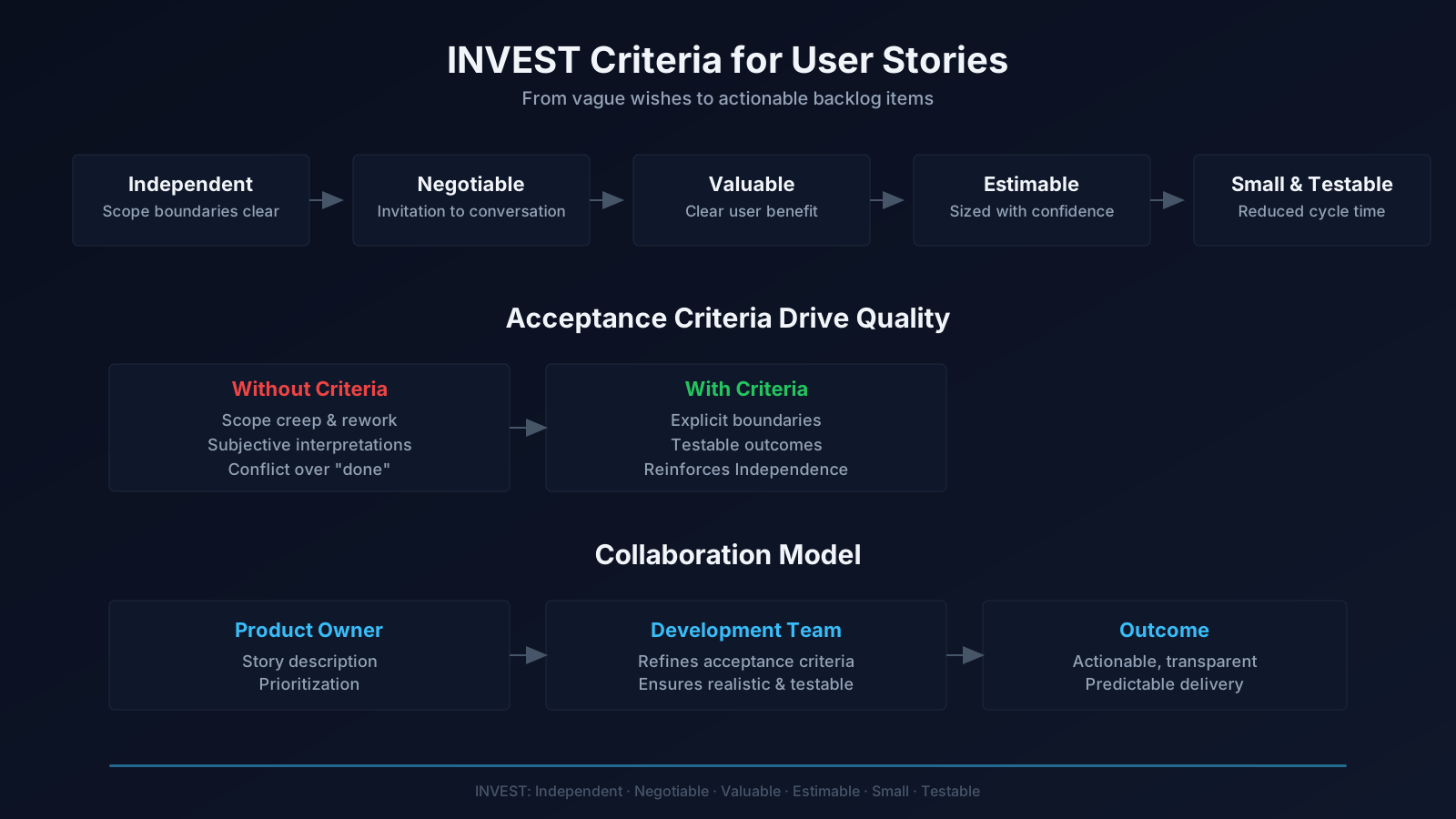
Many teams treat user stories as miniature requirements documents, but that mindset misses the point entirely. A user story is a placeholder for a conversation, not a specification frozen in time. It represents a small slice of functionality that delivers value to a user or customer and invites collaboration between product owners, developers, and designers. The INVEST criteria, coined by Bill Wake in 2003, gives us a checklist to ensure that each story is independent, negotiable, valuable, estimable, small, and testable. Acceptance criteria, on the other hand, define the boundaries of that story and give the team a concrete way to know when they are done. Together, they form the backbone of any healthy product backlog. Without them, you end up with a list of vague wishes that no one can estimate or build with confidence.
The interesting part is that even experienced agile practitioners sometimes slip into bad habits, writing stories that are too big, too vague, or too tightly coupled to other work. Over the years, I have seen teams spend entire sprint planning sessions trying to decompose a story that should never have made it into the backlog in its original form. Others deliver a feature only to discover that they built something technically impressive that no user actually wants because the value was never clearly articulated. This article will walk through the entire process, from the basic anatomy of a user story to a deep inspection of the INVEST criteria and then the art of acceptance criteria creation, all while showing how to avoid the most common traps.
Effective User Stories: INVEST and Acceptance Criteria Summary
| Key Concept | Summary |
|---|---|
| User Story | A user story encapsulates a small, value-driven increment of functionality that sparks collaboration among product owners, developers, and designers. |
| Backlog Refinement | Backlog refinement sessions reveal how story quality directly shapes development outcomes, highlighting the critical role of well-crafted user stories. |
| INVEST Criteria | During backlog refinement, teams apply the INVEST criteria (Independent, Negotiable, Valuable, Estimable, Small, Testable) to filter out poorly formed stories before they enter a sprint. |
| Acceptance Criteria | Crafting acceptance criteria not only ensures a story is testable and appropriately sized but also uncovers hidden dependencies and sizing issues that initial INVEST checks may overlook. |
| Technical Tasks | A frequent pitfall is writing stories that masquerade as user value but are actually technical tasks, for instance, refactoring a module without articulating the end-user benefit. |
| Story Card Limits | Treating a story card as a complete specification undermines quality by ignoring the tacit knowledge and nuance that only surface during direct conversation. |
| Alternative Items | In certain cases, alternatives such as a technical spike or an enabler story are more appropriate, either by clarifying the user value or by explicitly documenting architectural necessity. |
| Discovery Stories | Discovery stories adapt the INVEST framework for exploration: they remain negotiable, deliver learning value, are timeboxed for estimability, sized to a few days, and validated through qualitative user feedback. |
What Exactly Is a User Story?
Before diving into the details of how to write effective user stories, it helps to ground ourselves in what a user story actually represents. A user story is a concise, informal description of a software feature written from the perspective of the person who will use it. The classic template reads: “As a [type of user], I want [some goal] so that [some reason].” This template forces the team to consider who the user is, what they need, and why they need it. User story templates like this one are useful, but they are not the whole story. Over-reliance on the template can lead to hollow statements that skip critical context. The “so that” clause is where the real value lives, and it is frequently the part that gets omitted when teams rush.
Ron Jeffries described the three C’s of user stories: card, conversation, and confirmation. The card is the physical or digital token that captures the story text, acting as a reminder to have a conversation. The conversation is the collaborative discussion between the team and the product owner that fleshes out the details. The confirmation is the acceptance criteria that verify the story has been implemented correctly. This framework reminds us that a story is not a document to be signed off in isolation; it is a catalyst for dialogue. When teams treat the story card as the full and final specification, quality collapses because the nuance and tacit knowledge that emerge only through conversation are lost.
In practice, a user story might look like this: “As a frequent traveler, I want to save my payment method so that I do not have to re-enter my card details for every booking.” That sentence is clear, but it leaves many questions unanswered. Does the saved payment method persist across sessions? Is there a limit to how many methods can be stored? What happens when the card expires? The answers to those questions belong in the acceptance criteria, not stuffed into the story text itself. The story’s job is to define the who, the what, and the why, and to trigger the necessary conversations at the right time.
A common mistake is writing stories that are actually just technical tasks disguised as user stories, like “As a developer, I want to refactor the payment module so that it is more maintainable.” While refactoring is important, framing it as a user story often stretches the format and obscures the real user value. Sometimes it is better to use a different kind of backlog item, like a technical spike or an enabler story, making the underlying value to the user explicit or acknowledging that it is purely architectural. The way you frame the work affects how the team prioritizes it and how stakeholders perceive its importance.
Core Insights on User Story Basics
- Definition and classic template
- A user story articulates a feature from the user's perspective using the "As a [type of user], I want [some goal] so that [some reason]" template, keeping the focus on desired outcomes rather than technical specifics.
- The "so that" clause carries value
- The reason behind the goal captures the story's true value and drives prioritization, yet it is frequently skipped when teams rush, leaving stories without clear purpose or alignment.
- Story card as conversation catalyst
- A story card is a prompt to spark dialogue, not a final specification; treating it as a complete document erodes quality by suppressing the tacit knowledge that only collaborative discussion uncovers.
- Alternative backlog item types
- When work is purely architectural or lacks an obvious user-facing benefit, teams should use technical spikes or enabler stories to avoid forcing artificial user narratives and to keep the backlog transparent and purpose-driven.
How to Write Effective User Stories: INVEST Criteria and Acceptance Criteria
This is the core of the practice. Many guides treat INVEST and acceptance criteria as separate topics, but they are deeply intertwined. The INVEST criteria give you a lens to evaluate whether a story is well-formed, while acceptance criteria give you the executable definition of what success looks like for that story. Applying the INVEST criteria to your user stories ensures that each item is structurally sound before you even think about detailing the acceptance tests. Conversely, writing acceptance criteria often exposes hidden dependencies or size problems that the INVEST lens might have missed, creating a feedback loop that strengthens both.
The flow in a mature team often looks like this: the product owner drafts a story, the team examines it through the INVEST checklist during backlog refinement, and then together they hammer out the acceptance criteria to make the story testable and small. If a story fails the “testable” criterion, there is no way to write meaningful acceptance criteria. If it fails the “small” criterion, the acceptance criteria will sprawl across too many conditions, signaling that the story needs to be split. This section will unpack how the two concepts reinforce each other and then dive into the granular details of each element of INVEST and each technique for crafting acceptance criteria.
How to Write Effective User Stories: INVEST Criteria and Acceptance Criteria from the Backlog Grooming Perspective
Backlog refinement sessions are where the impact of good or bad story writing becomes painfully obvious. I have watched teams spend an hour on a single story because it violated multiple INVEST principles, usually because it was not independent or was far too large. When you approach refinement with a checklist that marries INVEST and acceptance criteria thinking, the quality of the conversation shifts. Instead of hand-waving about complexity, the team can point to specific acceptance criteria that cannot be tested without pulling in other story work, immediately exposing a dependency problem. This integrates the title’s core concept: the act of writing effective stories is not a solitary activity but a collaborative verification process.
One practical pattern is to require that every story entering a sprint planning session already has at least two or three well-formed acceptance criteria that align with the “testable” and “valuable” elements of INVEST. This simple rule prevents the all-too-common scenario where a story sounds reasonable in the abstract but proves impossible to estimate because nobody can agree on what it means. The product owner might push back, saying they are not sure about the exact interaction design yet, but that is precisely the moment to separate the conversation about the user outcome from the implementation details. Acceptance criteria can describe the outcome without prescribing the exact button placement, as long as they are still testable.
Sometimes there is a tension between negotiability, as required by INVEST, and the specificity of acceptance criteria. Teams worry that writing crisp criteria will lock them into a rigid solution early. The key insight here is that acceptance criteria should define boundary conditions and expected behaviors, not the user interface layout or the internal architecture. For example, “The system displays an error message when the credit card number is invalid” is a perfectly negotiable criterion: the message wording and visual treatment can still evolve, but the team knows what outcome to build toward. This perfectly illustrates that you can apply the INVEST criteria and still leave room for creative problem-solving.
How to Write Effective User Stories: INVEST Criteria and Acceptance Criteria for Distributed Teams
When team members are spread across time zones, the written story and its acceptance criteria carry more weight because the chance for spontaneous, face-to-face conversation is reduced. It becomes even more critical to get the INVEST criteria right, because misunderstandings over whether a story is independent or estimable can cascade into days of blocked progress. I have found that in distributed settings, the acceptance criteria must be more thorough than they would be in a co-located team, not because we want to replace conversation but because we want to make asynchronous communication efficient.
In this context, using a structured format for acceptance criteria, such as the Given/When/Then syntax, dramatically reduces ambiguity. A developer picking up a story at 6 a.m. their local time can read the criteria and understand exactly what outcomes are expected without waiting for a response from a product owner who is offline. This ties directly back to the testable element of INVEST; if the criteria are written in a language that both humans and automated testing frameworks can understand, the story can be pulled through the pipeline faster. Distributed teams that don’t invest in this level of clarity often find themselves with stories that linger in progress while they wait for clarification, eroding sprint velocity.
But there is a human factor too. Over-specifying acceptance criteria in a distributed team can backfire if it makes the story feel like a rigid contract that stifles the developer’s judgment. The product owner might not realize that the “small” criterion also applies to the mental load of reading a wall of acceptance criteria text. A story with twenty Gherkin scenarios is no longer small; it is an epic in disguise. So the remote context amplifies the need to apply INVEST with nuance, constantly checking that stories are independent, small, and testable while keeping the acceptance criteria crisp enough to avoid confusion but lean enough to respect the team’s intelligence.
How to Write Effective User Stories: INVEST Criteria and Acceptance Criteria within a Lean Discovery Process
In product discovery, you are not trying to build the final solution yet; you are trying to learn rapidly. That means the user stories you write during discovery might be lightweight, but the INVEST criteria and acceptance criteria are still useful as thinking tools. You might write a story with an explicit “so that” clause capturing a hypothesis, and the acceptance criteria become the signals that validate or invalidate that hypothesis. This approach transforms the story from a delivery ticket into a learning experiment, directly linking how to write effective user stories with the kind of evidence-based product management that drives innovation.
For example, a team exploring a new feature might write: “As a new visitor, I want to preview a personalized dashboard so that I can see the platform’s value before signing up.” The story might fail the estimable criterion in its raw form because the team does not know how much personalization engine work is required. In a lean discovery context, you do not fight that; you accept it and use the acceptance criteria to bound a small experiment: “The preview shows at most three metrics with placeholder data; no live connection to a user’s actual data is required.” That acceptance criterion makes the story testable and small, even if it’s not the final shippable increment. It still delivers value, because it delivers learning. This is how INVEST criteria adapt to different phases of the product lifecycle without losing their utility.
Product managers who treat user stories as static artifacts across all phases often struggle with discovery because they try to write full-feature stories with detailed acceptance criteria before they have any evidence. That leads to bloated backlogs full of guesses. A more effective approach is to write discovery stories with INVEST criteria adjusted for the context: negotiable by nature because the whole idea might pivot, valuable toward learning, estimable in terms of timebox rather than implementation effort, small enough to be completed in a few days, and testable through qualitative user feedback rather than automated checks. This flexibility shows that the principles behind the mnemonic are more important than a dogmatic application.
Breaking Down the INVEST Criteria One by One
Understanding each letter of the INVEST acronym in isolation is necessary before you can combine them effectively. Each INVEST element serves as a diagnostic tool to spot when a story is at risk of causing development headaches. When teams first adopt the mnemonic, they often latch onto “small” and “testable” while ignoring “independent” and “negotiable,” which leads to backlogs that look tidy but still contain deeply tangled dependencies. This section will walk through every component, not as an academic checklist but as a practical set of questions you can ask during refinement.
The “I” stands for Independent. Stories should be self-contained enough that they can be prioritized and implemented in any order without creating a catastrophic rework cascade. Perfect independence is rarely possible; some logical sequences are unavoidable. A story about user login will naturally precede a story about a personalized dashboard that requires authentication. The goal is to minimize dependencies rather than eliminate them entirely. When stories are highly interdependent, the team loses the ability to reprioritize based on new business insights because moving one item forces them to move five others. One technique is to use abstraction or stubs to simulate the missing parts of the system so that a story can be developed and tested in isolation, later integrating with the real component.
“N” is for Negotiable. A user story is an invitation to collaborate, not a contract carved in stone. The details of the implementation should emerge through conversation between the product owner and the development team, not be dictated upfront. If a story is overloaded with prescriptive instructions about how to build the feature, it ceases to be a story and becomes a micromanaged task. Negotiableness preserves the team’s ability to find better, more cost-effective technical solutions. There is a subtle balance because the acceptance criteria, which we will discuss later, do bring precision. The negotiable part is about the “how,” while the “what” and “why” remain firm. A story that says “Use a modal popup with a specific library” is not negotiable; a story that says “Display an error message when the form submission fails” leaves room for the front-end developer to choose the best component.
“V” stands for Valuable. Every user story should deliver some identifiable value to the user or the customer. If the value is not clear, the story either needs to be rewritten or it might be an internal task that should not be represented as a user story at all. Value can be hard to articulate for purely architectural work, and that is why many organizations use enabler stories or technical spikes, but they must still ultimately link back to a user benefit, even if the benefit is simply platform stability. I have seen teams write stories like “Upgrade the logging framework,” which on its own provides no user-facing value. Reframing it as “Reduce the time it takes to diagnose production errors so that the support team can resolve user issues faster” makes the benefit more apparent and helps with prioritization.
“E” is Estimable. The team needs to be able to roughly size the story to forecast how much work can be taken into a sprint. Stories become unestimable when they are too vague, when the technology is completely unknown, or when they are so large that the scope is fuzzy. This does not mean you need perfect hour-level precision; relative sizing using story points or T-shirt sizes is enough. The key to making stories estimable is to provide just enough detail, often in the acceptance criteria, that the team can understand the boundaries. If a team says a story is too uncertain to estimate, a spike story with a timeboxed investigation can produce the knowledge needed to estimate it later. The estimable criterion ties directly into the next one.
“S” is Small. This is arguably the most violated principle. A story should represent a few days of work at most, certainly not an entire sprint or longer. Small stories reduce risk, improve flow, and enable faster feedback. There are a number of story-splitting patterns that can help, such as splitting by operational boundaries, by data variations, or by interface. For example, a story “As a user, I want to search for products” could be split into “search by name,” “search by category,” and “filter by price range,” each a small, valuable increment that can be delivered and validated independently. The act of writing acceptance criteria often reveals that a story is too large because the criteria list becomes overwhelming, a clear signal to break it down further.
Finally, “T” is Testable. A story is testable if you can define pass/fail conditions that determine whether it has been successfully implemented. If the product owner cannot articulate how they would test the story, it is not clear enough to be built. Testability does not mean there must be an automated test ready before coding starts, but the story should be phrased in a way that makes it obvious how to verify it. Stories about fluffy outcomes like “improved user experience” are notoriously hard to test unless you translate them into measurable proxies: “reduce the page load time under 2 seconds” or “increase the conversion rate by 5%,” which then become acceptance criteria. Testability is the bridge between the INVEST criteria and the acceptance criteria that follow.
Key Takeaways on Practical INVEST Use
- Diagnostic tool for story risks
- Each INVEST criterion provides a structured checklist to surface stories that risk causing friction during implementation, allowing teams to address issues early in refinement.
- Common adoption blind spots
- Many teams focus heavily on making stories small and testable but neglect independence and negotiability, resulting in backlogs cluttered with hidden dependencies and constrained flexibility.
- Independence with realistic limits
- While perfect independence is rarely achievable, stories should be self-contained enough to be freely reordered; abstraction layers or stubs can effectively decouple them from external constraints.
- Negotiability and outcome framing
- Expressing stories in terms of desired outcomes rather than prescribed solutions preserves negotiability and clarifies the value proposition, enabling more effective prioritization.
The Art of Writing Acceptance Criteria
Acceptance criteria are the conditions that a product must satisfy to be accepted by the user, customer, or other stakeholder. Writing clear acceptance criteria transforms a vague story into an unambiguous set of tests that the team can rally around. They serve as the definition of “done” for that particular story, complementing the broader team-wide definition of done that might include code reviews, testing, and documentation. The criteria are typically written from the perspective of the end user and focus on observable outcomes and system behaviors, not on internal implementation details.
There are several common formats. The most widely adopted is the Given/When/Then syntax borrowed from behavior-driven development. It structures a criterion as: Given some initial context, When an action occurs, Then an expected outcome follows. For example: “Given a user has an item in their cart, When they apply a valid discount code, Then the total price updates to reflect the discount.” This format forces specificity and naturally lends itself to test automation using tools like Cucumber or SpecFlow. However, not every criterion needs to be in Gherkin. Sometimes a simple checklist-style sentence works better, especially for rules that are clear and discrete: “The system displays the shipping cost before the user enters payment details.”
What makes acceptance criteria truly effective is that they describe intent, not UI. A criterion like “The ‘Submit’ button is blue and located at the bottom right” is overly prescriptive and brittle. A better version would be “The user can confirm the order with a single action.” That gives the designer and developer room to choose the best interaction pattern while still verifying that the core outcome is achieved. The moment designers decide to change the button color or move it to a more prominent position, the brittle criterion would force a renegotiation of the story or, worse, a test failure that doesn’t reflect a real defect. Good criteria are stable even as the solution evolves.
There is also the question of scope. Acceptance criteria should focus on the happy path, alternative paths, and error conditions relevant to the story. Including every conceivable edge case bloats the criteria and leads to analysis paralysis. For a story about logging in, it is reasonable to include criteria for invalid credentials and a locked account, but perhaps not the intricate details of password strength enforcement if that is already covered by another story or a system-wide policy. Teams that try to capture every edge case in a single story’s acceptance criteria inevitably turn a small story into a massive one, violating the INVEST principle.
One nuance that often trips up new product owners is the distinction between acceptance criteria and the definition of done. Acceptance criteria are unique to each story and describe what must be true for that story to work. The definition of done applies to all stories and might include things like unit test coverage, peer review, and passing an accessibility audit. A story can meet its acceptance criteria but still fail the definition of done, meaning it’s not ready to be shipped. Both are necessary, and they serve different purposes. Confusing the two leads to stories that are marked “done” but still have latent quality issues.
Iterative Refinement and Splitting User Stories
The first version of a user story is rarely its final form. Splitting user stories effectively is a skill that separates high-performing teams from those that constantly complain about oversized backlog items. Story refinement is an ongoing process, not a one-time event before sprint planning. As the team learns more about the domain and the technology, they will naturally want to split larger stories into smaller, independently deliverable chunks. The INVEST criteria provide the guardrails for this splitting activity; you keep splitting until each resulting story is small, estimable, and independent enough to be pulled into a sprint.
There are established splitting patterns that help avoid creating a mess of overly granular, interdependent micro-tasks. One pattern is to split by the operations or actions a user can perform, often called the workflow steps pattern. A large story about managing a profile could be split into “update display name,” “change email address,” and “upload profile picture,” each a mini-feature with its own value and testability. Another pattern is to split by the complexity of data handling: implement the simplest version first (with hardcoded data or a minimal database table), then add the full data model in a subsequent story. This incremental approach keeps the first story small and delivers value quickly, allowing the team to gather feedback before investing in the complete backend.
Yet the splitting process is also where acceptance criteria shine an unforgiving light on hidden dependencies. As you attempt to write criteria for a story that seems small on the surface, you might realize that you cannot test it without mocking an external service that has not been integrated yet. That moment tells you the story is not truly independent, and you need to either work out a stub or split the story into an integration enabler and a feature story. Experienced teams use this acceptance-criteria-driven splitting technique instinctively when preparing stories for upcoming sprints. It is far more reliable than gut feeling alone.
It is worth acknowledging that splitting stories too aggressively can backfire if the resulting fragments lose their user value. A story that is so tiny that it makes no sense to a user is not a user story; it is a development task. For example, splitting “add item to cart” into “create an empty cart object,” “implement the add button,” and “connect the button to the cart object” would yield three stories that no user cares about. A better split would be to keep the entire “add to cart” interaction as one small, valuable story and then perhaps split variations like “remove from cart” or “update quantity” into separate stories, each with clear user value.
Key Insights on Story Splitting
- Refinement is continuous
- Story refinement unfolds continuously as the team acquires domain and technical knowledge, ensuring that the backlog evolves with the project rather than being finalized only before sprint planning.
- INVEST criteria as guardrails
- Teams keep splitting larger stories until each resulting item is small enough, estimable, and sufficiently independent to be confidently pulled into a sprint.
- Split by mini-features or data depth
- Common splitting patterns include focusing on user-visible mini-features such as the ability to update a profile picture, and adjusting for data handling complexity so that the simplest version ships early while the full data model is introduced in subsequent iterations.
- Testability shapes split decisions
- If a story that appears small cannot be tested without mocking an unintegrated external service, the split should be rethought to preserve coherent, high-value interactions like adding an item to the cart as a single small story that can be validated with real integrations.
Avoiding Common Pitfalls in User Story Writing
Even when teams know the theory, real-world pressures lead to recurring anti-patterns. Common user story mistakes can turn a well-intentioned backlog into a source of frustration. One classic error is writing stories that are too technical and skip the user perspective entirely. A story like “Set up the OAuth2 flow for the mobile app” is a technical task. While it may be necessary, it should be reframed as “As a mobile user, I want to log in using my company credentials so that I don’t need a separate account,” and the OAuth2 implementation becomes part of the acceptance criteria or a sub-task. This small shift forces the team to think about why the work matters.
Another pitfall is the “Franken-story”: a giant story that has been haphazardly cobbled together from multiple related features. The telltale sign is a story title with multiple “and” clauses, like “As a user, I want to search, filter, sort, and export results.” That is clearly not small, and it fails the estimable criterion because the scope is enormous. The fix is to treat each conjunction as a splitting point, creating separate stories for searching, filtering, sorting, and exporting. The acceptance criteria for each become simpler and more focused, and the team can deliver search in one sprint and filtering in the next, gathering user feedback along the way.
There is also the problem of gold-plated acceptance criteria that specify every imaginable detail in an attempt to prevent scope creep, which paradoxically creates scope that the product owner may not even want. A story about a notification system might include criteria about supporting fourteen different notification channels and animating the notification badge with a specific easing curve. The developer team will dutifully build everything that is written, but much of it may be unnecessary. It is better to write the bare minimum criteria for the first iteration and let real user feedback drive the addition of those details later. This keeps stories small and the backlog uncluttered.
Finally, the most subtle mistake is writing acceptance criteria that cannot be tested without setting up a highly specific environment that breaks independence. For example, “Given the user has exactly 1,000 unread messages, When they scroll to the bottom, Then the system loads the next page of 50 messages efficiently.” This criterion ties the story to a very specific dataset, making it hard to validate without a dedicated test fixture that might be difficult to maintain. While it is a valid test scenario, bundling it into the primary acceptance criteria may delay the story’s completion. A more pragmatic approach would be to have a general criterion about infinite scroll functionality and then create a separate performance testing story or task for the edge case.
Putting It All Together
The process of writing effective user stories is not a one-time ceremony but a continuous discipline that evolves as the team matures. The INVEST criteria and acceptance criteria are not separate tools that you use sequentially; they are interlocking perspectives that keep each other in check. A story that seems small might reveal its hidden dependencies when you try to write estimable acceptance criteria. A story that seems valuable might turn out to be completely worthless once you dig into the “why” behind it during a negotiation conversation. This constant interplay is what makes agile backlog management so much more than just maintaining a prioritized list.
Teams that adopt these practices often find that their refinement sessions become shorter and more productive because the real work has already been done. The product owner learns to draft stories that naturally satisfy most of the INVEST criteria before bringing them to the team, and the developers internalize the acceptance criteria format so well that they can spot gaps in seconds. That is the goal: not perfect documentation, but a state of shared understanding where the written artifacts support, rather than replace, human collaboration. The best stories become almost invisible; they convey the intent so clearly that the team can focus on building the right thing without bureaucratic overhead.
Yet it would be dishonest to suggest that every team reaches this state easily. Organizational culture, historical baggage from waterfall projects, and the fear of ambiguity can all push teams back toward over-specification or rigid templates. The antidote is to treat these techniques as experiments. Try writing your next batch of stories with a strict adherence to the testable and small criteria and see what happens to your cycle time. Try defining acceptance criteria in Given/When/Then syntax for one sprint and compare the defect rate to your previous approach. The results almost always speak louder than any management directive could. Writing effective user stories is ultimately a practice of continuous improvement, and the INVEST criteria and acceptance criteria give you the framework to iterate on that practice with discipline and clarity.
Core Insights on Story Discipline
- Continuous story writing discipline
- Effective story writing deepens as the team matures, evolving from a single ceremony into a persistent practice that continuously surfaces richer requirements and sharper trade-offs.
- Interlocking quality perspectives
- INVEST criteria and acceptance criteria act as mutually reinforcing lenses, each one exposing blind spots in the other and together elevating backlog clarity and implementability.
- Discovery through acceptance criteria
- Defining acceptance criteria regularly unearths hidden cross-team dependencies and, in some cases, reveals that a story which seemed high-priority has no substantive business grounding.
- Efficient refinement sessions
- Teams that embed this discipline enjoy lean, high-focus refinement sessions because the critical thinking is already woven into daily story evolution rather than deferred to a single event.
- Shared understanding over documentation
- The pursuit is collaborative clarity, where precisely articulated story intent fuels human deliberation and replaces static templates with dynamic, context-sensitive conversation.
Advance Your Career with Professional Certification
Earning a certification in project management demonstrates your ability to lead initiatives from conception to closure while balancing scope, time, and budget. Structured project management training helps you master methodologies like Agile, Scrum, and Waterfall, which are directly applicable to writing user stories that meet the INVEST criteria. Many programs also cover risk assessment and stakeholder communication so you can craft acceptance criteria that align with real-world constraints.
Professionals who pursue product management credentials learn to identify market needs, define product vision, and prioritize features effectively. Through dedicated product management training, you gain the analytical skills to break down epics into valuable user stories and ensure each one has clear, testable acceptance conditions. Certification coursework often includes hands-on workshops where you refine backlogs and write specifications that development teams can implement without ambiguity.
A certified HR manager develops expertise in talent acquisition, employee development, and organizational design, which are critical for building cross-functional product teams. Understanding HR frameworks helps you facilitate the collaboration between product owners, developers, and stakeholders that is essential for effective user story refinement. Formal certification confirms your ability to manage team dynamics and performance, ensuring that the people side of product delivery remains as disciplined as the technical process.