In the rapidly shifting landscape of modern product development, the title of Scrum Master has evolved from a niche facilitator role into a cornerstone of organizational agility . Teams across the globe are seeking professionals who can do more than just schedule meetings; they need leaders who can unlock the full potential of agile frameworks and methods. Scrum Mastery is not about rigidly enforcing a rulebook but about cultivating an environment where empirical process control, self-management, and continuous improvement thrive. It is a delicate blend of coaching, teaching, mentoring , and organizational design that requires a deep understanding of not just Scrum but the entire ecosystem of lightweight frameworks that surround it.
The journey to true mastery demands that a practitioner look beyond the boundaries of a single team and see the system of delivery. This article explores the multifaceted world of Scrum Mastery, dissecting the core mechanics of the Scrum framework while placing it within the broader context of complementary methods like Kanban, Lean, Extreme Programming, and scaled agile structures . We will examine the essential skills, the certification pathways , the challenging organizational impediments, and the subtle art of leading without authority . The goal is to provide a comprehensive, evidence-based guide to unlocking agile frameworks and methods, whether you are an aspiring Scrum Master, a seasoned practitioner aiming for mastery, or a senior leader trying to understand why this role is critical for enterprise adaptability.
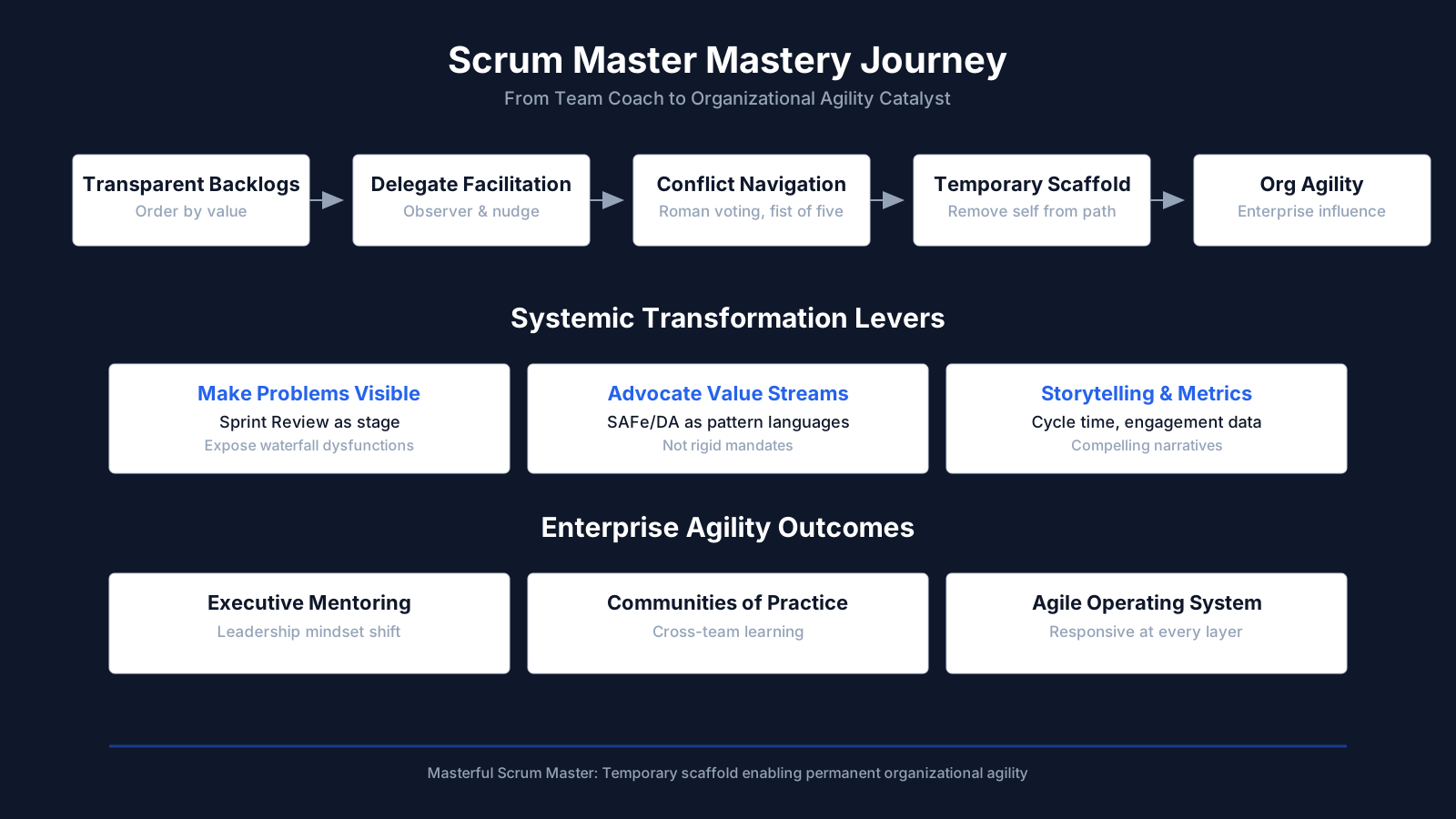
Scrum Mastery: Summary of Agile Frameworks & Methods
| Key Concept | Summary |
|---|---|
| Scrum Mastery | Scrum Mastery embodies a leadership discipline focused on cultivating empirical process control, self-organizing team dynamics, and relentless improvement rather than enforcing rigid procedural compliance. |
| Core Skills | Genuine mastery demands a combination of emotional intelligence, advanced coaching, targeted teaching, mentoring, and organizational design to skillfully navigate complex team dynamics and systemic organizational politics. |
| Framework Integration | An accomplished Scrum Master seamlessly weaves complementary methods such as Kanban flow management, Lean waste reduction, and Extreme Programming's technical excellence into Scrum, preserving its core feedback loops. |
| Versus Facilitation | Scrum Mastery transcends basic facilitation by prioritizing measurable business outcomes and catalyzing strategic organizational change, rather than simply timeboxing meetings. |
| Strategic Impact | A proficient Scrum Master serves as a change agent who surfaces systemic impediments, translates team metrics into compelling business narratives, and accelerates time-to-market while elevating product quality. |
| Scrum Foundation | The Scrum framework provides a lightweight yet deliberate structure of accountabilities, events, and artifacts that establishes an iterative inspect-and-adapt cadence through timeboxed Sprints. |
| Empiricism | Deep mastery involves not only understanding empiricism's pillars of transparency, inspection, and adaptation, but also applying them with nuanced judgment to drive actionable, evidence-based improvements. |
| Leading Without Authority | A masterful Scrum Master acts as a reflective mirror, exposing team dysfunctions without blame and progressively cultivating self-managing capabilities. |
| Organizational Debt | Scrum Mastery entails surfacing organizational debt, including outdated governance policies and inflexible budget cycles, to transition the enterprise toward a product-centric operating model that sustains continuous value delivery. |
| Psychological Safety | An adept Scrum Master detects subtle barriers to psychological safety that suppress honest conversation and intervenes at the systemic level to foster an environment of trust and open collaboration. |
Defining Scrum Mastery in a Complex World
Scrum Mastery represents a level of proficiency that transcends the mechanics of facilitating the Daily Scrum or managing the Product Backlog. A novice Scrum Master focuses on ensuring the team follows the Scrum Guide, which is the foundational document defining the framework's accountabilities, events, and artifacts. A master, however, understands the underlying theory of empiricism—transparency, inspection, and adaptation—and applies it with nuance. They know that the value of a Sprint Retrospective is not the event itself but the actionable improvement experiment that emerges from it. They shift the team’s focus from counting story points to delivering valuable increments of functionality, always keeping the Definition of Done as a quality contract rather than an administrative checklist.
This elevated practice involves a significant psychological dimension . Scrum Mastery requires deep emotional intelligence to navigate the complexities of team dynamics, cognitive biases, and organizational politics. A truly masterful Scrum Master serves as a mirror for the team, making systemic dysfunctions visible without assigning blame and, crucially, without becoming the bottleneck for every decision. They cultivate an internal locus of control within the team, gradually removing their own safety net of intervention so the team learns to self-manage and resolve its own conflicts. This ability to fade into the background while ensuring the structural integrity of the process is the hallmark of a professional who has achieved Scrum Mastery.
Furthermore, Scrum Mastery involves a paradoxical relationship with the framework itself. While the Scrum Guide is remarkably concise, the real world is messy. A master knows when to adhere strictly to the framework’s constraints to highlight a systemic issue and when to pivot toward complementary practices. They understand that Scrum is a framework that is intentionally incomplete, requiring a team to fill in the gaps with their own specific techniques. To unlock agile frameworks and methods effectively, a Scrum Master must become an expert in the "and"—knowing how to integrate technical practices from Extreme Programming, flow metrics from Kanban, and elimination of waste from Lean thinking directly into the Scrum container without breaking the core feedback loops.
How Scrum Mastery Differs from Basic Facilitation
Many organizations mistakenly hire a Scrum Master as an administrative assistant for the development team, a role often labeled "the team secretary." This misunderstanding completely undermines the potential of Scrum Mastery. Facilitation is a skill set used by the Scrum Master, but it is not the sum total of the role. Mastery involves shifting from a focus on timeboxing meetings to a focus on outcomes. A facilitator ensures the Sprint Planning lasts four hours; a master ensures the team leaves that meeting with a viable Sprint Goal and a realistic forecast of the work. A facilitator takes notes in a retrospective; a master detects the underlying safety issues preventing honest conversation and intervenes at the organizational level to improve psychological safety.
The distinction also lies in the scope of accountability. Basic facilitation stops at the team boundary. Scrum Mastery extends to the entire organization. A master actively teaches leadership about the dangers of utilization-driven management and the benefits of flow-based thinking. They help the Product Owner understand value-based prioritization techniques like Cost of Delay, and they mentor the organization on how to shift from a project-centric to a product-centric operating model. This requires a strategic mindset rarely found in simple facilitation roles. True Scrum Mastery is thus an accountable leadership position, not a junior support function.
The Strategic Impact of Unlocking Agile Frameworks
When an organization invests in developing Scrum Mastery rather than just hiring process coaches, the strategic benefits are profound. A skilled Scrum Master acts as a change agent who systematically exposes and removes impediments that slow the flow of value. These impediments often manifest as dependency management bottlenecks, excessive governance gates, or a culture of blame. By unlocking agile frameworks and methods at the team and leadership levels, the Scrum Master enables faster time-to-market, higher quality, and increased employee engagement. They translate empirical data from the team—such as cycle time and throughput—into business language that executives can use for portfolio forecasting.
This strategic layer of Scrum Mastery is often overlooked in training materials that focus solely on the mechanics of the Daily Scrum. The master leverages the Scrum framework to surface organizational debt, which includes outdated HR policies, rigid budgeting cycles, and architectural constraints. They facilitate conversations that break down silos, helping a collection of individual feature teams evolve into a cohesive, value-driven product ecosystem. In this context, unlocking agile frameworks and methods means creating an environment where business agility is not just a buzzword but an operational reality.
Core Insights on Scrum Mastery
- Empiricism over mechanical execution
- A masterful Scrum Master applies transparency, inspection, and adaptation with precision to design improvement experiments that produce measurable outcomes, rather than simply performing the Scrum Guide’s events by rote.
- Psychological depth is critical
- Scrum Mastery demands high emotional intelligence to navigate intricate team dynamics and organizational politics, surfacing dysfunctions without blame and fostering the team’s internal locus of control.
- Paradoxical application of the framework
- A master discerns when to rigorously apply Scrum’s constraints to expose systemic issues and when to incorporate complementary practices from Extreme Programming, Kanban, or Lean, always safeguarding the essential feedback loops.
- Outcomes over facilitated meetings
- Unlike a facilitator who merely timeboxes discussions, a true master ensures decisive outcomes such as a viable Sprint Goal, reliable forecasts, and the psychological safety required for honest, high-stakes conversations.
- Strategic organizational impact
- Scrum Mastery extends its influence throughout the organization, acting as a change agent who removes systemic impediments, instills value-based prioritization, and translates team data into business language that enables executive decision-making.
The Foundation of Scrum: A Single-Team Framework
Before one can achieve Scrum Mastery across a broad spectrum of methods, one must first master the foundational container: the Scrum framework itself. Scrum is purposefully lightweight, defined by its accountabilities of Scrum Master, Product Owner, and Developers, and its events of the Sprint, Sprint Planning, Daily Scrum, Sprint Review, and Sprint Retrospective. The artifacts of the Product Backlog, Sprint Backlog, and Increment serve as commitments of transparency. The power of Scrum lies not in its complexity but in its relentless insistence on an inspect-and-adapt cadence through a timeboxed Sprint, typically two weeks or less.
A deep command of Scrum Mastery requires an almost philosophical understanding of why these elements are indispensable. The Sprint is the heartbeat of agility, a protective container that shields the Developers from shifting priorities while allowing the business to respond to change immediately after the Sprint Review. The Sprint Goal acts as the cohesive mission that prevents the team from merely assembling a collection of disparate tasks. A master knows that if a Sprint Goal becomes invalid, the Product Owner has the authority to cancel the Sprint, a radical option that ensures the team never invests time in work that no longer serves the business strategy. Scrum Mastery involves protecting the integrity of this boundary system.
The Empirical Pillars and the Definition of Done
At the heart of the Scrum framework lies empiricism, which demands transparency, inspection, and adaptation. For a Scrum Master striving for mastery, the Definition of Done is the single most critical quality control mechanism. It is a formal description of the state of the Increment when it meets the quality measures required for the product. Without a clear, testable Definition of Done, the organization cannot inspect the Increment truthfully. A master crafts this understanding with the team, ensuring it encompasses everything from functional testing and code review to integration, documentation, and compliance checks. They understand that a weak Definition of Done hides massive undiscussable technical debt.
Transparency is often the first pillar to fail. When the Definition of Done is fudged to appease a deadline, the entire empirical process collapses, as the team is making decisions based on an illusion of progress. Scrum Mastery involves the courage to make this lack of transparency visible to stakeholders, even when it is uncomfortable. By teaching the Product Owner and the organization that an Increment that fails to meet the Definition of Done is not truly "done," the Scrum Master safeguards the long-term sustainability of the product. This act of holding the line on quality is a defining trait of someone who has transcended the mechanical aspects of the role and entered the realm of professional mastery.
Accountabilities and the Art of Self-Management
The shift from "roles" to "accountabilities" in the 2020 Scrum Guide was a nuanced change that a master must fully internalize. The Developers are not just "doing work"; they are accountable for creating a plan for the Sprint, the Sprint Backlog, and for instilling quality by adhering to the Definition of Done. The Product Owner is accountable for maximizing the value of the product resulting from the work of the Scrum Team. The Scrum Master is accountable for establishing Scrum as defined in the Scrum Guide, which includes serving the Scrum Team and the wider organization. True Scrum Mastery lies in enabling these accountabilities to flourish without stepping into them. A master avoids the trap of becoming a "super Product Owner" or a "tech lead," instead coaching the individuals to own their domains of responsibility.
Self-management is the ultimate goal of the Developers’ accountability. A team that self-manages decides internally who does what, when, and how. A Scrum Master unlocks this capability by structuring conversations around the Sprint Goal rather than assigning tasks. When a team member asks for a task, the master reframes the question to focus on the collective commitment to the Goal. This subtle shift from a command-and-control structure to a pull-based, collaborative model requires immense patience and coaching skill. The journey from a group of individuals waiting for instructions to a high-performing, self-managing unit is the very essence of unlocking agile frameworks and methods, and it happens one Sprint at a time through the guidance of a master.
Extending Mastery: A Landscape of Agile Frameworks and Methods
While Scrum is an excellent starter framework for team-level agility, business agility demands a broader toolkit. A Scrum Master with true mastery understands that context drives method selection. For operational or support teams with high variability in work items, Kanban might provide a far better starting point than Sprint-based Scrum. For projects involving high customer uncertainty, the hypothesis-driven cycles of Lean Startup are essential. The modern master does not evangelize Scrum as the only way; they help the organization right-size its process. Unlocking agile frameworks and methods means knowing when to apply Extreme Programming’s technical disciplines to rescue a team drowning in technical debt or when to introduce Lean’s value stream mapping to visualize organizational bottlenecks.
This cross-framework fluency is what separates an expert from a one-trick mechanic. The Kanban Method focuses on visualizing the workflow, limiting work in progress, and managing flow to optimize system delivery. It defines no mandatory roles. Extreme Programming (XP) offers prescriptive engineering practices like Test-Driven Development (TDD), pair programming, and continuous integration, which are often the missing link in Scrum implementations that struggle with quality. Lean thinking teaches the elimination of the eight wastes of software development, including partially done work, extra features, and task switching. A Scrum Master who masterfully integrates these concepts into a Scrum environment creates a robust, resilient delivery system that is far greater than the sum of its parts.
Mastering Kanban Flow within a Scrum Container
Many advanced Scrum teams adopt Kanban practices within the Sprint. This hybrid approach, sometimes called "Scrumban," does not require abandoning the Sprint, Daily Scrum, or Retrospective. Instead, it enhances visibility and flow. A Scrum Master applying this method helps the team visualize its Sprint Backlog on a board with explicit Work in Progress (WIP) limits. WIP limits physically prevent the team from starting too much work at once, a common anti-pattern called "over-commitment." By focusing on finishing rather than starting, the team reduces lead times and exposes bottlenecks. The master facilitates a daily stand-up that walks the board from right to left, focusing the conversation on blocked items and flow metrics rather than status reports.
The mastery here lies in understanding the metrics of flow: cycle time, throughput, and work item aging. A Scrum Master fluent in Kanban data can use these metrics to replace gut-feel estimation with probabilistic forecasting. When a Product Owner asks when a specific item will be done, a master can provide a Monte Carlo simulation derived from historical cycle time data rather than a single-point guesstimate. This unlocks a higher level of agile maturity, transforming conversation from hours and velocity to probability and risk. It requires the Scrum Master to teach the team and stakeholders how to interpret these data points, moving the organization toward a pull system where work is started only when capacity is available, drastically reducing burnout and improving predictability.
Integrating Extreme Programming Practices for Technical Excellence
Scrum without technical excellence is often a recipe for a stressed death march. The framework explicitly requires a potentially releasable Increment every Sprint, but it does not prescribe how to achieve the technical quality necessary for that cadence. This is where Extreme Programming (XP) becomes indispensable for Scrum Mastery. A master who recognizes the team’s struggle with regression bugs and integration hell introduces the concepts of test automation and continuous integration. They do not need to be the most senior engineer, but they must coach the team on the value of these practices and advocate for the creation of space in the Sprint Backlog to reduce technical debt.
Test-Driven Development (TDD) and pair programming are powerful tools for unlocking agile frameworks and methods because they fundamentally alter the economics of quality. TDD ensures that every line of production code is written to satisfy a failing test, creating a safety net of automated regression tests. Pair programming, a technique involving two developers working together at one workstation, serves as a continuous code review process, dramatically improving code quality and spreading domain knowledge across the team. A Scrum Master coaches the organization to accept the short-term slowdown of learning these practices in exchange for the long-term elimination of manual testing phases and maintenance nightmares. This is how mastery lifts a team from "agile in name only" to true sustainable pace.
Lean Thinking and the Elimination of Waste
Lean product development principles provide a crucial lens for a Scrum Master to evaluate the value stream. The seven original wastes of manufacturing translate to software as partially done work, extra features, relearning, handoffs, delays, task switching, and defects. A master demonstrates Scrum Mastery by mapping these wastes to the team’s daily reality. For instance, a massive Product Backlog containing hundreds of items that are poorly refined represents the waste of overproduction and handoffs. A Scrum Master coach guides the Product Owner to cut the backlog aggressively, keeping it lean and focused on the near-term value horizon. They facilitate "discovery Kanban" boards to limit speculation and validate assumptions before a user story ever enters a Sprint.
Moreover, the principle of "optimizing the whole" is central to Lean and to unlocking agile frameworks and methods across an enterprise. A Scrum Master who only focuses on team-level velocity may inadvertently optimize a single part of the system while sub-optimizing the whole. Mastery requires looking upstream and downstream. If a team delivers a perfect Increment that then sits in a release queue for two months because of a manual compliance check, the system is not agile. The master takes accountability for working with the compliance department to automate the governance process and integrate it into the Definition of Done, thereby eliminating the waste of waiting rather than simply reporting that the wait exists.
Core Insights on Agile Frameworks and Methods
- Context-Driven Method Selection
- A seasoned professional selects Kanban for operational teams facing variable work volumes, Lean Startup for high customer uncertainty, and Extreme Programming when technical debt demands immediate rescue, instead of defaulting to Scrum as the only framework.
- Kanban Flow within Scrum
- Teams strengthen Scrum by visualizing the Sprint Backlog, enforcing explicit work-in-progress limits, and applying flow metrics such as cycle time and throughput to generate probabilistic forecasts, replacing reliance on gut-feel estimation.
- Extreme Programming for Quality
- Scrum Mastery incorporates Test-Driven Development and pair programming to build automated regression tests and continuous code review, thereby eradicating regression bugs and integration bottlenecks while sustaining a manageable pace.
- Lean Waste Elimination
- Lean thinking targets the elimination of eight distinct wastes in software development, such as partially done work and excessive task switching, to streamline value streams and expose organizational bottlenecks that disrupt flow.
- Cross-Framework Fluency
- An expert Scrum Master blends Kanban, Extreme Programming, and Lean practices into a resilient delivery system, shifting the organization from rigid adherence to a pull-based model that reduces burnout and improves delivery predictability.
The Expanded Toolkit of a Scrum Master
To unlock agile frameworks and methods effectively, the modern Scrum Master must be a professional coach, a skilled facilitator, a gifted teacher, a mentor, and a management consultant. These are not just synonyms for "nice person." Professional coaching is the art of asking powerful, open-ended questions that unlock the team’s ability to solve its own problems. Instead of giving advice like "you should break that story down," a master asks, "What would be the smallest, most valuable slice of this functionality that would deliver a learning outcome?" This coaching stance preserves the team’s autonomy and builds its problem-solving muscle over time, preventing the Scrum Master from becoming an information bottleneck.
Teaching is another mode entirely. There are times when the team lacks knowledge, not awareness, and the Scrum Master must step into the role of a teacher to explain the principles of the framework or the mechanics of a new method. Mentoring involves sharing personal experience, such as "When I faced this situation before, we handled it by..." The agility of a master lies in consciously selecting which stance—coaching, teaching, mentoring, or consulting—to take in a given moment. This conscious use of self, rooted in self-awareness and context sensitivity, is a high-level competence that distinguishes a professional from an amateur practitioner.
Advanced Facilitation Techniques for Decision Making
Any Scrum event can devolve into a meandering waste of time without skilled facilitation. Scrum Mastery involves the use of structured divergent and convergent thinking techniques. During a Sprint Retrospective, a master understands that a team needs to diverge to generate safety and collect data, explore that data to identify root causes, and then converge to decide on a single, actionable improvement experiment. Frameworks like the "Five Whys," "Fishbone diagrams," and "Impact Mapping" are tools in the master’s kit, but they are applied with a light touch. The technique should never dominate the conversation; it should simply serve to keep the team from the cognitive biases of anchoring and groupthink.
Facilitation of decision-making is equally critical. Many teams stall because they aim for consensus, which often degrades into a weak compromise. A master introduces consent-based decision models, where a proposal is adopted if no one has a principled objection. They visibly track objections, synthesizing them not as blockers but as feedback that strengthens the proposal. For larger, multi-team events like the Sprint Review, the master shifts from a slide-show demo format to a technical open space, where stakeholders engage directly with the working software and data. Unlocking agile frameworks and methods often hinges on these subtle changes in meeting design that shift the dynamic from a reporting hierarchy to a collaborative inspection.
Navigating Organizational Impediments
The most difficult aspect of Scrum Mastery is not coaching the quiet team member or facilitating a Sprint Planning session; it is battling organizational gravity. This gravity comes in the form of a matrix management structure where the team reports to a functional manager who has no understanding of agility, or a budgeting process that demands a detailed scope locked down months in advance. A master sees these impediments not as personal failures but as the work itself. They switch into a management consulting mode, building a business case for change by connecting team-level metrics to corporate outcomes like reduced time-to-market or improved customer satisfaction scores.
To effectively unlock agile frameworks and methods in a resistant environment, the master often partners with an internal champion in the leadership team. They foster a "taxi-driver" approach: they wait for the executive to express a business pain (like "our competitors are releasing faster"), and then they offer a ride in the agile vehicle that addresses that specific pain, rather than presenting agility as a wholesale ideological conversion. This pragmatic, politically savvy approach is a necessary competence for enterprise agility. It requires the master to listen deeply, to frame the value of Scrum in the language of risk management, and to celebrate early adopters while building a coalition of the willing, isolating the resisters through a gravitational pull toward success.
Scrum Master Training and Certification Pathways
The market offers a wide array of Scrum Master training opportunities, but a piece of paper alone does not confer Scrum Mastery. The certification pathway, typically beginning with the Certified ScrumMaster (CSM) from the Scrum Alliance or the Professional Scrum Master I (PSM I) from Scrum.org, provides a crucial foundation of vocabulary and core principles. The PSM I is often valued for its rigorous assessment that cannot be passed by simply attending a course; it requires a genuine study of the Scrum Guide and its application. These entry-level certifications test knowledge of the accountabilities, events, and artifacts. They are the beginning of the journey, establishing a minimum threshold of competence to speak the language of Scrum.
True progression toward unlocking agile frameworks and methods requires moving beyond entry-level certifications to advanced credentials and deep practice. The PSM II and PSM III from Scrum.org, or the Advanced Certified ScrumMaster (A-CSM) and Certified Scrum Professional-Scrum Master (CSP-SM) from Scrum Alliance, shift the focus from the "what" to the "why" and "how." PSM II, for instance, expects a master to understand facilitation techniques, coaching stances, and the application of Scrum in complex multi-team environments. The PSM III assessment, often an essay and multiple-choice mix, tests the ability to apply the framework in non-traditional settings and to navigate ambiguous trade-offs, truly assessing the judgment that defines mastery.
Choosing the Right Training for Your Context
When seeking training to advance toward Scrum Mastery, look for programs that emphasize experiential learning over slide decks. High-quality training involves simulations and "flipped classroom" models where participants solve complex, real-world scenarios rather than just regurgitating facts. Programs that include a significant component of coaching practice, using fishbowl exercises where participants coach each other under observation, offer deeper skill development. It is also critical to cross-train in complementary agile frameworks. A Scrum Master who takes a certified Kanban course such as the Team Kanban Practitioner (TKP) or attends a Lean Startup workshop immediately brings more value to an organization than one who only knows a single framework.
The greatest training, however, is deliberate practice in the field. A wise candidate will seek mentorship from an experienced Scrum Master or an agile coach who has already walked the path. They will engage in peer learning communities, such as local Scrum user groups, and they will rigorously self-reflect after every event they facilitate. There is no substitute for the experience of handling a team that is in the "storming" phase of Tuckman’s model, or for the scar tissue earned from a Sprint Review where a stakeholder rejects the entire Increment. Training provides the map, but Scrum Mastery is the ability to navigate the terrain when the map doesn’t match reality.
Continuous Learning as a Core Competency
The field of unlocking agile frameworks and methods evolves continuously. What was considered best practice five years ago, such as the ubiquitous use of estimation scales, is now being challenged by the no-estimates movement focused on flow metrics. A Scrum Master committed to mastery adopts a growth mindset, reading widely beyond traditional agile literature into fields like cognitive psychology, organizational sociology, and complexity theory. Authors like David Marquet with "Turn the Ship Around!" on intent-based leadership, or the works of W. Edwards Deming on system optimization, provide deeper philosophical underpinnings than many agile training manuals.
This commitment to continuous learning also requires the master to be a voracious consumer of empirical data. They experiment with different retrospective formats, measure the impact, and discard what doesn’t work. They maintain a personal backlog of improvement experiments not just for their team but for themselves. This transparent modeling of a learning cycle is one of the most powerful teaching tools a Scrum Master has. When the team sees their master actively seeking feedback on their facilitation style and visibly adapting, it reinforces the cultural norm that vulnerability and growth are valued over the appearance of expertise.
Core Takeaways on Certification Pathways
- Entry-level certifications as the foundation
- Credentials such as CSM or PSM I provide a common language and a foundational grasp of Scrum, but they are merely the first milestone on the path to true mastery.
- Advanced credentials shift the focus
- Higher-level credentials, including PSM II and A-CSM, test your practical facilitation skills, decision-making in ambiguous settings, and your ability to adapt Scrum in context rather than merely recalling rules.
- Experiential learning over mere theory
- The most impactful development blends immersive simulations, repeated coaching practice, and real-world scenario work, while cross-training with Kanban and Lean practices equips you to manage workflow bottlenecks and systemic constraints.
- Continuous learning as a core skill
- Genuine mastery requires a growth mindset that reads beyond agile, studying organizational psychology and complexity theory, and models a personal cycle of experimentation by regularly refining your facilitation and coaching approaches.
Scaling Agility and the Role of the Master
As organizations move beyond a single Scrum team, they encounter the challenge of coordination. Scaling agility is not about layering on a heavy set of processes but about enabling multiple teams to seamlessly work on a single product. Frameworks like Nexus, LeSS (Large-Scale Scrum), and Scrum@Scale were designed to address this complexity while retaining a ruthless commitment to empiricism and self-management. The Nexus framework, for example, uses a Nexus Integration Team that acts much like a Scrum Master for the overall product environment, ensuring that dependencies are identified and integrated continuously.
Scrum Mastery at scale involves a delicate balance between team autonomy and product coherence. A master working within a scaled environment knows that the primary cause of scaling failure is not the lack of architecture but the lack of a single Product Backlog managed by a single Product Owner. When an organization fragments into feature teams with their own backlogs, it inevitably creates dependencies and hidden technical debt. A master unlocks agile frameworks and methods at scale by fiercely defending the concept of a single Product Backlog for a single product, even if it means challenging the traditional organizational chart.
The Function of the Scrum of Scrums and Cross-Team Coordination
The Scrum of Scrums is often misapplied as a status reporting meeting, a terrible waste of time that destroys agility. A master facilitates a Scrum of Scrums with a focus on answering two primary questions: what impediments is my team facing that will block another team, and what has my team done that may create a dependency for another team? This transforms the session into a coordination huddle, not a justification session. The master coaches the ambassadors from each team to walk a task board of cross-team dependencies, treating the coordination of the nexus as a flow problem rather than a project management problem.
Effective Scrum Mastery in this context requires systems thinking. Instead of optimizing the velocity of a single team at the expense of the whole, the master monitors the flow of value across the entire product. They may notice that one component team is overburdened because every vertical feature team relies on them. The master’s intervention is not to schedule more meetings but to coach the organization on the benefits of eliminating the component team entirely by cross-pollinating those specialists into the feature teams, thereby removing the cross-team dependency at its root cause. This type of structural self-management coaching is the apex of Scrum Mastery in a scaled environment.
Debunking Myths and Navigating the Anti-Patterns of Agile
No discussion of unlocking agile frameworks and methods is complete without a sharp critique of the persistent myths that degrade implementation. The most damaging myth is that "Agile means no planning." In reality, agile methods involve continuous planning at multiple levels. The Sprint is a detailed plan for the immediate future. The Product Backlog is a rolling wave plan. The Sprint Review provides empirical data that feeds business planning. A master debunks this myth daily by coaching the Product Owner on the use of burndown charts, cumulative flow diagrams, and release burndowns to make planning a transparent, ongoing dialogue rather than a single upfront ceremony.
Another prevalent myth is that a Scrum Master is only needed until the team "gets it." This reflects a fundamental misunderstanding of the role. While a team may become self-managing in terms of technical work, the organizational impediments and the complexity of product development are perpetual. The Scrum Master’s focus shifts, but the accountability for the overall system’s effectiveness never evaporates. In a mature team, the master spends less time on basic facilitation and more time on high-level organizational surgery, which is a full-time value proposition. Abolishing the role because the team is running Daily Scrums on its own is akin to firing a surgeon because the patient’s heart is currently beating.
The Agile Industrial Complex and Dark Scrum
Scrum Mastery includes the ethical duty to identify and resist what some practitioners call "Dark Scrum." This is the corruption of agile principles into a cargo-cult performance of ceremonies that maintains a hierarchical, fear-based management culture. Dark Scrum uses velocity as a performance metric to compare teams or rate individuals, thereby destroying psychological safety and encouraging gaming of the system. It turns the Sprint Review into an approval gate where the manager signs off on the work. A Scrum Master with integrity confronts these anti-patterns head-on, sometimes at personal career risk, by educating leadership on the catastrophic consequences of using agile metrics as a weapon.
The "agile industrial complex" refers to the vast certification and consulting machinery that often sells "best practice" templates that have no evidentiary basis for a specific context. Mastery involves a healthy skepticism of frameworks sold as silver bullets. The Scaled Agile Framework (SAFe), for example, is a comprehensive body of knowledge that has helped some enterprises structure their hierarchies, but it can also be implemented as a strict "waterfall in agile wrapping" if the underlying Lean-Agile mindset is ignored. A master evaluates any framework, whether it is SAFe, LeSS, or Disciplined Agile, through the lens of the Agile Manifesto values and the iron test of empirical evidence. They avoid investing their identity in a single framework, remaining a critical thinker loyal only to the outcome of value delivery.
Core Insights on Agile Myths and Anti-Patterns
- Agile requires continuous planning
- Agile replaces traditional upfront plans with iterative planning through Sprints, Product Backlogs, and Sprint Reviews, transforming planning into an ongoing, transparent conversation.
- Scrum Master role remains vital
- Even mature teams rely on the Scrum Master to navigate persistent organizational impediments and drive sustained systemic improvements, making the role far from temporary.
- Resist Dark Scrum and framework dogma
- Scrum Masters must actively combat anti-patterns such as using velocity as a punitive metric and critically evaluate scaling frameworks like SAFe through empirical evidence and alignment with core Agile values, avoiding uncritical adoption.
The Future of Scrum Mastery and Closing Thoughts
The role of the Scrum Master is evolving toward a fusion of agility leadership and enterprise coaching. As artificial intelligence and automation handle more repetitive project tracking, the distinctly human elements of Scrum Mastery—intuition, empathy, conflict resolution, and cultural transformation—become even more critical. The future master will need to be deeply literate in process analytics and data science to argue the case for agility in boardrooms that are data-driven, but their core value will remain the ability to inspire a team to find profound meaning in its work and to create environments where creativity overcomes compliance.
Unlocking agile frameworks and methods is a career-long journey of personal development. It requires the intellectual rigor to understand flow theory, the emotional resilience to absorb toxic systemic pressure, and the political savvy to reform it without being ejected from the organization. It demands a steadfast commitment to the ideals of the Agile Manifesto: individuals and interactions over processes and tools, working software over comprehensive documentation, customer collaboration over contract negotiation, and responding to change over following a plan. The greatest Scrum Masters are those who realize that mastery is not a destination but a state of constant becoming, a permanent apprenticeship to the craft of helping smart people work together better.
In the end, achieving Scrum Mastery is about embracing the complexity of human systems. You will experience Sprints that deliver zero increments and retrospectives that descend into shouting matches. You will battle middle managers who believe your role is redundant. But if you persist—if you study the depths of agile frameworks and methods, practice the nuanced art of coaching, and hold fast to the principles of transparency and empiricism—you will find that you have not just unlocked a process for your team, but unlocked a new level of potential within yourself and the organizations you serve.
Advance Your Career with Professional Certification
Earning a professional project management certification validates your expertise in industry-standard methodologies and showcases your ability to lead teams through complex, dynamic initiatives. By becoming a certified project manager , you gain a competitive edge that often translates into higher salaries, broader job opportunities, and greater trust from stakeholders. Organizations also benefit from reduced risk, improved resource allocation, and a consistent framework that elevates overall project success rates, making certified professionals invaluable assets in any industry.
In today's fast-paced Agile environments, earning a professional product management certification validates your ability to drive product vision and deliver customer value effectively. Becoming a certified product manager demonstrates a deep understanding of market analysis, roadmap strategy, and cross-functional leadership, setting you apart in a competitive job market. For organizations, certified professionals help reduce costly missteps by applying structured frameworks that align product goals with business outcomes, ultimately accelerating time-to-market and boosting stakeholder confidence.
Earning a professional HR management certification signals a deep commitment to mastering modern people strategies, from compliance and talent retention to fostering inclusive cultures. This credential not only accelerates your own career trajectory by distinguishing you in a competitive job market but also equips you to drive measurable organizational outcomes like reduced turnover and stronger employee engagement. As companies increasingly prioritize data-driven people operations, certified HR professionals are uniquely positioned to align workforce planning with business goals, making them indispensable strategic partners.