Most supply chain failures do not begin with a single catastrophic event. They begin with a handoff that was assumed to work, a dependency that nobody fully mapped, or a known weak point that became acceptable because nothing bad had happened yet. Failure Mode and Effects Analysis, commonly called FMEA, gives operations teams a structured way to look at those risks before they turn into missed shipments, production stoppages, or compliance failures. When managers ask how to apply Failure Mode and Effects Analysis in supply chain operations, they are usually looking for a practical method that goes beyond generic risk matrices and actually connects to daily material, information, and cash flows.
The challenge is that most traditional FMEA examples come from product design or manufacturing. A component can crack, a seal can leak, a torque setting can be too low. Supply chains have different failure characteristics. They involve multiple organizations, variable lead times, demand shifts, handoffs between systems, and human judgment. The same thinking still applies, but it needs to be adapted to flows rather than parts. This article covers the method, the scoring logic, common failure modes, and the implementation habits that make FMEA useful in supply chain work.
FMEA in Supply Chain: Summary of Key Topics
| Concept | Summary |
|---|---|
| FMEA | Failure Mode and Effects Analysis provides a systematic framework for identifying and prioritizing operational risks that could disrupt shipments, halt production, or trigger compliance failures. |
| Root Causes | Risk frequently originates in overlooked handoffs, undocumented dependencies, or tolerated vulnerabilities that persist because no major incident has exposed them. |
| Supply Chain Fit | Effective supply chain FMEA requires adapting the methodology to variability across organizations and inputs based on human judgment, rather than treating it as a closed manufacturing line. |
| Process Scope | The analysis delivers the greatest value when scoped to a specific chain such as from order to delivery, supplier onboarding, or the management of critical raw materials. |
| Facilitation | Successful implementation relies on running FMEA as a facilitated working session with the right stakeholders and defined boundaries, not as a routine paperwork exercise. |
| Flow Mapping | A thorough process map includes supplier acknowledgments, shipment milestones, receiving records, quality inspections, inventory postings, and customer notifications. |
| Scoring Rules | Establishing clear scoring criteria upfront prevents the team from cataloguing numerous risks of low value and keeps the analysis practical, selective, and focused on decisions. |
| Worksheet | A standard FMEA worksheet documents the process step, potential failure mode, effects, severity, causes, occurrence, current controls, detection rating, and resulting risk priority number. |
What FMEA Actually Does in a Supply Chain Setting
In manufacturing and product engineering, FMEA has a long history as a preventive risk tool. In a supply chain setting, the logic stays the same but the object changes from a machine or component to a sequence of handoffs and decisions. A supply chain FMEA looks at each step in a process, asks what could go wrong, what the consequences would be, and how likely the current controls are to catch the problem. This shift matters because supply chains are cross-organizational, uncertain, and influenced by human judgment in ways a closed manufacturing line is not.
FMEA is not a one-time audit and it is not a simple risk register. It is a structured analytical conversation that forces the team to name failure modes, trace their effects, and evaluate existing controls. The output is a prioritized set of vulnerabilities. The real value comes from the discussion, because it surfaces assumptions that otherwise remain buried in emails, forecasts, and supplier contracts.
Why Traditional FMEA Does Not Translate Directly
A manufacturing process FMEA often assumes a relatively stable sequence of operations. The process is under one roof, with known equipment, defined cycle times, and measurable output quality. In supply chain operations, a process step might be an approval, a transfer of goods, a customs clearance, a demand signal, or a supplier production schedule. The boundaries are fuzzier and the failure modes often depend on third parties.
That does not mean FMEA is wrong for supply chains. It means the scope has to be defined more carefully. Instead of analyzing a single machine, the analysis might cover the order-to-delivery cycle, the supplier onboarding process, or the management of critical raw materials. The team has to agree on where the process starts and ends before it can identify what could fail.
Supply Chain System Boundaries and Interfaces
One of the most useful ways to frame a supply chain FMEA is to think in terms of interfaces. Most supply chain failures happen at the points where information or material passes from one system or organization to another. A forecast becomes a purchase order, a purchase order becomes a supplier commitment, a shipment becomes a warehouse receipt, and an inventory record becomes an available-to-promise signal. Each transition is a place where the failure mode can hide.
When the team maps these interfaces, it can begin to ask better questions. What assumptions exist at each handoff? Who owns the data? What happens if the receiving system does not reflect the same reality as the sending system? FMEA gives those questions a structure instead of leaving them to a generic post-incident review.
The Business Case for Structured Failure Analysis
The immediate return from FMEA is prevention. Teams that identify a high-risk supplier dependency before a disruption can redesign the process or add a buffer. The secondary return is better alignment. Procurement, logistics, planning, quality, and finance often have different pictures of the same flow. FMEA creates a shared description that makes disagreement visible while there is still time to act.
There is also a cultural benefit. When FMEA is used regularly, teams stop treating near misses as isolated bad luck. They start recognizing patterns, naming weak controls, and preparing for combinations of conditions that could trigger a larger failure. That shift in mindset is often more valuable than the worksheet itself.
Key Insights on Supply Chain FMEA
- From machines to handoffs
- Supply chain FMEA redirects analysis from isolated components to the full sequence of handoffs, decisions, and approvals that determine process performance.
- Structured risk questioning
- Each process step is systematically examined to identify potential failure modes, assess their consequences, and evaluate the likelihood that existing controls will detect them.
- Cross-organizational complexity
- Unlike stable manufacturing lines, supply chains span multiple organizations, operate under significant uncertainty, and rely heavily on human judgment at key decision points.
- Discussion drives real value
- The structured discussion compels teams to explicitly name failure modes and trace their downstream effects, revealing assumptions that would otherwise remain hidden in emails, forecasts, and supplier contracts.
How to Apply Failure Mode and Effects Analysis in Supply Chain Operations
The practical sequence matters because a poorly scoped FMEA can generate hundreds of low-value risks and frustrate the team. The better approach is to treat applying failure mode and effects analysis to supply chain operations as a facilitated process, not a bureaucratic form-filling exercise. This means selecting a meaningful process, defining the boundaries, gathering the right people, and using clear scoring rules from the start.
Before assigning scores, the team needs a realistic process map. If the map is too high level, the failure modes will be vague. If it is too detailed, the analysis becomes unmanageable. A useful rule is to map the process at the level of decisions and handoffs that materially affect supply, cost, quality, or delivery. The team can always drill deeper later on the items that show high risk.
Scoping Failure Mode and Effects Analysis in Supply Chain Operations
Scoping is the most important step. A supply chain process can stretch from customer demand to final delivery, and attempting to analyze everything at once usually produces a shallow risk list. Instead, choose a process where the pain or exposure is significant. That might be inbound material availability for a critical component, the order fulfillment cycle for a key market, or the management of temperature-sensitive goods.
The scope should include the start and end points, the major inputs, the outputs, and the assumptions about demand and capacity. If the team cannot state the process objective in a sentence, the scope is not ready. For example, the objective might be to convert an approved customer order into a complete and accurate shipment within the promised window. That clarity helps separate in-scope risks from adjacent risks that belong in another analysis.
Building the Process Map for Failure Mode and Effects Analysis in Supply Chain Operations
A process map for supply chain FMEA should show both material flow and information flow. Many failure modes occur because the physical goods and the system records diverge. The map should include supplier acknowledgments, transportation milestones, warehouse receipts, quality inspections, inventory updates, and customer communication points. Each interface is a candidate for deeper analysis.
It often helps to walk through a recent order or shipment as a trace. Where did delays happen? Where did people override the system? Where did data get corrected manually? Those points are strong signals. The process map does not need to be perfect, but it needs to be accurate enough that the team can agree on the sequence and the critical handoffs.
Documenting the Worksheet During Failure Mode and Effects Analysis in Supply Chain Operations
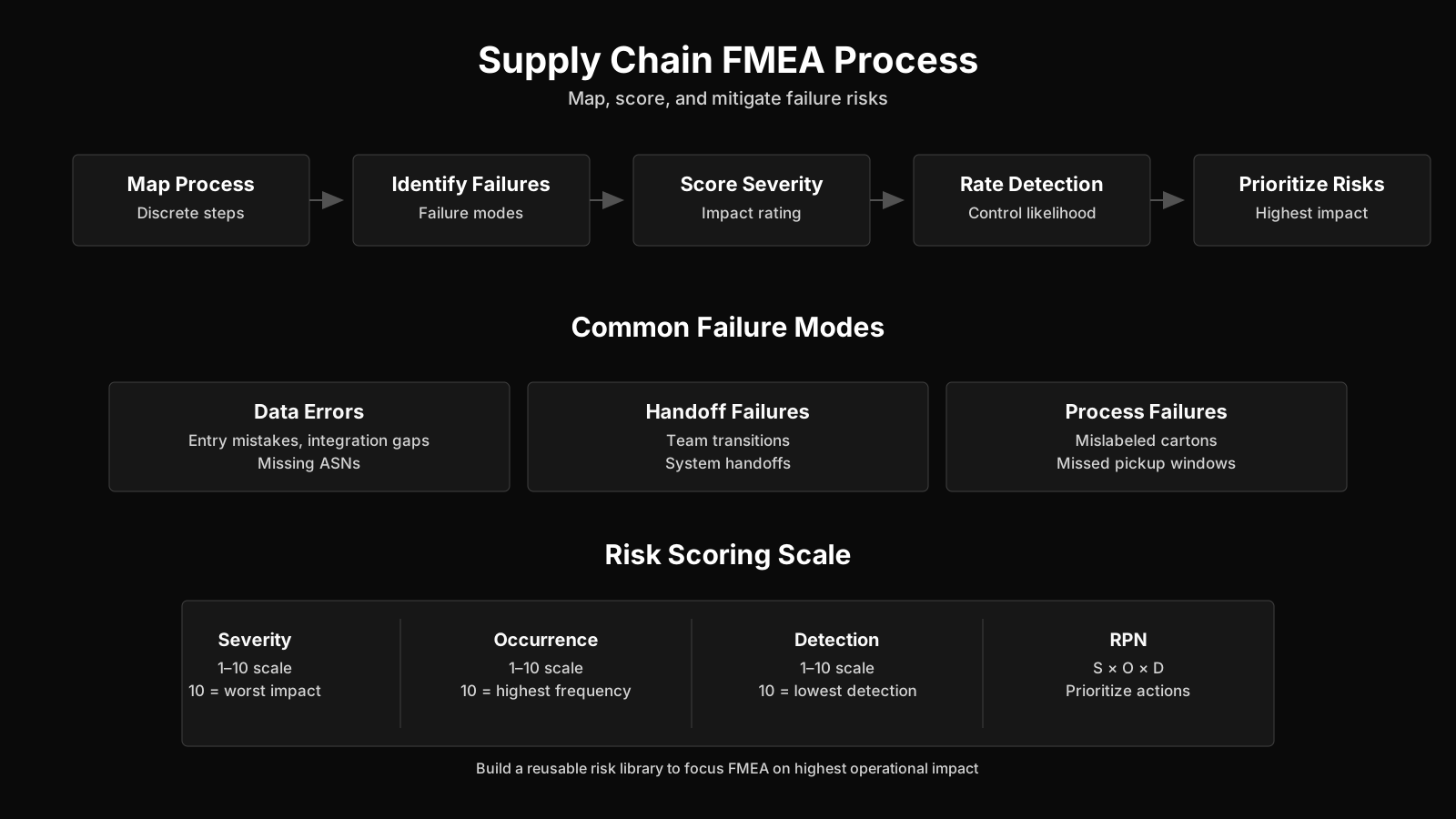
The FMEA worksheet usually includes process step, potential failure mode, potential effect, severity, potential cause, occurrence, current controls, detection, and risk priority. That structure works in supply chain settings as long as the language is adapted. A process step might be supplier order confirmation, not drill hole. A failure mode might be late confirmation or confirmation with incorrect quantity, not surface roughness.
Documentation should be concise but specific. Vague failure modes like supplier delay or system error do not lead to actionable controls. Better entries name the condition, the trigger, and the system or party involved. The worksheet is a working document, not a report to be filed and forgotten. It should evolve as controls improve and as new data becomes available.
Identifying Potential Failure Modes in Supply Chain Flows
The analysis is only as good as the failure modes the team can name. A structured approach to failure mode identification helps avoid the common trap of listing only the last three problems that happened. Using categories such as supplier, transportation, warehousing, demand planning, and information flow ensures broader coverage. It also helps the team consider failures that have not happened yet but are logically possible.
Failure modes should be expressed as something that can happen, not as a general risk theme. Instead of saying inventory risk, the team might say inventory record shows available stock while physical stock is blocked for quality hold. The latter is testable, observable, and easier to score.
Supplier-Related Failure Modes
Supplier failures often appear as late deliveries, partial shipments, quality nonconformances, or unplanned capacity constraints. A supplier may confirm an order but then fail to schedule production because its own raw material did not arrive. Another failure mode is a supplier introducing an unapproved process change that alters product characteristics. These failures can have direct effects on downstream production and customer deliveries.
In a supply chain FMEA, the team should also consider financial and compliance failure modes. A key supplier may face liquidity problems that disrupt supply even though its operational performance looks acceptable. A supplier may lose a certification or fail to meet a regulatory requirement. These are less visible than late shipments but can be more severe.
Transportation and Logistics Failure Modes
Transportation failure modes include missed pickup, equipment breakdown, port congestion, customs holds, and carrier capacity shortages. The effect might be a late arrival, a temperature excursion, or damage during handling. Weather and geopolitical events are not failure modes by themselves, but they can trigger the failure mode when the process has weak flexibility or limited alternative routing.
In many supply chains, transportation risks are treated as external and therefore acceptable. FMEA challenges that assumption. If a lane is critical and the detection control is only the carrier’s tracking update, the team may be accepting a much higher risk than necessary. The analysis can show where a second carrier option, a different mode, or a buffer stock strategy would reduce exposure.
Inventory and Warehousing Failure Modes
Warehousing failures often involve misplaced stock, inaccurate cycle counts, inadequate rotation of perishable goods, or capacity constraints during peak periods. A distribution center may receive goods but delay putaway because the system does not reflect the correct storage location. This creates a false stockout signal that triggers unnecessary replenishment orders.
Another common failure mode is damage during handling or storage, especially for items that require specific environmental conditions. The FMEA team should consider whether current controls can detect a problem before it affects the customer. If the main control is a physical inspection at the dock, there may be gaps for latent damage or slow deterioration.
Information and Demand Planning Failure Modes
Information flow failures are often underrated. A demand forecast may be biased upward, leading to excess inventory, or biased
The team should avoid inflating severity scores to force attention. If every failure mode is rated 9 or 10, the prioritization loses meaning. It is better to define severity based on the worst reasonable effect, assuming no detection control works. That separates the inherent danger from the current manageability of the failure.
Estimating Occurrence Without Perfect Data
Occurrence ratings are difficult in supply chain work because some events are rare and data may be limited. The team should use historical records where available, such as on-time delivery data, quality rejection data, and inventory accuracy reports. Where data is missing, structured expert judgment is acceptable as long as the assumptions are documented.
Occurrence should be expressed as a probability or frequency per number of transactions, not as a vague feeling. A rating scale might define 1 as less than once per 10,000 transactions and 10 as more than once per 100 transactions. Even rough anchors help the team calibrate. The key is to avoid rating every risk as moderate simply because no one wants to appear alarmist.
Assessing Detection Controls and Blind Spots
Detection refers to the likelihood that current controls will identify the failure mode or its cause before the effect reaches the customer or the next process step. In supply chains, detection controls might include supplier scorecards, incoming inspections, system alerts, forecast exceptions, or logistics tracking. A control that only detects the problem after the customer complains has a weak detection rating.
Teams often overestimate detection capability. They assume that because a system can produce a report, the right person will see the report and act. The FMEA should evaluate whether the control is automatic, whether it is monitored, and whether there is a defined response. If a report exists but nobody owns the response, detection is not as strong as it appears.
Key Insights on Failure Mode Identification
- Structured categories ensure broad coverage
- Organizing the analysis around categories like supplier, transportation, warehousing, demand planning, and information flow helps teams move beyond recency bias and systematically surface failure modes across the entire value chain.
- Specific descriptions beat vague labels
- Describing failure modes with operational specificity, such as inventory records showing available stock while physical units are blocked on quality hold, makes risks actionable and avoids the ambiguity of generic labels like inventory risk.
- Triggers differ from failure modes
- External events such as weather disruptions or geopolitical shifts become failure triggers only when processes lack flexibility or alternative routing, so teams should assess detection controls in light of that underlying vulnerability.
Prioritizing Risks with RPN and Action Priority
The risk priority number is a straightforward way to combine severity, occurrence, and detection. But many teams misuse it by setting arbitrary thresholds or treating the number as an objective fact. A better approach to risk prioritization with RPN and action priority involves using the score as a conversation starter rather than a final ranking. This matters in supply chain work where a low-probability event can still be unacceptable if the effect is severe.
The shift from pure RPN to a more balanced view has become common in industries where FMEA is governed by formal standards. The AIAG and VDA FMEA handbook introduced action priority to reduce the dominance of RPN and to focus attention on specific combinations of severity, occurrence, and detection. Both methods can work in supply chain applications if the team understands their limits.
How RPN Works and Where It Breaks Down
RPN is calculated by multiplying severity, occurrence, and detection. The result is a number from 1 to 1,000. A high number suggests a higher priority for action. The problem is that many different combinations can produce the same RPN. A failure with severity 10, occurrence 2, and detection 5 scores 100, as does a failure with severity 5, occurrence 10, and detection 2. Those two risks require very different responses.
Another issue is that detection has a strong influence on RPN even though detection does not reduce the inherent severity or occurrence of a failure. A team might improve detection by adding an inspection, which lowers RPN without changing the underlying risk. That can create a misleading sense of improvement if the inspection is not reliable.
Using Action Priority to Focus on Critical Combinations
Action priority evaluates severity, occurrence, and detection as a set of rules rather than a simple multiplication. It gives higher priority to failures with high severity, high occurrence, and weak detection, while treating lower-severity or well-detected failures differently. This approach aligns better with supply chain risk because the team wants to act on the combinations that truly threaten continuity.
If an organization does not have a formal action priority table, it can still apply the principle. The team can sort failures by severity first, then by occurrence and detection. That simple change prevents a large number of medium issues from drowning out one severe issue with a lower RPN.
Setting Review Triggers and Escalation Rules
Prioritization only matters if it leads to a decision. The FMEA team should define what happens when a failure mode exceeds a certain severity level or when a high-priority combination appears. The trigger might be any severity score of 9 or higher, or any failure mode with high occurrence and weak detection, regardless of RPN.
Escalation rules should connect the FMEA output to named owners. A high-priority supplier failure might go to the supplier management team. A high-priority logistics failure might go to the transportation and regional operations leaders. Without that link, the analysis remains a paper exercise.
Common Failure Modes in Supply Chain Operations
While every supply chain has unique characteristics, certain supply chain failure modes recur across industries. Recognizing them helps teams build a more complete FMEA and avoid blind spots. These failure modes cluster around supplier dependency, logistics, inventory, demand forecasting, and system integration. They are not always dramatic, but their effects compound over time.
The value of listing common failure modes is not to create a generic checklist. It is to give the team a starting point. Each failure mode must still be examined in the context of a specific process, a specific supplier, and a specific control environment. A generic list becomes useful when it triggers a discussion about a scenario that had not yet been considered.
Single Source Dependency and Capacity Constraints
When a critical material or component has only one qualified supplier, the supply chain inherits that supplier’s production risk, financial risk, and logistics risk. The failure mode may look like an extended shutdown at the supplier or a sudden reallocation of capacity to another customer. The effect can be severe because there is no immediate alternative source.
Capacity constraints are closely related. A supplier may be able to handle normal demand but fail during a spike because its equipment or labor is fully utilized. This failure mode is often accepted until demand increases. The FMEA team can ask whether the current controls include capacity visibility, alternate source qualification, or buffer inventory for the most critical part.
Transportation Lane Disruptions and Lead Time Variability
A transportation lane disruption occurs when a normally reliable route becomes unavailable or slows down. The cause might be port congestion, weather, equipment availability, or regulatory changes. The effect is not only late delivery but also increased variability in lead time, which makes planning less stable.
Lead time variability often hurts more than a single late shipment because it forces the organization to hold more safety stock or to accept a higher risk of stockout. FMEA can compare the current lead time assumption with the historical range. If the gap is wide, the failure mode deserves attention even if the average performance looks acceptable.
Demand Signal Distortion and Bullwhip Effects
Demand signal distortion happens when the information passed upstream does not reflect actual customer demand. Sales promotions, order batching, and manual overrides can amplify demand variability as it moves from retailer to distributor to manufacturer to supplier. This is often called the bullwhip effect. The effect includes excess inventory, expediting costs, and poor supplier relationships.
In FMEA terms, the failure mode is not the customer’s changing demand. It is the process that fails to communicate demand changes without distortion. Controls might include order smoothing policies, shared demand data, or replenishment rules that reduce batching. The team should examine how much of the demand volatility is created by internal practices rather than by the market.
System Integration and Master Data Failures
Many supply chain disruptions begin with a data problem. A duplicate supplier record, an incorrect lead time, or a mapping error between systems can cause orders to be placed late or not at all. The failure mode may go unnoticed until a planner notices an unexplained shortage. Detection is often weak because the system assumes its own data is correct.
Master data failures can also affect compliance and financial processes. A wrong country of origin or an incorrect harmonized system code can delay customs clearance. The FMEA team should consider whether master data changes are validated, whether data ownership is clear, and whether periodic audits catch inconsistencies before they become operational failures.
Core Takeaways on Recurring Failure Modes
- Recurring failure mode clusters
- Supply chain failures tend to concentrate in supplier dependency, logistics, inventory management, demand forecasting, and system integration. A generic failure list becomes most valuable when it prompts teams to examine scenarios they have not yet anticipated.
- Single source dependency risks
- When a critical material depends on a single qualified supplier, the downstream supply chain absorbs that supplier's production, financial, and logistics risks, including prolonged shutdowns and abrupt capacity reallocation to other customers.
- Capacity constraints during spikes
- A supplier that meets baseline demand can still fail during a volume spike because equipment and labor are already fully utilized. Teams should therefore assess capacity visibility, qualify alternate sources, and hold buffer inventory for critical components.
- Transportation lane disruptions
- A transportation lane disruption occurs when a normally dependable route becomes unavailable or significantly slower. Lead time variability often causes more damage than an isolated late shipment because it forces higher safety stock levels and increases the probability of stockouts.
Turning FMEA Results into Preventive Actions
The analysis is incomplete until high-priority risks are converted into action. A good preventive action plan does more than add an inspection or a report. It changes the process so that the failure mode is less likely to occur or the effect is contained. In supply chain operations, that might mean qualifying a second supplier, adjusting safety stock, changing a contract term, or redesigning an information handoff.
Actions should be specific, assigned, and dated. The team should distinguish between actions that reduce occurrence, actions that reduce severity, and actions that improve detection. All three are valid, but they have different costs and different levels of protection. A preventive action is generally stronger than a detection-only action because it removes or reduces the failure before it happens.
Reducing Occurrence Through Process Redesign
Occurrence reduction targets the causes of the failure. If a supplier frequently confirms orders with incorrect quantities, the action might be to verify the item master and supplier order template before sending the purchase order. If demand forecast bias drives stockouts, the action might be to change the statistical forecasting method or to add demand review meetings with key customers.
The key is to treat the cause, not the symptom. A team that adds a penalty for late deliveries without understanding why deliveries are late may get compliance activity but not a real improvement. FMEA helps because it forces the team to name the cause before committing to a countermeasure.
Reducing Severity Through Buffering and Alternatives
Some failure modes cannot be prevented, but their effect can be reduced. A second qualified supplier reduces the severity of a single supplier failure. Safety stock reduces the severity of a lead time spike. Alternate shipping modes reduce the severity of a transportation disruption. These actions do not stop the failure from occurring, but they protect the downstream customer.
In FMEA scoring, severity is usually considered inherent and unaffected by detection controls. However, some actions can truly change severity by changing the system configuration. For example, a regional distribution center that holds buffer stock does not reduce the likelihood of a supplier failure, but it does reduce the effect on customer orders. The team should record such actions carefully and update the severity score only when the system design changes, not when a short-term fix is applied.
Improving Detection Controls and Monitoring Systems
Detection improvements are often easier to implement, but they are also weaker than preventive actions. An exception-based alert that flags an ASN missing within 24 hours of expected shipment can help the logistics team react sooner. A supplier performance dashboard that tracks confirmation time and quantity accuracy can reveal early signs of deterioration. These controls do not stop the failure, but they reduce the time between failure and awareness.
When adding detection controls, the team should verify that someone has the authority and the capacity to act on the signal. A control that generates an email no one reads is not a real control. The FMEA should document who monitors the signal, what action they take, and how quickly they can respond.
Integrating FMEA with Supplier and Risk Management
FMEA is most effective when it is connected to other management processes. A standalone FMEA may produce insights that are never acted on because the owner is unclear or the priority conflicts with other initiatives. Integrating supplier risk management with FMEA output helps ensure that the highest vulnerabilities receive attention in supplier reviews, sourcing decisions, and operational planning.
This integration also prevents duplication. Many organizations maintain a risk register, a supplier scorecard, and a business continuity plan. If FMEA is done separately, the same risk may be described differently in each system. Combining these views creates a more complete picture and reduces the chance that a critical risk is missed because it lives in a silo.
Connecting Failure Mode and Effects Analysis in Supply Chain Operations to Supplier Scorecards
Supplier scorecards typically track delivery performance, quality, and responsiveness. FMEA adds depth by explaining why a performance issue matters and what the effect might be under different conditions. A supplier with an on-time delivery rate of 95 percent may look acceptable until the FMEA shows that the late deliveries always affect a bottleneck component with no alternative source.
The scorecard can also inform the occurrence and detection ratings in the FMEA. Historical delivery data gives the team a factual basis for scoring, while the FMEA helps interpret the data in terms of potential severity. This two-way exchange makes both tools more useful.
Adding FMEA to Supply Chain Risk Management Processes
Many supply chain risk management processes use heat maps and scenario planning. FMEA complements those tools by providing a process-level view of failure causes and controls. A heat map might show that a particular region is high risk, but it does not explain which specific handoff will fail or which control is missing. FMEA fills that gap.
Organizations can feed FMEA output into their enterprise risk register using a simple mapping rule. High-severity failures with weak controls become top risks. Failure modes with moderate severity but frequent occurrence may become operational improvement priorities. This connection helps executive teams understand why a seemingly minor process issue deserves attention.
Using FMEA for Scenario Stress Testing
FMEA can also support scenario planning. Once the team has identified failure modes, it can group several related failure modes into a scenario and ask whether the current controls would hold. For example, a scenario might combine a port closure, a supplier capacity shortfall, and a demand spike. The FMEA helps identify which combinations would overwhelm the existing buffers.
Stress testing with FMEA is not about predicting exact probabilities. It is about finding weak combinations that might not be visible when each failure mode is considered alone. This is one of the most practical uses of the method in supply chain operations, especially for global flows that face multiple correlated risks.
Core Takeaways on FMEA Integration
- Siloed FMEA limits actionability
- When FMEA findings exist in isolation, they rarely translate into corrective action because accountability is fragmented and competing initiatives dilute follow through.
- Unified risk view reduces blind spots
- Integrating FMEA outputs with risk registers, supplier scorecards, and business continuity plans creates a consolidated risk picture that surfaces cross functional exposures and reduces the chance that critical failures escape notice.
- FMEA deepens supplier scorecard insights
- Supplier scorecards monitor delivery, quality, and responsiveness, whereas FMEA adds the causal layer by showing how a performance gap could escalate under specific operating conditions.
- FMEA interprets data for decisions
- Historical delivery data supplies an objective baseline for supplier ratings, and FMEA translates that baseline into operational risk by revealing, for example, that a 95 percent on time delivery rate becomes critical when it involves a bottleneck component with no alternative source.
Maintaining the Supply Chain FMEA as a Living Document
A FMEA loses its value when it becomes a static document reviewed once a year. The supply chain changes too quickly for that. A living FMEA document is updated when new suppliers are onboarded, when route or mode changes occur, when demand patterns shift, and when an incident reveals a missing failure mode. The update cycle should be tied to real operational triggers, not just the calendar.
Maintenance requires discipline. The team should assign an owner who is responsible for keeping the FMEA current and for tracking whether recommended actions are completed. That owner does not need to do all the work, but someone needs to facilitate updates and ensure that changes in the environment are reflected in the scoring.
Updating Failure Mode and Effects Analysis in Supply Chain Operations Over Time
Updates should follow significant changes in the supply chain. A new logistics provider, a new ERP system, a change in supplier ownership, or a shift in customer requirements can all invalidate previous assumptions. If the FMEA is not updated, the team may be relying on controls that no longer exist or scoring a risk that has already changed.
The update process does not have to be a full rewrite. The team can review only the affected process steps and adjust the relevant scores. This keeps the FMEA manageable while ensuring that it reflects current reality. The important habit is to connect the update to the change management process so that no major change goes unassessed.
Avoiding Plausible but Static Risk Assessments
One common failure mode in FMEA itself is the plausible but static assessment. The team completes the analysis, the scores look reasonable, and everyone feels a sense of control. Then the environment changes and the scores are no longer true, but nobody updates them. The document still looks professional, which is worse than having no document at all.
To avoid this, the team should schedule a lightweight review after any supply chain disruption or near miss. The review can be as simple as asking whether the incident was already in the FMEA. If not, the team should add it and evaluate whether other similar failure modes were missed. This learning loop keeps the tool honest.
Measuring Whether FMEA Actually Reduces Risk
The effectiveness of FMEA is not measured by the number of risks identified or the size of the worksheet. It is measured by whether the recommended actions reduce the frequency or severity of operational failures. Metrics might include on-time in-full delivery, supplier nonconformance rates, inventory accuracy, and the number of high-severity disruptions.
If the actions are completed but the metrics do not improve, the team should revisit the causal logic in the FMEA. Perhaps the wrong failure mode was prioritized, or the control did not work as expected. That review is part of the learning process. FMEA is a method for managing uncertainty, not a guarantee against every failure.
Practical Limits and Misconceptions
FMEA has real limitations, and pretending otherwise undermines its credibility. The method is only as good as the team’s knowledge and the data it can access. It can highlight risks, but it cannot eliminate uncertainty. Understanding FMEA limitations helps managers use the tool appropriately and combine it with other approaches when necessary.
One misconception is that FMEA predicts failures. It does not. It systematically imagines potential failures and evaluates their consequences. The output is a judgment, not a forecast. Another misconception is that a high RPN automatically means the process is unsafe or ineffective. In practice, the context always matters.
RPN Is Not the Final Answer
RPN is a useful sorting mechanism, but it is not a precise measurement. Different teams may assign different scores to the same failure mode based on their experience and risk tolerance. That does not make the scores wrong, but it does mean they should not be treated as objective facts. The conversation behind the score is often more important than the number itself.
Managers should resist the temptation to set a single RPN threshold above which action is mandatory and below which action is ignored. That creates a gaming incentive. Teams may adjust scores to stay below the threshold or inflate them to force action. A better approach is to review the highest severity items first, then examine high-occurrence and weak-detection combinations.
FMEA Cannot Replace Root Cause Analysis
FMEA is a preventive tool, not a substitute for root cause analysis after an incident. When a failure actually occurs, the team should still investigate the specific cause using a method such as five whys, fishbone analysis, or fault tree analysis. FMEA can provide a starting point because it lists candidate causes, but it does not prove which cause occurred in a specific event.
The two methods are complementary. Root cause analysis provides evidence that can improve future FMEA scores. FMEA provides a structured way to look at potential causes before an event. Organizations that use both tools tend to have a more mature approach to operational risk than those that rely on only one.
Cross-Functional Disagreement Is a Feature, Not a Problem
In many FMEA sessions, people disagree about severity or occurrence. A procurement manager may believe a supplier is reliable because the scorecard looks good. A production planner may believe the same supplier is unreliable because the shortages always happen on the floor. Neither view is necessarily wrong, but the disagreement reveals different data and different assumptions.
A well-facilitated FMEA uses that disagreement to expose gaps. The team can look for evidence, compare historical records, and decide on a score that reflects the best available information. If the disagreement is suppressed, the FMEA becomes a consensus document that may not reflect operational reality. Healthy friction makes the analysis stronger.
Key Insights on FMEA Limits
- Accuracy depends on team inputs
- The credibility of an FMEA depends on the collective expertise of the team and the quality of the data they can access, so incomplete or inaccurate inputs directly weaken the validity of the findings.
- RPN scores are subjective
- Since scoring reflects the experience and risk tolerance of the people involved, the same failure mode can receive different RPN values, meaning a high RPN should not be taken as definitive proof that a process is unsafe or ineffective.
- Avoid rigid RPN thresholds
- Managers should avoid setting a rigid RPN threshold for mandatory action and instead prioritize failures with the highest severity first, then review cases where high occurrence combines with weak detection.
- FMEA identifies, not proves, causes
- When a failure actually occurs, FMEA can only identify candidate causes, so teams should apply structured root cause analysis methods such as five whys, fishbone analysis, or fault tree analysis to determine the specific cause of the event.
Making FMEA a Practical Supply Chain Habit
The organizations that get the most from FMEA treat it as a routine management practice rather than a special project. They use it when they design new flows, when they change suppliers, when they enter new markets, and when they review high-risk processes. The method becomes part of the decision-making rhythm instead of a one-time exercise triggered by an audit or a crisis.
Building that habit takes time. It requires a facilitator who can keep the team focused, a set of scoring anchors that everyone understands, and a clear path from analysis to action. Teams should start small, perhaps with a single critical process, and learn from the experience before expanding. The goal is not to have the largest risk register. It is to reduce the number of failures that surprise the organization.
FMEA works best when it is connected to the daily realities of supply chain operations. A shipping dock, a supplier portal, a planning system, and a customs broker all create handoffs where failures can occur. The method gives those handoffs a common language. It helps teams see the difference between a risk that is truly controlled and a risk that is simply not being watched.
The direct benefits include fewer expedites, better supplier conversations, more stable lead times, and a clearer understanding of where buffers are needed. The indirect benefits include stronger cross-functional relationships and a more disciplined approach to change. Neither benefit requires a perfect analysis. It requires a team that is willing to look honestly at what could go wrong and then do something about it before the next handoff fails.
Advance Your Career with Professional Certification
Earning a credential as a certified project manager helps supply chain professionals structure risk assessment initiatives like FMEA with clear timelines and stakeholder ownership. This certification focuses on scope control, resource allocation, and milestone tracking, which directly supports the cross-functional coordination required for failure mode analysis. You learn to document action plans, escalate critical risks, and measure the effectiveness of corrective measures. Many employers now require this qualification for roles that lead continuous improvement programs in logistics and procurement. The structured approach reduces the chance that high severity failure modes slip through due to unclear accountability.
Supply chain teams often overlook how product management training sharpens the FMEA process by forcing a deeper look at customer usage scenarios and field failure data. This credential teaches you to translate warranty claims and service reports into actionable design or process changes before new risks emerge. You also gain skills in prioritization frameworks, which help rank failure modes by real-world impact rather than assumption. Product managers with this background can bridge the gap between engineering, quality, and distribution when updating control plans. The result is a more proactive use of FMEA that ties directly to product lifecycle decisions and supplier scorecards.
Becoming a certified HR manager may seem distant from FMEA, but human error is a leading root cause in supply chain failures, and this certification equips you to address it systematically. You learn how to design training programs that reduce procedural mistakes, audit competency levels, and implement performance feedback loops that feed directly into severity and occurrence ratings. Certified HR managers can also lead root cause interviews without bias, improving the quality of failure data collected after incidents. Their expertise in change management helps teams adopt revised work instructions or new control measures more consistently. That makes the HR perspective a practical asset when turning FMEA findings into lasting operational improvements.