Employee turnover rarely happens without warning signs, yet most organizations only ask people why they are leaving after they have already resigned. A stay interview inverts that timing by asking current employees what keeps them working and what might push them out the door. This article outlines how to conduct stay interviews to improve retention, including the right questions, manager preparation, follow-up actions, and common mistakes to avoid.
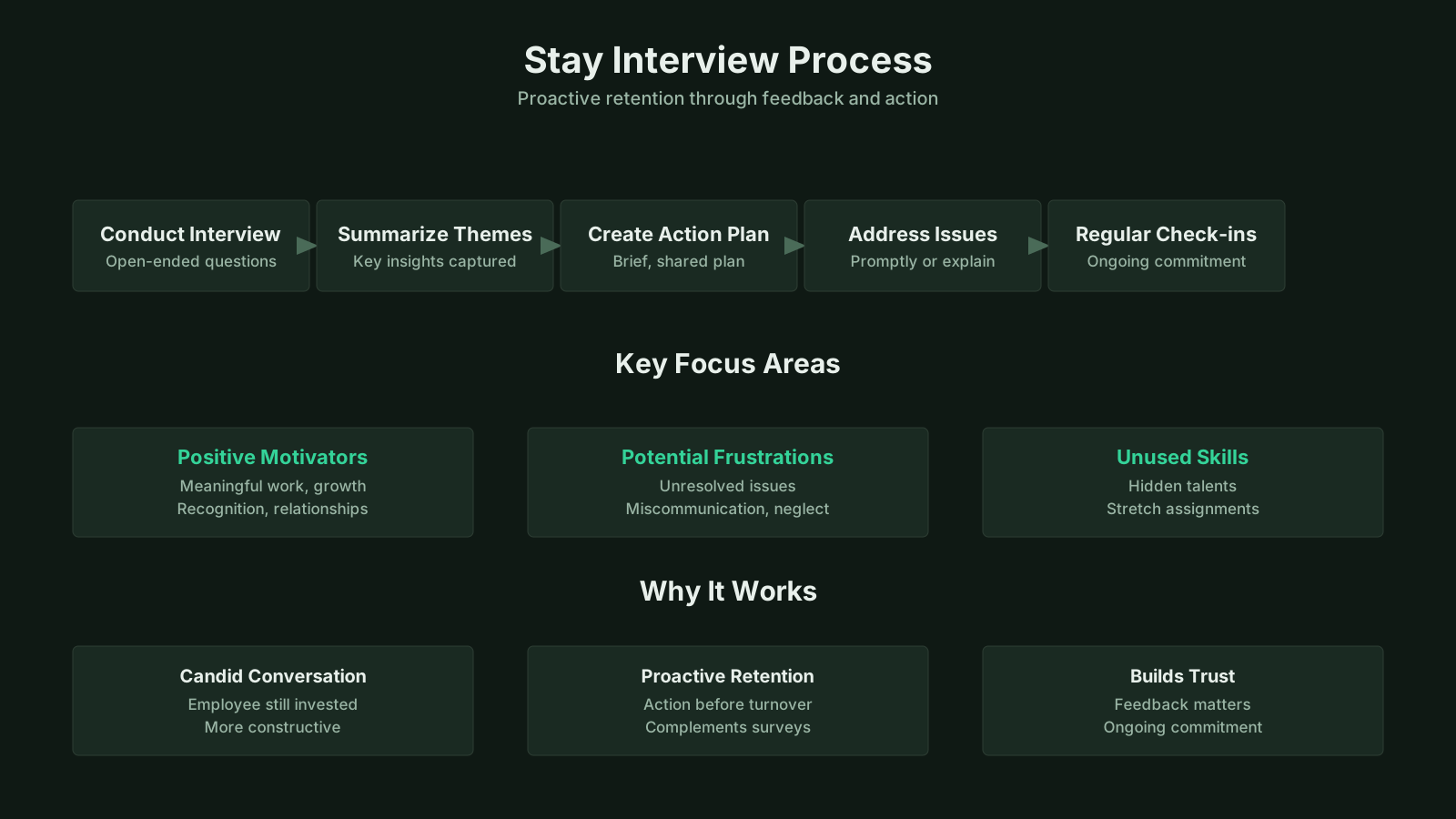
Stay Interviews to Improve Retention: Summary of Key Topics
| Key Concept | Summary |
|---|---|
| Stay Interview | A structured, forward-looking conversation in which a manager identifies what motivates an employee to stay and what factors could drive them to leave. |
| Proactive Retention Value | Stay interviews surface engagement risks while they are still reversible, giving leaders a chance to resolve concerns before the employee disengages or accepts an external offer. |
| Eliciting Candid Feedback | Asking directly what would tempt an employee to leave produces actionable detail when the manager asks with authentic curiosity and reassures the employee that there is no negative consequence. |
| Repeatable Process Design | A standardized set of questions and a predictable format enable consistent execution, build employee trust, and allow the organization to identify recurring retention themes across teams. |
| Strategic Timing | Conduct stay interviews during stable periods, well before performance reviews or major project deadlines, so employees can reflect thoughtfully and respond without defensiveness. |
| Role-Based Cadence | Schedule a formal stay conversation for new hires at roughly 90 days, then adjust the cadence based on flight risk, with high performers and critical-role employees receiving more frequent check-ins. |
Why Stay Interviews Are a Retention Tool Worth Taking Seriously
A stay interview is a structured one-on-one conversation between a manager and a current employee, focused on what the employee values about their role and what could make them leave. The stay interview benefits for retention are often underestimated because the conversation feels informal compared with annual engagement surveys. In practice, stay interviews surface timely, individual retention risks that broad surveys cannot capture.
Exit interviews have a place, but they arrive too late to change an employee's decision. By the time someone sits down for an exit interview, they have mentally detached, accepted another offer, or simply stopped looking for reasons to stay. A stay interview, by contrast, happens while the relationship is still active and the employee still has a reason to be candid about what would improve their experience.
Another difference is the emotional dynamic. Exit interviews often produce guarded responses because departing employees do not want to burn bridges. Stay interviews tend to feel more psychologically safe, especially when the manager has already built a foundation of trust. The employee is not defending a resignation, so the conversation can focus on possibility rather than blame.
A common assumption is that employees will not tell the truth about wanting to leave because they fear retaliation. That assumption becomes true only when managers have not established safety. If a manager asks a direct question such as "What would tempt you to consider another job?" and reacts defensively, the employee learns quickly that honesty is risky. But when the same question is asked with genuine curiosity and no punishment, employees often share surprisingly specific information about frustrations, career goals, and external opportunities.
Stay interviews also give managers a chance to repair small problems before they become exit reasons. An employee might mention that they feel underused on certain projects, or that they are unclear about how to move into a different role. That kind of feedback is actionable immediately, often without a major policy change. The interesting part is that many retention issues are not about pay alone, but about the daily texture of work, recognition, autonomy, and growth.
Core Insights on Stay Interviews
- Structured retention conversation
- A stay interview is a structured one-on-one conversation in which a manager asks a current employee what keeps them engaged, what frustrates them, and what might make them consider leaving.
- Outperforms annual surveys
- Because stay interviews are personal and conversational, they surface individual retention risks and real-time concerns that broad engagement surveys typically overlook.
- Exit interviews act too late
- Exit interviews occur after the employee has already disengaged or accepted another role, which means the feedback arrives too late to prevent the departure.
- Psychological safety encourages honesty
- When trust is established, stay interviews create a psychologically safe space where employees can share candid frustrations and career aspirations without worrying about damaging the relationship.
- Defensive reactions backfire
- A defensive reaction to a departure-related question teaches employees that honesty carries risk, while genuine curiosity and nonjudgmental listening encourage them to reveal surprisingly specific concerns.
How to Conduct Stay Interviews to Improve Retention: A Practical Framework
A clear process matters because inconsistent conversations produce inconsistent data and weak follow-up. The stay interview process steps should include preparation, a focused conversation, documentation, action planning, and a follow-up loop. Skipping any one of those steps tends to turn a stay interview into a pleasant chat that changes nothing.
This framework does not require a rigid script. In fact, a mechanical checklist can make the employee feel like a subject in an HR audit. The goal is to create a repeatable rhythm so managers know what to cover, employees know what to expect, and the organization can aggregate themes over time. A light structure with room for natural conversation works better than a formal interrogation.
Many organizations already have performance reviews and engagement surveys. The stay interview should not replace those tools, but it fills a gap they leave open. Surveys are anonymous and aggregate; they show patterns but not individual context. Performance reviews focus on past work and development needs. Stay interviews focus on the employee's present experience and future intentions, which makes them uniquely useful for retention decisions.
Choosing the Right Time and Frequency for Stay Interviews
Timing shapes the quality of the conversation. A stay interview conducted during a stressful quarter-end close or immediately after a layoff announcement will produce guarded answers. The better approach is to schedule stay interviews during relatively calm periods, when the employee has enough mental space to reflect on their experience rather than just managing the current workload.
Frequency depends on team size, turnover risk, and manager capacity. In general, conducting a stay interview once or twice a year per employee is practical for most teams. New hires might benefit from a check-in after the first three months, while high performers and employees in critical roles may need more frequent attention. The key is not to wait until someone appears disengaged, because by then the conversation is harder to start.
It sometimes happens that managers schedule stay interviews only when they suspect a problem. That selects for negativity and teaches employees that the conversation is a warning sign. A regular cadence normalizes the process and makes it feel like a standard part of how the team operates. When employees know stay interviews happen predictably, they are more likely to prepare their thoughts and speak honestly.
Preparing for a Stay Interview to Improve Retention
Preparation begins with reviewing what you already know about the employee, but not treating that history as a conclusion. The manager should look at recent projects, recognition, skill development, and any prior comments about workload or career goals. That background helps the manager ask better follow-up questions without making the employee repeat basic context.
Part of preparing for a stay interview to improve retention is choosing an environment that supports candor. A private room or a video call without distractions works better than a noisy open office or a rushed meeting between other obligations. The employee needs to feel that this conversation is important enough to deserve uninterrupted time.
Managers should also prepare themselves emotionally. Stay interviews can trigger defensiveness, especially when an employee says something critical about leadership, pay, or team culture. A manager who enters the conversation expecting only positive feedback will struggle when the feedback is hard to hear. The purpose is not to defend decisions but to understand the employee's lived experience.
Structuring the Conversation Without a Script
A useful structure includes three parts: opening the conversation, exploring retention drivers, and closing with a commitment. The opening should explain why the conversation is happening and what will happen with the information. That explanation reduces anxiety and helps the employee understand that the goal is improvement, not evaluation.
The middle of the conversation should follow the employee's energy. If the employee mentions a frustration, the manager should probe gently rather than rushing to the next question. Phrases like "Tell me more about that" and "What would a better version look like?" open up detail. The manager's job is to listen more than talk, which is harder than it sounds in practice.
Closing the conversation with a clear next step is essential. The manager should summarize what they heard, acknowledge themes, and explain what will happen next. If the manager cannot commit to a solution immediately, they should say so honestly and give a timeline for follow-up. An employee who leaves a stay interview without any sense of what happens next may feel that the conversation was performative.
Questions to Ask in a Stay Interview to Improve Retention
The quality of a stay interview depends heavily on the questions the manager chooses. Questions to ask in a stay interview to improve retention should be open-ended, specific, and grounded in the employee's day-to-day experience. Closed questions like "Are you happy?" produce one-word answers and do not reveal much about whether the person might leave.
Some useful questions include what the employee looks forward to most in their work, what parts of the role drain their energy, and what would make the job more satisfying. Another important question is what the employee is learning and whether they feel their skills are being used well. These questions reveal whether the employee feels challenged, valued, and connected to the team.
Asking about leaving directly can feel uncomfortable, but it is often the most honest question in the entire conversation. A manager might say, "If you were approached by another company tomorrow, what would make you consider it?" That phrasing does not accuse the employee of job hunting. It simply acknowledges that external opportunities exist and invites the employee to name the factors that matter most.
Managers should also ask what would cause the employee to stay for the next two or three years. This forward-looking question shifts the conversation from complaints to possibilities. The employee might mention a path to promotion, a more flexible schedule, or the chance to lead a project. Those answers become the raw material for a retention action plan.
Listening for Underlying Retention Drivers
Employees do not always state their real reasons for leaving in clear terms. A comment about being tired may actually reflect unclear priorities, while a complaint about pay may mask a deeper feeling of being undervalued relative to peers. Managers need to listen for patterns across the conversation rather than treating each statement as a separate request.
Some of the most common retention drivers include manager relationship, career growth, compensation fairness, autonomy, work-life balance, and connection to purpose. When an employee mentions one of these areas, the manager should explore it further. For example, if the employee says they feel stuck, the manager might ask what "unblocked" would look like in six months.
It can also help to pay attention to what the employee does not say. If someone speaks enthusiastically about projects but avoids commenting on their relationship with the manager, that silence may be meaningful. The manager should not force the issue, but they can create space by asking a broader question about what the employee would change about how the team works.
Acting on Stay Interview Feedback to Improve Retention
The most important part of the process happens after the conversation ends. Acting on stay interview feedback to improve retention means translating individual comments into specific actions, communicating those actions to the employee, and checking back later to see whether the situation improved. Without this step, stay interviews quickly lose credibility.
The manager should begin by identifying which themes are within their control and which require support from HR or senior leadership. A request for a promotion may need a formal process, while a request for more frequent feedback can be addressed immediately. Small changes made quickly can have a surprisingly strong effect on an employee's sense of being heard.
When the manager cannot act on a request, they should explain why rather than letting the issue disappear. Employees generally accept constraints if they understand the reasoning and see that their input was taken seriously. Silence after a stay interview is worse than a direct no, because silence signals that the conversation did not matter.
The Core Questions That Reveal Retention Risk
Retention risk is not always visible in performance data or attendance records. The stay interview questions to ask employees should therefore probe both positive and negative experiences. A balanced question set helps managers understand what keeps someone engaged and what might be quietly pushing them away.
One useful question is, "What part of your work gives you the most energy?" The answer reveals what the employee naturally gravitates toward, which can inform project assignments and development conversations. If the employee's energizing work is crowded out by administrative tasks, that is a retention risk the manager can address.
Another question with high diagnostic value is, "What skills do you have that we are not using?" This question uncovers hidden capabilities and signals whether the employee feels underutilized. In many cases, an employee starts looking elsewhere not because they dislike the company, but because they believe their potential is being wasted in their current role.
Managers should also explore what the employee would change if they were in charge of the team. This question can feel risky because it invites criticism, but it often produces practical suggestions about communication, workload, or decision-making. The employee who has a concrete improvement in mind is usually still invested enough to want things to get better.
A question about recognition can reveal whether the employee feels seen. Employees often leave not because they are unhappy, but because their contributions have become invisible. Asking "When was the last time you felt truly recognized for your work?" gives the manager a window into how recognition actually lands, rather than how often the company sends out appreciation emails.
Core Takeaways on Stay Interviews
- Balanced questions reveal hidden risks
- Retention risk often hides beneath solid performance metrics, so stay interview questions should deliberately examine both sources of fulfillment and points of friction to reveal what actually keeps employees committed or gradually disengages them.
- Energizing work versus administrative tasks
- Asking employees which tasks energize them reveals where their natural motivation sits, and if administrative work is crowding out those tasks, managers have identified a specific, addressable retention risk.
- Underutilization signals wasted potential
- Questions about untapped skills often surface feelings of underutilization, which is a significant warning sign because many employees leave not because they dislike the organization but because they believe their capabilities are being wasted in the current role.
- Improvement suggestions show investment
- Asking employees what they would improve invites criticism that can feel uncomfortable, but practical responses about communication, workload, or workflow often show that the employee still cares enough to contribute ideas for making things better.
Training Managers to Lead Stay Interviews Effectively
Stay interviews are only as good as the manager leading them. The manager stay interview training should cover active listening, emotional regulation, note-taking, and follow-through. Many managers have never been trained to ask open questions without leading the employee toward a preferred answer.
A common failure pattern is for the manager to turn the stay interview into a performance discussion. When that happens, the employee becomes defensive and the retention risk goes underground. Training helps managers see the stay interview as a listening exercise, not an opportunity to justify past decisions or correct the employee's perceptions.
Role-playing is one of the most effective training methods because it lets managers practice handling difficult answers. A manager might rehearse what to say when an employee admits they are considering another offer, or when an employee criticizes the manager's own communication style. Practicing those moments in a safe setting reduces the chance that the real conversation will go off track.
Managers also need guidance on how to document the conversation without turning it into a formal record that makes the employee nervous. Simple notes about themes and action items are usually enough. The purpose of documentation is to support follow-up, not to create evidence for a future performance case. When employees sense that their words are being recorded for HR, they tend to self-censor.
Turning Stay Interview Feedback into Retention Action
Feedback without action is worse than no feedback at all. The retention action planning from stay interviews should start with a review of common themes across the team, then move to individual commitments. Managers often feel pressure to solve every issue immediately, but the more realistic approach is to prioritize the changes that will have the greatest impact on retention risk.
For example, if several employees mention that unclear career paths are a concern, the manager might work with HR to clarify promotion criteria or create a simple development roadmap. If one employee mentions a specific scheduling conflict, the manager might adjust that individual's work arrangement and check back in a few weeks. Both types of action matter, but they require different timelines and levels of authority.
Communication is the bridge between feedback and trust. After a round of stay interviews, the manager should tell the team what themes emerged and what actions are being taken. This does not require sharing confidential details. It simply means letting people know that their input led to visible change. When employees see that stay interviews influence real decisions, participation quality improves in the next cycle.
There are limits, of course. No retention program can address every issue, and some employees will leave for reasons outside the organization's control. A stay interview is not a promise that everything will be fixed. It is a mechanism for reducing preventable turnover by resolving the issues that are within reach. The honest framing matters because it keeps expectations realistic.
Key Insights on Retention Action
- Themes before individual commitments
- Effective retention action planning starts with a review of recurring themes across the team before transitioning to individual commitments.
- Prioritize highest impact changes
- Managers should focus on the changes most likely to reduce retention risk rather than attempting to address every issue at once.
- Different actions, different authority
- Team-level and individual actions are both essential, yet they demand different timelines and levels of decision-making authority to execute effectively.
- Communicate visible results
- Communicating the themes that emerged and the resulting actions demonstrates to employees that their input produces visible change, which strengthens participation in future cycles.
Common Mistakes That Undermine Stay Interviews
Many well-intentioned stay interview programs fail because of predictable errors. The stay interview mistakes to avoid include asking leading questions, failing to act on feedback, treating the conversation as a one-time event, and using the information to punish or judge employees. Each mistake erodes trust and makes future conversations less useful.
Leading questions are especially damaging. A question like "You are happy with the team, right?" pressures the employee to agree and prevents the manager from hearing the real story. A better version would be, "How connected do you feel to the team right now?" The difference seems small, but the open phrasing invites a more honest response.
Another mistake is conducting stay interviews only when retention risk is already visible. By then, the employee may have already decided to leave. Stay interviews work best as a preventive practice, not a last-minute rescue attempt. A manager who only reaches out when someone seems disengaged sends a signal that the conversation is a warning sign rather than a genuine check-in.
Failing to follow up is probably the most common and most destructive mistake. An employee shares a concern, hears a vague promise, and then watches nothing happen. The next time the manager asks for feedback, the employee will likely say everything is fine because they no longer believe honesty leads to change. Consistent follow-up, even when the answer is no, preserves the credibility of the process.
Measuring the Impact of Stay Interviews on Retention
Stay interviews should be evaluated like any other management practice. The measuring stay interview effectiveness starts with defining what success looks like before the program begins. Common indicators include voluntary turnover rate, early turnover, retention of high performers, and the percentage of stay interview action items that are completed on time.
Turnover data can be noisy, especially in small teams where one departure changes the percentage dramatically. That is why managers should look at trends over several quarters rather than reacting to a single data point. A stay interview program typically takes time to influence exit patterns, and early results may be hard to isolate from other factors like market conditions or compensation changes.
Another useful measure is whether employees bring up concerns during stay interviews that later show up in exit interviews. If the same issues keep appearing after employees leave, the stay interview process may not be surfacing or resolving those issues effectively. Comparing stay interview themes with exit themes can reveal blind spots in how managers are asking questions or following up.
Managers can also measure participation and completion rates. If stay interviews are being postponed or skipped, the program will not produce results. Tracking completion helps HR and senior leaders see where managers need support or accountability. The point is not to treat conversations as a compliance activity, but to ensure the practice actually reaches the people it is meant to help.
Key Insights on Measuring Impact
- Define success upfront
- Effective measurement begins by establishing clear success criteria before the stay interview program is launched.
- Key retention indicators
- The most useful indicators typically include voluntary and early turnover rates, retention of high performers, and the percentage of action items completed on schedule.
- Watch trends over quarters
- Since a single departure can skew percentages in small teams, managers should examine turnover trends over multiple quarters instead of reacting to isolated data points.
- Compare stay and exit themes
- A side-by-side review of recurring stay and exit interview themes often exposes gaps in conversation quality or follow-through.
- Track completion for accountability
- Monitoring completion rates enables HR and senior leaders to identify where managers need additional support or accountability, keeping the process meaningful instead of a compliance exercise.
Adapting Stay Interviews for Remote and Hybrid Teams
Remote and hybrid work changes the texture of stay interviews without changing their purpose. The remote stay interviews best practices include scheduling dedicated video calls, minimizing distractions, and reading digital cues carefully. In a remote setting, casual hallway conversations disappear, so structured check-ins become even more important for detecting disengagement.
On a video call, the manager should avoid multitasking and make eye contact through the camera as much as possible. Employees can tell when a manager is reading messages or looking at another screen, and that behavior signals that the conversation is not a priority. A focused thirty-minute video call often yields more depth than an hour-long meeting squeezed between other obligations.
Remote employees may feel isolated in ways that onsite employees do not, so stay interviews should explicitly explore connection. Questions about how connected the employee feels to their team and what would improve that connection are especially relevant. The manager might also ask whether the employee has enough casual interaction with colleagues, since that informal contact often builds belonging.
Documentation and follow-up are just as important remotely, perhaps more so because there are fewer natural reminders. After a remote stay interview, the manager should send a brief summary of the main themes and agreed actions. That summary creates a shared record and gives the employee confidence that the conversation will not disappear into the digital noise.
Final Word on Building a Retention Culture
A stay interview program works best when it becomes part of a larger retention culture rather than a standalone HR initiative. The stay interview program retention culture emerges when managers listen regularly, act visibly, and treat employee feedback as an ongoing source of operational insight. No single conversation can fix a toxic environment, but repeated honest conversations can reshape how employees experience their work.
Organizations should start small and refine the approach over time. A pilot with a few teams can reveal what questions resonate, what training gaps exist, and how managers naturally react to critical feedback. That learning then informs a broader rollout without overwhelming the organization with a new process all at once.
Stay interviews are not a shortcut to perfect retention. Some employees will leave regardless, and some systemic problems require changes far beyond a manager's control. But when stay interviews are conducted with genuine curiosity and followed by visible action, they reduce the kind of turnover that stems from neglect, miscommunication, and unresolved frustration.
The real value of a stay interview is not the form or the framework. It is the signal the organization sends by asking people what would keep them before they have one foot out the door. That signal, repeated consistently, can be more powerful than any retention bonus or engagement campaign.
Core Insights on Retention Culture
- Culture over standalone programs
- Stay interview programs deliver the strongest outcomes when they are embedded in a broader retention culture rather than treated as a separate HR activity.
- Listening with visible action
- A retention culture takes hold when managers listen consistently, act on feedback in visible ways, and treat employee input as a continuous source of operational insight.
- Honest conversations reshape experience
- A single conversation rarely repairs a toxic environment, but repeated honest dialogue can fundamentally reshape how employees experience their work.
- Start small, then scale
- Piloting stay interviews with a few teams reveals which questions resonate and where training gaps exist, enabling a smoother rollout across the organization.
- Powerful preventive signal
- Regularly asking employees what would keep them sends a preventive signal that often reduces turnover driven by neglect and frustration more effectively than bonuses or engagement campaigns.
Advance Your Career with Professional Certification
Earning a project management certification equips professionals with frameworks for scope, schedule, and stakeholder communication that directly apply to employee retention programs. Organizations that invest in this credential see fewer project overruns caused by staff turnover. The training covers risk assessment, including attrition risks on critical teams. For HR and operations leaders, a project management certification adds structure to stay interview rollout and follow-up. This formal validation signals commitment to systematic planning rather than ad-hoc retention efforts.
Viewing the employee experience as an internal product requires the same discovery and iteration skills found in a certified product manager program. Candidates learn to map user journeys, prioritize feature requests, and measure satisfaction loops, all transferable to stay interview processes. A certified product manager credential also teaches roadmap communication, which helps HR teams explain retention initiatives to executives. The certification's emphasis on continuous feedback aligns closely with the cadence of effective stay interviews. Teams with this training often build better listening systems instead of relying on annual surveys.
A human resources certification covers the legal and ethical dimensions of stay interviews, including documentation standards and bias mitigation. Professionals who hold this credential can design structured conversation guides that yield comparable data across departments. The training includes workforce analytics, so certified HR practitioners know how to link interview themes to turnover cost models. Pursuing a human resources certification also builds credibility when advocating for retention budgets. Organizations often see better follow-through on stay interview action plans when HR teams have this formal grounding.