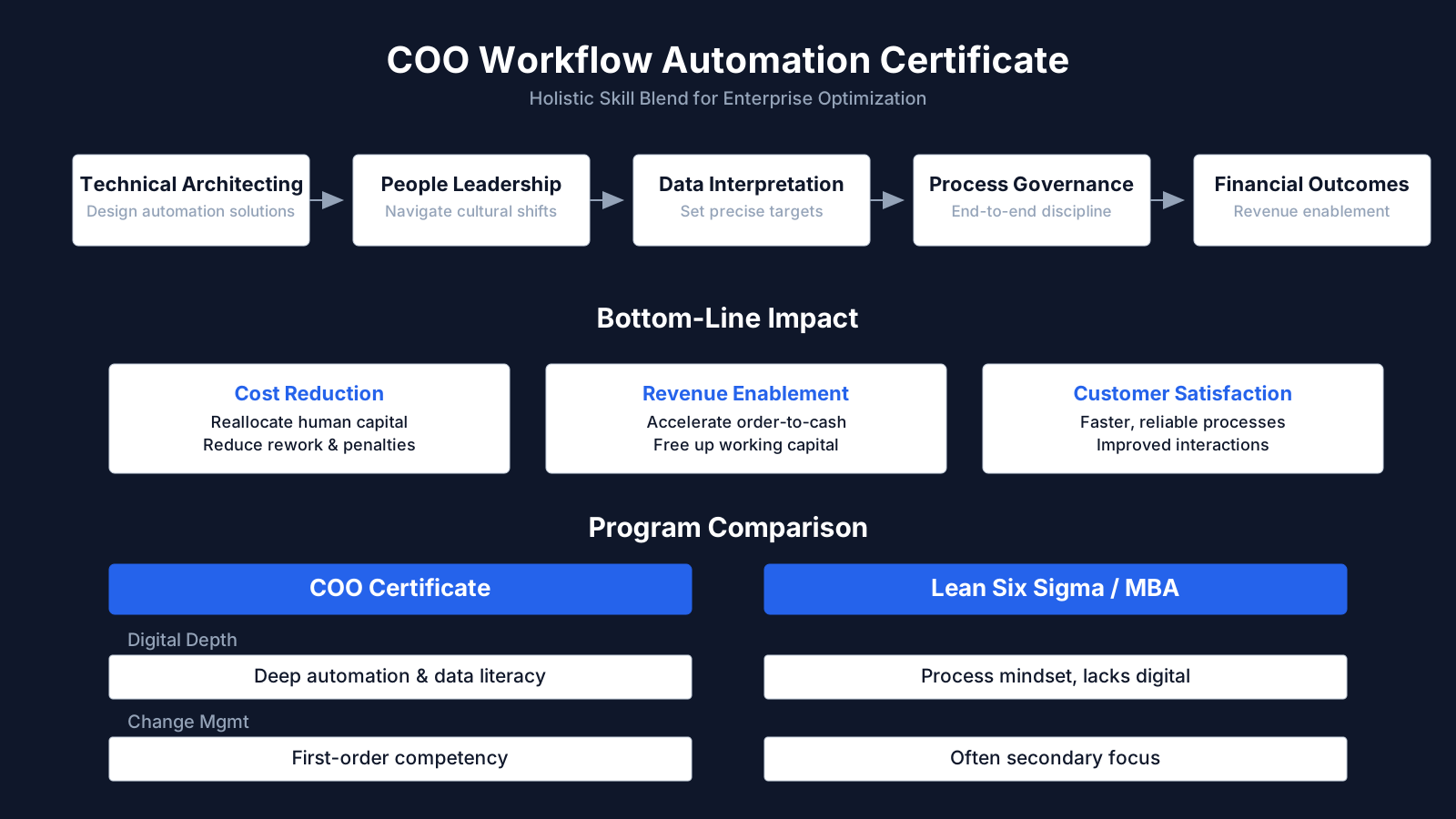
In an era where milliseconds separate market leaders from the also-rans, the Chief Operating Officer has been recast as the chief orchestrator of enterprise efficiency. The COO Workflow Automation & Optimization Certificate has emerged as the definitive credential for operational leaders charged not merely with understanding technology but with harnessing it to reimagine the entire organizational backbone. This intensive certification equips senior executives with the frameworks, data literacy, and change leadership skills required to automate complex workflows, eliminate friction, and scale operations without proportionally scaling headcount. As boardrooms worldwide elevate operational resilience to a strategic imperative, a certification that validates deep competency in streamlining processes through intelligent automation has become a powerful differentiator for career-minded COOs and aspiring operations chiefs alike.
COO Workflow Automation & Optimization: Summary of Key Topics
| Key Concept | Summary |
|---|---|
| COO Evolution | The contemporary COO has evolved from logistics overseer to digital strategist and culture architect, orchestrating adaptive, self-optimizing processes that continuously elevate operational resilience. |
| Certificate Purpose | The COO Workflow Automation & Optimization Certificate equips senior operations leaders with advanced frameworks, data literacy, and change leadership skills to engineer automated workflows and achieve scalable, sustainable growth. |
| Curriculum Depth | Premier programs immerse participants in operations science, digital twin simulation, and behavioral economics through interactive live sessions, intensive deep dives, and an applied capstone project addressing real operational challenges. |
| Process Mining | A core module trains participants to extract and visualize event logs to map actual workflows, revealing hidden bottlenecks, rework loops, and compliance gaps that stakeholder interviews often miss. |
| Technology Stack | Participants learn to holistically evaluate RPA, low-code platforms, and AI orchestration layers, then design integrated architectures that prevent departmental bot silos and enable end-to-end automation. |
| Lean & Six Sigma | Classic continuous improvement frameworks are enhanced with analytics and statistical process control, allowing leaders to eliminate waste before automating and continuously fine-tune automated workflows. |
| Scaling Strategy | Certified leaders adopt a governance framework that balances a central Center of Excellence with federated business-unit champions, ensuring controlled yet rapid scaling from pilot initiatives to enterprise-wide deployment. |
| Change Leadership | The program builds capability to overcome employee resistance and fragmented adoption by applying structured change management, executive sponsorship alignment, and workforce enablement tactics. |
| Risk Mitigation | Graduates internalize the 'optimize before you automate' principle, redesigning flawed processes first to safeguard measurable ROI and avoid the costly trap of digitizing inefficiency. |
| Career Impact | The certification differentiates COOs and aspiring operations chiefs by validating deep competency in driving operational excellence through intelligent automation, positioning them as strategic transformation leaders. |
The Evolving Mandate of the Modern Chief Operating Officer
The traditional COO role, once defined by oversight of day-to-day logistics and cost containment, has undergone a profound transformation. Today’s operating chief must be a digital strategist, a data evangelist, and a culture architect who can bridge the gap between legacy systems and the autonomous enterprise. Stakeholders now expect the COO to deliver not just predictable output but adaptive, self-optimizing processes that respond in real time to supply chain disruptions, customer sentiment shifts, and competitive moves. This expanded charter demands fluency in workflow automation technologies ranging from robotic process automation (RPA) and low-code platforms to artificial intelligence and process mining. A COO Workflow Automation & Optimization Certificate functions as a structured path to acquire that fluency without sinking years into piecemeal learning.
Organizations that place an untrained leader at the helm of automation initiatives risk fragmented deployments, employee resistance, and expensive tool proliferation that fails to connect the front, middle, and back office. When the COO has a deep understanding of how to map value streams, identify bottleneck patterns, and orchestrate a unified automation roadmap, the enterprise avoids the common trap of digitizing broken processes. Instead, it rethinks work at the root level, which is precisely what the best certificate programs teach through their focus on process optimization before automation.
Key Takeaways on the COO's New Role
- Expanded strategic responsibilities
- The modern COO must act as a digital strategist, data champion, and culture architect to bridge legacy systems with the demands of an autonomous enterprise.
- Need for workflow automation fluency
- A structured certification program provides the essential knowledge of robotic process automation, artificial intelligence, and process mining needed to design adaptive, real-time processes.
- Risk of untrained automation leadership
- Without proper training, COOs risk fragmented deployments and the costly mistake of digitizing broken processes, while trained leaders focus on optimizing workflows before introducing automation.
What the COO Automation & Optimization Certificate Actually Entails
A credible COO Workflow Automation & Optimization Certificate is not a surface-level survey of buzzwords. Top-tier programs, often delivered by leading business schools and executive education arms of global consultancies, immerse participants in a rigorous exploration of operations science, digital twin simulation, and the behavioral economics of organizational change. The curriculum typically spans several weeks of live virtual sessions, asynchronous deep dives, and a capstone project where participants apply automation frameworks to a real-world process from their own organization. This hands-on design ensures that graduates leave with not just theoretical knowledge but a portfolio-ready case study demonstrating measurable impact.
The faculty in these programs usually blends academic researchers specializing in operations management with seasoned practitioners who have led automation at scale in corporations like Amazon, Siemens, or Unilever. This duality grounds esoteric concepts in gritty implementation truths. Participants learn to differentiate between processes suitable for robotic automation, those that require cognitive AI decision engines, and those where human judgment must remain central. They also confront the uncomfortable reality that roughly thirty percent of automation projects fail to meet their initial ROI projections, not because of technology shortcomings but because of poor preparation and lack of operational sponsorship. The certificate purposefully builds the muscle to avoid these pitfalls.
Core Modules: From Process Mining to Enterprise Architecture
The backbone of any respectable COO workflow automation certification is a module on process mining and discovery. Rather than relying on stakeholder interviews, which often capture aspirational rather than actual workflows, participants learn to extract event logs from ERP, CRM, and messaging systems to visualize how work truly travels. This data-driven baseline reveals invisible loops, rework queues, and deviations that conventional value stream mapping overlooks. The insight shifts the automation conversation from subjective opinion to objective evidence, a skill that earns COOs immediate credibility with skeptical IT and finance partners.
Subsequent modules dive into the technology stack selection and architectural governance of an automation fabric. A COO with a Workflow Automation & Optimization Certificate will be equipped to evaluate the tradeoffs between leading RPA vendors like UiPath and Automation Anywhere, low-code business process management suites such as Appian or Pega, and AI orchestration layers that connect these bots to natural language processing and computer vision models. More importantly, they learn to design an integration layer that prevents the infamous bot silos and ensures that automated workflows can share master data and exception-handling protocols across departments. This architectural mindset transforms the COO from a consumer of IT services into a credible co-architect of the digital core.
Applying Lean and Six Sigma in the Age of Hyperautomation
While technology accelerates transactions, it cannot fix fundamentally flawed process logic. A high-quality COO Automation and Workflow Optimization Certificate does not discard classic continuous improvement frameworks; it evolves them. Participants explore how Lean principles of waste elimination and flow are turbocharged when analytics can pinpoint the exact second where information wait time spikes. Six Sigma’s DMAIC methodology becomes a guide for tuning the performance of unattended bots that process thousands of transactions, using statistical process control to detect drift before customers notice. The certificate teaches that the best automation begins with a meticulously simplified process, confirming the adage that automating a mess yields an automated mess at scale.
Graduates learn to lead Kaizen events that reimagine end-to-end customer journeys with automation in mind from the outset. For example, a COO in a mid-market logistics firm might apply the certificate skills to redesign the order-to-cash cycle. Instead of simply deploying a bot to copy data from a portal to their SAP system, they first eliminate the need for the copy by enabling direct API integration, a Lean simplification that made the robotic step redundant. This strategic sequencing of optimization before automation is the hallmark of the certified operational leader.
Strategic Implementation of Workflow Automation in the COO’s Domain
Possessing a COO Workflow Automation & Optimization Certificate means the leader can navigate the treacherous waters from pilot purgatory to enterprise deployment. Many organizations find early automation success in a single department, only to stall when they attempt to scale across divisions with different data models, compliance requirements, and cultural readiness. The certificate provides a battle-tested governance framework that balances the agility of a Center of Excellence model with the accountability of federated automation champions embedded in business units. COOs learn to set up an automation operating committee that prioritizes workflows based on a weighted scorecard of feasibility, strategic impact, and change difficulty.
This strategic lens is often missing when automation is left solely to technical teams. A certified COO will veto high-effort bots that merely add a layer on top of a dying legacy system, preparing instead for a migration strategy that includes temporary automation bridges. The curriculum also addresses the critical capability of managing vendor partnerships and platform roadmaps, ensuring the organization avoids lock-in while maturing along the hyperautomation continuum from task automation to entire business process management to intelligent orchestration that autonomously reroutes work during a demand surge.
Building an Automation-Ready Operating Culture
No workflow optimization initiative survives the first line of employee resistance if the COO cannot lead with transparency and instill psychological safety. This certificate dedicates significant time to the human dimensions of automation. Participants dissect case studies where well-intentioned automation programs triggered talent attrition because frontline workers feared redundancy. They learn to reframe automation as an augmentation strategy, where bots absorb the tedious, repetitive data entry and the human worker moves into exception handling, customer empathy, and continuous improvement analysis. The COO emerges equipped to design a people transition blueprint that includes upskilling pathways, internal mobility credits, and a communication cadence that treats employees as co-creators.
The certification also confronts the reality that middle managers often form the hardest barrier. When the COO knows how to coach department heads through the shift from command of a team’s activities to orchestration of a human-plus-digital workforce, the adoption curve shortens dramatically. Role modeling the use of analytics dashboards, celebrating the early wins of teams that redesigned their own micro-workflows, and tying automation adoption to performance incentives become practical levers in the certified COO’s toolkit. This cultural reengineering is what separates an automation mandate that gets launched from one that becomes woven into the organizational DNA.
Core Takeaways on COO Automation Strategy
- Enterprise scaling governance framework
- This certification arms COOs with a governance model that combines a centralized Center of Excellence with federated automation champions, effectively dissolving the organizational silos that cause scaling initiatives to stall.
- Strategic vendor and platform management
- Leaders gain the ability to manage vendor partnerships and platform roadmaps strategically, sidestepping vendor lock-in while maturing from task automation to intelligent orchestration that autonomously reroutes work during peak demand.
- Human-centered culture and transition design
- The program emphasizes psychological safety by repositioning automation as workforce augmentation, designing clear upskilling trajectories, and guiding middle managers through the transition from directing teams to orchestrating blended human and digital workforces.
Measuring the Impact and Sustaining the Optimization Engine
Investing in a COO Automation and Workflow Optimization Certificate yields a measurable return only if the COO establishes a disciplined benefit tracking system. The program stresses that vanity metrics like number of bots deployed or hours returned to the business are insufficient. Instead, certified COOs learn to trace automation outcomes to the operational KPIs that matter to the board: cash conversion cycle, perfect order rate, employee engagement in digital roles, and infrastructure cost as a percentage of revenue. They build waterfall dashboards that attribute financial uplift to specific optimization waves, allowing the C-suite to see the cumulative compounding effect of workflow automation.
Sustainability is engineered through a continuous improvement governance that treats automation not as a project with a finish line but as a capability that must be exercised daily. The certificate introduces the concept of a digital muscle assessment, a periodic health check of the automation portfolio to sunset underperforming bots instead of letting them accumulate technical debt. COOs are trained to stand up a process intelligence nerve center that passively mines transaction data to surface new optimization opportunities without manual mapping. This shift from periodic reengineering to perpetual optimization is the culmination of everything the certification instills, turning the operational layer into a competitive moat.
Navigating Technology Risks and Compliance in an Automated Enterprise
Automation amplifies risk if not governed with precision. The COO Workflow Automation & Optimization Certificate ensures that graduates are not blind to the compliance, security, and ethical dimensions that come with letting software bots manipulate financial records, customer data, and even physical machinery. Participants model scenarios where an unattended RPA bot processes incorrect data at high velocity because an upstream field changed format without notification. They design bot audit trails that satisfy both internal audit and external regulators, and they learn to incorporate human-in-the-loop checkpoints for high-judgment transactions such as credit limit increases or supplier onboarding.
The program also explores the growing regulatory scrutiny on algorithmic decision-making. As COOs deploy more intelligent automation that learns and adapts, they must ensure explainability and avoid unintended bias in workforce scheduling or loan application routing. The certificate provides a responsible automation framework that aligns with emerging AI governance standards from organizations like the OECD and NIST, making the certified COO the guardian of not only efficiency but also ethical integrity in automated operations.
The Career Trajectory Impact of the COO Workflow Automation & Optimization Certificate
For an experienced operations executive, obtaining this certificate is a signal of contemporary relevance that can accelerate progression to a divisional presidency or even CEO succession. Executive search consultants now actively seek COOs who can demonstrate a track record of digitizing operations at scale, and a rigorous certification from a respected institution serves as an independent validation of that capability beyond any single employer’s reference. The credential differentiates a candidate who might have decades of traditional plant management experience but limited exposure to modern workflow platforms.
From a compensation perspective, COOs who successfully lead automation transformations often command significant increases in base salary and equity-linked long-term incentives tied to digital performance metrics. The certification itself, when paired with tangible results, opens doors to board advisory roles where companies seek an operations-focused director to guide digital strategy. The peer network formed during the program, composed of fellow COOs and senior vice presidents of operations from diverse industries, becomes a lifelong resource for benchmarking and best-practice exchange that extends the certificate’s value beyond the curriculum.
Comparing the Top COO Automation Certificate Programs
Several elite institutions have launched specialized programs targeting the COO workflow automation and optimization niche, and the discerning professional must evaluate them on criteria beyond brand prestige. The best programs require participants to bring an active automation or process transformation challenge, ensuring that learning is immediately applied and that the program’s return is co-generated. Look for a curriculum that dedicates at least thirty percent of its contact hours to hands-on labs with process mining software, RPA development environments, and AI-assisted workflow design tools, not just case discussions.
Faculty composition also matters. A program co-directed by a professor of operations management and a former chief digital officer from a global manufacturer yields a richer synthesis than a purely academic or purely consulting-led program. The ideal certificate will include a post-program coaching phase where participants present their project outcomes to a panel and receive structured feedback, creating accountability for real-world impact. While investment in a COO Automation and Workflow Optimization Certificate typically ranges from eight to fifteen thousand dollars, the downstream organizational savings from a single avoided bot deployment failure often justify the cost many times over.
Integrating the Certificate into a Broader Operations Excellence Journey
Acquiring the credential is not a destination but a platform. Forward-thinking COOs use it as a springboard to pursue ongoing advanced credentials in AI product management, digital supply chain, or sustainability-linked operations, creating a composite skill set that is virtually irreplaceable. The certificate also becomes a tool for mentoring the next layer of operational leadership. Many graduates establish internal automation academies within their organizations, licensing the frameworks they learned to scale capability development. This turns the individual certification into an organizational asset, multiplying its strategic value.
To maintain the edge, certified COOs often commit to an annual immersion week or a dedicated membership in a process excellence network where they can study peer transformations and stay abreast of paradigm shifts like generative AI’s role in designing workflows. The workflow automation discipline evolves rapidly, and the certificate functions as a base camp from which the COO continually ascends to higher mastery rather than a static trophy. This commitment to perpetual learning ensures that the operational function remains a source of competitive innovation instead of a cost center awaiting commoditization.
Core Career and Compensation Insights
- Accelerated executive advancement
- The certificate signals mastery of modern operational models to executive recruiters, fast-tracking a COO’s progression into divisional president or CEO succession pipelines.
- Compensation and board opportunities
- COOs who lead automation initiatives with this credential often negotiate premium compensation packages and secure board advisory roles centered on digital transformation governance.
- Program evaluation criteria
- Leading programs require participants to solve live automation challenges, devote at least thirty percent of time to immersive labs, and receive post-program coaching to drive measurable accountability.
- Platform for continuous growth
- The certificate acts as a launchpad for advanced credentials in AI, digital supply chain, or sustainability, blending disciplines into an irreplaceable and future-ready skill set.
- Organizational capability multiplier
- Graduates frequently build internal automation academies that license the program's frameworks, converting individual certification into a scalable, enterprise-wide capability.
Overcoming the Organizational Inertia That Sinks Automation
Even with a prestigious COO Workflow Automation & Optimization Certificate, the leader will face entrenched power dynamics that resist the transparency automation brings. Finance departments sometimes fear that automated reconciliation will reduce their control, while seasoned plant managers doubt that a digital twin can capture the nuance of a thirty-year veteran’s intuition. The certificate prepares the COO to address these objections not with force but with co-creation. A technique taught in advanced modules involves running a parallel pilot in which the automated process and the legacy process run side by side for a defined period, with the data shared openly with skeptics so they can validate the results themselves.
The COO must also dismantle the myth that automation leads to massive layoffs, a fear that unions and employees legitimately hold. The certificate emphasizes that the most successful automation narratives show total employment stable or growing because the liberated capacity fuels new service lines, customized product variants, and proactive customer care that were previously uneconomical. The COO leads by painting a vivid picture of the future state where the team’s time shifts from firefighting to strategic value creation, and then backs that picture with concrete investments in reskilling that match the pace of automation rollout. Without this trust battery, no optimization certificate can rescue a toxic environment.
Leveraging Data-Driven Decision Making to Prioritize Workflow Work
The rigorous quantitative training within the COO Automation and Workflow Optimization Certificate equips leaders to build a prioritization engine that defies politics. Using process mining heatmaps and cost-to-serve analyses, the COO can demonstrate that a particular workflow, say, contract approvals in the legal department, consumes fifteen percent of sales cycle time but touches only eight percent of revenue, while customer onboarding delays cost far more in lost lifetime value. The data makes the case for reallocating automation resources unassailable. This evidence-backed methodology becomes a cultural artifact that outlives any single executive.
Furthermore, the certificate teaches the COO to set up a value realization office that tracks not only the direct savings of automation but the second-order effects: reduced employee attrition because of more engaging roles, fewer customer complaints due to faster response, and lower working capital tied up in inventory because the forecast-to-purchase workflow is automated and accurate. When the board sees a multi-million-dollar impact from optimization efforts that is directly attributable to the COO’s certified strategy, support for further digital investment becomes a foregone conclusion. This ability to narrate the complete value story is what elevates the COO to the strategy table permanently.
Scaling Automation Without Breaking the Enterprise
One of the most advanced modules in the COO workflow automation certificate addresses the fractal scaling challenge. An automation that works beautifully on a single team often collapses when extended to a different geography with distinct legal entities, tax codes, and language requirements. Participants learn to segment the global process into a standardized core that can be automated centrally and localized edges where human-in-the-loop configurability is retained. They apply principles derived from microservices architecture to business processes, ensuring that an update to the invoicing bot in Brazil does not break the order management bot in Germany.
The program also covers the financial orchestration of scaling automation, including how to structure internal chargebacks or innovation tax pools so that business units are incentivized to adopt the shared automation platform rather than procure their own shadow IT bots. This governance prevents the explosion of unmanaged automations that risk regulatory violations and data security breaches. The certified COO emerges as the central hub of a coherent automation ecosystem, possessing both the technical vocabulary to debate architects and the business acumen to negotiate with P&L owners.
Preparing for the Next Wave of Autonomous Operations
A forward-looking COO Workflow Automation & Optimization Certificate does not stop at current tooling. It devotes considerable attention to the frontier technologies that will define operations in the next decade. Participants explore how generative AI can now draft standard operating procedures from a simple prompt, how digital twins of the entire supply chain can simulate thousands of disruption scenarios to prescribe action automatically, and how collaborative robots in factories can be orchestrated by a central process engine that adjusts manufacturing schedules in real time. The certified COO becomes the executive best positioned to separate hype from practical deployment, advising the CEO on where to place bets without falling for vaporware.
The curriculum also emphasizes the ethical imperative of building automation that is resilient and human-centric. As ambient intelligence and wearable devices feed data into workflow engines, the COO must set boundaries on surveillance and ensure that productivity gains do not come at the cost of employee dignity. The certificate frames this as a strategic advantage: organizations that design their automated operations with worker well-being as a core design principle attract better talent and reduce regulatory risk. This fusion of technological sophistication and ethical stewardship is the ultimate deliverable of the COO Automation and Workflow Optimization Certificate experience.
In conclusion, the COO Workflow Automation & Optimization Certificate is far more than a line on a resume. It represents a transformative journey that reshapes how an operational leader perceives work, people, and technology interdependencies. In an environment where the cost of operational inertia grows by the day, this certification provides the mindset, the methods, and the measurable frameworks to convert complexity into a scalable, self-improving engine. The companies that invest in certifying their operations chiefs will not only survive the automation era but will define it, setting new performance benchmarks that competitors will struggle to match.
Core Takeaways on Future-Ready Operations
- Frontier Technologies for Operations
- Participants gain hands-on exposure to generative AI that drafts and refines operational procedures, digital twins that simulate supply chain disruptions in real time, and collaborative robots choreographed by intelligent central process engines.
- Separating Hype from Practical Value
- Certified COOs develop a disciplined investment lens, advising CEOs on which emerging technologies yield concrete operational returns while sidestepping inflated promises and nonviable solutions.
- Ethical and Human-Centric Automation
- The curriculum establishes clear automation guardrails, restricting intrusive surveillance and ensuring that productivity advancements never erode employee dignity, autonomy, or psychological safety.
- Strategic Advantage Through Worker Well-Being
- Organizations that embed worker well-being at the core of automation design strengthen their employer brand, attract high-caliber talent, and proactively reduce exposure to tightening regulatory standards.
- Transformative Journey for Operational Leaders
- The certificate fundamentally reorients a COO’s view of the interdependencies between work, people, and technology, turning systemic complexity into a scalable, self-improving operational engine.
Advance Your Career with Professional Certification
Earning a professional project management certification is a strategic investment that not only validates your skills but also enhances your ability to lead complex initiatives with confidence. Through structured project management training , you gain a deep understanding of frameworks like Agile or Waterfall, which directly improves workflow efficiency and stakeholder communication. For organizations, certified professionals consistently deliver projects on time and within budget, reducing risks and fostering a culture of accountability. This credential sets you apart in a competitive job market, often leading to higher salaries and senior leadership opportunities.
Earning a professional product management certification equips you with structured frameworks for prioritizing features, aligning cross-functional teams, and driving product-led growth in today's competitive landscape. Unlike ad-hoc experience, formal product management training validates your expertise, making you a more credible candidate for senior roles while immediately improving your ability to reduce costly missteps through data-driven decision-making. For organizations, certified product managers consistently deliver stronger ROI by bridging the gap between strategic vision and efficient execution, ultimately accelerating time-to-market and customer satisfaction.
Pursuing a professional HR management certification is a strategic move that sets you apart in a competitive job market by proving your proficiency in compliance, talent development, and organizational strategy. Earning an HR management certification not only deepens your practical knowledge but also signals to employers your dedication to upholding industry best practices. This credential can accelerate your career trajectory while equipping you to build stronger, more engaged teams that directly contribute to business growth and resilience.