In the contemporary business landscape, few topics generate as much discussion and as little clarity as organizational culture. Leaders instinctively know that culture influences performance, innovation, and talent retention, yet when asked to define or assess it, many rely on vague impressions rather than rigorous evidence. This gap between intuition and insight has created a pressing need for a more systematic approach, one that embraces both hard data and human experience. Measuring culture with numbers and narratives provides that approach, offering what can best be described as a dual lens through which the full picture of an organization’s shared values, behaviors, and beliefs comes into focus. By combining quantitative metrics with qualitative storytelling, companies can move beyond superficial engagement scores and truly understand the forces shaping their workplaces.
Dual Lens Culture Measurement: Key Topics Summary
| Key Concept | Summary |
|---|---|
| Multimethod Assessment | Combining quantitative metrics with qualitative narratives reveals the full spectrum of cultural drivers, capturing both measurable signals and the meaning behind them. |
| Strategic Imperative | Organizational culture directly influences financial outcomes and talent retention, making rigorous measurement a board-level priority rather than a soft HR initiative. |
| Limitations of Single Methods | Conventional HR metrics are lagging indicators that surface damage retrospectively, while purely narrative approaches lack the numerical grounding to shape strategy. |
| Quantitative Frameworks | Structured models like the Competing Values Framework translate subjective perceptions into normalized scores, enabling cross-unit benchmarking and trend detection. |
| Operational Data Trails | Existing data on attrition, internal mobility, and collaboration networks serve as objective imprints of cultural norms, highlighting emerging frictions. |
| Qualitative Depth | Open-ended surveys, stay interviews, and focus groups decode the motivations and unspoken assumptions that quantitative data cannot capture. |
| Continuous Listening | The shift from annual surveys to ongoing pulse checks and always-on channels creates a real-time cultural pulse, enabling timely interventions. |
| Analytical Literacy | Leaders must blend statistical interpretation with narrative intelligence, ensuring decisions honor both evidence and human context. |
| Data Ethics & Privacy | Sentiment analysis and communication monitoring require transparent ethical guidelines and rigorous privacy protections to sustain employee trust. |
| Actionable Intelligence | Integrating numerical evidence with rich narratives transforms data into diagnostic insights that pinpoint toxicity and scale cultural strengths. |
The Strategic Imperative of Measuring Organizational Culture
For decades, culture was relegated to the soft side of business, a feel-good concept featured in onboarding videos and annual retreats but rarely subjected to the same analytical rigor as finance or operations. That era is over. Multiple studies from institutions like McKinsey and Deloitte have demonstrated a statistically significant correlation between healthy cultures and superior financial performance, lower turnover, and higher innovation rates. The challenge, however, is that culture is inherently multidimensional and emergent, not a variable one can isolate in a laboratory. Culture lives in unspoken norms, in the way meetings are run, in who gets promoted, and in how mistakes are handled. Measuring it requires a methodology that captures both the visible artifacts and the invisible assumptions.
Traditional human resources metrics like headcount, time-to-fill, and absenteeism rates can hint at cultural problems, but they are lagging indicators at best. They tell you something has already gone wrong without revealing the underlying dynamics. On the other hand, purely narrative methods like leadership anecdotes or open-ended employee feedback can be dismissed as anecdotal or unrepresentative. The dual lens resolves this tension by treating numbers and narratives not as competing sources of truth but as complementary data streams that, when intertwined, produce actionable cultural intelligence.
Many leaders operate under the assumption that culture cannot be measured because it is too abstract. This is a myth that has held organizations back from diagnosing toxic environments or scaling positive attributes. In reality, every culture generates measurable traces through employee behavior, communication patterns, decision outcomes, and expressed sentiments. The key is knowing which signals to track and how to interpret them without losing the richness of context. This article will explore how to build a measurement system that respects the complexity of culture while providing the clarity needed for strategic decision making.
Core Insights on Culture Measurement
- Culture's measurable business impact
- Compelling evidence from McKinsey and Deloitte confirms that healthy organizational cultures consistently drive superior financial performance, lower employee turnover, and higher rates of innovation.
- Limitations of traditional metrics
- Standard HR metrics such as headcount and absenteeism operate as lagging indicators, surfacing problems only after they have materialized, and they offer no insight into the underlying cultural forces at play.
- Dual lens measurement approach
- A dual lens approach that weaves quantitative data together with qualitative narratives produces actionable cultural intelligence by treating both as complementary perspectives rather than conflicting sources of truth.
The Dual Lens: Integrating Numbers and Narratives for Culture Measurement
A dual lens framework is not a simple add-water-and-stir formula; it is a disciplined practice of triangulating insights from multiple sources. Quantitative data offers the what: how many employees feel a certain way, how frequently a behavior occurs, or how a composite index trends over time. Qualitative data provides the why: the personal stories, the metaphors employees use, and the unspoken rules that govern daily life. When a company sees its employee net promoter score drop by ten points in a quarter, the number alone signals a problem. But only by listening to exit interviews, reading open-ended survey comments, and conducting focus groups can leaders discover that the dip stems from a new performance management system perceived as unfair.
The integration of these two lenses requires a shift in mindset from measurement as an annual event to measurement as an ongoing conversation. Too many organizations run a yearly engagement survey, glance at the scores, and then file the report away. That is like taking your temperature once a year and expecting to manage your health. The dual lens approach implies continuous listening through pulse surveys, always-on feedback channels, and regular narrative capture. It also demands that leaders develop the analytical literacy to interpret statistical patterns and the empathetic skills to honor the stories behind the numbers.
Building a Quantitative Baseline for Measuring Culture with Numbers
The quantitative side of the dual lens often begins with a validated culture assessment instrument. Frameworks like the Competing Values Framework, the Denison Organizational Culture Model, or the Barrett Values Centre provide structured surveys that map culture onto dimensions such as adaptability, mission, involvement, and consistency. These instruments transform subjective perceptions into numerical scores that can be benchmarked against industry norms or tracked over time. The advantage is standardization and comparability; the limitation is that they force rich human experience into predefined boxes. Therefore, they should be treated as a starting point, not the final word.
Beyond broad culture surveys, organizations can mine a wealth of existing operational data for cultural indicators. Employee turnover rates, especially regrettable turnover segmented by demographics, reveal whether an inclusive culture truly exists. Promotion velocity and internal mobility rates shed light on whether the culture rewards talent or tenure. Attendance at voluntary events, utilization of learning platforms, and even collaboration tool metadata like meeting invitation response times and email network density can all serve as digital traces of cultural norms. For instance, a sharp decline in cross-functional meetings after a reorganization might signal the emergence of silos before any survey registers dissatisfaction.
Another powerful quantitative metric is the employee net promoter score, which asks a single, high-level question about likelihood to recommend the organization as a place to work. When paired with follow-up questions and segmented by department, eNPS can isolate pockets of cultural dysfunction with surgical precision. Similarly, internal sentiment analysis tools that scan Slack messages, emails, or intranet posts for positive or negative language can provide a real-time emotional pulse, though these tools require careful attention to privacy and ethical boundaries.
Capturing Qualitative Narratives That Bring Culture to Life
Numbers without stories are sterile; stories without numbers are anecdotal. Qualitative methods infuse the measurement process with the texture of lived experience. The most common qualitative tool is the open-ended survey question, but its effectiveness depends entirely on the craft of the prompt. Asking “What would you tell a friend about working here?” yields far richer responses than “Do you feel engaged?” Structured listening sessions, such as stay interviews with high performers and exit interviews conducted by neutral parties, generate narratives that reveal cultural drivers of retention and attrition. These conversations should not be mere administrative procedures but opportunities for deep inquiry into what makes employees feel valued, frustrated, or inspired.
Focus groups remain an underutilized qualitative method in culture measurement. When facilitated skillfully, a focus group of eight to twelve employees from diverse roles can surface shared assumptions and unspoken rules that no survey could capture. The group dynamic itself is diagnostic: do participants build on each other’s ideas or defer to hierarchy? Do they use language of ownership or blame? An anthropologically minded observer learns as much from the interaction patterns as from the verbal content. Additionally, storytelling workshops where employees construct collective narratives about pivotal moments in the company’s history can reveal deeply held cultural myths that guide behavior more powerfully than any official value statement.
One sophisticated qualitative technique is the use of cultural artifacts analysis, where organizations examine their physical and digital environments for embedded cultural messages. The wording of job descriptions, the layout of office space, the imagery on the company website, and even the rhythm of meeting cadences all tell stories about what the organization truly prioritizes. A company that espouses agility but requires six levels of approval for a small expenditure is telling a narrative of control, not flexibility. These qualitative data points, when documented systematically, form a narrative corpus that can be coded and analyzed for recurring themes.
Measuring Culture with Numbers and Narratives in Practice
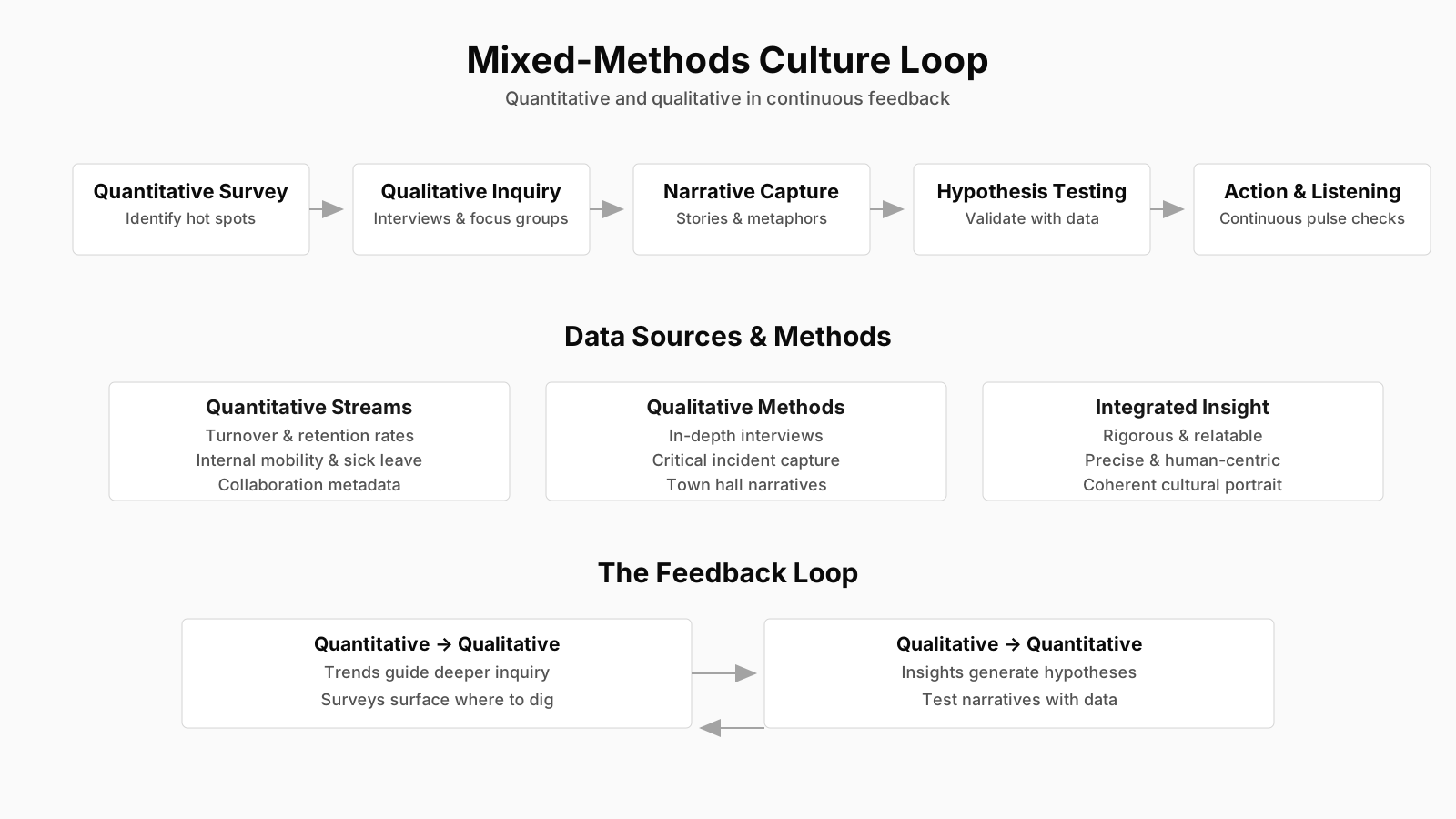
Translating the dual lens concept into daily practice requires designing an integrated measurement rhythm. Consider a quarterly cycle that begins with a short quantitative pulse survey targeting specific cultural dimensions identified as strategic priorities. The survey results are analyzed not only for overall scores but for variance across teams, which often reveals that culture is not monolithic but consists of microcultures. A sales team may score high on competition and low on collaboration, while an engineering team shows the opposite pattern. These quantitative insights then inform the qualitative phase: leadership selects a few teams with outlier scores and conducts deep-dive listening sessions to understand the stories behind the numbers.
This iterative loop between numbers and narratives prevents both data misinterpretation and storytelling bias. For example, a department with low innovation scores might be labeled resistant to change. However, narrative inquiry could reveal that employees are highly creative but lack psychological safety to share ideas because a past suggestion box was used to identify underperformers. The quantitative metric diagnosed the symptom; the qualitative narrative diagnosed the root cause. Acting on the number alone might lead to ideation workshops that fail. Acting on the story might lead to rebuilding trust, which then shifts the innovation metric.
Technology can amplify the dual lens approach but cannot replace human judgment. Analytics platforms that combine survey data, performance metrics, and natural language processing of open-text comments allow organizations to visualize culture in dynamic dashboards. However, the most elegant dashboard is worthless if leaders do not possess the interpretive skills to ask the right follow-up questions. A sudden drop in collaboration scores might be a data artifact caused by a change in survey wording, or it might be an early warning of a merger integration failure. Only by picking up the phone or walking the floor and talking to people can a leader distinguish noise from signal.
Overcoming Common Pitfalls When Measuring Culture with Numbers and Narratives
One of the most frequent mistakes organizations make is privileging one lens over the other. A data-obsessed culture may treat qualitative feedback as messy and irrelevant, while a relationship-oriented culture may dismiss quantitative surveys as reductive. Both extremes lead to blind spots. A purely quantitative approach can result in chasing score improvements that reflect nothing more than response bias or survey fatigue. A purely qualitative approach can miss systemic patterns and fail to hold leaders accountable to measurable change. The discipline lies in holding both lenses simultaneously and continuously cross-referencing their insights.
Another pitfall is measurement arrogance, the belief that culture can be captured exhaustively by any instrument. Culture is a complex adaptive system, meaning it exhibits properties that are not reducible to the sum of individual survey items. The very act of measurement influences the system; employees who are surveyed repeatedly may become cynical if they see no action, creating a secondary culture of disengagement around the measurement process itself. The remedy is to treat measurement not as an act of surveillance but as an act of respect, always closing the loop by sharing back what was heard and what will be done, even when the answer is that some things cannot change immediately.
A third common challenge is the failure to define what aspect of culture is being measured. Culture is not a monolith. It comprises layers: artifacts and symbols, espoused values, and basic underlying assumptions. A survey might access the first two layers fairly well, but the deepest layer of unconscious, taken-for-granted beliefs requires ethnographic observation and long-form narratives. Organizations that only measure surface-level engagement without probing deeper assumptions often find that their cultural transformation efforts stall because they are working on the leaves while ignoring the roots.
Using Numbers and Narratives to Diagnose Subcultures and Frictions
Most large organizations do not have a single culture; they have a dominant culture alongside numerous subcultures shaped by function, geography, or history. The dual lens is particularly adept at surfacing these nuances. Quantitative segmentation analysis can cluster employees based on response patterns, revealing distinct cultural tribes within the enterprise. A narrative follow-up can then explore how these tribes interact, where friction points emerge, and what shared identity might unify them. For instance, an acquisition might bring together a startup with a risk-tolerant, informal culture and a legacy corporation with a risk-averse, formal culture. Surveys will show divergent scores on empowerment and innovation, but stories will reveal the daily frustrations: the startup employees feeling stifled by procurement processes, the legacy employees feeling threatened by unstructured decision making.
Understanding these subcultural dynamics is essential for any large-scale change initiative. A one-size-fits-all communication plan will fail because it will not resonate with the unique narratives of each subgroup. By first measuring cultural distance quantitatively and then collecting the metaphors and anecdotes that define each tribe’s worldview, change leaders can craft bridging narratives that honor the past while inviting people into a shared future. This is not manipulation; it is acknowledging that culture change is a social movement within the organization, and social movements run on stories that make meaning.
Conflict within organizations is often misdiagnosed as personality clashes when in reality it is a collision of cultural logics. A product manager and a compliance officer may clash not because they dislike each other but because one’s cultural script prizes speed and iteration while the other’s prizes thoroughness and stability. Measuring culture with numbers and narratives can surface these hidden scripts, enabling a more productive negotiation of working agreements. Instead of personalizing the conflict, leaders can reframe it as a creative tension inherent in the business model, one that should be managed, not eliminated.
Core Insights on Measuring Culture
- Integrated Measurement Rhythm
- A quarterly cycle that combines quantitative pulse surveys with qualitative deep-dive listening sessions surfaces distinct microcultures and reveals the stories that explain what the numbers actually mean.
- Preventing Data Misinterpretation
- Iterating between numeric data and rich narratives guards against both misinterpretation and storytelling bias, because qualitative probes often expose root causes like fractured psychological safety that suppress innovation scores.
- Technology as an Amplifier
- Analytics platforms can visualize cultural patterns through dashboards, yet they cannot replace human judgment; leaders still need to engage directly with employees to separate signal from noise and verify which indicators point to genuine issues.
- Avoiding Privileging One Lens
- Relying solely on one data type creates blind spots: overindexing on numbers invites response bias, while overvaluing stories obscures systemic patterns that only broad quantitative evidence can surface.
- Diagnosing Subcultures and Frictions
- The dual-lens approach uses quantitative segmentation to identify cultural tribes, then follows up with narrative inquiry to map interactions and friction points, such as the tensions that emerge between a risk-tolerant startup and a risk-averse legacy organization after an acquisition.
From Measurement to Movement: Improving Culture with the Dual Lens
Measurement without action is not only useless but actively destructive to trust. Employees who take the time to fill out surveys and share personal stories are making an investment in the organization. When that investment is met with silence, cynicism grows. The dual lens framework therefore must include a robust action component that translates insights into interventions, interventions into changed behaviors, and changed behaviors into sustained cultural evolution. This is the improvement half of the equation, and it requires the same disciplined blending of numbers and narratives.
Quantitative metrics provide the accountability structure for improvement. If an organization decides that psychological safety is a cultural priority, it can set a baseline score, establish a target, and track progress through regular pulse surveys. Leading indicators might include participation rates in debriefing sessions after project failures, or the frequency with which junior employees speak up in town halls. These numbers create urgency and focus. However, the path from a low psychological safety score to a high one is paved with countless small acts of leadership that cannot be mandated by a dashboard. This is where narratives become essential for learning and scaling.
Stories of successful vulnerability from senior leaders, when shared widely, can shift the perceived cost of speaking up. Narratives of failures that led to learning, when celebrated rather than punished, rewrite the cultural code. The organization can cultivate these stories by training leaders to share them, by creating forums where employees can exchange experiences, and by explicitly linking recognition programs to cultural behaviors. Over time, the accumulation of consistent narratives reinforces the new norms, and the quantitative scores will follow. If the scores do not move despite the narrative shift, it is likely that the storytelling is dissonant with underlying structural factors like incentive systems, which must then be tackled.
Aligning Systems and Symbols with Numbers and Narratives
Culture is shaped not only by what is said but by what is rewarded, tolerated, and punished. The dual lens can expose misalignments between espoused values and operational systems. For example, a company may proclaim that customer centricity is a core value, and its culture survey may even show high scores on customer focus. However, if the compensation system rewards individual sales volume without regard to customer satisfaction, the numbers and the narratives will eventually diverge. Employees will tell stories of having to choose between doing what is right for the customer and hitting their targets. Quantitative analysis of incentive plan outcomes can reveal this dissonance, and narrative inquiry can capture the moral distress it causes.
Improving culture therefore requires systemic alignment, which is inherently a cross-functional endeavor. Human resources cannot change culture alone; finance, operations, IT, and legal all design processes that embed cultural values. The measurement system must involve these functions in interpreting data and co-creating solutions. A recurring finding from narratively informed surveys might be that employees feel a lack of empowerment due to restrictive IT policies that block access to tools they need. The IT department, upon hearing the stories and seeing the survey scores, might pilot a more flexible solution. This illustrates how culture improvement is not a standalone program but an ongoing orchestration of many small system adjustments.
Rituals and symbols also carry immense cultural weight. The dual lens approach can be applied to assess the health of these symbolic elements. Quantitatively, attendance and participation rates at company rituals like all-hands meetings or innovation days provide one signal. Qualitatively, the stories employees tell about these events reveal whether they are meaningful or empty. If stories consistently portray the annual values day as a box-ticking exercise where executives deliver scripted speeches, that narrative is a cultural indicator as valid as any survey score. Leaders committed to improvement will either reinvent the ritual to make it authentic or abandon it in favor of practices that genuinely reinforce the culture they seek.
Measuring Culture with Numbers and Narratives Across the Employee Lifecycle
The dual lens is not a one-time diagnostic but a framework that can be embedded into every stage of the employee lifecycle. During recruitment, quantitative data on candidate source effectiveness and time-to-hire can be enriched by candidate experience narratives that reveal whether the hiring process feels respectful, inclusive, and aligned with the advertised culture. If the employer brand narrative promises innovation but candidates interview with a panel that seems rigid and hierarchical, the gap between story and experience will surface in declining offer acceptance rates and negative Glassdoor reviews. Those reviews, a form of unsolicited narrative, are themselves a cultural metric that deserves systematic analysis.
Onboarding is a critical period of cultural imprinting. Quantitative completion rates of onboarding tasks are a poor proxy for cultural integration. A better metric is the time it takes for a new hire to make their first meaningful contribution, paired with narratives collected through thirty-day check-ins about what surprised them most about the culture. Often, newcomers see cultural norms that incumbents have become blind to, making their stories a valuable diagnostic tool. If multiple newcomers express shock at the lack of debate in meetings despite the stated value of transparency, that is a cultural truth worth investigating.
Talent development and promotion cycles offer a window into the culture of meritocracy and equity. Quantitative analysis of promotion rates by gender, ethnicity, and department can uncover patterns of bias. Yet numbers alone cannot explain why a gap exists. Spotlight interviews with individuals who have navigated the promotion process, both those who succeeded and those who did not, can reveal the informal sponsorship networks, the unwritten rules about visibility, and the perceived criteria that shape career outcomes. Combining these narratives with statistical regression analysis creates a powerful business case for changing talent processes in ways that statistical reports alone rarely achieve.
Measuring Culture with Numbers and Narratives in Remote and Hybrid Environments
The shift to remote and hybrid work has both complicated and enriched the measurement of culture. On one hand, the informal cultural signals we used to rely on like breakroom conversations, energy in the room, and spontaneous recognition are less accessible. On the other hand, the digital workplace generates a wealth of data that, when analyzed ethically, can reveal cultural patterns with unprecedented clarity. Collaboration platform analytics can measure network connectivity, response times, and the distribution of speaking time in virtual meetings. These are quantitative cultural traces that did not exist in a purely physical world.
Yet the narratives from a distributed workforce require more intentional collection. Watercooler moments must be replaced by structured virtual focus groups and one-on-one video conversations where leaders probe for how remote work is shaping employees’ sense of belonging. The stories from remote employees often differ markedly from those of in-office staff. A parent working from home may tell a narrative of increased productivity and flexibility, while a junior employee in a small apartment may share a story of isolation and fear of missing out on mentorship opportunities. Measuring culture with numbers and narratives ensures that the experiences of remote employees are not statistically hidden behind an aggregated average.
In hybrid settings, the risk of a two-tier culture, where in-office employees receive more visibility and opportunity, is real. Quantitative metrics such as time spent in meetings with senior leaders, frequency of direct messaging with mentors, and performance rating distributions can detect proximity bias. Complementing this with narrative accounts from employees who have chosen different work arrangements reveals the lived impact of policies that look equitable on paper. Organizations that use this dual lens can design hybrid models that optimize for both flexibility and fairness, adjusting their cultural norms around communication and recognition as the data and stories dictate.
Core Insights on Lifecycle Cultural Measurement
- Recruitment and Onboarding Diagnostics
- Quantitative hiring metrics combined with candidate feedback and early-tenure reflections reveal discrepancies between the employer brand and the daily employee experience.
- Promotion Equity Analysis
- Promotion rate data, illuminated by in-depth interviews with both promoted and bypassed employees, exposes informal sponsorship networks and the unspoken codes that govern career advancement.
- Remote and Hybrid Cultural Risks
- Digital collaboration analytics paired with systematically collected remote worker stories surface proximity bias and prevent a two-tier culture where on-site staff command outsized visibility and opportunity.
Leading with the Dual Lens: The Role of Management in Cultural Measurement
Leaders are not external observers of culture; they are active co-creators whose behavior is constantly being interpreted as a signal of what is truly valued. Therefore, the effectiveness of any culture measurement system depends heavily on the credibility and engagement of leadership. When executives embrace the dual lens with genuine curiosity rather than as a performance exercise, their openness to both data and stories permeates the organization. A CEO who publicly shares a difficult piece of survey feedback, along with a personal narrative of how it changed their thinking, models the vulnerability that a learning culture requires.
Middle managers are the linchpins of culture measurement and improvement. They translate organizational intent into team-level action, and they are the primary recipients of both the quantitative dashboards and the qualitative anecdotes from their direct reports. Too often, managers are given raw survey scores without coaching on how to facilitate a conversation about them with their teams. The dual lens approach requires equipping managers with the skills to interpret data, to ask open-ended questions that draw out stories, and to co-create improvement experiments. Management development programs should include modules on listening as a cultural practice and on analyzing patterns across mixed data types.
Accountability for culture must be distributed, not centralized in HR. Some organizations are experimenting with culture dashboards that form part of business unit reviews, placing culture metrics alongside financial and operational metrics. These dashboards are most effective when they include both quantitative trend lines and curated narrative highlights that capture the voice of the employee. They spur conversations that break down the false dichotomy between culture and performance. A regional director who sees a downward trend in inclusion scores accompanied by quotes about microaggressions is forced to confront the business impact of that cultural reality on innovation, customer service, and retention.
Ethical Considerations in Measuring Culture with Numbers and Narratives
The increased sophistication of culture measurement brings with it profound ethical responsibilities. Employee data, whether quantitative survey responses or qualitative personal stories, is entrusted to the organization with an implicit or explicit promise that it will be used to improve the work experience, not to punish or surveil. Breaching this trust can destroy the culture it seeks to measure. Anonymity and confidentiality must be carefully protected, particularly in narrative data where stories, even with names removed, can be identifiable due to unique details. Leaders must resist the temptation to trace a critical story back to its source and instead focus on the systemic insight it offers.
The use of passive data sources, such as email metadata or digital exhaust, to assess culture raises additional ethical flags. While these sources can provide objective behavioral traces, they can also feel intrusive if employees are not fully informed and have not consented. Transparency about what data is being collected, how it will be analyzed, and what decisions it will inform is non-negotiable. Organizations should establish cross-functional ethical review boards for people analytics initiatives, including representatives from legal, privacy, employee resource groups, and ethics functions. The dual lens should be wielded with care, never reducing human beings to data points without their agency.
Finally, there is an ethical dimension to the narratives themselves. Every story represents a partial perspective, and organizations can fall into the trap of privileging the narratives of the powerful or the articulate. Measurement systems must be designed to amplify marginalized voices, using quantitative sampling to ensure representation and qualitative outreach to build psychological safety for those who may fear speaking up. The resulting cultural picture should reflect a plurality of experiences, not a sanitized version that confirms the leadership’s existing biases. The dual lens, when practiced with integrity, becomes an instrument of inclusion rather than exclusion.
Sustaining Culture Health Through Continuous Measurement and Dialogue
Culture is not a problem to be solved but an ecosystem to be tended. The dual lens approach recognizes that measurement is not a project with a defined end date but a permanent capacity that the organization builds. Just as financial accounting systems provide continuous insight into economic health, so too should culture measurement systems provide ongoing insight into relational and normative health. This requires investing in technology platforms, people analytics skills, and, most critically, the conversational muscle to discuss culture openly at all levels.
Annual culture surveys still have a place as a comprehensive temperature check, but they must be complemented by frequent, lightweight touchpoints that capture real-time shifts. These can include single-question micro-surveys after key events like reorganizations, quarterly narrative check-ins with random stratified samples of employees, and ongoing monitoring of external employer brand platforms. The data streams converge in a culture operations rhythm, perhaps a monthly meeting where a cross-functional group reviews the latest quantitative and qualitative evidence and recommends small, testable experiments for improvement.
The long-term sustainability of culture measurement depends on demonstrating its value through tangible changes. Employees need to see that their feedback leads to modifications in policies, processes, and leadership behaviors. When a team’s story about excessive workload leads to a revised resource allocation model, that link must be made explicit. Culture champions should be celebrated, and the organization should share its own cultural transformation stories retrospectively, showing how data and narratives shaped the journey. This meta-narrative closes the loop and reinforces the belief that culture is not just something that happens to people but something they actively build together.
In the final analysis, measuring culture with numbers and narratives is an act of collective sense-making. It acknowledges that organizations are simultaneously machines of efficiency and communities of meaning. The numbers help us run the machine better; the narratives help us nourish the community. Neither lens alone is sufficient, but together they provide the clarity and compassion required to lead in an era where talent has choices, trust is fragile, and culture is the ultimate competitive advantage. Organizations that commit to this dual lens will not only understand their culture with unprecedented depth but will also cultivate the adaptive capacity to evolve it intentionally over time.
Core Takeaways on Ongoing Culture Measurement
- Continuous measurement as permanent capacity
- Organizations must evolve culture measurement into a permanent operational capability, much like financial accounting, to generate real-time insight into relational patterns and behavioral norms rather than conducting it as a single, isolated assessment.
- Frequent touchpoints complement annual surveys
- Annual culture surveys gain depth when paired with frequent, low-friction signals, including pulse micro-surveys triggered by pivotal moments, quarterly narrative check-ins that surface emerging themes, and ongoing monitoring of employer brand platforms to capture shifts in real time.
- Demonstrating value through tangible changes
- To sustain engagement, employees need visible evidence that their input drives specific changes in policies, processes, and leadership conduct, with transparent connections between feedback themes and action outcomes to strengthen collective culture stewardship.
When the Scores and the Stories Disagree
One of the most instructive moments in any culture measurement effort comes when the numbers and the narratives pull in opposite directions. A team may report solid engagement scores while hallway conversations reveal cynicism and quiet disengagement. Or a business unit may post mediocre survey results yet produce stories of employees who protect each other, solve problems creatively, and stay for years. Rather than treating these contradictions as a flaw in the data, experienced leaders treat them as the starting point for deeper inquiry. The gap itself contains information. Large discrepancies often indicate that employees have learned to say the right thing on anonymous surveys while reserving their true feelings for trusted colleagues, or that a leader is insulated from the daily friction their team experiences.
Practical triangulation means refusing to let either lens dominate by default. When a quantitative score moves, resist the urge to announce a conclusion until you have heard at least three distinct narratives that illustrate or complicate the number. Conversely, when a compelling story emerges in a focus group, check whether it shows up in the broader dataset before redesigning a policy around it. This discipline sounds straightforward, but in practice it often requires slowing down. The business habit of rewarding fast decisions can push leaders to act on whichever signal arrives first, which is usually the dashboard metric. Building a deliberate pause between seeing a number and naming its meaning is a low-cost way to improve the quality of culture decisions.
Middle managers are usually the best source for reconciling these signals, yet they are frequently left out of the interpretation process. They hear the unfiltered complaints, observe whether new initiatives are embraced or mocked, and know which survey questions employees answer cynically. Inviting them into small sense-making sessions after each measurement cycle turns raw data into shared understanding. It also builds ownership, because managers who helped interpret the findings are far more likely to adjust their own behavior than those handed a list of culture action items from headquarters. For richer narrative input before problems escalate, leaders should know how to conduct stay interviews with key employees instead of waiting for attrition to become the loudest form of feedback.
Finally, resist the temptation to measure everything. Culture assessment can easily become another bureaucratic ritual if every quarter adds new questions, new dashboards, and new follow-up meetings. The most useful measurement programs are selective. They track a small number of signals tied to strategic priorities and leave room for open-ended listening. That selectivity is itself a cultural statement. It tells employees that leadership values understanding over surveillance and is willing to act on what it learns, not just collect evidence that the culture exists.
Advance Your Career with Professional Certification
Professional project management certification serves as a powerful catalyst for career advancement, demonstrating a commitment to industry standards and a mastery of methodologies that employers highly value. As businesses face increasingly complex initiatives, they actively seek a certified project manager to navigate risks, optimize resources, and drive strategic alignment. Beyond individual growth, certified professionals embed best practices that enhance team collaboration, reduce costly errors, and deliver measurable project success across the organization.
Professional product management certification validates your ability to bridge business strategy and user needs, making you a more credible leader in competitive markets. Earning a recognized product owner certification demonstrates mastery of agile frameworks, prioritization techniques, and stakeholder communication—skills that directly improve product success rates. Organizations benefit from certified professionals who can reduce costly misalignments and accelerate time-to-value, while individuals often see faster career progression and expanded job opportunities.
Earning a professional HR management certification validates your expertise and commitment to the field, setting you apart in a competitive job market and opening doors to senior roles. Beyond personal advancement, a human resources certification equips you with contemporary strategies and legal knowledge that directly enhance organizational compliance, employee engagement, and strategic workforce planning. This blend of credibility and up-to-date competence fosters a culture of trust and drives measurable business outcomes, making certified HR leaders invaluable assets.